Governor Dinwiddie Directs Indians To Go “A Scalping” in 1757

In the spring and summer of 1757 the long expected Indian allies arrived in Virginia, as many as four hundred by May – Cherokees, Catawbas, Tuscaroras, and Nottaways. But Dinwiddie was wholly unable to use them effectively; and in order to provide amusement for them, he directed that they should go “a scalping” with the whites-“a barbarous method of war.”

(Quoted from The Conquest of the Old Southwest, published by the Century Company, New York in 1920. Chapter V by Archibald Henderson (Ph.D.))

Posted in Catawba, Cherokee, Nottoway, Tuscarora | 2 Comments

1716 NC Indian Child Slaves

North Carolina Historical and Genealogical Register Extracts

http://archive.org/stream/northcarolinahi00hathgoog/northcarolinahi00hathgoog_djvu.txt

Please note that this document has been scanned and optically read.  This means that in places the old type may not have read or been interpreted correctly, causing anomalies in the print of this document.  If in question, refer to an original.

Vol. No. I, published quarterly
January, 1900
THE NORTH CAROLINA
Historical and Genealogical Register
EDENTON, NORTH CAROLINA
ABSTRACT OF CONVEYANCES.

(Compiled from the office of Register of Deeds, for Chowan County, at Edenton, N. C. These records include all deeds and conveyances for Bertie and Hertford Counties to 1712, Tyrrell and Washington Counties to 1729, and Gates County to 1778. The names of the Bargainor and Bargainee are given, the date of the conveyance, number of acres of land or number of town lot, and the names of the witnesses to the instrument.)

Book W.

Pg 299

John Whitemarch, to Wm. Bonner. One Indian Boy; June 3d, 1716. Test, Richard Colbros, Robert Hicks.

Pg 616

Abstracts of Conveyances

Thomas Pollock, to Thomas Bray; Mch. 3d, 1715. Thomas Bray hath lately intermarried with Martha Pollock, my daughter; with my consent and approbation, do hereby give and grant unto him as a marriage portion, a plantation lying on Chowan Indian Town Creek, joining on dwelling plantation of James Farlow, with all the stock, cattle, hogs, etc., negro man Dewey and his wife Phillis and her child, negro man Ming, his wife Jenny and her child, Frank and her child, one Indian girl named Nanny, and one white servant girl named Dale, one silver tankard, one silver cup, six silver spoons, bed and furniture, and all horses and mares now under said Martha’s mark ; Mch. 3d, 1716. Test, Thos. Pollock, Jr., Cullen Pollock, John Thackeray.

Posted in Chowan | Leave a comment

Chowan Indian Land Conveyances 1733-1735

North Carolina Historical and Genealogical Register Extracts

http://archive.org/stream/northcarolinahi00hathgoog/northcarolinahi00hathgoog_djvu.txt

Please note that this document has been scanned and optically read.  This means that in places the old type may not have read or been interpreted correctly, causing anomalies in the print of this document.  If in question, refer to an original.

Vol. No. I, published quarterly
January, 1900

THE NORTH CAROLINA
Historical and Genealogical Register
EDENTON, NORTH CAROLINA
ABSTRACT OF CONVEYANCES.

(Compiled from the office of Register of Deeds, for Chowan County, at Edenton, N. C. These records include all deeds and conveyances for Bertie and Hertford Counties to 1712, Tyrrell and Washington Counties to 1729, and Gates County to 1778. The names of the Bargainor and Bargainee are given, the date of the conveyance, number of acres of land or number of town lot, and the names of the witnesses to the instrument.)

Book W.
Pg 106

Thos. Hoyter, King of the Chowan Indians, Jeremiah Pushing, Charles Beasley, James Bennett, chief men of the tribe, to Michael Ward. 300 acres on Katharine Creek; 2d August, 1733. Test, John Freeman, Robt. Hicks. (Gates.)

Same, to John Freeman. 200 acres, part of Chowan town; August 3d, 1733. Test, Robert Hicks, Edward Ilowcoit, James Craven.

Same, to Henry Hill 50 acres land on Bennetts Creek ; August 4, 1733. Test, John Freeman, Michael Ward, Wm. Flemmons.

(Gates.)

Pg 107

Chowan Indians, to Richard M’nchew. November 7,1734; 100 acres adjoining land of Aaron Blanchard, on the edge of Piney Marsh. Test, Benj. Blanchard, Jnms Taslin, James Brown.

Pg 109

Chowan Indians, to Henry Bonner. 320 acres in the Miry Branch, running down the Creek Swamp; December 15, 1735. Test, Nath’l Rice, Clerk of the Court.

Pg 113

Thomas Hiter, Chief of Chowan Indians, and other Indians, to Jacob Hinton. 200 acres land on Bennett’s Creek; November 15,1733. Test, Thomas Carman, Henry Hill.

Same, to Thomas Garrett. 400 acres on Gum Branch; April 11, 1734. Test, Michael Ward, Henry Hill. (Gates.)

Same, to James Hinton. 500 acres adjoining Jacob Hill; January 9, 1733. Test, John Alston, Thomas Garrett, Thos Carman, John Thomas. (Gates.)

Pg 114

Thomas Hoyter, King, and other Indians, chief men of the Tribe of Chowan Indians to James Brown. 100 acres adjoining Rountree and Hills land ; January 27, 1734. Test, Richard Minchew, Michael Ward, Benjamin Blanchard.

Same, to Michael Ward. 600 acres near new Poly Bridge, and John Freeman’s land ; November 7, 1734.

Same, to James Hinton. 100 acres adjoining lands of Lassiter and Wm. Hill; November 22d, 1734. Test, Henry Hill, Thomas Morris.

Same, to William Hill. 100 acres at the Fork of the Indian Swamp, adjoining Lassiter; November 4, 1734. Test, Thos. Jones, Robt. Forster.

Same, to Jacob Hinton. 50 acres head of Juniper Swamp, and up Mirey Branch; November 22d, 1734. Test, Henry Hill, Wm. Hill, Wm. Trevathan.

Posted in Chowan | 8 Comments

Peter Gansett, Indian

North Carolina Historical and Genealogical Register Extracts
http://archive.org/stream/northcarolinahi00hathgoog/northcarolinahi00hathgoog_djvu.txt

Please note that this document has been scanned and optically read.  This means that in places the old type may not have read or been interpreted correctly, causing anomalies in the print of this document.  If in question, refer to an original.

Vol. No. I, published quarterly

January, 1900

THE NORTH CAROLINA

Historical and Genealogical Register

EDENTON, NORTH CAROLINA

ABSTRACT OF WILLS.

(Taken from the Secretary of State’s office, Raleigh, N. C. Executed and probated prior to 1760. All wills probated before 1760 were filed with the Secretary of the Colony and recorded by him. Not until after 1760 were the wills recorded in the counties where the testator lived. This list is alphabetically arranged for the convenience of the reader.)

Pg 45

Pt-ter Ganlitt. Dead ; no will ; Thos. Pollock administrator; May 12,1702. (Indian.)

ABSTRACT OF CONVEYANCES.

(Compiled from Ihe office of Register of Deeds, for Chowan County, at Edenton, N. C. These records include all deeds and conveyances for Bertie and Hertford Counties to 1722, Tyrrell and Washington Counties to 1729, and Gates County to 1778. The names of the Bargainor and Bargainee are given, the date of the conveyance, number of acres of land or number of town lot, and the names of the witnesses to the instrument.)

Book W.

Pg 85

Peter Cornelas, to Peter Gansett (Indian). Tract of land on SW side of the mouth of Cassaya River (Cashie), where it enters into Morattuck River; 100 acres; September 23, 1701.

*Note.— Peter Gansett was an Indian.

Posted in Chowan, North Carolina | 1 Comment

Choctaw Nation in 1847 Provides Relief to Irish Famine Victims

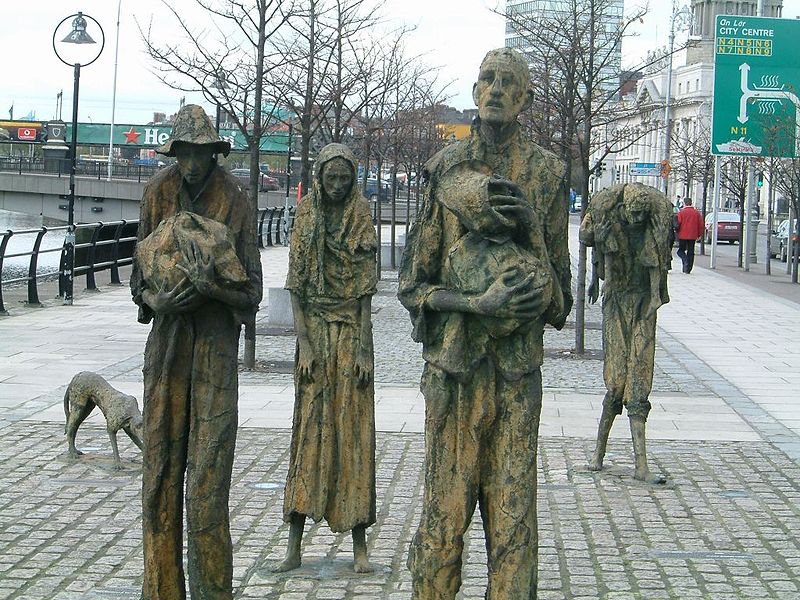
Dublin Famine Memorial

On March 23, 1847, the Indians of the Choctaw nation took up a collection.  Moved by news of starvation in Ireland, a group of Choctaws gathered in Scullyville, Okla., to raise a relief fund. Despite their meager resources, they collected $170 and forwarded it to a U.S. famine relief organization.

The Choctaw Indians may have seen echoes of their own fate in that of the Irish.  Just 16 years before, in 1831, the Choctaw Indians were forcibly removed from their ancestral lands in Mississippi to what is now known as Oklahoma on a forced march known as the Trail of Tears.  Starving, freezing, many died.

Now the Irish were suffering a similar fate.  In the fall of 1845, the potato blight in Ireland began.  By 1847, there was massive death and famine.  The Irish were only permitted potatoes by the English authorities, and when the potatoes perished, so did they.  As many as a quarter of the Irish population either starved or immigrated under the worst of circumstances.  Many of those who left Ireland never arrived at their destination.  Ships were known as “coffin ships.”

British colonial policies before and during the crisis exacerbated the effects of the potato blight, leading to mass death by starvation and disease. For example, in March of 1847, at the time of the Choctaw donation, 734,000 starving Irish people were forced to labor in public works projects in order to  receive food. Little wonder that survivors referred to the year as “Black ’47.”  What potatoes were harvested were shipped, by the English, outside of Ireland.  There is certainly some question about whether these acts were intentionally genocidal, the same questions that apply to the US policy driving the Removal Act which led to the Trail of Tears.

The Choctaw people reached deep into their own pockets and cumulatively came up with $170 to contribute to the plight of the Irish, who, by the way, never forgot their generosity.  It’s ironic that President Andrew Jackson (whose parents emigrated from Antrim) seized the fertile lands of the five civilized tribes (Chickasaw, Cherokee, Creek, Seminole, and Cherokee) and forced them to undertake that harrowing 500-mile trek to Oklahoma. Of the 21,000 Choctaws who started the journey, more than half perished from exposure, malnutrition, and disease. This despite the fact that during the War of 1812 the Choctaws had been allies of then General Jackson in his campaign against the British in New Orleans.

Perhaps their sympathy stemmed from their recognition of the similarities between the experiences of the Irish and Choctaw. Certainly contemporary Choctaw see it that way. They note that both groups were victims of conquest that led to loss of property, forced migration and exile, mass starvation, and cultural suppression (most notably language).

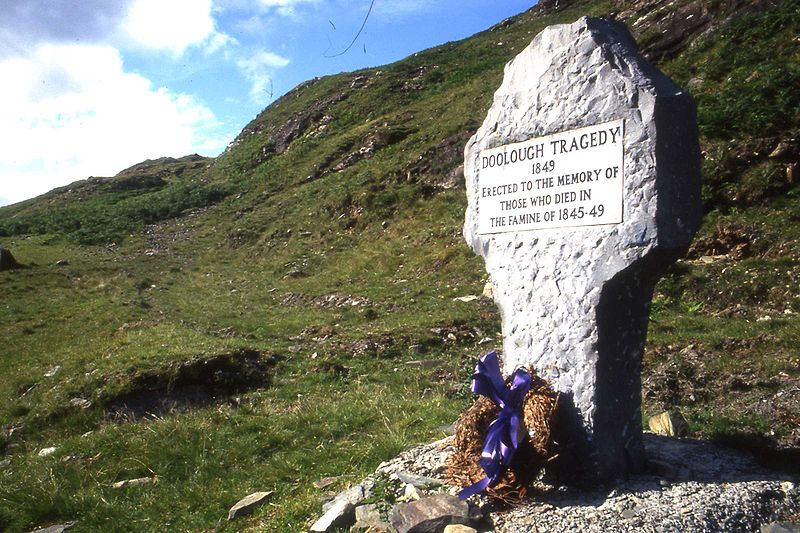
The photo above shows a memorial to the victims of the Doolough Tragedy  which took place on March 30, 1849. To receive relief, hundreds of starving Irish were instructed to travel many miles in bad weather.  Many died on the journey.

Increased attention to the Great Famine in recent years has led to renewed recognition of the Choctaw donation. In 1990, a delegation of Choctaw officials was invited to participate in an annual walk in County Mayo commemorating a tragic starvation march that occurred during the Famine. In honor of the special guests, the organizers (Action From Ireland, or AFRI) named the march The Trail of Tears. Two years later, two dozen people from Ireland came to the U.S. and retraced the 500-mile Trail of Tears from Oklahoma to Mississippi. That same year the Choctaw tribe made Ireland’s president, Mary Robinson, an honorary chief.

Doolough Tradegy

The photo at the beginning of this article depicts the Famine Memorial in Dublin today near the docks.  These pathetically thin people are portrayed walking towards the ships on the quay, their desperate escape to anyplace.  The story of the man on the right, carrying the child, is that by the time he arrived where there was soup, he discovered that he was carrying a dead child.

I’m always amazed at the degree of cruelty humans can carry out upon other humans.

An annual Great Famine walk was inaugurated in 1988 and has been led by such notable personalities as Archbishop Desmond Tutu of South Africa and the Choctaw Nation of Oklahoma. The walk, organized by AFrI (Action From Ireland), takes place on the first or second Saturday of May and links the memory of the Great Hunger with a contemporary Human Rights issue.

Additional reading:

http://www.irishcentral.com/news/New-facts-about-Great-Famine-emigration-out-of-Ireland–revealed-139540423.html

http://www.choctawnation.com/history/choctaw-nation-history/choctaws-helped-starving-irish-in-1847-this-act-shaped-tribal-culture/

https://pantherfile.uwm.edu/michael/www/choctaw/hiberian.html

http://en.wikipedia.org/wiki/Great_Famine_(Ireland)

Posted in Choctaw | 17 Comments

Henderson Roll – Cherokee Census of 1835

This Roll is also called the Trail of Tears Roll.

The Henderson Roll or Rolls of 1835 is a listing of 16,000 Cherokees living in Alabama, Georgia, Tennessee, & North Carolina to be removed to Oklahoma, per Treaty New Echota.

It was taken in the months leading up to the conclusion of the Treaty of New Echota in December 1835. It lists more than 900 heads of household, with statistical information about each family, including number of people by blood percentage, number of slaves, and farm capacity. The census is organized by state, county, and watercourse, providing the general area where each family lived.

The link below is a transcribed full version of the roll.  It’s otherwise only available in surname summary, or on microfilm, or transcribed in a book.  There is an index at the end of this document but there are also 2 indexed within the document after each state.

https://dcms.lds.org/delivery/DeliveryManagerServlet?dps_pid=IE1988300

Thank you to Yvonne for this valuable link.

A listing of all of the Rolls:

http://cherokeeregistry.com/index.php?option=com_content&view=article&id=387&Itemid=582

Many rolls transcribed and in print:

http://www.cherokeeroots.com/

By state, by surname only.

http://www.accessgenealogy.com/native/1835-henderson-roll.htm

Posted in Cherokee | 4 Comments

Iroquois World in 1812

Iroquois in the War of 1812

One of the online groups I follow is currently focused on researching the Mingoes.  They have been compiling as many occurrences of the name along with locations as they can find.  This map is particularly interesting, not just because of the Mingo mention in Ohio, but because it lists the major Indian villages in New York in 1812.  Please note that other tribes in Canada and Michigan have been omitted, so this is not comprehensive.  Also, the highlighting is not mine.

Hat tip to Chris for this map.

Posted in Iroquois, Mingoes, Oneida, Onondaga, Seneca, Tuscarora | 1 Comment

Cherokee Tribal Membership Requirements

Cherokee nation seal

Jamie Oxendine of www.powwows.com wrote a great article about Cherokee tribal members, requirements for membership today with quite a bit of history thrown in for good measure.

He includes the guidelines for membership in each of the three federally recognized Cherokee tribes, the Cherokee Nation of Oklahoma, the Eastern Band of Cherokee Indians and The United Keetoowah Band of Cherokee Indians.

Each tribe, as do all tribes, has their own enrollment and/or membership requirements.  The Oklahoma tribe uses the final Dawes Roll of 1906, the Eastern Band the 1924 Baker Roll and the Keetoowah Band, the Base Roll of 1949.

Jamie then goes on to discuss the various Rolls, challenges in terms of proving citizenship and membership and discusses what it really means to “be Cherokee.”

Jamie did a great job documenting this topic and I see no reason to recreate the wheel, so enjoy.

Hat tip to Don for pointing out this article.

Posted in Cherokee | 6 Comments

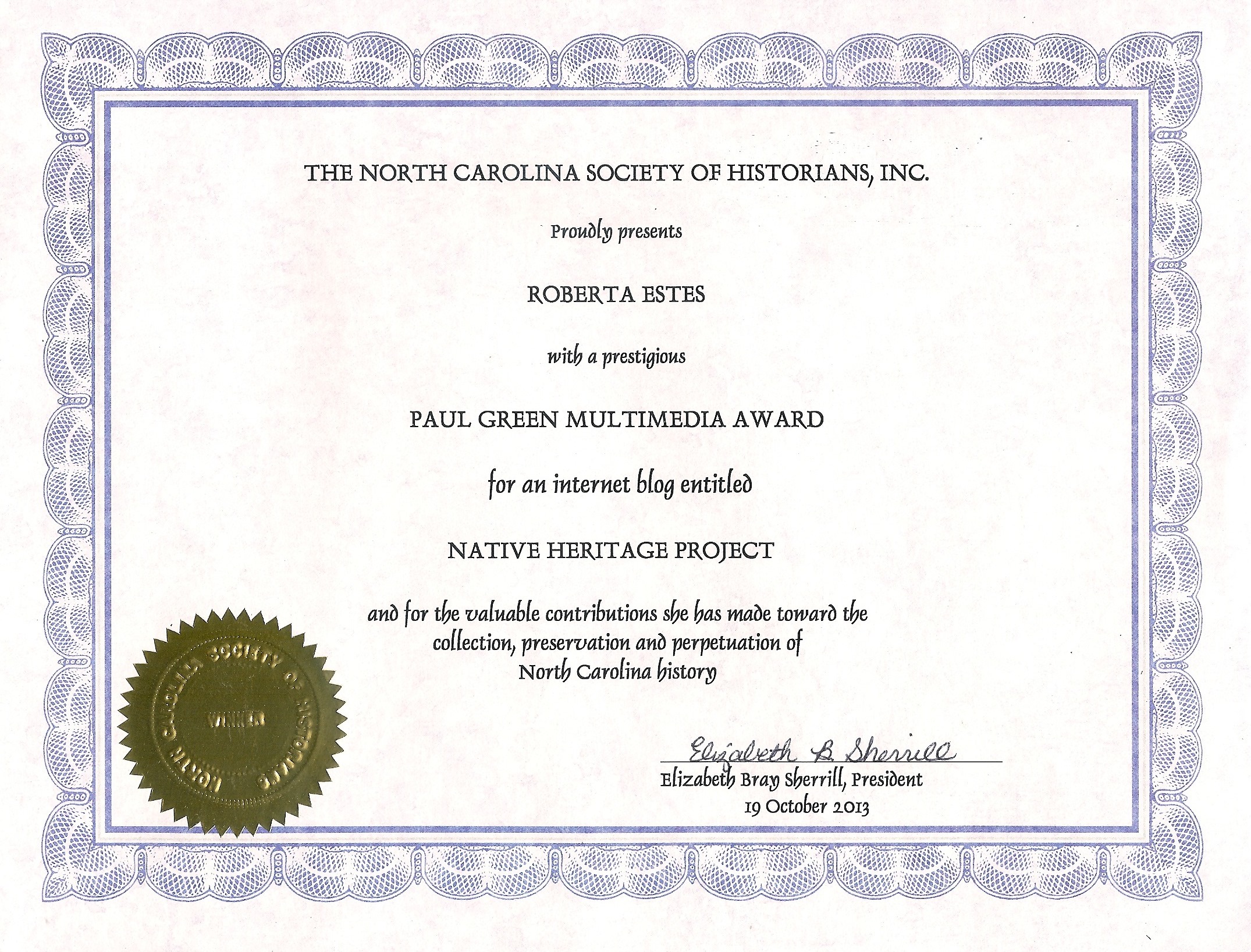
Native Heritage Project Wins Award From North Carolina Society of Historians

Native Heritage Proj 2

I am very honored and humbled to have received an award from the North Carolina Society of Historians for the Native Heritage Project.  Every year since 1941, this group has conferred awards on worthy nominees in 11 different categories, plus 2 special awards; the President’s Award and the Historian of the Year.

This year, The Native Heritage Project was awarded the Paul Green Multimedia Award.

The judges collective comments were:

“This is a monster of a project that seems to be well in control of a person having superior knowledge of her subject matter.  There is so much data involved in the blog that it literally boggles the mind, yet it is the evidence and result of one with a serious quest to inform and educate.  Everything we examined on the site was documented, interesting, enlightening and often, surprising.  Ms. Estes demonstrates her masterful abilities in many areas relating to the site, one of which is setup and design.  We give this entry ‘5 star,” and it is easy to see that it receives recognition based on the unanimous decision of our panel.”

Posted in Awards | 15 Comments

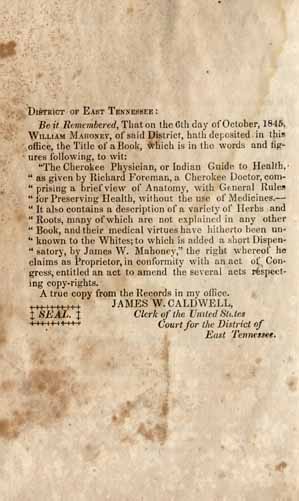
The Cherokee Physician or Indian Guide to Health as Given by Richard Forman, Cherokee Doctor

Indian guide health

THE  CHEROKEE PHYSICIAN,  OR  INDIAN GUIDE TO HEALTH, AS GIVEN BY
RICHARD FOREMAN, A CHEROKEE DOCTOR;

COMPRISING A BRIEF VIEW OF ANATOMY, WITH  GENERAL RULES FOR PRESERVING HEALTH  WITHOUT THE USE OF MEDICINES.  THE DISEASES OF THE U. STATES, WITH THEIR SYMPTOMS, CAUSES, AND MEANS OF PREVENTION, ARE TREATED ON IN A SATISFACTORY MANNER.

IT ALSO CONTAINS A DESCRIPTION OF A VARIETY OF HERBS AND ROOTS, MANY OF WHICH ARE NOT EXPLAINED IN ANY OTHER BOOK, AND THEIR MEDICAL VIRTUES HAVE HITHER TO BEEN UNKNOWN TO THE WHITES; TO WHICH IS ADDED A SHORT STORY.

Indian guide health 1

http://docsouth.unc.edu/nc/foreman/menu.html

This book was written in 1845 and published in 1849.  It’s available today as a download having been transcribed and scanned by the University of North Carolina at Chapel Hill.

This book not only includes disease descriptions and treatments, but also plants and herbs, where to find them and how to utilize them for treating various diseases.

Thanks to El for this link.

Posted in Cherokee | 5 Comments