2013 – Native Heritage Project in Review

The WordPress.com stats helper monkeys prepare a 2013 annual report for their blogs.  I really like this service, and here’s part of what it said.

The Louvre Museum has 8.5 million visitors per year. This blog was viewed about 150,000 times in 2013. If it were an exhibit at the Louvre Museum, it would take about 6 days for that many people to see it.

In 2013, there were 205 new posts, growing the total archive of this blog to 526 posts. There were 290 pictures uploaded, taking up a total of 162 MB. That’s about 6 pictures per week.

The busiest day of the year was November 28th with 1,316 views. The most popular post that day was Thanksgiving Conundrum.

These are the articles that received the most views in 2013.

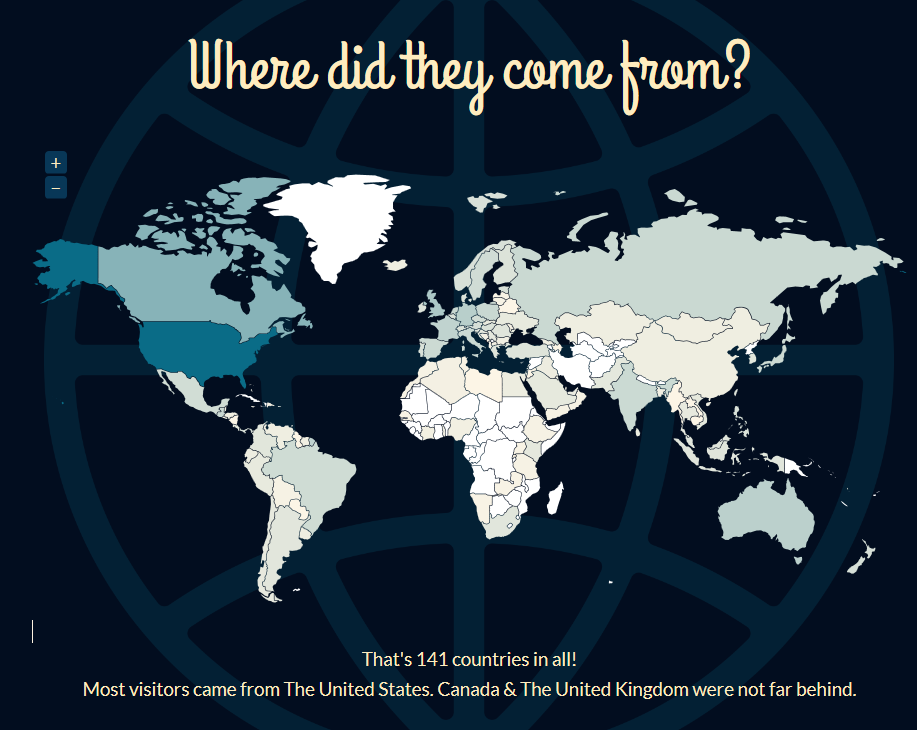
Surprisingly, people who viewed these articles came from a total of 141 countries from around the world.

2013 native blog reach

The Native Heritage Project blog was created on March 2nd, 2012, so 2012 does not represent a full year.  In 2012, I posted 321 articles and the blog received 64,000 views.

These numbers don’t count people who subscribe via RSS feed or read posts through an e-mail subscription.  They would account for another 300,000 or so views per year.

In 2013, I posted 205 articles, for a total of 526 and the site received 150,000 views.  That means that views more than doubled, increasing 234% from 2012 to 2013.  Add that to the 300,000 subscriptions and about 450,000 sets of eyes read these articles in 2013.  Pretty amazing and a fitting tribute to our ancestors!

Thanks one and all for your support.  Many of these items are contributed by readers.  Thank you.  If you have something of interest to share, please send it my way.  I know we’re going to have a wonderful 2014 with many more records and lots more information about Native American Heritage!

Posted in Uncategorized | 2 Comments

The Day the KKK Visited the Lumbee

KKK Lumbee Article

Some days, thing just don’t go as you have planned.  That’s exactly what happened to one James “Catfish” Cole, the Grand Dragon of the KKK in South Carolina in January 1958.

Cole, having just embarrassed himself in late 1957 in a failed attempt to intimidate a black doctor was looking for easier prey, someone easy to intimidate, and he mistakenly selected the Lumbee who had only recently, in 1956, been recognized as an Indian Tribe by the state of North Carolina.  Many believed they were mixed race, a mixture that included African ancestors.

Cole advertised his upcoming hate-filled rally by driving through the streets of Lumberton and utilizing a loud speaker on a flat-bed truck.

The Lumbee decided to do anything but take this laying down.  The day of the rally, between 100 and 500 armed Lumbee surrounded the few people who did attend and after Cole and the Lumbee leader, Sanford Locklear, exchanged words, a scenario which quickly deteriorated into a physical altercation, Neill Lowery shot the floodlight which darkened the entire area.  The Lumbees then shot into the air, terrifying the KKK members who ran for their lives, often leaving their wives and children to their own devices.  Cole’s own wife was so terrified that she drive into a ditch and had to be rescued by none other than several Lumbee men.  It was described as a “total rout.”

The KKK not only embarrassed themselves, terribly, but Catfish Cole was also prosecuted for inciting a riot and spent 2 years in jail.

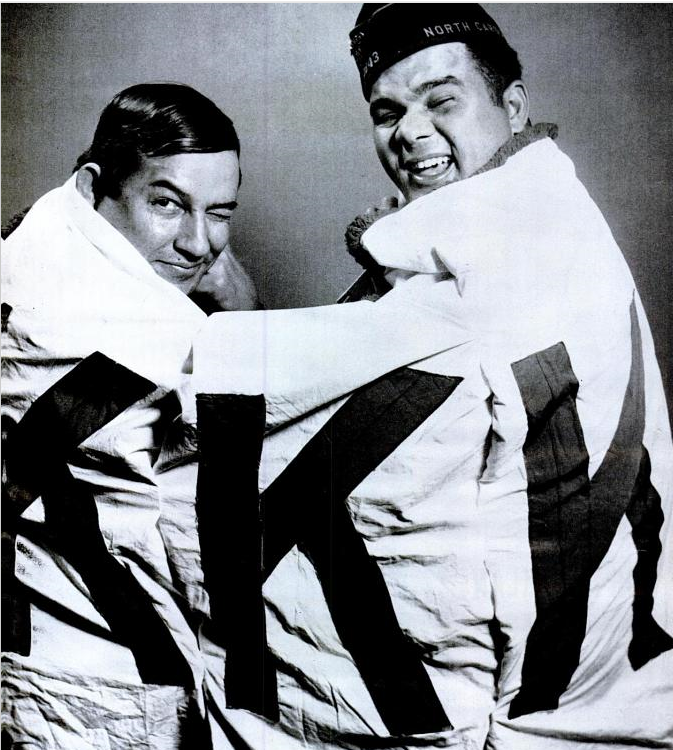
Time Magazine even featured the event.  You can see photos beginning on page 24, including this one of Charlie Warriax and Simeon Oxendine victoriously wrapped in the KKK banner they confiscated that evening.

Lumbee in KKK Banner

http://books.google.com/books?id=5VUEAAAAMBAJ&pg=26#v=onepage&q=&f=false

Here is an interview with Sanford Locklear discussing the clan gathering of 1958 which he attended as a child.

https://www.youtube.com/watch?v=NbikXpIRxlA

You can read more at the following links.

http://www.dailykos.com/story/2010/01/17/826081/-The-day-the-Klan-messed-with-the-wrong-people#

http://en.wikipedia.org/wiki/Battle_of_Hayes_Pond

Lyrics to the song, “The Battle of Maxton Field.”  http://people.wku.edu/charles.smith/MALVINA/mr011.htm

Malvina Reynolds performing “The Battle of Maxton Field.”

https://www.youtube.com/watch?v=qIF5wJgXagc

Posted in Lumbee | 4 Comments

Native Americans, Neanderthal and Denisova Admixture

Denisova cave

Recently, a Neanderthal toe bone yielded enough DNA to sequence the full genome of the woman whose remains were found in the Denisova Cave in the Altai Mountains, shown above.  This information was published in the Journal Nature in an article titled “The complete genome sequence of a Neanderthal from the Altai Mountains” by Prufer et al.  I wrote about what was found here, but it wasn’t until I really read the 200+ pages of supplemental information that I found additional buried information.

The article itself talks about some of the findings relative to Native Americans, but the supplemental information provides additional detail and the supporting charts.

In the paper, the Mixe and the Karitiana people of Mexico and Brazil, respectively were most often used to represent Native Americans.  There are about 90,000 Mixe language speakers alive today, so their population is not small.  However, the Karitiana are just the opposite, with only about 320 people in a very remote region of Brazil.  The Karitiana shun contact with outsiders.  In some parts of this study, additional population groups were used for additional Native samples.

Here’s what the article itself has to say about Neanderthals, Denisovans and Native Americans.

Denisovan gene flow in mainland Asia

We used the two high-coverage archaic genomes and a hidden Markov model (HMM) to identify regions of specifically Neanderthal and specifically Denisovan ancestry in 13 experimentally phased present-day human genomes (Supplementary Information sections 4 and 13). In the Sardinian and French genomes from Europe we find genomic regions of Neanderthal origin and few or no regions of Denisovan origin. In contrast, in the Han Chinese, the Dai in southern China, and the Karitiana and Mixe in the Americas, we find, in addition to regions of Neanderthal origin, regions that are consistent with being of Denisovan origin (Zscore54.3 excess relative to the Europeans) (Supplementary Information section 13), in agreement with previous analysis based on low-coverage archaic genomes. These regions are also more closely related to the Denisova genome than the few regions identified in Europeans (Supplementary Information section 13). We estimate that the Denisovan contribution to mainland Asian and Native American populations is ,0.2% and thus about 25 times smaller than the Denisovan contribution to populations in Papua New Guinea and Australia. The failure to detect any larger Denisovan contribution in the genome of a 40,000-year-old modern human from the Beijing area suggests that any Denisovan contribution to modern humans in mainland Asia was always quantitatively small. In fact, we cannot, at the moment, exclude that the Denisovan contribution to people across mainland Asia is owing to gene flow from ancestors of present-day people in Oceania after they mixed with Denisovans. We also note that in addition to this Denisovan contribution, the genomes of the populations in Asia and America appear to contain more regions of Neanderthal origin than populations in Europe (Supplementary Information sections 13 and 14).

The fascinating part of this, aside from the fact that Native people also carry both Denisovan and Neanderthal DNA, and that they carry more than Europeans, is that the Denisovan and Neanderthal DNA that they carry is different than that carried by Europeans.  In fact, it appears that not all Europeans carry Denisovan DNA and this paper lowers the estimated percentage of Neanderthal for all Europeans.

This difference in the Neanderthal and Denisovan DNA might be able to help solve a long-standing mystery, and that’s whether or not part of the Native population of the Eastern seaboard, and in particular, the far Northeast part of that region, was populated by or admixed with Europeans long before the time of Columbus and other European pre-colonial explorers.  This information, of course would have to come from pre-contact burials, but they do exist and with this new information in hand, they might just yield answers never before available.

Dr. Ricki Lewis, in her DNA Science Blog, mentioned something else quite interesting culled from a Christmas Day issue of Nature titled “Sequence variants in SLC16A11 are a common risk factor for type 2 diabetes in Mexico.”  In a nutshell, from article introduction, we find this commentary:

“The risk haplotype carries four amino acid substitutions, all in SLC16A11; it is present at ~50% frequency in Native American samples and ~10% in east Asian, but is rare in European and African samples. Analysis of an archaic genome sequence indicated that the risk haplotype introgressed into modern humans via admixture with Neanderthals.”

Ricki extrapolated on this further:

“Researchers determine the degree to which a mutant gene differs from the most common sequence (wild type), then impose a time scale in the form of  known mutation rates. The SLC16A11 five-site haplotype is so divergent that it goes back to nearly 800,000 years ago — before our ancestors expanded out of Africa.

The most plausible explanation, unexpected I suspect, seemed to be that the haplotype came from an archaic human – a Neanderthal or Denisovan or their as-yet unnamed contemporaries. And the haplotype indeed shows up in the skeleton of a Neanderthal found in the Denisovan cave in Siberia.”

And so, it seems that the Native American people today indeed inherited their propensity for type 2 diabetes from their ancient Neanderthal ancestors who lived in the Altai Mountains.  It also appears that this genetic predisposition did not carry forward to Europe, if indeed this group of Neanderthals was ancestral to Europeans at all.

Posted in Archaic Indians, Denisova, Karitiana, Mixe, Neanderthal | 3 Comments

The Cherokee Mother of John Red Bank Payne

John Red Bank Payne

There is nothing I love more than a happy ending.  Second to that perhaps is to know that my blog or work helped someone, and in particularly, helped someone document their Native heritage.  In doing so, this confirms and unveils one more of our elusive Native people in early records.

I recently received a lovely thank you note from Shawn Potter.  We had exchanged notes earlier, after I wrote “The Autosomal Me” series, about how to utilize small segments of Native American (and Asian) DNA to identify Native American lines and/or ancestors.  This technique is called Minority Admixture Mapping (MAP) and was set forth in detail in various articles in the series.

Shawn’s note said:  “I’ve been doing more work on this segment and others following your method since we exchanged notes.  I’m pretty sure I’ve found the source of this Native American DNA — an ancestor named John Red Bank Payne who lived in North Georgia in the late 18th and 19th centuries.  Many of his descendants believe on the basis of circumstantial evidence that his mother was Cherokee.  I’ve found 10 descendants from four separate lines that inherited matching Native American DNA, pointing to one of his parents as the source.”

Along with this note, Shawn attached a beautiful 65 page book he had written for his family members which did document the Native DNA, but in the context of his family history.  He included their family story, the tales, the genealogical research, the DNA evidence and finally, a chapter of relevant Cherokee history complete with maps of the area where his ancestors lived. It’s a beautiful example of how to present something like this for non-DNA people to understand.  In addition, it’s also a wonderful roadmap, a “how to” book for how to approach this subject from a DNA/historical/genealogical perspective.  As hard as it is for me to sometimes remember, DNA is just a tool to utilize in the bigger genealogy picture.

Shawn has been gracious enough to allow me to reprint some of his work here, so from this point on, I’ll be extracting from his document.  Furthermore, Elizabeth Shown Mills would be ecstatic, because Shawn has fully documented and sourced his document.  I am not including that information here, but I’m sure he would gladly share the document itself with any interested parties.  You can contact Shawn at shpxlcp@comcast.net.

From the book, “Cherokee Mother of John Red Bank Payne” by Shawn Potter and Lois Carol Potter:

Descendants of John Red Bank Payne describe his mother as Cherokee. Yet, until now, some have questioned the truth of this claim because genealogists have been unable to identify John’s mother in contemporary records. A recent discovery, however, reveals both John Red Bank Payne and his sister Nancy Payne inherited Native American DNA.

Considering information from contemporary records, clues from local tradition, John’s name itself, and now the revelation that John and his sister inherited Native American DNA, there seems to be sufficient evidence to say John Red Bank Payne’s mother truly was Cherokee. The following summary describes what we know about John, his family, and his Native American DNA.

John Red Bank Payne was born perhaps near present-day Canton, Cherokee County, Georgia, on January 24, 1754, married Ann Henslee in Caswell County, North Carolina, on March 5, 1779, and died in Carnesville, Franklin County, Georgia, on December 14, 1831.

John’s father, Thomas Payne, was born in Westmorland County, Virginia, about 1725, and owned property in Halifax and Pittsylvania counties, Virginia, as well as Wilkes County, North Carolina, and Franklin County, Georgia.  Several factors suggest Thomas travelled with his older brother, William, to North Georgia and beyond, engaging in the deerskin trade with the Cherokee Nation during the mid 1700s. Thomas Payne died probably in Franklin County, Georgia, after February 23, 1811.

Contemporary records reveal Thomas had four children (William, John, Nancy, and Abigail) by his first wife, and nine children (Thomas, Nathaniel, Moses, Champness, Shrewsbury, Zebediah, Poindexter, Ruth, and Cleveland) by his second wife Yanaka Ayers.  Thomas married Yanaka probably in Halifax County, Virginia, before September 20, 1760.

Local North Georgia tradition identifies the first wife of Thomas Payne as a Cherokee woman. Anna Belle Little Tabor, in History of Franklin County, Georgia, wrote that “Trader Payne” managed a trading post on Payne’s Creek, and “one of his descendants, an offspring of his Cherokee marriage, later married Moses Ayers whose descendants still live in the county.”

Descendants of John Red Bank Payne also cite his name Red Bank, recorded in his son’s family Bible, as evidence of his Cherokee heritage.  Before the American Revolution, British Americans rarely defied English legal prohibitions against giving a child more than one Christian name.  So, the very existence of John’s name Red Bank suggests non-English ethnicity. On the other hand, many people of mixed English-Cherokee heritage were known by their Cherokee name as well as their English first and last names during this period.

Furthermore, while the form of John’s middle name is unlike normal English names, Red Bank conforms perfectly to standard Cherokee names.  It also is interesting to note, Red Bank was the name of a Cherokee village located on the south side of Etowah River to the southwest of present-day Canton, Cherokee County, Georgia.

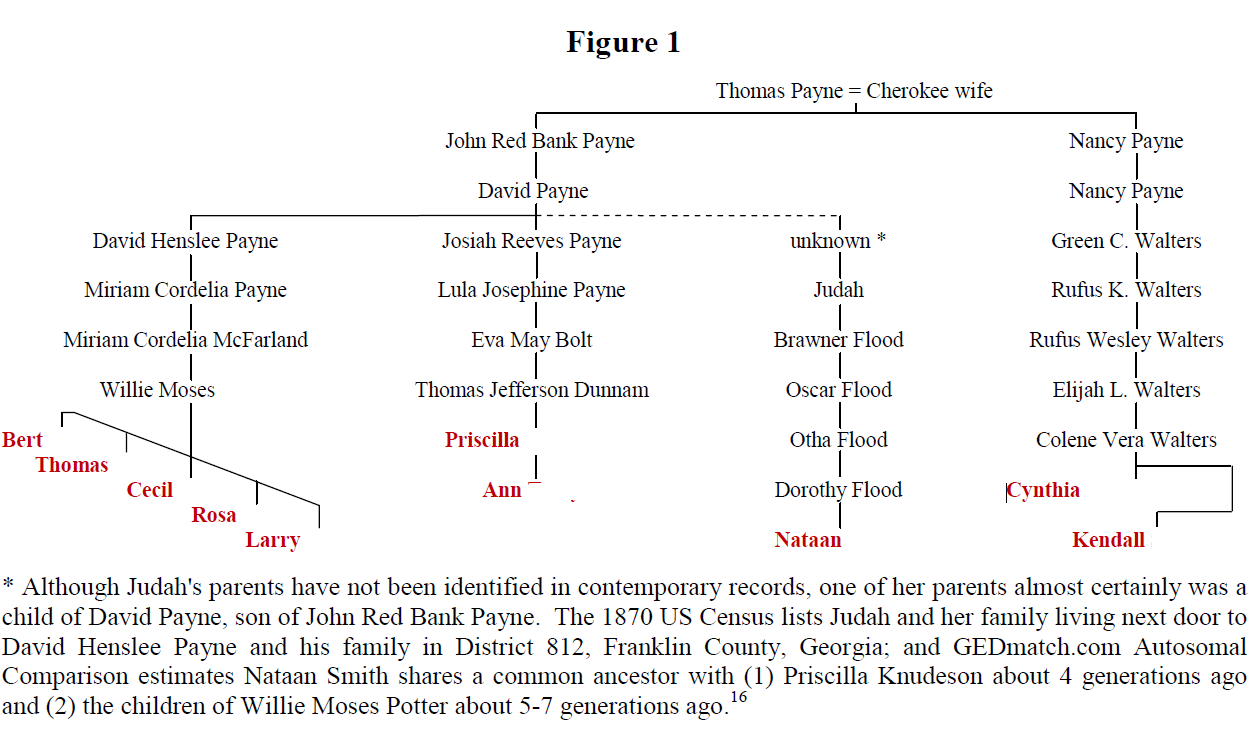
While some believe the above information from contemporary records and clues from local tradition, as well as John’s name Red Bank, constitute sufficient proof of John’s Cherokee heritage, recently discovered DNA evidence confirms at least one of John’s parents had Native American ancestry. Ten descendants of John Red Bank Payne and his sister Nancy Payne, representing four separate lineages, inherited six segments of Native American DNA on chromosomes 2, 3, 5, 8, 13, and 18 (see Figure 1 for the relationship between these descendants; Figures 2-7 for images of their shared Native American DNA; and http://dna-explained.com/2013/06/02/the-autosomal-me-summary-and-pdf-file/ for an explanation of this method of identifying Native American chromosomal segments).

Upon careful reflection, there seems sufficient reason to believe John Red Bank Payne’s mother truly was Cherokee.

Roberta’s note:  I have redacted the surnames of current testers.

Payne chart

Chromosome 2, Segment 154-161

In this segment, Bert P, Rosa P, Nataan S, Cynthia S, and Kendall S inherited matching Native American DNA described as Amerindian, Siberian, Southeast Asian, and Oceanian by the Eurogenes V2 K15 admixture tool, and as North Amerind, Mesoamerican, South America Amerind, Arctic Amerind, East Siberian, Paleo Siberian, Samoedic, and East South Asian by the Magnus Ducatus Lituaniae Project World22 admixture tool. Since their common ancestors were Thomas Payne and his wife, the source of this Native American DNA must be either Thomas Payne or his wife. See Figures 2a-2g.

Note: Since Native Americans and East Asians share common ancestors in the pre-historic past, their DNA is similar to each other in many respects. This similarity often causes admixture tools to interpret Native American DNA as various types of East Asian DNA. Therefore, the presence of multiple types of East Asian DNA together with Native American DNA tends to validate the presence of Native American DNA.

Payne graph 1

Payne graph 2

Payne graph 3

Payne graph 4

Payne graph 5

Roberta’s Summary:  Shawn continues to document the other chromosome matches in the same manner.  In total, he has 10 descendants of Thomas Payne and his wife, who it turns out, indeed was Cherokee, as proven by this exercise in combination with historical records.  These people descend through 2 different children.  Cynthia and Kendall descend through daughter Nancy Payne, and the rest of the descendants descend through different children of John Red Bank Payne.  All of the DNA segments that Shawn utilized in his report share Native/Asian segments in both of these family groups, the descendants of both Nancy and John Red Bank Payne.

Shawn’s success in this project hinged on two things.  First, being able to test multiple (in this case, two) descendants of the original couple.  Second, he tested several people and had the tenacity to pursue the existence of Native DNA segments utilizing the Minority Admixture Mapping (MAP) technique set forth in “The Autosomal Me” series.  It certainly paid off.  Shawn confirmed that the wife of Thomas Payne was, indeed Native, most likely Cherokee since he was a Cherokee trader, and that today’s descendants do indeed carry her heritage in their DNA.

Great job Shawn!!  Wouldn’t you love to be his family member and one of the recipients of these lovely books about your ancestor! Someone’s going to have a wonderful Christmas!

Posted in Cherokee, Georgia, North Carolina, Virginia | 15 Comments

Purported Gravestone of Ananias Dare Found

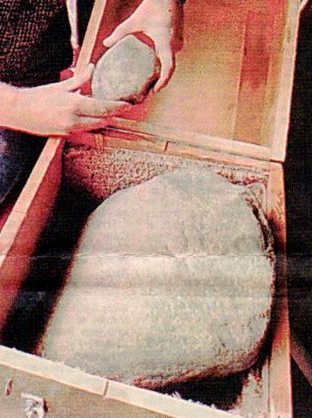
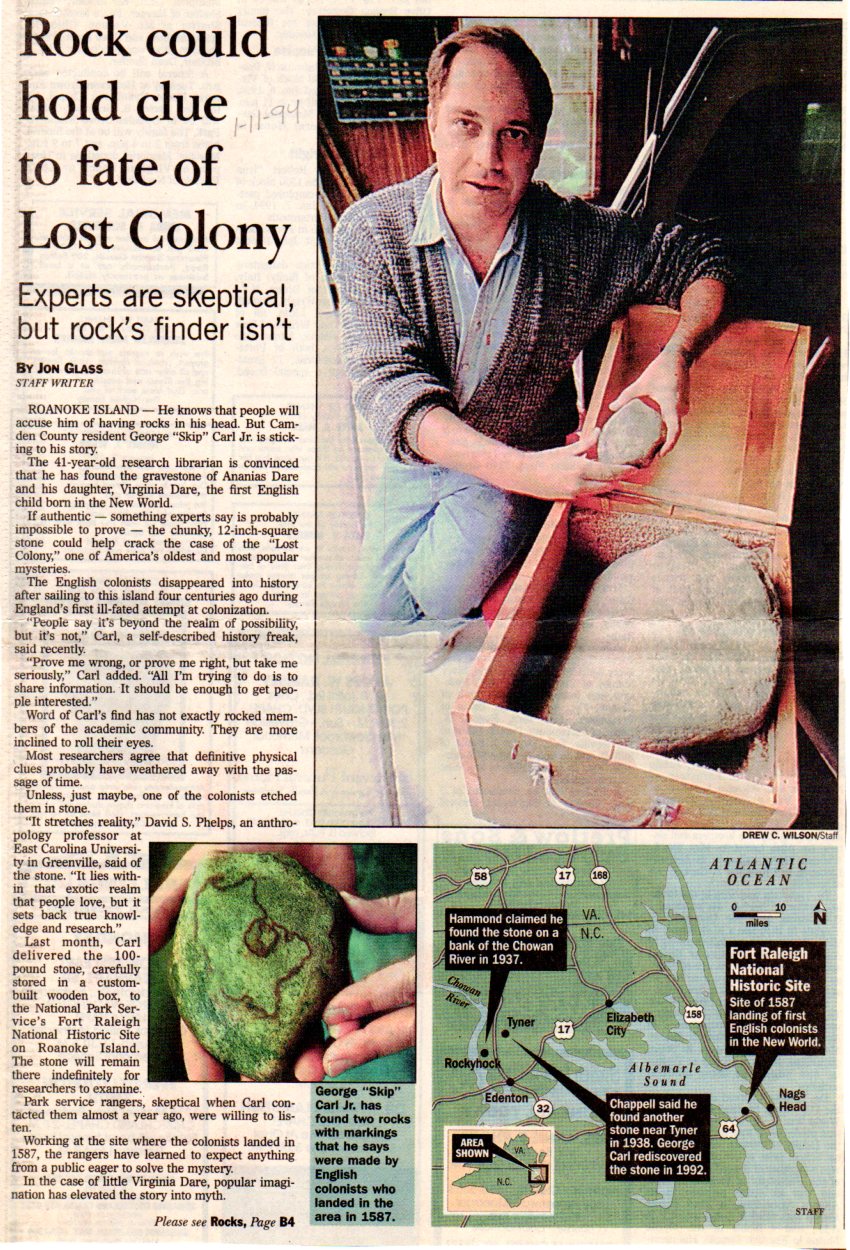
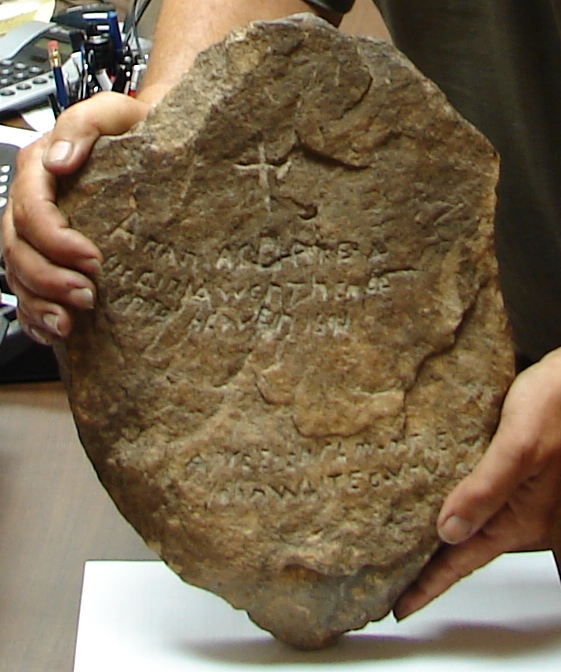
One great thing about publishing stories about historical items is that often, they encourage other people with additional information to come forth.  That’s what happened recently when I published a series of stories about the Dare Stones supposedly related to Sir Walter Raleigh’s Lost Colony.  Rod Mann, with Albemarle Genealogical Society, stepped forward to share some additional information about yet another “Dare Stone,” of sorts.  The large stone, shown below, is purported to be the gravestone of Ananias Dare and the smaller stone, to hold a map.

Gravestone

We know that the original Dare Stone was found near Edenton in 1937, followed by the series of stones, 2-48, that were exposed as frauds after Dr. Pearce of Breneau College (now University) offered to pay $500 for any additional inscribed stones.  The stones, 2-48, were not found in the Edenton area, but significantly further south, in South Carolina and Georgia.

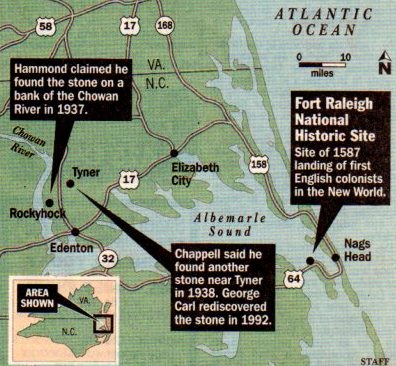
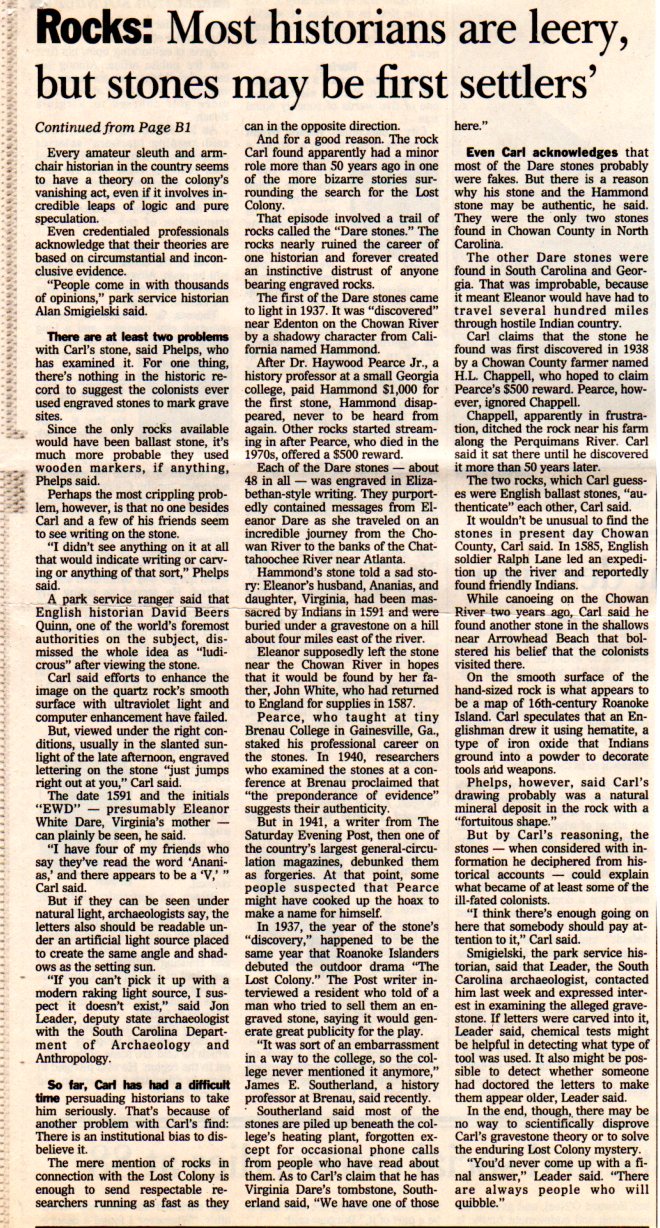
Rod contributed a 1994 article from the Virginia Pilot.  I’ve included the article in its entirety at the end of this article.  Of particular interest is the map showing the location of the original Dare Stone find and this second stone, purported by history buff, George Carl Jr. to be the gravestone of Ananias Dare.

Stone Location map

This “gravestone” stone was also originally found near Edenton, not far from the location of the original Dare Stone.  In fact, it was originally found in 1938 by a Chowan County farmer, H.L. Chappell who offered it to Pearce, hoping to claim a $500 reward, but was then rebuffed.  Chappell then ditched the rock along the Perquimans River on his farm where Carl rediscovered it more than 50 years later.

Carl says that in the right light, he can see the date 1591 and the initials EWD inscribed.  Others, including park rangers and archaeologist, David Phelps, now deceased, but at that time with ECU, cannot.

Carl says that some of his friends have also reported that they can see the word Ananias inscribed as well, of course suggesting that the stone is the gravestone of Ananias Dare, whose death was reported on the original “Dare Stone” found in the same vicinity.  The original Dare Stone said that Ananias was buried “neere fovre myles easte this river upon small hil names writ all ther on rocke.”

Experts such as now deceased Phelps say that there is no evidence to suggest that colonists ever used engraved stones to mark grave sites.  While that is true, if this were a marker for Ananias Dare, it certainly wasn’t a normal situation.  Eleanor Dare would have been trying to leave her father “bread crumbs” to follow her trail…hence the “Dare Stone” itself.

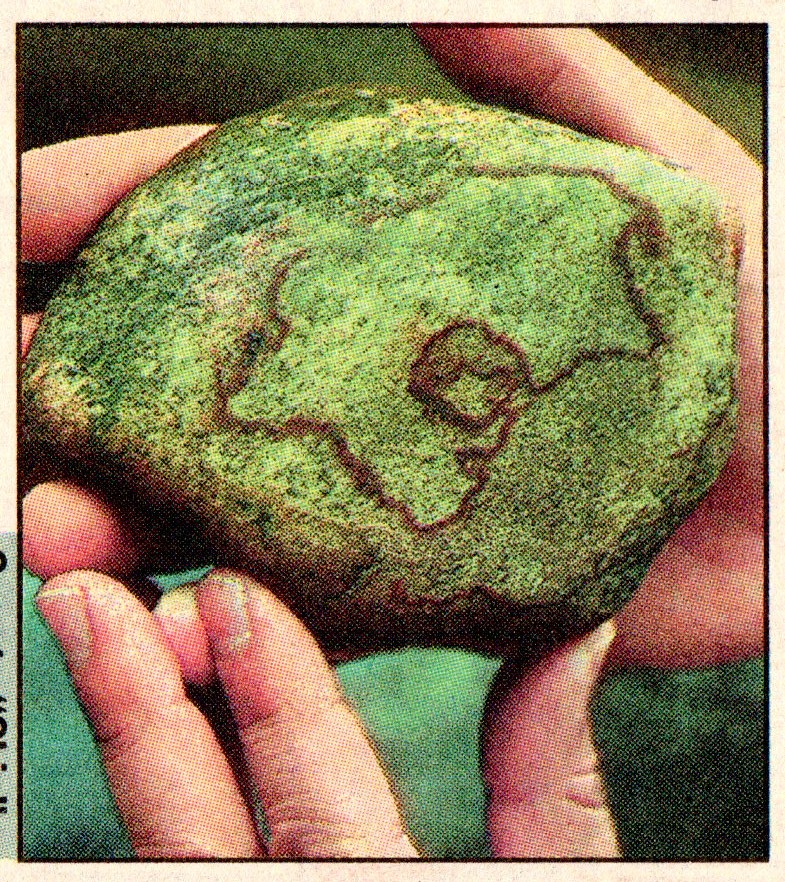
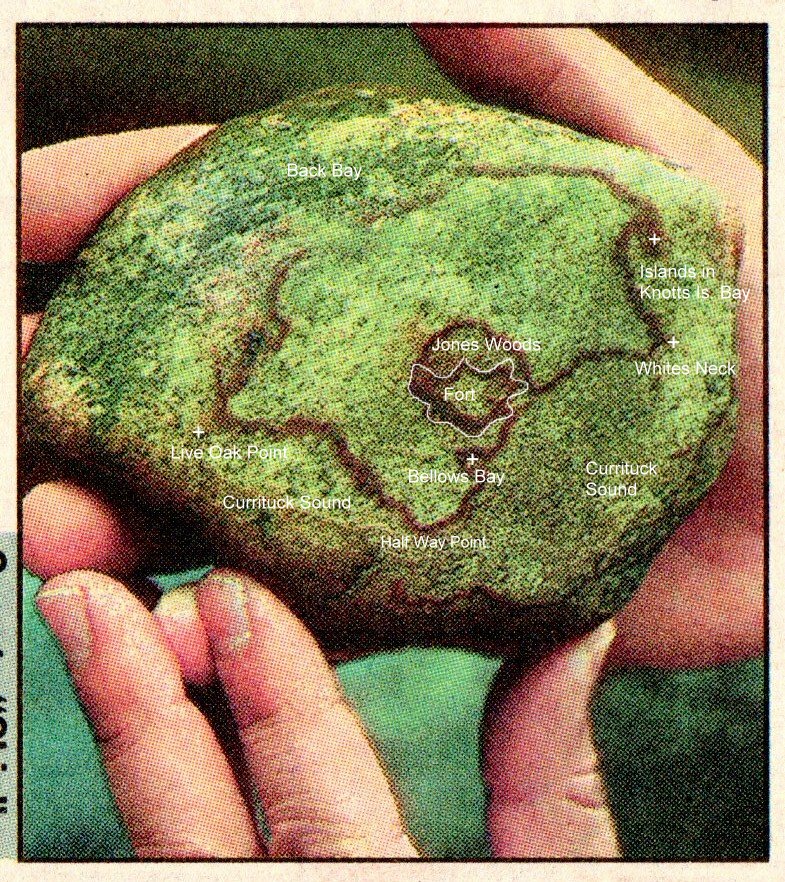
Carl then found another rock while canoeing that he says appears to be a map of Roanoke Island.  David Phelps says that it’s likely a natural occurrence.  Others have been equally as dismissive.

As the newspaper article points out, there is institutional bias against inscribed stones.  The entire “Dare Stone” fiasco was extremely embarrassing to many people as well as Breneau University.  Most people just wanted to forget the entire episode, so any newly appearing rocks bear a far greater burden of proof that any other type of artifact would bear in other situations.  On top of that, the Lost Colony, an unsolved romantic mystery, attracts many people with theories or stories of all descriptions.  Because it’s nearly unprovable and possibly unsolvable, it’s very safe to speculate and propose theories, because your theory is as good as the next one and none of them can be proven or disproven.

In fact, I was recently contacted by Jesus Christ himself, by e-mail, telling me that the Lost Colony was in fact part of the Lost Tribe of Israel.  And no, I’m not kidding.  That is what this person said and they were dead serious.

Hence, the high degree of skepticism in professional circles.

Having said this, I don’t think it’s wise to dismiss every or any claim because they might be fanciful.  I did, however, dismiss the possibility that aliens picked up the colonists, as proposed by another theorist, mostly because it’s unprovable, unless of course we find an inscribed rock with a picture of the aliens and the spacecraft.  In this case, however, the rocks are close enough and in the right context that they might be authentic.  Rocks weather over time, so the writing, if it existed, could be in very poor condition now, and nearly unreadable.

Rod took things one step further and did some work on his own.

Below is a photo of the second rock discovered by Carl on his canoe trip that he believes is a map.

Dare Stones021

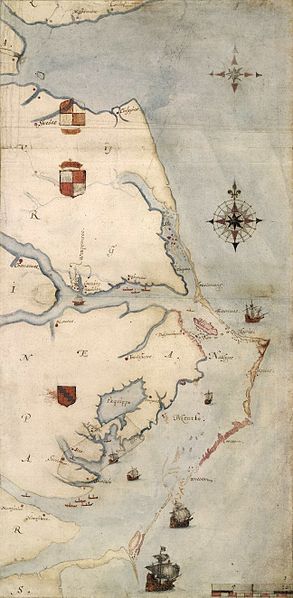
Here is the John White Map showing Roanoke Island and the Albemarle Sound area towards current Edenton and Currituck Sound which is north of Albemarle Sound inside the barrier islands in Virginia.

John White map

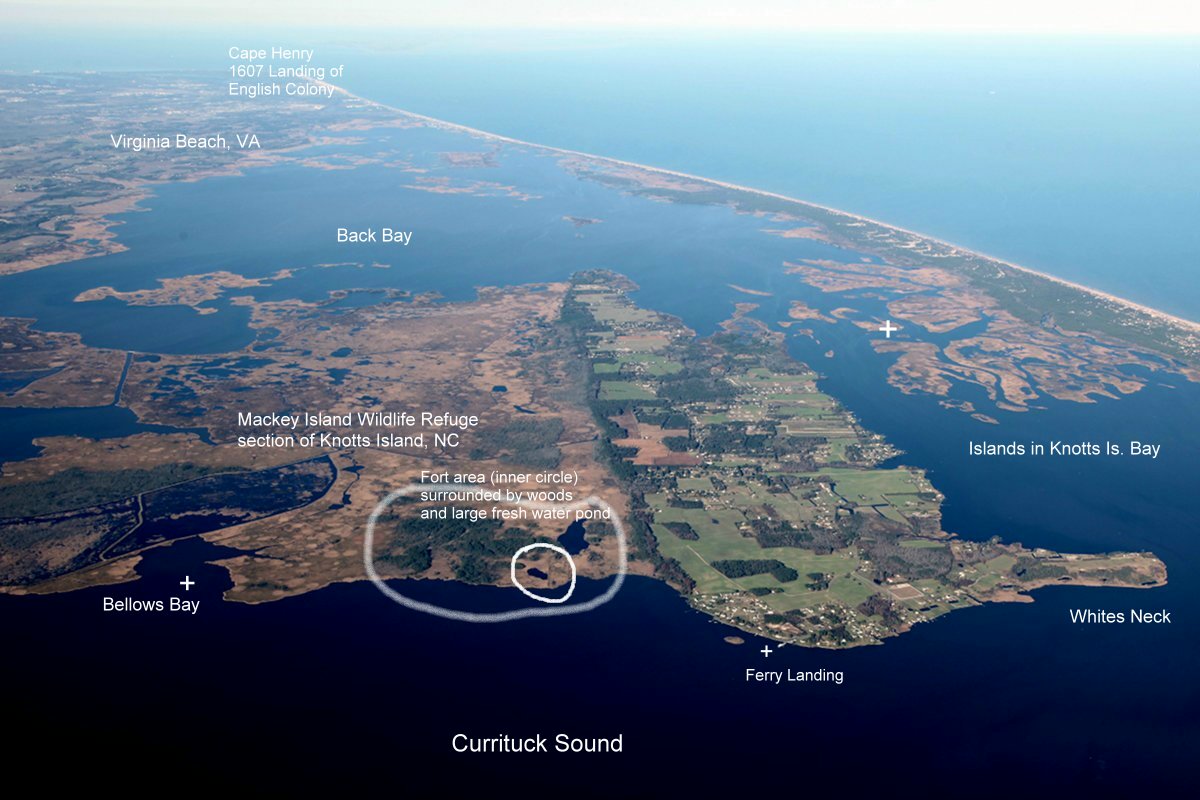
Here is an aerial view of Currituck Sound with an area we’ll discuss circled by Rod.

aerial4b.

Here’s Rod’s overlay of the Roanoke map stone discovered by Carl with the above map locations of Currituck Sound.

Dare Stones021a.

Why could this be important?

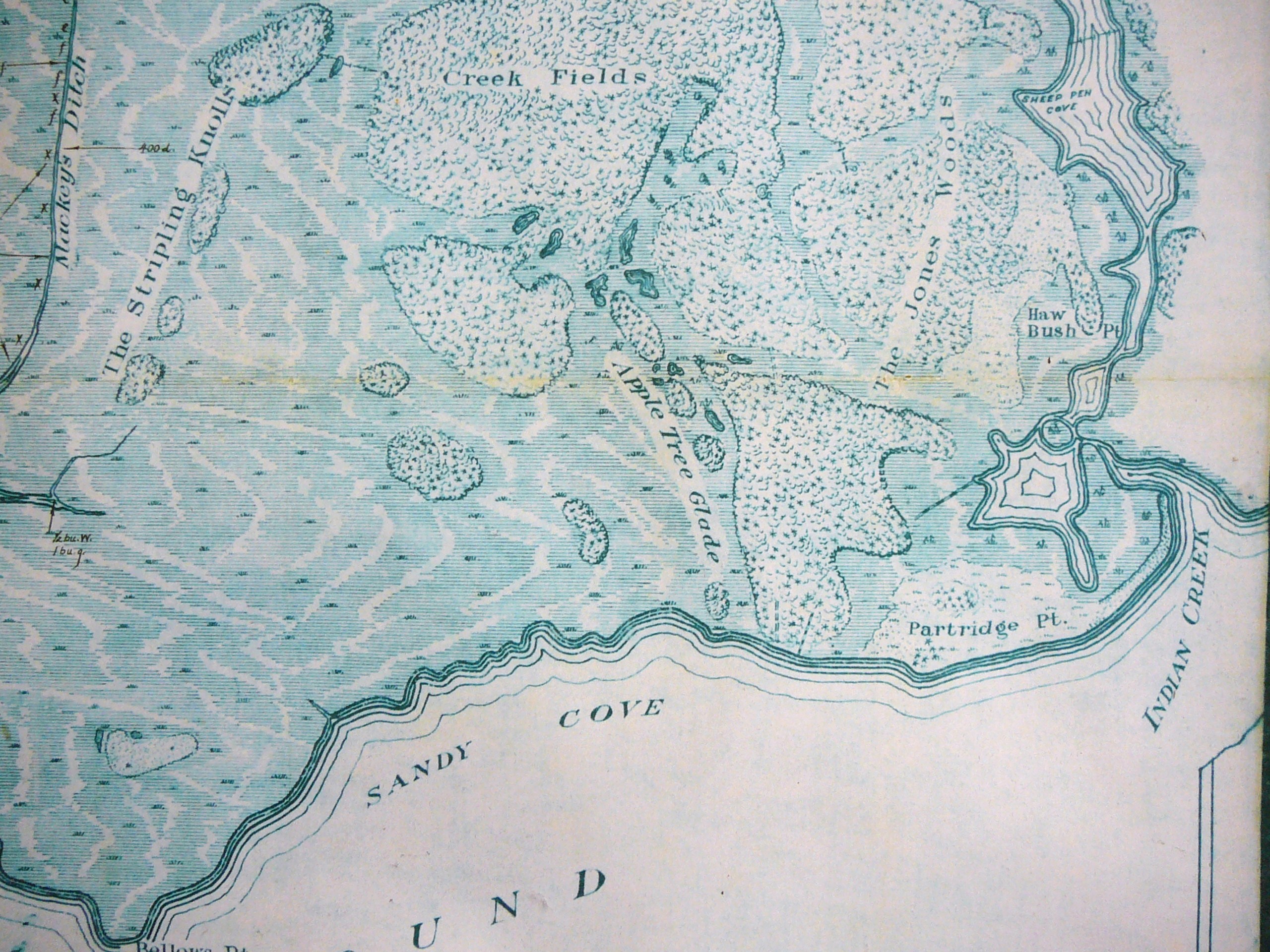
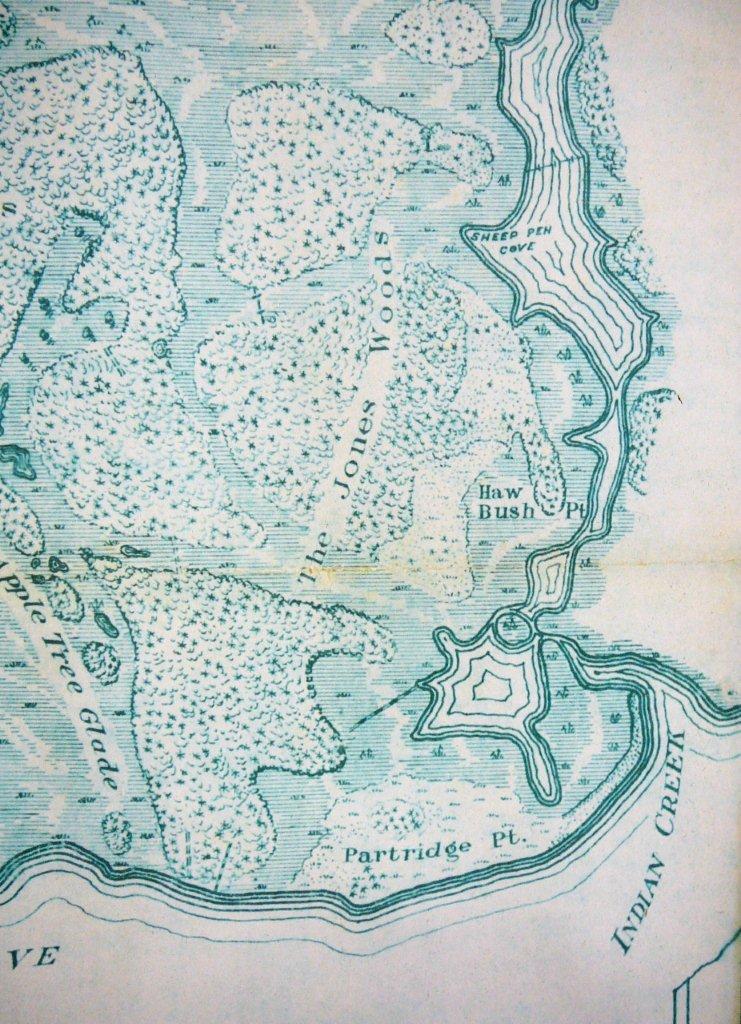
Back in 1923, a surveyor drew a map of Knott’s Island that showed a fort structure in almost this exact location, if indeed this rock is a map and not a natural phenomenon.  Today, unfortunately, the fort location, if it was that and not a natural phenomenon, is underwater.  You can see the fort shape on the map below on the right by Partridge Point and Indian Creek.

1923 Mackay Is. topo map - Joseph Knapp (4)

Here’s a closeup

1923 Mackay Is. topo map - Joseph Knapp (3)a

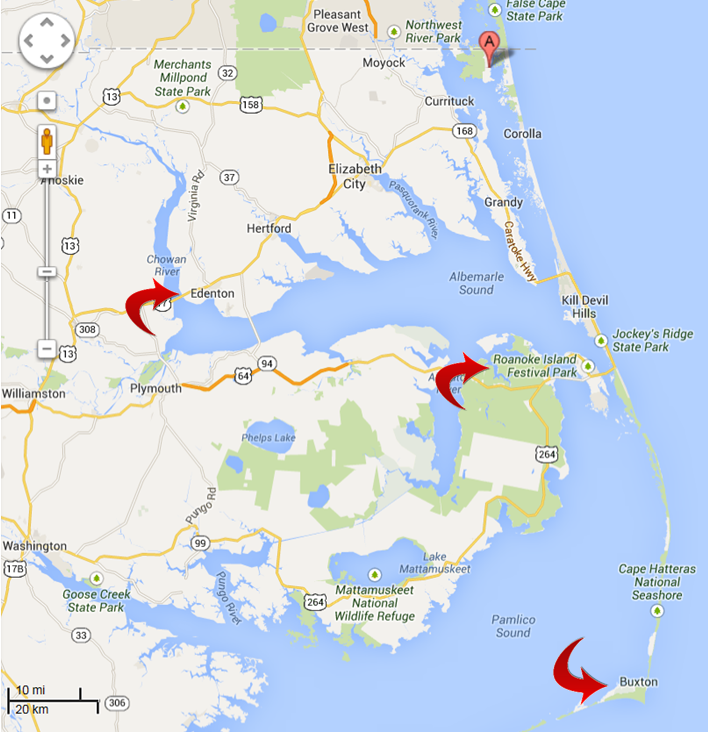
Remember, we don’t know where the colonists settled after they left Roanoke Island.  White says they were preparing to go 50 miles into the main.  Certainly Knott’s Island would not be outside the scope of possibility at about 40 miles by water and it would be a location where the colonists could watch for approaching ships.

On the map below, we see Knott’s island, the red “A” balloon and then Edenton and Roanoke Island with red arrows and Buxton, on Hatteras Island near the bottom.  Hatteras Island is where the Croatoan Indians lived and where it’s widely believed that the colonists went, at least initially, based on the message they left carved on a tree and stockade post on Roanoke Island.

current albemarle map

We still don’t know where the colonists went when they left Roanoke Island.  The 1923 map is credible, created by a surveyor, but we don’t know why that area near Indian Creek was shaped the way that it was.  In other words, it could have been natural, not manmade.

The gravestone found by Mr. Carl, questionable, and I’m assuming here that Mr. Carl is credible.  If he was going to fake a stone, he could do a much better job with a few crude tools.  Technology today might be able to shed a better light on the purported gravestone than was available in 1994, although it’s unclear whether the Park Service still has the stone or whether it was returned at some time to Mr. Carl.  Additionally, the evidence would have to be nearly irrefutable for any academic professional in any field to even suggest that it’s possible for the stone to be genuine, given the embarrassing past history with Dare Stones 2-48.  Without some prodding, and funding, the stone is likely to rest in oblivion forever, much like the colonists.

The map stone found by Mr. Carl, interesting, but certainly not conclusive, although the overlay map done by Rod Mann is extremely suggestive.  Still, it could simply be a coincidence. It would be much more compelling if the map had been “on” the gravestone or even near the gravestone.

So what we have here isn’t a solution.  The mystery hasn’t been solved.  If anything, it has been deepened.  That seems to be the overarching theme of the Lost Colony.  But you have to admit, it’s very, VERY interesting.

Our thanks to Rod Mann for his research and contributions.

Dare Stones (1) George Carl, Jr

Dare Stones (2) George Carl, Jr

Posted in Lost Colony, North Carolina, Virginia | 9 Comments

The Code Talkers

ChoctawCoders

The term Code Talkers is associated with the United States soldiers during the world wars who used their knowledge of Native-American languages as a basis to transmit coded messages. In particular, there were approximately 400-500 Native Americans in the United States Marine Corps whose primary job was the transmission of secret tactical messages. Code Talkers transmitted these messages over military telephone or radio communications nets using formal or informally developed codes built upon their native languages. Their service improved communications in terms of speed of encryption at both ends in front line operations during World War II.  The enemy never broke the codes.

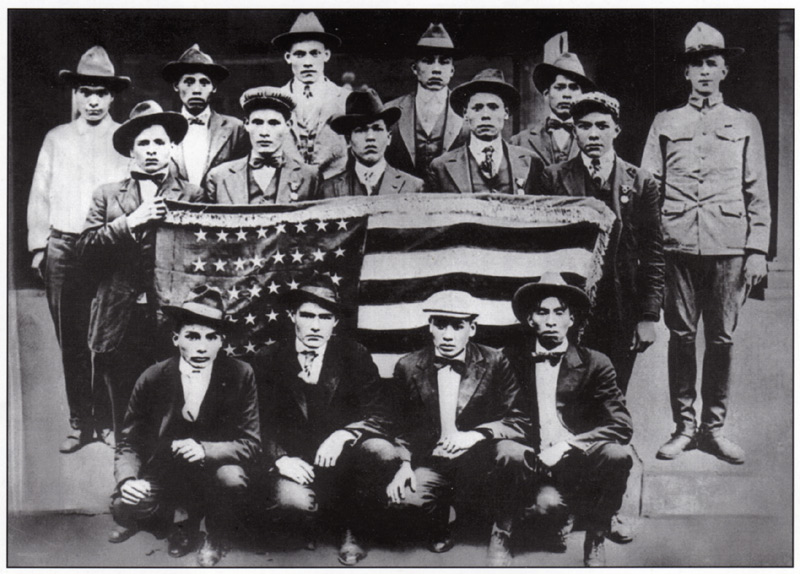
The name Code Talkers is strongly associated with bilingual Navajo speakers specially recruited during World War II by the Marines to serve in their standard communications units in the Pacific Theater. Code talking, however, was pioneered by Choctaw Indians serving in the U.S. Army during World War I. These soldiers are referred to as Choctaw code talkers.  The photo above is of the Choctaw Code Talkers training in WWI.

Other Native American code talkers were deployed by the United States Army during World War II, including Cherokee, Choctaw, Lakota Meskwaki, and Comanche soldiers.

In the memoir, “Code Talker: The First and Only Memoir By One of the Original Navajo Code Talkes of WWII,” written by Chester Nuz, one of the original Navajo Code Talkers, it’s a sad irony that Chester Nuz wasn’t even his real name, but his English name assigned in kindergarten.  He then went on to boarding school in Fort Defiance where he was punished for speaking his Native Navajo language, the very language that would assure military victory for the US over Japan in WWII.  When Pearl Harbor was bombed, Chester answer the warrior’s call and served his country.

The National Museum of the American Indian recognizes and honors the Code Talkers at the link below:

http://nmai.si.edu/education/codetalkers/

Hat tip to Don for this link.

You can read more about the Code Talkers at these links:

http://en.wikipedia.org/wiki/Code_talker

Navajo Code Talkers

http://www.navajocodetalkers.org/

Posted in Cherokee, Choctaw, Comanche, Lakota, Navajo | 3 Comments

The Lost Colony and Pelzer, SC

???????????????????????????????

The Community of Pelzer Historical Society (CPHS) has graciously allowed us to reprint an article that appeared on their website in January of 2010.  Please take a few minutes to visit their website at www.historicpelzer.org and if you’d like more information about that area of South Carolina, contact Beth at beth@historicpelzer.org.

THE LOST COLONY AND HISTORIC PELZER, SC

Late in the afternoon of August 15, 1591, two small ships sailed into the bay at Hatorask (Hatteras)and dropped anchor some three leagues from the shore. As twilight fell one of the voyagers paced the deck restlessly from stern to stern. The voyager was John White, Governor of Sir Walter Raleigh’s Roanoke colony, who was finally returning to the little band of English settlers, among them his own daughter, whom he had left nearly four years before to return to England for supplies. Upon first coming to anchor in the place where the Colony were left in 1587, John and the others saw ..”..a great smoke..”. This had them in high hopes that all was well and that the colonists were in John’s words..”…there expecting my return out of England.” John found no sign of the colonists at the site. An agreement had been established between John’s group and the colonists in which in the event that the colonists were to run into any trouble, they would ..”carve over the letters or name a Cross in this form (a Maltese cross with arms of equal length..) There were no such signs of distress. After exploring at least two signs of smoke, which led to no positive result, John White and his group closely observed at the site “…in all this way we saw in the sand the print of the Savages’ feet of 2 or 3 sorts…and as we entered up the sandy bank, upon a tree, in the very brow thereof, were curiously carved these fair Roman letters CRO: which letters presently we knew to signify the place where I should find the planters seated, according to a secret token agreed upon between them and me at my last departure from them; which was, that in any ways they should not fail to write or carve on the trees or posts of the doors the name of the place where they should be seated; for at my coming away they were prepared to remove from Roanoak 50 miles into the main.” White was disturbed to find that the houses had been taken down and in their place built a “..high palisade much like a fort…”. After closer inspection, White found “..one of the chief trees or posts at the right side of the entrance had the bark taken off, and five foot from the ground in fair Capital letters was graven CROATOAN without any cross or sign of distress..” There were a few items found and the area was nearly overgrown with grass and weeds. John White and his men ended up sailing back to England and any other search was abandoned. Thus, the Roanoke Colony became the famous “Lost Colony” in American history. It should be remembered that this colony included the first child born of English parents in the new world, Virginia Dare, daughter of Eleanor, herself the daughter of John White, and Ananias Dare.

One day, in 1937, a tourist found a stone with what appeared to be Elizabethan English words on the banks of the Chowan River near Edenton, North Carolina. Eventually this stone found its way to the desk of a professor at Emory University, by the name of Haywood J. Pearce Jr., an authority on fourteenth to seventeenth century English writing. He aroused the interest of his father, Dr. H J Pearce Sr. , then President of Brenau College in Gainesville, GA. Then, in 1939, a “Bill” Eberhart, of Fulton County, GA was traveling by automobile through the upcountry of South Carolina. He pulled over to take a nap in his car and realized that he had a flat tire. He used a stone that he picked up in a clay ravine to help raise his car from the ground. He noticed the stone had writing on it. He was curious and went back to the ravine and found twelve more similar stones. The site of Eberhart’s discovery was a hillside on the Greenville County side of the Saluda River some twelve miles below Greenville just outside the town of Pelzer on Hwy 20. The story told from these stones is indeed amazing as it tells of a 350 mile trek begun by one hundred and seventeen settlers of the Roanoke Colony to the southwest through  North Carolina into South Carolina. By the time they arrived near the hillside by the Saluda River, their number had diminished to twenty four. At this place, the band was attacked by savages, resulting in seventeen additional persons killed, including Ananias and Virginia Dare. The seventeen were then buried on that hillside.

After discovery of the “Pelzer stones”, the Drs. Pearce believed that the Edenton stone was originally inscribed on the hill in Pelzer and then sent by an Indian runner to be placed on Roanoke Island for the purpose of informing John White or others of what had become of the colony. They thought that perhaps the Indian runner had either died or was killed near Edenton, hence, the stone found in that particular location. The hill property is said to have been sold to the Pearce gentlemen and that after a search of the ravine they concluded that the stones had probably not been originally placed there by the colonists, but simply thrown there by workmen later clearing the fields. On October 21, 1940, the two Drs. Pearce invited a select committee to discuss the “Pelzer stones” or “Dare stones”. They chose Samuel Eliot Morrison, then of Harvard and President of the American Antiquarian Society to head the committee. After much discussion, they concluded that…”The preponderance of evidence points to the authenticity of the stones commonly known as the Dare stones.”

It is said that WWII precluded further study of the stones and that Dr. Pearce Sr. died in 1943. Additionally, his heirs sold the Pelzer hill to P. M. McClane for $700. Although no conclusive statement can be made about the stones, is it possible that the blue-eyed Lumbee Indians of the Laurinburg area of North Carolina, and the bearded Keyauwee Indians who lived near the Chattahoochee River, could have acquired these characteristics from intermarriage with remnants of the Roanoke Colony?

Memories of Pelzer, CPHS Archives

Posted in Croatoan, Keyauwee, Lost Colony, Lumbee | 5 Comments

Video Interview with Sitting Bull’s Great-Grandson

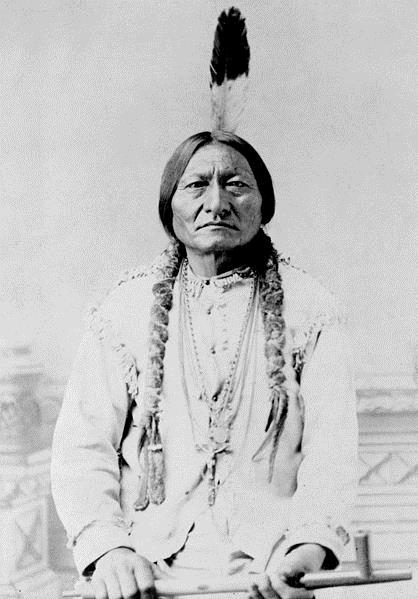
Sitting Bull 1885

It was 123 years ago today, December 15, 1890, that Sitting Bull (shown above in 1885) was killed by Indian agency police on the Standing Rock Indian Reservation during an attempt to arrest him for supporting the Ghost Dance movement.  During the ensuing struggle between Sitting Bull’s followers and the agency police, at 5:30 in the morning, Sitting Bull was shot in the side and head by Standing Rock policemen Lieutenant Bull Head (Tatankapah) and Red Tomahawk (Marcelus Chankpidutah) after the police were fired upon by Sitting Bull’s supporters. His body was taken to nearby Fort Yates for burial, but in 1953, his remains were possibly exhumed and reburied near Mobridge, South Dakota, by his Lakota family, who wanted his body to be nearer to his birthplace.

Until listening to this video, I never realized that Sitting Bull was betrayed by one of his own people, Henry Oscar One Bull, who was looking to make a name for himself.

Ernie LaPointe, Sitting Bull’s lineal great grandson, tells his great grandfather’s oral history. In this film clip he tells who the family holds most responsible for the death of Sitting Bull. Full two part DVD series available at http://www.reelcontact.com. This clip is from part two of ‘The Authorized Biography of Sitting Bull By His Great Grandson”.

At this link, you will find two videos, towards the bottom of this page.  Ignore the ad under the title, it has nothing to do with the LaPointe videos.

Posted in Lakota | 6 Comments

The Lost Rocks by David La Vere

The Lost Rocks” is a book written by David La Vere about the Dare Stones.  David teaches American Indian History at the University of North Carolina at Wilmington.  His book is available at major online bookstores, as well as in the used marketplace. Lost Rocks by LeVere
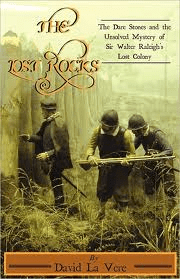
David seeks, in his book, to sift through the various pieces of evidence to determine whether or not the stones were real, or elaborate fakes.  If they are real, they offer the answer to the oldest mystery in American.  If they are fake, they are one of the most elaborate hoaxes ever wrought, and managed to fool, or at least confuse a great number of very intelligent people for a long time.  In fact, the jury is still officially “out” on at least one of the stones.

The book begins by providing historical detail about the colonists and how the first stone was found, which we have already covered.  It also covers a great deal about the political background occurring at that time in North Carolina at the time that might have influenced the climate about the stones.  For example, the state and some groups desperately wanted an increase in tourism, and someone suggested that “stones” be found.  While I’m not going to delve into these factors, I do suggest that the book is a great read for anyone interested in the nitty gritty details of the saga of the Dare Stones.  It’s a great mystery and well written.

The first problem with these multiple stones is that two of them, both purporting to be Virginia Dare’s tombstone, found in vastly different locations, give different years of her death, one in 1591 and one in 1597.  The 1597 stone, found by a retired surveyor in response to the $500 reward offered, was quickly dismissed as a forgery.

About this time Eberhardt arrived with another stone, this date being 1589, and he was pretty quickly dismissed by the Pierce’s due to the fact that his date was both too early and in conflict with the already found 1591 tombstone date.  Not to be dissuaded, Eberhardt reappears a couple of week later….with….guess what….a stone with the names of seventeen colonists, including Ananias and Virginia Dare, and the date of 1591.  Now he had the Pierce’s interest as this is more in line with what they were expecting….and they had told him so previously.

The next grouping of South Carolina stones gave the Pierce’s pause. They contradicted some of the information on the original Chowan River Dare Stone which indicated that the colonists were there, or someplace nearby, in 1591. The South Carolina stones said they were there in 1589.  If so, what were they doing back on the Chowan in 1591?

Another stone was dated 1587 and had an arrow pointing southwest.  Knowing that both Mrs. Harvie and Eleanor Dare had given birth in August of 1587, and the colonists strengthened the fort (according to what White found in 1590), and were expecting supplies in the spring of 1588, this seems very unlikely, yet the stone begged for an explanation.

In 1940, new stones, beginning with stone 15, moved the colonists out of South Carolina into Georgia.  In one haul, Eberhardt showed up with 9 different stones.  By now, the total of stones was up to 23, plus the original Chowan River stone which bore no resemblance to the other stones.  There was also the issue of the names of some colonists on the stones which did not appear on John White’s manifest.

Dr. Pierce decided that a possible explanation was that White had made an error on the manifest and that the first stone could be explained by the fact that Eleanor Dare, after Ananias and Elizabeth were killed in South Carolina on the Saluda River, had the original Chowan Stone carved as a message to her father and send it by friendly Indian messenger to be placed back at Roanoke.  The Indian made it as far as the Chowan River, was perhaps killed, and there the stone lay for the next three and a half centuries until it was found in the 1930s.

The same year, 1940, Breneau wrote and produced a “romantic comedy” about the colonists and their trek through South Carolina into Georgia, ending on the Chattahoochee River.  Recall that the Lost Colony play by Paul Green had opened on Roanoke Island in 1937, the same summer that the first Dare Stone was found.

It was about this time that the Pierces undertook background investigations of the three men who had found all of the stones.  Louis Hammond found the Chowan River Stone, Isaac Turner found one stone and amazingly, all of the rest had been found by Bill Eberhardt.  Hammond has in essence disappeared and no one really tried to investigate him.  The investigators did little more than interview Eberhardt and Turner.

The story needed an end.  It was left with Eleanor Dare and 6 other colonists living with a Cherokee King at Hontaoase town in the Nacoochee Valley in northern Georgia.  What happened to them?

Not to leave the story untold, Eberhardt steps up to the plate once more and finds even more stones for the Pierce’s.  One would think that by this time, even the most naive of people would be highly suspicious of this continued good fortune by Bill Eberhardt, and Bill alone.  And not only did he find stones, he found a lot of stones.

By October of 1940, just in time for the scientific conference to determine the authenticity of the Dare Stones, stones 25 through 47 had been found and added to the collection.  These stones detailed the deaths of the remaining colonists, including Eleanor Dare.  The last remaining colonist, the stonecarver himself, was purported to be Griffen Jones.

The score at this point is as follows:

  • Louis Hammond of California found the first stone on the Chowan River in August      1937.
  • Bill Eberhardt of Atlanta found a total of 41 stones: 13 on the Saluda River in SC, 9 in Habersham Counthy, Georgia and 19 in Fulton County, Georgia near Atlanta
  • Isaac Turner of Atlanta found 3 stones, one on the Chattahoochee north of      Gainesville, one on Ball’s Creek at the Jett homestead when Eberhardt was with him, and part of broken stone 46, also with Eberhardt’s involvement.
  • William Bruce found two stones in Fulton County.

La Vere totals the stones accounting for either 62 or 64 colonists, although only 51 names were mentioned.  The rest of the 117 colonists are unaccounted for.

On the last stones, Eleanor Dare marries the Cherokee chief and has a daughter, Agnes.  In the end, the fate of Agnes remains unknown, and of course that of Griffen Jones as well.

What seems obvious, at least to me, as too much of a good thing, maybe wasn’t.  At least one stone had lichen covering three letters.  Even the best forger wouldn’t be able to do that.  And so, the scientists convened in the fall of 1940 to study the stones.

In Pierce’s speech at the conference, he gave the good, the bad and the ugly.  He said that no other evidence had been found, that there were no artifacts or anything else to support the stones, but he also said that the stones were in perfect harmony with history.

Linguists, geologists and other scientists probed and testified, collaborating.  However, a bombshell was about to drop.  Eberhardt’s shady past caught up with him.  He had been previously implicated in the selling of forged Indian artifacts.

In November the committee issued a statement in which they said that the “preponderance of evidence points to the authenticity of the stones”, but they had concerns and made a list of recommendations and suggestions, which is summarized below:

1.  A search for graves, relics, and artifacts should be pursued.

2.  Fraudulent proposals connected to the 1937 “Lost Colony” play launch and with Eberhardt’s sale of fraudulent Indian relics should be investigated.

3.  Complete check of words and phrases on stones for authenticity, in particular the suspect words “reconnoiter” and “primaeval” as to whether those words were in use at that time or whether they are contemporary.

4.  Check of dialect usage.

5.  Study of the forms of letters on the stones.

6.  Comparative study of names on the stones.

7.  Study of the stones as to the age of the inscriptions.

8.  Study of topographical and ethnological maps.

9.  Genealogical study of the White and Dare families as to the name of Agnes.

10.  Seeking cooperation and collaboration with other agencies and universities.

11.  Application for grant funding to do the above.

12.  If future stones are uncovered, that they be left where they are found so they can be evaluated.

With only one or two exceptions, Eberhardt had ignored the repeated requests of the Pierce’s to leave the stones where he found them and to take them to the stones.

Eberhardt continued to find stones and Dr. Pierce, anxious to move forward, not wanting to wait for the slow wheels of academia and believing that the stones are genuine, make the mistake of writing the story for the Saturday Evening Post, opening a can of worms he was never able to close again.

Pierce was crushed by the story run by the Post.  It wasn’t anything like he had written.  His story was one of “mystery solved” and theirs was one of “hoax perpetuated.”

Not done yet, Eberhardt showed up with another stone in late 1941 but Pierce refused to purchase any more stones out of context.  He would only pay for stones left in their original setting.  Pierce was becoming more distrustful of Eberhardt because some of the information on the new stones was contradicting information on the previous stones.  It looked like someone was getting sloppy with their information and wasn’t being careful.

Days later, Eberhardt shows up again, this time with word of a cave and an inscription in the cave, from Eleanor.  Dr. Pierce went to the cave, without Eberhardt, but with a geology professor.  Both declared the cave inscription a fake, but then the bottom fell out.  The geology professor, Dr. Gibson, discovered a glass bottle of sulfuric acid which had been used to smear on the rock to give it the appearance of age.  Pierce confronted Eberhardt.  The gig was up.

But that wasn’t the end for Eberhardt.  He called Dr. Pierce Sr.’s wife and asked to meet with her.  At the meeting, he shows up with yet another stone, but this one was quite different.  It said “Pearce and Dare Historical Hoaxes.  We Dare Anything.”

This was a blackmail attempt.  He threatened to turn this stone over to the Saturday Evening Post and admit faking all the stones, unless he was paid $200.  In order to entrap Eberhardt, Pierce paid him the $200, with a witness, requiring him to sign for the money, and then took the entire ordeal to the newspaper, exposing Eberhardt as a forger and the entire episode as a hoax.  On the front page  of the Atlanta Journal on May 15, 1941 the headline read “Hoax Claimed by ‘Dare Stones’ Finder in Extortion Scheme, Dr. Pearce Charges’.

Eberhardt, when finally located, told the story a bit differently.  He said he never faked the stones, only looked where the Pierce’s had told him to.

One thing is for sure, the second and subsequent stones were not genuine, regardless of how this hoax was perpetuated, by whom and with the assistance of whom.  Not for one minute do I believe that Bill Eberhardt with a third grade education was capable of composing Elizabethan English without some type of mentor.  All of that makes a wonderful mystery and great reading, but the important part is that those stones can be dismissed from consideration as part of the solution to the mystery of the lost colony.

What is not as clear is whether the first stone is authentic or not.  Louis Hammond was never found which seems a bit suspicious.  The stone has neither been authenticated or proven unreliable.  It was found “at the right time in the right place” to generate tourist interest for the Outer Banks and the new Lost Colony play, and there had been earlier discussion, and reports even of stones, as suggested “plants” to do just that.  But whether the Chowan River stone was part of an earlier hoax or whether it is the real McCoy remains part of the mystery of the Lost Colonists.

Posted in Cherokee, Croatoan, Georgia, Lost Colony, North Carolina, South Carolina | 2 Comments

The Inglis Fletcher Dare Stone Letter

Baylus Brooks, in his search for historical information having to do with the Lost Colonists happened across a letter to Inglis Fletcher.  This letter was donated to ECU as part of the Inglis Fletcher Papers upon her death by her family and is now in the ECU Special Collections which can be seen at the link below. http://digital.lib.ecu.edu/special/ead/view.aspx?id=0021&q=inglis+fletcher

Jennifer Sheppard was kind enough to transcribe the typewritten letter so that we can share it with you here today.

How did Inglis Fletcher get involved with the search for the Lost Colonists?  The North Carolina Writer’s website provides us with this from her biographical information:

“The great-granddaughter of a man from North Carolina’s Tyrell County, Inglis Fletcher was born in Alton, Illinois. She spent the first half of her adult life with her mining engineer husband in northern California, Washington State and Alaska, once moving twenty-one times in five years. She had already published two successful novels by 1934, when a search for information about her Tyrell County ancestors piqued her interest in North Carolina’s early years. She spent the next six years researching, writing, and editing Raleigh’s Eden, an historical novel about Albemarle plantation families from 1765 to 1782. Between its publication in 1942 and 1964, she produced an additional eleven novels which eventually became known as the Carolina Series, covering two hundred years of North Carolina history from 1585 to 1789. Her established working pattern was to spend one year researching and one year writing each volume.

Inglis Fletcher was a firm believer in extensive research for her novels, so committed to accuracy that she would not begin to outline her plots until she was steeped in details of everything from historical events to what people ate and wore. Her favorite characters and their descendants reappeared from book to book, taking part in intricate plots, wild adventures and love stories that blended with actual past events and personages. When Raleigh’s Eden was criticized by native Tar Heels for historical “errors,” she publicly countered all accusations with documented quotations.”

Inglis Fletcher wrote the book “Roanoke Hundred” in 1948.  You can see more about her and a list of her books which are still available today at this link:  http://www.ncwriters.org/services/lhof/inductees/ifletche.htm

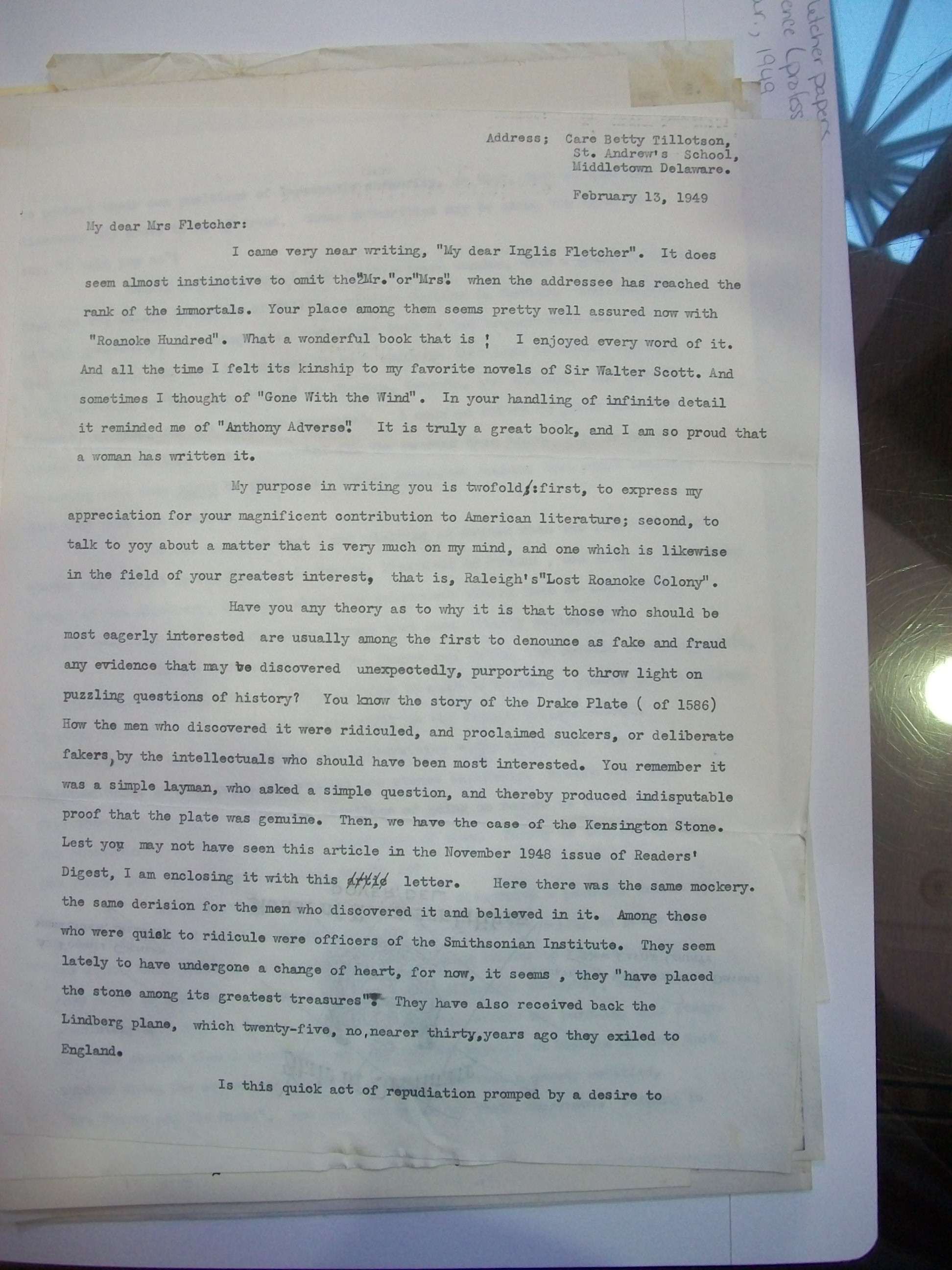
Her research into the Lost Colony attracted the attention of Florence Rohr, a teacher who had worked with the Drs. Pierce at Breneau and who had been lecturing about the Dare Stones.  Aside from the Drs. Pierce themselves, and of course, Bill Eberhardt, she may have been the closest to the stones, their study and the unfolding saga of events.  Here is her letter to Inglis Fletcher.

Address:  Care Betty Tillotson,

St. Andew’s School,

Middletown, Delaware.

February 13, 1949

My dear Mrs Fletcher:

I came very near writing, “My dear Inglis Fletcher”. It does seem almost instinctive to omit the “Mr.” or “Mrs.” when the addressee has reached the rank of the immortals.  Your place among them seems pretty well assured now with  “Roanoke Hundred”.  What a wonderful book that is!  I enjoyed every word of it. And all the time I felt its kinship to my favorite novels of Sir Walter Scott. And sometimes I thought of “Gone With the Wind”. In your handling of infinite detail it reminded me of “Anthony Adverse”.  It is truly a great book, and I am so proud that a woman has written it.

My purpose in writing you is twofold: first, to express my appreciation for your magnificent contribution to American literature; second to talk to yoy (sic) about a matter that is very much on my mind, and one which is likewise in the field of your greatest interest, that is, Raleigh’s “Lost Roanoke Colony”.

Have you any theory as to why it is that those who should be most eagerly interested are usually among the first to denounce as fake and fraud any evidence that may be discovered unexpectedly, purporting to throw light on puzzling questions of history?  You know this story of the Drake Plate (of 1586)   How the men who discovered it were ridiculed, and proclaimed suckers, or deliberate fakers, by the intellectual who should have been most interested.  You remember it was a simple layman, who asked a simple question, and thereby produced indisputable proof that the plate was genuine.  Then, we have the case of the Kensington Stone.  Lest you may not have seen this article in the November 1948 issue of Readers’ Digest, I am enclosing it with this (the word artie appears here but is struck through) letter.  Here there was the same mockery. The same derision for the man who discovered it and believed in it.  Among these who were quick to ridicoule (sic) were officers of the Smithsonian Institute.  They seem lately to have undergone a change of heart, for now, it seems, they “have placed the stone among its greatest treasures”.  They have also received back the Lindberg plane, which twenty-five, no, nearer thirty, years ago they exiled to England.

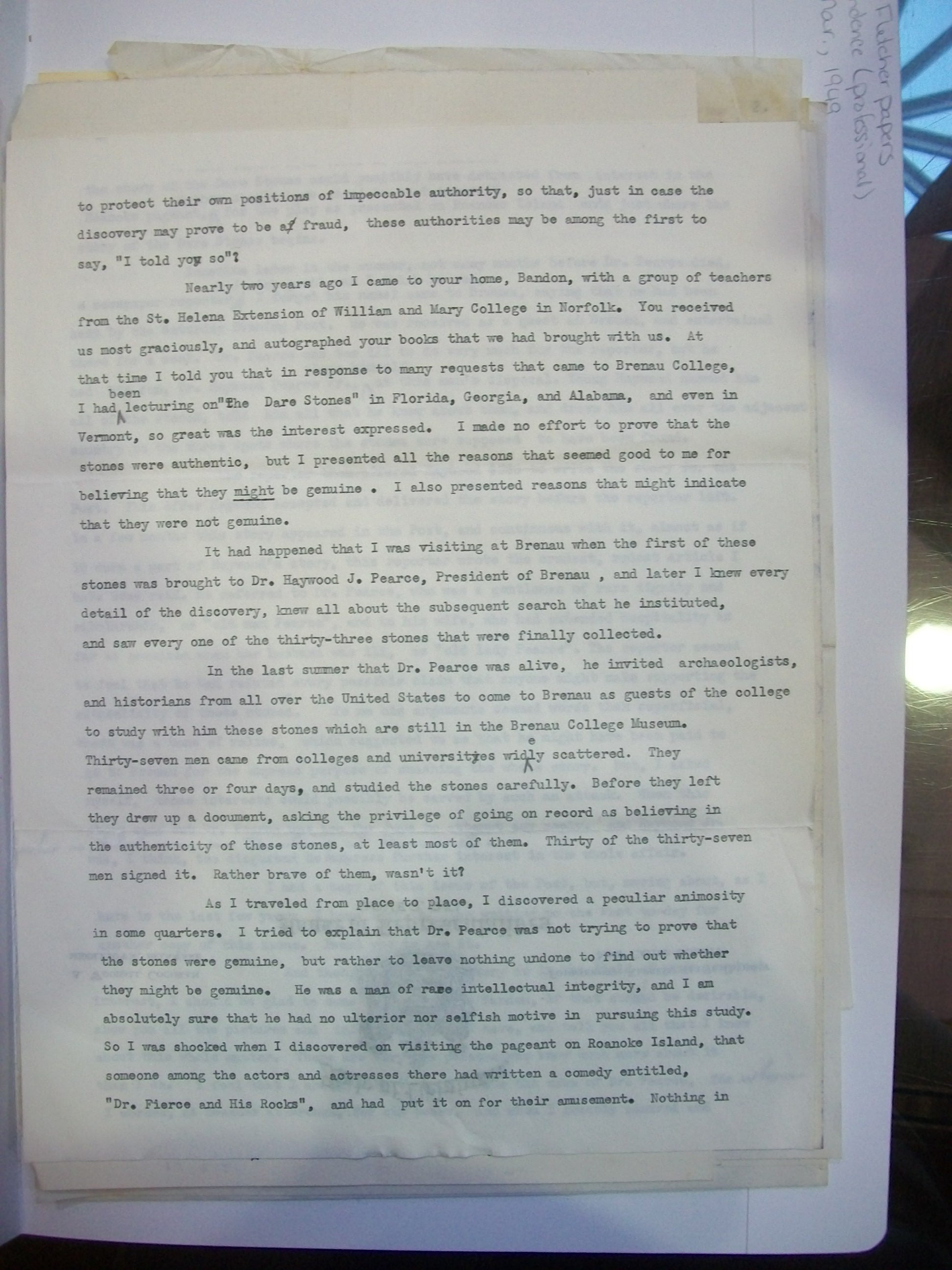
Is this quick act of repudiation promped (sic) by a desire to to (sic) protect their own positions of impeccable authority, so that, just in case the discovery may prove to be a fraud, these authorities may be among the first to say, “I told you so”?

Nearly two years ago I came to your home, Bandon, with a group of teachers from the St Helena Extension of William and Mary College in Norfolk.  You received us most graciously, and autographed your books that we had brought with us.  At that time I told you that in response to many requests that came to Brenau College, I had been lecturing on “The Dare Stones” in Florida, Georgia, and Alabama, and even in Vermont, so great was the interest expressed.  I made no effort to prove that the stones were authentic, but I presented all the reasons that seemed good to me for believing that they might  be genuine.  I also presented reasons that might indicate that they were not genuine.

It had happened that I was visiting at Brenau when the first of these stones was brought to Dr. Haywood J. Pierce, President of Brenau, and later I knew every detail of the discovery, knew all about the subsequent search that he instituted, and saw every one of the thirty-three stones that were finally collected.

In the last summer that Dr. Pearce was alive, he invited archaeologists, and historians from all over the United States to come to Brenau as guests of the college to study with these stones which are still in the Brenau College Museum.  Thirty-seven men came from colleges and universities widely scattered. They remained three or four days, and studied the stones carefully.  Before they left they drew up a document, asking the privilege of going on record as believing in the authenticity of these stones, at least most of them.  Thirty of the thirty-seven men signed it.  Rather brave of them, wasn’t it?

As I traveled from place to place, I discovered a peculiar animosity in some quarters.  I tried to explain that D. Pearce was not trying to prove that the stones were genuine, but rather to leave nothing undone to find out whether they might be genuine.  He was a man of rare intellectual integrity, and I am absolutely sure that he had no ulterior nor (sic) selfish motive in pursuing this study. So I was shocked when I discovered on visiting the pageant on Roanoke Island, that someone among the actors and actresses there had written a comedy entitled, “Dr. Pearce and His Rocks”, and had put it on for their amusement.  Nothing in story of the Dare Stones could possibly have detracted from interest in the Roanoke pageant, rather should have added to that interest for the play as presented on Roanoke Island ends just where the story of the Dare Stones begins.

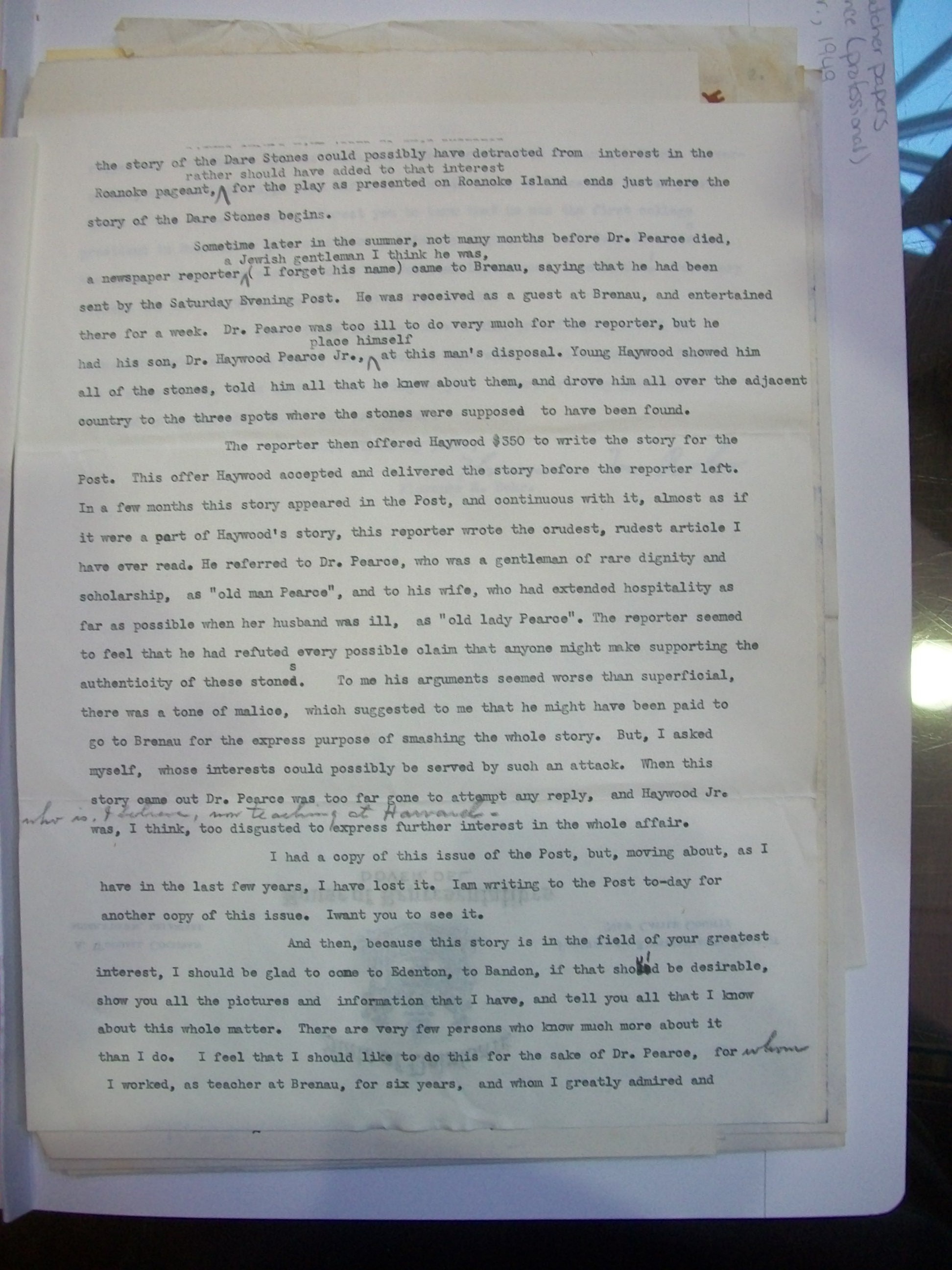
Sometime later in the summer, not many months before Dr. Pearce died, a newspaper reporter a Jewish gentleman I think he was, (I forget his name) came to Brenau, saying that he had been sent by the Saturday Evening Post.  He was received as a guest at Brenau, and entertained there for a week.  Dr. Pearce was too ill to do very much for the reporter, but he had his son, Dr. Haywood Pearce Jr., place himself at this man’s disposal.  Young Haywood showed him all of the stones, told him all that he knew about them, and drove him all over the adjacent country to the three spots where the stones were supposed to have been found.

The reporter then offered Haywood $350 to write the story for the Post.  This offer Haywood accepted and delivered the story before the reporter left.  In a few months this story appeared in the Post, and continuous (sic) with it, almost as if it were a part of Haywood’s story, this reporter wrote the crudest, rudest article I have ever read.  He referred to Dr. Pearce, who was a gentleman of rare dignity and scholarship, as “old man Pearce” and to his wife, who had extended hospitality as far as possible when her husband was ill, as “old lady Pearce”.  The reporter seemed to feel that he had refuted every possible claim that anyone might make supporting the authenticity of these stones.  To me his arguments seemed worse than superficial, there was a tone of malice, which suggested to me that he might have been paid to go to Brenau for the express purpose of smashing the whole story.  But, I asked myself, whose interests could possibly be served by such an attack.  When this story came out Dr. Pearce was too far gone to attempt any reply, and Haywood Jr. who is I believe, now teaching at Harvard, was I think, too disgusted to express further interest in the whole affair.

I had a copy of this issue of the Post, but, moving about, as I have in the last few years, I have lost it.  I am writing to the Post to-day for another copy of this issue.  I want you to see it.

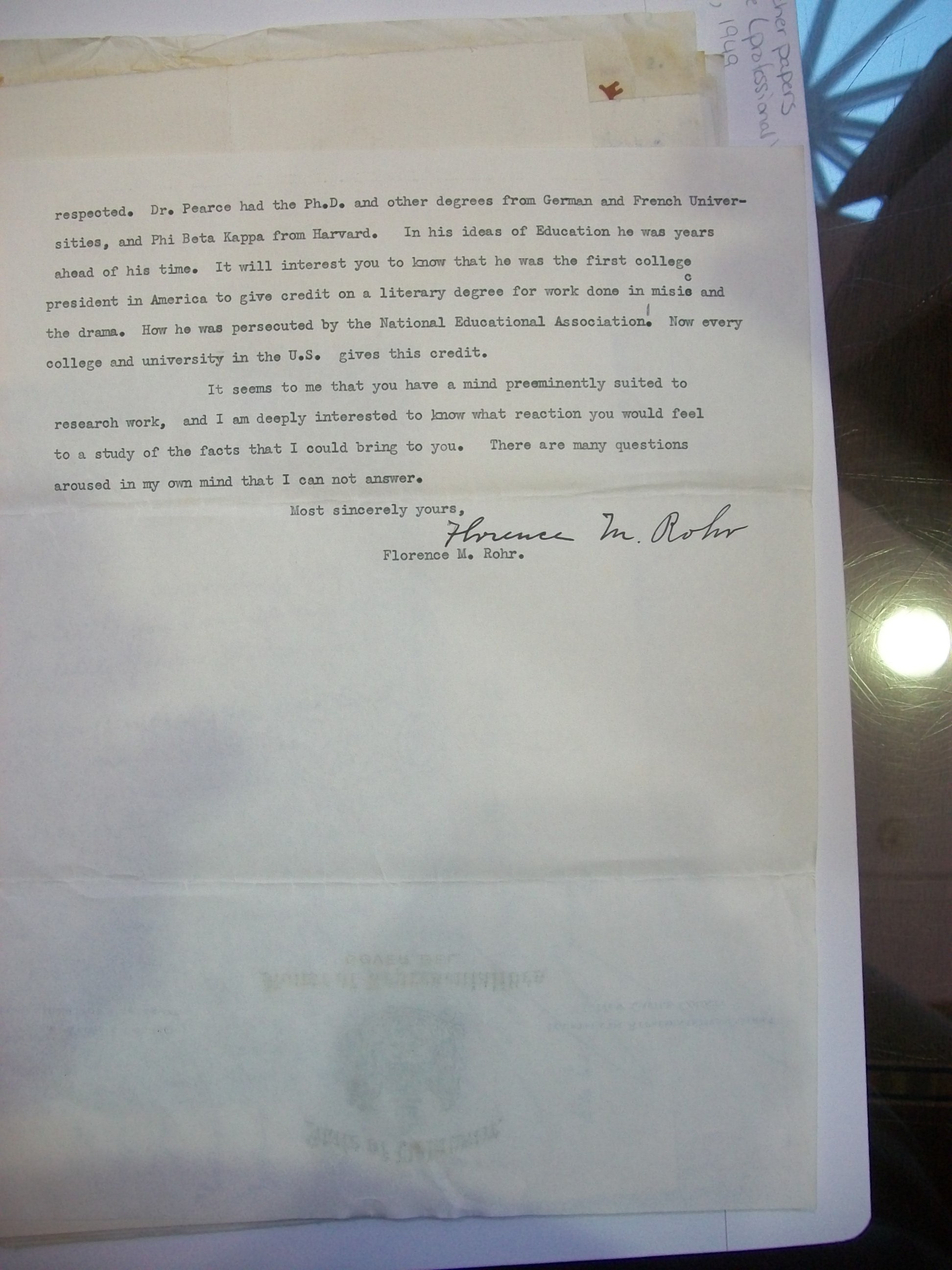
And then, because this story is in the field of your greatest interest, I should be glad to come to Edenton, to Bandon, if that should be desirable, show you all the pictures and information that I have, and tell you all that I know about this whole matter.  There are very few persons who know much more about it than I do.  I feel that I should like to do this for the sake of Dr. Pearce, for whom I worked, as teacher at Brenau, for six years, and whom I greatly admired and respected.  Dr. Pearce had the PH.D. and other degrees from German and French Universities, and Phi Beta Kappa from Harvard.  In his ideas of Education he was years ahead of his time.  It will interest you to know that he was the first college president in America to give credit on literary degree for work done in misic (sic) and the drama.  How he was persecuted by the National Educational Association!  Now every college and university in the U.S. gives this credit.

It seems to me that you have a mind preeminently suited to research work, and I am deeply interested to know what reaction you would feel to a study of the facts that I could bring to you.  There are many questions aroused in my own mind that I can not answer.

Most sincerely yours,

Florence M. Rohr.

Fletcher, Inglis 1

Fletcher, Inglis 2

Fletcher, Inglis 3

Fletcher, Inglis 4

Posted in Georgia, Lost Colony, North Carolina | 2 Comments