1757 Letter from the Chiefs of the Catawba Nation to SC Governor Lyttleton

A letter signed on the 16th of June 1757 by the Chiefs of the Catawba Nation and several formerly separate tribes within that Nation, says, among much else, that:

“Our brothers, the Cherocees, has sent us a tomahawk for to kill the French with.  We have likewise received assurance from the Creeks, Chicasaw, Tuskaruras, Saponas and Notowas that they will join heart and hand against the enemies of the great King George, the beloved father of his people.”

At “Watree, June the 16th, 1757, King Haglar, Captain Water, Captain Scot, Captain Jack, Captain Cutlash, Captain James Harris, Captain Santee Jemmy, Captain Johney of Pedee, Johney Yong and Captain Watree Jemmy,” in that order, signed the letter, each man signing with “his mark.”  Someone addressed the letter thus:

“King Hagler and other the head Men of and warriors of the Catawba Nation/to his Excellency William Henry Lyttleton, Esquire, Governor of South Carolina.”

(The foregoing copied from a Zerox, supplied by Jim Merrell of the History Department at Johns Hopkins University, of a single parchment sheet date of June 16, 1757, in the Lyttleton Papers or William Henry Lyttleton Papers at the William Clements Library in Ann Arbor, Michigan.)

Document Source:

Saponi: written as part of the “Historical Overview” section of a petition for recognition in behalf of the Saponi descendants along Drowning creek, Robeson county, N.C. [Book 2 of 7] : [typescript], 1980-1981 / Wes White.

Housed at the SC Department of Archives and History

This letter holds several valuable nuggets.  It shows that the Notoway, Saponis and Tuscarora were separate and functioning tribes at this time.

It also tells us that the Wateree and Pedee, based on the names of the warriors and head men, were now functioning as part of the Catawba Nation.  Given that they had representation among the head men, it appears to be more of a merger than a hostile takeover.

Posted in Catawba, Cherokee, Chickasaw, Creek, Nottoway, Peedee, Santee, Saponi, Tuscarora, Wateree | 9 Comments

Gov. Walker and the Bay River Indians

North Carolina Historical and Genealogical Register Extracts

http://archive.org/stream/northcarolinahi00hathgoog/northcarolinahi00hathgoog_djvu.txt

Please note that this document has been scanned and optically read.  This means that in places the old type may not have read or been interpreted correctly, causing anomalies in the print of this document.  If in question, refer to an original.

Vol. No. I, published quarterly
January, 1900
THE NORTH CAROLINA
Historical and Genealogical Register
EDENTON, NORTH CAROLINA

Pg 597

Governor Walker and the Bay River Indians

ORDER FROM GOV. HENDERSON WALKER RELATING TO BAY RIVER INDIANS.

N. Carolina, May 14th, 1701.

“Whereas Mr. Thomas Amy hath made Information to me yt he with some other men being in Indian Canoe with five Indians who pretended to carry them to ye English butt gooing a shoare they took up a Gun and a bow and arrow and presented it at ye said Mr. Amy butt he having one of ye Indians in ye Canoe who could not readily leap out he secured him and pretended to kill him with his sword upon wch they run away.

Wherefore in his majies name I doe impower the said Mr. Thos. Amy, Capt. Thos. Luten, Mr. Niche’s Tyler, Capt. Nicho Daw and Mr Wm. Barrow or any three of them to go to ye Matchepungo or Bear River Indians and there to demand the aforesaid Indians to be delivered up to them who made ye assault as alsoe the Arms they conveyed away; and to use such other means in ye management of ye same affair as to you or any three of you shall think fitt and if they shall deliver up ye same Indians to bring them before ye Couneell holden ye first Monday in June next and I doe in his Majies name to well & require you to press men, horses, boats and other conveniences by you thought most for ye doing thereof. And I doe require and Comand all his Maj’tes subjects to be obedient to you in ye fulfilling herein.

And you are to return an account of your proceedings herein And for your fulfilling hereof this shall your warrant. Given under my band ye 14th May, 1701.  HENDERSON WALKER.

698

Gov. Walker and the Bay River Indians.

LETTER FROM JOHN LAWSON TO GOV. WALKER, RELATING TO THE BAY RIVER INDIANS.

(From Records of Albemarle County at Edenton, N. C. )

Pampticough, June ye 23r, 1701.

Hon. Sir:

“Thursday last I was with ye Bay River Indians & acquainted them with ye contents of ye Honbl. Warrt given in by Capt. Dawfl. Their Kings Southwell & During with their great men Mett & Sent for me to Southwell’s Cabin before I mentioned anything of my Message to them: They produced a paper containing five articles concluded from them to ye English & signed by Mr. Akehurst, Mr. Calloway, Capt. Blount & Mr. Slade. I told ym ye Governor demanded 4 Indian men & a boy who had offered Severall Indignities to some English Gentlemen in ye Sand banks as for cocking a gun & setting it to Mr. Amey’s breast ; they utterly denied ; their story to me runs thus : 4 Indian men and one boy mett with some English in a Canoe who belonged to a Vessel yt was castaway & stuck aground as they terme it, ye English asked way to Roanoke ye Indians profered their service to bring ym to ye English there, ye Gentlemen gave them 3 Clay potts full of Rum, (Fisher one of ye Indians said he told ye English if they made ye Indians drunk they would be rude, ye Indians gave ye English Venizen & 20 * * * Drums, one of ye Indians got drunk, hearing ym talk of Ashley River made ym afraid of being taken thither, they fled & let fall 3 guns of ye English into ye water in this escape, one of ym was a great gun, all which since they have left with one Anthony the English took forcibly from them 4 rawe Dear Skins, one Otter, one hairy match coat & 4 bushels of corn; they were extraordinary sivil to me although most of ym Drunk ; they say the have done no harm to ye English & hope they may not suffer ye Englsh displeasure for a thing they have not acted or Intended : They would make me no positive answer as to delivering up ye Indians but always (told me) they might not * * * any breach of their articles from ye articles. I have no more at present but remain Sr yr Hour. Most humble. Most Obedient & Most Devoted Svt., JOHN LAWSON.

ARTICLES OF AGREEMENT WITH THE BAY RIVER INDIANS.

(Original in the Court House at Edenton, N. C.)

Pg 699

Pamptico, the 23rd Yber, 1699.

Articles of agreement made and concluded on by & between Daniel Akehurst, Caleb Calloway, Thomas Blount & Henry Slade of •on parte in behalf of the Goverment of North Carolina & Sothel King of the Bear River Indians with his Great Men on behalf of the sd Nation of the other Parte as foloweth :

lly. The Indians shall at all times if they are accused by any Englishmen or Judiciary of murdering any of the King’s Subjects they shall send the said Indians soe accused into the English Government or to some Officer to answer the Accusation.

21y. If any Shipp or Vessel shall be cast away on any shore & any of the men be found that have effects in the load, they shall relieve them with provisions & conduct them to sum English plantation for which they shall have a match coat reward for each man soe conducted & what goods they find on the Seashore they will deliver to the English goverment & they shall allow them reasonable salvage for ye same.

3rdly. As to the goods they can take any that are ruin, for all they shall bring into the English as alleged *** *** ***, or vessel in which they are * *** **** ****  have a match coat for each.

4thly. The Indians shall at all times assist the English in all trouble with all Indians as shall ofer, are not to fight against the English or any Indians who fight with them.

5thly. The sd King or sum of his great men shall yearly & during year make their appearance at the Genirall Corte to be holden in July & then & their pay to pair of Skins as a tribute to the English Government.

King Sothell Matthews, [RJE Note – based on the two signums below, I believe this is two people, King Sothell and Matthews.]

Signum. Signum.

Edmund Welly, Capt. Gibbs, Lewis Vandermulen, Geo. Fisher,

Signum. Signum. Signum. Signum.

Posted in Bare River Indians, Bay River Indians, Machapunga | Leave a comment

Clovis People Are Native Americans, and from Asia, not Europe

In a paper published in Nature today, titled “The genome of a Late Pleistocene human from a Clovis burial site in western Montana,” by Rasmussen et al, the authors conclude that the DNA of a Clovis child is ancestral to Native Americans.  Said another way, this Clovis child was a descendant, along with Native people today, of the original migrants from Asia who crossed the Bering Strait.

This paper, over 50 pages including supplemental material, is behind a paywall but it is very worthwhile for anyone who is specifically interested in either Native American or ancient burials.  This paper is full of graphics and extremely interesting for a number of reasons.

First, it marks what I hope is perhaps a spirit of cooperation between genetic research and several Native tribes.

Second, it utilized new techniques to provide details about the individual and who in world populations today they most resemble.

Third, it utilized full genome sequencing and the analysis is extremely thorough.

Let’s talk about these findings in more detail, concentrating on information provided within the paper.

The Clovis are defined as the oldest widespread complex in North America dating fromClovis point about 13,000 to 12,600 calendar years before present.  The Clovis culture is often characterized by the distinctive Clovis style projectile point.  Until this paper, the origins and genetic legacy of the Clovis people have been debated.

These remains were recovered from the only known Clovis site that is both archaeological and funerary, the Anzick site, on private land in western Montana.  Therefore, the NAGPRA Act does not apply to these remains, but the authors of the paper were very careful to work with a number of Native American tribes in the region in the process of the scientific research.  Sarah L. Anzick, a geneticist and one of the authors of the paper, is a member of the Anzick family whose land the remains were found upon.  The tribes did not object to the research but have requested to rebury the bones.

The bones found were those of a male infant child and were located directly below the Clovis materials and covered in red ochre.  They have been dated  to about 12,707-12,556 years of age and are the oldest North or South American remains to be genetically sequenced.

All 4 types of DNA were recovered from bone fragment shavings: mitochondrial, Y chromosome, autosomal and X chromosome.

Mitochondrial DNA

The mitochondrial haplogroup of the child was D4h3a, a rather rare Native American haplogroup.  Today, subgroups exist, but this D4h3a sample has none of those mutations so has been placed at the base of the D4h3a tree branch, as shown below in a grapic from the paper.  Therefore, D4h3a itself must be older than this skeleton, and they estimate the age of D4h3a to be 13.000 plus or minus 2,600 years, or older.

Clovis mtDNA

Today D4h3a is found along the Pacific coast in both North and South America (Chile, Peru, Ecuador, Bolivia, Brazil) and has been found in ancient populations.  The highest percentage of D4h3a is found at 22% of the Cayapa population in Equador.  An ancient sample has been found in British Columbia, along with current members of the Metlakatla First Nation Community near Prince Rupert, BC.

Much younger remains have been found in Tierra del Fuego in South America, dating from 100-400 years ago and from the Klunk Mound cemetery site in West-Central Illinois dating from 1800 years ago.

It’s sister branch, D4h3b consists of only one D4h3 lineage found in Eastern China.

Y Chromosomal DNA

The Y chromosome was determined to be haplogroup Q-L54.  Haplogroup Q and subgroup Q-L54 originated in Asia and two Q-L54 descendants predominate in the Americas: Q-M3 which has been observed exclusively in Native-Americans and Northeastern Siberians and Q-L54.

The tree researchers constructed is shown below.

Clovis Y

They estimate the divergence between haplogroups Q-L54 and Q-M3, the two major haplogroup Q Native lines, to be about 16,900 years ago, or from between 13,000 – 19,700.

The researchers shared with us the methodology they used to determine when their most common recent ancestor (MCRA) lived.

“The modern samples have accumulated an average of 48.7 transversions [basic mutations] since their MCRA lived and we observed 12 in Anzick.  We infer an average of approximately 36.7 (48.7-12) transversions to have accumulated in the past 12.6 thousands years and therefore estimate the divergence time of Q-M3 and Q-L54 to be approximately 16.8 thousands years (12.6ky x 48.7/36.7).”

Autosomal

They termed their autosomal analysis “genome-wide genetic affinity.”  They compared the Anzick individual with 52 Native populations for which known European and African genetic segments have been “masked,” or excluded.  This analysis showed that the Anzick individual showed a closer affinity to all 52 Native American populations than to any extant or ancient Eurasian population using several different, and some innovative and new, analysis techniques.

Surprisingly, the Anzick infant showed less shared genetic history with 7 northern Native American tribes from Canada and the Artic including 3 Northern Amerind-speaking groups.  Those 7 most distant groups are:  Aleutians, East Greenlanders, West Greenlanders, Chipewyan, Algonquin, Cree and Ojibwa.

They were closer to 44 Native populations from Central and South America, shown on the map below by the red dots.  In fact, South American populations all share a closer genetic affinity with the Anzick individual than they do with modern day North American Native American individuals.

Clovis autosomal cropped

The researchers proposed three migration models that might be plausible to support these findings, and utilized different types of analysis to eliminate two of the three.  The resulting analysis suggests that the split between the North and South American lines happened either before or at the time the Anzick individual lived, and the Anzick individual falls into the South American group, not the North American group.  In other words, the structural split pre-dates the Anzick child.  They conclude on this matter that “the North American and South American groups became isolated with little or no gene flow between the two groups following the death of the Anzick individual.”  This model also implies an early divergence between these two groups.

Clovis branch

In Eurasia, genetic affinity with the Anzick individual decreases with distance from the Bering Strait.

The researchers then utilized the genetic sequence of the 24,000 year old MA-1 individual from Mal’ta, Siberia, a 40,000 year old individual “Tianyuan” from China and the 4000 year old Saqqaq Palaeo-Eskimo from Greenland.

Again, the Anzick child showed a closer genetic affinity to all Native groups than to either MA-1 or the Saqqaq individual.  The Saqqaq individual is closest to the Greenland Inuit populations and the Siberian populations close to the Bering Strait.  Compared to MA-1, Anzick is closer to both East Asian and Native American populations, while MA-1 is closer to European populations.  This is consistent with earlier conclusions stating that “the Native American lineage absorbed gene flow from an East Asian lineage as well as a lineage related to the MA-1 individual.”  They also found that Anzick is closer to the Native population and the East Asian population than to the Tianyuan individual who seems equally related to a geographically wide range of Eurasian populations.  For additional information, you can see their charts in figure 5 in their supplementary data file.

I have constructed the table below to summarize who matches who, generally speaking.

who matches who

In addition, a French population was compared and only showed an affiliation with the Mal’ta individual and generically, Tianyuan who matches all Eurasians at some level.

Conclusions

The researchers concluded that the Clovis infant belonged to a meta-population from which many contemporary Native Americans are descended and is closely related to all indigenous American populations.  In essence, contemporary Native Americans are “effectively direct descendants of the people who made and used Clovis tools and buried this child,” covering it with red ochre.

Furthermore, the data refutes the possibility that Clovis originated via a European, Solutrean, migration to the Americas.

I would certainly be interested to see this same type of analysis performed on remains from the eastern Canadian or eastern seaboard United States on the earliest burials.  Pre-contact European admixture has been a hotly contested question, especially in the Hudson Bay region, for a very long time, but we have yet to see any pre-Columbus era contact burials that produce any genetic evidence of such.

Additionally, the Ohio burial suggests that perhaps the mitochondrial DNA haplogroup is or was more widespread geographically in North American than is known today.  A wider comparison to Native American DNA would be beneficial, were it possible. A quick look at various Native DNA and haplogroup projects at Family Tree DNA doesn’t show this haplogroup in locations outside of the ones discussed here.  Haplogroup Q, of course, is ubiquitous in the Native population.

National Geographic article about this revelation including photos of where the remains were found.  They can make a tuft of grass look great!

Another article can be found at Voice of America News.

Science has a bit more.

If you’d like to take a DNA test, click here.

Posted in Aleut, Algonquian, Anthropology, Archaeology, Archaic Indians, Asia, Chippewa, Clovis, Cree, DNA, Europe, First Nation, French, History, Ojibwa, Origins, Paleoindians, Research, Solutrean, South America | 1 Comment

Buckskin Williams’ Indian Store, Lenoir Co., NC

North Carolina Historical and Genealogical Register Extracts

http://archive.org/stream/northcarolinahi00hathgoog/northcarolinahi00hathgoog_djvu.txt

Please note that this document has been scanned and optically read.  This means that in places the old type may not have read or been interpreted correctly, causing anomalies in the print of this document.  If in question, refer to an original.

Vol. No. I, published quarterly
January, 1900
THE NORTH CAROLINA
Historical and Genealogical Register
EDENTON, NORTH CAROLINA

Pg 575 Whitfield Record

The 2nd William Whitfield and wife Rachel Bryan moved to the “Rich Lands” on the Neuse River in Lenoir Co., NC, and lived at Rockford on the North bank of the river.  He afterwards purchased White Hall now “Seven Springs” in Wayne county from Buckskin Williams (father of Gov. Ben and John Pugh Williams) and brother of Old Ben Williams. Buckskin Williams kept an Indian Store at White Hall until 1776.

Does anyone have any more information about this “Indian store” or Buckskin Williams?

Posted in North Carolina | Leave a comment

Meherrin Indian Tribe Petition for Federal Recognition Denied

The Meherrin Indian Tribe petitioned the federal government for federal recognition as an Indian tribe and was denied on January 16, 2014.  The government’s response to their petition can be seen here.

I was mortified to read their reasoning, and the sources they used.  In particular, Paul Heinegg’s work.  I am a fan of Paul’s work.  Paul is very careful to use works like “may,” “might,” and “probably.”  Paul does not set forth that his gathering and clustering of surnames is gospel and that these people are absolutely related.  He says they might be related, and he is looking for patterns.  There is a huge difference between a possibility and a conclusion and Pauls’ work, in my opinion, has been misconstrued, taken out of context and given far more weight than other more concrete evidence.

Despite the government denial of the Meherrin application, there is a plethora of great information in this document, including the list of Meherrin names on page 29.

Posted in Uncategorized | 13 Comments

Notes on the Indian Burial Mounds of Eastern North Carolina (Between 1882 and 1915)

Notes on the Indian burial mounds of eastern North Carolina (between 1882 and 1915)

By J. A. HOLMES.

So far as is known to me, no account of the Indian burial mounds, which are to be found in portions of Eastern North Carolina, have, as yet, been published. This fact is considered a sufficient reason for the publication of the following notes concerning a few of these mounds which have been examined in Duplin and a few other counties in the region under consideration.

It is expected that the examination of other mounds will be carried on during the present year, and it is considered advisable to postpone generalized statements concerning them until these additional examinations have been completed. It may be stated, however, of the mounds that have been examined already, that they are quite different from and of much less interest, so far as contents are concerned, than those of Caldwell and other counties of the western section of the State. As will be seen from the following notes, they are generally low and rarely rising to more than three feet above the surrounding surface, with generally circular bases varying in diameter from 15 to 40 feet; and they contain little more than the bones of human (presumably Indian) skeletons, arranged in no special order. They have been generally built on somewhat elevated, dry, sandy places, out of a soil similar to that by which they are surrounded. No evidence of an excavation below the general surface has as yet been observed. In the process of burial, the bones or bodies seem to have been laid on the surface or above, and covered up with soil taken from the vicinity of the mound. In every case that has come under my own observation charcoal has been found at the bottom of the mound.

Mound No. 1 — Duplin county, located at Kenansville, about one half mile southwest from the courthouse, on a somewhat elevated, dry, sandy ridge. In form, its base is nearly circular, 35 feet in diameter; height 3 feet. The soil of the mound is like that which surrounds it, with no evidence of stratification. The excavation was made by beginning on one side of the mound and cutting a trench 35 feet long, and to a depth nearly 2 feet below the general surface of the soil, (5 feet below top of mound) and removing all the soil of the mound by cutting new trenches and filling up the old ones. In this way all the soil of the mound and for two feet below its base was carefully examined. The soil below the base of the mound did not appear to have been disturbed at the time the mound was built. The contents of the mound included fragments of charcoal, a few small fragments of pottery, a hand-full of small shells, and parts of sixty human skeletons. No implements of any kind were found. Small pieces of charcoal were scattered about in different portions of the mound, but the larger portion of the charcoal was found at one place 3 or 4 feet square near one side of the mound. At this place the soil was colored dark, and seemed to be mixed with ashes. There were here with the charcoal, fragments of bones, some of which were dark colored, and may have been burned; but they were so nearly decomposed that I was unable to satisfy myself as to this point. I could detect no evidence of burning in case of the bones in other portions of the mound. Fragments of pottery were few in number, small in size, and scattered about in different parts of the mound. They were generally scratched and crossscrated on one side, but no definite figures could be made out. The shell “beads” were small in size — 10 to 12 mm. in length. They are the Marginella roscida of Redfield, a small gasteropod which is said to be now living along the coasts of this State. The specimens, about 75 in number, were all found together, lying in a bunch near the skull and breast bones of a skeleton. The apex of each one had been ground off obliquely so as to leave an opening passing through the shell from the apex to the anterior canal — probably for the purpose of stringing them.

The skeletons of this mound were generally much softened from decay — many of the harder bones falling to pieces on being handled, while many of the smaller and softer bones were beyond recognition. They were distributed through nearly every portion of the mound, from side to side, and from the* base to the top surface, without, so far as was discovered, any definite order as to their arrangement. None were found below the level of the surface of the soil outside the mound. In a few eases the skeletons occurred singly, with none others within several feet; while in other cases several were found in actual contact with one another; and in one portion of the mound, near the outer edge, as many as twenty-one skeletons were found placed within the space of six feet square. Here, in the case last mentioned, several of the skeletons lay side by side, others on top of these, parallel to them, while still others lay on top of and across the first. When one skeleton was located above another, in some cases the two were in actual contact, in other cases they were separated by a foot more of soil.

As to the position of the parts of the individual skeletons, this could not be fully settled in the present case, on account of the decayed condition of many of the bones. The following arrangement of the parts, however, was found to be true of nearly every skeleton exhumed:

The bones lay in a horizontal position or nearly so. Those of the lower limbs were bent upon themselves at the knee, so that the thigh bone (femur) and the bones of the leg (tibia and fibula) lay parallel to one another; the bones of the foot and ankles being found with or near the hip bones. The knee cap or patella, generally lying at its proper place, indicated that there must have been very little disturbance of the majority of the skeletons after their burial. The bones of the upper limbs, also, were seemingly bent upon themselves at the elbow ; those of the fore-arm (humerus) generally lying quite or nearly side by side with the bones of the thigh and leg; the elbow Joint pointing toward the hip bones, while the bones of the two arms below the elbow Joint (radius and ulna) were in many cases crossed, as it were, in front of the body. The ribs and vertebrae lay along by the side of, on top of, and between the bones of the upper and lower limbs; generally too far decayed to indicate their proper order or position. The skulls generally lay directly above or near the hip bones, in a variety of positions; in some cases the side, right or left, while in other cases the top of the skull, the base or front was downward.

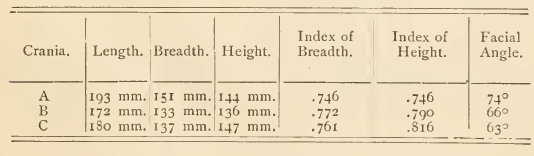
But two of the crania (A and B of the following table) obtained from this mound were sufficiently well preserved for measurement; and both of these, as shown by the teeth, are skulls of adults. C of this table is the skull of an adult taken from mound No. 2. below.

mounds table

The skeletons were too much decomposed to permit the distinguishing of the sexes of the individuals to whom they belonged; but the size of the crania (adults) and other bones seem to indicate that a portion of the skeletons were those of women. One small cranium found was evidently that of a child — the second and third pair of incisor teeth appearing beyond the gums.

Mound No. 2, located If miles east of Hallsville, Duplin county, on a somewhat elevated, dry, sandy region. Base of mound nearly circular, 22 feet in diameter; height, 3 feet, surface rounded over the top. Soil similar to that which surrounds the mound— light sandy. Excavations of one-half of the mound exposed portions of eight skeletons, fragments of charcoal and pottery, arranged in much the same way as described above in ease of mound No. 1. The bones being badly decomposed, and the mound being thoroughly penetrated by the roots of trees growing over it, the excavation was stopped. No implements or weapons of any and were found.

There was no evidence of any excavation having been made below the general surface, in the building of the mound, but, rather evidence to the contrary. The third cranium (C) of the above table was taken from this mound.

Mound No. 3, located in a dry sandy and rather elevated place about one-third of a mile east of Hallsville, Duplin county. In size and shape, this mound resembles those already mentioned. Base circular, 81 feet in diameter ; height 2.5 feet. No excavation was made, other than what was sufficient to ascertain that the mound contained bones of human skeletons.

Mound No. 4, Duplin county, located in a rather level sandy region, about one mile from Sarecta P. O., on the property of Branch Williams. Base of mound circular, 35 feet in diameter; height 2.5 feet. Soil sandy, like that which surrounds it. Around the mound, extending out for a distance varying from 5 to 10 yards, there was a depression, which, in addition to the similarity of soils mentioned above, affords ground for the conjecture that here, as in a number of other cases, it is probable the mound was built by the throwing on the soil from its immediate vicinity. Only a partial excavation was made, with the result of finding human bones, and a few small fragments of charcoal and pottery.

Since the above mounds were visited, I have obtained information as to the localities of mounds similar to those described, in the eastern, southern and western portions of Duplin county; and I can hardly doubt but that a closer examination of this region will prove them to be more numerous than they are now generally supposed to be.

In Sampson county, the localities of several mounds have been noted; but one of these, however, so far as I am informed, has been examined with care. This one (Mound No. 5), examined by Messrs. Phillips and Murphy of the Clinton School, is located about 2.5 miles west of Clinton (Sampson county), on the eastern exposure of a small hill. In general characters it resembles the mounds already described. Base circular, 40 feet in diameter; height 3.5 feet; soil sandy loam, resembling that surrounding the mound. Contents consisted of small fragments of charcoal, two bunches of small shell “beads,” and the parts of 16 human skeletons. These skeletons were not distributed uniformly throughout the portion of the mound examined. At one place there were 9, at another 6, and at a third place 5 skeletons, lying close to, and in some cases on top of one another. In this point as in the position of the parts of the skeletons (“doubled-up”) this mound resembles those described above.

The bones were generally soft from decay. The small shells were found in bunches under two skulls; they are of the same kind (Marginella roscida, Redfield) as those from Mound No. 1, and their ends were ground off in the same way. No bones were found below the surface level, and there was no evidence of excavations having been made below this point. No stone implements of any kind were found in the mound. One-half this mound was examined.

In Robeson and Cumberland counties several mounds have been examined; and for information concerning these, I am indebted to Mr. Hamilton McMillan, of Dora, Robeson county. Five mounds are reported as having been examined in Robeson county, averaging 60 feet in circumference, and 2 feet high, all located on elevated, dry ridges, near swamps or water-courses; and all contained bones of human skeletons. One of these mounds, located about two miles east of Red Springs, examined by Mr. McMillan, in 1882, contained about 50 skeletons. Many of these bones near the surface of the mound, in Mr. McMillan’s opinion, had been partly burned — those nearer the bottom were in a better state of preservation. There was an “entire absence of skulls and teeth” from this mound — a somewhat remarkable fact. A broken stone “celt” was found among the remains; but with this one unimportant exception, no mention has been made of implements having been found.

In addition to the above, Mr. D. Sinclair, of Plain View, Robeson County, has informed me that he has seen four mounds in the southern portion of this county — two near Brooklyn P. O., and two between Leesville and Fair Bluff, about five miles from the latter place.

In Cumberland county, two mounds are reported by Mr. McMillan as having been examined. One of these located about ten miles south of Fayetteville, was found to contain the crumbled bones of a single person, lying in an east and west direction. There was also found in this mound a fragment rock rich in silver ore. The other mound, located ten miles southwest from Fayetteville, near Rockfish Creek, was examined by Mr. McMillan in 1860, and found to contain a ” large number of skeletons,” — “bones were well preserved and, without exception, those of adults.” The mound was located on a high sandy ridge, its base about 20 feet in diameter ; height 2.5 feet.

In Wake county one mound has been reported as being located on the northeast and several on the southwest side of the Neuse River, about seven miles east from Raleigh; and from the former it is stated that large numbers of stone implements have been removed.

But I have been unable to examine these or to obtain any definite information concerning them. One mound in this county, examined in 1882 by Mr. W. S. Primrose, of Raleigh, is worthy of mention in this connection, as it resembles in general characters the mounds of Duplin county. This mound is located about ten miles south of Raleigh, on a small plateau covered with an original growth of pines.

Base of mound circular, about 14 feet in diameter; Height 2 feet. The contents of the mound consisted of small fragment of charcoal, and the bones of 10 or 12 human skeletons, much decayed, and, arranged, so far as could be determined, without any reference to order or regularity. No weapons or implements of any kind were found.

https://archive.org/details/notesonindianbur00holm

Hat tip to Chris for this document.

Posted in Burial Mounds, North Carolina | 1 Comment

Indian Troubles Out of Which Came the Indian War of 1711-12

North Carolina Historical and Genealogical Register Extracts

http://archive.org/stream/northcarolinahi00hathgoog/northcarolinahi00hathgoog_djvu.txt

Please note that this document has been scanned and optically read.  This means that in places the old type may not have read or been interpreted correctly, causing anomalies in the print of this document.  If in question, refer to an original.

Vol. No. I, published quarterly
January, 1900
THE NORTH CAROLINA
Historical and Genealogical Register
EDENTON, NORTH CAROLINA

Page 437

ITEMS RELATING TO THE INDIAN TROUBLES OUT OF WHICH CAME THE INDIAN WAR OF 1711-12.

(Originals in Court House at Edenton, N. 0.)

Honourable G’r, October ye 20th, 1704.

These comes to acquaint your honour about the bare river Indians, that come on Thursday last to my house. There was about sixteen; with King Lowther all with their guns; I was at worke in the woods and one Christopher Gold; I made what haste I could, but they ware too quick for me; for my wife and children had left the house, they took away several things that we miss, they haven taken all Aminition; King Lowther struck me with a bow. I told him I would tell yr honour off it, he said you might **** *** ***. They stood with there guns cocked so yt I cold not gett into my house tell they had Done, what they pleased ; I believe itt is through the Instigation of one John Eldredge;  for he told the Indians when I brough a letter to your honour from Mr. Lawson; that it was cut them of; which made them Ifey wait for me at Sedar Island, as they told me then. They called *** ** * *****. & said they would bume my house & when it was Light Moon the would gether my corne & ye Englishmans corne; Eldredge told them further yt the Englishmen would not sell them no Amunition because they would cut them of. So we humbly crave that your honour would Take some Corse or other with them or else here will be no living. So no more to trouble yr honour with but yr humble Srvt to Command.”  WILLIAM POWELL.

“And further John Fulford; has to acquaint yr honour: that they where asleep att the Inlett: in the Night: There where three in Company: They went there a fishing at Drum Inlett: & there came two Indians as they found next morning by there Track: on the Sand: They took with them one Matt: Two fishing lines: d one blanckett & tme broad axe: & one stuff West: & two pr of Linned D]f!awes: & the Majer part of there provision. No More att present to Acquaint yr honour, but yr humble servant to Command.”  JOHN FULFORD, OBADIAH RICH,

Bath County. 441

ITEMS RELATING TO BATH COUNTY.

(Originals in Court House at Eden ton, N. C. )

“Court held At the house of Robert Molynes in Pamplico Nov. 22d, 1704. Present Will Barrow, Esq., Edmund Pirie, Esq., Lyonel Reading, Esq., and James Leigh, Esq.

”Nicholas Dawe sayes he have paid The Indians for all his land according to contract. Char. Smith sayes he have pd The Indians for his land and have receipts for the same. King Charles told the sd Smith, that Sheriff and Indian would nock him in ye head & kill him, Keep his gim allways Ready, the season was, because he had told Robert Molynes that he had killed two of his hoggs, likewise he found three of his own hoggs kill’d In a swamp nere to the Towne of his mark.”

John Easter says that two Indians came into his field and seet there Dogg on his hoggs & killed one, because he demanded the reason, beate him and had he not been Resqud they had Killd him.”

Henry Hoborn says he owes the Indians for his land and would pay them in Reason, but they will not take less than 7 pounds 13 shillings and 6 pence and noe less.”

“William Lewis says Patrick an Indian designs to kill the Sheriff whenever he sees him in the woods.”

The people are all willing to pay the Indians for the lands, but they demand such great prices, that they cannot buy of them.

Posted in Bare River Indians | 1 Comment

Sarum School – Chowan Indians – Thomas Hoyle

North Carolina Historical and Genealogical Register Extracts

http://archive.org/stream/northcarolinahi00hathgoog/northcarolinahi00hathgoog_djvu.txt

Please note that this document has been scanned and optically read.  This means that in places the old type may not have read or been interpreted correctly, causing anomalies in the print of this document.  If in question, refer to an original.

Vol. No. I, published quarterly
January, 1900
THE NORTH CAROLINA
Historical and Genealogical Register
EDENTON, NORTH CAROLINA

Pg 263-265

Rev. John Urmston was the Missionary in charge of the work in Chowan and other Precincts. In a letter from him, dated July 7, 1711, making a report of his work, we find the following language: ” We had neither Church nor Chapel in 3 of the Precincts, and those two we have in Chowan and Perquimans were never finished — ready to drop down; that in the former Precinct hath neither floor nor seats, only a few loose benches upon the sand, the key being lost the door has stood open ever since I came into the country. All the Hoggs and Cattle flee thither for shelter in the summer and warmth in the Winter; they first dig holes and bury themselves, then with the rest make it a loathsome place,” &c. (Col. Rec, vol. I, pages 769-70 )

The expression in the above extract, ” only a few loose benches on the sand,” seems to indicate that the church was located on the ♦shore of the bay, as sand can only be found upon the Smithwick tract at or near the water. However, as this may be, it could have been hauled from the shore to the church and placed within it to make the dirt floor more comfortable. Rev. Mr. Adams had left Chowan and gone to Coratuck in 1709, at which time he was succeeded by Rev. John Urmston. Mr. Adams writes to the Secretary, his letter being dated in London May 13, 1709, as follows, speaking of the Precincts: ” Chowan is the westernmost, the largest and thinnest settled. They built a Church some years ago, but it is small, very sorrily put together, and is ill looked after; and therefore I prevailed with them to build another, which they went about when I came away. The plan of it I brought over, and was desired to procure as much glass as will be necessary for the windows, which by computation will amount to Bl5 feet.” (Col. R- c, vol. I, pages 711-12 )

At a meeting of the vestry held the 1st June, 1711-12. ” Ordered, that Mr. John Urmston be allowed for officiating in this precinct, the year following commencing from the 25th Dec. last past, at the several times and places hereafter mentioned, seventy pounds to be levied and paid as the Act of Assembly for establishing a Church and making provision for Ministers doth appoint and direct, dated Mch. ye 10, 1710-11, viz., One Sunday on the south shore, then the two next on the western shore alternately.” (Col. Rec, vol. I, pages 830-1.)

Letter from Rev. John Urmston to John Chamberlain, dated on Board the Bayly, James River, May 30, 1712: ” I intend to come for England God willing pr. the next fleet. The country owes me 100£ already, and the longer I stay the worse it will be.” (Idem, page 851.)

In a letter from Rev. Giles Rainford to John Chamberlain, dated Chowan in North Carolina, July 2*, 1712, the following language appears: “June the 5th I arrived at the Governor’s, where I was most kindly received by him, as afterwards by Col. Pollock and Mr. Duckinfield. * * * * Whit Sunday * * * * several of the people came that day to Public Service, hut perfect strangers to the Method of Worship of our Church. Mr. Urmston and I by a mutual agreement, with the approbation of the Governor, are to manage after this manner. He proposes to supply the North Shore at the lower end of Chowan, together with all Paspetanck, provided I take care of the West Shore (where there is no church). But since the whole country is entitled to my labors, I visited his shore (which I am sorry to say) has been a long time neglected. Mr. Urmston is lame and says be cannot do now wbat be formerly bas done, but this lazy distemper has seized bim by what I hear ever since his coming to the country. * * * * There’s a small Chapel near an old Indian Town where I preached at June 5th, had vast crowds come to hear me, but I observed they exprest very little or rather no devotion in time of Divine Service. June 22d I preached at one Mr. Garratt’s, the upper end of Chowan, but had such numbers that I was obliged to go under a large Mulberry Tree. * * *I had several conferences with one Thomas Hoyle, King of the Chowan Indians, who seem very inclinable to embrace Christianity and proposes to send his son to School to Sarum to have him taught to read and write by way of foundation in order to a further proficiency for the reception of Christianity. I readily offered my service to instruct him myself, and having tbe opportunity of sending him to Mr. Garrett’s, where I lodge, being but three miles distance from this Town. I found be had some notions of Noah’s flood, which he came to the knowledge of and exprest himself after this manner: “My father told me I tell my son.”

There’s one Mr. Mashburn who keeps a school at * Sarum on the fronteers of Virginia between the two Governments and neighboring upon 2 Indian Towns.” (Col. Rec, Vol. I, 858-9.)

* Sarum was in all probability located at or near the ”Ballard place,” about 8 miles Northwest of Gatesville at the head of “Sarum Creek.” It was three miles from Thos. Garrett’s on Catharine Creek to Thos. Hoyle’s Indian Town, located on their grant for 11,000 acres of land lying between Catharine Creek and Bennett’s Creek, making it about 5 or 6 miles distant from the present Town of Gatesville, N. C. The other Indian Town referred to as being convenient to the School at Sarum was most probably that of the Meherrin Indians at or near the mouth of the Meherrin River. Sarum being located at the head of Sarum Creek was about equidistant between the two towns. On a recent visit to Gatesville, in conversation with an old gentleman 83 years old, he stated, that when a boy there were evidences at or near the Ballard place of a very old settlement.

♦If this had been a Baptist Church, it is reasonable to presume it would have been located  “at or near the water.”

Posted in Chowan, Meherrin | 2 Comments

Logan’s Lament

Logan's status

Logan, also called Logan the Orator, born about 1723 and died in 1780, was a Native American orator and war leader born in the Iroquois Confederacy.  The statue above in Logan, West Virginia, honors his memory.  Although Logan was of the Cayuga nation, after his 1760s move to the Ohio Country, he was sometimes referred to as a Mingo.  This suggests that Mingo may have been a differentiation of location, not of tribe.  This may also suggest that other Mingos were Cayuga as well.

Scholars agree that Logan was a son of Shikellamy, an important diplomat for the Iroquois Confederacy, but which son has been disputed by scholars. Logan the orator has been variously identified as Tah-gah-jute, Tachnechdorus (also spelled “Tachnedorus” and “Taghneghdoarus”), Soyechtowa, Tocanioadorogon, the “Great Mingo”, James Logan, and John Logan.

The name “Tah-gah-jute” was popularized in an 1851 book by Brantz Mayer entitled Tah-gah-jute: or Logan and Cresap. However, historian Francis Jennings wrote that Mayer’s book was “erroneous from the first word of the title” and instead identified Logan as James Logan, also known as Soyechtowa and Tocanioadorogon. Historians who agree that Logan the orator was not named “Tah-gah-jute” sometimes identify him as Tachnechdorus, although Jennings identifies Tachnechdorus as Logan the orator’s older brother.

Shikellamy

Logan’s father Shikellamy,  above, who was of the Oneida nation, worked closely with Pennsylvania official James Logan in order to maintain the Covenant Chain relationship with the colony of Pennsylvania. Following a prevailing Native American practice, the man who would become Logan the Mingo took the name “James Logan” out of admiration for his father’s friend.

Iroquois who migrated to the Ohio Country were often called “Mingos.” Logan the Mingo is usually identified as a Mingo “chief”, but historian Richard White has written that “He was not a chief. Kayashuta and White Mingo were the Mingo chiefs. Logan was merely a war leader….”  Like his father, Logan maintained friendly relationships with white settlers moving from eastern Pennsylvania and Virginia into the Ohio Country, the region which is now Ohio, West Virginia, Kentucky, and western Pennsylvania.

Logan’s friendly relations with white settlers changed with the Yellow Creek Massacre in 1774.

The Yellow Creek Massacre was a brutal killing of several Mingo Indians by Virginia frontiersmen on April 30, 1774. The atrocity occurred at Yellow Creek on the upper Ohio River in the Ohio Country — now Yellow Creek Township, Columbiana County, Ohio — and was the single most important incident contributing to the outbreak of Lord Dunmore’s War (May-October 1774). It was carried out by a group led by Jacob and Daniel Greathouse. The perpetrators were never brought to justice.

This incident was all the worse because Mingo leader Logan was a good friend of the English-speaking settlers in the region. Logan was away on a hunt but his wife Mellana, his brother Taylaynee (called John Petty by many English speakers), Taylaynee’s son Molnah and his Logan’s and Taylaynee’s sister Koonay were among the slain. Koonay was also the wife of John Gibson a prominent trader between the English and various Native American groups who at the time of the massacre was on a trading expedition to the Shawnee.

The Greathouse group lured the Mingos who had been living near the mouth of Yellow Creek under Taylaynee to the cabin of Joshua Baker, a settler and rum trader who lived across the Ohio River from the Mingo village, with a promise of rum and sport.  They then sprung an ambush on the Mingos and shot them dead. After the killings many of the bodies were mutilated. In a particular brutal killing Jacob Greathouse ripped open Koonay’s abdomen and removed and scalped her unborn son. The only member of the first group who was not killed was Koonay’s two-year-old daughter who was eventually returned to the care of her father, John Gibson, after she had for a time been in the care of William Crawford.  Gibson’s daughter survived, married George Wallace and Gibson spent his elder years with her.

At least two canoes were dispatched from the Yellow Creek village, but they were repelled by Greathouse’s men concealed along the river. In all, approximately a dozen were murdered in the cabin and on the river. Logan was summoned to return by runners.

Influential tribal chiefs in the region, such as Cornstalk (Shawnee), White Eyes (Lenape), and Guyasuta (Seneca/Mingo), attempted to negotiate a peaceful resolution lest the incident develop into a larger war, but by Native American custom Logan had the right to retaliate for the murders. Several parties of mixed Mingo and Shawnee warriors soon struck the frontier, including one led by Logan. They attacked settlers in several frontier regions, both killing and taking captives. The Royal Governor of Virginia, Lord Dunmore, responded by launching an expedition against the Mingos and Shawnees, in the conflict that became known as Dunmore’s War.

Following the Yellow Creek Massacre, Logan wrote this letter:

“To Captain Cressap – What did you kill my people on Yellow Creek for. The white People killed my kin at Coneestoga a great while ago, & I thought nothing of that. But you killed my kin again on Yellow Creek, and took my cousin prisoner then I thought I must kill too; and I have been three time[s to war since but] the Indians is not Angry only myself.”

— Captain Joh[n Logan]

It was not Cresap who murdered Logan’s family.  The relationship between Logan and Michael Cresap led to the latter naming his son after Logan after the two resolved their differences and Cresap proved his innocence.  Since then three generations of Logans followed.

Logan was not at the Battle of Point Pleasant (10 October 1774), the only major battle of Dunmore’s War. Following the battle, Dunmore’s army marched into the Ohio Country and compelled the Ohio Indians to agree to a peace treaty. According to tradition, Logan refused to attend the negotiations and instead issued a speech that would become famous as “Logan’s Lament,” although some scholars debate whether the words were actually his.

“I appeal to any white man to say, if ever he entered Logan’s cabin hungry, and he gave him not meat; if ever he came cold and naked, and he clothed him not. During the course of the last long and bloody war, Logan remained idle in his cabin, an advocate for peace. Such was my love for the whites, that my countrymen pointed as they passed, and said, Logan is the friend of the white men. I have even thought to live with you but for the injuries of one man. Col. Cresap, the last spring, in cold blood, and unprovoked, murdered all the relations of Logan, not sparing even my women and children. There runs not a drop of my blood in the veins of any living creature. This has called on me for revenge. I have sought it: I have killed many: I have fully glutted my vengeance. For my country, I rejoice at the beams of peace. But do not harbour a thought that mine is the joy of fear. Logan never felt fear. He will not turn on his heel to save his life. Who is there to mourn for Logan? Not one.”

It was John Gibson, Logan’s brother-in-law, who produced the written version of Logan’s speech.  The speech was printed in colonial newspapers, and in 1782 Thomas Jefferson reprinted it in his book Notes on the State of Virginia. The American elm tree in Pickaway County, Ohio — under which he supposedly gave the speech — became famous as the “Logan Elm” and grew to great size before dying in 1964.

The remainder of Logan’s life is shrouded in obscurity. Along with many other Ohio natives, he participated in the American Revolutionary War against the Americans. He was murdered near Detroit in 1780 by a nephew.

Fort Hill Cemetery in Auburn, NY has a large monument place on an Indian mound in his honor for the fact that he was from the Cayuga Indian tribe which was based where Fort Hill Cemetery is now located.

Posted in Cayuga, Dunsmore's War, Iroquois, Lenape, Military, Mingoes, Oneida, Seneca, Shawnee | 8 Comments

Indian Jack and Whiskenboo

North Carolina Historical and Genealogical Register Extracts

http://archive.org/stream/northcarolinahi00hathgoog/northcarolinahi00hathgoog_djvu.txt

Please note that this document has been scanned and optically read.  This means that in places the old type may not have read or been interpreted correctly, causing anomalies in the print of this document.  If in question, refer to an original.

Vol. No. I, published quarterly
January, 1900
THE NORTH CAROLINA
Historical and Genealogical Register
EDENTON, NORTH CAROLINA

Pg 475

Dr. Joseph A. Groves of Selma, Ala., wants the first settlement of the two John Alstons, especially the elder, who removed to S. C. and died in 1719 near Charleston, he probably first settled in Nansemond or Norfolk Co., Va., about 1690-5, and partly raised his children there, before going South.  Will of Thomas Harris March 1672 in Isle of Wight Co., Va., mention “sons John and Thomas three other children all minors,” his widow married John Sojqmer in 1673.  John Saunders and Thomas Blake were in Isle of Wight Co., in 1681. John Alston administered on the estate of Jno. Harris and married the widow, daughter of Leonard Saunders about 1690.  His will mentions land laid off for Miss Hebecca Harris, also Fairwells land and Lady Blake’s.  The names of Indian Jack and Whiskenboo also appear.

Posted in South Carolina, Virginia | Leave a comment