Dr. Arwin Smallwood’s Tuscarora Research – Another Lost Colony Survival Scenario

Dr. Arwin Smallwood, Professor of Colonial American History at the University of Memphis is well known for his Tuscarora interest and research.  You can read more about his research and publications at the University of Memphis website at http://cassian.memphis.edu/history/asmallwd/

Dr. Smallwood has documented a Tuscarora survival story of the Lost Colonists.  It’s quite interesting.  From the website:

According to the oral history of some Tuscarora their tri-racial origins begin in 1586 when they attacked Ralph Lane on the Roanoke River.  According to this legend the Tuscarora attacked and pursued Lane and his men to Roanoke Island where they found over three hundred African and West Indian Maroons who had been left there by Sir Francis Drake who promptly took Lane and his men back to England.  According to the Tuscarora they absorbed these Maroons into their society and a year later, in 1587, most of the white men, women, and children of the “Lost Colony.”  They refused to absorb several of the colonists who had blonde or red hair which they had never seen before.  These colonists were feared as children of the sun and put in a canoe and sent south into the Pamlico Sound to the lands of the Croatan Indians. It is believed these whites were taken in by the Croatans and became the Lumbee Indians of Robeson county North Carolina whom are also bi and tri-racial.

You can read more about what Dr. Smallwood has to say at http://cassian.memphis.edu/history/asmallwd/The%20Tuscarora.html

Posted in Lost Colony, Tuscarora | 1 Comment

Study of the Poteskeet Indians

Penny Ferguson, a long time researcher of mixed race records, has graciously given  permission to republish her Study of the Posteskeet Indians which was originally published on the Historical Melungeons Blog at http://historical-melungeons.blogspot.com/search?q=poteskeet.  This blog is an excellent resource for factual Melungeon information.

Penny is a the co-administrator of the Melungeon DNA project, as well as a founding member of the Melungeon Historical Society.  She has been researching this mysterious group of people for years, debunking popular myths about their heritage.

One of the theories about the Melungeons is that they are descendants of the Lost Colonists.  The Melungeons did in fact claim that they were Portuguese, or at least “Portygee”, which was interpreted at Portuguese. Of course, there are other legends as well, which may or may not be founded in historical fact.

Penny wondered if there was any connection between “Portygee” and the various spellings and pronunciations of the Posteskeet tribe of Indians found in the same areas where the original Melungeon families were located in early Virginia near the North Carolina border.  The result is her “Study of the Posteskeet Indians.”  Thank you Penny for allowing us to print this important research.

Study of the Posteskeet Indians
Penny Ferguson

While pondering why some of the Melungeon people would say they were Portugee, I thought I’d share some of the notes I’ve made on the Posteskeet Indians. This isn’t in a time line, it is presented to show where and when they were mentioned, and to show their connection with the Nansemonds. The Nansemonds were associated at times with the Saponi, and no matter what tribe of American Indian occupied Fort Christiana they all seem have been recognized by outsiders as Saponi.

It is possible people who became known or were called Melungeon were saying the name of an Indian tribe. Notice in the notes below a band of Nansemond was sometimes called Pochick or Porchyackee. Mooney says the Posteskeets “occupied that portion of North Carolina north of Albemarle sound and extending as far westward as Edenton, between Albemarle sound and Pamlico river and on the outlying islands were the Secotan of Raleigh’s time.” This places them close to the “Lost Colony” which is interesting to me. Any quotes below from C.S. Everett were taken from the Appalachian Journal, Summer 1999, an article written by Everett titled, “Melungeon History and Myth.”

The Indians occupying the coast of Virginia, and extending as far inland as the geologic structure line marked by the falls of the principal streams, formed the Powhatan confederacy, belonging to the Algonquian stock.  Adjoining them on the south were another Algonquian people, known to Raleigh’s colonists of 1585 as the Weapemeoc, and at a later date as Yeopim (Weapeme-oc), Perquiman, Pasquotank, and Posteskeet, occupying that portion of North Carolina north of Albemarle sound and extending as far westward as Edenton; between Albemarle sound and Pamlico river and on the outlying islands were the Secotan of Raleigh’s time, known afterward as Mattamuskeet, Machapunga and Hatteras Indians; while the Pamlico country, between Pamlico and the estuary of Neuse river, was held by the Pamlico or Pamticough, together with the Bear River Indians, the Pomouik or Pamwaioc of Raleigh’s colonists; all these people being Algonquian….. The Souian Tribes of the East, James Mooney, p 7.

The link between the Saponi and Melungeons was noted by Cherokee scholar Robert Thomas when he surveyed the Indian groups in the Southern Appalachians where he concluded that the Melungeon Collins family were, “descendants of … Collins who resided in Orange County, North Carolina in 1760; a family of Saponi Indians.” Thomas also noted the Pochick and Nansemond association with the Saponi Indians in Granville County area around modern Kitrell, North Carolina. Everett p 366.

The Weyanocks began feuding with a segment of the Nansemonds called Pochicks in 1663 and with the Tuscaroras in 1667; in both those years they had to seek refuge among the English.  Pocahontas’s People, Helen Rountree, p 94.

Thus, the Assembly’s census of 1669 shows “(Christianized) Nansemonds” with forty-five bowmen living in Nansemond County and the other segment, called “Pochay-icks” or Pochicks, with thirty bowmen in Surry County, which then included the head-waters of the Blackwater River.

A “King” of Nansemond signed both versions of the Treaty of Middle Plantation in 1677. The traditionalists may or may not have continued to intermarry with their Christianized relatives; however, toward the end of the century they became so embroiled in Nottoway affairs that they became speakers of Nottoway as well, and a single interpreter served the Nottoways, Meherrins, and Nansemonds. Pocahontas’s People, Helen Rountree p108

Everett p 394-5, on the Saponi in southern Virginia where they were associated at times with the Nottoway and Nansemond, a band of which was sometimes called ” Pochick” or “ Porchyackee,” see, “Executive Journals of the Council of Colonial Virginia,” ed. H.R. Mcllwaine et al. (Richmond. 1925-1966), Vol. IV, pp. 208-9, 269, 290-1 and Vol. VI, pp. 34, 38-9; “Observations of Superintendent John Stuart and Governor James Grant of East Florida on the Proposed Plan 1764 Regarding the Future of Indian Affairs,” American Historical Review, 20:4 (1915), 815, and Hazel, “Occaneechi-Saponi descendants,” pp 3-29.

Everett p 395, the Pochicks have variously been termed “Poachaick,” “Poachyack,” “Poaychick,” “Pochickee,” and possibly “Portoskite,” and Poteskeet” (in association with northeastern North Carolina.)

Before the European settlement of northeastern North Carolina, the area now known as Currituck County was home to the Poteskeet Indian Tribe. Although the Poteskeet’s main village was located on the mainland, they used the northern Outer Banks, including the area now within the Reserve, as hunting and fishing grounds. Oyster shell middens and pottery fragments found at several locations in the northern Outer Banks are evidence that the Poteskeet used this area (Gale 1982). As English colonists began to settle in the area, documents dictate several nonviolent disputes over territory with the Poteskeet. By 1730, the Poteskeet had mostly disappeared from the Currituck area (Gale 1982).
http://74.125.93.132/search?q=cache:FFtVdmoZG_8J:www.nccoastalreserve.net/uploads/File/general/siteProfileChapter2%2520.pdf+Poteskeet+Indian&cd=2&hl=en&ct=clnk&gl=us&client=firefox-a

The Saponi were primarily piedmont Indians. By 1714 several tribes, including the Occaneechi, came together under the name Saponi. They lived most often in the area that has become Virginia but traveled throughout the entire Virginia and North Carolina piedmont region. At times in the 17th century they were associated with the Monacan Indians of modern Amherst County, Virginia, as well as with the so-called “Tutelo” in southwestern Virginia and northwestern North Carolina.

Later in the 18th century, the Saponi associated at various times and in various ways with Cheraw, Meherrin, Nansemond, Nottoway, Occaneechi, Pochick (or Poachyacke), and Tuscorara. Between about 1710 and the mid-1750’s, remarkably active in colonial-Indian trade, war and politics, several bands of the Saponi Nation moved back and forth from Virginia where they had “reservations” from about 1714 to 1722 (though some Saponi were still present at least until 1728) and again briefly in the 1730’s, to the Catawba Nation in what is now northern South Carolina. About 1731, some resided in the upper piedmont between the Roanoke and Appomattox rivers in Virginia and settled down briefly about 1732 near present Danville. Iroquois raids forced them to flee east again, and this time they evidently split up into several small bands.

In late April or early March of 1733, one group petitioned the Tuscarora Nation and the North Carolina Executive Council for residence on the Tuscarora Reservation in Bertie County. They were received by the Tuscarora and granted the right to remain on the Indian Woods reservation by the Executive council.

A few years later and further north, a 1737 Amelia County deed–recorded just southwest of Richmond in territory bordered by Cumberland County (see Jarvis above) –demarcated a boundary of newly purchased lands for Alexander Bruce as “beginning at a white oak above the Sappone Indians Cabbins.” This deed evidently refers to another band of the same nation. Page 365-6 Everett.

Because of the virtual lack of records from the time of the Roanoke colony until the second half of the seventeenth century, we know nothing of the history of the Weapemeoc Indians for over 70 years. During this period the Weapemeoc were reduced in numbers, had been dispossessed of their originally held tribal lands, and had become separated into bands or divisions.

Currituck, Pasquotank, and Perquimans Counties, each set up as a precinct of Albemarle County in 1670, are usually said to have been named for Indian tribes inhabiting the vicinity of these political divisions (169), but the only record of native groups by these names is Lawson’s reference to a “Paspatank” Indian town of 30 or 40 inhabitants, which he named after the river on which the town was located in 1709 (170).

Mooney referred to the Yeopim, Perquiman, Pasquotank, and Poteskeet as “bands or sub-tribes” of the Weapemeoc of 1585 (171), but his only authority cited is Lawson, who enumerated 10 “Paspatank” and 30 “Potaskeit” adult male Indians and 6 “Jaupin (Yeopim) people” in 1709. The Jaupin are not located, but Lawson referred to the Paspatank and Potaskeit as inhabiting towns on Paspatank (Pasquotank) and North Rivers, respectively. Lawson’s names for these Indian groups were, with the possible exception of Potaskeit, place names already in use by the colonists.

Only two of the four Weapemeoc bands above mentioned seem to have been commonly known by the names given them by Mooney. These are the Yeopim, who inhabited the Yeopim River region and in general the western part of former Weapemeoc territory, and the Poteskeet who lived in the eastern half.

In March, 1715, the Council of Carolina was petitioned by the “Porteskyte Indians” who complained that the white inhabitants of “Corratuck Bank” were hindering them from hunting on “those their usual grounds.” The natives reported that white settlers had threatened to destroy the guns of the Indians, without which they could not hunt, and that “without the liberty of hunting” they could not subsist. The Council ordered that thenceforth the Poteskeet should be permitted to hunt on any of the banks without the hindrance of the English (172) .The reference is of interest in locating the Poteskeet in Currituck County and in indicating their possession of firearms by 1715.

There is also mention of trade with these Indians and of their sale of tribal lands previous to that date (173). Governor Burrington included the “Pottaskites” as one of the six Indian “nations” inhabiting Carolina in 1731 and stated that they numbered then less than 20 families. Twenty years earlier the Rev. James Adams had reported “about 70 or 80 Indians… in the Precinct arid Parish of Carahtuck …many of which understand English tolerably well” (174).

Notes 169-174 are from the Algonkian Ethnohistory of the Carolina Sound by Maurice A. Mook, Part 4 http://homepages.rootsweb.ancestry.com/~jmack/algonqin/algonqin.htm

Posted in Poteskeet | Leave a comment

Hamilton McMillan’s List

Hamilton McMillan wrote a book in 1888 titled “The Lost Colony”.  Mr. McMillan spent his entire career as an advocate for the Lumbee, then called variously the Croatan Indians, Cherokee and the Indians of Robeson County.  His achievement which probably had the most lasting effect on the Lumbee was his ability to secure special schools for their children.  An original copy of his book can be seen at: http://www.rootsweb.ancestry.com/~molcgdrg/rml/mcmillian.htm.

I transcribed this book, and applied more recent research techniques to the task at hand.  My paper, “McMillan Revisited” can be seen in its entirely at:   http://www.rootsweb.ancestry.com/~molcgdrg/rml/mcmillian2.htm

One of the most interesting aspects of McMillan’s book was his list of colonist surnames that, in his decades of interacting with the Lumbee as well as his extensive research, he had discovered were associated with an oral history of being descended from the Lost Colony.  You’ll notice in his book that when he doesn’t know, he says so, and when a theory doesn’t fit, he says that as well.  Given his apparently honesty, there is no reason to think that this list is anything but accurate, to the best of his knowledge.

McMillan spent decades gathering information about the Lumbee and working among them.  He has this to say about the colonists and the Lumbee families he believed descended from them.

“Governor John White, at the solicitation of the colonists, returned to England.  Simon Fernando, the Spanish pilot of the expedition, also returned.  George Howe, one of the “assistants” of Governor White was killed by the Indians on Roanoke Island soon after the arrival.  Omitting the name of the perfidious Fernando, we have 120 persons in all, including men, women and children, and about 90 family names, represented in the colony.  The names in the [following] list in italics [and bold] are those which are found at this time among the Indians residing in Robeson county and in other counties of NC.  The traditions of every family bearing the name of one of the lost colonists point to Roanoke as the country of their ancestors.”

His list appears on the following page.  We know that James Junde was either mistranscribed or mistyped by McMillan and on the original 1589 Hakluyt list, it was James Hynde.  Similarly, Alice Charman is actually Alis Chapman.

P 22 – Chapter 7 – “In investigating the traditions prevalent among this singular people, we found many family names identical with those of the lost colony of 1587.  For the information of the reader, we give a list of the names of all the men, women and children of Raleigh’s colony, which arrived in Virginia and remained to inhabit there.  This list is found in the first volume of Hawk’s History of NC and copied from Hakluyt, Volume III, page 280.

Annoe regni reginae Elizabethae 29.

Men

  • John White
  • Roger Baily
  • Ananias Dare
  • Christopher Cooper
  • Thomas Stevens
  • John Sampson
  • Dionys Harvie
  • Roger Prat
  • George Howe
  • Simon Fernando
  • Nicholas Johnson
  • Thomas Warner
  • Anthyony Cage
  • William Willes
  • William Brown
  • Michael Myllet
  • Thomas Smith
  • Richard Kemme
  • Thomas Harris
  • Richard Taverner
  • William Clement
  • Robert Little
  • Hugh Tayler
  • John Jones
  • John Brooks
  • Cutbert White
  • John Bright
  • Clement Taylor
  • William Sole
  • John Cotsmuir
  • Humphrey Newton
  • Thomas Colman
  • Thomas Gramme or Graham, Graeme
  • Mark Bennet
  • John Gibbes
  • John Stilman
  • John Earnest
  • Henry Johnson
  • John Starte
  • Richard Darige
  • William Lucas
  • Arnold Archard
  • William Nichols
  • Thomas Phevens
  • John Borden
  • Robert Wilkinson
  • John Tydway
  • Ambrose Viccars
  • Edmund English
  • Thomas Topan
  • Henry Berry
  • Richard Berry
  • John Spendlove
  • John Hemmington
  • Thomas Butler
  • Edward Powell
  • John Burdon
  • James Junde (Hynde)
  • Thomas Ellis
  • John Wright
  • William Dutton
  • Maurice Allen
  • William Waters
  • Richard Arthur
  • John Chapman
  • James Lasie
  • John Cheven
  • Thomas Hewett
  • William Berde
  • Richard Wildye
  • Lewes Wotton
  • Michael Bishop
  • Henry Browne
  • Henry Rufotte
  • Richard Tomkins
  • Henry Dorrell
  • Charles Florrie
  • Henry Mylton
  • Henry Paine
  • Thomas Harris
  • Thomas Scot
  • Peter Little
  • John Wyles
  • Bryan Wyles
  • George Martin
  • Hugh Pattenson
  • Martin Sutton
  • JohnFarre
  • John Bridger
  • Griffin Jones
  • Richrd Shabedge

Women

  • Eleanor Dare
  • Margery Harvie
  • Agnes Wood
  • Winnifred Powell
  • Joyce Archard
  • Jane Jones
  • Elizabeth Glane
  • Jane Pierce
  • Andry Tappen
  • Alice Charman (Chapman)
  • Emma Merimoth
  • ? Colman
  • Margaret Lawrence
  • Joan Warren
  • Jane Mannering
  • Rose Payne
  • Elizabeth Viccars

Boys and Children

  • John Sampson
  • Robert Ellis
  • Ambrose Viccas (sic)
  • Thomas Archard
  • Thomas Humphrey
  • Thomas Smart
  • George Howe
  • John Prat
  • William Wythers

Children born in Virginia

  • Virginia Dare
  • ? Harvie

The amazing thing is the sheer number of families with identical surnames, about 43%.  I decided to see if the surnames were so common that we would expect by sheer chance to find them in both groups.  Surely names like Smith and Jones could be expected to be found in any group carrying English surnames, but what about the rest?

The result of this research is the following data table based on the 1881 census, in least- to-most frequent order.  McMillan’s “Lost Colony” surnames are bolded.

1881 Order – Least Frequent to Most Frequent

Surname Rank Order 1881 Rank Order 1998
Berde Na Na
Borden Na Na
Bordon Na Na
Bridgers Na Na
Cheven Na Na
Cotsmuir Na Na
Daridge Na Na
Darige Na Na
Earnest Na Na
Farre Na Na
Florrie Na Na
Gibbes Na Na
Glane Na Na
Graeme Na Na
Gramme Na Na
Hemmington Na Na
Junde Na Na
Kemme Na Na
Lasie Na Na
Merimoth Na Na
Mylton Na Na
Nicholes Na Na
Pattenson Na Na
Phevens Na Na
Prat Na Na
Rufoote Na Na
Rufotte Na Na
Scot Na Na
Shabedge Na Na
Shaberdge Na Na
Shaberge Na na
Starte Na Na
Stilman Na Na
Tappen Na Na
Topan Na Na
Tydway Na Na
Wildie Na Na
Wildye Na Na
Wythers Na Na
Ernest 18000 17040
Cage 16673 11630
Myllet 12490 25553
Viccars 10918 15711
Archard 9603 11146
Stillman 9529 10713
Willes 8705 22625
Spendlove 7547 7287
Mannering 6832 7110
Dorrell 6434 6615
Taverner 6138 7424
Start 5240 6261
Sole 5087 5906
Wyles 4852 5044
Wotton 4545 5613
Burdon 3871 3954
Harvie 3782 5127
Millett 3442 2742
Dare 3406 3221
Tayler 2648 5104
Charman 2517 2408
Baily 2306 7251
Bridger 1745 2270
Colman 1623 2332
Tomkins 1508 1537
Clement 1474 1901
Hewett 1341 2137
Burden 1178 1291
Paine 1136 1649
Milton 1114 1061
Bennet 1084 4745
Wilde 1008 850
Pierce 989 1260
Withers 933 1082
Sampson 911 949
Browne 844 297
English 812 730
Bright 732 839
Arthur 638 869
Dutton 625 684
Humphrey 549 639
Nichols 450 671
Warner 421 376
Howe 388 337
Waters 362 370
Smart 304 311
Lucas 303 306
Coleman 287 216
Gibbs 286 299
Little 283 304
Pratt 225 356
Sutton 197 204
Warren 195 203
Lawrence 194 126
Bishop 183 195
Newton 149 176
Berry 145 164
Payne 126 115
Brooks 109 121
Butler 108 97
Stevens 104 100
Harvey 103 105
Graham 90 76
Powell 82 80
Chapman 73 77
Ellis 68 72
Wilkinson 64 74
Bennett 62 51
Allen 49 42
Cooper 30 31
Martin 29 24
Harris 28 22
Scott 26 30
Wright 16 13
White 14 16
Wood 13 21
Johnson 12 10
Taylor 5 5
Brown 4 4
Jones 2 2
Smith 1 1

The table above proves quite interesting.  The names closest to the bottom are the most frequently found, and it is telling that 15 most common surnames are found in both groups. I would expect this in any group of people bearing English surnames.

On the other end of the spectrum, the surnames where we found nothing are most likely misspelled versions of the correct surname, whatever that might be. In some cases, Andy has offered alternatives and they are reflected in the demographic papers for that surname.  In other cases, such as Merimoth, we may never know.  Cage, Viccars, Willes, Harvey/Harvie and Dare are the least common surnames that continue to have a presence in the UK.  Finding these and other relatively rare surnames in both groups causes me to wonder if this is something other than coincidence.

Fortunately, because of their rarity, these would be the surnames most likely to be tracked in the UK.  Finding the right Smith family, for example, would be nearly impossible without a definitive family connection and a solid genealogy to the present.

Finding a Viccars might be another matter, and tracking a Viccars family might be much easier as it’s unlikely that there are many.  In fact, aside from adoptions (historical or contemporary), it’s conceivable that the entire Viccars family may descend from a common source, one common ancestor.  Of course, we won’t know that until we can find some Viccars males to DNA test, which brings us full circle in our discussion of the origins of the colonists.

Posted in Lost Colony, Lumbee | 4 Comments

Carlisle Student Records Location Analysis – Part 3 of 3 – North Dakota through Wyoming

This is the third of 3 articles including the state by state and tribe by tribe analysis of the student locations who attended the Carlisle Indian School in Carlisle, Pa.  This groups includes the states of North Dakota through Wyoming.  A total of 42 states are represented, also some states such as Georgia, Maine and Florida only have a handful of students.

The post populat states are Washington State, New York and Oklahoma.  The Dakotas along with Montana also represent another large pool of students.

In terms of the number of tribes represented, clearly, Oklahoma leads the way.  Oklahoma was the old Indian Territory where all the tribes were “settled,” so one would expect to find remnants of all the tribes who were removed to Indian Territory.  A total of 52 different tribes of 146 represented in the student population are found in Oklahoma.  In the West, Washington is the most populous with 31 tribes represented.  In the East, it’s New York where many tribes were granted reservation land. In the 1700s and 1800s, other tribes from other states including Virgnia and North Carolina joined the tribes in New York and on into Canada.  New York had 43 different tribes represented.

North and South Dakota along with neighbor Montana were a somewhat different situation.  While they only had about 25 tribes represented, they had a very large number of students.  The Sioux was the second largest student population in the school, second only to the Chippewa.  Both the Sioux and the Chippewa were found in a widely dispersed area, far moreso than would have been expected.  For example, the Sioux, a northern plains tribe, was found in Arizona, California, Idaho, Illinois, Montana, Minnesota, Nebraska, New York, New Mexico, North Carolina, Oklahoma, South Dakota, Washington and Wisconsin.

The message here seems to be that Indians traveled, moved and visited a lot more than we think they did – and sometimes covered vast distances, but kept their original tribal designation.  We find them where we don’t think they should be, based on the location(s) of their home tribes.  So no matter what, we can think, we can hypothesize, we can ponder,  but we can never, ever assume.

Tribe ND NM NE NJ NY NC ND
Tuscarora x
Abanke x x
Alaskan x
Aleute
Algonquin
Allegheny x
Anadarko x
Allegheny x
Apache x x x x
Arapahoe x
Arickara x
Arickaree x
Assiniboine x
Bannock
Blackfeet
Blue Hill
Caddo x x
Catawba
Cayuga x
Cayuse
Chamita x
Checto
Chehalis
Chelan
Cherokee x x x
Cheyenne x x
Chickasaw
Chinook
Chippewa x x x x x
Choctaw
Clallam
Coeur d’Alene
Colville
Comanche
Concow
Coos Bay
Coquell
Covelo
Cowlitz
Creek
Crow x x
Delaware x
Digger x
Elkek
Flathead
Gros Ventre x x
Hoopa
Hopi
Iowa x
Iroquois x x
K
Kalispell
Kaw
Kickapoo
Kilckita
Kiowa x x
Klamath x
Kooenai
Limi
Lipan
Little Lake
Little Rock
Lum(n)i
Madoc e
Mandan x
Maricopa
Mashpee
Menominee x
Miami
Micmac
Mission x x
Modoc
Mohawk x
Mojave
Munsee x
Narragansett
Navajo x
Nez Perce x x
Nome Lake
Nooksack
Ojibway
Okanogan
Omaha x x
Onadago x
Oneida x x x
Onondaga x x x
Opinagon
Osage x x
Otoe
Ottawa x
Paiute
Pamunkey
Papago
Pawnee
Pend d’Oreille
Penobscot
Peoria
Piegan x
Pima
Pitt River
Pokanoket
Pokanot
Pomo
Ponca x
Potawatomi x
Pueblo x x
Puyallup
Quapaw
Queres x
Sac & Fox x x
Samsean
Sanpoil
Seminole
Seneca x x x x
Ser(r)anao
Shawnee
Shebit x
Sheyennek
Shinnecock x
Shoshone x x
Siletz
Sioux x x x x x
Six
Skagit
Skokomish
Spokane x
Stockbridge
Summie
Towakoni
Ukiah or Pomo
Umatilla
Umpqua
Ute
Walla Walla
Washoe
Wichita x x
Winnebago x x x
Wishashan
Wyandote
Yakima
Ylack
Yuma x
Yuma/Apache x
Tribe NV OK OR PA RI SC SD
Tuscarora x x
Abanke
Alaskan x x x
Aleute
Algonquin
Allegheny
Anadarko
Allegheny
Apache x x x
Arapahoe x
Arickara x
Arickaree
Assiniboine x x
Bannock
Blackfeet
Blue Hill x
Caddo x
Catawba x
Cayuga
Cayuse x
Chamita
Checto x
Chehalis
Chelan
Cherokee x
Cheyenne x x x
Chickasaw x
Chinook x
Chippewa x x
Choctaw x x
Clallam
Coeur d’Alene
Colville
Comanche x
Concow
Coos Bay x
Coquell x
Covelo
Cowlitz
Creek x x
Crow x
Delaware x
Digger x
Elkek
Flathead
Gros Ventre x x
Hoopa
Hopi
Iowa
Iroquois
K x
Kalispell
Kaw x
Kickapoo x
Kilckita
Kiowa x
Klamath x x
Kooenai
Limi
Lipan x
Little Lake
Little Rock
Lum(n)i
Madoc
Mandan x
Maricopa
Mashpee
Menominee x
Miami x
Micmac x
Mission
Modoc x x
Mohawk x x x
Mojave
Munsee
Narragansett x
Navajo
Nez Perce x x
Nome Lake
Nooksack
Ojibway
Okanogan
Omaha
Onadago
Oneida x
Onondaga x
Opinagon
Osage x
Otoe x
Ottawa x x
Paiute x x
Pamunkey
Papago
Pawnee x x
Pend d’Oreille
Penobscot x
Peoria x
Piegan x
Pima
Pitt River x
Pokanoket
Pokanot
Pomo
Ponca x
Potawatomi x
Pueblo x x
Puyallup
Quapaw x
Queres
Sac & Fox x
Samsean
Sanpoil
Seminole x
Seneca x x x
Ser(r)anao
Shawnee x
Shebit
Sheyennek x
Shinnecock
Shoshone x
Siletz x
Sioux x x
Six
Skagit
Skokomish
Spokane
Stockbridge x
Summie
Towakoni
Tsimpshean/Alaskan
Ukiah or Pomo
Umatilla x x
Umpqua x
Ute
Walla Walla x
Washoe x x
Wichita x
Winnebago x x
Wishashan
Wyandote x
Yakima
Ylack x
Yuma
Yuma/Apache
Tribe TX UT VA WI WA WY
Tuscarora x
Abanke
Alaskan x
Aleute
Algonquin
Allegheny
Anadarko
Allegheny
Apache
Arapahoe x
Arickara
Arickaree
Assiniboine
Bannock
Blackfeet
Blue Hill
Caddo x
Catawba
Cayuga
Cayuse x
Chamita
Checto
Chehalis x
Chelan x
Cherokee x
Cheyenne x x x
Chickasaw
Chinook x
Chippewa x x
Choctaw
Clallam x
Coeur d’Alene x
Colville x
Comanche
Concow
Coos Bay
Coquell
Covelo
Cowlitz x
Creek x
Crow x
Delaware
Digger
Elkek
Flathead
Gros Ventre x
Hoopa
Hopi
Iowa
Iroquois
K
Kalispell
Kaw
Kickapoo
Kilckita
Kiowa
Klamath
Kooenai
Limi x
Lipan
Little Lake
Little Rock
Lum(n)i x
Madoc
Mandan
Maricopa
Mashpee
Menominee x
Miami
Micmac
Mission
Modoc
Mohawk x
Mojave
Munsee
Narragansett
Navajo
Nez Perce
Nome Lake
Nooksack x
Ojibway x
Okanogan x
Omaha x
Onadago
Oneida x x
Onondaga x
Opinagon x
Osage
Otoe
Ottawa x x
Paiute x
Pamunkey x
Papago
Pawnee x
Pend d’Oreille
Penobscot
Peoria
Piegan
Pima
Pitt River
Pokanoket
Pokanot
Pomo
Ponca
Potawatomi
Pueblo x x
Puyallup x
Quapaw
Queres
Sac & Fox
Samsean x
Sanpoil x
Seminole
Seneca x x
Ser(r)anao x
Shawnee
Shebit x
Sheyennek
Shinnecock
Shoshone x x
Siletz
Sioux x x
Six
Skagit x
Skokomish x
Spokane x
Stockbridge x
Summie x
Towakoni
Ukiah or Pomo
Umatilla x x
Umpqua
Ute x
Walla Walla x
Washoe x
Wichita x
Winnebago x
Wishashan
Wyandote
Yakima x
Ylack
Yuma x
Yuma/Apache
Posted in History | 2 Comments

Carlisle Student Records Location Analysis – Part 2 of 3 – Georgia to North Carolina

This is the second of three postings regarding the locations of the tribes of the students attending the Carlisle Indian School.  These records spanned about 30 years, covering about 12,000 students by their count, approximately 7000 of which are covered in my records.  That equates to about 400 new students a year using their numbers and about 233 a year covered in my records.

Some of this information is quite interesting.  For example, the Iowa tribal members were not from Iowa, but from Kansas and Nebraska.

The Kiowa originated in Montana and moved gradually south into the southwest region where they allied with the Comanche and Apache.

http://www.accessgenealogy.com/native/tribes/kiowa/kiowahist.htm

However, Kiowa students are found in Alaska, Montana, New Mexico, New York and Oklahoma.  New Mexico and Oklahoma are to be expected, and possibly Montana as well, although the southern movement was supposed to have occurred hundreds of years previously but Alaska and New York?

There are lots of little nuggets too.  The one Micmac student was from South Dakota.  The Micmac are traditionally a northeastern Canadian tribe.  Maine of the northeast US wouldn’t have surprised me, or even one of the Great Lakes tribes, but South Dakota is a long and difficult journey from Nova Scotia.

Tribe GA IA ID IL IN KS LA
Tuscarora
Abanke
Alaskan
Aleute
Algonquin
Allegheny
Anadarko
Allegheny
Apache
Arapahoe
Arickara
Arickaree
Assiniboine
Bannock x
Blackfeet
Blue Hill
Caddo
Catawba
Cayuga
Cayuse
Chamita
Checto
Chehalis
Chelan
Cherokee x x x x
Cheyenne
Chickasaw
Chinook
Chippewa x x x x
Choctaw
Clallam
Coeur d’Alene x
Colville
Comanche
Concow
Coos Bay
Coquell
Covelo
Cowlitz
Creek
Crow x
Delaware
Digger
Elkek
Flathead
Gros Ventre
Hoopa
Hopi
Iowa x
Iroquois
K
Kalispell
Kaw
Kickapoo x
Kilckita
Kiowa
Klamath
Kooenai
Limi
Lipan
Little Lake
Little Rock
Lum(n)i
Madoc
Mandan
Maricopa
Mashpee
Menominee
Miami x
Micmac
Mission
Modoc
Mohawk
Mojave
Munsee
Narragansett
Navajo
Nez Perce x
Nome Lake
Nooksack
Ojibway
Okanogan
Omaha
Onadago
Oneida
Onondaga x
Opinagon
Osage
Otoe
Ottawa x
Paiute x
Pamunkey
Papago
Passamaquoddy
Pawnee
Pend d’Oreille
Penobscot
Peoria
Piegan x
Pima
Pitt River
Pokanoket
Pokanot
Pomo
Ponca
Potawatomi x
Pueblo x
Puyallup
Quapaw x
Queres
Sac & Fox x x
Samsean
Sanpoil
Seminole
Seneca x
Ser(r)anao
Shawnee x
Shebit
Sheyennek
Shinnecock
Shoshone x x
Siletz
Sioux x x
Six
Skagit
Skokomish
Spokane
Stockbridge
Summie
Towakoni
Tsimpshean/Alaskan
Ukiah or Pomo
Umatilla
Umpqua
Ute
Walla Walla
Washoe
Wichita
Winnebago
Wishashan
Wyandote
Yakima
Ylack
Yuma
Yuma/Apache
Tribe MA ME MI MO MN MT NC
Tuscarora x
Abanke x
Alaskan x
Aleute
Algonquin x
Allegheny
Anadarko
Allegheny
Apache x
Arapahoe x
Arickara x
Arickaree x
Assiniboine x
Bannock
Blackfeet x
Blue Hill
Caddo
Catawba
Cayuga x
Cayuse
Chamita
Checto
Chehalis
Chelan
Cherokee x
Cheyenne x x
Chickasaw
Chinook
Chippewa x x x x
Choctaw
Clallam
Coeur d’Alene
Colville x
Comanche
Concow
Coos Bay
Coquell
Covelo
Cowlitz
Creek x
Crow x x x
Delaware x
Digger x
Elkek
Flathead x
Gros Ventre x
Hoopa
Hopi
Iowa
Iroquois
K
Kalispell x
Kaw
Kickapoo
Kilckita x
Kiowa x
Klamath x x
Kooenai x
Limi
Lipan
Little Lake
Little Rock
Lum(n)i
Madoc
Mandan
Maricopa
Mashpee x
Menominee x
Miami
Micmac
Mission
Modoc
Mohawk x x
Mojave x
Munsee
Narragansett x
Navajo x x
Nez Perce
Nome Lake
Nooksack
Ojibway
Okanogan
Omaha x x
Onadago
Oneida x
Onondaga x x x
Opinagon
Osage
Otoe
Ottawa x x
Paiute
Pamunkey
Papago
Pawnee x x x
Pend d’Oreille x
Penobscot x
Peoria x
Piegan x
Pima
Pitt River
Pokanoket x
Pokanot x
Pomo
Ponca
Potawatomi x
Pueblo x x x
Puyallup
Quapaw
Queres x
Sac & Fox
Samsean
Sanpoil
Seminole
Seneca x x x
Ser(r)anao
Shawnee x
Shebit
Sheyennek
Shinnecock
Shoshone
Siletz
Sioux x x
Six
Skagit
Skokomish
Spokane
Stockbridge x
Summie
Towakoni x
Tsimpshean/Alaskan
Ukiah or Pomo
Umatilla
Umpqua x
Ute
Walla Walla
Washoe
Wichita
Winnebago
Wishashan
Wyandote
Yakima
Ylack
Yuma
Yuma/Apache
Posted in History | Leave a comment

Carlisle Student Records Location Analysis – Part 1 of 3 – Arizona to Florida

The Carlisle student records are not only quite valuable individually, especially given that the assignment of some surnames occurred at enrollment, but as a group as well.

In the National Archive records, three pieces of information are given for each student, in addition to their names.  First, their tribe, second the Indian agency they attended through, if applicable and third, the state where they lived.

After working with the nearly 7000 records, I noticed that the tribe and the state were not always what was expected.  After completing a spreadsheet for the students, I sorted by tribe, and by state, and created a summary document.  This is the first of 3 articles dealing with these records.  The tables show all of the tribes listed in the documents on the left side and the states where the tribes are found across the top.  This posting only goes through Florida.

You’ll  notice that some states are absent.  That’s because there were no students from these states. There were only students from where there were tribes, which by the late 1800s means reservations.

There are probably some surprises here.  There may be tribes that you have never heard of before.  You’re in good company.  Me too.  This is what we call a “teachable moment”:)

There are also other surprises.  For example if you look down the column for Arizona, you’ll see several tribes you would expect to find.  In addition, you find Chippewa, Mohawk, Oneida, Onondaga, Seneca and Sioux.  What were these people from East and Northern Midwestern/Plains tribes doing in Arizona?  And while we’re asking questions, what were the Cheyenne and Oneida doing in Alaska?  Could some of these records have been transcribed incorrectly?  Of course, but probably not great numbers of them.

By the way, I don’t have the answers, just more questions.

Tribe AZ AK AL CA Can CO FL
Tuscarora x
Abanke
Alaskan x x
Aleute x x
Algonquin
Allegheny
Anadarko
Allegheny
Apache x x
Arapahoe
Arickara
Arickaree
Assiniboine
Bannock
Blackfeet
Blue Hill
Caddo x
Catawba
Cayuga
Cayuse
Chamita
Checto
Chehalis
Chelan
Cherokee
Cheyenne x x x
Chickasaw
Chinook
Chippewa x x x
Choctaw
Clallam
Coeur d’Alene
Colville
Comanche
Concow x
Coos Bay
Coquell
Covelo x
Cowlitz
Creek x
Crow
Delaware
Digger x
Elkek x
Flathead
Gros Ventre
Hoopa x
Hopi x
Iowa
Iroquois
K
Kalispell
Kaw
Kickapoo
Kilckita
Kiowa x
Klamath x
Kooenai
Limi
Lipan
Little Lake x
Little Rock x
Lum(n)i
Madoc
Mandan
Maricopa x
Mashpee
Menominee
Miami
Micmac
Mission x x
Modoc x
Mohawk x
Mojave x
Munsee
Narragansett
Navajo x
Nez Perce
Nome Lake x
Nooksack
Ojibway
Okanogan
Omaha x
Onadago
Oneida x x x
Onondaga x x
Opinagon
Osage x
Otoe
Ottawa
Paiute x x
Pamunkey
Papago x
Passamaquoddy
Pawnee
Pend d’Oreille x
Penobscot
Peoria
Piegan
Pima x
Pitt River x
Pokanoket
Pokanot
Pomo x
Ponca x
Potawatomi
Pueblo x
Puyallup
Quapaw
Queres
Sac & Fox
Samsean
Sanpoil
Seminole x x
Seneca x x
Ser(r)anao x
Shawnee
Shebit
Sheyennek
Shinnecock
Shoshone
Siletz
Sioux x x
Six x
Skagit
Skokomish
Spokane
Stockbridge
Summie
Towakoni
Tsimpshean/Alaskan x
Ukiah or Pomo x
Umatilla
Umpqua
Ute
Walla Walla x
Washoe x x
Wichita x
Winnebago
Wishashan x
Wyandote x
Yakima
Ylack
Yuma x
Yuma/Apache
Tribe GA IA ID IL IN KS LA
Tuscarora
Abanke
Alaskan
Aleute
Algonquin
Allegheny
Anadarko
Allegheny
Apache
Arapahoe
Arickara
Arickaree
Assiniboine
Bannock x
Blackfeet
Blue Hill
Caddo
Catawba
Cayuga
Cayuse
Chamita
Checto
Chehalis
Chelan
Cherokee x x x x
Cheyenne
Chickasaw
Chinook
Chippewa x x x x
Choctaw
Clallam
Coeur d’Alene x
Colville
Comanche
Concow
Coos Bay
Coquell
Covelo
Cowlitz
Creek
Crow x
Delaware
Digger
Elkek
Flathead
Gros Ventre
Hoopa
Hopi
Iowa x
Iroquois
K
Kalispell
Kaw
Kickapoo x
Kilckita
Kiowa
Klamath
Kooenai
Limi
Lipan
Little Lake
Little Rock
Lum(n)i
Madoc
Mandan
Maricopa
Mashpee
Menominee
Miami x
Micmac
Mission
Modoc
Mohawk
Mojave
Munsee
Narragansett
Navajo
Nez Perce x
Nome Lake
Nooksack
Ojibway
Okanogan
Omaha
Onadago
Oneida
Onondaga x
Opinagon
Osage
Otoe
Ottawa x
Paiute x
Pamunkey
Papago
Passamaquoddy
Pawnee
Pend d’Oreille
Penobscot
Peoria
Piegan x
Pima
Pitt River
Pokanoket
Pokanot
Pomo
Ponca
Potawatomi x
Pueblo x
Puyallup
Quapaw x
Queres
Sac & Fox x x
Samsean
Sanpoil
Seminole
Seneca x
Ser(r)anao
Shawnee x
Shebit
Sheyennek
Shinnecock
Shoshone x x
Siletz
Sioux x x
Six
Skagit
Skokomish
Spokane
Stockbridge
Summie
Towakoni
Tsimpshean/Alaskan
Ukiah or Pomo
Umatilla
Umpqua
Ute
Walla Walla
Washoe
Wichita
Winnebago
Wishashan
Wyandote
Yakima
Ylack
Yuma
Yuma/Apache
Posted in History | Leave a comment

The Sioux at Carlisle

The National Archives holds records for almost 7000 students who attended the Carlisle Indian School in Carlisle, Pa.  Records for the school indicate that there were a total of 12,000 students, so some records appear to be missing from the online archives.

Of these nearly 7000 students, the second most from any one tribe was 705 students from the Sioux, or about 10%.  The Chippewa had 813.

These Carlisle records span the time from 1879 when the school first opened until 1918 when the school closed.

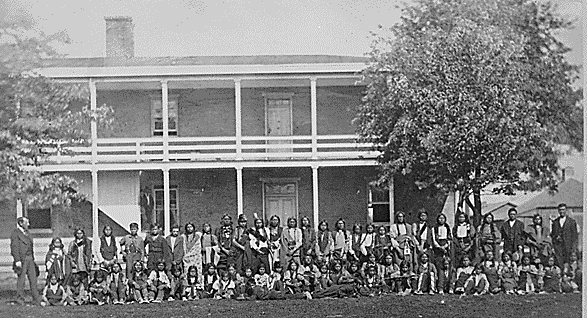
The Sioux sent many students when the school first opened.  In the archives we also find a photo of the Sioux boys as they were dressed on arrival at the Carlisle School on October 5th, 1879.

Posted in Sioux | Leave a comment

Geronimo

“Geronimo!”  That’s what we yelled as kids just as we lept off the roof of the porch, or off of the hayloft into the hay.  Anything extremely brave required the “Geronimo” shout.

More recently, in 2011, Geronimo was the code word for the US military raid that killed Osama bin Laden.  Some people objected, but I’m thinking Geronimo would have been proud of those brave soldiers.

While working with the Carlisle School student records, I found a Robert Geronimo who was an Apache.  This didn’t surprise me one bit, and I had to wonder if he was indeed related to the infamous Geronimo.

Indeed, this Robert Geronimo appears to be the son of Geronimo, according to several Rootsweb trees and other documentation.  Robert was born in August 1889 and didn’t die until in October of 1966 on the Apache Mescaloro Indian Reservation in Otero, New Mexico.  This is confirmed in the Social Security Death Index records.

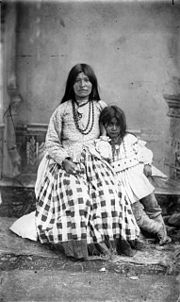
I have only found documentation of Geronimo having one surviving child.  He may have had more that are unrecorded, as he did have several wifes who did have children.  The photograph below of his wife and child would have been taken after Geronimo’s 1886 surrender and could have been young Robert.

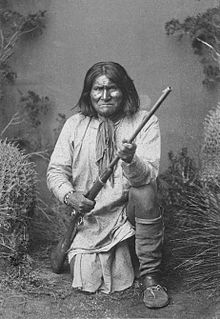
Geronimo himself was born in 1829 near Turkey Creek, a tributary of the Gila River in what was then Mexican territory.  His grandfather, Mako had been the chief of the Bedonkohe Apache.  His Native name, Goyathlay or Goyahkla means “one who yawns.”

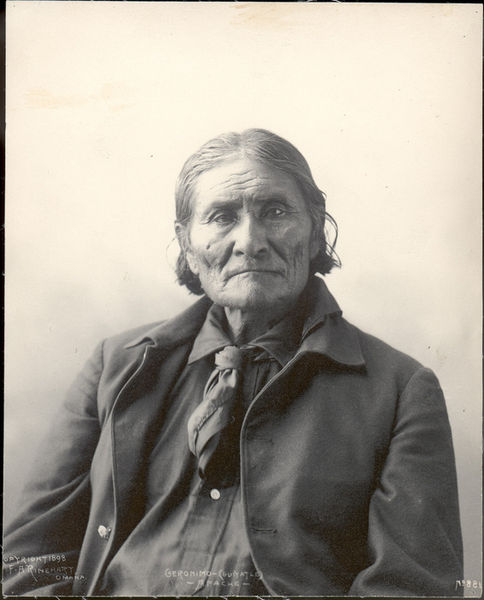
This photograph was taken in 1898 of Geronimo by Frank Rinehart.

After an attack in 1858 by Mexican soldiers on undefended women while the men were in town trading that killed his mother, wife and all 3 of his children, he joined revenge attacks on the Mexicans.  He became the war chief of the Chiricahua Apache and was notorious for urging raids on the Mexicans and later against the Americans occupying the Apache territory.  Although legends of how disagree, it was during this time that the name Geronimo came to be.  His daring exploits and numerous escapes from seemingly inescapable situations became legendary.  Geronimo chronicles these in his autobiography, just before his death, titled “Geronimo: His Own Story.”

http://www.amazon.com/Geronimo-Story-Autobiography-Patriot-Warrior/dp/0452011558

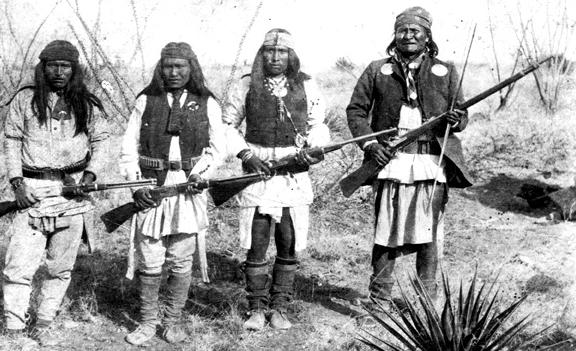
The pursuit of Geronimo in 1886 along with a few of his men by hundreds of soldiers is legendary.  The 1886 photo below shows Geronimo, at right, with his warriors.

Eventually, Geronimo surrendered and became a prisoner of war for the rest of his life.  He alleged that the terms of his surrender were ignored.  On his deathbed, he confessed that he was sorry that he had surrendered.

Late in life, he became somewhat of a celebrity, appearing in fairs and such, including the 1904 St. Louis World’s Fair and in 1905 rode in President Theodore Roosevelt’s inauguration parade, but was never allowed to return to his home land.  He died in 1909 of pneumonia after falling off of a horse and laying all night in the cold before being discovered.  He is buried at Fort Sill, Oklahoma.

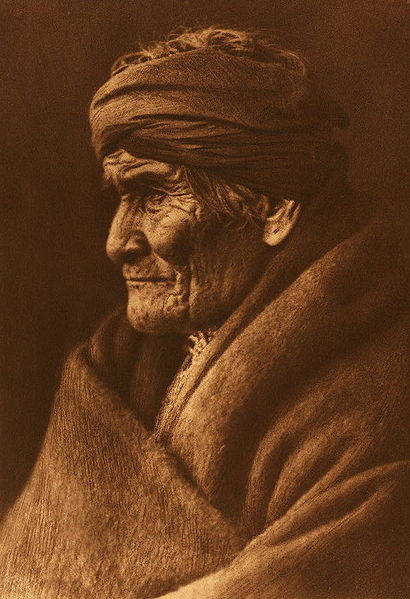
I particularly like this Edward Curtis portrait of Geronimo done in 1905, above, as opposed to the 1887 publicity photograph taken of Geronimo, below, following his surrender.

In 1992, National Geographic did an article on Geronimo.  He has been the topic of many movies and books.  You can see a list at wiki here: http://en.wikipedia.org/wiki/Geronimo

You can see the narrative of the PBS special about Geronimo, “We Shall Remain” here:  http://www.pbs.org/wgbh/amex/weshallremain/files/transcripts/WeShallRemain_4_transcript.pdf

Posted in Apache | 87 Comments

Anti-Miscegenation Laws Overturned in the US in 1967

Many people with early Native heritage “lose” their ancestor in colonial Virginia, NC or one of the states east of the Blue Ridge.  Maybe said another way, we have legends that they exist, but we can’t figure out who they were or sometimes, even which family exactly.  So we don’t exactly lose them, we just can’t find them.  Why is this so tough?

One of the issues facing our ancestors, especially those of who were admixed with African or Native and white blood was the effects of anti-miscegenation laws.  Enacted quite early in both Virginia and North Carolina, they effectively criminalized marriage between any white person and any person of color.  While the severity of the consequences varied, as did the timing of the earliest laws and the definition of who was “of color”, nearly all states enacted some sort of law prohibiting such marriages and sexual interactions outside of marriage.  Women who bore mixed race children out of wedlock (because you couldn’t within wedlock) were publicly whipped.  If one could claim any admixture other than African or Indian, it was far better socially and legally than the “colored” races.  That’s one reason why we probably see so many people claiming to be Portuguese. It explained why one was “dark,” but Portuguese were legally “white,” European, and those of Portuguese ancestry did not suffer under the cruel fist of discriminatory laws.

Someone e-mailed me recently with a seemingly simple question.  When could a Native American or other person with any admixture marry a white person in North Carolina or Virginia?  I knew that they could not in the 1600s, the 1700s or the 1800s, but I didn’t really know when they could.  I suspected in some states that it was probably connected to the Civil Rights Acts of 1964 and 1965, but I surely didn’t know the answer.

And the answer is….an amazing 1967.  I was surprised at this late date, but it certainly explains why we, as children, were utterly forbidden to discuss our Native ancestry, at all, ever.  My Mom received a call from my school teacher when I was in first or second grade because I had proudly said something about my Indian heritage.   From my mother’s perspective it would have been far better had my father never told me about that.  She certainly never told me about hers until AFTER her DNA tests came back telling the story.

These discriminatory laws were ruled unconstitutional in 1967 by the United States Supreme Court in the case of Loving vs the State of Virginia.

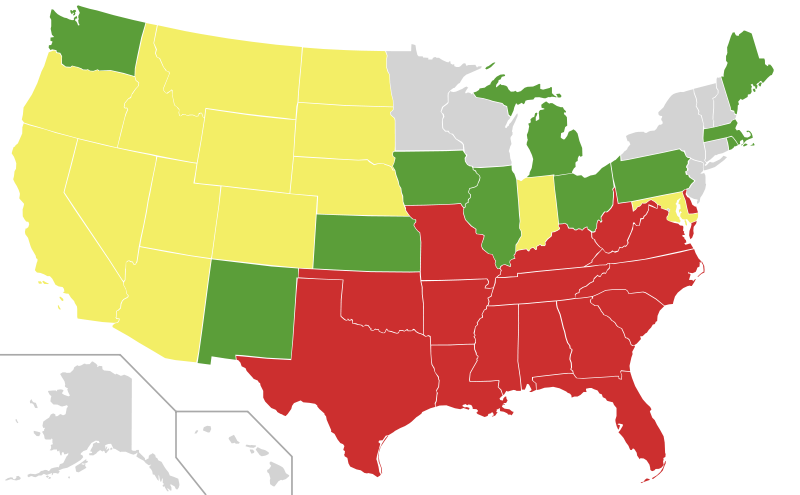
The map below shows the states, in red, whose laws prohibiting intermarriage between nonwhites and whites were overturned by the 1967 ruling.

In the grey states, no laws were ever passed.  In the green, the offending laws were repealed before 1887.  The yellow states’ miscegenation laws were repealed between 1948 and 1967.

You can read more about the specifics at:                              http://en.wikipedia.org/wiki/Anti-miscegenation_laws_in_the_United_States and http://www.redboneheritagefoundation.com/Chronicles/interracial_marriage_timeline.htm

Posted in History | 9 Comments

Oneida Chief Skenandoah

Oskanondonha, known as Skenandoah, the Oneida War Chief also known as “the Deer” was born, according to tradition, to the Susquehannock and was adopted into the Wolf Clan of the Oneida.  He eventually became the War Chief, a position chosen on the basis of merit and ability, not heredity.  During the French and Indian War, he led war parties against the French.

By 1770, Skenandoah was the principal leader of Oneida Castle, a major Oneida settlement.  Samuel Kirkland, an American missionary succeeded in converting Skenandoah to Christianity, at which point, he took the first name of John.

During this timeframe, Skenandoah had an life-changing experience with alcohol.  In 1775, while on an official visit to Albany on behalf of his people, he was given liquor by his so-called friends. He became drunk and the next morning found himself in the gutter along one of Albany’s streets. Everything of value had been taken from him including most of his clothes and his chieftainship regalia. He was so chagrined and humiliated that he resolved never again to become intoxicated, a determination from which nothing could ever move him. On one occasion he said to his people. “Drink no firewater of the white man. It makes you mice for the white men who are cats. Many a meal they have eaten of you.”

Known always as a friend to the white man, he fought bravely and valiantly on the side of the Americans during the Revolutionary War and played a key role in the decision of the Oneida to support the Americans.  He arranged for 700 bushels of corn to be delivered to Valley Forge during the horrible winter of 1777/78, saving many lives.  Unfortunately, his support of the Americans cost the Oneida their homes, as Oneida Castle was destroyed in 1780.

Skenandoah travel by snowshoe carrying  a message from the Americans in the dead of winter in 1780 urging the Iroquois to cooperate.  In return the Iroquois refused to accept the wampum belts brought by Skeandoah and other emissaries.  Skenandoah and the others  were held in jail until they agreed to serve the British cause in July 1780.  What followed is uncertain, as there are several variations of the story, but what we do know is that the Skenandoah was returned to the Americans as a result of the Treaty of Fort Stanwix in 1784.

Following the war, Skenandoah remained the principal Chief of the Oneida.  Chief Skenandoah lived to be a very elderly man. His age at his death in 1816 was reported to be 110 years old.  His life, unfortunately, nor the fate of his people had a happy ending…all in all a sad testimony to broken promises and betrayal.

Because of all that the Oneidas had done for the cause of the Americans, British troops destroyed their villages, crops and orchards.  Congress applauded the Oneidas for their firmness and integrity, assuring them friendship and protection of their lands.  After the war, their hunting and fishing grounds were invaded by the whites who sent up a clamor and an increasing cry for their removal to the west. The poor, tired Oneidas were not long to enjoy the settlement that they had worked so hard to keep. They were totally averse to moving and leaving their old homelands and the graves of their forefathers. Greedy land speculators, who coveted their lands, won out and it was in 1823 that their removal from New York was decided upon.  Some moved to Canada, but most went and joined the Menominee in Wisconsin.  Their trail to the west was wet by tears as the Oneidas left their beautiful homelands and the graves of their fathers. Old Skenandoah had fought, repeatedly, and died in vain for the white people who would betray him and his people!

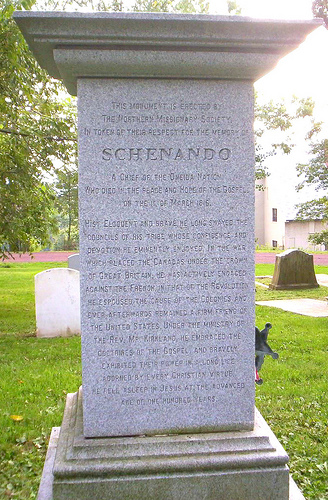
Chief Skanandoah is buried in the Hamilton College Cemetery in Clinton, NY.  His people brought him to be buried beside his trusted friend, Samuel Kirkland.

You can read more about Chief Skenandoah here:  http://www.accessgenealogy.com/native/sixnations/skenandoahs_grave.htm

For a picture of the boulder that marks the last home of Chief Skanandoah, look here:  http://grannysu.blogspot.com/2012/03/skenandoahs-stone.html

Posted in Military, Oneida | 2 Comments