Thomas Asylum for Orphan and Destitute Indian Children

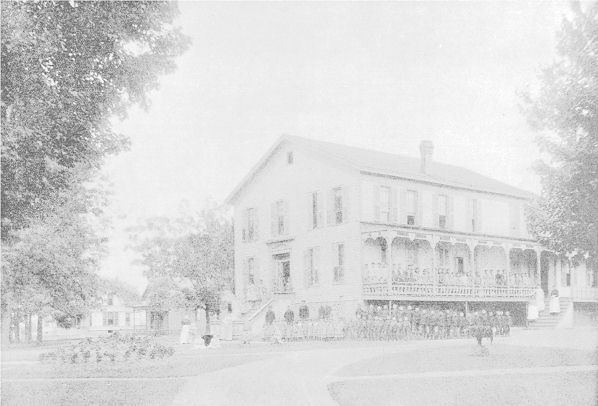
Thomas Orphan Asylum

When I was transcribing the New York Indian Census records from the 1880s, I noticed that at the end of several tribal lists was a short, separate list called “Thomas Asylum” or “Thomas Orphans” with children listed.

Indeed, the Thomas School was just that, an orphanage.  The word “asylum” in this context does not mean mental illness although I did see one reference to the word insane, but I have found no records to indicate that the Thomas School was anything other than an orphanage.

The Thomas Asylum for Orphan and Destitute Indian Children was incorporated in 1855 as a private institution receiving State aid. The asylum was located within the Cattaraugus Indian Reservation in Erie County, NY and was charged to receive destitute and orphaned children from all Indian reservations in the State. It was named for Philip E. Thomas, a benefactor of New York’s Native Americans and early financial backer of the asylum.

In 1875 ownership of the asylum was transferred to the State and it was made subject to the supervision and control of the State Board of Charities. As a State institution, its purpose was to furnish resident Native American children with “care, moral training and education, and instruction in husbandry and the arts of civilization.”  Boys were trained for industrial work, and girls for domestic tasks.

To reflect its emphasis on education the asylum’s name was changed in 1905 to Thomas Indian School.

Ownership of the asylum later transferred to the state of New York , and its State Board of Charities provided oversight.   The State closed the Thomas Indian School in 1957.

Thomas Orphan Asylum photo from Access Genealogy from their topic, Education, Schools, Language and Education on the Reservations.

http://www.archives.nysed.gov/a/research/res_topics_ed_native_content_thomas.shtml

http://cantonasylumforinsaneindians.com/history_blog/the-canton-asylum-for-insane-indians/orphans

Posted in Education, New York, Schools | 5 Comments

Cherokee Indian Guards at the Battle of Tazewell

cumberland gap old map

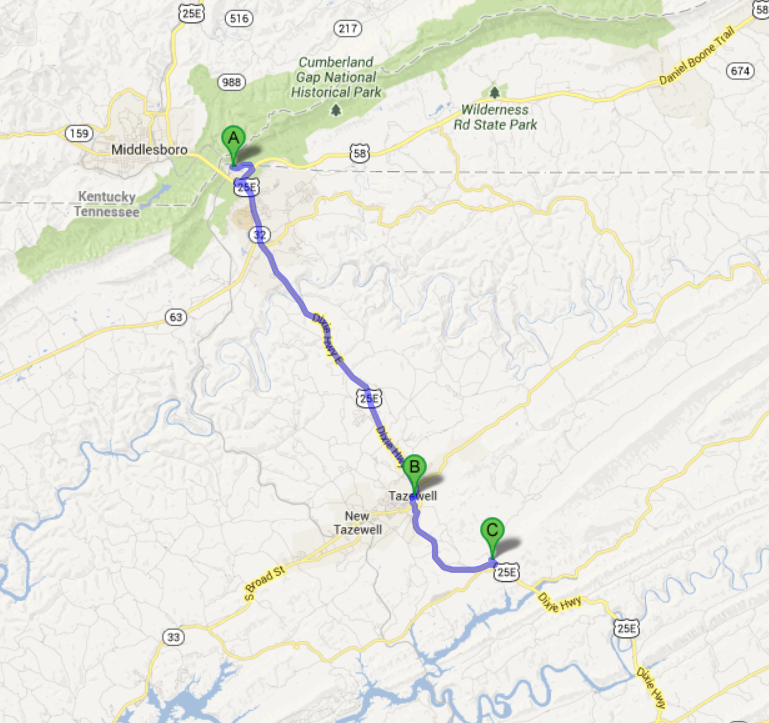
During the Civil War, the battle of Tazewell, TN, took place beginning on August 2nd, 1863.  It happened outside of Tazewell, TN at the current location of the intersection of US 25E and Lone Mountain Road where it becomes Little Sycamore Road at Springdale.  This location is about 15 miles south of Cumberland Gap.  On the map above from the Civil War, Tazewell is shown at the bottom right.  On the contemporary map below, the town of Cumberland Gap (A), Tazewell (B) and Springdale (C) are shown.

Springdale

A soldier in Company E, the 16th Ohio, which was taken captive had some interesting observations of his 9 days spent as a hostage.  He recorded his experiences.  Unfortunately, they are anonymous, as he never signed his name.

One of his comments gives us some perspective on the Cherokees at that time and the stereotypical outlook about Indians.

“August 8th, a large number of rebel soldiers, under arrest for various offences, were brought up from Bear Station and placed in the “bull pen” with us. They were guarded by a company of Cherokee Indians that had been enlisted from the old reservation in North Carolina. Very few of these indians were full blooded; some of them had wavy hair and the full lip of the African. Among their numbers might have been found all the grades of complexion from the bronzed face of the common soldier to the deep copper tint of the aboriginal, but all wore the listless, lazy look of the true indian.”

Posted in Cherokee, Military | Leave a comment

Betty, An Indian, A Free Woman By the Laws of Nature

Lisa Y. Henderson, on her blog, Fourth Generation Inclusive, posts this information about Negroe Dick found in Pasquotank County, NC in 1788.

The Petition of Negroe Dick at present confined in the Common Gaol of the County: — by the next friend John Smith.

Most Humbly Sheweth That your Petr. has been taken up by Sundrey Persons supposing him to have been a Slave the property of John Smith one of the people called Quakers and illegally liberated by him.

That your Petr. Is at present confined in Gaol under the acts of Assembly 1777 and 1779.

Sheweth that your Petr. Grandmother, Betty was an Indian, a free woman by the Laws of Nature.

What can we tell from this information?

First, I wanted to see if I could find any hint of Negroe Dick in the 1790 census.  I browsed the entire Perquimans County 1790 census, and there are only five free families of color, four by the surname Overton and one by the surname Ashburn, and none of them having a first name of Dick or Richard.

There are several families that are white that include some free people of color.  Of course, there is no way to know who those people are.  Many of these families also include slaves, so they could be “free” wives or husbands.

An interesting aspect of this record is John Smith, the “next friend” of Negroe Dick.  John Smith is further identified as being a Quaker.  The Quakers were known to oppose slavery.  They often purchased slaves.  They freed them until that became illegal, and after that, the Quakers still “owned” their slaves, but treated them as free.  That indeed maybe what was going on with Negroe Dick and why he was “taken up” and presumed to be a runaway.  He was simply acting “too free.”  John Smith in Pasquotank County does in fact own slaves, but a John Smith, Jr. does not.

The Quakers first arrived in Perquimans County in 1672.  Of course, we don’t know if John Smith was a Quaker before arriving n Perquimans, became a Quaker after the Meeting House was established there, or if John brought Negroe Dick with him from elsewhere, probably Virginia where most of the people who settled in this part of North Carolina were from.  Research on the family of John Smith might reveal more.  Some of the Quaker families from Perquimans County moved from Nansemond and Isle of Wight  Counties in Virginia.

What else can we tell about Negroe Dick?  We know that his grandmother was an Indian, and a free woman.  We also know that this had to be his grandmother on his mother’s side, because that was how legal status, that of free or slave, was determined.  The children’s status followed that of the mother, so if Negroe Dick has the right to be free, it was because his mother did as well and someone in his maternal line had to have been free.

We don’t know how old Negroe Dick was in 1788, but let’s say he was age 30, so born about 1758.  If his mother was age 25 when she had him, and his grandmother the same age when she had his mother, his Indian grandmother would have been born about 1708.  Of course, there is a lot of room for error here.

In Perquimans County, the Yeopim Indians were the original Native tribe.  In 1661, the Indian Chief, Kilcocanen, who took the English name George Durant after his white “brother” George Durant, sold “Durant’s Neck” to European settlers.  The Yeopim didn’t just leave, they lived in Indian town and then they assimilated.  Indian Town was still mentioned and on maps as late as 1778 and 1784 and still on a map in 1808.

It’s also obvious that something inappropriate happened to the children of either Negroe Dick’s grandmother Betty, a free Indian woman, or Dick’s mother.  If Betty was free, then Dick’s mother should have been free, and Dick should have been as well.  Someplace, something went wrong.  It was very common during that time, especially if Betty or Dick’s mother had children by a black man, for those children to be either stolen and enslaved or simply enslaved, without anyone asking any questions.  The only recourse was in court of course.  This was legally available to slaves, but not necessarily practically available.  One can only imagine the bravery it would have taken for a slave to file a suit against their master and the repercussions that might well follow.  This did happen, although rarely, and we know from depositions that often slave owners would then move, or move the slave in question, to a distant location so the slave could not pursue the suit.  Sometimes you were better simply to suffer through.

We also know that Negroe Dick either knew or knew of his grandmother, so he was not entirely disconnected from his family.  This means likely that Dick’s grandmother was a ‘local Indian” and he was not the product of an Indian slave captured and sold.  Of course, the question is, “where was local?”

But sadly, that is all we know about Negroe Dick and his Indian grandmother, Betty.

I wonder if Betty has any descendants today that descend from her through all females.  If so, I wonder if they were from enslaved people, so today, would likely be found among the African American population.  Sometimes people test their DNA and find a surprise, like a Native American haplogroup.  In this case, DNA testing might be the only way that Betty’s descendants might ever know they had a Native American ancestor.  Of course, they would never know her name was Betty, nor her history.  But finding her DNA would afford them a little glimpse into the past, allowing them to connect with an unknown heritage, and making Betty just a little more real, resurrecting the only memory they can ever have of her.

Posted in North Carolina, Quakers, Slaves, Yeopim | 10 Comments

Tuscaroras and Monacans

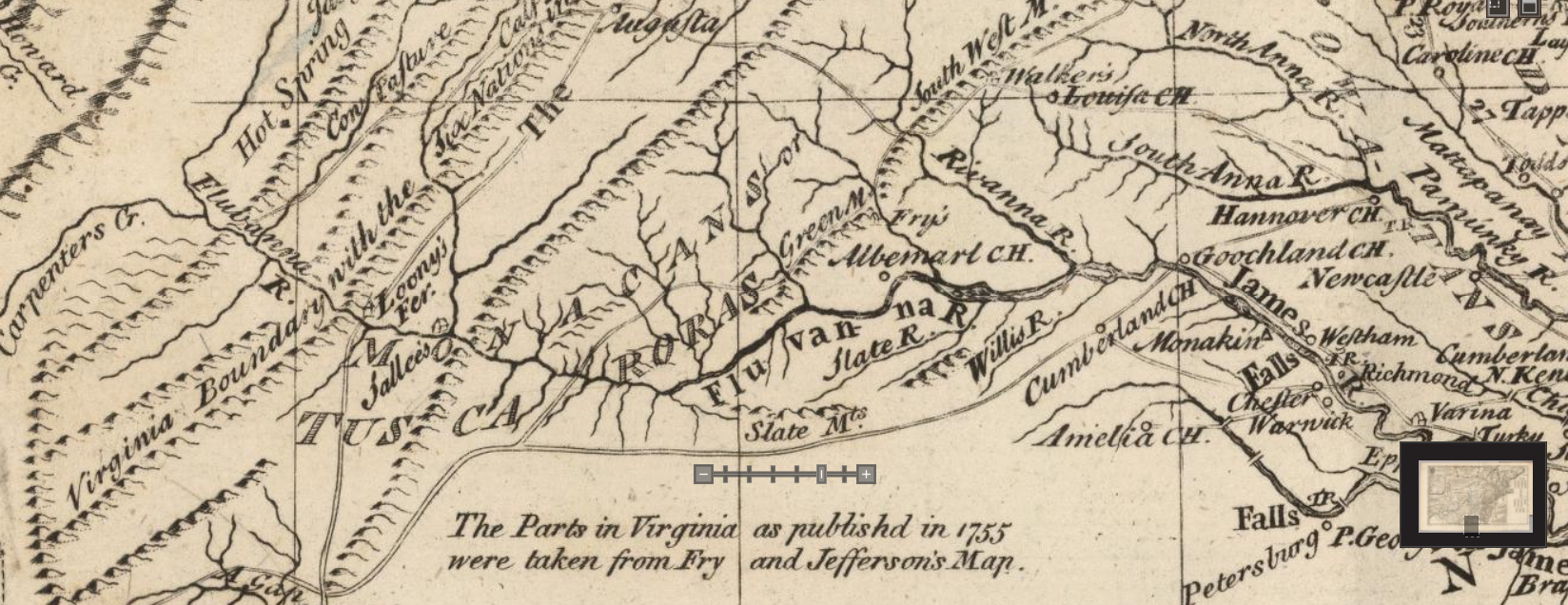
On the 1755 Lewis Evans map, in what is today Amherst, Bedford and Nelson County, Virginia, areas, the Tuscarora or Monacans are clearly marked.

The David Rumsey map collection allows you to navigate and zoom in and out on this remarkable map.

http://www.davidrumsey.com/luna/servlet/detail/RUMSEY~8~1~231390~5508817:A-Map-of-the-Middle-British-Colonie

The area marked Tuscarora or Monacan is shown below.

monacan map 1

This view is zoomed out a bit so you can get some perspective relative to the rest of Virginia and the North Carolina border.

monacan map 2

Traditionally the Tuscarora, an Iroquoian tribe, have been located in NC, before their removal to New York in the early 1700s.  The Monacan were a Siouian people.  Apparently when the Tuscarora were displaced following the Tuscarora War in 1711, some settled in Virginia near the Monacan.  The Monacan claim that they adopted remnant Tuscarora.  Most of the Tuscarora who did not remove to New York in 1711 settled on a reservation in Bertie County, NC, but obviously, not everyone.  There was enough of a settlement to be recorded on this map in 1755 with the Monacan.

According to the Monacan Indian Nation website, as late as 1742, this area near current Lynchburg was virtually unsettled by Europeans.  By 1758, the Monacan were proving “troublesome” to those attempting to settle on their lands.  But of course, as is the case with all of the Indian nations east of the Mississippi, European settlement did occur, displacing  and then assimilating the Indians.  For more information about the Monacan people, then and now, please read this Wikipedia article and visit the Monacan Nation website.

Posted in Maps, Monacan, Tuscarora | Leave a comment

George Washington Letter to the Tuscarora

The French and Indian War took place from 1754 to 1763.  During this time, a significant amount of land was disputed, and fighting took place primarily in these regions and in borderlands.  The Native American tribes were key players, often because they already lived in these regions, understood the lay of the land, and had been recruited through promises of their lands being returned if the French won.

French Indian War map

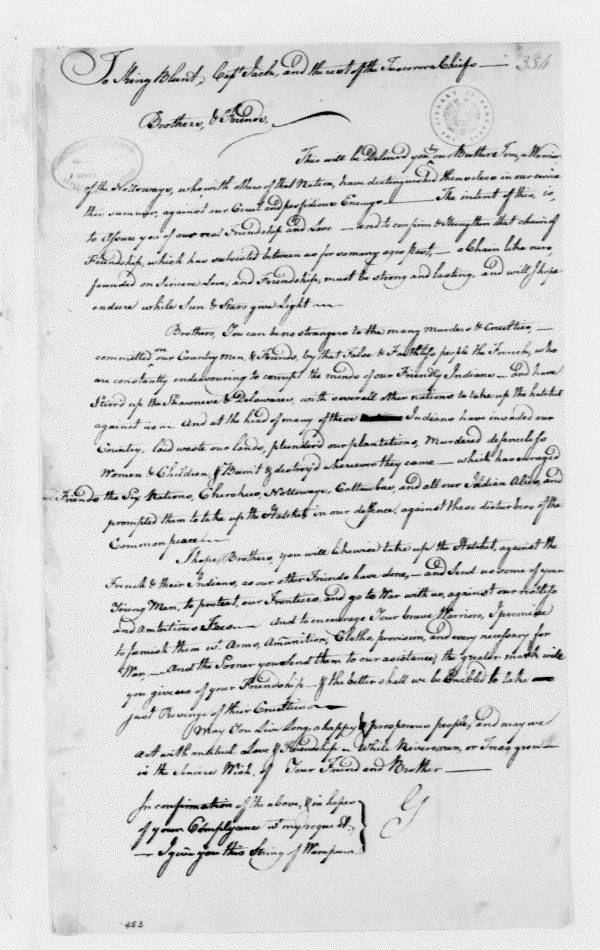
We often don’t think of George Washington as a player in the French and Indian War, more often in conjunction with the Revolutionary War, but he was clearly involved.  In the letter below, he wrote to the Tuscarora Indians of North Carolina asking for their support.  An underscored word means I couldn’t read it clearly, or at all in some cases.

Tusc letter

George Washington Papers, 1741-1799

To King Blount, Capt Jack and the rest of the Tuscarora Chiefs.

Brothers and Friends.  This will be delivered you by our brother Tom, a warrior of the Nottoways who with others of that nation have distinguished themselves in our service this summer against our great and perfidious enemies.

The intent of this is to assure you of our real friendship and love and to confirm and strengthen that chain of friendship which has subsisted between us for so many years past….a chain like ours founded on sincere love and friendship must be strong and lasting and will I hope endure while the sun and stars give light.

Brothers you can be no strangers to the many murders and cruelties committed on our countrymen and friends by that false and faithless people the French who are constantly endeavoring to corrupt the minds of our friendly Indians and Lord have stirred up the Shawnee and Delaware with several other nations to take up the hatchet against us and at the head of many of their Indians have invaded our country, laid waste our lands, plundered our plantations, murdered defenseless women and children, burnt and destroyed wherever they came….which has enraged friends the Six Nations, Cherokees, Nottoways, Cattawbas, and all our Indian allies and prompted them to take up the hatchet in our defense against these disturbances of the common peace.

I hope Brothers you will likewise take up the hatchet against the French and their Indians as our other friends have done and send us some of your young men to protect our frontiers and go to war with us against our notiss and ambitious Frenchmen and to encourage your warriors, I promise to furnish them with arms, ammunition, clothes, provision and ever necessary for war…and the sooner you send them to our assistance the greater ___ will give us of your friendship and the better shall we be enabled to take just revenge on the cruelties.

May you live a happy prosperous people and may we act with sincere love and friendship and while rivers run and trees grow is the sincere wish of your friend and Brother.

Signed with George Washington’s signature

In confirmation of the above and in hopes of your compliance with my request…I give you this string of wampum.

http://memory.loc.gov/cgi-bin/ampage?collId=mgw4&fileName=gwpage030.db&recNum=411

Posted in Catawba, Cherokee, Nottoway, Six Nations, Tuscarora | 4 Comments

Bonita Bent-Nelson, Quillwoman

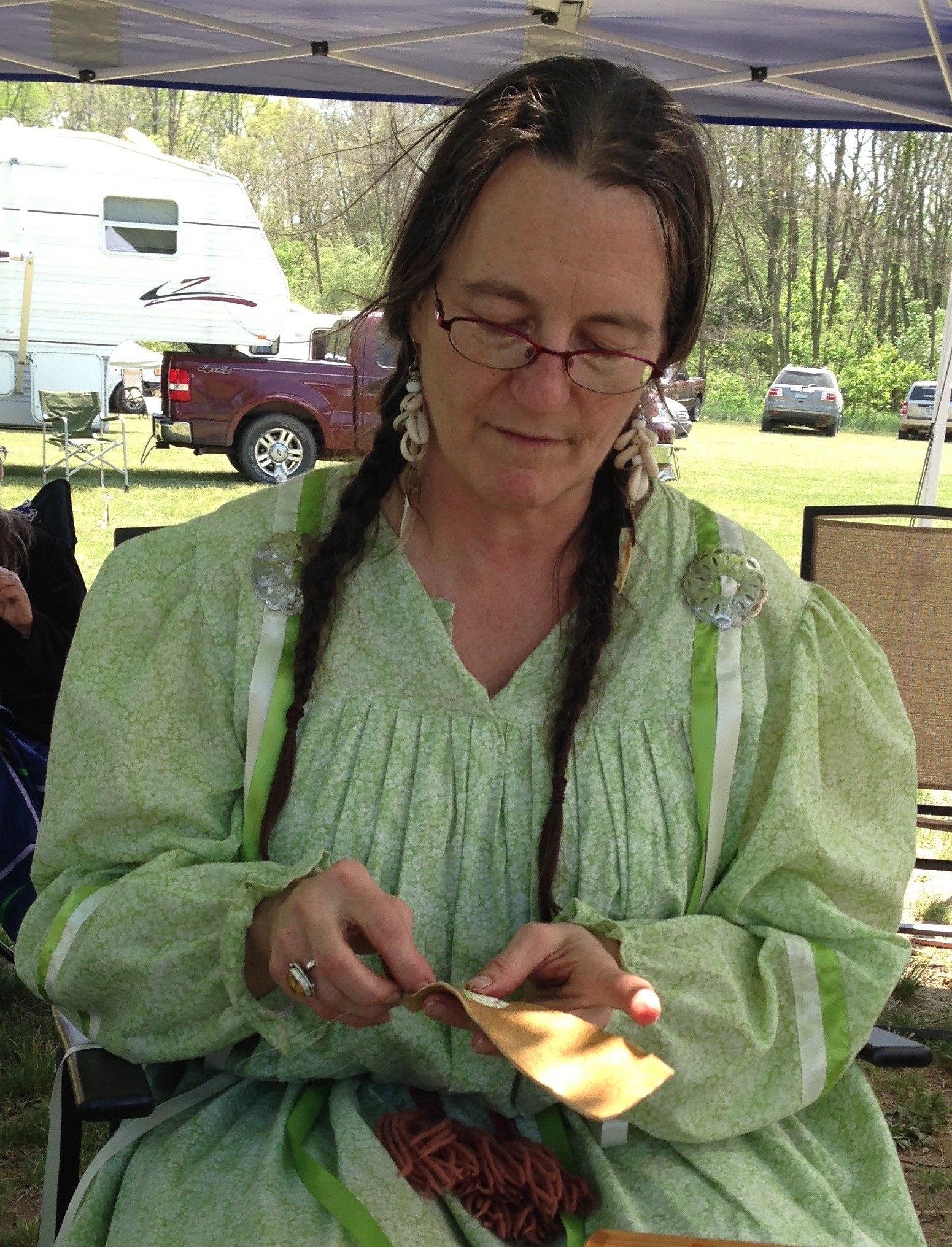
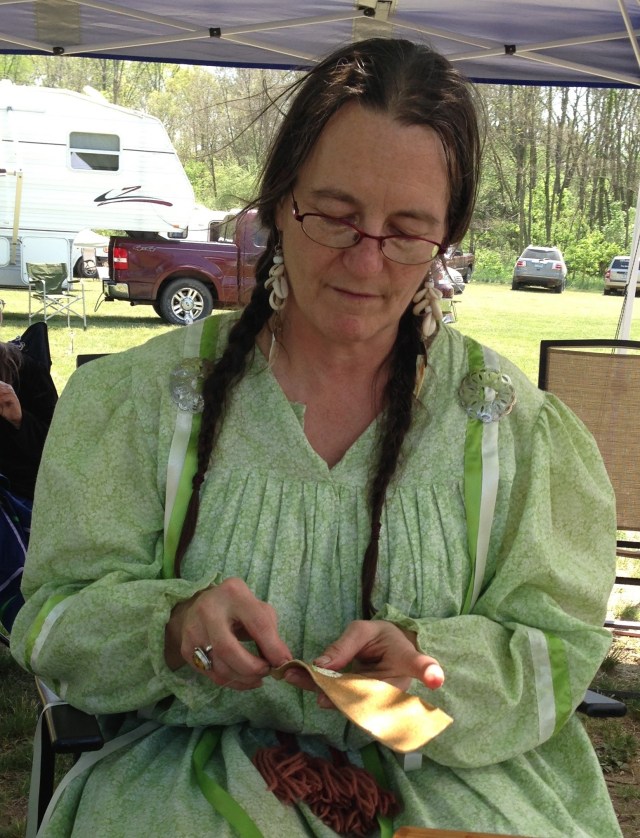
quillwoman 3.1

Recent, I attended a powwow and met a remarkable artist, Bonita Bent-Nelson, also known as Quillwoman.  How she earned the name Quillwoman is obvious once you see her quillwork. But before we look at Bonita’s work, let’s learn a little about Quillwork.

Quillwork is a form of textile embellishment traditionally practiced by Native Americans that employs the quills of porcupines as a decorative element.quillwork knife sheath

Porcupine quillwork is an art form completely unique to North America. Before the introduction of glass beads, quillwork was a major decorative element used by the peoples who resided in the porcupine’s natural habitat. The use of quills in designs spans from Maine to Alaska and south to the Mexican border.  Where you find porcupines, you find some form of quillwork. The earliest known quillwork was found in Alberta, Canada and dates back to the 6th century CE.

Cheyenne oral history, as told by Picking Bones Woman to George Bird Grinnell, says quilling came to their tribe from a man who married a woman, who hid her true identity as a buffalo. His son was also a buffalo. The man visited his wife and son in their buffalo home, and, while among the buffalo, the man learned the art of quilling, which he shared with the women of his tribe.

Joining the Cheyenne Quilling Society was a prestigious honor for Cheyenne women. Upon entering the Society, women would work first on quilling moccasins, then cradleboards, rosettes for men’s shirts and tipis, and ultimately, hide robes and backrests.

Porcupine quills often adorned rawhide and tanned hides, but during the 19th century, quilled birch bark boxes were a popular trade item to sell to European-Americans among Eastern and Great Lakes tribes.  The Odawa were famous for their beautiful quillwork embroidery.

Quills suitable for embellishment are two to three inches long and may be dyed before use. In their natural state, the quills are pale yellow to white with black tips. The tips are usually snipped off before use. Quill readily take dye, which originally was derived from local plants and included colors such as black, yellow, red, and blue. By the 19th century, aniline dyes were available through trade and greatly expanded the quilling palette.

The four most common techniques for traditional quillwork are appliqué, embroidery, wrapping, and loom weaving. Appliquéd quills are stitched into hide in a manner that covers the stitches. In wrapping, a single quill may be wrapped upon itself or two quills may be intertwined.  Above, a traditional quillwork knife sheath.

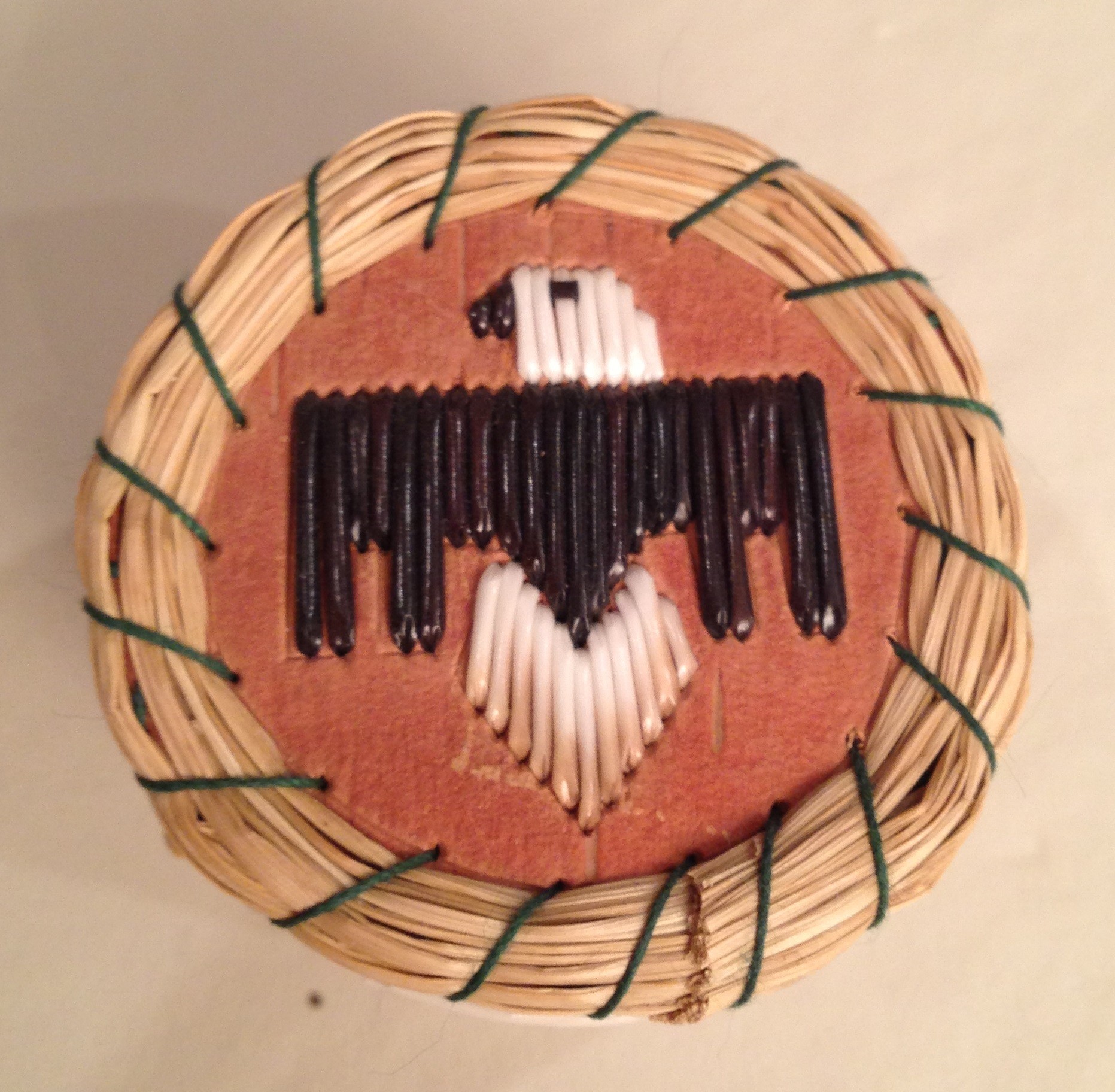
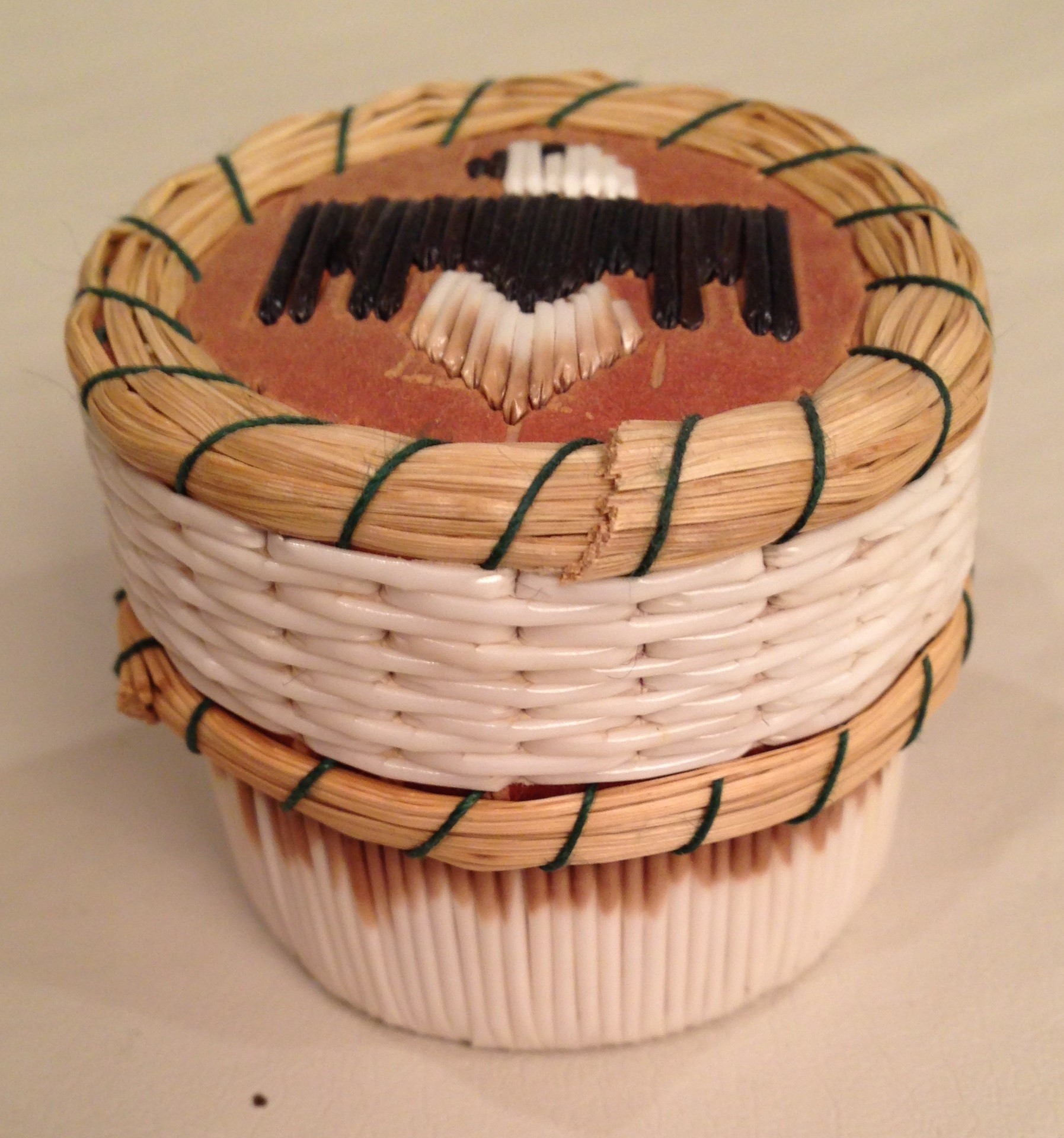
Today, most quillwork is decorative and done on a birchbark base.  This small birchbark, sweetgrass and quillwork eagle box from my own collection illustrates the type of quillwork most often seen today.
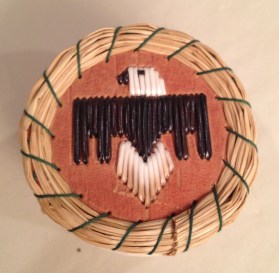
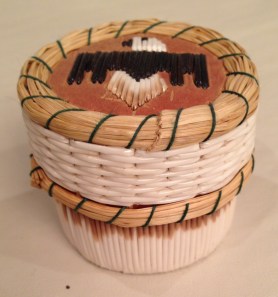
quill eagle box quill eagle box 1

In many places, quillwork is a dying art because it’s difficult and porcupine quills are not readily available.

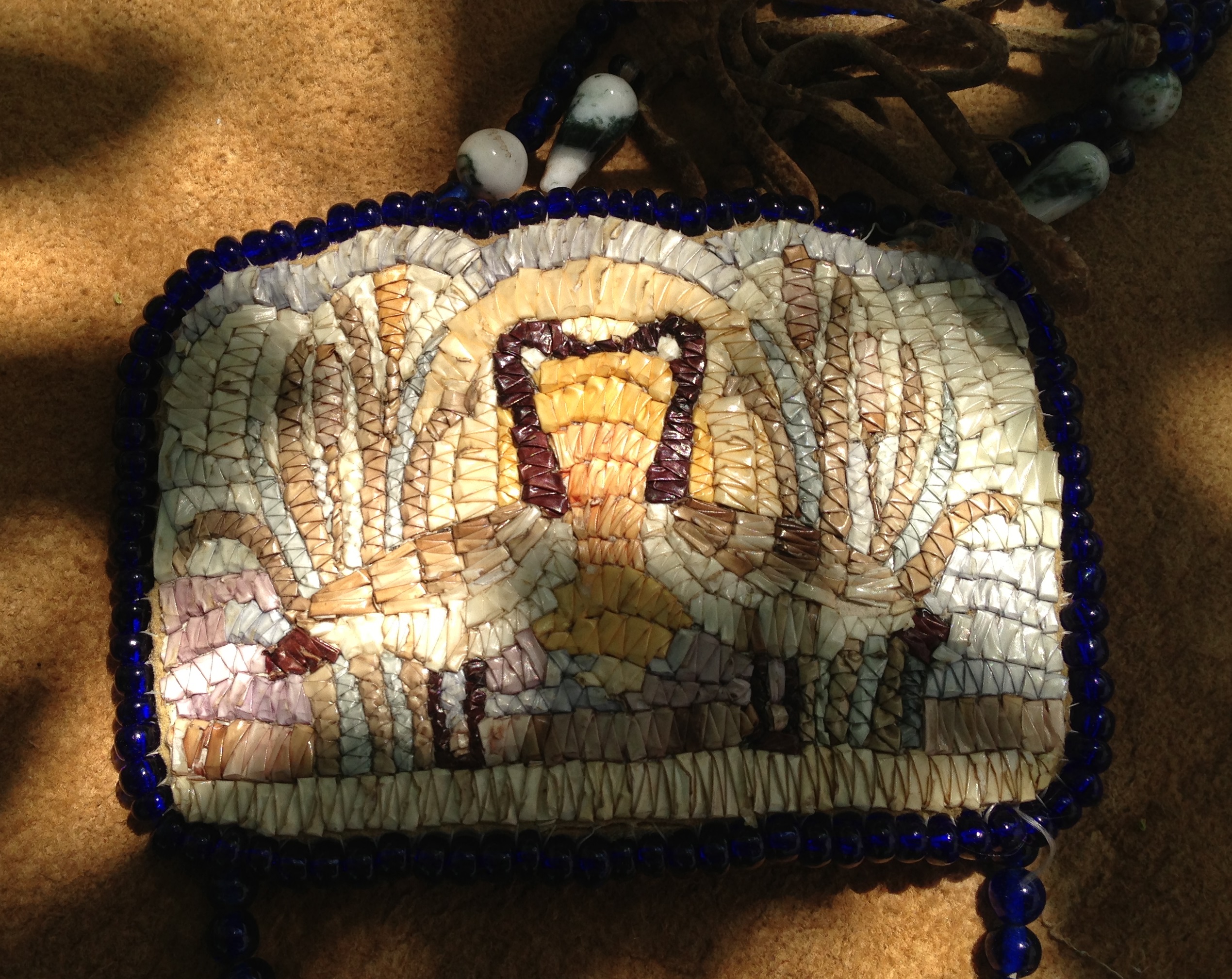
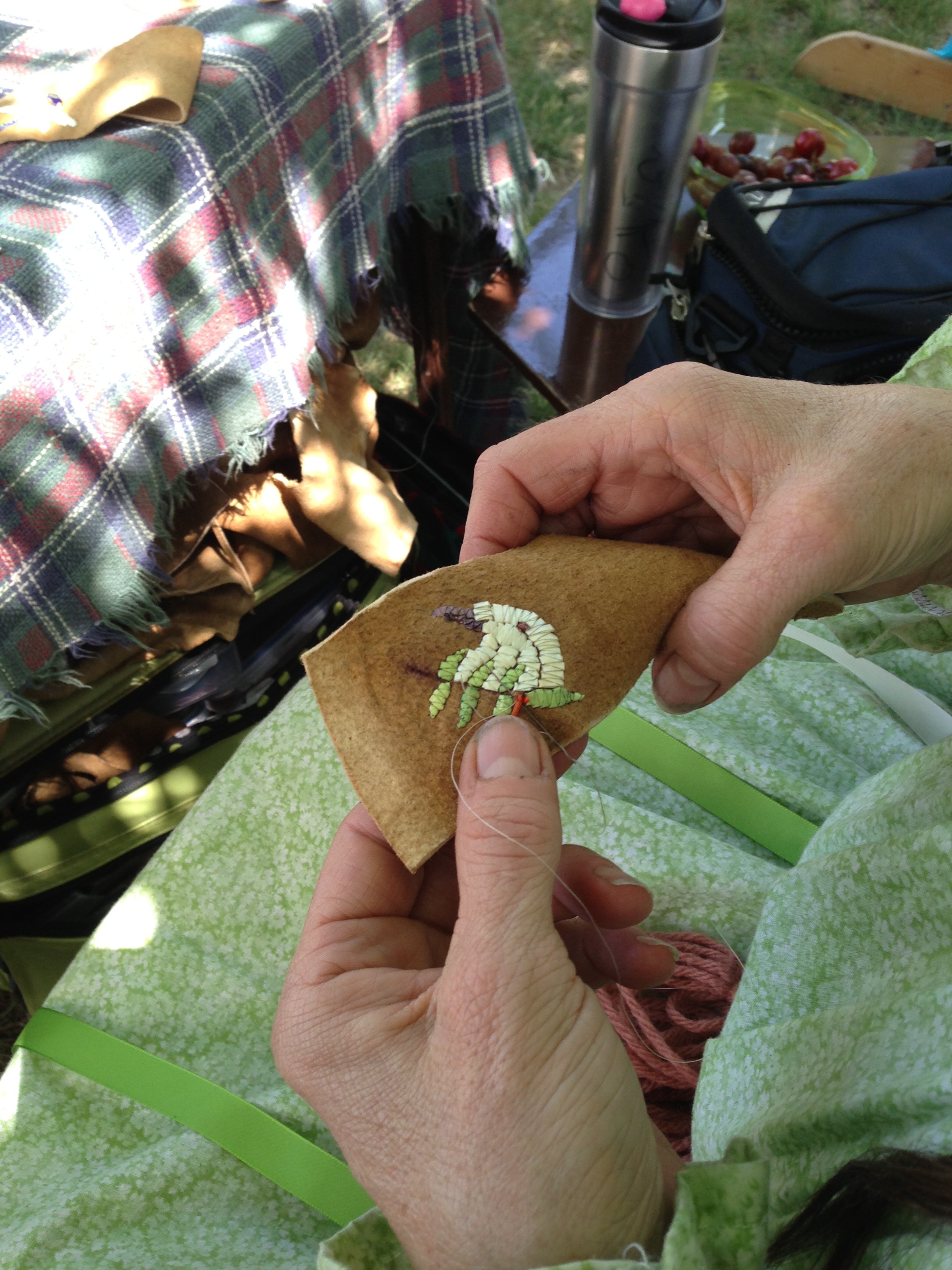
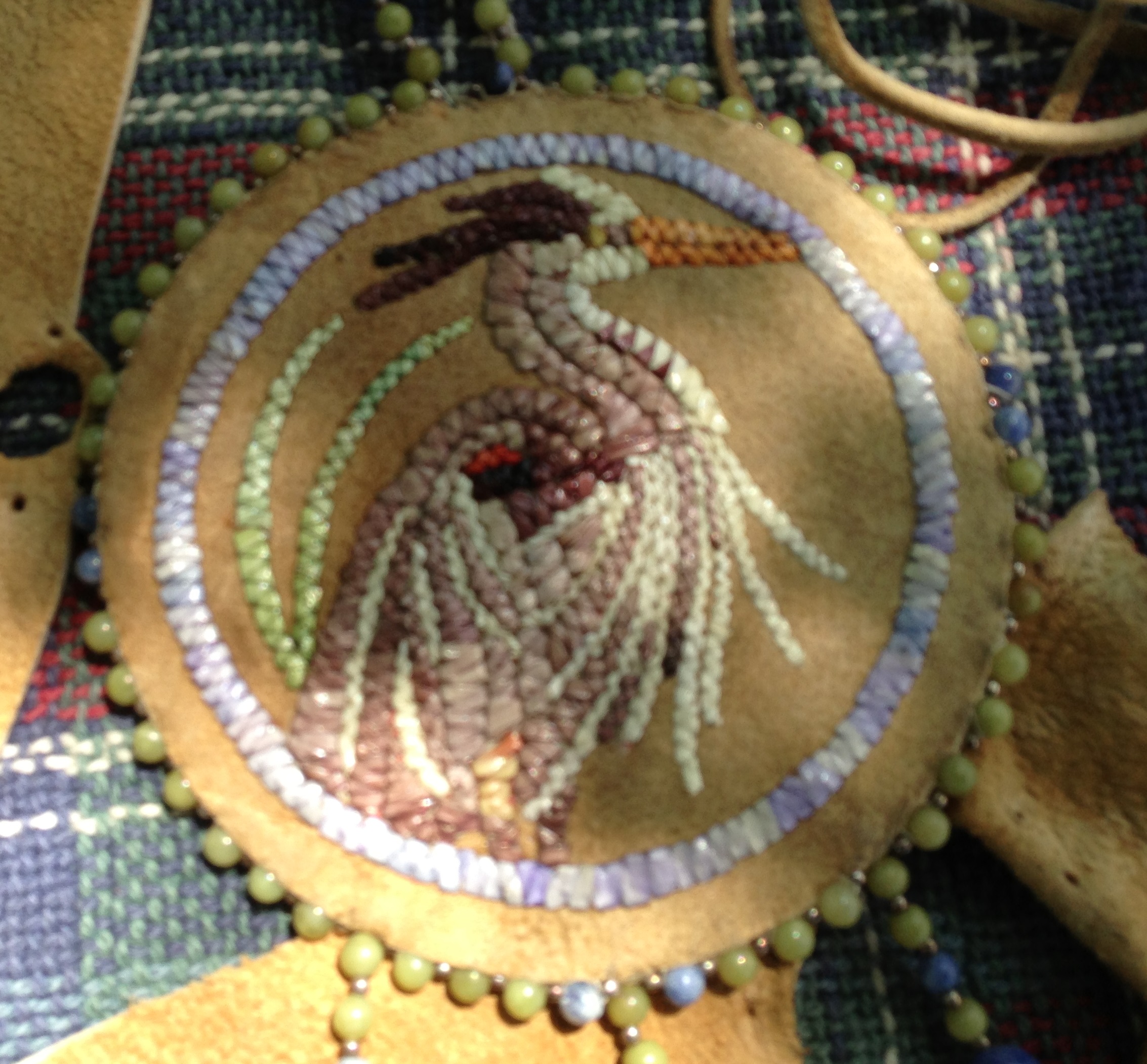
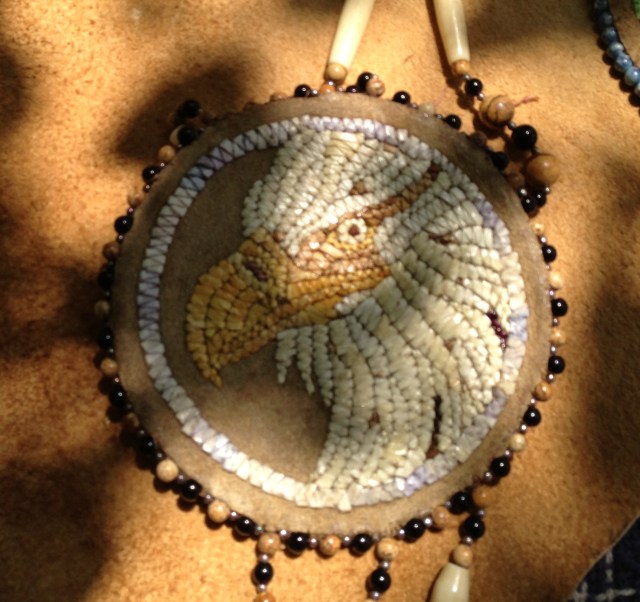
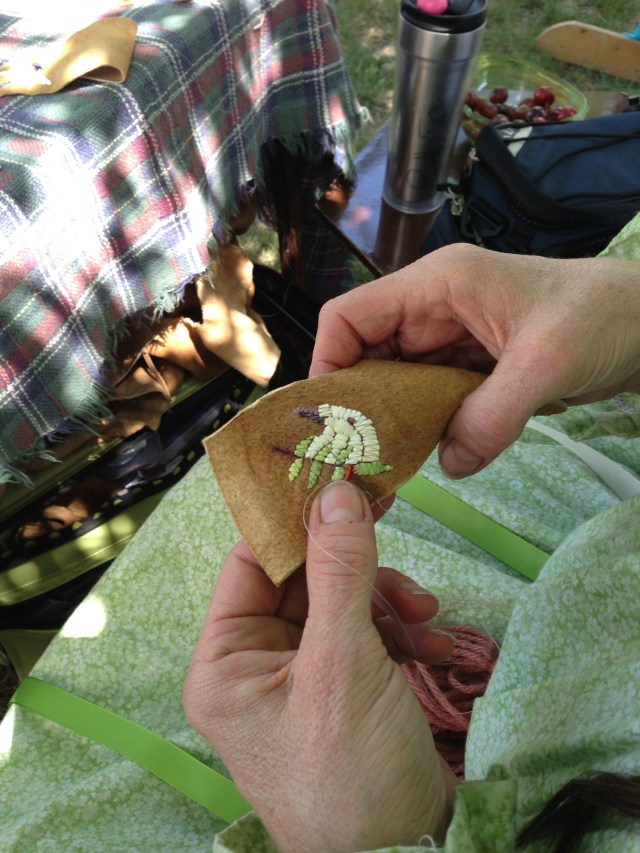
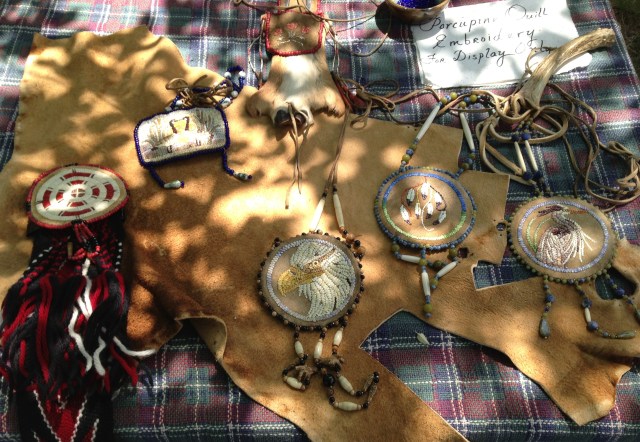
When I saw Bonita’s work, I was stunned, not only at the beauty, but also at the amount of work and preparation that goes into the product, even before the quills are ready for embroidering.  Most quillwork is done with the quill in intact, meaning still rounded, but Bonita cuts each quill apart and uses the quill itself as thread.

You can see the difference between the older knife sheath, my eagle box and Bonita’s work, below.
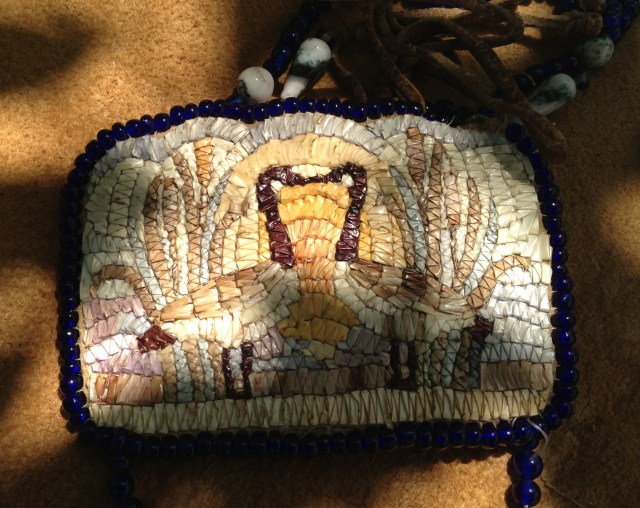
quillwoman 5

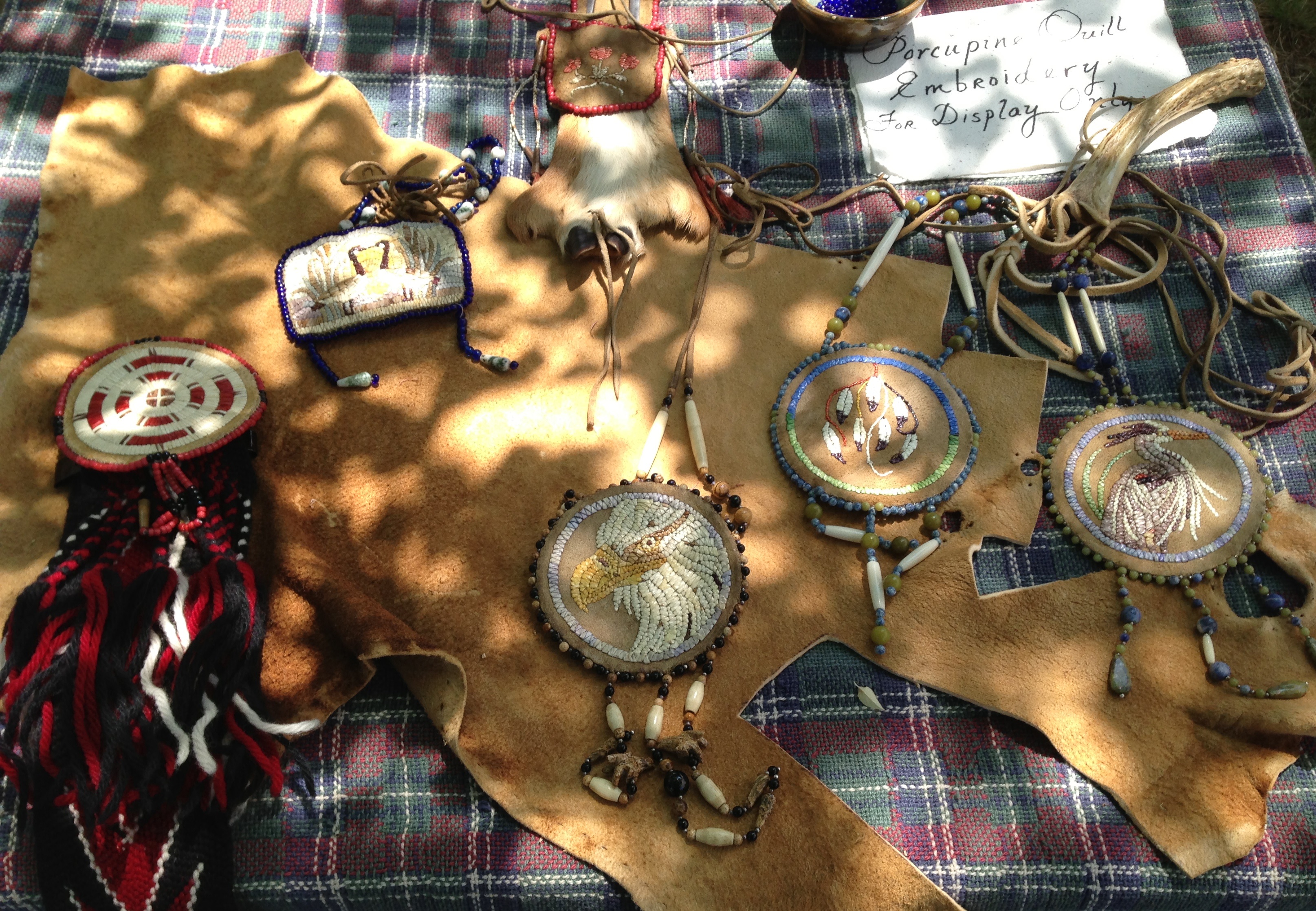
Most of Bonita’s work is done on leather, not birchbark.

I asked Bonita how she began, and she told me that she found a dead porcupine and plucked it’s quills.  As with many skills, she learned the basics from elders, but then, she was on her own.  As you can see, she has developed her own artistic voice.
quillwoman 7

Bonita was told that her first year, which is in essence a form of apprenticeship, was her give-away year.  Everything she made that year was to be given away.  The concept of “give-away” in the Native community is linked to the spiritual aspect of grace and gratitude.  It has more to do with the giver than the receiver.

Bonita says, “I learned quillwork almost 20 yrs. ago from the late Cherokee elder Ganda-gija-I. Creator gave me the gift of quills and my work reflects that gift. I demonstrate and give workshops and lectures at powwows, historical reenactments, universities, museums and cultural centers throughout the Great Lakes.

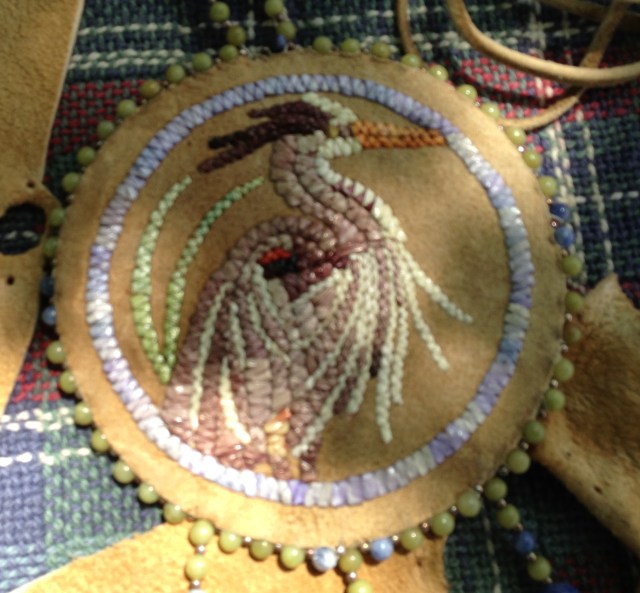
I learned quillwork from the ground up…literally…picking up fresh roadkill, plucking, cleaning and dying my own quills, sometimes using natural dyes, sometimes using RIT dye. I only quill on braintan leather and though I know how to tan my own hides, I leave that task to my friend Dan Vogt of IL because the physical labor it entails is too hard on my hands. While I can sew in historic fashion using only the old methods, I prefer to use a more modern, single-needle technique which makes it quicker and ultimately more affordable but the result is identical to the old way. I have been called on to do restoration of historic items but most of my own work is concentrated on animals, giving life & spirit to each piece with a realism few others do.”
quillwoman 1

In addition to powwows and reenactments, Bonita has worked with the Eiteljorg Museum of American Indian and Western Art in Indianapolis, IN and the Museum of the American Indian in Evanston, IL.  Her work has appeared in Native People’s Magazine and as cover art for Studies in American Indian Literature.

Bonita is not an enrolled tribal member, but has both Cherokee and Southern Cheyenne ancestors.  I addition, she is an adopted Odawa.

I was absolutely fascinated by her work and the realism that she is able to achieve.
quillwoman 6

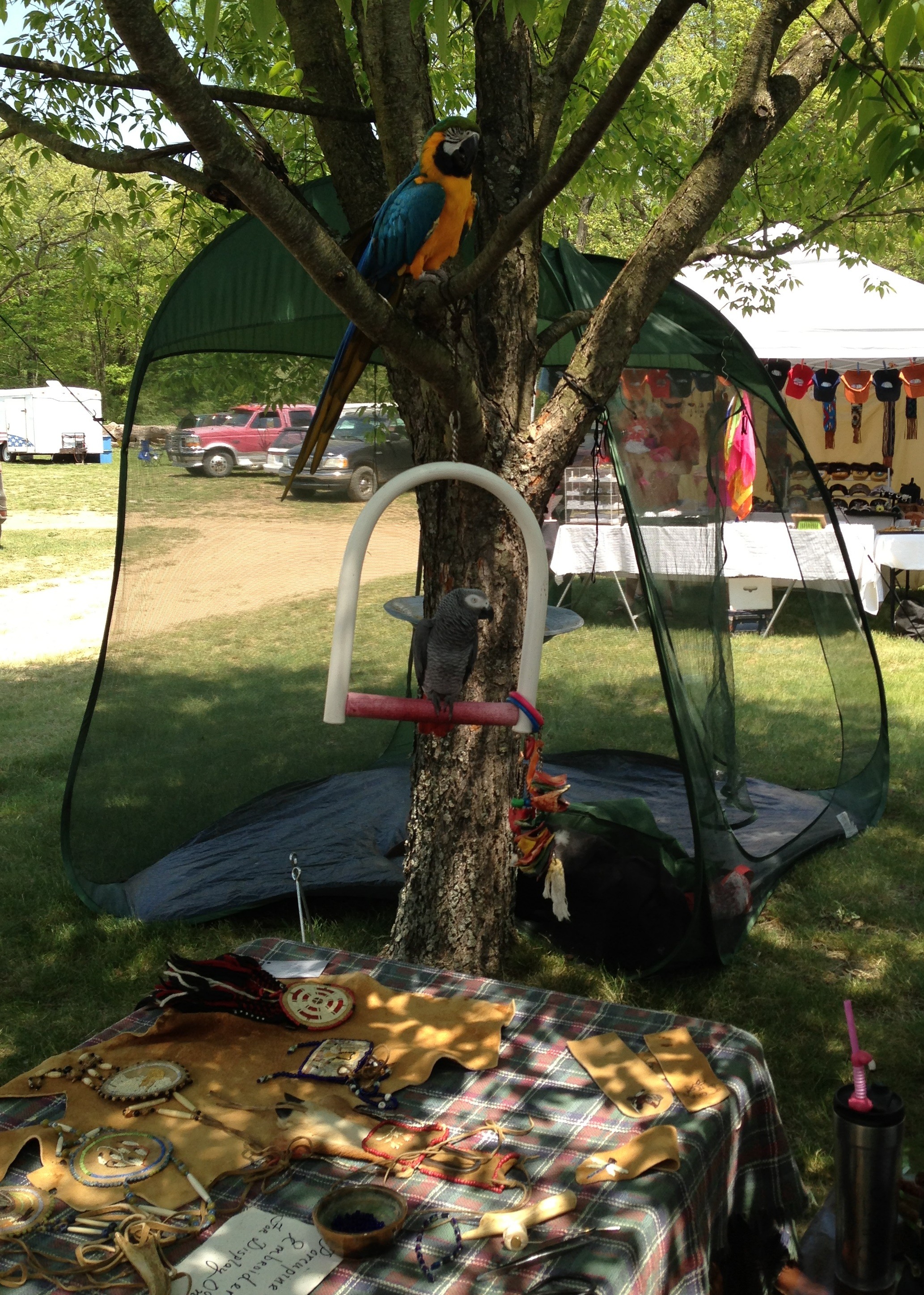
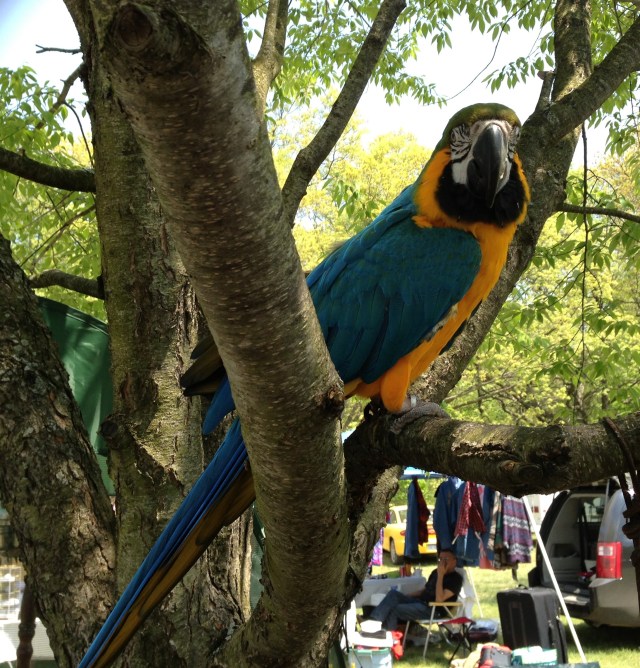
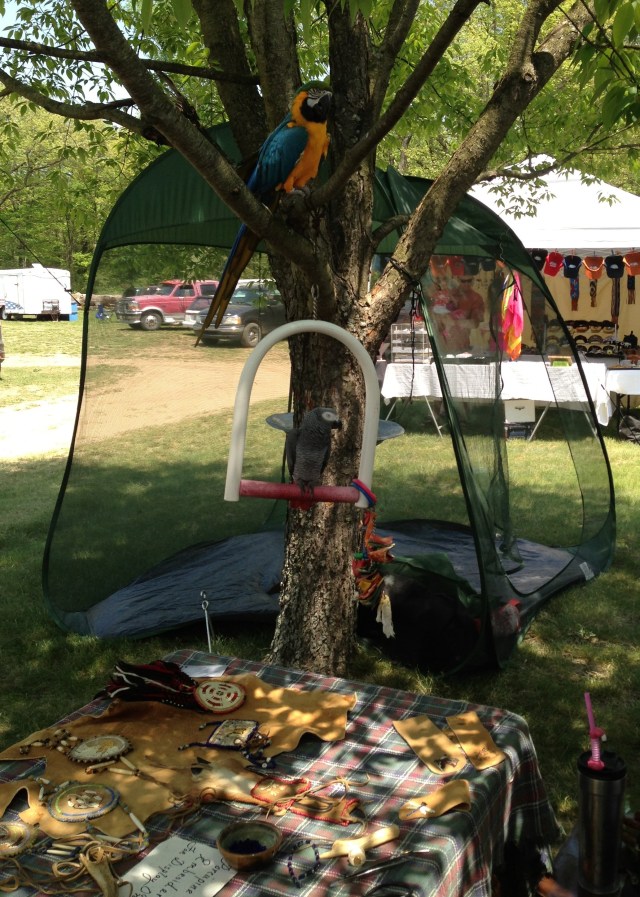
I had been at Bonita’s table, under a tree for several minutes, utterly engrossed in her work, when I became acutely aware of movement directly beside my head.  I turned my head and to my amazement saw….
quillwoman abby 3

Meet Abby Bent.  Abby nearly gave me a heart attack.  She was quite interested in what I was doing and was looking over my shoulder at her “mother,” Bonita.  Abby goes to powwows and reenactments with Bonita.  Why, Abby Bent even has her own facebook page, friend and followers.

But that’s not all, Abby had a sidekick, an African Grey named Shaka Zulu, adopted last year when his owner died.  Unfortunately, one of Abby’s favorite things to do it to unhook Shaka’s perch chain from the tree and watch poor Shaka drop to the ground.  Who thinks birds don’t have personality has never met these birds!

quillwoman abby

As you can see, Bonita’s table where she works and displays her wares is right here, beside Abby and Shaka, and she keep an eye on both, much like a couple of feathered toddlers.
quillwoman abby 2

One thing is for sure, you won’t forget meeting Bonita and her traveling menagerie anytime soon.

It you want to find Bonita, she is on Facebook under “Bonita Bent Nelson” where you can see more of her astounding work, powwows, reenactments, and of course, Abby and Shaka.
quillwoman 8

Posted in Art, Cherokee, Cheyenne, Odawa | 4 Comments

Buffalo Bird Woman’s Garden

Buffalo Bird Woman, 1910

Buffalo Bird Woman’s Garden

As Recounted by

Maxi’diwiac (Buffalo Bird Woman) (ca.1839-1932) of the Hidatsa Indian Tribe

Originally published as

Agriculture of the Hidatsa Indians: An Indian Interpretation

by Gilbert Livingstone Wilson, Ph.D. (1868-1930)

In the words of Buffalo Bird Woman, herself, shown above in 1910:

“We Hidatsas believe that our tribe once lived under the waters of Devils Lake. Some hunters discovered the root of a vine growing downward; and climbing it, they found themselves on the surface of the earth. Others followed them, until half the tribe had escaped; but the vine broke under the weight of a pregnant woman, leaving the rest prisoners. A part of our tribe are therefore still beneath the lake.

My father, Small Ankle, going, when a young man, on a war party, visited Devils Lake. “Beneath the waves,” he said, “I heard a faint drumming, as of drums in a big dance.” This story is true; for Sioux, who now live at Devils Lake, have also heard this drumming.

Those of my people who escaped from the lake built villages near by. These were of earth lodges, such as my tribe built until very recent years; two such earth lodges are still standing on this reservation.

The site where an earth lodge has stood is marked by an earthen ring, rising about what was once the hard trampled floor. There are many such earthen rings on the shores of Devils Lake, showing that, as tradition says, our villages stood there. There were three of these villages, my father said, who several times visited the sites.

Near their villages, the people made gardens; and in these they planted ground beans and wild potatoes, from seed brought with them from their home under the water. These vegetables we do not cultivate now; but we do gather them in the fall, in the woods along the Missouri where they grow wild. They are good eating.

These gardens by Devils Lake I think must have been rather small. I know that in later times, whenever my tribe removed up the Missouri to build a new village, our fields the first year, were quite small; for clearing the wooded bottom land was hard work. A family usually added to their clearing each year, until their garden was as large as they cared to cultivate.

As yet, my people knew nothing of corn or squashes. One day a war party, I think of ten men, wandered west to the Missouri River. They saw on the other side a village of earth lodges like their own. It was a village of the Mandans. The villagers saw the Hidatsas, but like them, feared to cross over, lest the strangers prove to be enemies.

It was autumn, and the Missouri River was running low so that an arrow could be shot from shore to shore. The Mandans parched some ears of ripe corn with the grain on the cob; they broke the ears in pieces, thrust the pieces on the points of arrows, and shot them across the river. “Eat!” they said, whether by voice or signs, I do not know. The word for “eat” is the same in the Hidatsa and Mandan languages.

The warriors ate of the parched corn, and liked it. They returned to their village and said, “We have found a people living by the Missouri River who have a strange kind of grain, which we ate and found good!” The tribe was not much interested and made no effort to seek the Mandans, fearing, besides, that they might not be friendly.

However, a few years after, a war party of the Hidatsas crossed the Missouri and visited the Mandans at their village near Bird Beak Hill. The Mandan chief took an ear of yellow corn, broke it in two, and gave half to the Hidatsas. This half-ear the Hidatsas took home, for seed; and soon every family was planting yellow corn.

I think that seed of other varieties of corn, and of beans, squashes, and sunflowers, were gotten of the Mandans  afterwards; but there is no story telling of this, that I know.

I do not know when my people stopped planting ground beans and wild potatoes; but ground beans are hard to dig, and the people, anyway, liked the new kind of beans better.

Whether the ground beans and wild potatoes of the Missouri bottoms are descended from the seed planted by the villagers at Devils Lake, I do not know.

My tribe, as our old men tell us, after they got corn, abandoned their villages at Devils Lake, and joined the Mandans near the mouth of the Heart River. The Mandans helped them build new villages here, near their own. I think this was hundreds of years ago.

Firewood growing scarce, the two tribes removed up the Missouri to the mouth of the Knife River, where they built the Five Villages, as they called them. Smallpox was brought to my people here, by traders. In a single year, more than half my tribe died, and of the Mandans, even more.

Those who survived removed up the Missouri and built a village at Like-a-fishhook bend, where they lived together, Hidatsas and Mandans, as one tribe. This village we Hidatsas called Mu’a-idu’skupe-hi’cec, or Like-a-fishhook village, after the bend on which it stood; but white men called it Fort Berthold, from a trading post that was there.

We lived in Like-a-fishhook village about forty years, or until 1885, when the government began to place families on allotments.

The agriculture of the Hidatsas, as I now describe it, I saw practiced in the gardens of Like-a-fishhook village, in my girlhood, before my tribe owned plows.”

The rest of the document is available at this link:

http://digital.library.upenn.edu/women/buffalo/garden/garden.html

Hat tip to Terri and Elaine for sending this my way.

Posted in Agriculture, Hidatsa, Mandan, Sioux | 1 Comment

The Autosomal Me Series Finishes with Identification of Native Family Lines

John Y Estes

Finally, it’s done!!!  What’s done, you ask?  The final chapter in the DNA series, “The Autosomal Me.”  The goal of this series was to use my DNA results to see if I could identify which family lines carried Native heritage.  Lines, plural?  Yes indeed, I have identified more than one line in my family that carries Native heritage – and multiple lines on both sides of the family.  That was a bit of an AHA moment.

I’ve known for years that my mother has Micmac heritage via her Acadian family lines.  What I didn’t know is that she likely has a second line too….and that my father’s genealogy just might contain a common ancestor with my mother.  Yes, this was a revealing process – full of surprises.

The process I’ve established in The Autosomal Me series will walk you through your minority admixture as well, with the goal of finding those elusive Native or minority admixture ancestors.  Warning – it’s long and intensive and not for the uncommitted.  I would classify it as for the genetic genealogical warrior, so to speak.

It’s really quite interesting, because although I did not receive “the answer” in a nice neat package with a bow, the process did eliminate many lines from consideration, and on my father’s side, there are three candidate lines, one involving the known Native Hatcher family.  Now, it’s time to focus on the genealogy research to see if I can turn up additional documentation or evidence for these family lines.  Maybe there was no “nice neat answer” to receive, and what I’ve received is the truth, delivered in the work clothes of opportunity:)

http://dna-explained.com/2013/05/31/the-autosomal-me-the-holy-grail-identifying-native-genealogy-lines/

The photo is of my oldest ancestor whose photo I have in my Native line, John Y. Estes (1818-1895).  He carries DNA from several of the lines identified in the DNA discovery process.  Maybe we’ve uncovered an explanation for why his skin color was identified as “dark” on his Civil War paperwork and the persistent family stories of Native ancestors.  Please note that this is the only known photo of him and it was in very bad shape when found in the bottom of a box that mice had chewed.  This photo has been professionally restored.

Posted in DNA, Education, Micmac | 7 Comments

Native Warriors and Battles

At the Military and Historical Image Bank, I discovered several renderings of Native people, mostly in military context.

The first group shows 6 images, including the Battle of Oriskany, about which I had just been reading.  The Battle of Oriskany was one of the bloodiest battles of the Revolutionary War wherein the Six Nations Indians fought with the Loyalists against the Patriots and the Oneida Indians near Fort Stanwick, New York.  This division of loyalty caused a significant rift within the Indian nation.

http://www.historicalimagebank.com/gallery/main.php/v/album01/Native+American/

This second group is the French and Indian War and includes another Native warrior not includes on the Native page.

http://www.historicalimagebank.com/gallery/main.php/v/album01/album10/

I hope you enjoy the photos.  We can’t visit our ancestors today, but being able to view how they dressed and look at paintings and renditions of historically accurate Indians, combined with history, help us to connect with them in their life and times.  Enjoy.

Hat tip to Paul for this resource.

Posted in Military, Oneida, Six Nations | 4 Comments

Nooherooka Website at ECU

Tuscarora smoking pipeEastern Carolina University hosted the 300th Anniversary Commemoration of the Battle of Fort Nooherooka in the spring of 2013.  In preparation for this even, ECU constructed a website, which I hope they will continue to maintain, adding documents, papers, photos and other information relevant to Tuscarora history.  In fact, this would be the perfect forum for ongoing study, papers, conferences and community events for the northern and southern Tuscarora people.

Let’s take a look at the primary pages they have assembled.

http://blog.ecu.edu/sites/nooherooka/?page_id=38

As with any website, the intro pages and acknowledgements te;; about the goals of the site and who is involved.  That list is pretty impressive.

http://blog.ecu.edu/sites/nooherooka/?page_id=380

http://blog.ecu.edu/sites/nooherooka/?page_id=44

Perhaps of more interest to our readers are the historical pages, as follows:

Artifacts excavated from the Nooherooka site by the ECU Anthropology Department between 1990 and 2001, including the smoking pipe with the eel or snake design, shown above:

http://blog.ecu.edu/sites/nooherooka/?page_id=17

Tuscarora War Documents including the Barnwell Journal:

http://blog.ecu.edu/sites/nooherooka/?page_id=38

Discussion board which holds historical articles and not really discussion:

http://blog.ecu.edu/sites/nooherooka/?page_id=632

Other items of interest include the Construction of the Nooherooka Monument as well as some videos from a visit by the New York Tuscarora in 2012 in preparation for the 300th Anniversary Commemoration Event in the spring of 2013.

http://blog.ecu.edu/sites/nooherooka/?page_id=42

Videos:

http://blog.ecu.edu/sites/nooherooka/?page_id=19

I would love to see them add some photos of the Commemoration event itself.  We’ve includes two articles, one about the Commemoration and the second, a historical family story interwoven with the historical events.

https://nativeheritageproject.com/2013/03/26/fort-neoheroka-300-years-later-tuscarora-commemorative-monument/

https://nativeheritageproject.com/2013/03/31/tuscarora-the-ones-that-stayed-behind/

Another ECU site provides this video of the events:

http://www.ecu.edu/cs-admin/news/N300.cfm

Additional ECU photos:

http://ecuphotos.zenfolio.com/p1046596618

This Facebook site includes photos taken by the attendees:

https://www.facebook.com/events/628042403879898/

Posted in Military, Tuscarora | 1 Comment