Photos of the Dakota Territory

These photographs of the old Dakota Territory are fascinating.  I’m not sure where these pictures originally came from.  In many ways, they look like the Edward Curtis photos that were taken between 1885 and 1930, but some appear to have been taken too early to be his work.  http://en.wikipedia.org/wiki/Edward_S._Curtis

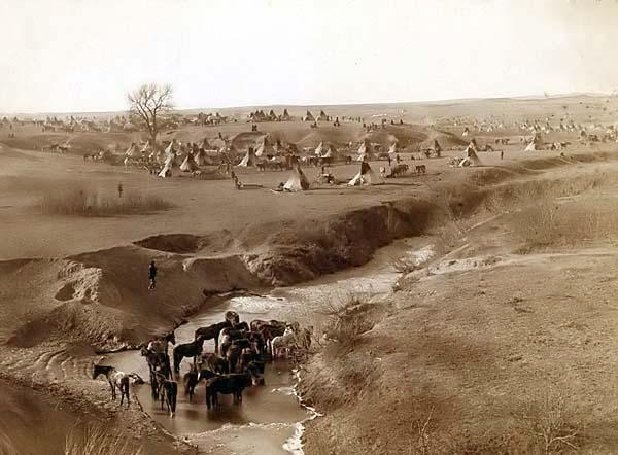
Village of the Lakota Sioux  Indians


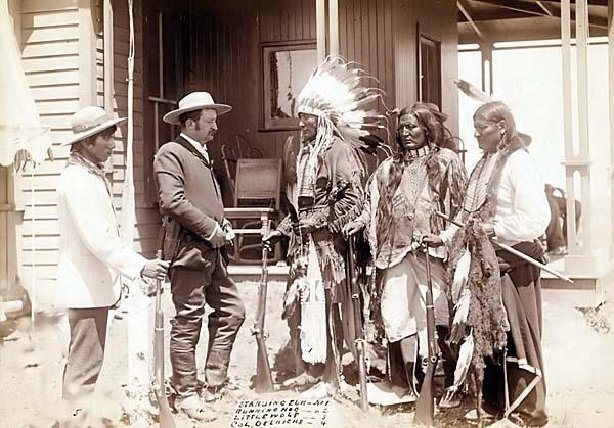
Cheyenne Indians

The photo above of the Cheyenne Indians looks like it is a posed photo, perhaps for visitors.  You can see what looks like pricing on the placard at the bottom of the picture.  Did you pay to have your photo taken with the Indians?


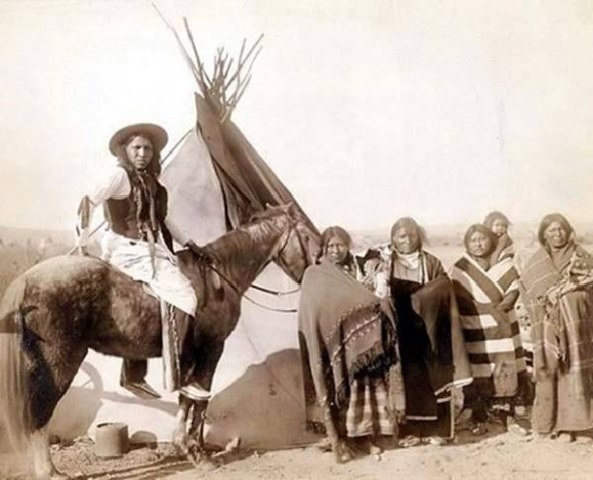
Lakota Sioux Indian Camp

Blankets were such an integral part of Indian life.   The patterns are beautiful.  I wish we could see color.  Notice that the Indian on horseback has no saddle.


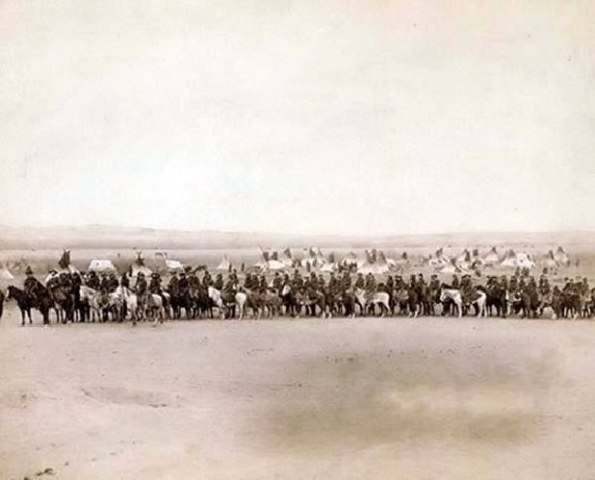
Captain Taylor and 70 Indian  Scouts


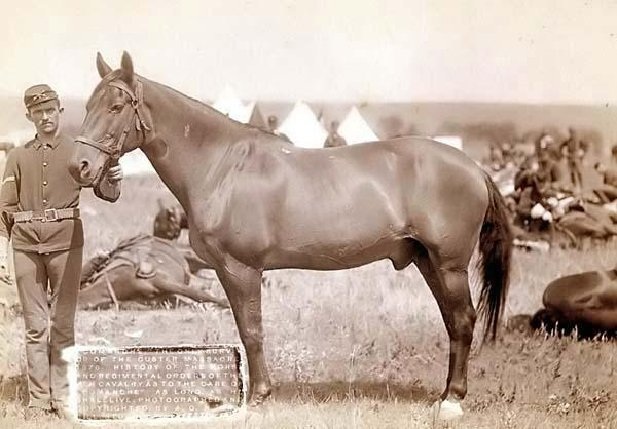
“Comanche,” the only survivor of the Custer  Massacre, 1876


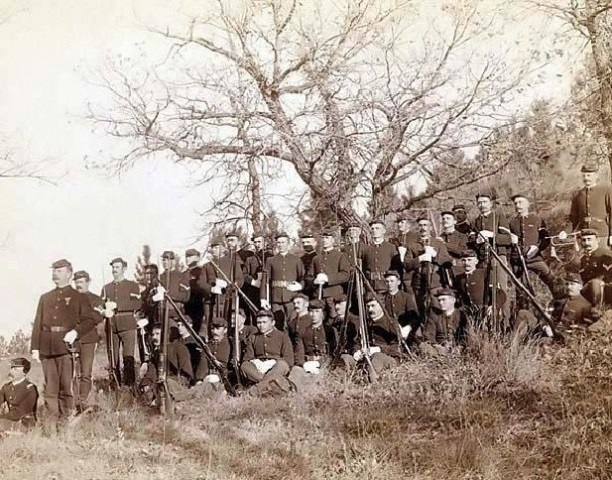
Indian Fighters from the US Army  Infantry


Posted in Lakota | 1 Comment

Caribbean Indians Admixture at Jamestown

The earliest Jamestown records are very interesting.

In the October 1627 court minutes, we find the following commentary:

Capt. Sampson had brought into the colony some Indians from the Carib Islands, who have since run away, hid in the woods, joined Indians here, stole goods and likely killed some people according to some Carib Indians who confessed to the same. After some deliberation, it is ordered that these Carib Indians shall be hanged “till they be dead.”

Posted in Jamestown | 1 Comment

Plunder of the Chickahominy

When we think of plunder, it’s often in the context of Indians raiding English homesteads and villages. We think of the settlers as having valuables and livestock to plunder, and the Indians having little.  But that wasn’t always the case, as we can see in the following record where Thomas Turner is to keep his share of the plunder he took from the Chickahominy amounting to 190 pounds of tobacco and a cask:

 A Study of Virginia Indians and Jamestown: The First Century

http://www.nps.gov/history/history/online_books/jame1/moretti-langholtz/chap10a.htm (chapter 10 table link)

Related Issues to Bacon’s Rebellion:

Source Name/ Party Type Date Payment/
Action
Servants Slaves Details
Haun 1989:104 Thomas Turner & Lt. Thomas Busby Judgement 6 May 1679 Southwarke Share of plunder     Thomas Turner to have his share of the plunder that he and Busby took from the Chickahominy Indians. The balance is 190 lbs. of tobo. & cask.
Posted in Chickahominy, Virginia | Leave a comment

Headrights for Jacob, an Indian

So how does one obtain headrights for an Indian?

Headrights in colonial America were rights to a certain amount of land, typically 50 acres, to be claimed by someone who imported an individual by ship from the mother country.  If people paid their own way, they claimed thier own headrights and those for their family members.  If someone else paid your way, they claimed your headrights. 

Some folks are found listed multiple times, which means they were transported more than once.  Yes, people did make multiple trips back to the mother country.  It may also be that some people were counted if they were transported from one location to another, like maybe from Maryland to Virginia – but this is beginning to fall into the category of speculation.  One thing you can be sure of – human nature being what it is – if there was a way to capitalize on a given situation – someone found a way to do it.

Regardless of how, indeed, Robert Caufield did claim headrights for Jacob, an Indian, as shown in the following record, leaving us to wonder how and why.

A Study of Virginia Indians and Jamestown: The First Century

http://www.nps.gov/history/history/online_books/jame1/moretti-langholtz/chap10a.htm (chapter 10 table link)

Abstracts: Acts of Assembly

Abstracts: Colonial Papers (Library of Virginia)

Abstracts: Correspondence

Abstracts: County Records

Surry County:

Source Name/ Party Type Date Payment/
Action
Servants Slaves Details
Haun 1989:89 Mr. Robert Caufield Certificate 2 July 1678
Southwarke
Grant certificate for 350 acres of land from Secretary’s Office.     7 headrights, one being Jacob, an Indian.
Posted in Virginia | Leave a comment

Indian Thomas, First Indian with a Christian Name

In Jamestown in 1663, we see the first instance of an Indian being given a Christian name, except for Pochahontas who was renamed Rebecca after her 1614 married to John Rolfe.  Prior to this, the Indians, when mentioned, were either simply referenced as an Indian slave or their Native name was used.  They were probably given Christian names or nicknames on plantations all along since Native names would have been difficult for Europeans to pronounce.

In 1663, an Indian man is referenced as Thomas, but no surname is used at this point.  In this record, Thomas complains of illegal detention by Mr. Hoe.  The court orders Rice Hoe to provide Thomas, the Indian, with two new canvas shirts and one pair of new canvas drawers; and pay all costs of suit.

Posted in Virginia | 3 Comments

Indian Reservations as Sovereign Nations

Did you know that Indian reservations are independent nations?  Indian Nations are allowed, within limits to govern themselves.  Many have their own police forces and courts. 

Tribal sovereignty in the United States refers to the inherent authority of indigenous tribes to govern themselves within the borders of the United States of America. The federal government recognizes tribal nations as “domestic dependent nations” and has established a number of laws attempting to clarify the relationship between the federal, state, and tribal governments. The Constitution and later federal laws grant local sovereignty to tribal nations, yet do not grant full sovereignty equivalent to foreign nations, hence the term “domestic dependent nations”.

However, in times of war, all men, including Indians have to register.  In WWI, this caused some consternation.  Each registrar had to record the county name in which the registrant registered.  If they registered on an Indian Reservation, even if the reservation was located within a county, the reservation itself was not part of the county, as it is considered a separate Nation.

This bureaucratic anomaly became apparent in New York in states East of the Mississippi.  In New York, Indians who registered on the reservation are listed in our old friend, Miscellaneous County.  In other places, Miscellaneous is a sign that someone is either hospitalized, institutionalized or returned a late registration after the county office had closed.  In this case, it’s not necessarily a sign of any of those things, but each return has to be looked at individually to determine the individual circumstance.  Just as I was about to decide that all New York entrants in Miscellaneous County were Reservation Indians, I found one who lived on a reservation, followed by someone of the same name, also an Indian, in prison.  No assumptions allowed.

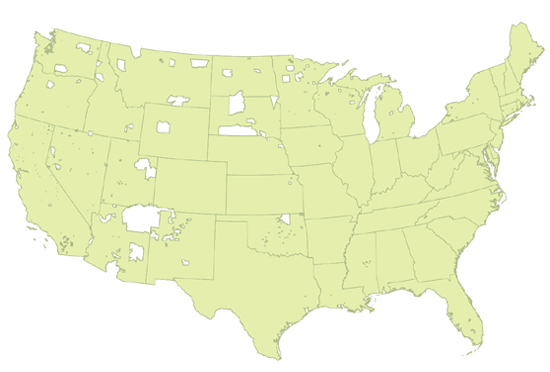
The map below is a very different map of the US.  It’s a map of the US minus the sovereign Indian nations within the continental US.  Sort of looks like Swiss Cheese doesn’t it.  Some of these areas are much larger than one might expect. 

Of course all of this has not been without issues.  You can read more about applicable laws here:  http://en.wikipedia.org/wiki/Tribal_sovereignty_in_the_United_States

Posted in History | 21 Comments

How do you spell Opportunity? Highland Park, Michigan

Where, you ask, is Highland Park, Michigan and why would someone go there?  More specifically, why would many someones go there?

The answer becomes apparent when looking at the draft card registrations of the men in 1917 and 1918 who were born elsewhere, from many places, but were all registering in Highland Park, Michigan.  Patterns means something, so lets look at Grover W. Martell and see what we can discover.  His record is particularly rich.

Grover W. Martell, in the index, is listed at having been born in Oklahoma in 1892 and was registering for the draft in Highland Park, Wayne Co., Michigan.  This in and of itself isn’t terribly unusual, but the fact that so many men were registering from Highland Park, which is a small suburb of Detroit, caused a raised eyebrow.

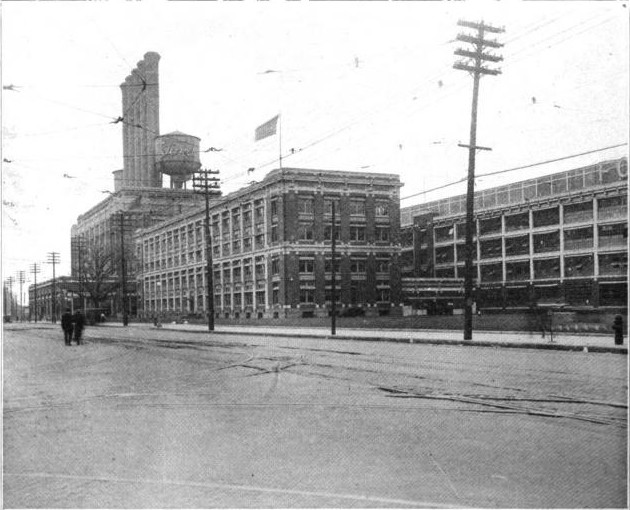
Looking at Grover’s registration card itself, there are three great pieces of information for us.  First, the answer to the original question of why so many people registered in Highland Park.  It’s a 4 letter word – one that all of us are very familiar with.  Ford.  Yes indeed, Ford had a facility there.  So did Chrysler, eventually.  The Ford plant there was the second production facility for the Model T, a hot item at that time, and was state of the art, having opened in 1910.  It was the first plant to have an assembly line, and as all assembly line work does, it needed workers.  And that is what spelled opportunity for many people from all over the country.  Highland Park, and eventually all of southeastern Michigan became a destination location.

But that’s not all we discover about Grover Martell.  He was born in Tecumseh, Oklahoma.  He had spent 5 years at the Carlisle Indian School in Carlisle, Pa. which he claimed as 5 years of military service.  He says he’s a student at the Ford Plant.  I’ve seen this on the registrations of several others, so I’m not positive what this means.  From his address, it appears that he is living in some of the housing constructed by Ford for the workers.  It wasn’t free, but it was quite reasonable and was created to attract workers.  The community could not absorb so many people without additional housing.

Like so many others, Grover Martell moved when opportunity came knocking.

Posted in Michigan, Military, Oklahoma, Pennsylvania | 2 Comments

William Eaton’s Muster Roll of 1754 – Granville Co., NC

The Saponi Indians were allied and grouped with the Eno, the Shakori, the Totera and others especially after their time settled at Fort Christanna from about 1714-1716.  William Eaton was a well-known trader and he obtained land in Granville County, NC.  The smaller eastern tribes were quite unsettled after Fort Christanna was closed and tried living in different locations.  Eventually, all of these people were simply called the Saponi.  In 1730 the group went to live with the Catawbas in South Carolina on the North Carolina border, but in 1733, they were back in Virginia again.  In 1742, they returned to the Catawba, but returned a second time in 1748.  During this time, the Catawba were absorbing a number of remnant tribes who were not strong enough to protect themselves.  Indian numbers were dwindling due to constant warfare and disease.  Unlike the English, with a new supply of colonists constantly arriving from Europe, there was no replacement mechanism for the Native people.

By 1754, William Saunders in the “Colonial Records of North Carolina” report that a group of 30-40 Saponi had settled on the lands of William Eaton in Granville County, NC. 

As luck would have it, Janet Crain discovered the “Muster Roll of the Regiment of Granville County under the command of Colonel William Eaton as taken as a general muster of the said Regiment October 8, 1754.”

On that list are several surnames that are recognizable as families associated with Native heritage such as Harris, Chavers, Alford, Cade, Nichols, Hedgeparth, Gowen and others.  Several are also associated with Melungeon heritage such as Gowen, Mullins, Collins, Bolton (Bollin) and Moore. 

However, the question is whether or not there is anything on the muster list that might identify who is Native or of Native descent, and who is not, and indeed, there is.  Several people are noted at either negro or mulatto, as follows:

  • Edward Harris, negro
  • William Chavers, negro
  • William Chavers Jun., Mul.
  • Gilberth Chavers, Mulatto
  • John Smith   Nut Bush (I’m just going to leave this alone)
  • Thomas Gowen, mulatto
  • Mickael Gowen, mulatto
  • Edward Gowen, mulatto
  • Robert Davis, mulatto
  • William Burnel, mulatto

John Smith’s note of “nut bush” could be an indication of a location.  One man is noted by a creek name and one says “up the river”.  Or it could possibly be an indication of a Native group association.  If we exclude this individual, as he is not noted as being negro or mulatto, there are a total of 9 men “of color.”  Only free people could serve in the militia, so we know these men weren’t slaves.

If each man had a wife and one child, that would be 27 people, 2 children would be 36 people and 3 children would be 45 people.  This fits the 30-40 Saponi stated to have gone to live on William Eaton’s land, assuming that the 30-40 meant total people and was not a family count.  Of these, the Chavers and Gowen families are known to be Lumbee as well as Tuscarora.  Harris is the primary Catawba surname, although being a very common surname, may not be related.  Gowen (Goins) is a Melungeon surname as well.

Perhaps, using the muster roll and the NC colonial records, together, we’ve just identified a number of Saponi families.  By this time in the historical record, the name Saponi could represent any of the eastern remnant tribes’ members.

I suspect that at least some of the men not classified as “of color” also carried mixed heritage.  Many of the surnames were the same.  You can take a look at the complete list here:                                                                                                                    

http://melungeon-historical-societymhs.blogspot.com/p/muster-roll-of-regiment-in-granville.html

Posted in Catawba, Melungeon, North Carolina, Saponi | 8 Comments

Golden Hill Paugussett Indian Tribe

Sometimes this project takes you down paths on journeys you didn’t anticipate.

Today’s journey was to the Paugussett Tribe in Stratford., Ct.  While searching for works by Wesley (White) Taukchiray Jr. in 1975 and 1988, which I never found, I instead found a document entitled The Final Determination for the Golden Hill Paugussett Tribe.

http://www.bia.gov/idc/groups/xofa/documents/text/idc-001604.pdf

In essence, in the 1990s tribal members applied for federal recognition.  For a variety of reasons, it was denied, but the history and genealogy, as best can be documented, is included in the findings. 

In 1762 the general assembly set aside 80 acres as a reservation for the benefit of the Indians at Stratford.  By 1763, non-Indian settlers were occupying all but 8 acres of the 80.   Sarah Shoran and Eunice Shoran, the “surviving heirs of the Pequanok/Paugussett Indians” petitioned to have the land reclaimed.  At this time, Eunice who had married Thomas Sherman and their children were the only Indians remaining and they were given a place to live at Golden Hill.

Sarah Shoran married Elijah Wampey, a Brotherton Indian, and moved to Oneida, NY.  She was no longer found in the Connecticut records.

Eunice died before 1797 and Tom Sherman, her husband, died in either 1800 or 1801.  It is unknown if he was all or part Native, and if so, what tribe.  After his death, the “remainder of the tribe” which consisted of their 4 children and a man named John Chops petitioned for the land to be sold.  It was, and the proceeds were put into a fund for the benefit of the Indians.

In the 1840s, two additional individuals were identified as descendants, Ruby Mack or Mansfield and Nancy Sharpe alias Pease.  A Henry Pease who was somehow related to Nancy is also documented as being a tribal member.

A William Sherman appears on the scene about this time.  The current tribes consternation revolves around this man, whether he was a descendant of Tom Sherman’s wife, who was documented as Native, and if so, how. The descendants who were applying for tribal status in 1996 apparently all descended from this man who was documented to be Indian in at least two places, the 1870 and 1880 census, but in others was documented as white. 

Additional information is available in the document, if you are interested. 

The outcome of this particular petition was that tribal status was denied based on a number of factors, the first being their inability to document his descent from Sarah Shoran and Tom Sherman, their inability to document him as Native without conflicting evidence and the fact that a tribe, as was defined at that time, could descend from one person.

Posted in Connecticut | 16 Comments

Who was Isaac Zane?

We found Isaac Zane mentioned in the  petition of the descendants of John Ward, a white man captured by the Indians as a youth and raised among them.  Isaac Zane was involved, but how and why?  We also discovered he had received land.

In the US Serial set, ID ASP028 Pub.land64, Jan 11, 1802, we find the answer in the form of a “Confirmation of Indian grant, petition of Isaac Zane,” excerpted as follows.

Isaac Zane was made a prisoner by the Wyandot Indians when he was 9 years old with which nation he has ever since remained, having married an Indian woman and having had many children.  His attachment to the whites has subjected him to numberless inconveniences and dangers during the almost continual wars which existed between the US and the Indians until the peace of Greenville in 1795.

Prior to that period, a tract of land on which he now lives had been assigned to him by the Wyandot Indians and that the land when given to him was not thought to fall within the boundary of the US, which now appears to be the case. 

Two certificates, one signed by 5 Indian chiefs at a place called the Big Rock on Sept. 10, 1800, state that the Wyandot Nation of Indians alotted the said Zane a tract of land of 4 miles square on Mad River and that Zane had a pre-exemption right ever since the year 1758 to the lands of the Wyandot Nation.  The second certificate is given by Abraham Chapline, a gentleman of character in the State of Kentucky, who certifies that he was made a prisoner in the year 1780 by the Wyandot and that at that time the British Indians  were marching with formidable force to attack the Kentucky country.  The said Zane found it out and gave Mr. Chapline a gun and ammunition with directions what course to proceed to alarm the whites and the said Zane also purchased another prisoner from the Mingoe Indians which he gave $100 for and furnished him with a gun also to go with the same Chapline to alarm the Kentuckians, and that the said Zane was very friendly to the prisoners in general. 

The petition continues with testimony from the Indian agent that at a conference with the chiefs of the Wyandot in October of 1799, they confirmed that they had given Zane land 4 miles square called Big Bottom on the Mad River, a branch of the Great Miami.  It is noted that this is the location where “Zane now lives.”

Five Indian Chiefs sign their names, by their mark at Big Rock on September 16, 1800.

  • Sas-ta-red-zi
  • Sa-en-tes-con
  • Des-cha-ra-man
  • Sy-et-ta
  • Da-ri-on
Posted in Slaves, Wyandot | Leave a comment