Oto Indians

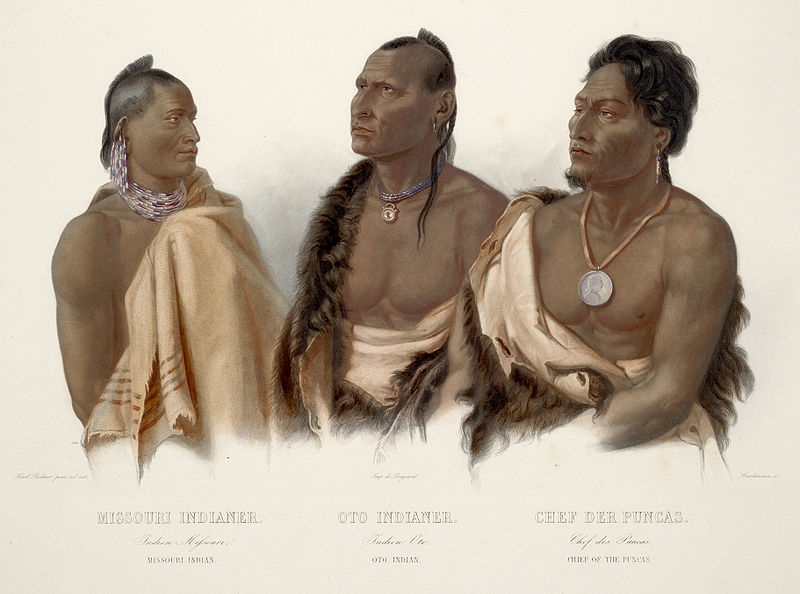
Once again, the Carlisle records provided the name of a tribe I hadn’t seen before, the Oto Indians.  The painting above by Karl Bodmer shows the Missouri, the Oto and the Chief of the Puncas (Ponca) circa 1840-1843.

The Otoe, or Oto, and Missouria, or Missouri, tribes both originated in the Great Lakes region of Siouian stock, part of a group commonly known at the Winnebago.  They are thought, along with the Ho-Chunk and Iowa tribes, to have once been a single tribe.

In the 16th century, the Iowa, Otoe, and Missouria broke away from that tribe and moved to the south and west. This group eventually split again, coalescing into at least three distinct tribes: the Ioway, the Missouria and the Otoe. The latter settled in the lower Nemaha River valley. They adopted the horse culture and semi-nomadic lifestyle of the Great Plains, making the American bison central to their diet and culture.

By the late 17th century, the Missouria had settled near the Missouri and Grand Rivers in Missouri.

Meanwhile the Otoes settled along what is now the Iowa-Minnesota border. They first came into contact with Europeans in late 17th century. Jacques Marquette, the French explorer, included them in a 1673 map, placing the Otoe near the Des Moines and upper Iowa Rivers. Pierre Le Moyne d’Iberville wrote in 1700 that the Otoe and the Iowa lived with the Omaha tribe, between the Mississippi and Missouri Rivers. After contact, they migrated to Nebraska and settled near the Platte River on what became the Otoe Reservation.

The 18th century was devastating for the Missouria people. Smallpox killed many in the tribe, as did constant warfare with enemies, such as the Sac and Fox. In 1796, some surviving Missouria joined the Osage and Kaw tribes, while 80 Missouria joined the Otoe.

In the 19th century, the Missouria and the Otoe established permanent villages consisting primarily of earth lodges, but also occasionally tipis and bark lodges. Their joined society was patrilineal and comprised seven to ten clans. Tribal members had to marry outside of their clan. Each clan had a leader, and together the clan chiefs formed a tribal council. The chief of the Bear Clan was the principal leader of the tribes. They hunted buffalo and grew such crops as squash, beans, corn, and pumpkins. In 1803, Lewis and Clark estimated their population to be 500. George Catlin estimated their population at 1200 in 1833. In 1830 there were an estimated 1500 Otoe-Missouria living in together. By 1886, only 334 Otoe-Missouria survived.

Following the Louisiana Purchase by the United States, the Lewis and Clark Expedition headed up the Missouri River to explore the new territory. The Otoe were the first tribe they encountered. They met at a place on the west bank of the Missouri River that would become known as the Council Bluff.

Like other Great Plains tribes, the Otoe periodically left their villages to hunt for buffalo. Between 1817 and 1841, the Otoe lived around the mouth of the Platte River in present-day Nebraska. During this time, the remaining families of the Missouria rejoined them. They gathered with others to trade for European goods.

In the 1830s, the tribe was noted to have problems with alcohol, which was widely dispensed by traders. Some Otoe would trade vital supplies for alcohol, to the point of becoming destitute. As their dependence on alcohol grew, the men no longer hunted, but resorted to looting vacant Pawnee villages while the people were out hunting. This story of Indians suffering the ill effects of alcohol is all too familiar and was repeated over and over again in the history of many Native tribes.

In 1854 the Otoe-Missouria ceded most of their lands south of the Platte River in eastern Nebraska to the U.S. by treaty. They retained the Oto Reservation along the Big Blue River on the present Kansas-Nebraska border. They struggled to adapt to reservation life.

During the 1870s, the tribe split into two factions. The Coyote band favored an immediate move to Indian Territory, where they believed they could better perpetuate their traditional tribal life outside the influence of the whites. The Quaker band favored remaining on the Big Blue River land. They were willing to sell the western half of the reservation to whites to gain income for a tribal annuity.

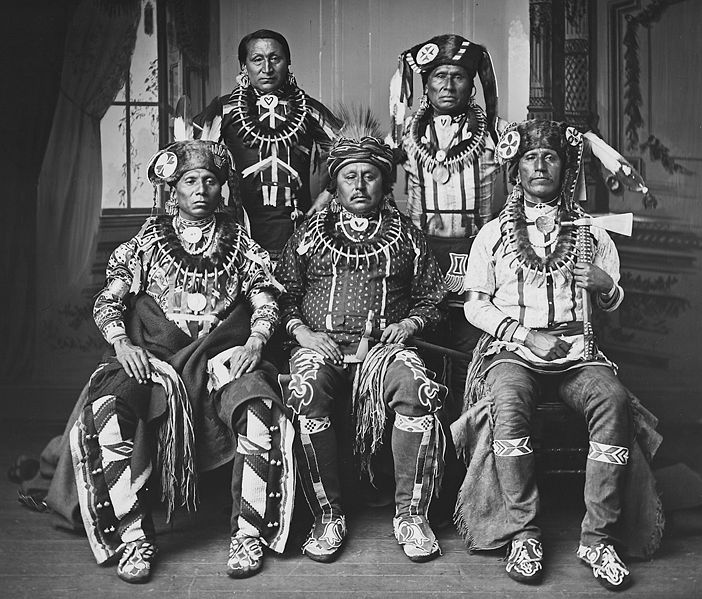
Below, the Oto 1881 delegation in a photograph by John K. Hillers.

By the spring of 1880, about half the tribe had left the reservation and taken up residence with the Sac and Fox Nation in Indian Territory. By the next year, in response to dwindling prospects of self-sufficiency and continued pressure from white settlers, the remaining Otoe members in Nebraska sold the Big Blue reservation. They migrated to Oklahoma.

These Otoe men’s moccasins were made about 1880.

With the Otoe-Missouria already in Oklahoma, they purchased a new reservation in the Cherokee Outlet in the Indian Territory. This is in present-day Noble and Pawnee Counties, Oklahoma. Today the Otoe-Missouria Tribe of Indians is federally recognized. It is based in Red Rock, Oklahoma.

The Otoe or Oto language, Chiwere, is part of the Siouan family and closely related to that of the related Iowa and Missouri tribes.  Today, there are only 3 speakers of the Native language but the tribe has put a language revitalization program in place.

Posted in Ho-Chunk, Ioway, Kaw, Missouria, Omaha, Osage, Otoe, Ponca, Sac and Fox, Winnebago | 7 Comments

Freedom Suits in Virginia

The current exhibit at the Library of Virginia, “You have no Right:  Law and Justice in Virginia”  delves into the issue of Indian slavery in Virginia, both legal and illegal.  Many Native people were wrongfully enslaved.  They and their descendants were held as slaves when in fact they should have been free.  In some cases, the descendants of these women filed suits and sought their freedom decades after the originally wrongfully enslaved person had died.  You can see an example of that in the pedigree chart, submitted above as part of one of these suits.  The original wrongfully enslaved person was “Jane Gibson, An Indian Woman, the Ancestor,” shown at the top of the chart.

People in Virginia took the status of their mother.  If the mother was a slave, so was the child, even if fathered by a free person.  If the mother was free, so was the child, even if fathered by a slave.  If a woman was wrongfully enslaved, that means her children, and their children, were as well.  This law went into effect in 1662 after an individual fathered with an enslaved woman by a free white man gained their freedom.

In Virginia, in 1682, a law allowed the lifetime enslavement of Indians imported from other colonies.  It was repealed in 1684, supposedly, and in 1691, and again in 1705. It was determined that the 1705 repeal was the “real” one, which meant that Indians captured or purchased by traders between 1684 and 1705 had been legally enslaved. It was only people enslaved after 1705 that could, if they knew about the law and had the means, file for their freedom.  In many cases, that took decades and could be easily derailed by things like the attorney not showing up for court, or dieing, as is demonstrated by some of the examples.

This article, “Hundreds of the Descendants of Indians Have Obtained Their Freedom”: Freedom Suits in 18th and 19th Century Virginia discusses several of these suits, the history behind them, and near the end, how to use the chancery records online search capability to find these freedom suits.

Kudos to the Library of Virginia for their ongoing efforts to bring the chancery and other previously obscure records into the digital age and into the hands of people who need access to them.  Maybe one of your ancestors is waiting there for you.

Posted in History, Slaves, Virginia | Leave a comment

The Chitimacha

I ran across another tribe while transcribing the Carlisle Indian School student records that I wasn’t familiar with.  Adrian Depremont was listed as a Chitimac.  Having never heard of this tribe before, I turned to my friend, Google, and discovered that the Chitimacha are a small tribe in Louisiana.  That explains the French surname.  Shortly thereafter in the Carlisle records, Mary Darden was also listed at Chitimacha.

The Chitimacha’s historic home was the southern Louisiana coast. They and their ancestors lived there for about 2,500 years and perhaps as long as 6,000. They had migrated from the area surrounding modern Natchez, Mississippi, and before that, from eastern Texas.

In the early 18th century, the Chitimacha encountered French colonists, who raided their territory in search of slaves. By the time peace was reached in 1718, the population had declined drastically, through exposure to new infectious diseases to which they had no immunity and warfare. Survivors were forced to move north.

One hundred years later, the arrival of Acadian refugees in their area brought a further decline in the Chitimacha population.

Some members married Acadians and became acculturated to their community, including converting to Catholicism. New settlers grabbed land. In 1917, the tribal leadership sold what was left of the Chitimacha land to the United States government. By 1930, the Chitimacha population had dropped to just 51 people.

Since that low, the population has climbed as the people have recovered. There are 720 registered Chitimacha. The 2000 census reported a resident population of 409 persons living on the Chitimacha Indian Reservation. Of these, 285 were of solely Native American ancestry.

The Chitimacha Indians inhabited the Mississippi Delta area of South Central Louisiana before the arrival of Europeans. Tradition asserts that the boundary of the territory of the Chitimacha was marked by four prominent trees. The Chitimacha were divided into four sub tribes: the Chawasha, Chitimacha, Washa and Yagenachito. This confederation occupied about fifteen villages.

At the time of Columbus’ discovery of America, the combined strength of the four groups was about 20,000. Although the Chitimacha were to have virtually no contact with Europeans for two more centuries, they suffered Eurasian infectious diseases contracted from other natives, to which they lacked immunity. Epidemics had reduced their number by half by 1700, when the French began to enter the Mississippi Valley. At that time, the Chawasha had about 700 people, the Washa about 1400, the Chitimacha some 4,000; and about 3,000 for the Yagenichito.

According to the Chitimacha, their name comes from the term Pantch Pinankanc, meaning ‘men altogether red.’ The name Chawasha is a Choctaw term for ‘Raccoon Place.’ Washa is also Choctaw and means ‘Hunting Pace.’ Yaganechito means ‘Big country.’ The Chitimacha spoke a dialect of the Tunica language, an isolate. The Chitimacha language has become extinct. Contemporary Chitimacha speak Cajun French and English.

Archaeological finds suggest that the Chitimacha and their ancestors have been living in Louisiana for perhaps 6,000 years. Prior to that they came from somewhere west of the Mississippi. The fifteen or so villages which the French came across at the beginning of the 18th century were self-governing groups. A central governing authority was vested in the person of the Grand Chief.

The Chitimacha were distinctive in their custom of flattening the foreheads of their male babies. Adult men would typically wear their hair long and loose. They were skilled practitioners of the art of tattooing, often covering their face, body, arms and legs with tattooed images. Because of the hot and humid climate, the men would normally only wear a breechcloth, and the women a short skirt.

The Chitimacha were divided into a class system, with nobles and commoners. So large was the distinction between the two that they spoke different dialects. Intermarriage between the classes was forbidden.

Between the years 1706–18, the Chitimacha engaged in a long, bitter war with the French. The result was that the eastern Chitimacha were nearly wiped out. Those who survived were resettled by the French along the Mississippi River. Infectious disease and alcohol took a toll on the tribes. By 1784 the combined numbers of the tribes had fallen to just 180. In the early part of the 19th century, they were absorbed by the Houma.

In the early 20th century, however, the Chitimacha began to re-establish their tribal identity. From just six families in 1880, the numbers have grown to reach a present figure of about 900. In 1917, the Chitimacha were officially recognized as a tribe by the United States government.

In 1870, Francois Bernard painted the portrait titled “Two Chitimacha Indians,” shown at the top of this article.  This was only about 10 years before their lowest point in terms of population, so it shouldn’t be too difficult to narrow the range of the identities of these people in the portraits, if the identities of the six families in 1880 is known.

You can read more about the Chitimacha Nation on their website.

Louisiana Trails to the Past provides some additional information and photos.

Posted in Chitimacha | 4 Comments

Lapwai

When transcribing the Carlisle records, I came across a tribal designation I wasn’t familiar with, the Lapwai.  Who were the Lapwai?

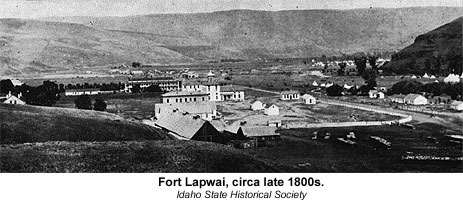
The Lapwai were part of the Nez Perce who lived in Idaho.  Today, the city of Lapwai, Idaho is the center of the Nez Perce Indian Reservation.

Henry Harmon Spading established a Nez Perce Indian mission at Lapwai in 1836. Reverend Spading and his wife introduced Christianity, agriculture, and opened the school in Idaho for Indian children. In 1839 Henry Spading began publishing the Bible in Lapwai on the earliest printing press in the Pacific Northwest. Chief Timothy of the Nez Perce, the first native Christian leader, was baptized at Lapwai on November 17th, 1839.

The amicable relationship between the Nez Perce and the White Men lasted many years, but began to slowly deteriorate as more and more settlers arrived in their lands, and with the discovery of precious metals in Idaho.

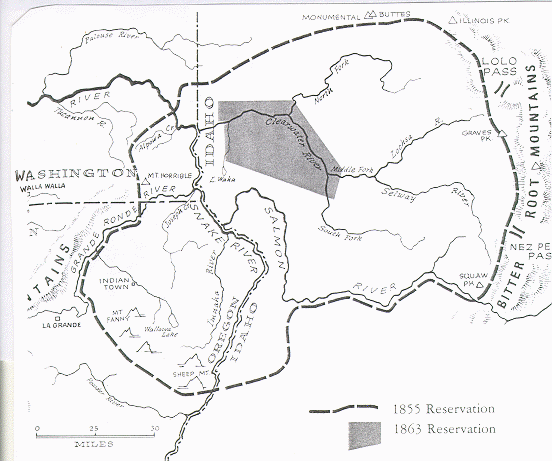
In 1855 U.S. Officials persuaded the Nez Perce to sign the Walla Walla Treaty in which they sold much of their lands for less than 8 cents an acre. The treaty ordered the Nez Perce to relinquish their ancestral territory and move to Oregon’s Umatilla Reservation with the Walla Walla, Cayuse, and Umatilla Tribes. However, all the tribes so opposed this plan that Territorial Governor Isaac Stevens granted the Nez Perce the right to remain in their own territory, on the condition that they relinquish nearly 13 million acres to the U.S. government. A large reservation (10,000 square miles) was established across central Idaho and into the Wallowa Valley of Oregon. Many of The People moved into Idaho. Some however remained in the Wallowa Valley. Among these was Old Chief Joseph and his band.

You can read more about the Nez Perce tribe at their website, http://www.nezperce.org/

Posted in Lapwai, Nez Perce | Leave a comment

Birth Date not Known

As I work my way thorough the draft registrations in Kansas, there are several registrants who only have Native names, meaning names in the Native language and no English names.  For example, there is a John Nag-Mo, except he signs his name only Nag-Mo and then by an X, no John.  His next of kin is M-sco-ta-quah.  They live in Brown Co., Kansas, so most likely one of the Potawatomi tribe.  There are several more people with names like this, with or without an “English” first name.

One of the most interesting aspects of this group of people still utilizing purely Native names as late as 1918 or so is that none of these people knew their birth date.  They all knew their birth year, but not the month or day.   One had a month with a question mark. The registrar did not simply leave that field blank, but wrote in that the person didn’t know.  I think we can deduce from this that people still living a culturally Native lifestyle didn’t record or care about their actual birthdate, but they did care about the year, or how old they were.

It appears from this information that there may have been a cluster of people in that timeframe on the Potawatomi Reservation that were much more conservative and much less acculturated than the majority of Native people in the first quarter of the 20th century.  It’s unusual to find tribes that lived among Europeans that did not at least adopt English first names.  Perhaps some were simply assigned to them.  Maybe John hadn’t been John very long, and maybe he wasn’t John after he left the draft office.

I turned to the 1920 census to see what that shows us.  Indeed, we do find John Nag-mo, but he is mis-indexed at Ancestry.  He is age 46, and interestingly enough, listed as white.  His wife, Lizzie, 42, is listed as Indian as is their 5 year old child who carries only a Native name.

Posted in History, Kansas, Potawatomi | 1 Comment

Prairie Band Potawatomi Nation of Kansas

I’m working on the last few states of the WWI Draft registrations for the Native Names project.  Today, I’m in Kansas.  I’ve noticed a couple of quite interesting things.

There are a lot of registrations, but many, probably about half, are for people born in Mexico.  Many were working on or for the railroad.  They need to be included, because if they were born in Mexico in the last quarter century of the 1800s, their descendants will be living in Kansas today, some 135 years later, or about 5 generations.  We’re quite likely to find their DNA one of these days in an unsuspecting descendant.

Another interesting fact is that many people registered in Brown County, Kansas.  Not huge groups of people with the same name, but still quite a few people.

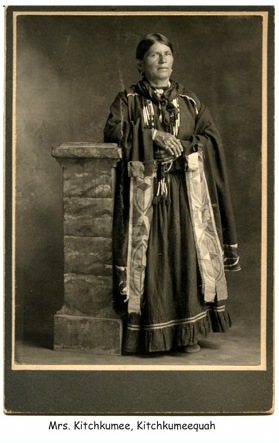
I ran across Francis Kitch-kum-me.  That is very clearly a Native name and I was actually very surprised to see it near 1920.  The registration board had no idea what to do with a hyphenated name like that, so it became Francis Kitch Kum ME in the index.  One would never find it.  The name also bears a striking resemblance to how one says the Native word for Lake Superior, Gitchi gumee.

Francis was born in 1892 in Holy Cross.  He attended Indian School, someplace, where he participated in military drills.  He farms near Mayetta, Kansas.  We have enough information to determine more about Francis.

I began with Mayetta, Kansas, and sure enough, it lead me to a casino, located in Mayetta, owned by the Prairie Band Potawatomi Nation.

The Mshkodésik (“People of the Small Prairie”) division of the Potawatomi were originally located around the southern portions of Lake Michigan, in what today is southern Wisconsin, northern Illinois and northwestern Indiana.  One of the draft registrants with a Native name gave his next of kin as living in Wisconsin.

As part of the Council of Three Fires (Ojibwas, Potawatomi and Odawas) , the Prairie Band were signatories to the 1829 Treaty of Prairie du Chien. Independently of the Council of Three Fires, the Prairie Band were also signatories to the 1832 Treaty of Tippecanoe as the Potawatomi Tribe of Indians of the Prairie.

Under the Indian Removal Act, the Prairie Band were forcibly relocated west, first to Missouri’s Platte Country in the mid-1830s and then to the vicinity of Council Bluffs, Iowa in the 1840s, where they were known as the Bluff Indians. The tribe controlled up to five million acres at both locations. After 1846, the tribe moved to present-day Kansas. At that time, the reservation was thirty square miles which included part of present-day Topeka.

On their website, the tribe provides both a brief history and a historical timeline. It’s interesting that the Potawatomi settled in Michigan in about the 1400s and begs the question of where they lived previously.

One thing is for sure, the Potawatomi weren’t terribly different from other tribes.  We think today of tribes as stable, staying and living in one place, but they weren’t always that way.  Just in this brief timeframe, we track the Potawatomi to Michigan, from Michigan (Great Lakes area) to Missouri, Iowa and finally Kansas about 1840.  And that just takes into account the time we have knowledge of from about 1400 through the mid-1800s.  Where they were and what happened to them in the hundreds of preceding years is still a mystery.

When you visit the tribe’s website, don’t miss the wonderful “Historic Image Gallery.”

Posted in History, Kansas, Michigan, Ojibwa, Ottawa, Potawatomi | 1 Comment

X Marks the Spot

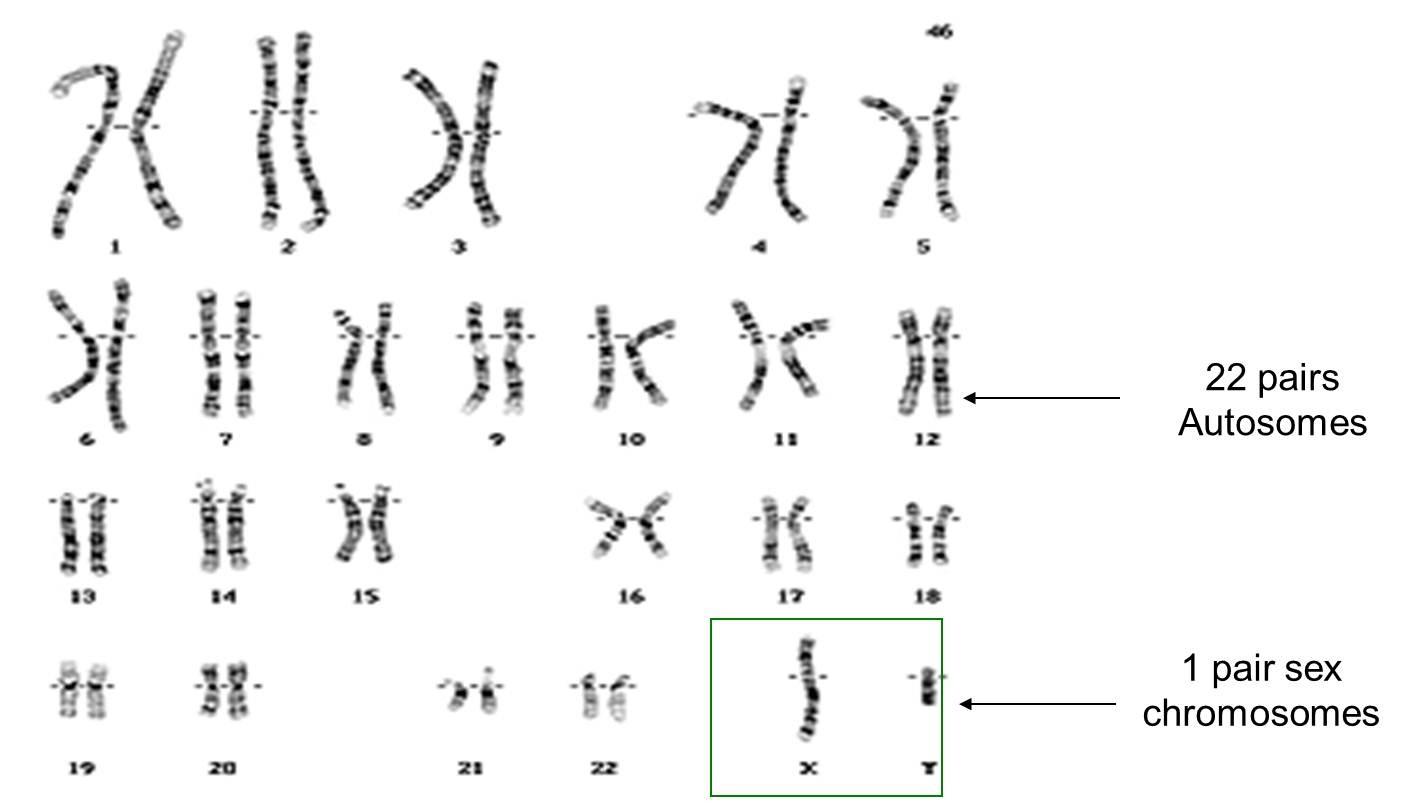
When using autosomal DNA for genetic genealogy, the X chromosome is a powerful tool with special inheritance properties.  Many people think that mitochondrial DNA is the same as the X chromosome.  It’s not.

Mitochondrial DNA is inherited maternally, only.  This means that mothers give their mitochondrial DNA to all of their children, but only the females pass it on.  So tracking mitochondrial DNA back up your tree, it goes to your mother, to her mother, to her mother, until you run out of direct line mothers on that branch.  The mitochondrial DNA is shown by the red shading below.  The Y chromosome is blue.

Mitochondrial DNA is not one of the 23 chromosomes you obtain from both of your parents.

The X chromosome is different.  The X chromosome is one of the 23 pairs of chromosomes.  The 23rd pair is the pair that dictates the gender of the child.  If a child has an X and a Y, it’s a male.  Remember that the father contributes the Y chromosome to male children only.  If the child has two X chromosomes, it’s a female.

The inheritance patterns for the X chromosome for males and females is therefore different.  Men inherit only one X chromosome, from their mother, while women inherit two Xs, one from their mother and one from their father.  In turn, their parents inherited their X in a specific way as well.  All ancestors don’t contribute to the X chromosome.

In my paper published in the Journal of Genetic Genealogy (Vol. 6 #1) in the fall of 2010, in a paper titled Revealing American Indian and Minority Heritage Using Y-line, Mitochondrial, Autosomal and X-Chromosomal Testing Data Combined with Pedigree Analysis, in addition to other types of analysis, I analyzed my X chromosome and what it told me about where some of my Native and African inheritance came from.

At that time, the only company returning ethnicity information about the X chromosome was deCode genetics.  My X chromosome showed that I carried Native American heritage on the X chromosome as well as on some other chromosomes.

I’m going to share the part of this paper involving the X chromosome and how it can be used genealogically and in particular, to identify candidates who could have contributed this Native and African ancestry.

Blaine Bettinger granted me permission to use 2 charts in the paper and again for this blog.  Thanks much, Blaine.  He originally published them on his blog, The Genetic Genealogist, in December 2008 and January 2009 in his blogs about how to use the X chromosome for genealogy.

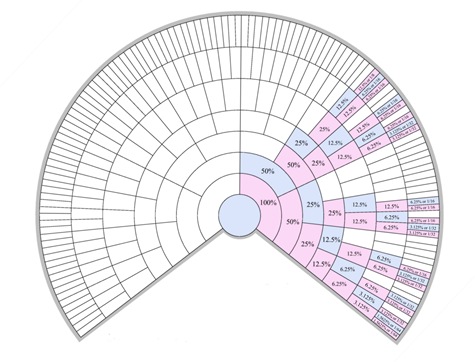
The first chart shown below is the male’s X chromosome inheritance chart.  You can see that he only obtains his X chromosome from his mother who inherited it from both her mother and father, but only from some of her ancestors on either side.

The next chart is the female’s inheritance chart.  She obtains her X from both of her parents.

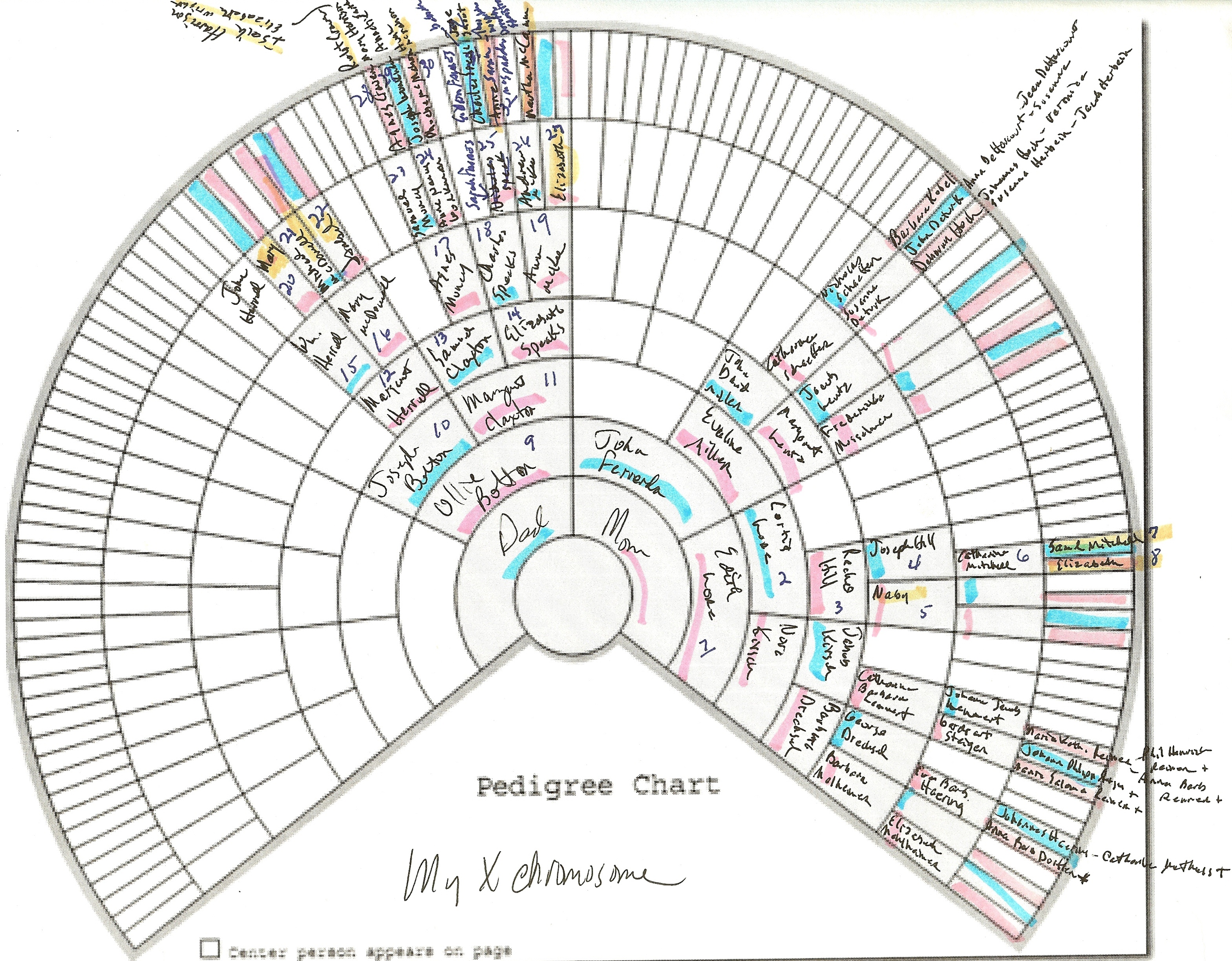
Blaine color coded these, pink for females and blue for males, so I was then able to quickly use them to fill in my ancestor’s names.  I know this next chart looks messy, but it’s what I did and I still refer to this regularly.  I don’t’ expect you to READ this, I expect you’ll DO something like this with your own pedigree chart.  So excuse the look into my messy closet:)

I numbered the slots so that I could work with them later.

The results were quite surprising.  The first thing that became immediately evident is that I didn’t have to worry about a few lines.  On the chart below, you can see that my mother’s German lines could be immediately eliminated, because we know they were not the source of the Native American heritage.

This leaves only three individuals on the mother’s side as candidates for Native ancestry.  Those are the numbered slots between the German lines.

The people below correspond to the numbered slots above.  See, I told you that you didn’t need to read the chicken scratch chart.

5 – Naby (probably short for Abigail), last name unknown but may be Curtis, born in Connecticut in about 1793.

7 – Capt. Samuel Mitchell, born probably about 1800, possibly in Kittery, Maine or possibly in Europe, mother unknown.  This line is probably eliminated.

8 – Captain Mitchell’s wife, Elizabeth, last name unknown

Using the pedigree chart, we narrowed the mother’s side from 21 possible slots to 5 with one more probably eliminated.  Of these, mitochondrial DNA sampling of the descendants of the two women whose last name is unknown would produce the answer to the question of maternal Native or African ancestry.

The father’s side is more complex because many of his ancestors immigrated in the colonial era.  Candidates for Native ancestry are as follows:

20 – Mary, wife of John Harrold (Herrald, later Harrell), born about 1750, died in 1826 in Wilkes County, NC.  She was rumored to have been Irish.

21 – Michael McDowell, born 1747 in Bedford Co., Va. – his mother is unknown.  His father was a second generation immigrant who lived in Halifax and Bedford Counties in Virginia.

22 – Isabel, wife of Michael McDowell, probably born about 1750, surname unknown, located in Virginia.

27 – Elizabeth, born about 1765, wife of Andrew McKee of Virginia.

28 – Agnes Craven is the last slot on the chart, but not the last in the line.  Her father was Col. Robert Craven born 1696 in Delaware and was well to do.  His mother is unknown.  Robert’s wife was Mary Harrison, born in Oyster Bay, New York to Isaiah Harrison and Elizabeth Wright.  These lines appear to reach back to Europe but are unconfirmed, probably eliminating these lines.

30 – Phoebe McMahon, wife of Joseph Workman, born 1745 York Co., Pa, daughter of Hugh McMahon, mother unknown.

31 – Gideon Faires’ mother was Deborah, born 1734, possibly in Augusta Co., Va.

32 – Sarah McSpadden’s father was Thomas McSpadden born 1721 in Ireland, eliminating this line.  Sarah’s mother was Dorothy Edmiston whose father was born in Ireland, eliminating that line.  Dorothy’s mother was named Jean and was born in 1696 but nothing further is known.

33 – Martha McCamm, born before 1743, wife of Andrew Mackie of Virginia, parents unknown.

On the father’s side, we began with 13 slots, positively eliminating one and probably eliminating a second, leaving 11.  Of these, 7 could be resolved on the maternal line by mitochondrial DNA testing.  Taken together, this side of the pedigree chart is a much better candidate for both Native and African DNA sources.  Notice all of the females who have no surnames.  These are excellent places to look for Native ancestry.  On my chicken scratch version, these are highlighted in yellow.

While the X chromosomal pedigree chart analysis is not the perfect scenario, the pedigree chart has 128 slots.  Using the X chromosome narrows the candidates to 34 slots.  Genealogy narrowed the slots to 15 and focused mitochondrial DNA testing could narrow them to 6.  Further genealogy research on those ancestors could potentially eliminate them by placing them “over the pond” or by discoveries which would facilitate DNA testing.

Marja and Me

You might recall that Marja and I are also related on our X chromosome.  In this case, since she is from Finland, the probabilities are exactly the opposite.  It’s much less likely that our connection is on my father’s or mother’s British Isles lines, and much more probable that it’s through my mother’s German lines. The early colonial settlers tended to be from the British Isles and certainly the people filling the X chromosome slots from my father’s side appear to be, with names like McDowell, McSpadden, etc.

Mother’s Anabaptist line (Brethren) is the German grouping through my mother’s father and descends from France and Switzerland,although these particiular lines don’t appear to have become Brethren until after immigrating to America.  Marja also has other matches with people from the Anabaptist project.

Those end-of-line people are:

  • Barbara Kobel – born 1713 probably Scholarie Co., NY
  • Anna Maria Deharcourt – born 1687 Muhlhofan, France, died Oley Valley, Berks Co., Pa., probable parents Jean Harcourt and wife, Susanna
  • Veronica – wife of Rudolph Hoch, born 1683 Basel, Switzerland, died 1728 Oley Valley, Berks Co., Pa.
  • Susanna Herbein – born 1698, Switzerland, father Jacob, died 1763 Oley Valley, Berks Co., Pa.
  • Jacob Lentz – born 1783 Wurttemburg, Germany, died 1870, Montgomery Co., Ohio
  • Fredericka Moselman – born 1788 Wurttemburg, Germany, died 1863 Montgomery Co., Ohio

Mother’s Dutch line is eliminated, because it’s through her father’s father.  Marja and I thought that might be a possibility, but we can see from this chart that it is not.  My father also has a Dutch line that was eliminated because it came from his paternal line.

Mother’s Lutheran Palatinate line, end-of-line ancestors show below, is though Mother’s maternal line.

  • Johann Jacob Borstler – born about 1659 Beindersheim, Bayern, Germany
  • Anna Stauber – born 1659, Schaeurnheim, Germany, father Johannes Stauber
  • Johann Peter Renner – born 1679, Mutterstadt, Bayern, Germany
  • Anna Catherina Schuster – born about 1679 probably in Mutterstadt, Germany
  • Maria Magdalena Schunck – born 1688 probably Mutterstadt, Germany, father Johann George Schunck
  • Johann Martin Weber – born about 1700 Mutterstadt, Germany
  • Rudolph Sager and wife Elizabetha – born about 1669 Ruchheim, Bayern, Germany
  • Rosina Barbara Lemmert – born 1669 Mutterstadt, Bayern, Germany
  • Anna Blancart – born 1642 Mutterstadt, possibly French
  • Johann George Hoertel and wife, Anna Catharina – born about 1642, Mutterstadt, Bayern, Germany
  • Matthaus Matthess – born 1695/1715 Rottenback, Bayern, Germany, wife unknown
  • Anna Gerlin – born 1697, Windischerlaibac, Bayern, Germany
  • Johannes Buntzman – born 1695/1720 Fulgendorf, Bayern, Germany
  • Barbara Mehlheimer – mitochondrial line J1c2 – born 1823 Goppsmannbuhl, Bayern, Germany, mother Elizabetha, unmarried

Note that the mitochondrial line is indeed one of the lines that contributes to the X chromsome inheritance path, but only one of many.

So Marja, it looks like we have to be related through one of my British Isles ancestors, listed in the first part of this article, or from one of Mother’s two German groups.  Personally, I’m betting on the German groups, but you never know.  DNA is full of surprises.

The good news is that my mother’s information is also at GedMatch, along with mine and Marja’s, so by process of elimination, we can at least figure out whether to focus on the pink or the blue side of my chart.

Today, downloading your raw results to GedMatch, combined with Blaine’s X charts above, is really the only good way of working with X chromosome matches.  Please note that only Family Tree DNA with their Family Finder test or 23andMe allow you to download your raw data file so that you can upload it to GedMatch.  Ancestry does NOT allow you access to your raw data.

I’m planning to package this article as a pdf file and send it to my X chromosome matches.  You can substitute your information for mine and do the same thing.  Hopefully, your matches will then understand the X chromsome, its unique inheritance properties, and will provide their X end-of-line ancestors for you as well.

If you’d like to take a DNA test, click here.

Posted in DNA | 3 Comments

Tuscarora Names Extracted

One of our blog followers has extracted the names of a number of Tuscarora for thier own use and has submitted the list for our blog readers.  A big hat tip to our benefactor. 

In my Native Names project, I am only including names that are somewhat anglicized.  In other words, the first name, below, Achsaquareesey,would not have been included.  My goal in that project is for people to be able to find an ancestor and those names don’t come forward in time.  However, Cornelius Akus or Okus would be, as would Tom Blount, for example.  This person indicated that they started out to do the same thing, but then realized that sometimes you eventually find the link between a Native name and an anglicized one, and then you know more about the person when you can identify the Native name of the person with the anglicized name.  You can see examples of this with George Croghan and Nicholas Cusick.

The primary source for this information was Chief Elias Johnson’s “Legends, Traditions, and Laws of the Iroquois, or Six Nations, and History of the Tuscarora Indians.”   Other information has been added from other sources as well.  All work beginning at this point is theirs.

ACHSAQUAREESEY – mentioned by Weiser as headman of the Tuscarora, said to be the “wisest and the best”. Oct. 4, 1753

Think this is probably William Chew, otherwise known as Sacarussa, in Skarure, Seh-kwah-ree’?-shreh. Turtle Clan chief, means “spear trailer”.

ADORIES – A Tuscarora chief, present at Treaty at Albany. Aug. 29-Sept 12, 1722 possibly “The-Bear-Cub”, Uh-deh-gwah-denh?-ah’, chief of bear clan.

AGHSEMTEREES – Tuscarora, present at councils in Philadelphia with Six Nations. July 12, 1742 (II)

AGHSONTTERREES – Tuscarora, present at councils in Philadephia. July, 1742

AKIS (or ANGUS) – present at councils at Lancaster. Aug. 11, 1762 Tuscarora, present at the councils at Lancaster. Aug. 12, 1762

AKUS (or AKUS CORNELIUS; OKUS) –  formerly an Indian. Sent to bring messages from  Coursey to Indians. Aug. 3-13, 1682 (I)  interpreter for a council in Albany. He was described  as “formerly an Indian”. Aug. 3-13, 1682 (II)  interpreter, accompanied D. Wessells to Canada.

ATTIUSGU, ATTRUESQUE – Attruesque, Tuscarora, present at councils in Lancaster. June 30, 1744

ATTIUSKA or ATTIUSKU – Tuscarora, present at councils at Lancaster. June, 1744 Signed release of Six Nations lands in Virginia. July 2, 1744

BLOUNT, James – A Tuscarora Chief to whom land reserved by the Tuscaroras is confirmed for the Tuscaroras by an act of the North Carolina legislature. [1748]

BLOUNT, Tom (or BLUNT) – Tuscarora chief who signed preliminary articles of peace with North Carolina. Nov. 25, 1712 Tuscarora chief who negotiated with the government of North Carolina for an exchange of land. June 5, 1717

CANUNOSK – A Tuscarora who was named as one to be brought in as prisoner by the Tuscarora in preliminary articles of peace between Tuscarora and North Carolina. Nov. 25, 1712

CAUNNOSHQUOSHKENOU – Tuscarora who was named as one to be brought in by the Tuscarora, as prisoner, in preliminary articles of peace between Tuscarora and North Carolina. Nov. 25, 1712

CANYHAAG – Tuscarora, present at councils at Philadelphia with Six Nations. July 12, 1742 (II)

CAYADANORA – A Tuscarora Indian who was killed at the battle of Lake George. Feb. 2-27, 1756

CASHIE, Nicholas – A Tuscarora Chief who signed on November 19, 1831, a lease of lands in Bertie County North Carolina, acknowledging the receipt of $3,250 for these lands.

CARIGHWAGE – A Tuscarora sachem who reported to William Johnson on Governor Shirley (of Massachusetts) offering the Six Nations Indians money if they would join the Niagara expedition. July 27, 1755

CHERIGH-WASTHO – Tuscarora, present at councils in Philadelphia with Six Nations. July 12, 1742 (II)

CHERRIGWASTHO – Tuscarora, present at councils in Philadelphia. July, 1742

CHEUNTHARUNTHOO (or CHEUNTHERUNTHOO) – A Tuscarora chief who signed preliminary articles of peace with North Carolina. Nov. 25, 1712

CHEW, William – See also SACHARISSA – A Tuscarora Chief who signed on November 19, 1831, a lease of lands in Bertie County North Carolina, acknowledging the receipt of $3,250 for these lands.

CROGHAN, George – See also ANAGARUNDA; BUCK. July 28, 1756 present at a meeting of Onondagas, Oneidas and Tuscaroras with William Johnson at German Flats.

CUSICK, James- See Geeme.

CUSICK, Nicholas – aka KANATSOYH –  Tuscarora signer to a treaty with the Oneida, Tuscarora, and the Stockbridge dwelling in the lands of the Oneida. Dec. 2, 1794. Signer of the Tuscarora submission to changes in the Treaty of Buffalo Creek. Jan. 15, 1838, signer to an agreement with the Commonwealth of Massachusetts; attached to the Treaty of Buffalo Creek. Jan. 15, 1838. Tuscarora signer to the Treaty of Buffalo Creek. Jan. 15, 1838

CUSICK – A Tuscarora delegate coming from New York to North Carolina to press claim to lands in Carolina. Nov. 12, 1828

DANIEL See also AGHNYEATE; ESSONEYOWALUND; OGHNAWERA; TONEGHSLISHEA; TOWANEAGHHALISE. –  mentioned by Weiser to be one of the headmen of the Tuscaroras. Oct. 4, 1753

DEYIRROAS – chief of the Tuscarora, present at councils in Philadelphia. July, 1742

DIIEROES – one of the chiefs of the Tuscaroras, present at councils in Philadelphia with Six Nations. July 12, 1742 (II)

DIONAGHSCOGHTHA – Tuscaroras, present at councils in Philadelphia with Six Nations. July 12, 1742 (II)

DIONAGHSKOGHHO – Tuscarora, present at councils in Philadelphia. July, 1742

DIDIGHWEGHSON -Tuscarora, present at a council in Philadelphia with Six Nations. July 12, 1742 (II)

DOGHSYTOAWAX – Chief of the Tuscarora, present at councils in Philadelphia. July, 1742

DOGHSYTOWAX – Tuscaroros, present at councils in Philadelphia with Six Nations. July 12, 1742 (II)

EHOTIOSQUOST (or LYSLE, Henry) – a Tuscarora who was named as one to be brought in as prisoner by the Tuscaroras in preliminary articles of peace between Tuscaroras and North Carolina. Nov. 25, 1712

ENASQUANA – Tuscarora, present at the councils at Lancaster. Aug. 12, 1762

EUNQUOROHAU – A Tuscarora who was named as one to be brought in as prisoner by the Tuscaroras in preliminary articles of peace between Tuscaroras and North Carolina. Nov. 25, 1712

GANIGA – Tuscarora, present at councils at Lancaster. Aug. 14, 1762

GEEME (or CUSICK, James) – named in a deposition to receive $125; attached to the Treaty of Buffalo Creek. Jan. 15, 1838, signer to an agreement with the Commonwealth of Massachusetts; attached to the Treaty of Buffalo Creek. Jan. 15, 1838.

GOUROQUAN (or ELM, Peter) – Member of the Second Christian Party; signer to the Oneida submission to the changes in terms of the Treaty of Buffalo Creek. Jan. 15, 1838. Signer to an agreement with the Commonwealth of Massachusetts; attached to the Treaty of Buffalo Creek. Jan. 15, 1838. Tuscarora signer to the Treaty of Buffalo Creek. Jan. 15, 1838

HEUNTHANOHNEH (or HEUNTHANOHNOH) – A Tuscarora chief who signed preliminary articles of peace with North Carolina. Nov. 25, 1712.

HORUNTTOCKON – A Tuscarora chief who was absent at the signing of preliminary articles of peace with North Carolina. Saroonha signed for Horuntockon. Nov. 25, 1712

HWANYOCHTHU – Tuscarora, present at councils at Lancaster. June, 1744

HARICHHENGOCHTHA – Tuscarora, present at councils at Lancaster. June, 1744

JACK, Luther W. -letter to, from J. Bryan Grimes, Secretary of State (North Carolina). Re: lands in Bertie County, North Carolina, formerly held by the Tuscarora Indians. Apr. 5, 1911

JACK, Mark – signer to the Tuscarora submission to changes in the Treaty of Buffalo Creek. Jan. 15, 1838

JACK, Mathew – signer of the Tuscarora submission to the changes in the Treaty of Buffalo Creek. Jan. 15, 1838

JACK, Matthew – A Tuscarora Chief who signed on November 19, 1831, a lease of lands in Bertie County North Carolina, acknowledging the receipt of $3,250 for these lands.

JOHNSON, William – A Tuscarora Chief who signed on November 19, 1831, a lease of lands in Bertie County North Carolina, acknowledging the receipt of $3,250 for these lands.

JEQUARASORA – Signed the land grant and boundary line ratification for the Tuscarora. Nov. 5, 1768

JUHURUATKAK (or PATTERSON, John) – named in deposition to receive $46; attached to the Treaty of Buffalo Creek. Jan. 15, 1838, signer to an agreement with the Commonwealth of Massachusetts; attached to the Treaty of Buffalo Creek. Jan. 15, 1838 signer to the Tuscarora submission to changes in the Treaty of Buffalo Creek. Jan. 15, 1838 Tuscarora signer to the Treaty of Buffalo Creek. Jan.15, 1838

KARRYHOGEANA – Tuscarora, present at councils at Lancaster. June, 1744

KAWNNYHAAGH – Tuscarora, present at councils in Philadelphia. July, 1742

KAWREAROCKKA (or FOX, John) – Tuscarora signer to the Treaty of Buffalo Creek. Jan. 15, 1838, signer to an agreement with the Commonwealth of Massachusetts; attached to the Treaty of Buffalo Creek.

KING, Rut – a Tuscarora Indian who was present at a conference at Harris Ferry, Lancaster. Mar. 29-May 21, 1757 sent as a messenger to Six Nations. Apr. 2, 1757, present at a council at Harris’ Ferry on Apr., 1757.

KANASQUISAT – Tuscarora, present at councils at Lancaster. June, 1744

KANATSOYH (or CUSICK, Nicholas) –  Tuscarora signer to a treaty with the Oneida, Tuscarora, and the Stockbridge dwelling in the lands of the Oneida. Dec. 2, 1794. Signer of the Tuscarora submission to changes in the Treaty of Buffalo Creek. Jan. 15, 1838, signer to an agreement with the Commonwealth of Massachusetts; attached to the Treaty of Buffalo Creek. Jan. 15, 1838. Tuscarora signer to the Treaty of Buffalo Creek. Jan. 15, 1838

LENASIOKANA – present at the councils at Lancaster (Tuscarora). Aug. 11, 1762

LONGBOARD – A Tuscarora delegate coming from New York to North Carolina to press claim to lands in Carolina. Nov. 12, 1828 a Tuscarora from New York who went to North Carolina for investigation of Tuscarora leases. June 20, 1803.

MAHANQUANGO – Village on the N. Br. of the Susquehannah populated by Mingoes and several Tuscaroras. June 25, 1756

MILLER, Isaac – A Tuscarora Chief who signed on November 19, 1831, a lease of lands in Bertie County North Carolina, acknowledging the receipt of $3,250 for these lands.

MOUNT PLEASANT, William (or KAWWEAHKA) – An Indian signer to a treaty between the Oneida Indians and the United States. Sept. 16, 1836 named in a deposition to receive $117; attached to the Treaty of Buffalo Creek. Jan. 15, 1838, Signer to an agreement with the Commonwealth of Massachusetts; attached to the Treaty of Buffalo Creek. Jan. 15, 1838, signer to the Tuscarora submission to changes in the Treaty of Buffalo Creek. Jan. 15, 1838, Tuscarora signer to the Treaty of Buffalo Creek. Jan. 15, 1838

NAWOONTTOOTSERE (or NOWOONTTOOTSORY) – A Tuscarora chief who signed preliminary articles of peace with the government of North Carolina. Nov. 25, 1712

NICHAQUANTAQUSAK – Tuscarora, present at meetings with Six Nations at Easton. Oct. 24, 1758

NOUROUHQUOTKAN (or PAGETT, John) – A Tuscarora who was named as one to be brought in as prisoner by the Tuscaroras in preliminary articles of peace between Tuscaroras and North Carolina. Nov. 25, 1712

OGHIOGHSE – Tuscarora, present at councils in Philadelphia with Six Nations. July 12, 1742 (II)

OGHYUCHSY – Tuscarora, present at councils in Philadelphia. July, 1742

OHUWAASEH – Tuscarora, present at councils in Philadelphia. July, 1742, Tuscarora, present at councils in Philadelphia with Six Nations. July 12, 1742 (II)

ONOCK-KALLYDUONY (or ONOTHKALLYDOWY; WATSATHUAS; WATSATUHA; WATSATUHHA) – Signed a release of Six Nations land in Virginia. A Tuscarora [Oneida]. July 2, 1744 (I) & (II) present at the Albany Conference; said to be from Oneido. Aug. 6, 1754

ONOHOQUAGA – Tuscarora from this village on the upper Susquehannah present at the councils at Lancaster. Aug. 11, 1762

ONONDIA. See BAUDE DE FRONTENAC ET DE PALLUAU, Louis de. ONONGHSAWANGHTE (or ANONGHSAWANGHTI; ONONGHSAWENGTI) – Signed the treaty of Fort Stanwix (1784) for the Tuscarora. Oct. 22, 1784, a Tuscarora sachem who signed a deed of land from the Six Nations to the Commonwealth of Pennsylvania, at Fort Stanwix. Oct. 23, 1784

ONUCKNAXQUA (or ONICHUAGUA; ONISKUAAGUA) – A Tuscarora [Oneida], signed release of Six Nations lands in Virginia. July 2, 1744 (I) & (II)

ONUGHSOEWUGHTY – Tuscarora, present at councils in Philadelphia. July, 1742

ONUGHSOWUGHTE – Tuscarora, present at councils in Philadelphia with Six Nation. July 12, 1742 (II)

ORONTAKAYON (NIXON, John) – Tuscaroras signer to the deed for the Susquehannah country at the Albany Conference. Aug. 6, 1754 return of John Nixon noted. Apr. 8, 1756

OTAHGUAWNAWWA (or JACOBS, Samuel) – Signer to an agreement with the Commonwealth of Massachusetts; attached to the Treaty of Buffalo Creek.  Jan. 15, 1838 signer to the Tuscarora submission to changes in the Treaty of Buffalo Creek. Jan. 15, 1838  Tuscarora signer to the Treaty of Buffalo Creek. Jan. 15, 1838

OTQUAHIG – Tuscarora, present at councils in Philadelphia. July, 1742  

OT-QUEHIG – Tuscarora, present at councils in Philadelphia with Six Nations. July 12, 1742 (II)

PETER, Daniel (or TUNAKSHEAHAN) – A signer of a treaty between the Oneidas of Green Bay, Wisconsin and the United States. Sept. 16, 1836 signer to an agreement with the Commonwealth of Massachusetts; attached to the Treaty of Buffalo Creek. Jan. 15, 1838 Tuscarora signer to the Treaty of Buffalo Creek. Jan. 15, 1838

PRINTUP, George L. – Signer to the Tuscarora submission to changes in the Treaty of Buffalo Creek. Jan. 15, 1838

PRINTUP, Jonathan – A Tuscarora Chief who signed on November 19, 1831, a lease of lands in Bertie County North Carolina, acknowledging the receipt of $3,250 for these lands.

RADT – “A Tuscarora Chief” present at a meeting with William  Johnson. May 20, 1756

RALICHWANONACHSHY – Tuscarora signer to the deed of 1749; enclosed in the proceedings to the councils at Easton. July 21-Aug.7, 1757

ROANOKE RIVER (or KONENTCHENAKE; MORRATOCK RIVER) – A deputation of Tuscaroras from New York arrive in North Carolina for the purpose of ceding land on the River Roanoke. Oct. 18, 1802. Konentchenake, given as the Indian name for the Roanoke River. Aug. 14-Dec. 1, 1722

RUTH – A Tuscarora, present at the Treaty of Fort Johnson. Apr. 3, 1756

SACAREESA – A Tuscarora delegate from New York who went to North Carolina for investigation of Tuscarora leases. June 20, 1803

SACHARISSA (or WILLIAM, Chew) – Named in deposition to receive $115; attached to Treaty of Buffalo Creek. Jan. 15, 1838, signer to an agreement with the Commonwealth of Massachusetts; attached to the Treaty of Buffalo Creek. Jan. 15, 1838. Signer to the Tuscarora submission to changes in the Treaty of Buffalo Creek. Jan. 15, 1838, Tuscarora signer to the Treaty of Buffalo Creek. Jan. 15, 1838

SACHQUACHNUCHTY – Tuscarora, present at councils at Lancaster. June, 1744

SAGADDIO – Tuscarora, present at councils in Philadelphia. July, 1742

SAGOCHSIDODAGON – Tuscarora signer to the deed for the Susquehannah country at the Albany Conference. Aug. 6, 1754

SAGOWITHA (or PRINTESS, Jonathan; PRINTUP, Jonathan) – Tuscarora signer to the Treaty agreement between the Menominee and the Indians of New York purchasing lands Sept. 23, 1822; documents enclosed in the Treaty with the Menominee. Feb. 8, 1831 deposition agreeing to pay him $93; attached to the Treaty of Buffalo Creek. Jan. 15, 1838 signer to the Tuscarora submission to the changes to the Treaty of Buffalo Creek. Jan. 15, 1838

SAHEWASH – Tuscarora, present at councils at Lancaster. June, 1744

SAIADIO – Tuscaroras, present at councils in Philadelphia with Six Nations. July 12, 1742 (II)

SALIGHWANAGHS – Tuscaroras, present at councils in Philadelphia with Six Nations. July 12, 1742 (II)

SALLIGHWANONAGHEY – Tuscarora, present at councils in Philadelphia. July, 1742

SAROONA – A Tuscarora chief who signed preliminary articles of peace with North Carolina. Nov. 25, 1712

SAWANTAGA (or SA-WANTKA) – Tuscarora present at a council at Stenton. Sept. 28, 1736 chief of the Tuscaroras, present at councils at Philadelphia with Six Nations. July 12, 1742 (II)

SAWANTKA – Chief of the Tuscarora, present at councils in Philadelphia. July, 1742

SAWUITKA – A Tuscarora chief, present at Treaty at Albany. Aug. 29-Sept. 12, 1722

SAWUNGA (or SAWUNGTHE; SAWUNTGA) – Signer to the 1736 deed in Philadelphia with the Penn family concerning lands in the Susquehannah country. Aug. 6, 1754, signer to a deed in 1736 where Six Nations relinquished lands east to the Delaware River; enclosed in the proceedings of the councils at Easton. July 21-Aug. 7, 1757  Tuscarora signer to a deed relinquishing Six Nations lands in Lower Pennsylvania in 1736; enclosed in the proceedings of the councils at Easton. July 21-Aug. 7, 1757

TACARCHER – Tuscarora, present at councils in Philadelphia with Six Nations. July 12, 1742 (II)

TAHANATAKQUA – Tuscarora, present at councils in Philadelphia with Six Nations. July 12, 1742 (II)

TAHANNASACHQUA – Tuscarora, present at councils in Philadelphia. July, 1742

TAHAWEGHTON – Tuscarora, present at councils in Philadelphia. July, 1742

TAKARREHERCHODATTUPEH – Tuscarora, present at councils in Philadelphia. July, 1742

TESHAUSOMEU – Tuscarora, present at a council in Philadelphia. Aug. 20, 1736

TEYELLIGHWEGHSON – Tuscarora, present at councils in Philadelphia. July, 1742

THANALYWA – Tuscarora, present at councils at Lancaster. June, 1744

THARONDAWAGEN. See THARONDAWAGON.

THARONDAWAGON (or THARONDAWAGEN) – Signed the Treaty of Fort Stanwix (1784) for the Tuscarora. Oct. 22, 1784, a Tuscarora sachem who signed a deed of land from the Six Nations to the Commonwealth of Pennsylvania, at Fort Stanwix. Oct. 23, 1784.

THAUTONDAUWAUGON – Tuscarora signer to a treaty with the Oneida, Tuscarora, and Stockbridge dwelling in the lands of the Oneida. Dec. 2, 1794

THAWEEHTU – Tuscarora, present at councils at Lancaster. June, 1744

THIGHROROTIA – Tuscarora, present at councils at Onondaga. Sept. 10, 1756

TIONASKACTO – Tuscaroras, present at councils at Lancaster. Aug. 14, 1762

TISTSAGHTON – Tuscaroras signer to the deed for the Susquehannah country at the Albany Conference. Aug. 6, 1754

TOGODAHAKON – Tuscarora, present at councils at Lancaster. June, 1744

TOHASAANGARROROUS (or TOHASHWA; TOHASHWANGARUS; TOHASHWAUROROW – Signed a release of Six Nations land in Virginia. July 2, 1744 (I) & (II) Tuscaroras signed to the deed for the Susquehannah country at the Albany Conference. Aug. 6, 1754.

TOHAWEGHTON – Tuscarora, present at councils in Philadelphia with Six Nations. July 12, 1742 (II)

TOHODZACHTTU – Tuscarora, present at councils at Lancaster. June, 1744

TOKARRYHOGON – Captain among the Tuscaroras, present at councils in Philadelphia. July, 1742; July 12, 1742 (II)

TONGHGOTHA – Tuscarora, present at councils in Philadelphia. July, 1742

TONGKOTHA – Tuscarora, present at a council at Philadelphia with Six Nations. July 12, 1742 (II)

TOUHQUIANTH – A Tuscarora who was named as one to be brought in as prisoner by the Tuscaroras in preliminary articles of peace between Tuscaroras and North Carolina. Nov. 25, 1712

TRUNTANTIYUO – A Tuscarora who was named as one to be brought in as prisoner by the Tuscaroras in preliminary articles of peace between Tuscaroras and North Carolina. Nov. 25, 1712 

TUFFDICK, Whitmill – A Tuscarora chief through whom lands were secured for the Tuscaroras via an act of the North Carolina legislature. May 2, 1778

TUWAIADAIHQUA – Tuscarora, present at councils at Lancaster. June, 1744

TUWAISDACHQUA (or TAWAYADACHQUA) – Tuscarora, present at councils in Lancaster. June 30, 1744

TYEROS (or TYEROI; TYIEROX) – present at councils at Stenton. Sept. 28, 1736 Tuscarora signer to a deed relinquishing Six Nations lands in lower Pennsylvania in 1736; enclosed in the proceedings of the councils at Easton. July 21-Aug. 7, 1757, Tuscarora signer to the deed of 1749; enclosed in the proceedings of the councils at Easton. July 21-Aug. 7, 1757

TYIEROX. See TYEROS.

UNATA – See also CANYENQUIHQUOA; JONATHAN. headman of Tuscaroras, present at councils at Easton. Oct. 8, 1758

WARCHIEF, George

YORUGHIANNEGO – Tuscarora, present at councils in Philadelphia with Six Nations. July 12, 1742 (II)

Posted in Tuscarora | Leave a comment

Red Coated Chiefs of the Shawnee

Fletcher Freeman has once again graced us with his research.  Thank you Fletcher!

By Fletcher Freeman

            In my research on the Shawnee Indians I have run across an interesting “Coincidence” spanning 75 years that I have not seen in the history of other tribes.  Three Chiefs adopted British red coats as their “formal” attire.  In fact in my examination of the old paintings of Indians by McKenney & Hall, George Catlin, and others, I have only seen one other Indian dressed in a Redcoat and this was a Mohawk Sachem named Hendrick whose portrait was published in 1755.

            Thomas Hoyter was Chief of the Chowan Indians in North Carolina from approximately 1700-1740.  The Chowan were variously called Chawan, Chowanoke, Chowanoc, Chawanoke, Chuwon and Shownanocs.  Some Indian scholars believe that the Chowan were a branch of the Shawnee Nation due to the similarity in names, name root word, localities,  and pronouncing the “ch” as “sh.”  We are fortunate that an early North Carolina scholar, John Brickell, met and described Chief Thomas Hoyter (Highter) in his 1737 book “The Natural History of North Carolina.”

     “Dinner being ended the Glass went round very merrily and whenever they drank to the Governour they always stiled him by the Name of Brother These three Kings speak English tolerably well and are very wary and cunning in their Discourses and you would be surprised to hear what subtile and witty Answers they made to each Question proposed to them notwithstanding they are in general Illiterate People having no Letters or Learning to improve them King Blunt being the most powerful of these I have mentioned had a Suit of English Broadcloth on and a pair of Women’s Stockings of a blue Colour with white Clocks a tolerable good Shirt Cravat Shoes Hat &c King Durant had on an old Blue Livery the Wastecoat having some remains of Silver Lace with all other Necessaries fit for wearing Apparel such as Shirt Stockings Shoes &c made after the English manner.  King Highter had on a Soldiers red Coat Wastecoat and Breeches with all other conveniences for wearing Apparel like the former And it is to be observed that after their return home to their Towns that they never wear these Cloaths till they make the next State Visit amongst the Christians.

            King Blunt was Chief of the Tuscarora Indians , King Durant was Chief of the Yeopim Indians, and King Highter was Chief of the Chowan who at that time had been reduced to less than 50 people.

            Thomas Hoyter probably received his red coat following the Tuscarora War of 1711 as a reward for assisting the English Colonists in defeating the renegade Tuscarora.  King Blunt was leader of the friendly Tuscarora during this war.

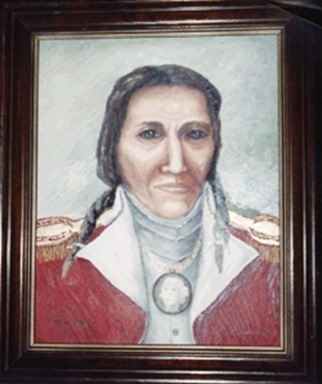
            Blue Jacket was a famous Shawnee War Chief who lived c1743-c1810 in what is now Ohio.  He fought the Americans following the Revolutionary War and was ultimately defeated at the “Battle of Fallen Timbers” by General “Mad Anthony Wayne” and subsequently ceded most of the Ohio Territory to the United States.  In 1792, a white captive by the name of O. M. Spencer was captured near Cincinnati and adopted into a Shawnee family.  He visited Chief Blue Jacket at his home on July 4, 1792 and wrote this description

“His person, about six feet high was finely proportioned, stout, and muscular; his eyes large, bright, and piercing; his forehead high and broad; his nose aquiline; his mouth rather wide, and his countenance open and intelligent, expressive of firmness and decision …. He was dressed in a scarlet frock coat, richly laced with gold and confined around his waist with a part-colored sash, and in red leggings and moccasins ornamented in the highest style of Indian fashion. On his shoulders he wore a pair of gold epaulets, and on his arms broad silver bracelets; while from his neck hung a massive silver gorget and a large medallion of His Majesty, George Ill. Around his lodge were hugh rifles, war clubs, bows and arrows, and other implements of war; while the skins of deer, bear, panther, and otter, the spoils of the chase, furnished pouches for tobacco, or mats for seats and beds. His wife was a remarkably fine looking woman; his daughters, much fairer than the generality of Indian women, were quite handsome; and his two sons, about eighteen and twenty years old, educated by the British, were very intelligent”

            CHIEF BLUE JACKET as portrayed by Isabel Smucker based upon the description given by Oliver Spencer.  It is not an authentic or contemporaneous portrait and none are known to exist.

            Tecumseh was a Shawnee Chief who was born in 1768 and was killed in 1813 by the Americans at the Battle of the Thames in Indiana where he sided with the British during the War of 1812.  He had been a warrior at the Battle of Fallen Timbers and must have known and seen Chief Blue Jacket in his “Red Coat.”  In 1808 a French Trader, Pierre Le Dru, painted a portrait of Techmseh in which he is depicted wearing a red military coat with gold epaulets.  Around his neck is a medallion with the likeness of  King George III.

                                                            CHIEF  TECUMSEH

Posted in Shawnee | 9 Comments

Panics

Why were the Europeans so intent upon “civilizing” the Native people, which is a politically correct word for destroying their existing cultures and way of life?

One answer lies in the fact that they feared the Indians.  Beginning in 1622 with the Jamestown massacre, the Native people after being pushed just so far, would rebel and would raid the European complexes in an attempt to rid themselves of the European infringement and the implied threats associated with the encroachment.  What threats?  Further encroachment, primarily, but that compounded with broken promises, enslaving children and cheating the Indians in business dealings was enough for them to not only distrust, but dislike, the European settlers.  The Europeans were interlopers on the Indian land and they wanted them gone.

The Europeans were prone to bouts of panic.  Some of it quite justified, as in the 1711/1712 timeframe when the Tuscarora of NC decided they had had quite enough, following the sale of their village land by an unauthorized European to settlers.  Indeed, they sought revenge and over 100 settlers were killed. 

So settlers, especially those living on or near the borderland with the Indians were particularly nervous and often sought refuge in forts constructed for group protection when word came that the Indians were on the warpath again.

Often, warnings came though the slaves who were in much closer contact with the Indians than most white people.  In fact, a slave could earn his or her freedom by reporting a potential uprising of either Natives or slaves.

Here’s an actual example, found in the court records of Prince George County, Maryland in March of 1729, page 414 in the deposition of Eleanor Cusheca aged about 22 years.  Unfortunately, her race is not noted.

The court record of her deposition states “that a small time after Christmas last past she was in company with some of Captain Richard Smith’s Negroes and other Negroes belonging to some gentlemen living near the said Smith in the said Smith’s kitchen and Quarter and they were discoursing of a negro man of Mr. John Miller’s (then in company) being returned from the Monocosy Mountains whose name is Harry had absented himself for considerable time from his Master’s service and had come home with an intent to visit his ship mates and he the said Harry informed the company that there were many Negroes among the Indians at Monococy. A Negro man of Mr. Thomas Brooks named Geo: and a negro woman of Colonel Darnall’s named Beck acquainted the rest of the Company that the Indians would shortly come down among the English inhabitants and would kill all the white people.”

The next entry, on page 415, states that the information is groundless, although it doesn’t say how they came to that conclusion.

Posted in History, Jamestown, Powhatan, Tuscarora | Leave a comment