Proving Native American Ancestry Using DNA

Every day, I receive e-mails very similar to this one.

“My family has always said that we were part Native American.  I want to prove this so that I can receive help with money for college.”

The reasons vary, and not everyone wants to prove their heritage in order to qualify for some type of assistance.  Some want to find their tribe and join to reclaim their lost heritage.  Some want to honor their persecuted and hidden ancestors, undoing some of the wickedness of the past, and some simply seek the truth.  Regardless of why, they are all searching for information lost to them.

I’d like to talk about three topics in proving Native Ancestry.  First, I’d like to do some myth-busting.  Second, I’d like to talk a little about conventional research and third, I’d like to discuss what DNA can, and can’t, do for you.

As you read this blog, please click on the links.  I’m not going to repeat something I’ve already covered elsewhere.

Myth-Busting

Myth 1 – Free College

There is no free college for Native Americans.  There are sometimes scholarships and grants available, mostly by the individual tribes themselves, for their official members.

Myth 2 – Joining a Tribe

Many people think that if they can only figure out which tribe their ancestor descends from, they can join.  This is untrue.  Each tribe is a sovereign nation, and they get to determine their criteria for membership.  Most tribes require a specific percentage of Native “blood,” called blood quantum, in addition to being able to document which tribal member you descend from.  Some tribes require as much as 25% Native heritage, and most require at least 1/16th Native heritage, which is one great-great grandparent.  If you don’t know who in your family was a tribal member it’s unlikely that you would be able to meet the blood quantum requirement.

Myth 3 – DNA Testing Will Reveal my Tribe

Generally, DNA testing does not provide us with the information needed to determine a tribe, although it can clearly tell, using y-line or mitochondrial DNA testing, whether your direct paternal or maternal line was or was not Native.  Sometimes you will be able to infer a tribe based on your matches and their documented history, but the definition of tribes, their names and locations have changed over time.  We are working on improving this ability, but the science simply isn’t there yet and the number of Native people who have tested remains small.

Simply put, most federally recognized tribes aren’t interested in more tribal members.  More members mean a smaller piece of the pie for existing members.  The pot of resources, whatever resources you’re discussing, is only so large and it must be shared by all tribal members.

What is a Tribe?

Tribes in the US fall into two categories.  When most people think about tribes they are talking about federally recognized tribes.  Those are tribes that have some continuity with the past, such as they have always been a tribe, or they still retain tribal lands, etc., and the federal government recognizes them as such.  These are the tribes that qualify for government programs and many own casinos.  As you might imagine, with the influx of casino money, the desire to join a tribe has increased significantly.

The second category is non-federally recognized tribes.  Some are state recognized and others, not at all.  State recognition does not in any way guarantee federal or state funding and there are no universal standards for state recognition.  In other words, your mileage may vary, widely.  Non-federally recognized tribes are often run as non-profit entities.  In many cases, these tribes will help people research and document their genealogy and may be more open to tribal membership for those connecting with their Native heritage.

Be aware that some “tribes” that fall into the non-federally funded category may be less than ethical.  Some tend to come and go.  In one case, to apply to join, one had to provide information such as social security numbers and a complete family pedigree including your children. In some cases, membership is very expensive, hundreds of dollars, but is available to almost anyone for the right price.  When evaluating tribes that are not federally recognized, if something sounds fishy, it probably is.  Caution is the watchword.

In general, the federally recognized tribes do not feel kindly towards the non-federally recognized tribes and view them as “fake,” interlopers trying to get part of that pie.  Of course, the non-federally recognized tribes feel differently; that they are reclaiming their heritage denied them.  Native American politics is nothing new and is fraught with landmines.

No federally recognized tribes, to the best of my knowledge, have considered DNA testing as a criteria for membership.  No federally recognized tribe has endorsed or participated in DNA testing that I’m aware of.  This does not mean that individuals have not privately tested.

Traditional Genealogy Research

Given the criteria for membership in federally recognized tribes, traditional genealogy is the only way to obtain the type of information required.  If your family history includes a tribal name, and east of the Mississippi, that most often is Cherokee, contact the various Cherokee tribes to inquire about membership criteria.  If the membership criteria is 25% blood quantum, and you must live on the reservation, you’re toast…..no need to continue that line of research if your goal is to join the tribe.

If your goal is simply to find your Native ancestor, that’s another matter entirely.  Begin by using the traditional research tools.

First, look at where your ancestor or that family line was located.  Did they migrate from elsewhere?  How were they listed in the census?  Was someone listed as other than white, indicating mixed race?  Check the records where they lived, tax records and others to see if there is any indication of non-European heritage.  Remember that your non-white ancestor would have retained their “darker” countenance for at least 2 generations after being admixed.  Many Native people were admixed very early.

So first, check the normal genealogy records and look for hints and traces of non-European ancestry.

Second, turn to Native resources that might reflect the Native people in the areas where your family is or was found.  The Access Genealogy site is absolutely wonderful and has an amazingly complete set of records including searchable tribal rolls.  In addition, I add information almost daily to the Native Heritage Project at www.nativeheritageproject.com, which is searchable.  There are many more resources including several collections at Ancestry.com.

Hopefully, these records will help narrow your focus in your family tree to a particular person or two, not just a general branch.  Family rumors like “Grandma was a Cherokee Princess” are particularly unuseful.  What they more likely mean is that there was indeed some Native ancestry someplace in her line.  Cherokee has become a generic word like Kleenex.  It may also have meant that Indian heritage was claimed to cover much less desirable African heritage.  Institutionalized discrimination existed against any people of color in pre-1967 America, but Indians generally retained some rights that people of African ancestry did not.  Laws varied by state and time.  Take a look at my blog about Anti-Miscegenation Laws and when they were overturned.

Now, let’s look at DNA testing to see what it can do for you.

DNA Testing to Prove Native Ancestry

There are three types of DNA testing that you can do to prove Native Ancestry.  Two are very focused on specific family lines, and one is much more general.

  • Mitochondrial for your direct maternal line.
  • Y-line for your direct paternal line – if you are a male. Sorry ladies.
  • Autosomal to test your ethnic mix and one direct marker test for Native ancestors.

On a pedigree chart, these genealogical lines look like this:

adopted pedigree

You can see the path that the blue Y chromosome takes down the paternal line to the brother and the path the red mitochondrial DNA takes down the maternal line to both the brother and the sister.  Autosomal tests the DNA of all of the 16 ancestral lines shown here, but in a different sort of way.

Let’s look at each type of testing separately.

Y-Line DNA – For Paternal Line Testing for Males

The Y-line testing tests the Y chromosome which is passed intact from father to son with no DNA from the mother. This is the blue square on the pedigree chart. In this way, it remains the same in each generation, allowing us to compare it to others with a similar surname to see if we are from the same “Smith” family, for example, or to others with different surnames, in the case of adoption or Native heritage.  Native American genetics isn’t terribly different than adoptees in this situation, because different English surnames were adopted by various family members, into the late 1800s and sometimes into the early 1900s, depending on the location.

Y-line DNA can tell you whether or not you descend from a common male genealogically when compared to another testing participant.  Small mutations do take place and accumulate over time, and we depend on those so that we don’t all “look alike” genetically.  It can also tell you by identifying your deep ancestral clan, called a haplogroup, whether or not you descend from early Native Americans who were here before contact with Europeans.  For that matter, it can also tell you if you descend from those of African, European or Asian ancestry.

Scientists know today that there are only two primary haplogroups indicating deep ancestry that are found among Native American males who were here prior to contact with Indo-Europeans, and those haplogroups are C and Q3.  It is not accurate to say that all C and Q3 individuals exist only in the American Native population, but the American Native population is part of the larger group worldwide that comprises C and Q3.  We find some haplogroup C and Q3 in Europe but none in African populations, although we do learn more every single day in this infant science.

This sometimes becomes confusing, because the single most common male haplogroup among current Cherokee tribal members who have tested is R1b.  How can this be, you ask?  Clearly, one of three possibilities exists:

  1. The Cherokee (or those tribes who were assimilated into the Cherokee) adopted a European male into the tribe or a European male fathered a child that was subsequently raised as Cherokee.
  2. The R1b ancestor was not adopted into the tribe, maintained their European/American identity but married a Cherokee individual woman and their descendants are recognized as Cherokee today.
  3. There is some level of R1b admixture in the Native population that preceded contact with Europeans that we have not yet identified.

Because of the unique haplogroups for Native Americans who preceded European contact, Y-line is the only way to positively confirm that a specific line is or is not of Native American descent.  This obviously applies to all of the individuals in the pedigree chart who directly descend from the oldest known ancestor in this paternal line.

Y-line testing does not indicate anything about the contributions of the other ancestors in this family tree.  In other words, you could be 3/4th Native, with only the direct paternal line being European, and this test would tell you nothing at all about those other three Native lines.

When ordering DNA tests at Family Tree DNA, which is where I recommend that you test, everyone is encouraged to join projects.  There are several types of projects, but to begin with, you should join your surname project.  Not only does this group you with others whom you are likely to match, but this also assures that you receive the project based discounts.  I blogged about how to find and join relevant projects.

You can test at 12, 25, 37, 67 or 111 marker “locations” on the Y chromosome. I generally recommend 37 or 67 to begin which gives you enough to work with but isn’t terribly expensive.  At Family Tree DNA, you can always upgrade later, but it’s less expensive in total to test more initially.  Right now, 37 markers cost $119 and 67 markers are $199, but a sale is currently underway.

Family Tree DNA also provides significant tools for Y-line DNA as well as Mitochondrial DNA. You can see both Family Tree and Ancestry Y-line results compared on this blog, which shows you how to use both companies’ tools. At Family Tree DNA, for all their tests, you are provided with the e-mail addresses of your matches. At Ancestry and 23andMe, you contact matches through their internal message system. My experience has been that direct e-mails have a better response rate.

The person looking for Native Heritage will be most interested in their haplogroup designation.  If your haplogroup is either Q or C, you’ll want to join your haplogroup project, minimally, as well as other relevant Native American projects, and work with the administrators for further testing.  Remember, neither haplogroup Q nor C are always Native, so deeper testing may be in order.  You may also match others with confirmed Native heritage, including a tribe.

If the haplogroup is not Native, then you’ll have to take a look at possible reasons why.

One can never interpret non-Native haplogroup results of any one line to answer the much broader questions of, “do I have Native heritage”, “how much” and “where?”  What you can do at that point is to continue to test other lines in order to discover the identity of your Native American ancestor.

Obviously, the Y-line test is only for males. Ladies, I feel your pain. However, these next tests are for both sexes.

Mitochondrial DNA – For Direct Maternal Line Testing for Both Sexes

Mitochondrial DNA is inherited by all children from their mother only, with no admixture from the father. Women obtain their mitochondrial DNA from their mother, who got it from their mother, on up the line into infinity. This is the red circle on the right hand side of the pedigree chart. Like Y-line DNA, mitochondrial DNA is passed intact from one generation to the next, except for an occasional mutation that allows us to identify family members and family lines.

Unfortunately, it does not follow any surname. In fact the surname changes with every generation when women marry. This makes it more challenging to work with genealogically, but certainly not impossible. Because of the surname changes in every generation, there are no “surname” projects for mitochondrial DNA, per se, but there are other types of projects.  For example, the Mothers of Acadia project is using mitochondrial DNA to reconstruct the Acadian families including those of Native American heritage.

There are three levels of testing you can take for mitochondrial DNA at Family Tree DNA, which is where I recommend that you test. The mtDNA, the mtDNAPlus and the Full Sequence. The mtDNA test is a starter test that will provide you with a base haplogroup, but will leave people searching for Native ancestry needing a more complete test for full haplogroup identification confirming Native ancestry. I strongly recommend the full sequence test, but if the budget just won’t allow that, then the mtDNAPlus will do until you can afford to upgrade. Family Tree DNA is the only major lab that tests the full sequence region, plus, they have the largest matching data base in the industry.

To put this in perspective for you, the mtDNA and the mtDNAPlus tests both test about 10% of your mitochondrial DNA and the full sequence test tests all of your 16,569 mitochondrial locations. You can then compare them with other people who have taken any of those 3 tests.  Pricing for the mtDNAPlus is currently $139 and the full sequence is $199.

MtDNA testing is not as popular as Y-line testing because it’s more difficult to use genealogically as last names change every generation.  When you look at your matches, you have no idea whatsoever if you might be related to these people in a genealogically relevant time frame by looking at their last names.  Those who have invested the effort to collaboratively work on their mtDNA matches, assuming a full sequence match and a shared geographical history as well, have been pleasantly surprised by what they’ve found.

A haplogroup assigning deep ancestry is provided through mitochondrial testing, so like the Y-line, depending on the haplogroup assigned, you will know if your ancestors were here before European contact.  Maternal haplogroups that indicate Native heritage include A, B, C, D and X.  Like Y-line DNA testing, none of these haplogroups are exclusive to Native Americans, so a full sequence level test will be required to confirm a Native American subgroup.

Testing the Y-line and mitochondrial DNA individually gives us a great deal of very specific information about 2 lines in your pedigree chart.  The best method of identifying Native American ancestors is indeed to test as many lines on your DNA pedigree chart using this methodology as possible.  Let’s take a minute to look at how to create a DNA pedigree chart.

DNA Pedigree Chart

If your Y-line and mitochondrial DNA have proven not to be Native, that doesn’t mean that the rest of your lines aren’t.

Let’s take a look at how to create a DNA pedigree chart so that you can focus your Y-line and mitochondrial DNA testing for other lines.

The purpose of a DNA pedigree chart is to provide guidance in terms of inheritance and also to provide a way of documenting your progress.  My chart is shown below, as an example.
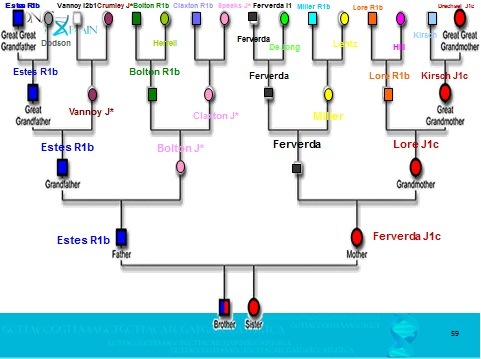
DNA Pedigree

You can see the Y-line of my father and the mitochondrial line of my mother, on both ends of the pedigree chart.  At the top of each line, I have recorded the haplogroup information for each family.  Color coding each line helps in tracking descendants who would carry the DNA of the ancestor of that line.  For example, my mother’s father’s mother’s line is the yellow Miller line.  I need to find a daughter of my grandfather’s sisters, or their children, or their daughter’s children, to test for that mitochondrial DNA line.  Which reminds me, I need to call my cousin.  Family reunions, picnics and holidays are great for this type of thing.  Sadly, so are funerals.

I blogged about how to put together your own DNA pedigree chart.  You can get a free copy and instructions on my website too, at www.dnaexplain.com under the Publications tab.  If you’re Native and adopted, then refer to the adoptee blog instead, or in addition.

But sometimes, we can’t find the right people in order to test, so we move to autosomal testing to help us fill in the blanks.

Autosomal Testing – For Both Sexes – The Rest of the Story 

Autosomal DNA testing tests all of your 23 pairs of chromosomes that you inherit from both of your parents. You get half of each chromosome from each parent. You can see this pattern on the pedigree chart, represented by all of the 16 genealogical lines. Therefore, as you move up that tree, you should have inherited about 25% of your DNA from each grandparent, about 12.5% of your DNA from each great-grandparent, as have all of their other great-grandchildren.

Therefore beginning with your parents, you carry the following approximate amount of DNA from each of these ancestors. I say approximate, because while you do receive exactly 50% of your DNA from each parent, there is no guarantee that their parents DNA was admixed in your parents such that you receive exactly 25% from each grandparent, but it’s close.  You can see the percentages in the chart below.

Generation Relationship % of Their DNA You Carry

1

Parents

50

2

Grandparents

25

3

Great-grandparents

12.5

4

GG-grandparents

6.25

5

GGG-grandparents

3.125

6

GGG-grandparents

1.56

7

GGGG-Grandparents

0.78

Given this chart, if the Native percentage is back beyond 6 generations and drops below the 1% threshold, it’s extremely difficult to discern today.

Autosomal testing will pick up relationships reliably back to about the 6th or 7th generations, and sporadically beyond that.

Autosomal testing provides you minimally with two things.  First, with a list of “cousin matches” by percentage and estimated relationship.  Second, percentages of ethnicity.  It’s this second part that’s most important for the person seeking to prove Native American heritage.

Percentages of Ethnicity

As the field of genetic genealogy has moved forward, research has begun to indicate that certain autosomal markers are found in higher or lower frequencies in different ethnic populations.

For example, if someone has the Duffy Null allele, or genetic marker, we know they positively have African admixture.  We don’t know how much African admixture, or from which line, or when that individual with African admixture entered their family tree, but we know for sure they existed.

Attempting to determine the population frequency of varying markers and what that means relative to other populations is the key to this analysis.  Few markers are simply present or absent in populations, but are found in varying frequencies.  Some populations are widely studied in the research literature, and others are virtually untouched.  Thousands have only been recently discovered as part of the National Geographic, Genographic project.

The process of compiling this information in a meaningful manner so that it can be analyzed is a formidable task, as the information is often found in nearly inaccessible academic and forensic research publications.  It’s difficult to determine sometimes if the DNA analysis of 29 individuals in a small village in northern Italy is, for example, representative of that village as a whole, of northern Italy, or more broadly for all of Italy.  Is it representative of Italy today or Italy historically?  These and other similar questions have to be answered fully before the data from autosomal testing can be useful and reliable.

Having said this, the recent release of the National Geographic, Genographic Project version 2.0 holds great promise.  It’s one of 4 autosomal tests on the market today that provide next-generation chip based wide spectrum testing which replaces the older CODIS type testing.   The difference between the old and new technology is using 15 or 20 markers versus a half a million or so.  They aren’t even in the same ballpark.  If you want to see a comparison of the older type tests, read my paper titled Revealing American Indian and Minority Heritage Using Y-Line, Mitochondrial, Autosomal and X Chromosome Testing Data Combined with Pedigree Analysis.

Let’s take a look at all 4 of the contemporary autosomal tests and what they have to offer.

Genographic 2.0

Of the 4 tests, the Geno 2.0 is the newest and appears to reach back the deepest in time, meaning it may well be picking up anthropological results, not just genealogical results.  We don’t know exactly how the analysis is done, but we do know, in general, that if you evaluate segments, you will get results closer in time than if you evaluate individual ancestry informative markers (AIMS).

You can take a look at the results of a man with Native ancestry on both his paternal and maternal sides.  You can also take a look at the reference populations used by National Geographic in this overview of their test results.

Family Tree DNA

Family Tree DNA sells the Family Finder test. Right now it is priced at $199 or bundled with attractive pricing with either the Y-line or mitochondrial DNA tests. I often like to use this tool in conjunction with the Y-line and mitochondrial DNA tests to see, if you match someone closely, whether you are actually related to them in a recent timeframe or if it is further back. Family Tree DNA is the only one of the autosomal testing companies that has the ability to do this type of advanced comparison.  Compared to 23andMe and Geno 2.0, they are the only ones to offer traditional Y-line and mitochondrial DNA testing which provides individual marker results and matches.

In addition to a list of autosomal matches, you will receive your breakdown of ethnicity, by percent.  The results below are for the same man with Native ancestry whose Geno 2.0 results are shown in the Geno 2.0 – First Peek blog.

native pop finder

You can read more about the Family Tree DNA autosomal product on their FAQ.

23andMe

Another company that sells autosomal testing is www.23andme.com. In addition to a list of cousins, you also receive admixture percentages, and their specialty, health traits.  You also receive a paternal and maternal haplogroup, but with no markers for personal comparison.  These Y-line and mitochondrial results are not as accurate at the Geno 2.0 nor the Family Tree DNA Y-line and mitochondrial DNA full sequence tests.

Be aware that while people who test at Family Tree DNA are interested in genealogy, the typical person at 23andMe tested for the health portion, not the genealogy portion, and may not answer contact requests or may know very little about their family history.

Right now, their test is $99, and you can download your results and upload them to Family Tree DNA for an additional $89, making the total price similar to the Family Tree DNA test. However, you need to be somewhat technically savvy to complete the download/upload process.

23andMe recently released a new version of their software which added quite a bit of resolution after years of being woefully behind.  Native American wasn’t even a category previously.  You can take a look at the new format here.

Ancestry

Ancestry.com recently introduced an autosomal test.  You receive matches and ethnicity percentages.  However, their ethnicity percentages have significant issues and I would not recommend them at this time.  Their cousin matches come with no analysis tools.  So for now, just skip Ancestry and concentrate on the other resources.

One Last Autosomal Test

One marker value in particular, known as D9S919 is present in about 30% of the Native people.  The value of 9 at this marker is not known to be present in any other ethnic group, so this mutation occurred after the Native people migrated across Beringia into the Americas, but long enough ago to be present in many descendants.  You can test this marker individually at Family Tree DNA, which is the only lab that offers this test.  If you have the value of 9 at this marker, it confirms Native heritage, but if you don’t carry 9, it does NOT disprove Native heritage.  After all, many Native people don’t carry it.

To order this test, for existing Family Tree DNA clients, click on the “Order Upgrade” orange button on the right hand side of your personal page, then on “Advanced Test”, then enter “autosomal” in the drop down box, then you will see the list below. D9S919 is the last one and it costs $15.  There may be a $10 one time transfer fee as well if your DNA sample is not in the Houston lab.
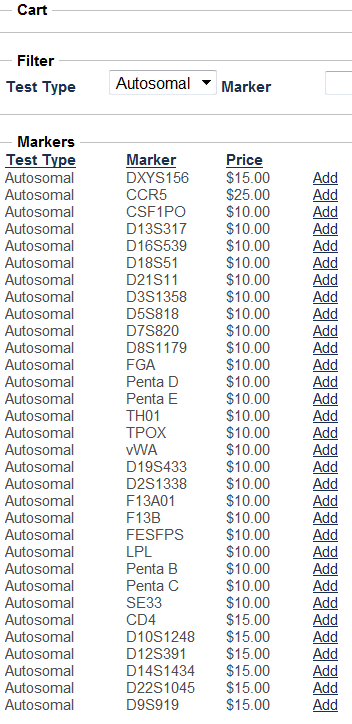
native d9s919 order

Swimming in Many Pools

As you can see there are lots of tools available to you that can be used individually or in conjunction with each other.  Like anything else, the more work and effort you are willing to devote to the search, the more likely you are to be successful.

Most people test their Y-line and mitochondrial DNA, not just for Native ancestry, but to learn more about the lines they can test for themselves without reaching out to other family members.

Use your DNA pedigree chart to plan who to ask in your extended family to test for which lines.

Plan to test with multiple autosomal testing companies.  Autosomal testing in particular is still in its infancy. I like to use the results of multiple companies, especially when you are dealing with small amounts of admixture.  They use different markers, combinations, analysis tools and reference populations, so you can expect slightly different results.  One company may pick up slight minority admixture while another may not.  This has happened repeatedly with both my Native and African minority admixture.

GedMatch

After you obtain your results from either Family Tree DNA or 23andMe, you’ll want to download your raw data results and then upload the file to www.gedmatch.com. This is a privately run “donation” site, not associated with any of the testing companies, meaning there is no subscription or fee to use the tools, but they do appreciate and are funded by donations.

After uploading your results you can utilize several admixture tools to compare and contrast your results.

Getting Help

If you’re struggling with working through your family possibilities for who to test, I do offer a DNA Test Plan service.

If you would like a Personalized DNA Report for Y-line or mitochondrial results, those are available as well.

If you have what amounts to a quick question that I can answer in less than an hour, including prep, I offer the Quick Consult service.

For more extensive consulting, contact me.  You can see my services here.

In Summary

Finding our Native ancestors is a way to pay homage to their lives and to the culture that was stripped from their descendants, ironically, by using their own DNA that has been gifted from them to us.  Native people, after contact with Europeans were marginalized, and that’s the best that can be said.  Many were killed, either intentionally or by European diseases, or enslaved.  The results are that Native people left few if any individual records and those that might be available often can’t be identified or linked to them personally.  For those who cannot unearth their Native ancestry using conventional genealogical means, genetic testing is the last hope left.  Fortunately, the tools and our knowledge improve every day.  We’re making great strides with what we can do, enlarging what was a pinhole into a keyhole, allowing us to peer into the past.  So, click your heels, order your tests and let’s see where your DNA takes you.

If you’d like to order a DNA test, click here.
Posted in DNA | 133 Comments

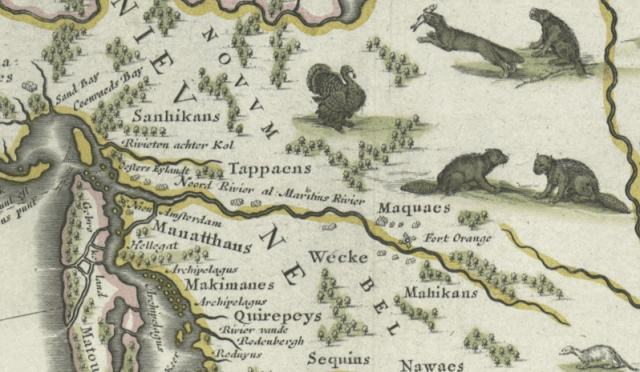
Hudson River 1665 Map

Hudson 1665 map

I love old maps, especially maps which show the locations of tribes and villages of Native people.  I don’t know how many of you have been to New York City and visited Long Island, but suffice it to say, it looks nothing today like it looked in 1665.

On the map above, North is to the right, and you can see the island to the left, along with lots of Native tribal notations.

New York was only a village at that time.  In the painting below from 1664, you can get a good feel for New York City as the village of New Amsterdam of long ago.

New Amsterdam 1664

Posted in Maps, New York | 4 Comments

Scholarships Available to Study on the Mohawk Reserve

Dr. Arwin Smallwood, a history professor at the University of Memphis is coordinating a study abroad opportunity for students to study at the Mohawk Reserve in Canada.  He has asked that this information be passed on to anyone who might be interested.  He has included several links to answer questions.  The following information is from Dr. Smallwood. If you have questions, please contact Dr. Smallwood directly.  His contact information is at the end of this article.

The first link answers questions about scholarships. We offer scholarships for our students here but there are several scholarships available nationally click on the link to the study Abroad Program to learn more about the various scholarships. http://www.memphis.edu/abroad/scholarships.php

I believe other university’s Study Abroad Programs can be applied to our program as well. Please  check with your Study Abroad Program.

This Study Abroad course is on Native American History it is worth 3 credit hours. Here at the University of Memphis these credits would count towards a persons degree. A participant should be able to transfer these credits to their University.

Here is a link to the course but it is only a rough draft.  The trip for example will be only two and a half weeks not four but it gives students a clear idea of where we will go and what they should learn. http://cassian.memphis.edu/history/asmallwd/HIST%204941-Study%20Abroad.html

As for Housing we will be staying on the Mohawk reserve in Kahnawake, at Loyalist College near the Mohawk Reserve at Tyendinaga and at the Bears Inn on the Six Nations Reserve in Grand River. To learn more just click on this link and the embedded hotlinks.

https://memphis.studioabroad.com/index.cfm?FuseAction=Programs.ViewProgram&Program_ID=10400

Finally, I thought students would enjoy this video made by the Mohawks of Kahnawake or as the young Mohawks say “K-Town” http://www.kahnawake.com/video/ktownalone.asp

If you know any students there or at other universities that might be interested please pass on these links to them.

All the best,

Arwin Smallwood

Associate Professor of History

The University of Memphis

Mitchell Hall 121

Associate Professor of History

http://history.memphis.edu/asmallwd/

(901) 678-3869

asmallwd@memphis.edu

Posted in Mohawk | Leave a comment

Finding the Gopah Indians

While transcribing the Carlisle Indian School records I came across a record for Miguel Mooat (sic), a Gopah Indian.  Having never heard of the Gopah Indians, I set out to find what I could about them, using my normally trusty resources, but with absolutely no luck whatsoever.  The only references I could find were to the Carlisle School and two Indians they recorded as Gopah, Miguel and another student named Nicholas J. Pena.

Searching further for Miguel was fruitless, probably because a variant surname spelling, but maybe Nicholas J. Pena would be more productive.  Not only is it rather unique, he also has a middle initial, but the name isn’t so rare that it would be likely to be misspelled.

My first find was a record of Nicholas J. Pena and his sister, and it tells us that he attended the Carlisle School and provides the name of his tribe, which was not Gopah.

The Juliana Pena Calac Papers, donated to Marquette University in the 1990s tell us the following:

Juliana Peña Calac (1893-1967) and her brother, Nicholas J. Peña, were Cupeño Indians from Pala, California. Nicholas attended Carlisle Indian School (Carlisle, Pennsylvania) and the Sherman Institute (Riverside, California).

http://www.marquette.edu/library/archives/Mss/JPC/JPC-sc.shtml

Looking at the Census records, we find Nicholas, but it appears that perhaps there was more than one Nicholas J. Pena, although we do find what appears to be his family in California.

Now that we have a location for Nicholas Pena, the other Gopah student, what we can find for Miguel Mooat?

The 1900 census is actually most useful.  Miguel is a resident at the Carlisle School in 1900, and it gives us his middle initials, C. B.  These initials allow us to find him in the Indian census in 1895, 1898, 1900, 1902 and 1903 telling us that he was born about 1877, but ages vary by a few years as they often do in census records, and that he was part of the Agua Caliente “Warner Con” tribe in California.  Agua Caliente is a location within the Cupeno tribe.  So, apparently the students listed as Gopah were actually Cupeno.

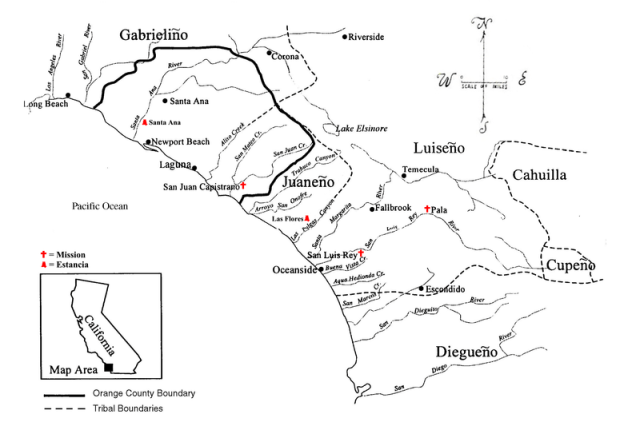
The Cupeno traditionally inhabited lands in California about 50 miles north of the Mexico/California border.  By 1905, in total, there were only about 150 tribal members.  The following map shows the Cupeno language region.

Cupeno language

So where did the word Gopah come from?  Perhaps it is slang or a nickname for a small band or part of a tribe.  If it is a misspelling, it is consistently misspelled, and it’s not similar to any other tribal name.  One of the 2 main villages was spelled Kupa or Cupa, so it’s possible that Gopah is how the people at Carlisle understood what was being said to them.  English was likely a third language for these students, their Native language being their first and Spanish, the second.

You can read more about the Cupeno here:

http://en.wikipedia.org/wiki/Cupe%C3%B1o_people

This is a great site written by a historian about their removal:  http://www.socalhistoryland.mysite.com/article.html

Posted in Cupeno, Gopah | Leave a comment

Geno 2.0 Results – First Peek

The results for males just started coming in yesterday.  One of our blog subscribers with Native ancestry on his paternal and maternal lines was kind enough to allow me to use his results.  You’ll notice that there is no identifying information about you on this page, so if you forward this to someone, and that is something you can do, you’ll need to be sure to sign it with your name.  It comes as a “no-reply” type of e-mail from National Geographic, not from you.

try 1

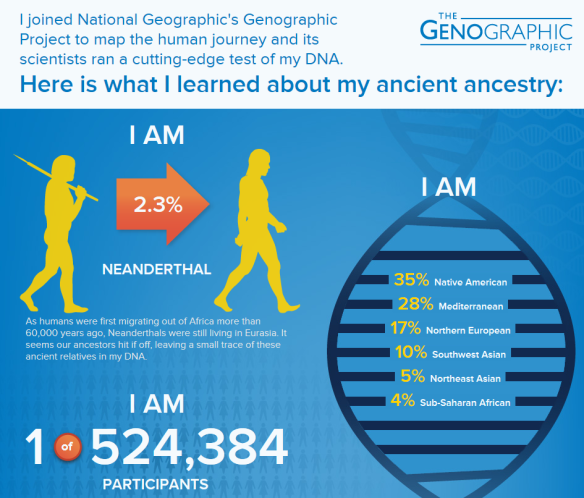
There’s lots of info provided here.  First, you can see how much Neanderthal you carry.  Ok, so no more Neanderthal jokes about your brother-in-law.

You can also see the division of your ethnicity.  Compared to this person’s Family Finder results, this test seems to be more sensitive, picking up admixture not found in Family Finder.  Their Family Finder results were 43% Europe, 5% East Asian (Siberian), 38% Native American and 13% Middle Eastern, rounded to the nearest percent.  It looks like the Native American is about the same, the Middle Eastern may be absorbed by Mediterranean or Southwest Asia, and the Sub-Saharan African is new, but accurate according to this person’s genealogy.

The second half of his display shows both the y-line and mitochondrial DNA map along with the migration path for the haplogroup.  His mitochondrial DNA is B2g1.  This is different from his B2 assigned at Family Tree DNA as a result of the full sequence test.  His Y-line is haplogroup Q with a terminal SNP of Z780.  He had tested for this SNP at Family Tree DNA also (as well as many others), and was classified as Q1a3.

try 2

It’s really exciting to see these results.  Of course, now the questions begin, and there are already a lot of them.  One of the first is about the ability to upload results to Family Tree DNA.  Apparently you cannot do that if you have already SNP tested, have a mitochondrial DNA haplogroup assigned or have taken the Family Finder test.  I sincerely hope this is simply a delay in development and that this will be addressed shortly.  We need this information on our home pages.

Other questions are about the Y-line SNPs, which SNPs are included, and which aren’t, how to reference a new tree to see where you fit, and how has the tree, either the YCC tree at Family Tree DNA or the ISOGG tree, been shuffled.  It’s obvious from seeing results for someone whose terminal SNP has not changed, but whose haplogroup has changed significantly that there has been major surgery to the tree.  It’s difficult to figure out quite what you’re seeing at a deeper level.

And for autosomal of course, there are lots of questions about reference populations.  Dave Dowell has already pointed out that there is a big discrepancy between his Geno 2.0 autosomal results and the ones returned by 23andMe last week.  But 23andMe references 500 years and the Geno 2.0 test is billed as more of an anthropological test, so maybe they are measuring differently.  Plus, there are all those new SNPs Nat Geo discovered and is using.  I’m sure those are making a big difference too.

It’s been a great week or so for genetic genealogy, but yes, lots more questions than answers, so stay tuned.

Update: The Genographic tests are no longer available, but the tests at Family Tree DNA are. If you’d like to take a DNA test, click here.

Posted in DNA | 2 Comments

Seneca George

Seneca George was an Iroquoian Indian who had a special friendship with one Conrad Weiser, a German settler in Pennsylvania.

Conrad Weiser’s father, Johann Conrad Weiser had emerged as one of the leaders in the German community of 1709/1710 immigrants who settled first in Schoharie County, New York in 1712 and then in Berks County, Pennsylvania about 1723.  Living on the frontier and wanting a good relationship with the Indians that surrounded them, Johann Conrad sent his 16 year old son to live with the Mohawks for nearly a year in 1712, in present day Schoharie County, New York.

His son, Conrad developed a special relationship with the Mohawks, was adopted by them, probably into their leader Quainant’s family, and moved between the German and Indian worlds for the rest of his life, although as an adult he lived among the Germans.  Conrad was an interpreter and much loved and respected in both communities.

When Conrad died in 1760, his Iroquois friend Seneca George realized the significance of his passing.  “We, the 7 nations and our cousins are at a great loss and sit in darkness as well as you, by the death of Conrad Weiser as since his death we cannot so well understand one another.”

In August of 1769 an important conference was held in newly formed Augusta Township in Berks County, Pennsylvania. Seneca George, son of the Indian “Captain” Seneca George, had been killed a few miles below the mouth of Middle Creek. The Provincial authorities were very apprehensive that this might produce serious repercussions among the Indians. Peter Read, a relative of the late Conrad Weiser was implicated in the murder and lodged in the Lancaster jail to await trial.

Colonel Turbutt Francis went to Philadelphia and reported the incident to the Provincial Council and impressed upon them the importance of immediately calling a conference with the Indians to be held at Fort Augusta and of presenting the elderly Seneca George and others with presents of condolence. A message of condolence was prepared in behalf of Governor John Penn by Mr. Logan and Mr. Peters. Francis returned post-haste to Augusta Township and immediately dispatched messengers to Seneca George to invite those concerned to meet with him at Fort Augusta.

On Saturday August 19, 1769, Seneca George arrived at the fort accompanied by the Conoy King, Last Night, The Onondaga Chief, Genequant and twenty two other Indians. Fifty inhabitants of Augusta Township also arrived at the fort for the purpose of attending Divine Services to be conducted by the Reverend William Smith, D.D., provost of the College of Philadelphia (Now University of Pennsylvania). Dr. Smith arrived at Fort Augusta just one half hour ahead of Seneca George and his retinue.

That afternoon Colonel Francis met with the Indians with Isaac Still acting as interpreter. Seneca George addressed the group and made two requests; that no strong drink be given to any of the persons on either side of the conference, and that food should be given to him and his party.

Learning that Divine Services were to be held at the fort for the white people who were assembled there, Seneca George sent word that since his people worshipped the same God as the English, they would attend also. Accordingly, Dr. Smith had a congregation of more than 125 persons, fifty additional residents of Augusta Township having arrived early Sunday morning. Rev. Smith directed the latter part of his discourse particularly to the Indians. Isaac Still interpreted it for them. The Indians conducted themselves with great ‘decency all during the services.’

Most of the inhabitants of Augusta Township who had attended the Divine Services remained for the Monday conference. Frederick Weiser, son of the deceased Conrad Weiser, was also in attendance.

Colonel Francis opened the conference by reading the letter of condolence sent in behalf of Governor Penn. He assured the Indians that if found guilty, the person responsible for the death of young Seneca George would be punished the same as if he had killed a white man. The Colonel then symbolically covered the body of the deceased Seneca George with a black shroud, took a handkerchief and wiped away his tears and sorrow, that they should grieve no more, with a belt of wampum, symbolically scraped up the blood that had lain on the ground so that it could be buried under the ground that neither Seneca George nor his friends’ eyes could behold it as they passed where the accident happened. Then taking another belt, Colonel Francis symbolically buried the body of young Seneca George so that none should bear the least ill will towards the English.

Colonel Francis then delivered to Seneca George and his relatives the following presents from Governor Penn: A piece of Black Stroud, a piece of Black half thicks, a piece of Black Striped Duffills, two dark coloured Banbanoe Silk Handkerchiefs, six ruffled shirts, six plain shirts, two pieces of Scarlet and Star Gartering, 50 pounds of Tobacco, four pairs of shoes, four pairs of Buckles, fifteen gallons of Rum in three kegs, two pounds of Vermillion, one dozen Small Brass Kettles and two barrels of Pork.

After the presentation of these gifts, Seneca George brought the conference to a close by stating that they had heard Governor Penn speak through Colonel Francis, and on the morrow would give an answer to what the Governor had said.

On Tuesday, Seneca George sent word that the Indians were not yet ready to reply. The conference was accordingly postponed until Wednesday. In the meantime nearly Fifty Delaware Indians, led by Chief New Aleke, though uninvited, came down the West Branch from the Great Island to attend the conference. The Nantikoke and Conoy refused to permit them to do so, stating they had no business in it. Colonel Francis sent for their leaders and informed them the conference was called for Seneca George and his relatives only. However, Francis gave them some provisions and rum and sent them home.

On Wednesday, when Colonel Francis reconvened the conference, both Seneca George and Last Night, the Conoy King, expressed satisfaction with the Governor’s speech. Last Night presented the Colonel with two strings of wampum and three belts. The conference then took a dramatic turn. Frederick Weiser asked permission to speak.

Addressing the Indians he confessed that it was his brother who had killed young Seneca George; he spoke of the great love which his father, Conrad Weiser, had had for the Indians, that it was an accident which caused the death of the young Indian, but that if the court decided it was murder, the Weisers would not interfere with his punishment. He then presented Seneca George with a gift from the Weiser family which he told him was to wipe away his tears.

As Frederick Weiser spoke, Seneca George, who had been a staunch friend of Conrad Weiser, was filled with emotion. With tears, he arose and expressed his great friendship for Conrad Weiser. Slowly approaching the table where Colonel Francis and the other officials sat, he stated that he held no animosity for the Weisers, and suddenly grasping Frederick Weisers hand, he declared “I have no ill will to you Mr. Weiser, none to you Colonel Francis, nor to you Father (meaning Reverend Smith), nor to you Mr. Stewart.” As he spoke, he grasped each by the hand, and finally with outstretched hands toward the Augusta Township spectators, he said “Nor have I any ill will to any of you, my brethren, the English.”

With this act, Seneca George fades into history.

Posted in Conoy, Delaware, Iroquois, Mohawk, Nanticote, Onondaga | 2 Comments

Pomo Indians

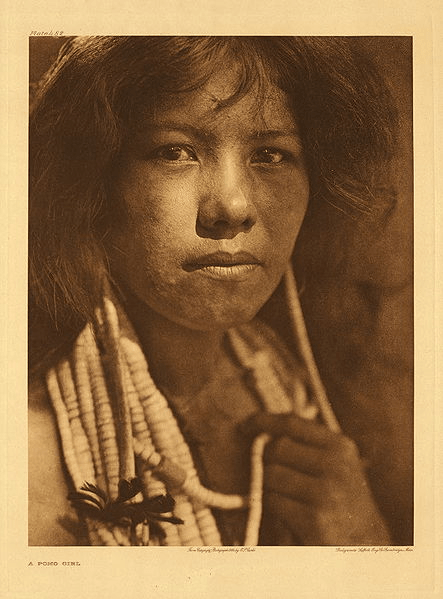
Pomo 1924 Curtis

While working with the Carlisle records, I noticed that there were two students listed as Pomo Indians, Emily Moran and Elmer Busch.  I had never heard of the Pomo tribe, so I took a look to see what I could find.  The picture above was taken of a Pomo woman in 1924 by photographer, Edward S. Curtis.

The Pomo people inhabit northern California near Clear Lake and have a strong mythology of creation and world order. It includes the personification of the Kuksu or Guksu healer spirit, spirits from six cardinal directions, and the Coyote as their ancestor and creator god.

The Pomo people participated in shamanism; one form this took was the Kuksu religion that was held by people in Central and Northern California. It included elaborate acting and dancing ceremonies in traditional costume, an annual mourning ceremony, puberty rites of passage, shamanic intervention with the spirit world, and an all-male society that met in subterranean dance rooms.  The Pomo believed in a supernatural being, the Kuksu or Guksu (depending on their dialect), who lived in the south and who came during ceremonies to heal their illnesses. Medicine men dressed up as Kuksu.

A later shamanistic movement was the “Messiah Cult”, introduced by the Wintun people. It was practiced through 1900. This cult believed in prophets who had dreams, “waking visions” and revelations from “presiding spirits” and “virtually formed a priesthood.” The prophets earned much respect and status among the people.

According to some linguistic reconstructions, the Pomo people descend from the Hokan-speaking people in the Sonoma County, California region. This area was where coastal redwood forests met with interior valleys with mixed woodlands. In this hypothesis, about 7000 BCE, a Hokan-speaking people migrated into the valley and mountain regions around Clear Lake, and their language evolved into Proto-Pomo. The lake was rich in resources. About 4000 BCE to 5000 BCE, some of the proto-Pomo migrated into the Russian River Valley and north to present-day Ukiah. Their language diverged into western, southern, central and northern Pomo.

Another people, possibly Yukian speakers, lived first in the Russian River Valley and the Lake Sonoma area. The Pomo slowly displaced them and took over these places.

Recently, analysis of archaeological evidence has suggested that the indigenous historical economy observed by the Spanish at their arrival in the Pomo lands of central California may have first developed during the Mostin Culture period (8500-6300 BP) in the Clear Lake Basin. This was an economy that was based on women processing acorns by mortar and pestle.

In 1770 there were about 8,000 Pomo people.

In 1800 there were estimated to be 10,000 to 18,000 Pomo in total among 70 tribes speaking seven Pomo languages. The way of life of the Pomo changed with the arrival of Russians at Fort Ross (1812 to 1841) on the Pacific coastline, and Spanish missionaries and European-American colonists coming in from the south and east. The Pomo native to the coastline and Fort Ross were known as the Kashaya. They interacted and traded with the Russians.

The Spanish missionaries moved many of the southern Pomo from the Santa Rosa Plain north to Mission San Rafael at present-day Healdsburg to between 1821 and 1828. Only a few Pomo speakers moved south to Mission Sonoma, the other Franciscan mission, located on the north side of San Francisco Bay. The Pomo who remained in the present-day Santa Rosa area of Sonoma County were often called Cainameros in regional history books from the time of Spanish and Mexican occupation.

In the Russian River Valley, a missionary baptized the Makahmo Pomo people of the Cloverdale area. Many Pomo left the valley because of this. One such group fled to the Upper Dry Creek Area. The archeology surveyors of the Lake Sonoma region believe that European encroachment was the reason why Pomo villages became more centralized; the people retreated to the remote valley to band together for defense and mutual support.  Below, a Pomo Indian in a tule boat in 1924.

Pomo

The Pomo suffered from infectious diseases brought in by new migrants, including measles and smallpox. They did not have immunity to such diseases and fatalities were high. In 1837 a deadly epidemic of smallpox, originating in settlements at Fort Ross, caused numerous deaths of native people in the Sonoma and Napa regions.

In 1851 their population was estimated between 3,500 and 5,000, a dramatic decrease.

The Russian River Valley was settled in 1850 by the 49ers, and the Lake Sonoma Valley was homesteaded out. The US government forced many Pomo on to reservations so that the new Americans could homestead the former Pomo lands. Some Pomo took jobs as ranch laborers; others lived in refugee villages.

On 15 May 1850, after tensions and raids by a band in the area, the 1st Dragoons US Cavalry attacked a different group of Indians as mistaken punishment. They slaughtered from 60-400 people, mostly women and children of the Clear Lake Pomo and neighboring tribes, on an island in Clear Lake. The event became known as the Bloody Island Massacre.

One of the Pomo survivors of the massacre was a 6-year-old girl named Ni’ka, or Lucy Moore. She hid underwater and breathed through a tule reed. Her descendants formed the Lucy Moore Foundation to work for better relations between the Pomo and other residents of California.

One ghost town in the Lake Sonoma Valley excavations was identified as Amacha, built for 100 people but hardly used. Elder natives of the region remember their grandfathers hid at Amacha in the mid-1850s, trying to evade the oncoming immigrants. They tell that one day soldiers took all the people in the village to government lands and burned the village houses.

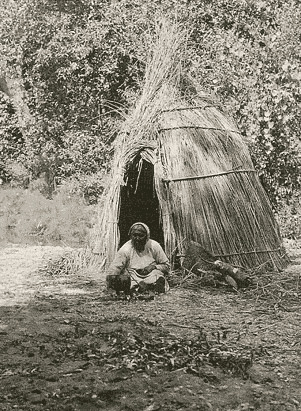
pomo house

By 1880, the population has dropped to an estimated 1450 people. The 1910 Census reported 777 Pomo, but that is probably low. Anthropologist Alfred L. Kroeber estimated 1,200 in the same year. According to the 1930 census there were 1,143.

From 1891 to 1935, starting with National Thorn, the artist Grace Hudson painted over 600 portraits, mainly of Pomo individuals living near her in the Ukiah area. Her style was sympathetic and poignant, as she portrayed domestic native scenes that would have been fast disappearing in that time.  She and her husband were advocates for Native people.

National thorn

National Thorn, above, was the first of Grace Hudson’s 684 popular portraits of Pomo individuals.

You can read more about the Pomo at this link:  http://www.mendorailhistory.org/1_redwoods/pomo.htm

Posted in Pomo | 6 Comments

New 23andMe Worldview Includes Native Americans

23andMe released a new version of their Ancestry Composition – and guess what – my Native Ancestry is shown for the first time.  Yahoo!  It was previously shown at 23andMe as Asian, and the chromosomal locations have changed somewhat as well.

23andMe has greatly improved their product offering, moving from a significantly outdated 3 step ethnicity approach, European, African and Asian, to a multi-tiered, regional platform.

Let’s take a look at what we have today.

Here’s me in my new worldview at 23andMe under the Ancestry Composition tab.  The regions where I have ancestry are brightly colored.

rje world 23andme

Looking at my ethnic breakdown, shown on the right on my page, but shown below here, you can see that I’m 99.4% European, 0.5% Native American and 0.1% unassigned.

rje world 23andme 2

The worldwide breakdown into regions is quite interesting as well.

rjeregion23andme

By highlighting any region item, above, it shows you the corresponding region on your worldview, below.  Pretty cool.

rjeregion23andme2

They’ve updated the Chromosome View as well.  Previously, my Chromosome View looked like this:

rjechromosome view old 23andme

Now, it looks like this, reflecting the new regional ethnicity information.

rjechromosome view 23andme new

Another setting that you can manipulate is found in the drop down box in the upper right corner. It has 3 options, standard estimate, conservative estimate and speculative.  In my case, this changes the results very little, the Native moving around a bit, but the regions within Europe do change.  Be sure to take a look at all of these.  The drop down box is easy to miss.

One thing I do really like about this new rollout is that the X chromosome is included.  You can see it at the bottom of the list.  This is new and has been promised for a long time.

One feature that I would very much like to see is the ability to determine which, if any, of my matches actually match me on the segments determined to be Native American.  I realize that not everyone at 23andMe is interested in genealogy, but if you could contact them and say, “Hey, we match on my Native segment – let’s see if we can find some common ancestry,” it might generate enough interest to garner a response.  I would like to find a way to use these results more effectively.  I think there is a lot of unrecognized potential just waiting to be harvested.

All in all, a significant step forward for 23andMe.  For me, not a lot of new information.  I discovered that I have some Native genes on chromosome 2 in addition to chromosome 1.  My African ancestry picked up elsewhere is missing here.  Fortunately, my Native American heritage is now classified as such, and not Asian.  However, on the speculative view, I still have a smidgen of Asian, likely from the Native American heritage.  I really like the 3 choices in how to display results, conservative, standard and speculative.

As soon as the National Geographic Geno 2.0 ethnicity information is available, I’ll be comparing all the results from the various companies against my known genealogical heritage and taking a look at all of those results combined.  Stay tuned….things are really getting interesting!

Posted in DNA | Leave a comment

Sioux Tribe Purchases Sacred Land

Pe'sla2

I just wanted to follow up on an earlier article.

On November 19th, I posted information about the Sioux Tribes who, as a joint effort, were attempting to raise 9 million dollars to purchase the lands sacred to them by a November 30th deadline.  At that time, they were still 2 million short, but a concerted fundraising effort was underway that included bloggers, celebrities and anyone who might be able to help in any way.

Well, guess what, it worked!!!

The Tribe released their official announcement and have purchased Pe’Sla.

You can read about it at this link:

http://protectpesla.org/in-the-news/tribes-reach-9-million-goal-and-purchase-sacred-site-of-pe-sla

I love happy endings!  Congratulations to the Rosebud Sioux and thanks to everyone who participated and contributed.

Posted in Sioux | 1 Comment

Mittie, Towaconie

I love it when I can find photographs of some of the people I find in the records I transcribe for the Native Names project.  I first find Mittie, noted as a Towaconie Indian, in the Carlisle School records.

Seldom do I locate a photo of a person with only a first name, at least not one that I can connect successful with a record.

That’s not the case, for Mittie.  However, due to significant restrictions, I can’t include her photo, but you can see it by clicking here.  I have to wonder….did Mittie marry?  Who did she marry?  Did her children have surnames?  Are her grandchildren or great-grandchildren reading this blog right how??  Who was Mittie?

The next question is who were the Towaconie?

I found a reference in a treaty and counter offers from Indians to the US government in 1891.  Two Towaconie Indians signed the counter offer, requesting payment for land, Ta Wakaney Jim and Nas as Toe, in addition to several other Indians who sign their tribal affiliation as Wichita, Caddo, Keechie and Delaware.  Note that Ta Wakeney Jim is said phonetically is Tawakoni Jim, or the Tawakoni Indian named Jim.  It’s evident how his name evolved.

There are a few early references to the Towaconie, but today the tribe is known as the Tawakoni, a group closely related to the Wichitas and who spoke a Wichita dialect of the Caddoan language family.  They are part of the Wichita tribe.

At the beginning of the 18th century, the Tawakoni lived in villages in what is now Oklahoma and Texas. In his 1719 expedition, French explorer Jean Baptiste Bénard de La Harpe encountered a Tawakoni village in present day Muskogee County, Oklahoma. The French wrote that the Tawakoni raised corn and tobacco. La Harpe negotiated a peace treaty between the Tawakoni, eight other tribes, and the French government. Hostilities with the Osage pushed the tribe south into Texas.

In Texas, the Tawakoni were closely allied with the Waco tribe. Until 1770, they were friendly to the French but hostile to the Spanish. European-American settlers fought with the tribes in the 1820s, and disease and warfare had dramatically reduced their numbers. Stephen F. Austin’s Republic of Texas drove the tribes out from central Texas. The Tawakoni helped convince the Comanche and the Wichita to sign a peace treaty with the United States government, which became the first treaty signed between Plains Indians and the US. In 1835, they signed a treaty with the United States at Camp Holmes. This was the first time they were included with the Wichita peoples, a practice that continued in subsequent treaties, signed in 1837 and 1846.

In 1853 an Indian reservation was established on the upper Brazos River in Texas, but settlers ultimately forced the tribes off the reservation. In August 1859, 258 Tawakoni people were forced to relocate to Indian Territory. With the Wichita, Waco, Caddo, Nadaco, Kichai, and Hainai tribes, the Tawakoni settled on a reservation in 1872 between the Canadian and Washita Rivers.

In 1894, 126 Tawakoni people were recorded.

Although these tribes resisted the allotment policy outlined in the Dawes Act, their reservation was broken into individual allotments, and “surplus” lands were opened to non-Native settlers on August 6, 1901.

Under the 1934 Oklahoma Indian Welfare Act, they joined other Wichita peoples in organizing a new tribal government.

You can read more about the Tawakoni tribe here:  http://www.accessgenealogy.com/native/tribes/caddo/tawakoniindianhist.htm

.

Posted in Tawakoni, Wichita | Leave a comment