John White Map Chowan Fort Discovery – Analysis

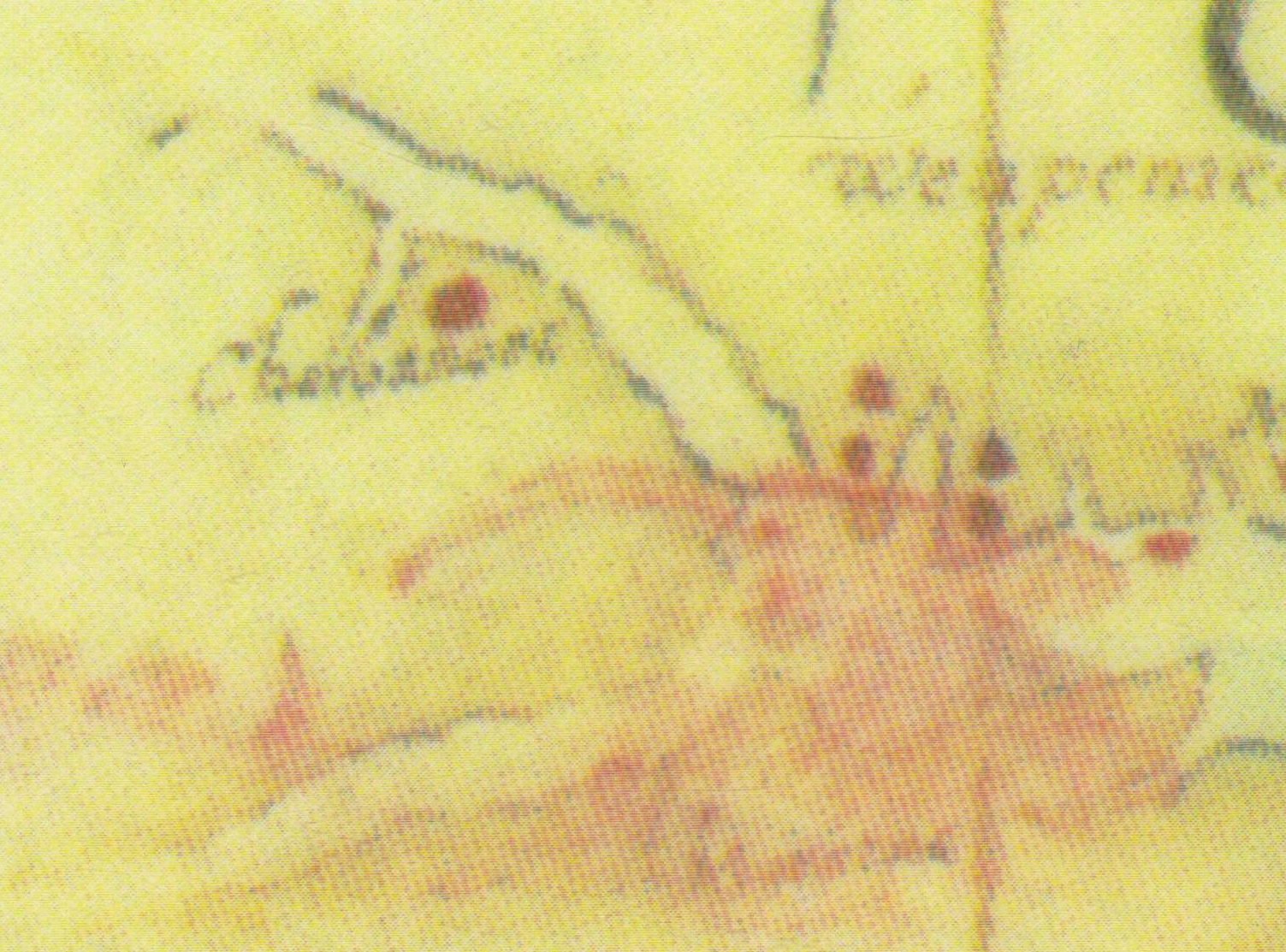
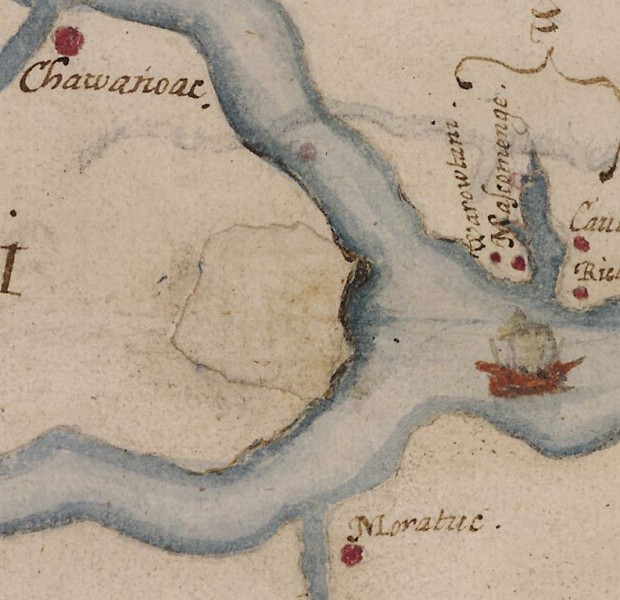
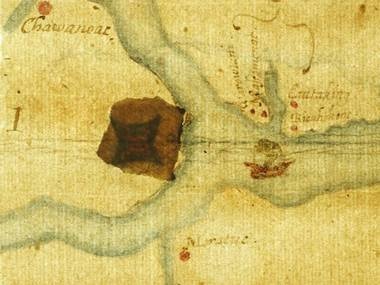
First I’d like to congratulate Brent Lane with the First Colony Foundation for his keen eye in spotting the anomaly on John White’s map drawn of “Virginia” in 1585-1586 and the British Museum for their fine detective work.  The Museum analyzed the map, shown below, and discovered the hidden icon locating a fort at the confluence of the Roanoke and Chowan Rivers under a patch.


An enlargement  of the fort location on the map is provided, below, by the British Museum.  There were actually two fort icons, one on top of the other, and two layers of patches, per  their published technical results.  http://www.britishmuseum.org/research/search_the_collection_database/search_object_details.aspx?objectid=753203&partid=1


This new piece of information is both important and enlightening….and like many news items, has been blown a bit out of proportion.  It has been reported that this is the location where the lost colonists relocated, which at this point, is certainly a leap of logic.   Let’s take a look at what was found, what we know, and the possibilities of what it might mean.

John White was an artist.  He accompanied the 1584 and 1585/1586 military expeditions to what was then called “Virginia.”  Those expeditions, headquartered off of Roanoke Island, were specifically to scout a suitable location for establishing a colony, the “Citie of Raleigh.”  The location chosen was in the Chesapeake region, not Roanoke Island, but a snafu in 1587 resulted in the colonists being literally abandoned in August  on Roanoke Island where the following supply ships would never find them.  They sent John White, then the governor of the “Citie of Raleigh” back to England for supplies which they expected to arrive in the spring of 1588.  

The above map is John White’s map drawn during the 1585-1586 military voyage of discovery.  The military men spent quite a bit of time exploring the region, meeting the natives, learning about the region and potential locations for a permanent colony. 

John White, in 1587 was only on Roanoke Island for a few days before departing again for England, so we know this map was not drawn on that trip.  Prevented from returning to Roanoke in 1588 and 1589 by England’s war with Spain, when he was able to return in 1590, he found the colony removed and the message “CRO” and “Croatoan” carved on both a tree and fort post for him.  If they relocated to the Chowan River location, why would they have carved Croatoan and CRO at the fort?

Before White left, the colonists has discussed moving “50 miles into the main.”  White told us this, but he never revealed the location.

However, the message they left for John White to find up on his return was “Croatoan.”  They had done as they had promised they would, letting John White know where they went.  White, in his own words from his journal, was “greatly joyed that I had safely found a certain token of their safe being at Croatoan which is the place where Manteo was born”, “the island our friends.” 

John White could not have drawn this map in 1590, as he was only on Roanoke Island and only for a day or so before a hurricane blew the ship back to England.  Therefore, John White’s original map had to have been drawn no later than 1586.  However, John could have modified this map anytime between then and his death in 1593.  Someone else could have modified the map, then or later.  But, assuming the modifications were made by White, why would John White cover this location?  And what does this fort location mean?

I’ve read in several news sources in the past few days that this is the final destination of the colonists and indeed, where they went.  While this is certainly one of the possibilities, there are also others, and I’d like to briefly touch upon the various possibilities and the logic for each.

1.  Military Fort – It’s certainly possible that at one time the military colonists of 1585/1586 were planning to built a fort further inland.  If so, this initially looks like a great location, at the juncture of two rivers and fairly easy to defend.  However, there is no indication a fort was ever built there….and the resulting “coverup” patch on the map may indeed only reflect that change of plans and the lack of an eraser.  John White worked in paint, and there was no “White Out” or erasure for that.  His only choice if a planned location did not develop would have been to put a patch over the location.  A second patch on this map indeed is only to show changes to the coastline on the map.

2.  “50 Miles Into The Maine” – This fort icon on the map indeed may be the fabled location recorded in John White’s own words, “at my last departure from them…for at my coming away, they were prepared to remove 50 miles into the maine.”  Given that John White returned to England and was not with the colonists, the only piece of information he could convey is the PLANNED location of “50 miles into the maine.” 

When White left, the relations with the Indians were deteriorating rapidly.  The English had just beheaded Wingina and killed many of his villagers.

John White never knew where the colonists actually went, although he believed, based on what he found, that they went to Croatoan and were safe.  He had arranged with the colonists before he left for a secret token, a cross, to be carved if they were in danger or under duress when they left Croatoan Island.  No crosses were found.  But a clear location, carved twice, was found.

If this fort was the “50 miles into the maine” location, why might John White cover it up? 

There are really only two options.  First is that it was no longer valid, meaning that further discussions or investigation caused them to change their mind about that location.  However, it’s worth noting that no other location is marked and that this region does fit the “50 miles” criteria fairly accurately. 

The second possibility is to hide the location, probably from the Spanish.  Espionage was common in England at this time and the Spanish were actively seeking the colony in order to destroy them. 

3.  The only thing shown on the map is a fort symbol.  We don’t know if this was originally meant to be a military outpost, the new “Citie of Raleigh” or something else.  We cannot assume that this fort was ever built.  In fact, there are no oral histories, or local histories or even rumors of a fort in this location.  It would be difficult to built a fort of the size required to house 117 people without some remnant remaining and being recorded in some type of record. 

By 1654, explorers from the Jamestown region were active in this same area and no fort or remnant of a fort was ever reported, less than 65 years later. 

It should be noted that the Tuscarora have an oral tradition of being descended from the Colonists.  The Hatteras Indians are recorded by Lawson in 1701 as both having an oral tradition along with grey eyes and lighter hair, unlike any other Indians.

4.  In terms of relations with the Indians, the military expedition of 1585-1586 was a disaster as what is known of the 1587 settlement before White departed for England. 

The 1585/1586 military colonists burned the village of Aquascogoc, destroying the corn crop, and therefore the food of the people for the upcoming winter.  These actions were the precipitating factor in the murder of George Howe, one of the 1587 colonists upon their arrival.  In retaliation for Howe’s death, 1587 colonists beheaded Wingina, the chief, and massacred the people in his village across the bay from Roanoke island where they had resettled after leaving Roanoke Island where the English fort was located. 

For a refresher of the events leading up to the 1587 colony, please visit our website at this link:  http://www.rootsweb.ancestry.com/~molcgdrg/faqs/lcstory.htm

Given these aggressions, would it be logical for the colonists to move to a location where they are surrounded by three tribes of Indians, at least one of them known to be hostile and a second likely to be?

Taken from Andy Powell’s book, “Grenville and the Lost Colony of Roanoke,” the following is excerpted from the transcript of the original Barlowe journal from 1585-1586 which was included in the Hakluyt records compiled in 1589.  Several men, with Manteo, rowed upstream in the Roanoke River to the Chowan and up the Chowan for some distance, a total of about 140 miles hoping to find gold or the location of where gold could be found.  The newly discovered fort icon on the map is at the confluence of those two Rivers.  Here’s what Barlowe had to say about that exploratory trip upriver.

“…on the one side whereof stands a great town, called Chowanoake, and the Lord of that town and country is called Pooneno: this Pooneno is not subject to the King of Wingandancoa, but is a free Lord. Beyond this country, there is another king, whom they call Menatoan, and these three Kings are in league with each other.”

Apparently, word preceded their arrival, because many of the Indian towns were entirely deserted.  When leaving, the Indians took their food supplies with them.  Not only did the Englishmen want to learn where valuable ores might be found (gold and silver), they also wanted food, a commodity in scarce supply.  They had not taken enough food with them and presumed they would be able to obtain food from the Indians en route.  In order to obtain cooperation, they kidnapped Chief Menatonon and his son.  In Barlowe’s words:

“I took a resolution with myself, having dismissed Menatonon upon a ransom agreed for, and sent his son into the Pinnesse to Roanoak, to enter presently so far into that River with two double wherries, and forty persons one or other, as I could have victual to carry us, until we could meet with more either of the Moratiks, or of the Mangoaks which is another kind of Savages, dwelling more to the Westward of the said River: but the hope of recovering more victual from the Savages made me and my company as narrowly to escape starving in that discourse before our return, as ever men did that missed the same.”

Note on White’s map the label, Moratuc, just below and across the river from the fort icon.  These Indians were not friendly to the military colonists.  The Chowanac weren’t terribly happy with them either.  Kidnapping the king and his son did not endear the English to the Native people.  Barlowe again:

“I having been enforced to make him privy to the same, to be served by him [Menatonan] of a guide to the Mangoaks, and yet he did never rest to solicit continually my going upon them, certifying me of a general assembly even at that time made by Menatonon at Choanoak of all his Weroances, and allies to the number of 3,000 bows preparing to come upon us at Roanoak and that the Mangoaks also were joined in the same confederacy, who were able of themselves to bring as many more to the enterprise.”

Nor were these tribes friendly towards each other.  Menatonan’s son had also been a prisoner among the Mangoaks, later known as the Tuscarora.  The English sought to find the Mangoaks as they wanted to take some of the people prisoner, as described by the following passage from Barlowe:

“And that which made me most desirous to have some doings with the Mangoaks either in friendship or otherwise to have had one or two of them prisoners, was, for yet is it a thing most notorious to all ye country, that there is a Province to the which said Mangoaks have recourse and traffic up that River of Morattico [Roanoke], which has a marvellous and most strange Mineral. This mine is so notorious amongst them, as not only to the Savages dwelling up by the said river, and also to the Savages of Choanoke [Chowan], and all them to the westward, but also to all them of the main: the countries name is of same, and is called Chaunis Temoatan.”

The fabled mines of Chaunis Temoatan have never been found.

When they did eventually find the Indians which they sought, this was the results, again told by Barlowe:

“…we heard certain Savages call as we thought, Manteo, who was also at that time with me in boat, whereof we all being very glad, hoping of some friendly conference with them, and making him to answer them: they presently began a song, as we thought in token of our welcome to them: but Manteo presently betook him to his piece [probably a gun], and told me that they meant to fight with us: which word was not so soon spoken by him, and the light horsemen ready to put to shore, but there lighted a volley of their arrows amongst them in the boat.”

The reputation of the English had preceeded them.  The Indians on Roanoke island presumed the English would die of starvation.  They did not, and returned to the island with Menatonan’s son as hostage.

When the English settlers arrive in 1587, hard feelings remained among the various mainland tribes.  George Howe was murdered in retaliation for the burning of the village of Aquascogoc.  The English then escalated the conflict and massacred the inhabitants of Wingina’s village.  This action in 1587 just prior to John White’s departure for England, did nothing to endear the English to the Native people.  By this time, they had alienated nearly all of the neighboring Native tribes by either warfare, kidnapping or burning their villages.  They were sitting on a tenderbox and the only tribe who would provide them with assistance would be Manteo’s people, the Croatoan. 

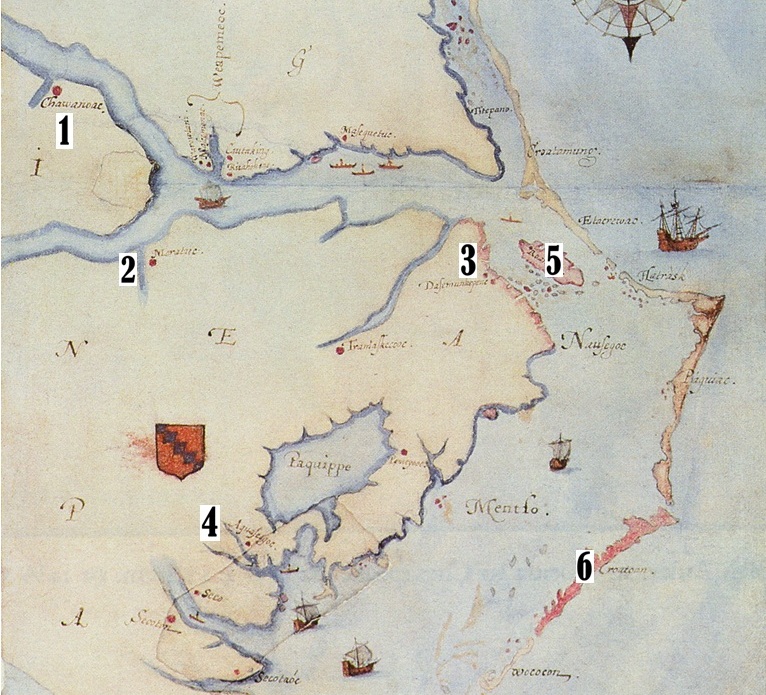
Given this information, I’ve plotted the locations of the events noted above.

1=kidnapping of Menatonan and his son – both Chowanac

2=location of Moratuc [Tuscarora] who fought with Chowanac and fired upon the English.

3=location where English massacred Wingina and the people of his village

4=location of Aquascogoc, burned by the English

5=Roanoke Island, the site of the 1584 and 1585/86 military forts and where George Howe was murdered by Natives in revenge in 1587.  Subsequently, Wingina was murdered across the bay.

6=Croatoan, the location given by the colonists for John White to find when leaving the fort on Roanoke Island

Given the volatile situation in 1587, would you locate 117 English non-military colonists between locations one and two in a fort, or on Hatteras Island among friendly Indians?
 

We can discuss logic and pros and cons today about whether the fort on the map was ever built, and for what purpose, but the real truth about the fort, if it ever existed in reality, lies someplace under about 1200 acres, including a golf course, near Salmon Creek in a location known as Avoca in present day Bertie Co., NC.  We are excited about an upcoming archaeological dig being planned by the Lost Colony Foundation and look forward to their findings.  http://www.firstcolonyfoundation.org/news/2012_white_map.aspx

The above map images are copyrighted by the Trustees of the British Museum.
Posted in Chowan, Hatteras, Tuscarora | 2 Comments

Sir Walter Raleigh’s Lost Fort Found?

For those familiar with the Lost Colony mystery and saga, you’ll know that the location of the final destination of the colonists has been debated for literally centuries.  You can read more about the background at the website www.lostcolonyresearch.org.

In an announcement made May 3rd, it appears that Sir Walter Raleigh’s lost fort may indeed have been found.  This story has all the elements of a good mystery, intrigue, lost clues, hidden maps, invisible ink and messages delivered long after the death of the sender – 425 years to be exact.


It’s as if John White is speaking to us from the grave, revealing the secrets that he kept, or at least tried to conceal.  He did a fine job of that too, almost too fine a job in fact. 

Recently a hint found on an old map may indeed tell the story of where Raleigh’s mysterious fort was placed when the colonists moved “50 miles into the Maine.”  Or maybe, this is where they planned to go, but never went. 

Now, a clue has emerged that experts hope could help solve the centuries-old mystery of the settlers’ disappearance, and lead them to the site of what Raleigh and Queen Elizabeth I hoped would be a capital, the first English attempt at colonisation.

Shown on the photo above, on one of John White’s maps of “Virginia” in the new world is a hint drawn in what appears to be invisible ink, further disguised by a barely-discernible patch of paper glued to it.

Scientific tests have revealed that a lozenge, the symbol for a fort, was hidden on the map drawn by John White, who accompanied Raleigh’s first attempts to establish a colony. Its concealment on the map reflects an age mired in political intrigue – Elizabeth I was then facing plots to place the Catholic Mary Queen of Scots on the English throne – and fears of such a map getting into the hands of court spies were rampant.  Indeed, later, at Jamestown, a map did find its way to the Spanish, so those concerns were certainly justified.

Invisible ink was concocted at that time from milk, citrus juice or urine, and usually revealed by applying heat.

An official announcement was made on May 2nd, and carried at http://www.independent.co.uk/news/uk/this-britain/drawn-in-invisible-ink-is-this-the-site-of-walter-raleighs-lost-colony-7707486.html

The Independent reported that scientific tests were conducted by the British Museum’s curator, Kim Sloan, and scientist, Janet Ambers, following a request by Brent Lane, a professor at the University of North Carolina and a director of the First Colony Foundation, which conducts archaeological and historical research.

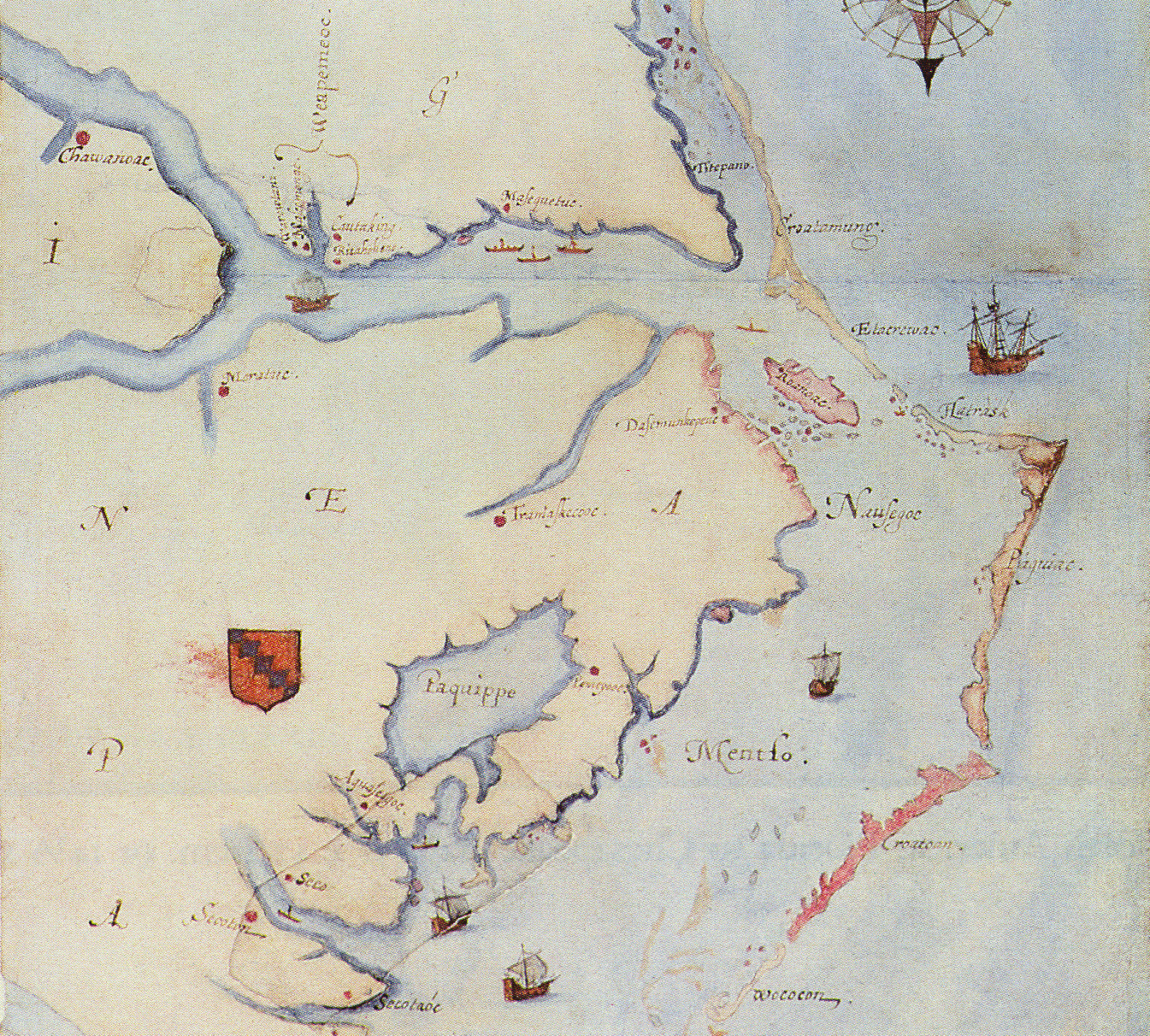
I took the segment of the map shown with the fort in the Independent and attempted to reconcile it to the John White map we are all familiar with. It’s obviously not the same map.  So, with a clue to one mystery, more questions are introduced.  John White created two maps of the region during this period, one much more detailed than the other.

John White’s second map is the one with the patch.  It’s obvious that this is not the same map as shown above.

On White’s second map, shown above and below, the patch at the confluence of the Roanoke and Chowan Rivers is quite obvious, along with a second patch just below Paquippe, today’s Lake Mattamuskeet.  Stay tuned as events unfold and more information becomes available.

Map images are copyright the Trustees of the British Museum.
Posted in History, North Carolina, Virginia | 1 Comment

The Mystery Surrounding Chocolate

I have seen this surname before.  In my own family research, I found people in the census with this last name listed intermittently as mulatto.  Mostly, I found two things interesting about that.  First, that their race was intermittently listed as mulatto, like they were so close they flitted back and forth across that color line.  Secondly, I found the name very interesting.  Not only is it very unique, it’s just quite unusual.  I wouldn’t say that it’s “European,” but it is an English word.  But chocolate itself is not a plant indigenous to North America.  The name falls in to that “isn’t that interesting” category that signals something else is up, but we don’t know what.

Fast forward in time now 15 years or so, give or take 5 or 10, and today, I found a Chocolate family in the 1869 Cherokee West Census.  Just one.  Nancy Chocolate was living in a household with 2 women and no children.  Elderly perhaps.  I wonder if that was 2 women in addition to Nancy, or two women total.  Regardless, when I saw that entry, all of a sudden the Chocolate entry associated with my Virginia Moore family from so many years ago made more sense.

I found the answer though, a few pages further in the census where an Eli Chu-ca-late is listed with 1 female and also a William Chi-ca-late.  Indeed, I think we’ve solved the chocolate mystery.  A Native word that sounded like chocolate to the English ear.

In another few pages we find five Cherokee Chuculate families as well one “colored” family who qualified for citizenship as well, likely former slaves who belonged to the Chuculate family.

Posted in Cherokee, Names | 1 Comment

Jolly Albert

One of the unpublished census records is the 1869 census of the Cherokee Nation West.  This census holds a great deal of information.  The Cherokee Nation West is present day Oklahoma.  The only people who were supposed to be there were indeed Cherokees and their families.

At the end of the Civil War (which was anything but), the Cherokee by treaty agreed to free their slaves and include them in the tribe.  There were certain restrictions on who could be a tribal member.  For former slaves, they had 6 months to moved back to Indian Territory, if they had left, and to apply to join the tribe.  White people could be tribal members, but only if they were married into the tribe.

The great thing about this census is that there are notes about the people and who is eligible for citizenship in the tribe.  No notes at all mean they are citizens. Other notes say  things like “white intruder” and “colored person not eligible for citizenship.”  So in essence, if the people aren’t tribal members, it tells us who they are and why they are living there.

I ran across Jolly Albert.  What a wonderful name.  Who could not like someone named Jolly Albert….and how could Jolly Albert be anything but happy?  In 1869, he surely was, because he was free.  He was noted in the Cherokee West census as a “colored person” which implies by what it does not say, that he is eligible for citizenship.  This means that he was a former slave, now a Freedman.  He probably got his wonderful name as a slave.

I tried to find more about Jolly Albert, but Indian Tribal members were not included in the 1870 or 1880 census.  By 1900, they were included on a special schedule.  We find lots of Alberts living in Indian Territory, but sadly Jolly is not among them, at least not by that name.  He could have passed on by then.  In 1869 he would have been an adult, so born in 1849 or earlier. By 1900, he was at least 50 and possibly significantly older.

Posted in Cherokee, Names | Leave a comment

Liver and Return

No, this isn’t a joke about Pete and Repeat.  Liver and Return are actual first names of two men in the Cah-yar-nee family in 1869 in the Cherokee West Census.  Yes, really!

Not only that, they are the only two men of that surname.  If you were related to Liver and Return, would you claim the same surname?  It appears that Liver might be the son of Return, because Liver has no one living with him and Return has an adult female living with him, 4 male children and 2 females.  Or conversely, Liver could be elderly and the father of Return.

I can hear it now.  What’s your father’s name?  “Liver.”  And my kids thought I embarrassed them in high school.

Let’s hope that he didn’t name one of his sons Return Jr., or in this case,  it would be Return, again.

Posted in Cherokee, Names | 1 Comment

Martin Buzzard-Flopper

Martin Buzzard-Flopper was listed on the 1869 Cherokee West Census.  There were several Buzzards, but only one Buzzard-Flopper.  In his household were 1 woman, 4 male children and 2 female children.

What, exactly, was a Buzzard-Flopper?  I can see a practical joker, one who flops the buzzard. 

I was curious about Martin.  Surely a man with such an unusual name would either be easy to find or impossible.  Easy if he used Buzzard-Flopper, or difficult if this were a one-time name that he decided to use for this census.

Martin it turns out, was easy to find.  He was born sometime around 1838 in Georgia.  He married Peggy Pumpkinpile, another Cherokee.  He served in the Civil War.  He is listed on the Drennan Roll in 1851, but on the Dawes Rolls, his son James changed his name to Martin, from Buzzard-Flopper.  I can’t imagine why.

Martin died between 1876 and 1880, not an old man.  His native name is recorded two different ways, Ah-Yun-Ta-Kee and A-Hu-Lu-De-Gi, the translation given as “he throws away the drum.”  I thought sure it would be “he who flops the buzzard.”  Maybe he threw the drum at the buzzard.

So I have to wonder, are there some Martin families out there today who thinks they are Martins but in reality, they are Buzzard-Floppers and don’t know it?!!

Posted in Cherokee, Names | 10 Comments

Nicholas Cusick – Revolutionary War Patriot, Sachem, Tuscarora Chief

In 1776, there were an estimated 1,810 Indian warriors living in New York. Of them, 230 were friendly to the Americans, the remaining 1,580 had chosen to side with the British.

In contrast to the federal government, New York exempted Indians from service in the Colony’s militia by legislative acts passed in 1778 and 1782.  These were the same acts that also exempted slaves from militia service.

Although many Indians served in the American army, only a few were pensioned. Among them were Honyere Tewahangarahken, an Oneida Indian also known as Honyere Doxtator, and Nicholas Kaghnatsto, a Tuscarora Indian known as Nicholas Cusick.

We will meet Nicholas Cusick, a very highly respected sachem and Tuscarora Chief, again in a future article dealing with the Tuscarora and their land transactions in North Carolina.  

Nicholas Kaghnatsto, a pensioner, served as a Lieutenant under Lieutenant Colonel Louis Atayataroughta, also simply known as Colonel Louis, in Colonel Goose Van Schaick’s Regiment.  He signed his English name, Nicholas Cusick, when he applied for a federal pension. Cusick died sometime before March 1841 as attested to by his son, James, who was then living in Rochester, New York.  Another son lived in Canada and refused to return to the US to collect from his father’s estate.

Nicholas Cusick’s pension application in 1826 shows that he was then about 65 years old, so he was born about 1761, although he was serving in the Revolution by 1777 and in 1779 was holding an officer’s position.  That would be unlikely for a young man of 18, so perhaps he was somewhat older.  His 1828 letter says he was nearly 70 which would put is birth about 1758. Nicholas received a pension and bounty land in Seneca County, NY, 500 acres initially, and apparently an additional 2000 at some point, but his son in a letter to President Filmore says that Nicholas was “cheated of it.”

Nicholas applied for a pension in 1818 for those who were impoverished or disabled.  He lived on the Tuscarora Reservation, and says that the tribe also owns rented land in North Carolina.  Those rents, when received, are divided among the tribe by the “number of souls.”  His only possessions, since the land is jointly held, is a small log cabin, a yoke of oxen, one cow, 12 hogs, 2 old ploughs, 4 hoes, 2 axes, enough corn to feed the stock and the family until next spring “I hope” and an old wagon.  He has cooking utensils and “tabb” furniture which is for the use of his family.  He is also an interpreter and received $200 per year from the government for those services.

He says of himself, “I am in a decrepit state, unable to labor by means of a rheumatic affection which has caused one hip to be displaced.  I am feeble in strength.”  He says his wife is age 57 and can do little for the support of the family.  He goes on to say that he has two daughters who are “dumb” and three children of another daughter who is deceased that he has to support as well.  He signs a declaration that includes the information that he has 10 children. 

Nicholas also served as a gatherer of intelligence during the war, one of the most valuable services that the northern Indians provided to the American Army. On August 23, 1777, he and Johannes Oosterhout, Jr. submitted a lengthy intelligence report concerning the activities of various enemy Indians groups. The report was made available to the New York Council of Safety a few days later.

Honyere Tewahangarahken and Nicholas Kaghnatsto were among a group of twelve Oneida and Tuscarora Indians whose commissions were authorized by the Continental Congress on April 3, 1779.

In total, Nicholas Cusick served in the American Revolution for 5 years.

Posted in Tuscarora | 6 Comments

What is a Johnnycake?

In the 1869 Cherokee West census, there are several families with the surname Johnnycake.  This makes me wonder, what, exactly, is a Johnnycake and what is the history of the food?

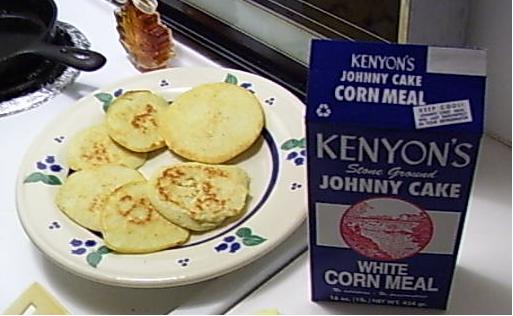
Some think these fried cornmeal cakes were originally called Journey Cakes, while others belive they were first called Shawnee Cakes after the tribe in the Tennessee Valley.  They look much like a cornmeal pancake.   You can find a recipe here:  http://southernfood.about.com/od/cornbread/r/bl01002g.htm

Also spelled Jonnycakes, the earliest attestation of the term “johnny cake” is from 1739 (in South Carolina); the spelling “journey cake” is only attested from 1775 (on the Gulf coast), but may be the earlier form. The word is likely based on the word “Jonakin,” recorded in New England in 1765, itself derived from the word “jannock,” recorded in Northern England in the 16th century.  According to wiki, it is the term was the name given “by the [American] negroes to a cake made of Indian corn (maize).”

The cornmeal flatbread is indigenous to the Native people and is prepared and eaten from Newfoundland to Jamaica.  It’s now a New England staple and is known also as “hoecake” in the south. 

Native Americans were using ground corn for cooking long before European explorers arrived in the New World. The jonnycake originates with the native inhabitants of Northern America; the Algonquians of the Atlantic seaboard are credited with teaching Europeans how to make the food.

Southern Native American culture (Cherokee, Chickasaw, Choctaw, Creek) is the “cornerstone” of Southern cuisine. From their culture came one of the main staples of the Southern diet: corn (maize), either ground into meal or limed with an alkaline salt to make hominy, also called masa, in a Native American technology known as nixtamalization. Corn was used to make all kinds of dishes from the familiar cornbread and grits to liquors such as whiskey and moonshine, which were important trade items. Cornbread was popular during the American Civil War because it was very cheap and could be made in many different sizes and forms. It could be fashioned into high-rising, fluffy loaves or simply fried for a fast meal.

To a far greater degree than anyone realizes, several of the most important food dishes that the Southeastern Indians live on today is the “soul food” eaten by both black and white Southerners. Hominy, for example, is still eaten … Sofkee live on as grits … cornbread [is] used by Southern cooks … Indian fritters … variously known as “hoe cake”, … or “Johnny cake.” … Indian boiled cornbread is present in Southern cuisine as “corn meal dumplings”, … and as “hush puppies”, … Southerners cook their beans and field peas by boiling them, as did the Indians … like the Indians they cure their meat and smoke it over hickory coals.
—- Charles Hudson, The Southeastern Indians.
Posted in Cherokee, Food | 3 Comments

Brafferton School Student List

I’ve been trying to find some way to obtain a copy of the thesis, So Good a Work: The Brafferton School, unpublished Ph.D. dissertation, 1988, Department of History, The College of William and Mary, Williamsburg, Virginia by Karen Stuart.  This document says it’s unpublished but available through Proquest Dissertations and Thesis to universities.  https://digitalarchive.wm.edu/handle/10288/5807

I mean, I’ve got the bloodhounds on this.  Hat tip to Baylus for trying to interlibrary loan it for me into another institution in NC, and to my local librarian for trying to do the same here.  Know what?  Interlibary loan, well “it ain’t what it used to be,” much like that old grey mare.  The University of William and Mary has two copies, won’t copy them, won’t scan them, won’t loan then, won’t do anything with them except let you look at them if you visit there….and maybe that’s assuming too much.  Can you hear my level of frustration?

Why is this so important?  One of the first, if not the first, Indian Schools was at Fort Christanna in Virginia beginning about 1714.  It served all of the Virginia and NC Piedmont remnant tribes who were lumped under the group name Saponi.  Charles Griffin was the schoolmaster there.  In 1718, when Fort Christanna was closed, Charles was transferred to Brafferton, and he apparently took some of the students with him.  A list of students does not exist from Fort Christanna, but this thesis supposedly holds the names of the students that are still in existance from Brafferton.

Googleing my heart out, I did find a reference to one other person, a lady named Sonia, who went to the College to view the thesis about 10 years ago.  She posted the results on the Saponitown forum.  It’s a very old post (I’m not even sure the forum is still active), and I’m not a subscriber, so I have no way to ask her if this was all that was in the thesis about the students or if she was selective in what she extracted.  Her post is here: 

http://www.saponitown.com/forum/showthread.php?2431-Brafferton-Indian-school&p=20316#post20316

I have reposted below what she noted:

These notes are from Karen Stewart “So Good Work: The Brafferton School”, William and Mary College.

June 1715. Griffin’s students numbered 70 boys and girls. (Fort Christianna)

Brafferton School

Year Number Other Info

1711 10 1 Chickahominy, 2 Meherrin, 2 Nansemond, 2 Nottoway, 3 Pamunkey (Spottswood)

1712 20 plus 4 brought years ago

1713 17 Spotswood; in the past as many as 7 or 8 at a time; now can get very few (Hugh Grove)

1736-1742 3 Will[iam Jeffries]; Thomson; Jno. Ward (Wharton)

1743 4 Scarborough; Stephen; Tomkins; Jno. Ward; two boys

1754-1755 8 William Cooke; Gideon Langston;

John Langston; John Montour; Charles Murphy;

John Sampson; Thomas Sampson;

William Squirrel

1769 2 Robert Mush; George Sampson

1770 5 [W&M Bursar]

1771 5 John Nettles

1772 5

1773 5

1774 5

1775 6 Mons.Baubee; George Sampson; Reuben Sampson

1776 5 James Gunn; Edmund Sampson

Thomas Wharton – treated students for their various illnesses 1736 thru 1743.

Jno. Ward

Stephen

Will

Scarborough

Tomkins

Thomas

Thomson

(School) Masters Of Brafferton

Christopher Jackson – 1716

Christopher Smith -1716-1718

Rev. Charles Griffin – 1718-1720

Richard Cocke – 1728-1729

Rev. John Fox – 1729-1737

Rev. Robert Barret – 1737-1738

Rev. Thomas Dawson – 1738 – 1755

Emmanuel Jones – 1755-1777

Rev. John Bracken – 1777 – 1779

Well Sonia, wherever you are, thank you for this much. 

As a followup note to this posting, Karen Stuart was kind enough to send me Appendix B of her disseration which lists the students.  All of the students on her list are in this posting, so it is complete.  Thank you Karen!

Posted in Chickahominy, Meherrin, Nansemond, Nottoway, Pamunkey, Saponi | 15 Comments

The Mandan

1832 painting of Mandan girl, Shakoka, by George Caitlin.

The Mandan are arguably one of the most interesting of the Native tribes, in part, because of the persistent belief by some that they are not entirely Native….and haven’t been since before the 1400s in the era we describe as that of “European contact.”

The Mandan today live in North Dakota, along the Missouri River, but historically, they lived in Missouri.  They are believed to have migrated from the Ohio River Valley sometime between 700 nd 1300.  They were a more settled tribe than most, establishing year round villages and permanent homes.

The first documented Mandan encounter with Europeans occurred with the visit of the French Canadian trader Sieur de la Verendrye in 1738. It is estimated that at the time of his visit, 15,000 Mandan resided in the nine villages on the Heart River, a tributary of the Missouri River near Mandan, North Dakota.

The encounter with the French in the 18th century created a trading link between the French and Native Americans of the region; the Mandan served as middlemen in the trade in furs, horses, guns, crops and buffalo products. Spanish merchants and officials in St. Louis explored the Missouri and strengthened relations with the Mandan (whom they called Mandanas) in an effort to discourage trade in the region by the English and the Americans. The Spanish sought to establish direct overland communication between Santa Fé and St. Louis.

In 1796 the Mandan were visited by the Welsh explorer John Evans, who was hoping to find proof that their language contained Welsh words. Evans had arrived in St. Louis two years prior, and after being imprisoned for a year, was hired by Spanish authorities to lead an expedition to chart the upper Missouri. Evans spent the winter of 1796–97 with the Mandan but found no evidence of any Welsh influence. In July 1797 he wrote to Dr. Samuel Jones, “Thus having explored and charted the Missurie for 1,800 miles and by my Communications with the Indians this side of the Pacific Ocean from 35 to 49 degrees of Latitude, I am able to inform you that there is no such People as the Welsh Indians.”

The Mandan were first plagued by smallpox in the 16th century and had been hit by similar epidemics every few decades.  In 1804 when Lewis and Clark visited the tribe, the number of Mandan had been greatly reduced by smallpox epidemics and warring bands of Assiniboine, Lakota and Arikara. (Later they joined with the Arikara in defense against the Lakota.) The nine villages had been consolidated into two villages.

In 1833, artist George Catlin visited the Mandan near Fort Clark. Catlin painted and drew scenes of Mandan life as well as portraits of chiefs, including Four Bears or Ma-to-toh-pe, shown below.

Between 1837 and 1838, another smallpox epidemic swept the region. In June 1837, an American Fur Company steamboat traveled westward up the Missouri River from St. Louis. Its passengers and traders aboard infected the Mandan, Hidatsa and Arikara tribes. There were approximately 1,600 Mandan living in the two villages at that time. The disease effectively destroyed the Mandan settlements. Almost all the tribal members, including the chief, Four Bears, died. Estimates of the number of survivors vary from only 27 individuals to up to 150, though most sources usually give the number 125. The survivors banded together with the nearby Hidatsa in 1845 and created Like-a-Fishhook Village.

The Mandan joined with the Arikara in 1862. By this time, Like-a-Fishhook Village had become a major center of trade in the region. By the 1880s, though, the village was abandoned. With the 1934 Indian Reorganization Act, the Mandan officially merged with the Hidatsa and the Arikara into the Three Affiliated Tribes, known as the Mandan, Hidatsa and Arikara Nation.

With the second half of the 19th century there was a gradual decrease in the holdings of the Three Affiliated Tribes (the Mandan, Hidatsa and Arikara).  Between 1851 and 1950, the federal government reduced the holdings of the Affiliated Tribes from 12 million acres originally granted to them to 900,000 acres, and then in the 1950s flooded more than 25% of that when building a dam, mostly prime agricultural land.  The Garrison dam created Lake Sakakawea, which flooded portions of the Fort Berthold Reservation including the villages of Fort Berthold and Elbowoods as well as a number of other villages. The former residents of these villages were moved and New Town was established for them.

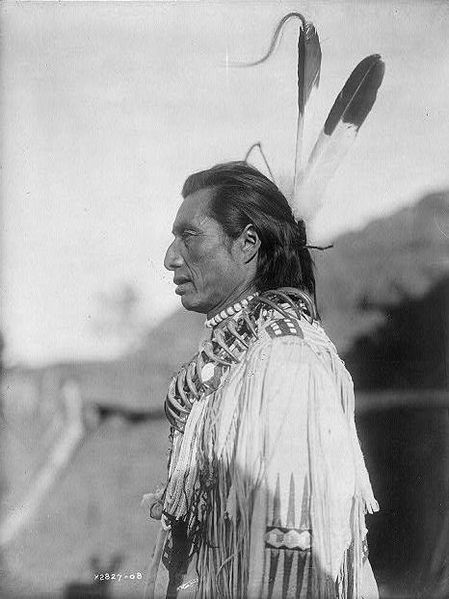
Edward Curtis visited the Mandan in the early 1900s and took the earliest photographs of them.  This 1908 photo is of Chief Crow’s Heart.

But let’s take a step back.  Why was John Evans interested in discovering whether or not the Mandan had Welsh words in their language?  That seems rather unusual.  This was not the first report of Welsh Indians however.  In 1608 one of the Jamestown settlers reported that the Mandoag Indians spoke a language that resembled Welsh and he had been asked to interpret.  Later the Tuscarora, called the Doag, included a war captain who spoke Welsh.  A location called Devil’s Backbone about 15 miles upstream on the Ohio River from Louisville, KY was reported to be an ancient home of Welsh Indians.  Fortifications in Georgia and Alabama are also attributed to the Welsh as Indians were not known to use that type of construction.  The Cherokee in Georgia also carried the story of “moon eyed” people matching the descriptions of Europeans having lived in Georgia as well.    

In 1810, John Sevier, the first governor of Tennessee, wrote to his friend Major Amos Stoddard about a conversation he had in 1782 with the old Cherokee chief Oconostota concerning ancient fortifications built along the Alabama River. The chief allegedly told him that the forts had been built by a white people called “Welsh”, as protection against the ancestors of the Cherokee, who eventually drove them from the region. Sevier had also written in 1799 of the alleged discovery of six skeletons in brass armor bearing the Welsh coat-of-arms.

18th-century reports about characteristics of Mandan lodges, religion and physical features among tribal members, such as blue and grey eyes along with lighter hair coloring, stirred speculation about the possibility of pre-Columbian European contact. Catlin believed the Mandan were the “Welsh Indians” of folklore, descendants of Prince Madoc and his followers who emigrated to America from Wales in about 1170. This view was popular at the time but has since been disputed by the bulk of scholarship, although in some circles is it certainly not considered resolved.

Later speculation has suggested the Mandan may have had pre-Columbian contact with Viking explorers. Controversial interpretations of the Kensington Runestone, found in 1898 in the largely rural township of Solem, Douglas County, Minnesota, have cited the runestone as evidence of Viking presence. There is no known evidence of Mandan-Viking contact, however. This theory is not supported generally by members of the intellectual establishment such as anthropologists and professional historians.  Furthermore, if the Mandan were living in the Ohio River Valley before their migration to the Missouri River area, the would not have been living in close proximity to the runestone if the Vikings were in Minnesota.

DNA evidence in this case might prove interesting, but it would be necessary to be able to identify lines of descent that went back to the survivors of the smallpox epidemic of 1837 and 1838.  After that, they were intermarried with the Arikara and Hidatsa.  The last full-blooded Mandan was Mattie Grinnell who died in 1971.

You can read more about the Mandan at this link:  http://en.wikipedia.org/wiki/Mandan

You can read more about Prince Madoc and Welsh Indians at this link:  http://en.wikipedia.org/wiki/Madoc

Posted in Mandan | 10 Comments