Paul Heinegg’s Native Heritage Introduction

Paul Heinegg on his website www.freeafricanamericans.com provides the following (extracted) introductory material focused primarily on the records involving Native Americans in North Carolina, Virginia, Maryland and Delaware.

After the Civil War, light-skinned African Americans who owned land in the Southeast did not fit into the new society where churches and schools were either white or former slave. Many could vote by the grandfather clause. They had developed a culture very similar to whites because they had gone to school and church with whites since the colonial period and had become part of the local white farming communities.

In 1875 the Democrats in Delaware enacted a law that required all “Colored Persons” to pay a tax of 30 cents on every $100 of property for the erection of separate schools for “Negroes.” The families that had been free since the colonial period in Indian River, Sussex County, organized as a “certain class of Colored Persons” and pressured the legislature to allow them to have their own schools so they would not have to attend with the former slaves. In 1881 the legislature permitted them to form an “Incorporated Body” under which they would be allowed to construct their own separate schools. They included members of the Johnson, Norwood, Wright, Harmon, Street, Clark and Drain families. They built Warwick School on land donated by the Harmon family and Holleyville School on land donated by Samuel Norwood [State Laws of Delaware XVI, Chapter 364, p. 378 cited by Weslager, Delaware’s Forgotten Folk, 112-117].

In 1885 Hamilton McMillan of Robeson County, North Carolina’s Democratic (Jim Crow) Party wrote and helped pass a law creating separate school districts for the former free persons of color of the county in an effort to win their votes in a county and state that were about equally divided between Republicans and Democrats. McMillan invented the name “Croatan Indians” and theorized that they had descended from a friendly tribe of Indians on the Roanoke River in eastern North Carolina who had mixed with the whites in Sir Walter Raleigh’s lost colony in 1587 and had settled in Robeson County during the colonial period. The law created three castes: white, Negro and Indian and prohibited marriage between them. Later, there would be three sets of water fountains, seating areas, rest rooms, etc. [Blu, The Lumbee Problem, 23, 62-3].

This influenced Anthropologist James Moody of the Smithsonian to study other possible Indian groups in Maryland, Delaware, Virginia and North Carolina in 1889. Moody visited the mixed-race community in Charles and Prince George’s counties [Maryland] made up of members of the Proctor, Butler, Newman, Savoy, Swann, and Thompson families which has come to be called “Piscataway Indians” or “Wesorts” [Porter, Quest for Identity, 99-100; Gilberts, Surviving Indian Groups of the Eastern United States] (all families clearly identified in the colonial court records as having descended from white women who had children by men of African descent, convicted of “Mulatto bastardy” and sold as servants for seven years.)

In 1898 William H. Babcock visited the Delaware “Nanticoke Indian” community and observed that “they have near as many white attributes of mind and body, habit, and temper” [Babcock, American Anthropologist, 1 (1899): 277-82].

A study of the mixed-race communities of North Carolina in 1886 reached a similar conclusion, “In their habits, manner, and dress, the free negroes still resemble, as they always did, the poorest class of whites much closer than they do the freedman” [Dodge, “Free Negroes of North Carolina,” Atlantic Monthly 57 (January 1886):20-30].

In 1903 the “Incorporated Body” of Sussex County petitioned the legislature to change their name from “a certain class of Colored Persons” to the “Offspring of the Nanticoke Indians,” and the legislature complied [State Laws of Delaware XXII, Chapter 470, 986 cited by Weslager, Delaware’s Forgotten Folk, 117].

Anthropologist Frank G. Speck visited the Indian River, Sussex County community in 1911, 1922 and 1942. In 1922 he helped the community to incorporate as the Nanticoke Indian Association. He taught them Indian dances and songs and taught them to prepare costumes, strings of beads and feather headdresses, subjecting them to the ridicule of whites in the area [Porter, Quest for Identity, 103, 108-9, 111].

Indian Indentured Servants

The indenture of Indians as servants was not common in Maryland. The Governor and his Council were not familiar with the practice on 18 July 1722 when they heard the case of Marcus Andrews who was charged with indenting an Indian boy named James in Somerset County and selling the indenture to someone in Philadelphia. Andrews explained that it was a “Customary thing in Ackamack in Virginia to indent with them for a Time or Term of years” and that he had indented with the boy in Virginia, not in Maryland [Archives of Maryland 25:390-1].

Women convicted of having children by native Indians were prosecuted for the lesser offense of fornication and had to pay a fine or suffer corporal punishment.  In June 1721 Eliza Lester named an Indian called Sackelah as the father of her child and received a fine or corporal punishment from the Baltimore County court [Proceedings 1718-21, 498, 507].

The indenture of East Indian servants was more common.  Eleven examples exist that very clearly state that the individual is East Indian and they are indentured, not slaves for life. 

East Indians apparently blended into the free African American population. Peter, an East Indian who was one of the ancestors of the Fisher family, had a child by a white woman named Mary Molloyd about 1680 and “became a free Molato after serving some time to Major Beale of St. Mary’s County” [Anne Arundel County Judgment Record 1734-6, 83; 1743-4, 11].

For more detail on East Indians, see Paul’s links below.

http://www.freeafricanamericans.com/Intro_md.htm

http://freeafricanamericans.com/East_Indians.htm

Also see the blog titled “East Indian Indians in Early Colonial Records” where I have assembled all of the East Indians records from Paul’s work in summary form in one place.

The sources for Paul’s work and the entire book “Free African Americans of North Carolina, Virginia and South Carolina” are available on his website http://www.freeafricanamericans.com. Each statement in Paul’s book is followed by the source in brackets and there is a complete list of sources at the end of the book.
Posted in Croatoan, Delaware, East Indians (from India), Lumbee, Maryland, Nanticote, North Carolina, Piscataway, Virginia, Wesorts | 9 Comments

God Willing and the Creek Don’t Rise

When I was growing up, this was something we said all of the time.  Given that many small farm streams were crossed without bridges, which worked find most of the time, a swollen stream would cause problems.  Most of the ones on paved roads had bridges or culverts by that time, but not all of them and everyone still clearly knew what that saying meant – even if the threat wasn’t very real anymore.  Well, at least we thought we did….but maybe not.

Did you know the saying “God willing and the Creek don’t rise” was in reference to the Creek Indians and not a body of water?  We didn’t.

It turns out that the phrase was written by Benjamin Hawkins in the late 18th century. He was a politician and Indian agent. While in the south, Hawkins was requested by the President of the U.S. to return to Washington. In his response, he was said to write, “God willing and the Creek don’t rise.” Because he capitalized the word “Creek” it is deduced that he was referring to the Creek Indian tribe and not a body of water.

January 2021: Hat tip to Maria whonotes that the collection of Benjamin Hawkins’s letters has now been digitized and can be read at this link. A search for the word “rise” does not produce this phrase, so it appears that the body of water theory was correct after all.

Posted in Creek | 7 Comments

Scotch Irish Influence on Native Names

We all know that the Scotch-Irish immigrated to the colonies, and then the States, in droves, spurred by warfare and famine.  Many times these most hearty of pioneers settled on the frontiers as they did in Pennsylvania, then the Shenandoah Valley, as well as in colonial South Carolina.  Settling on the frontiers means bumping up against the Native population.  And as always, when you have two very different cultures abreast of each other, you have conflicts and you have intermarriage. 

The Carlisle School records are good for seeing a broad brushstroke of Native people in the late 1800s and early 1900s.  In the case of Scottish names, those that start with Mc, of which there is no question about their genesis, we see the range of the influence of the Scottish people in the US.  It’s more extensive than I thought.  The Oklahoma names aren’t surprising of course, because the Oklahoma tribes are all uprooted tribes, those that used to live someplace East of the Mississippi.  But some of the other tribes are rather surprising.  Once they arrive in the States, it appears that the Scottish people never stopped traveling!

Last First Tribe State
McAdams Jimmie Shoshone Wyoming
McAdams Lonnie Shoshone Wyoming
McAffee Hettie Choctaw Oklahoma
McArthur Robert Chippewa Minnesota
McArthur Rose Umpqua Oregon
McBride Emma Sioux South Dakota
McCann Frank J Chippewa Wisconsin
McCann Michael Chippewa Wisconsin
McCarthy Alice Chippewa Minnesota
McCarthy Edgar Osage Oklahoma
McCarthy Herman Osage Oklahoma
McCarty Solomon Osage Oklahoma
McCauley Eugene Chippewa Minnesota
McCauley Theodore Omaha Nebraska
McClanahan Leonard Cherokee Oklahoma
McClean Robert Sioux South Dakota
McClellan Julia Ottawa Michigan
McClellan Moses Pawnee Michigan
McCloskey James Sioux South Dakota
McClure Frank Blackfeet Montana
McCoonse Joseph Chippewa Oklahoma
McCoovey Isaac Klamath California
McCurtain Ewart P Choctaw Oklahoma
McDaniels George Miller Cherokee Oklahoma
McDonald Augustus Ponca Oklahoma
McDonald Daniel Delaware Oklahoma
McDonald Edna Delaware Oklahoma
McDonald Flora Spokane Washington
McDonald John Mohawk New York
McDonald Louis Ponca Oklahoma
McDonald Mary A Mohawk New York
McDonald Phoebe A Spokane Washington
McDongan Daniel Osage Oklahoma
McDougall Alex Chippewa Minnesota
McDougall Duncan Chippewa Minnesota
McDougall Lillie Chippewa Minnesota
McDougall Susie Chippewa Minnesota
McDowell Donald Lumi Washington
McDowell John Limi Washington
McFarland David Nez Perce Idaho
McFarland Nora Nez Perce Idaho
McGannus John Washoe Wisconsin
McGilbray Solomon Creek Oklahoma
McGilles Frank Chippewa North Dakota
McGregor James Mohawk New York
McIntish Daisy Chippewa Minnesota
McIntosh Alice Chippewa Minnesota
McIntosh Dondal Apache Arizona
McIntosh Elizabeth Ottawa Oklahoma
McIntosh John Creek Oklahoma
McIntosh Millie Creek Oklahoma
McIntosh Nancy  Creek Oklahoma
McIntosh Robert Chippewa Minnesota
McIntosh Tookah Creek Oklahoma
McKay Alfonso Sioux North Dakota
McKay Henry Sioux North Dakota
McKay Lena Creek California
McKay Margaret Sioux North Dakota
McKee Charles Shoshone Nevada
McKellop Almarine Klamath Oklahoma
McKenzie Valintine Sioux South Dakota
McKenzie Zonie Sioux South Dakota
McKieg Frank Chippewa Minnesota
McKinley James Osage Oklahoma
McKinley John Yuma Arizona
McKinley Owen Yuma Arizona
McLane Emeline Creek Oklahoma
McLaughlin Blanche Osage Oklahoma
McLean Florence Sioux South Dakota
McLean Gladys M Seneca New York
McLoud Marie Alaskan Alaska
McMann Francis Chippewa Minnesota
McNac Alexander Creek Oklahoma
McNac Elizabeth Peoria Oklahoma
McPherson George Menominee Wisconsin
McPherson Herbert Menominee Wisconsin
Posted in History | 2 Comments

Alaska Culture Comes Alive in Tanacross

Alaska seem so remote from the continental US.  That’s because it is in more ways than one. 

During my visits to Alaksa, I have always felt like I stepped back about 40 or 50 years in time.  Things are different there.  Life is different.  Slower, less commercialized and much more self-reliant.  Of course, in Anchorage, you can find a coffee shop, but you can also go to the farmers market and buy carvings from a man who lives in a home without plumbing….along with the rest of his neighbors….and that is normal.

In the June 2012 Alaska magazine, Jeanie Greene wrote a short article called “Culture Comes Alive.”  I am going to quote part of it below:

“I can imagine thousands have driven by the village just a short drive off the main highway near Tok, Alaska.  The village had moved 3 times and now Tancross has been in its present location on the Tanana River since 1973.

I drove in one day and stayed a week.  They were planning a potlatch.  I ended up filming the activities and captured the elders and local people cooking and baking and the men, dicing moose meat for the moose head soup, so delicious with a hint of smoke flavor from the meat shed.

During the big meal, hundreds were fed and my eyes grew huge as I watched my husband pick a hunk of moose and bone as big as his plate.  Something about being around Alaska Natives turns this softspoken scholarly man into one of them.  Happens all the time, like in Fort Yukon, we visited a lovely elder named Mrs. Ward.  She told us stories of her tough life, walking for miles in the winter snow.  She served us tea and showed us her beautiful beadwork.  She didn’t have indoor plumbing but her charm and dignity belied her humble surroundings.  To us she was royalty.

That’s what makes Alaska so wonderful.  It hasn’t caught up to the rest of the US, in that sense.  Alaska Natives live far enough apart that traditions and customs remain intact, as does the pride in the differences.”

Here is a youtube video showing the dancing in Tanacross.          http://www.youtube.com/watch?v=oVuJFkFFLbA&feature=plcp

Jeanie summed it up so eloquently.  I have always felt the spirit of inclusion in Alaska.  I have wonderful memories of dancing in the long house wearing a beautiful eagle robe loaned by one of the elders.  It’s hard to leave.  It’s easy to stay a day, a week, a month, and before you know it, forever.  I have friends there who have done exactly that.

I imagine that when the Europeans first encountered the Native people in the lower 48 that culture and life was much the same here.  Note the comment about the village having moved 3 times.  We know from early maps here that villages moving, and sometimes significant distances, wasn’t so uncommon. 

Visiting Alaska, for me, was a way to transport myself back in time to when the Native people had not been spread to the winds, before losing their cultural connections in the tsunami of Europeanization and assimilation. 

You can see and listen to Jeanie Green’s award-winning documentary series, “Heartbeat Alaska,” depicting the life of Alaska’s Native people in remote villages at this link:  http://tunein.com/radio/Heartbeat-Alaska-p53393/

Posted in Alaska Natives | Leave a comment

Oliver Cromwell, an Indian Patriot from New Jersey

Oliver Cromwell, an Indian of possible “mixed descent,” served in the 2nd New Jersey Regiment in the Revolutionary War.  While in his mid twenties, he enlisted at the beginning of the war.  He served in the 2nd Regiment of the New Jersey Continental Line and in the New Jersey Militia under Captains James Lawrie, Nathaniel Bowman, Jonathan Dayton and Absalom Martin.  

He was born May 24, 1753, at Black Horse (now Columbus, Burlington County, New Jersey. He lived with the family of John Hutchin and was raised as a farmer.  Cromwell had a light complexion and it is believed that he was never a slave.

A look at Cromwell’s pension application reveals the soldier’s clear recall of events in his Revolutionary service.  He states he was serving under Captain Lawrie at the Battle of Short Hills on June 26, 1777 when Lawrie was wounded and taken prisoner.  Captain Lawrie was a Quaker who was disowned by the Chesterfield Monthly Meeting for entering military service. He died as a prisoner of war in New York on July 10, 1777.

During the Revolutionary War, Cromwell enlisted in a company commanded by Captain Lowery of the Second New Jersey Regiment, Colonel Isreal Shreve commanding. Cromwell was present at the battle of Trenton, Princeton, Brandywine, Monmouth and Yorktown and at the memorable crossing of the Delaware on December 25, 1776.

A copy of Cromwell’s discharge, signed by George Washington, is in his pension file. Cromwell was awarded both a federal pension and bounty land for his six years of service. Washington also designed a medal which was awarded to Cromwell.

Some years after the war, Cromwell applied for a veteran’s pension. He was well-liked in Burlington, and although he was unable to read or write, local lawyers, judges and politicians came to his aid, and he was granted a pension of $96 a year.  He purchased a 100-acre farm outside Burlington, and fathered 14 children, then spent his later years at his home at 114 East Union Street in Burlington.

Cromwell died in Burlington County, January 4, 1853 at the age of ninety‐nine years and 10 months, outliving 8 of his children, and is buried in the cemetery of the Broad Street Methodist Church.  His descendants still live in the city.

It is possible that Oliver was of both Indian and African descent.  The 1850 census for Burlington Co., NJ lists Cromwell and some of his family a mulatto.  He is 97 years of age and under occupation “Drummer in the Revolution.”  He was obviously quite proud of his service.

In the New Jersey state military records, Cromwell is listed as an Indian.  The 1850 census did not have a category for Indian, so the census taker may simply have recorded him as mulatto, meaning “not entirely white.”  I have to wonder if he was also mixed European given his light complexion noted in his memorial at www.fold3.com

http://www.fold3.com/page/747_african_american_patriots_of_the/

His pension papers are also available at Fold3, for members:   http://www.fold3.com/image/#13161611 and service records here: http://www.fold3.com/image/#19147522

Posted in Military, New Jersey | 2 Comments

Little Abraham Tyorhansera, Mohawk Indian, Wolf Clan Chief

I was very surprised to find this man listed in the Forgotten Patriots document as a Revolutionary War veteran.  Do you recall why perhaps?  Yes, indeed, the Mohawks, for the most part, joined the British, in Canada, and fought AGAINST the American cause.  So finding the Wolf Clan Chief listed as a patriot caused me to pause and consider.

Looking further, we find that Little Abraham was the son of Old Abraham.  Not surprising. 

In 1755 he first appears in the records as a pine tree chief, elected because of his military prowess.  In 1760 he is referred to by Sir William Johnson as the “best Indian of the Mohawks.”

His lifelong crusade was to protect Indian lands from the whites who were encroaching upon them.  He worked to this end in the 1760s, but the 1770s, with the outbreak of the Revolutionary War, he saw life get much harder and his quest more difficult.  Initially the Mohawks attempted to remain neutral.  Tyorhansera declared that the Six Nations had “no inclination or purpose of interfering in the dispute between Old England and Boston.” As he put it, the Iroquois considered the revolution “a family affair” and would “sit still and see you fight it out.”

Neutrality didn’t work.  The Mohawks resented American land-grabbers.  They were close to the British and since the Americans could not adequately furnish the Indians with essential supplies-their reliance upon the more dependable flow of British trade goods increased, as did their relationship with the British. As a result, the Mohawks were generally regarded as British allies.  After the battle of Oriskany (near Rome, N.Y.) in August 1777, many Mohawks were driven from their homes to the safety of Montreal.

Surprisingly, he and a few other Mohawks chose to remain.  The reason is unclear.  It could be because General Philip John Schuyler, an American Indian commissioner, had intimated to the Mohawks that if they deserted their villages they would never be allowed to return. Quite possibly Tyorhansera remained in hopes of preventing the loss of his people’s land.  Even then, he tried to remain neutral and prevent bloodshed.

Unfortunately, either his neutrality or the fact that he did not remove to Canada, or both, made him a traitor in the eyes of the British. When he went to Niagara in February 1780 to try to negotiate a prisoner exchange and to appeal for an end to Iroquois involvement in the war, he was denounced by Kaieñkwaahtoñ and Kanonraron (Aaron Hill) and arrested by Guy Johnson.  Sadly, the ageing chief did not survive the ordeal and he died in prison.

In a sense his death was a blessing, for he was spared the pain of witnessing the irrevocable loss of his people’s homeland.  There is no happy ending to this story.

Posted in Mohawk | 2 Comments

Honyere and Honyost Doxtator

In the book, Forgotten Patriots, in the New York section, we find something rather unique and interesting.   An Oneida Indian is given by his Native names, which are spelled variously, probably phoenetically as best they could be, but then he is also given by his English name, Honyere Doxtator.  In addition, two alternate first name spellings are also given, Honyost and Hanyose.  As it turns out, Honyere and Honyost were brothers, both of whom served.

Hanyere’s native name is given as:

  • Tewahangahken
  • Tewahangarahken
  • Tewahangarah
  • Tewahongarhkin

We find out more in the book, “The Oneida Indian Experience: Two Perspectives” by Jack Campisi.  He tells us that in July of 1775, military units were formed and the Oneida Indian, Tewahongarahkin, known later to whites as Honyere Doxtator, gathered together a unit of Indians friendly to the American cause and entered the service along with his brother Honyost.  Honyere’s son Peter who filed his pension application spelled his name Tewahangaraghkan, yet another spelling where the letter a supplants the letter o.  These people lived at “Oriskany Castle” known to the Indians as Orisata-aak in Oneida Co., NY. 

In 1852, after his death, his wife Jenny applied for his pension, and all arrears from 1828 when he would have been eligible, stating that he was unaware, as was she, that he qualified for a pension.  His pension application which tells of his military career and lists his family members is available at www.fold3.com at http://www.fold3.com/image/#18662241 if you are a member.

I find it sad that veterans didn’t know they were eligible for pensions.  Not only were they entitled to the pension, but I suspect it would have made a significant difference to them in their later years of life.  However, it is his service to the United States that provides us with everything that is recorded of this man’s life, including his family members, his residence and both his English and Native names.  Truly a treasure trove of history that would have otherwise been lost.

Posted in Oneida | 2 Comments

Daniel Earring

I was quite surprised to see the name Daniel Earring in the Carlisle Indian School records.  I was interested to know whether this name was an anomaly or whether it was a name found among Native families.  Daniel was Sioux. 

At Ancestry.com there is a large collection named the “Indian Census Rolls: 1885-1940”. In reality, I believe this includes 1880 as well, but regardless, these are the people recorded on the special Indian census forms.  I was surprised to find numerous families with that surname in several different tribes.  Here’s just some of what was found.

  • Rose Feather Earring – Sioux (several other Feather Earring family members as well)
  • Ear-Ring (Blackfeet)
  • Pumpkin Earring – Sioux
  • Blue Earring – Brule
  • Spear Woman Earing – Blackfeet
  • Iron Earring – Cheyenne
  • Bird Earring – Blackfeet
  • Red Seat Fasthouse Earring – Fort Peck
  • Leonard Yellow Earring – Sioux

Indians, not unlike people today, adorned their bodies.  The first paintings we have of Native people in what would become the United States clearly shows very artistic adornments. 

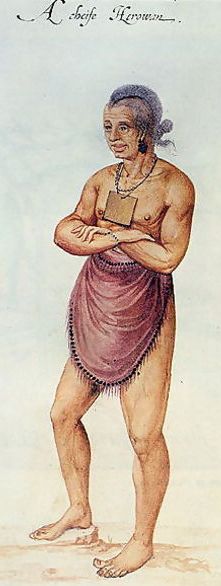
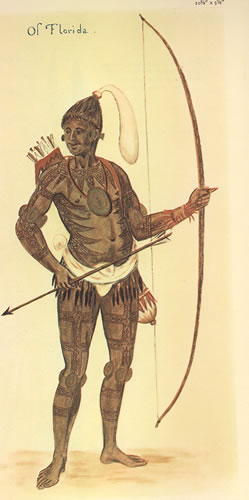
John White (yes, the John White of Lost Colony fame) painted the first image we have of Native people.  In 1584 he painted a Timucan male and female from the region of what is now St. Augustine, Florida.  You guessed it, they wore earrings, of a sort, the male included.  Jewelry was  not just for women in Native society.

Another John White painting depicting a coastal Carolina Indian Chief or Elder shows a different style of earring.

Posted in Blackfoot, Brule, Cheyenne, Sioux, Timucan | 4 Comments

Eleazor Wheelock and the Dartmouth Indians

Eleazar Wheelock (April 22, 1711 – April 24, 1779) was an American Congregational minister, orator, educator, and founder of Dartmouth College.

He was born in Windham, Connecticut to Ralph Wheelock and Ruth Huntington. He is the great-grandson of the first teacher of the first free school in the United States located in Dedham, Massachusetts, The Rev. Ralph Wheelock. In 1733, he graduated from Yale College having won the first award of the Dean Berkeley Donation for the distinction in classics. He continued his theological studies at Yale until he was licensed to preach in May 1734, and installed as pastor of the Second Congregational Church of Lebanon, Connecticut. in February 1735. He served as their minister for 35 years. On April 29, 1735, he married Sarah Davenport. He participated fully and enthusiastically in the Great Awakening, which had begun to sweep the Connecticut River Valley around the time of his graduation from Yale. He was one of its greatest proponents in Connecticut, serving as the “chief intelligencer of revival news”.

In 1743, he took in a student named Samson Occom, a Mohegan who knew English, and had been converted to Christianity in his childhood. Wheelock’s success in preparing Occom for the ministry encouraged him to found a school in Lebanon for Native American Indians, with the purpose of instilling, in the boys, elements of secular and religious education, so that they could return to their native culture as missionaries. The girls were to be taught “housewifery” and writing. The school was to be supported by charitable contribution. His plans to educate the young Native American students in his school, which was called the Moor’s Charity School, located on the Lebanon town green, did not progress well however — many of his students became sick and died while some turned profligate and in other ways failed to successfully pursue the charter of missionary work.

He eventually decided to enlarge the school and add a college (for the education of whites in the classics, philosophy, and literature) and began to search for another location for the schools. Wheelock obtained a charter from King George III on December 13, 1769. Samson Occom and the British Board of Trustees headed by Lord Dartmouth opposed the addition of the college, and despite (or because of) Lord Dartmouth’s opposition, Wheelock named the college Dartmouth College. Hanover, New Hampshire was chosen for the site, and in 1771, four students were graduated in Dartmouth’s first commencement, including Wheelock’s son John.

The Rev. Eleazar Wheelock died during the Revolutionary War, on April 24, 1779. He is buried in Hanover. His writings include “Narrative of the Indian School at Lebanon,” which is available at this link:  http://archive.org/details/briefnarrativeof00whit

In 1929, Eric Kelly wrote an article for the Dartmouth Alumni Magazine titled “The Dartmouth Indians.”  Thanks to one of our blog subscribers, Nancy, I now have a copy of this article, plus a second one in 1800 by Lon Richardson which details the Indians at Dartmouth from 1800-1893.  Big hat tip to Nancy for this contribution!!! 

In the first article, Eric Kelly shares some history with us.  Here is an extract of some of the text of the article:

“There is hardly a Dartmouth gathering anywhere at which some reference is not made to the Dartmouth Indian, but who was that Indian?  And yet it was probably the efforts of Samson Occom, an Indian, in England, when he raised a sum equivalent to about $66,000, that determined the success of the Moor School and Dartmouth College.

Indians are mentioned in about every book written about the college, yet outside of the names of Occom, Joseph Brant, Charles G. Eastman and more lately John Meyers of baseball fame, there is little familiarity among the alumni with the names of the Indians who have attended Dartmouth and the Moor School since 1743.  Yet that unwritten history fairly sparkles with romance.  Some of the early Moor School men were engaged in the Brothertown enterprise in New York where an attempt was made to settle a colony of Indians who would live as white men did.  Somewhere in Deansville, NY, in a cemetery discovered by Dr. W. D. Love and members of the Hamilton College Alumni, probably lies the body of Samson Occom, the grave unmarked, as far as I know, and not distinguishable from the graves of other Indians.  The same is true of the Indians buried at St. Francis in Canada and New London, Conn.

There were Indians from Dartmouth who blazed trails into the West.  There were Dartmouth Indians who led scouting parties in the Revolution and engaged in the war on both American and British sides.  One Indian in Hanover thought himself the Lost Dauphin or Louis 17th of France; another was a the age of 14 elected King of a tribe of Indians in Canada; another went back to Canada a hundred years ago and founded a church and a school that have been continued until this day.  And this is but the beginning.  The records are scattered over so many books, letters, diaries and manuscripts that it will require years of patient effort to collect them all.”

Kelly then goes on to tell us that on the inside page of one of Wheelock’s Memorandum books, he found a list of Indians.  He titles this Wheelock’s List 1743-1770, which I’ve transcribed below.  When the student only had one name, it is in the Last Name column.  And who knew that rusticated meant expelled? 

Date Last (or only) First Tribe Comments
1743-1748 Occom Samson    
12-18-1754 Pumshire John Delaware since dead
12-18-1754 Wooley Jacob Delaware run away
2-18-1757 Woyboy Samson   since dead
4-9-1757 Woolley Joseph Delaware since appointed schoolmaster among Indians
4-9-1757 Calvin Hezekiah Delaware  
12-7-1758 Johnson Joseph Mohegan  
4-12-1760 Fowler David Montauk appointed schoolmaster among the Indians
4-28-1760 Occom Aaron Mohegan went away October 1761
11-26-1760 Uncaus Naiah Isaiah Mohegan taken to work on the farm
6-2-1761 Johnson Amie Mohegan  
8-1-1761 Brant Joseph    
8-1-1761 Negyes   Mohawk since returned home
8-1-1761 Center   Mohawk  
9-1761 Stores Miriam Delaware  
11-27-1761 Moses   Mohawk  
11-27-1761 Johannes   Mohawk  
4-20-1762 Wyoge Sarah Mohegan rusticated (expelled)
7-22-1762 Closs Enoch Delaware run away
7-22-1762 Tallman Samuel Delaware  
7-28-1762 Mossock Daniel Farmington went away soon after
7-28-1762 Major Abraham Mohawk  
7-28-1762 Minor Abraham Mohawk  
7-28-1762 Peter   Mohawk  
8-24-1762 Johnson Patience Mohegan since dismissed
9-25-1762 Ashpo Samuel Mohegan licensed to preach
11-27-1763 Fowler Jacob Montauk  
4-10-1763 Simon Manuel Narragansett sent away soon after
9-1763 Poquiantup Hannah Nehantic went away soon after
12-17-1763 Garrett Hannah Narragansett
12-17-1763 Sequettass Mary Narragansett
11-30-1764 Major William Mohawk went away Feb. 16 of 67
11-30-1754 Minor William Mohawk went away April of 67
11-30-1754 Elias   Mohawk  
6-12-1765 Susannah   Mohawk  
6-12-1765 Katherine   Mohawk went away Jan. 9 1767
6-12-1765 Mary   Mohawk went away Jan. 9 1767
6-12-1765 David   Oneida  
10-5-1765 Mundeus   Oneida  
10-5-1765 Jacob   Oneida  
12-13-1765 Symonds Sarah Narragansett
12-13-1765 Daniel Charles Narragansett
1-11-1766 Green John Mohawk went away Feb. 16 1767
6-27-1766 Oneida William    
9-28-1766 Margaret   Mohawk went away Jan. 9 1767
12-3-1766 Occom Aaron Mohegan  
12-8-1766 Seth   Mohawk went away Feb. 16 1767
12-16-1767 Shadduck John Narragansett
12-16-1767 Shadduck Toby    
12-29-1767 Shadduck Toby’s wife and child  
4-3-1767 Nabby   Narragansett Abigail went away June 4
4-3-1767 Martha   Narragansett
6-10-1767 Nonesuck Hannah Nehantick
9-24-1767 Hannah   Oneyada  
9-24-1767 Cornelius   Oneyada  
9-24-1767 Peter   Oneyada  
9-24-1767 Minor William Oneyada  
10-14-1767 Simons James    
10-29-1767 Apolles   Mohawk  
12-4-1767 Clapp Nathan Indian of Yarmouth expelled July 9, 1768
12-11-1767 Mooch Mary of Newcut in Norwich
1-2-1768 Peter   Oneida  
6-30-1768 Hannah      
6-28-1768 Joseph      
6-28-1768 Joseph   Oneida  
10-28-1768 Symans Abraham Narragansett
3-17-1770 Symons Daniel    
9-1770 Watts Caleb    
Posted in Delaware, Farmington, History, Mohawk, Mohegan, Narragansett, Oneida | 4 Comments

The Hatteras Indian Village and the Live Forked Oak Stump

The Indian Village on Hatteras Island was granted to William Elks and the Hatteras Indians in 1759.  They were already living there as had been demonstrated in a 1756 NC legislative record wherein Thomas Elks complains that Thomas Robb is infringing on the Indian’s lands.  Robb’s response was that he wasn’t infringing on anything because the Indians didn’t have a land grant or patent.  In 1759, that small detail was taken care of when William Elks was granted the 200 acres on Hatteras Island where the Indian town was located.

In 1771, William Elks sold 50 acres of this land to George Clark, and the beginning survey marker was a forked live oak stump.

Currituck Deed book 3 deed [406], p. 340: 25 July 1771, Dec [–], 177[–]; WILLIAM ELKS of CT, planter to GORGE CLEARK of CT, cons. 50 pounds proc., 50A, on Hatarass Banks, beg at a forked live oak stump, “running ye sd: Courses of the patron;” wit: THOMAS OLIVER, JOHN SCARBROUGH, THOMAS MILLER, Junr., jurat; signed: WILLIAM [E] ELKS.

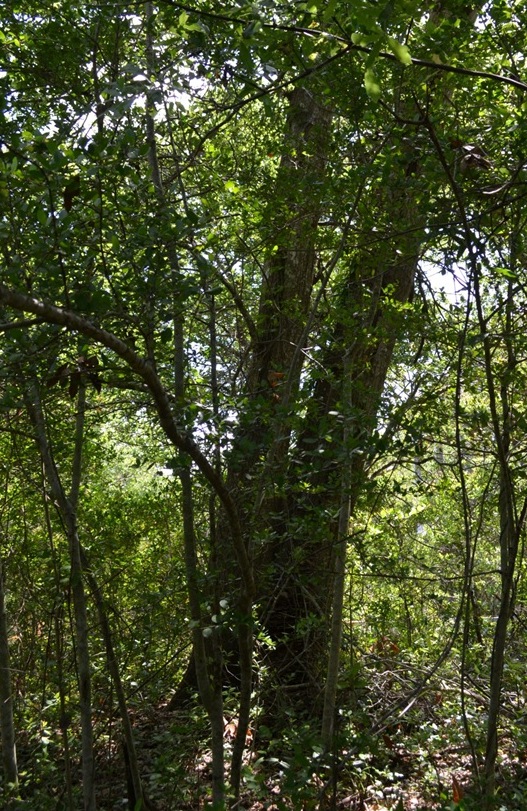
So, ask yourself, what are the chances of that forked Oak stump still existing today?  We do know where this land is today and we know the approximate location of this stump, but could we find it? 

In the photo below, this tree is exactly where, using today’s property lines, we think the forked stump should be.  But it’s not a stump and it doesn’t appear to be old enough, although we’ve been cautioned by tree experts not to compare Hatteras trees to other trees when determining age because the environment tends to stunt Hatteras trees, so they are older than they appear.

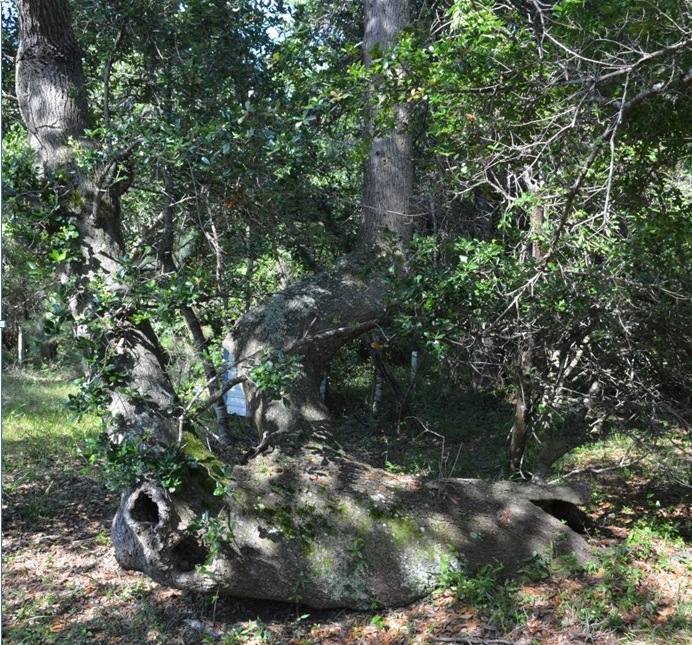
However, look what we found just a few feet away, not exactly where we thought it should be, but very close.  We also have to take into consideration that the survey equipment of the 1600s wasn’t as accurate as what we have today.

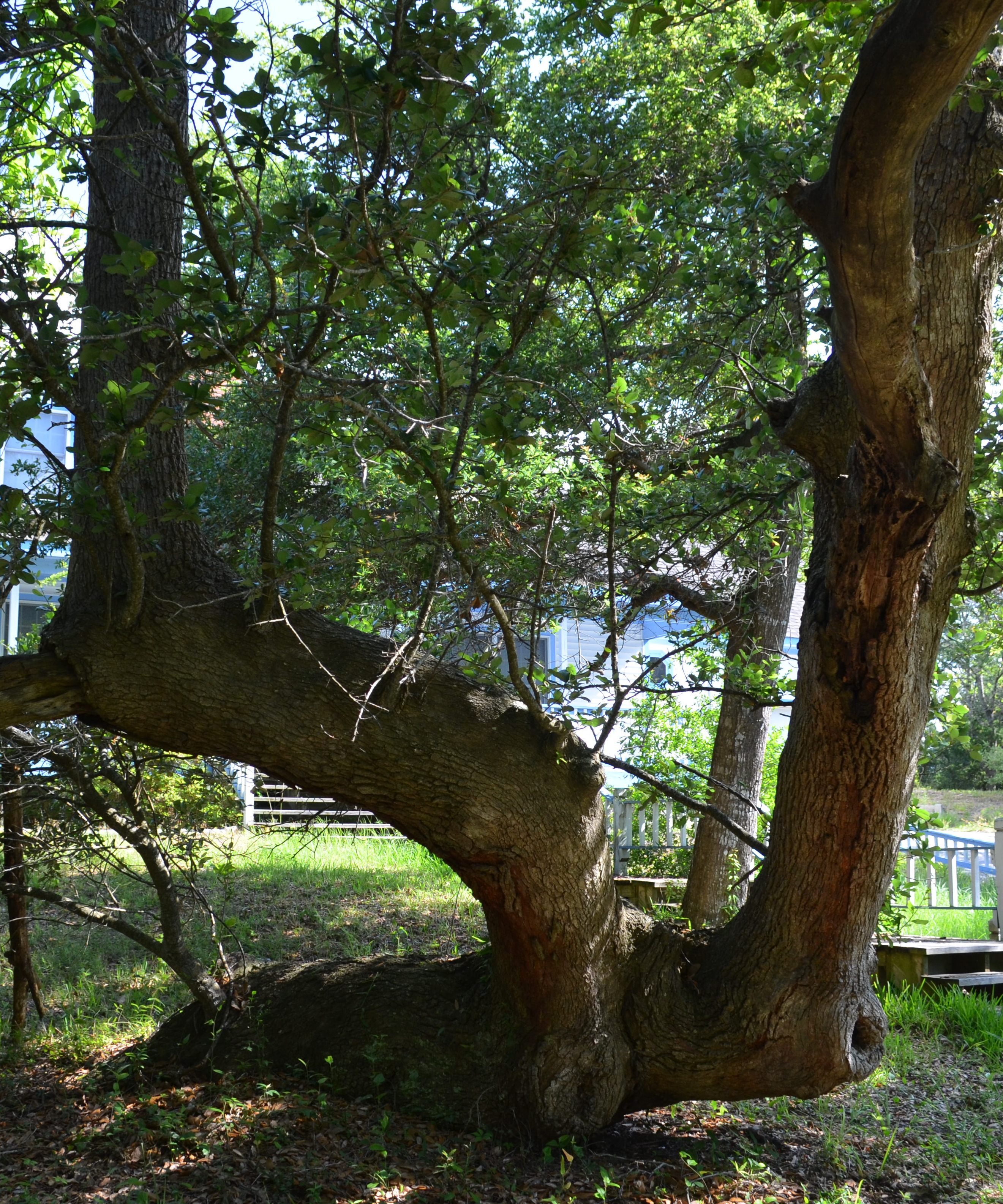
This surely looks like a forked live oak stump, and it’s old, quite old.  Could this be the actual boundary marker tree in question?  You can see the fork quite well in the next photo.  If only this tree could talk!

Posted in Hatteras | Leave a comment