Does CRO = Chowan?

I originally wrote this article for the Lost Colony Research Group Newsletter, published in June, 2012.  www.lostcolonyresearch.org

A few months ago, Fletcher Freeman, one of our members, e-mailed me and asked me a simple question, which, as simple questions often do, let to a much more detailed discussion.  Fletcher is descended directly from John Freeman who was closely allied with the Chowan Indians. It is thought that John’s wife, Tabitha, was or may have been the  daughter of Chowan Chief, John Hoyter.

The Chowanoke Descendants Community have a lovely website at this link:  http://www.chowanoke.webs.com/

On the website, they also feature a blog where members interact.  One of their members had a question or theory, and Freeman was interested in whether it had any validity.

“The theory was that the letters “CRO” carved in the tree by the Lost colonists represented the words “Chowan River Ohanoke” and was a clue to their destination.  Ohanoke was the principal town of the Chowan Indians.  Thus the belief that the Lost Colonists flew to the home of the Chowans where they settled and melded with the tribe.  John Smith later reported that the Chowans lived in houses similar to the English and there were stories of whites working in copper among the Chowan.”

My first question back to Fletcher was whether the Chowan River had always been called the Chowan River.  It turns out that Fletcher has written a lovely piece about the history of the Chowan Indians, and he has kindly given us permission to reprint it.

Before getting to Fletcher’s article, the CRO theory certainly deserves some consideration.  My first thought was that it seemed to conflict with the second engraving, which was “Croatoan” and which John White clearly knew, or thought he knew, how to interpret.

There are some who embrace the theory that the colonists split up.  It’s true that 100+ people were a lot to feed and a lot of people to incorporate into any tribe.  That was the size of many tribal groups.  On the other hand, there is safety in numbers, and the colonists did have leverage – guns and metal objects like swords and knives.  They had an advantage, which would both encourage collaboration and also attacks.  We certainly welcome any thoughts and commentary on this topic or Fletcher’s article, The Chowan Indians by Fletcher Freeman, to be published on this blog tomorrow.

Posted in Chowan | Leave a comment

Lenny Trujillo: The Journey of You

In the fall of 2010, Lenny Trujillo embarked on a journey unaware that he was going anyplace.  That was the journey to discover himself, his ancestry….and what a journey it has been.  Lenny was unique, very unique.

After Lenny’s results came back, he purchased a DNA Report.  In the process of analyzing his DNA, I realized what an opportunity was at hand.  Lenny was Native American  and his Y DNA likely harbored new SNPs that would identify a new sub-haplogroup, and we needed to take a look.  When I wrote Lenny and asked if he would consider a Walk the Y (WTY) test, he told me that he had retired that very day.  My heart sunk, because I presumed that meant “no”, that he’d be making financial adjustments like so many retirees.  But then Lenny went on to say that he wanted to proceed in order to leave a legacy for his grandchildren.

And what a legacy Lenny has to leave them.  Lenny made history and advanced science.  Indeed, by comparing Lenny’s DNA to another European man in haplogroup Q1a3, 7 new SNPs were discovered. I wrote a paper about this process and Lenny’s contribution.  This was a red letter day for Native American ancestry, as well as for Lenny, delivered as fate would have it, Christmas week.

However, Lenny’s remarkable story doesn’t end there.  That’s only the beginning.  But, I’ll let Lenny tell his own story, in his own words.  He wrote an article for the Los Angeles Beat which was published today.   His story is so heartwarming and inspirational and the records that document his Native ancestry that Lenny has been able to find have been absolutely amazing.

Lenny also tells his story on the Family Tree DNA YouTube Channel in various segments for those who haven’t yet seen Family Tree DNA’s infomercial.

So whether you read it or watch it, or both, come along, share Lenny’s journey, and enjoy!

If you’d like to take a DNA test, click here.

Posted in DNA, Genizaro, History, Pueblo | 4 Comments

The 1637 Pequot War

One of the great things about blogging is that you get the opportunity to learn.  One of our subscribers, Steve, send me a note and said that he considered King Philip’s War to be the final war, not the first war, and the 1637 Pequot War was really the first. 

So I took a look, and lo and behold, Steve is right.  Who knew? Thanks Steve!

The Pequot War was an armed conflict spanning the years 1634–1638 between the Pequot tribe against an alliance of the Massachusetts Bay, Plymouth, and Saybrook colonies who were aided by their Native American allies, the Narragansett and Mohegan tribes. Hundreds of Native people were killed; hundreds more were captured and sold into slavery to the West Indies. Other survivors were dispersed. At the end of the war, about seven hundred Pequots had been killed or taken into captivity.  The result was the elimination of the Pequot as a viable political entity in what is present-day Southern New England.

The Pequot and their traditional enemies, the Mohegan, were at one time a single sociopolitical entity. Anthropologists and historians contend that sometime before contact with the Puritan English, the Pequot split into the two competing groups. The earliest historians of the Pequot War speculated that the Pequot migrated from the upper Hudson River Valley toward central and eastern Connecticut sometime around 1500. These claims are disputed by the evidence of modern archeology and anthropology finds.

In the 1630s, the Connecticut River Valley was in turmoil. The Pequot aggressively worked to extend their area of control, at the expense of the Wampanoag to the north, the Narragansett to the east, the Connecticut River Valley Algonquians and Mohegan to the west, and the Algonquian people of present-day Long Island to the south. The tribes contended for political dominance and control of the European fur trade. A series of smallpox epidemics over the course of the previous three decades had severely reduced the Indian populations due to their lack of immunity to the disease. As a result, there was a power vacuum in the area.

The Dutch and the English were also striving to extend the reach of their trade into the interior to achieve dominance in the lush, fertile region. By 1636, the Dutch had fortified their trading post, and the English had built a trading fort at Saybrook. English Puritans from Massachusetts Bay and Plymouth colonies settled at the newly established river towns of Windsor, Hartford and Wethersfield.

Before the war’s inception, efforts to control fur trade access resulted in a series of escalating incidents and attacks that increased tensions on both sides. Political divisions between the Pequot and Mohegan widened as they aligned with different trade sources—the Mohegan with the English, and the Pequot with the Dutch. The Pequot assaulted a tribe of Indians who had tried to trade at Hartford. Tension sparked at the Massachusetts Bay Colony, a stronghold for wampum, the supply of which the Pequot had controlled up until 1633.

John Stone, an English rogue, smuggler and privateer, and about seven of his crew were murdered by the Western tributary clients of the Pequot, the Niantic. According to the Pequots’ later explanations, they did that in reprisal for the Dutch having murdered the principal Pequot sachem Tatobem, and were unaware of the fact that Stone was English and not Dutch. In the earlier incident, Tatobem had boarded a Dutch vessel to trade. Instead of conducting trade, the Dutch seized the sachem and appealed for a substantial amount of ransom for his safe return. The Pequot quickly sent bushels of wampum, but received only Tatobem’s dead body in return.

Stone, the privateer, was from the West Indies. He had been banished from Boston for malfeasance (including drunkenness, adultery and piracy). Since he was known to have powerful connections in other colonies as well as London, he was expected to use them against the Boston colony. Setting sail from Boston, Stone abducted two Western Niantic men, forcing them to show him the way up the Connecticut River. Soon after, he and his crew were suddenly attacked and killed by a larger group of Western Niantic. While the initial reactions in Boston varied between indifference and outright joy at Stone’s death, the colonial officials later decided to protest the killing. They did not accept the Pequots’ excuses that they had been unaware of Stone’s nationality. The Pequot sachem Sassacus sent some wampum to atone for the murders, but refused the colonists’ demands that the Western Niantic warriors responsible for Stone’s death be turned over to them for trial and punishment.

On July 20, 1636, a respected trader named John Oldham was attacked on a trading voyage to Block Island. He and several of his crew were killed and his ship looted by Narragansett-allied Indians who sought to discourage English settlers from trading with their Pequot rivals. In the weeks that followed, colonial officials from Massachusetts Bay, Rhode Island, and Connecticut, assumed the Narragansett were the likely culprits. Knowing that the Indians of Block Island were allies of the Eastern Niantic, who were allied with the Narragansett, Puritan officials became suspicious of the Narragansett. However, Narragansett leaders were able to convince the English that the perpetrators were being sheltered by the Pequots.

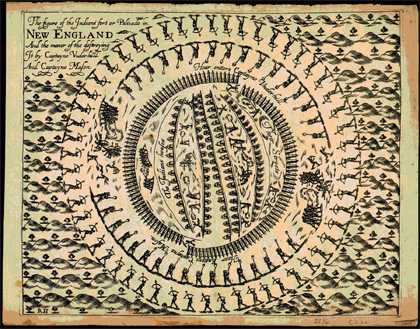
Raids and warfare followed, on both sides, but the final blow was dealt by the English when they massacred the Pequot at their village, Mystic.  Today, this is known as the Mystic Massacre.  Most of the men were absent from the fort, so mostly women, children and the elderly were present.  The English set the fort on fire, and directed that anyone attempting to escape should be killed.  Between 600 and 700 Pequot perished in the fort, with only 7 taken prisoner and another 7 escaping into the woods.  The woodcut below represents the attack on Fort Mystic.

In September, the victorious Mohegan and Narragansett met at the General Court of Connecticut and agreed on the disposition of the Pequot and their lands. The agreement, known as the first Treaty of Hartford, was signed on September 21, 1638. About 200 Pequot “old men, women, and children” survived the war and the massacre at Mystic. Unable to find refuge with a neighboring tribe, they finally gave up and offered themselves as slaves in exchange for life:

“ There were then given to ONKOS, Sachem of MONHEAG, Eighty; to MYAN TONIMO, Sachem of NARRAGANSETT, Eighty; and to NYNIGRETT, Twenty, when he should satisfy for a Mare of Edward Pomroye’s killed by his Men. The Pequots were then bound by COVENANT, That none should inhabit their native Country, nor should any of them be called PEQUOTS any more, but MOHEAGS and NARRAGANSETTS for ever.”

This is one of the saddest documents I’ve seen in a long time.

Other Pequot were enslaved and shipped to Bermuda or the West Indies, or were forced to become household servants in English households in Connecticut and Massachusetts Bay. Colonists appropriated Pequot lands under claims of a “just war”. They essentially declared the Pequot extinct by prohibiting speaking the name of the people. The few Pequot who managed to evade death or slavery later recovered from captivity by the Mohegan and were assigned reservations in Connecticut Colony.

The colonists attributed the success of end of the murderous aggression of the Pequot tribe to an act of God:

“ Let the whole Earth be filled with his Glory! Thus the LORD was pleased to smite our Enemies in the hinder Parts, and to give us their Land for an Inheritance. ”

Lion Gardiner, a soldier involved in the Pequot War, in his 1660 Relation of the Pequot Wars, expressed a different perspective:

“ And now I am old, I would fain die a natural death or like a soldier in the field with honor and not to have a sharp stake set in the ground and thrust into my fundament and to have my skin flayed off by piecemeal and cut in pieces and bits and my flesh roasted and thrust down my throat as these people have done and I know will be done to the chieftest in the Country by hundreds if god should deliver us into their hands as Justly he may for our sins. ”

This was the first instance wherein Algonquian peoples of what is now southern New England encountered European-style warfare. After the Pequot War, much weakened, the Native people were too frightened to rise up against the colonists. In 1675, a fairly long period of peace came to an end with the outbreak of King Philip’s War.

You can read more about the Pequot War at this link.

Posted in Algonquian, Bermuda, Mohegan, Narragansett, Niantic, Pequot, Wampanoag, West Indies | Leave a comment

Germain Doucet and Haplogroup C3b

I love a good mystery, don’t you?  Well, the Doucet family has one and it’s a doosey.

Marie Rundquist, the founder and administrator of the Amerindian Ancestry Out of Acadia project at Family Tree DNA has recently written a new paper about the C3b results within the project.

Marie’s paper, titled “C3b Y Chromosome DNA Test Results Point to Native American Deep Ancestry, Relatedness, Among United States and Canadian Study Participants,” tells about the project and the findings relative to haplogroup C3b.  Her raw data is available within the project.  The Native American people involved are the Mi’kmaq and ironically, while we have found several Mi’kmaq men who carry haplogroup C3b, we haven’t found any carrying the much more common Native American haplogroup Q1a3a.

The Acadian people were French and settled in the eastern-most region of Canada beginning in 1605 in Port Royal, Nova Scotia.  They mixed freely with the Native people and intermarried.  Beginning in 1710 and continuing until 1755, when they were forcibly deported, they were in conflict with the English government and refused to sign an oath of loyalty to England. The families were highly endogamous.  Today, if you discover you descend from an Acadian family, you will discover that you descend from many Acadian families.  I have one cousin who figures out that he and I are related 132 different ways.

The map below shows Acadia just before the Acadians were deported.

Marie’s paper shows that 6 different families with different surnames carry haplogroup C3b and all are related within 16 generations, or between 400 and 500 years.  Many are, of course, related much more closely.

The Doucet family is represented by 8 different males who all tested as haplogroup C3b.  They descend from various sons of Germain Doucet, born in 1641.  Germain was always presumed to be the son of the French founder, Germain Doucet, born in 1695 in France, the commander of the garrison, Fort Royal.

Hmmm, this is known as a fly in the ointment.  Indeed, the original descendants of Germain Doucet (1595) who had tested carried haplogroups of R1b1a2, clearly European, just as we would expect.  But then, there was another Doucet test and he was discovered to be haplogroup C3b.

Keith Doucet, the man who tested to be C3b, and Marie subsequently wrote about their discovery and the process they went through to find other men to confirm that DNA result in a story titled “Confirmed C3b Y DNA Results Test the Heritage of Cajun Cousin Keith Doucet.”

This of course, raises questions, none of which can be readily answered.  Doesn’t every genealogy find raise at least two new questions?  Well, this one raises a few more than two.

The other son of Germain Doucet (1595), Pierre tests to be R1b1a2, while “son” Germain (1641) tested to be C3b.  Obviously, these man cannot both be the genetic children of Germain Doucet (1595) and unless a Native American Mi’kmaq male made their way to France sometime in the distant past, Germain (1641)’s father was not from France and was not Germain Doucet (1595).

We know that Germain Doucet (1595) arrived in Port Royal in 1632, was noted as the commander in 1640 and returned to France in 1654 after Port Royal fell to the English, leaving at least two of his 4 children who had married in Port Royal.

So what happened?  Here are some possibilities.

  • Germain Doucet (1595) and his wife adopted an Indian child and named him Germain Doucet
  • One of Germain Doucet’s older daughter’s had an illegitimate child and named him Germain Doucet, in honor of her father.
  • Germain’s wife became pregnant by a Native man.
  • A Native person adopted Germain Doucet’s name out of respect.  When Native people were baptized in the Catholic faith, they were given non-Native names.

So, through Marie’s project and hard work, we’ve solved one mystery and introduced yet another.

If you’d like to take a DNA test, click here.

Posted in Acadian, Micmac | 22 Comments

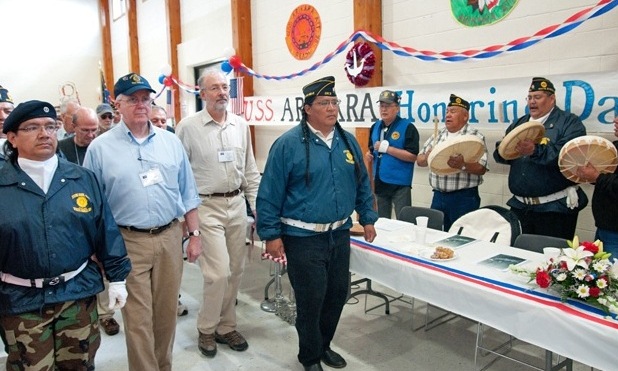
The USS Arikara Crew Meets the Arikara Nation in North Dakota

A connection between crewmembers on a small United States Navy ship and a Native American tribe in North Dakota is now forever tied. On June 20, 2012, eight Vietnam War Navy veterans who served aboard the USS Arikara were in White Shield, N.D., on the Fort Berthold Indian Reservation for a reunion, as well as to meet members of the tribe for which the ship was named.

http://www.legion.org/membership/205586/uss-arikara-crewmembers-reunite

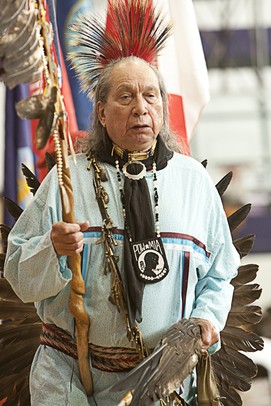
For those who don’t know, the Native American tribes have always honored warriors and veterans highly.  Native Americans have a higher percentage of their population who have served in the military than any other ethnic group.  The tradition of honoring veterans continues today with every powwow that I’ve ever attended, regardless of the sponsoring tribe.  All Native people are extremely proud of those who serve.

Veterans are always a part of the Grand Entrance ceremony and there is almost always a “Head Veteran.”  George Martin, below, at the Mother Earth Powwow in March, 2012, has been leading Michigan powwows for at least 30 years now as our beloved Head Veteran.  At some point in the festivities, all veterans present are generally recognized as well. 

In 1998, a Powwow was formed specifically to honor veterans – http://www.defense.gov/specials/nativeamerican01/powwow.html

Today there is an annual Veterans Powwow – http://nhinac.weebly.com/annual-veterans-powwow–psu.html

Hat tip to Sharron for the info about the Arikara crew.

Posted in Arikara | Leave a comment

Meeting with King Hagler and the Catawba Nation – 1756

Colonial and State Records of NC – Report by Peter Henley concerning his conference with King Hagler and the Catawba Nation – Henley, Peter, 1725-1758

May 26, 1756 – May 28, 1756

Volume 05, Pages 579-584


[B. P. R. O. North Carolina. B. T. Vol. 12. C. 106.]

Copy of a Conference held with the King and Warriors of the Cataubas by Mr. Chief Justice Henley at Salisbury in North Carolina in May 1756.
Salisbury Thursday 26 May 1756.

At two o’Clock this afternoon King Hagler of the Catawba Nation of Indians with 15 of his principal Warriors and about 30 of his young

——————– page 580 ——————–

Men painted and armed in the manner that they are when going to War and in great Order and regularity marched through this Town, and encamped a small distance from it, about an hour after he waited upon Peter Henley Esqre Chief Justice at the House of Edward Cusick, and by an Interpreter expressed himself as follows.

I and my people are Brothers and fast friends to the English and intend always to be so: Having heard of some Injuries lately done to my Brethren it has given me great concern, and being told that you and many more of them were to be here at this time I am come to talk with you about these Matters, and to endeavour to make all things streight.

To which the Chief Justice answered: King Hagler I have a sensible pleasure in seeing you and my other Brothers the Catawbas here. As I dont know the particular Articles upon which you desire this Conference when you please to communicate yourself upon that subject, I will hear you with the greatest attention.

To which the King replied. I thank you, but as it is now late I will defer doing it to 9 o’Clock to-morrow morning if that time be agreable to you, which being answered by the Chief Justice in the Affirmative on Friday May 27th the Chief Justice and principal Gentlemen in Town with King Hagler 15 of his Warriors and the rest of his people went to the House of Peter Arran and being seated round a Table, the King spoke as follows—

The Cherokees We and the White People have been Brothers, and I desired that the path between us might be kept clear but the Cherokees have been playing the Rogue at which I am extremely concerned.

All the White People from South to North as far as New York nay beyond the great Waters under the great King are our Brothers, should the French come we will stand by our Brethren the English or go down into the Grave with them.

The Cherokees have told me that they would enter into a Friendship with the French but be assured that the White People shall still be my Brothers and I will assist them, these men I have brought here (pointing to his Warriors) are all come freely and voluntarily to acquaint the English that they will stand by them as long as they live, Mine is a small Nation yet they are brave men, and will be fast friends to their Brothers the White people as long as the sun endures.

I always advise my Men to be kind and obliging to the White People, as they are their Brothers and I shall continue to do so and remain their Brother ’till a sharp thing pierces my Breast so that I die, when that happens they must do as they please.

——————– page 581 ——————–

As I suppose there will soon be a War, I desire the Governour of North Carolina as this Land belongs to him to send us some Ammunition as soon as possible, and that he will build us a fort for securing our old men women and children when we turn out to fight the Enemy on their coming and as we love to wear silver plates on our Breasts and Arms I should be glad he would send us some of them with some Wampum.

Colo Alexander Colo Harris and Capt Berry told me they would make my Warriors a small present for assisting the White People in retaking their Goods Horses &c: from the Cherokees which they had plundered them of.

I go very much among the White people and have often my Belly filled by them and am very sorry they should at any time be distracted.

I return the Governour thanks for his care in purchasing Corn for my people which has saved the lives of many of our old men women and children.

As my people and the White people are Brethren I desire that when they go to their houses they may give them victuals to eat, some of the White People are very bad and quarrelsome and whip my people about the head, beat and abuse them but others are very good.

I desire a stop may be put to the selling strong Liquors by the White people to my people especially near the Indian Nation. If the White people make strong drink let them sell it to one another or drink it in their own Families. This will avoid a great deal of mischief which otherwise will happen from my people getting drunk and quarrelling with the White people. Should any of my people do any mischief to the White people I have no strong prisons like you to confine them for it, Our only way is to put them under ground and all these men (pointing to his Warriors again) will be ready to do that to those who shall deserve it.

I desire to know what is to be done with the White Woman I took from the Cherokees: I hope she will not be put to death, she is but a Woman and can do no great harm and I think she was compelled by the Cherokees to do what she did.

To which the Chief Justice answered, Nothing has hitherto appeared against her that will affect her life. I am informed she is an indented servant to a man in Virginia, if that be the case and she should not be charged with any offence I shall direct her to be conveyed to her proper owner.

To which King Hagler replied, I am glad of it. I am always sorry to lose a Woman. The loss of one Woman may be the loss of many lives because one Woman may be the mother of many children. At

——————– page 582 ——————–

which the audience smiling, he added I believe I have spoke nothing but Truth.

I look upon the English and ourselves as many good things put into one pockett as Brothers that have issued from one Womb.

When the Gentlemen from Virginia were in this Nation they told me to get a house built for myself and they would repay me the expence when they saw me in Virginia but having lately acquainted Colo Alexander and Colo Harris with this they said No they would as I lived in Carolina get it done at their own Expence by workmen that resided near us.

After this the King informed the Chief Justice he had nothing more to say to him but had something to observe to his Warriors and thereupon addressed himself to them and then to his young men and desired them to declare whether in what he had said to his Brethern the English he had expressed their Sentiments as well as his own to which they unanimously answered that he had. Then he added, That should his Brethern of Carolina be engaged in a War as he feared they soon would he would have his Men all ready on the first notice to march to their assistance. He desired them to fight on such an occasion as became Catawbas and do nothing that might lessen the great Character they had obtained by their Military atchievements He added they were under the greatest Obligations to do this for two reasons. First because the English had cloathed them naked and fed them when hungry.  Secondly because the White people were now seated all round them and by that means had them entirely in their power.

To which the Warriors and young men all answered they would remember what he had given them in charge.

On this the King presented the pipe of Peace to the Chief Justice who as well as the rest of the company accepted it in the usual manner. The King was then informed that the Chief Justice would Answer his Speech the next morning and they met accordingly, as before, when he spoke as follows.

King Hagler, Bretheren and Friends Sachems and Warriors of the brave Catawba Nation.

It can’t help giving me vast satisfaction to see here so many great Indian Warriors who are as remarkable for their conduct and Intrepidity in Battle as their brotherly affection for the English I look upon your coming here upon this occasion as a fresh instance of the inviolable friendship you have for our common Father and Benefactor the King of Great Britain as well as for us his children and your brothers.

——————– page 583 ——————–

Your expressions of concern in regard to the Behaviour of the Cherokees your determined resolution to stand by and assist us against the French or go down into the Grave with us and the Willingness with which your Warriors have embraced the same resolution require the particular acknowledgement of us all.

Let the Cherokees behave as they will I hope We and our Bretheren the brave Catawbas shall stand firm together like a large mountain which cannot be moved.

The Station our Great King has been pleased to place me in will in many Instances enable me to be assisting in the Preservation of that Peace and Harmony which subsists between us and if any Injuries or offences should again be committed against you by the White People I will take care upon a proper Application to me that they shall not go unpunished.

You have our Thanks for the resolution you have taken of punishing such of your young people as shall commit any Injuries upon us your Bretheren, but we hope you will not have occasion to make any Examples of that kind.

Your Observation in respect to the White peoples selling Liquor to the Indians is very just as there is no Law at present to prevent it I will mention to the Governour the necessity of making one to restrain these pernicious practices for the future.

I will also take the first opportunity of representing to him in the strongest manner I can the singular services you have done us in compelling the Cherokees to deliver up the White Woman and in obtaining restitution of the Goods they had unjustly taken from us.

The application of the publick money, belongs to the Governor and Assembly with the advice of the Council, over that I have no power but I will use all the Interest I have to obtain a present from them as a small acknowledgement of the Obligations we think ourselves under to you upon that account.

I shall also faithfully represent the request you have made by me to your Brother the Governor to have a speedy supply of Ammunition to have a fort built as soon as possible for the protection of your old men your wives and children and some silver plates for your Breasts and arms with some Wampum.

In the mean time as a Testimony of the great regard we have for our brave friends and Bretheren the Catawbas we have procured at our own Expence such a supply of powder and lead as we could get to supply your present necessities which we now present you with.

Colo Alexander and Colo Harris assure me they will build the house they promised as soon as conveniently they can.

——————– page 584 ——————–

To which the King answered. I look upon you as my elder Brother and what you told me to day I shall not forget tomorrow but remember as long as I live. If any of the English shall at any time be attacked by the Enemy let me know it as soon as possible by any hand and I and my people will immediately come to your assistance.

The Chief Justice observed to him that their Brethren the White people of Virginia and the Nottoway Indians were now fighting to the Northward against the French and their Indians and had long expected their joining them and were surprised they had not yet done it.

The King replied that when the Gentlemen of Virginia were in their parts, his Warriors were all willing and desirous to go with them, but when they were gone Governor Glenn sent an express to him and forbad him to let them go unless he should order it, and that he had sent the said Govr for answer that he would wait till he had further considered of the Matter but that he had taken up the Hatchet against the French and could not lay it down without useing it.

N. B. There were two Interpreters sworn Mr. Giles and Mr. Tool.

Posted in Catawba, Cherokee, Nottoway | Leave a comment

Robeson County, NC 1840 Petition Regarding “Free Colored”

Hat tip to Phyllis for this important document.  Thank you so much.  I had heard rumors of this document for years, but was never able to nail down a source, until now.

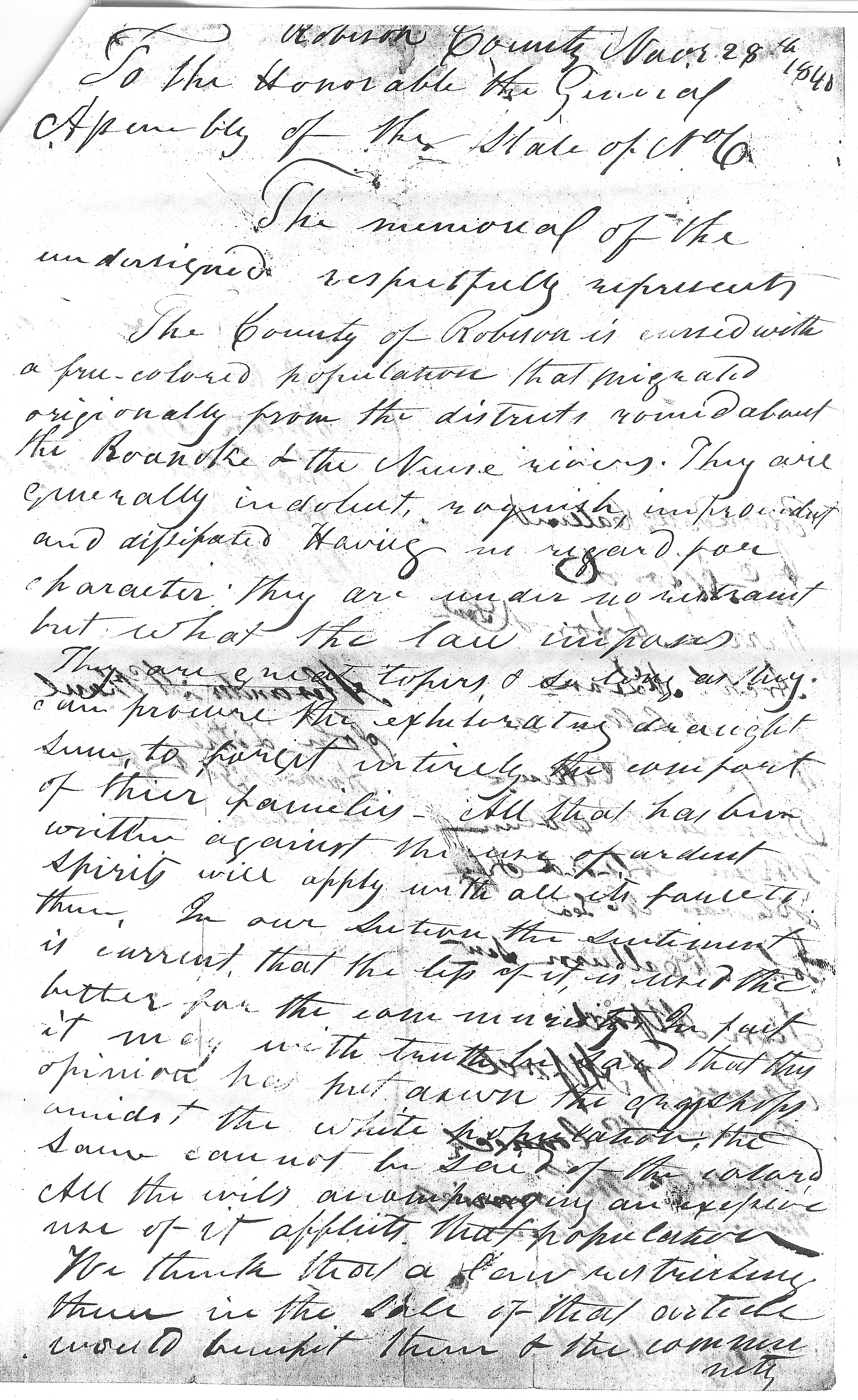
The people of Robeson County, North Carolina petitioned the North Carolina legislature in 1840 regarding the “free colored population.”  This document is critically important because it tells us the location where the “free colored” came from.  I have transcribed this document along with a second document which replies to the original, below.  There are 4 words that I was not able to translate, but they don’t appear to be critical to the understanding of the document.  They are noted with an underscore and a question mark.

I scanned the page in question with the words I had problems with and inserted it after the transcribed verbiage.  If anyone can figure out what those words actually say please let me know.

Transcription begins below:

Robeson County.  Nov 28, 1840.  To the Honorable the General Assembly of the State of NC.

The memorial of the undersigned respectfully represents the County of Robeson is cursed with a free-colored population that migrated originally from the districts round about the Roanoke and the Neuse rivers.  They are generally in indolent, roguish, improvident and dissipated.  Having no regard for character, they are under no restraint but what the law imposses. 

They are great topers? (or tossers?), as long as they can procure the exhilarating draught some to forget entirely the comfort of their families.  All that has been written against the use of ardent spirits will apply with all its force to them.  In our section the sentiment is current that the less of it is used, the better for the community.  In fact, it may with truth be said that this opinion has put down the grogshops? amidst the white population, the same cannot be said of the colored.  All the evils accompanying the use of it affects that population.  We think that a law restricting them in the sale of that oucteche? would benefit them and the community at large and hence the undersigned cannot too strongly recommend to the legislature that propriety of such a restraint and they are duty bound  November 18, 1840

John Gilcrest

W.H. Brown

Arch. Smith

Arch. McCallum

Edward McCallum

James Alford

Warren Acton Sr.?

Archibald McLean

John McCallum Jr.

William D. McCallum

Duncan McCallum

Warren Alford Jr.

Oleander McLea

John McCallum Sr

Lion Alford

James J. Alford

Duncan McCormick

Null C. McCormick

Washington A. McCain

Neill Baker

Angus McCallum

Wiley Alford

Duncan McNair

Paccom? Purcell

John Purcell Jr.

Britain Drake

Archibald Purcell

Joseph Bell Calum

Robbheshihey?

Theophulus Thompson

Dugal McCallum

Alexander McPhael

John Little

Archibald Rogert Jr.

Archibald Baker

Daniel W. Callum

The committee on propositions and grievances to which was referred the memorial of sundry citizens of Robeson County praying that some law be enacted by the legislature restricting the sale of aren’t spirits to free persons of color have had the same under consideration and beg lave to report:

That they regard all traffic in ardent spirits as a great and dangerous evil; tending as it does to the encouragement of intemperance.  The pernicious consequences of which on society and on individuals on public and private morals on public and private prosperity on public and private happiness are too evident to require argument.  And while your committee deeply lament the fatal effects of intemperance they regret to say they fear and believe there is no remedy to be hoped for in legislating particularly such as would meet the views of your memorialists.  Would you pass a law which is to effect the innocent as well as the guilty?  This would be pronounced unjust if not unwise.  And if such a law be desire who and what tribunal will be clothed with such discriminating power?  In proof of the utter inability to meet and cure the evils of intemperance by any general law we would name the 15 gallon law as it has been called of Massachusetts a state famous for its intelligence, and steady habits for its moral and religious devotion.  Yet in such a community as this, as will be remembered this has produced such incitement and apposition as to effect a most complete political revolution. 

Again in South Carolina and Georgia a violent and general incitement and opposition was manifested at the mere effort to circulate and procure subscribers to memorials to the legislatures of these states suggesting legislative enactments with a view to suppress ordinary traffic in ardent spirits. Is such have been the effect of positive incitements and the men attempt at positive legislation on this subject in these states, all must perceive the difficulty and admit the questionable character of the policy. 

Your committee are not however, inclined to support hope nor effort on this subject.  They believe however that the true policy is a strict observance of the laws now in force on this subject and a proper example and inention? on the part of the men reflecting and patriotic to encourage a praiseworthy feelings on this subject.  In this way they believe much may be done towards the suppression of this vice.  And they are not prepared to say that the law as now in force might be so amended or enlarged as to effect much good, but certainly the advanced period of the session and the mass of business now to be acted on in so short a time does not admit at this time of such a course. 

All of which is respectfully submitted. 

Matt? Moore Chairman

Posted in Lumbee | 4 Comments

Harvard University’s Indian College

In 1665, Caleb Cheeshahteaumuck became the first Native American to graduate from Harvard University.

Cheeshahteaumuck, of the Wampanoag tribe, came from Martha’s Vineyard and attended a preparatory school in Roxbury. At Harvard, he lived and studied in the Indian College, Harvard’s first brick building, with a fellow member of the Wampanoags, Joel Iacoomes. Cheeshahteaumuck died of tuberculosis in Watertown less than a year after graduation.

Apart from Cheeshahteaumuck and Iacoomes, at least two other Native American students attended the Indian College. One of them, Eleazar, died before graduating and the other, John Wampus, left to become a mariner. As for Iacoomes, he was lost in a shipwreck a few months prior to graduation while returning to Harvard from Martha’s Vineyard. It is therefore believed that Cheeshahteaumuck is the only native American to have graduated in the lifetime of the Indian College. These first students studied in an educational system that emphasized Greek, Latin, and religious instruction.

On December 16, 2010, a portrait of Caleb Chesshahteaumuck commissioned by the Harvard Foundation was unveiled in the University’s famous Annenberg Hall. A part of the Harvard Foundation Portraiture Project diversity initiative, it was painted by alumnus Stephen Coit and involved careful historical research and consultation with Wampanoag tribal members. Rev. Peter J. Gomes chaired the project and was present with Harvard President Drew Faust and members of the Harvard Native American Program to commemorate the day.

Posted in Wampanoag | Leave a comment

The Wampanoag

Recently, a subscriber sent me this wonderful excerpt.  I’ve published it below, intact, but then it made me wonder what more we know about these people being described.

TRADITIONS OF THE NORTH AMERICAN INDIANS:

BY JAMES ATHEARN JONES.

IN THREE VOLUMES.

 VOL. I.  LONDON: HENRY COLBURN AND RICHARD BENTLEY, NEW BULINGTON STREET.
1830

TO

WASHINGTON IRVING, ESQ.

THESE VOLUMES ARE RESPECTFULLY INSCRIBED BY HIS

FRIEND AND COUNTRYMAN, THE AUTHOR.

It has been thought that the introduction prefixed to the first edition, and which was intended as a mere framework upon which to hang the traditions, was not satisfactorily contrived, and that the title did not set forth the true nature of the work. I think so myself, and have therefore suppressed that introduction, and given to the work a strictly accurate title. I have supplied the place of the introduction with a brief statement of the opportunities I have had of studying the Indian character, and with an exhibition of proofs of the genuineness of the traditions themselves. The public having been pleased to say that “_if_ the matter was genuine, the manner was good,” and that a successful attempt to “stamp the legends with the character of authenticity” would elevate them to the dignity of “historical records,” I have been at some pains to collect and offer the required proofs.

INTRODUCTION.

I was born within twelve miles of a principal tribe of Indians, within two miles of a small band, and within six miles of two other small bands, of that tribe. They were a remnant of the Pawkunnawkuts, who, at the first settlement of the country, were a very numerous, powerful, and war like nation, but at the time of my birth had dwindled in numbers to about five hundred souls, and were restricted in territory to some six or seven thousand acres. They then, and at present, sank their primitive appellation [Aquinnah] in the less poetic name of Gayheads, which was given them by the white people with reference to the little elbow or promontory of land where they lived. Though the manners and customs of the Whites had made sad inroads on the primitive Indian character, there yet remained, at the time of my birth, enough to make them objects of ardent and profitable interest.

The recollections of my earliest childhood are of Indians. My grandfather had an old Indian woman in his house for the greater part of the first fifteen years of my life. Our house-servants and field-labourers were chiefly Indians. It was my grandfather’s custom, and had been that of his ancestors, ever since their settlement, a hundred and fifty years ago, in the vicinity of the tribe, to take Indian boys at the age of four or five years, and keep them until they had attained their majority, when they usually left us, chiefly to become sailors–an employment in which their services were specially valued. During my minority we had three of these little foresters in our house, and these drew around them their fathers, and mothers,and sisters, and brothers: very frequently our house was an “Indian Camp” indeed. <End of transcription.>

We often wonder how Indians took English names.  The process described above may well be a hint.  Given that the “Indian Camp” was located on the land of a white family, the Indians likely became know as the Indians associated with that surname, and eventually, either adopted the surname or it was conferred upon them as a form of identification.

I found it very interesting that many of the Indians became sailors.  The records on Hatteras Island having to do with the whaling fleet show Indians as crew on these vessels as well, many identified as being from Nantucket.  The image below is of Amos Haskins, a Wampanoag of the Aquinnah band who became a whaling captain.

Who Are the Gayheads?

The Wampanoag people, Wôpanâak in the Wampanoag language, are a Native American tribe. Wampanoag people today are enrolled in two federally recognized tribes, the Mashpee Wampanoag Tribe and the Wampanoag Tribe of Gay Head (Aquinnah) of Massachusetts, or four other tribes, recognized by the state of Massachusetts.

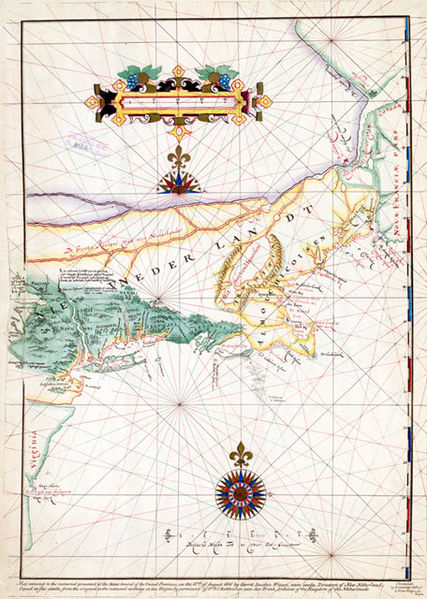
Wampanoag means “Easterners” or literally “People of the Dawn.”  The word Wapanoos was first seen on Adriaen Block’s 1614 map, shown below, and was the earliest European representation of Wampanoag territory. Other synonyms include “Wapenock,” “Massasoit” and “Philip’s Indians”.

In 1616, John Smith erroneously referred to the entire Wampanoag confederacy as the Pakanoket. Pokanoket continued to be used in the earliest colonial records and reports. The Pokanoket tribal seat was located near present-day Bristol, Rhode Island.

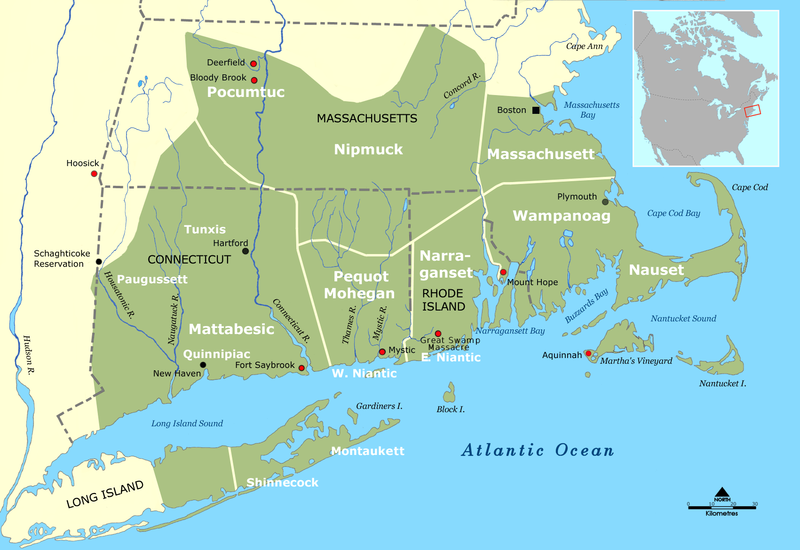
In the beginning of the 17th century, at the time of first contact with the English, the Wampanoag lived in southeastern Massachusetts and Rhode Island, as well as within a territory that encompassed current day Martha’s Vineyard and Nantucket. Their population numbered in the thousands due to the richness of the environment and their cultivation of corn, beans and squash. Three thousand Wampanoag lived on Martha’s Vineyard alone.  Tribal territories of New England aer shown below, including the Aquinnah on Martha’s Vineyard.

One of the earlier contacts between the Wampanoag and Europeans dates from the 16th century, when merchant vessels and fishing boats traveled along the coast of present-day New England. Captains of merchant vessels captured Native Americans and sold them as slaves in order to increase their earnings. For example, Captain Thomas Hunt captured several Wampanoag after enticing them aboard his vessel in 1614. He later sold them in Spain as slaves. A Patuxet named Tisquantum (or Squanto), was bought by Spanish monks who attempted to convert him. Eventually he was set free.

Despite his prior experiences, Tisquantum boarded an English ship again to accompany an expedition to Newfoundland as an interpreter. From Newfoundland, he made his way back to his homeland in 1619, only to discover that the entire Patuxet tribe – and with them, his family – had fallen victim to an epidemic.

In 1620, religious separatists and others from England called “Pilgrims” arrived in present-day Plymouth. Tisquantum and other Wampanoag taught the starving Pilgrims how to cultivate varieties of corn, squash and beans (the Three Sisters); catch fish, and collect seafood.  So it’s really the Wampanoag we can thank for Thanksgiving.

From 1616 to 1619 the Wampanoag suffered an epidemic of what researchers now believe was leptospirosis, a bacterial infection also known as Weil’s syndrome or 7-day fever. It caused a high fatality rate and nearly destroyed the society. Historians believe the losses from the epidemic made it possible for the English colonists to get a foothold in creating the Massachusetts Bay Colony in later years.  King Philip’s War (1675–1676) against the English colonists resulted in the deaths of 40 percent of the tribe. Most of the male survivors were sold into slavery in the West Indies. Many women and children were enslaved in New England.

While the tribe largely disappeared from historical records from the late 18th century, its people persisted. Survivors remained in their traditional areas and continued many aspects of their culture, while absorbing other people by marriage and adapting to changing economic and cultural needs in the larger society. Although the last native speakers of Wôpanâak died more than 100 years ago, since 1993 the tribe has been working on a language revival project that is producing new native speakers, the first time this has been achieved in the United States.

You can read more about the historical GayHead and their interactions with Europeans in the History of Martha’s Vineyard.

You can read about the Wampanoag tribe of Gay Head, on their website and Mashpee Wampanoag on theirs as well.

Hat tip to Steve for sending the original article my direction.

Posted in Aquinnah, Mashpee, Patuxet, Pokanoket, Wampanoag, West Indies | 1 Comment

King Philip’s War

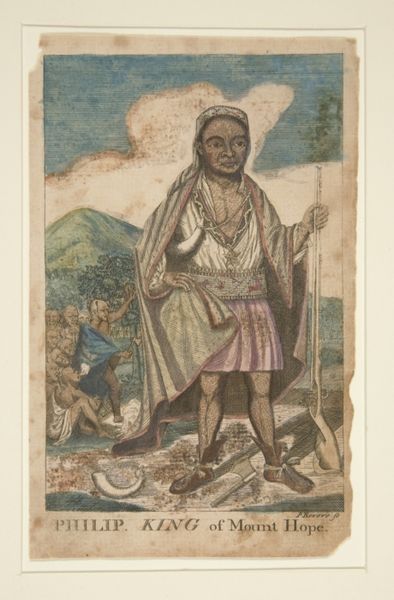
King Philip’s War was sometimes called the First Indian War, Metacom’s War, or Metacom’s Rebellion and was an armed conflict between Native American inhabitants of present-day southern New England, English colonists and their Native American allies in 1675–76. The war is named after the main leader of the Native American side, Metacomet, known to the English as “King Philip”. 

Plymouth, Massachusetts, was established in 1620 with significant early help from Native Americans, particularly Squanto and Massasoit, Metacomet’s father and chief of the Wampanoag tribe. The building of towns such as Windsor, Connecticut (est. 1633), Hartford, Connecticut (est. 1636), Springfield, Massachusetts (est. 1636), and Northampton, Massachusetts (est. 1654), on the Connecticut River and towns such as Providence, Rhode Island, on Narragansett Bay (est. 1636), progressively encroached on traditional Native American territories.

Throughout the Northeast, the Native Americans had suffered severe population losses due to pandemics of smallpox, spotted fever, typhoid and measles, infectious diseases carried by European fishermen, starting in about 1618, two years before the first colony at Plymouth had been settled. Shifting alliances among the different Algonquian peoples, represented by leaders such as Massasoit, Sassacus, Uncas and Ninigret, and the colonial polities negotiated a troubled peace for several decades.  In the photo below, this boulder now known as King Philip’s Seat was a location for meetings.
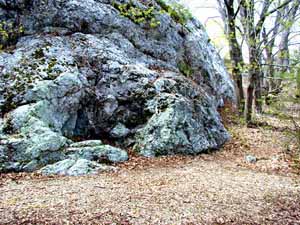
For almost half a century after the colonists’ arrival, Massasoit of the Wampanoag had maintained an uneasy alliance with the English to benefit from their trade goods and as a counter-weight to his tribe’s traditional enemies, the Pequot, Narragansett, and the Mohegan. Massasoit had to accept colonial incursion into Wampanoag territory as well as English political interference with his tribe. Maintaining good relations with the English became increasingly difficult, as the English colonists continued pressuring the Indians to buy land for new towns.

Prior to King Philip’s War, tensions fluctuated between different groups of Native Americans and the colonists, but relations were generally peaceful. As the colonists’ small population of a few thousand grew larger over time and the number of their towns increased, the Wampanoag, Nipmuck, Narragansett, Mohegan, Pequot, and other small tribes were each treated individually (many were traditional enemies of each other) by the English colonial officials of Rhode Island, Plymouth, Massachusetts Bay, Connecticut and the New Haven colony. As their population increased, the New Englanders continued to expand their settlements along the region’s coastal plain and up the Connecticut River valley. By 1675 they had even established a few small towns in the interior between Boston and the Connecticut River settlements.

Tensions escalated and the war itself actually started almost accidentally, certainly not intentionally, but before long, it has spiraled into a full scale war between the 80,000 English settlers and the 10,000 or so Indians.

John Sassamon, a Native American Christian convert (“Praying Indian”) and early Harvard graduate, translator, and adviser to Metacomet, was a figure in the outbreak of the war. He told the governor of Plymouth Colony that Metacomet, King Philip, was intending to gather allies for Native American attacks on widely dispersed colonial settlements.

King Philip was brought before a public court to answer to the rumors, and after the court officials admitted they had no proof, they warned him that any other rumors—baseless or otherwise—would result in their confiscating Wampanoag land and guns.  Not long after, Sassamon was murdered and his body was found in the ice-covered Assawompset Pond.

On the testimony of a Native American witness, the Plymouth Colony officials arrested three Wampanoag, who included one of Metacomet’s counselors. A jury, among whom were six Indian elders, convicted the men of Sassamon’s murder. The men were executed by hanging on June 8, 1675, at Plymouth. Some Wampanoag believed that both the trial and the court’s sentence infringed on Wampanoag sovereignty.

John Sassamon, a Native American Christian convert (“Praying Indian”) and early Harvard graduate, translator, and adviser to Metacomet, was a figure in the outbreak of the war. He told the governor of Plymouth Colony that Metacomet was intending to gather allies for Native American attacks on widely dispersed colonial settlements.

King Philip was brought before a public court to answer to the rumors, and after the court officials admitted they had no proof, they warned him that any other rumors—baseless or otherwise—would result in their confiscating Wampanoag land and guns.  Not long after, Sassamon was murdered and his body was found in the ice-covered Assawompset Pond.

On the testimony of a Native American witness, the Plymouth Colony officials arrested three Wampanoag, who included one of Metacomet’s counselors. A jury, among whom were six Indian elders, convicted the men of Sassamon’s murder. The men were executed by hanging on June 8, 1675, at Plymouth. Some Wampanoag believed that both the trial and the court’s sentence infringed on Wampanoag sovereignty.

In response to the trial and executions, on June 20, 1675, a band of Pokanoket, possibly without Metacomet’s approval, attacked several isolated homesteads in the small Plymouth colony settlement of Swansea. Laying siege to the town, they destroyed it five days later and killed several people.

On June 27, 1675, a full eclipse of the moon occurred in the New England area. Various tribes in New England looked at it as a good omen for attacking the colonists.  

Officials from the Plymouth and Massachusetts Bay colonies responded quickly to the attacks on Swansea; on June 28 they sent a punitive military expedition that destroyed the Wampanoag town at Mount Hope (modern Bristol, Rhode Island).

The war quickly spread, and soon involved the Podunk and Nipmuck tribes. During the summer of 1675, the Native Americans attacked several towns. 

The New England Confederation, comprising the Massachusetts Bay Colony, Plymouth Colony, New Haven Colony and Connecticut Colony, declared war on the Native Americans on September 9, 1675. The Colony of Rhode Island and Providence Plantations, settled mostly by Puritan dissidents, tried to remain mostly neutral, but like the Narragansett they were dragged inexorably into the conflict.

With these actions, a full scale war was indeed underway. 

King Philip was shot and killed by an Indian named John Alderman on August 12, 1676. King Philip was beheaded, then drawn and quartered (a traditional treatment of criminals in this era). His head was displayed in Plymouth for twenty years.   The stone below marks the location of King Philip’s death in Miery Swamp in Mounty Hope, Rhode Island.
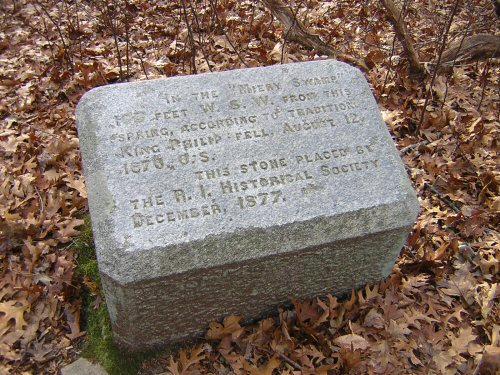
King Philip’s head was secreted away by a colonial family that was friendly to him. The Leonard family kept King Philip’s head for many generations, before giving it to his descendants.

The war in the south largely ended with Metacom’s death. Over 600 colonists and 3,000 Native Americans had died, including several hundred native captives who were tried and executed or enslaved and sold in Bermuda. The majority of the dead Native Americans and the New England colonials died as the result of disease, which was typical of all wars in this era.

Those sent to Bermuda included Metacom’s son (and also, according to Bermudian tradition, his wife). A sizable number of Bermudians today claim ancestry from these exiles. Members of the Sachem’s extended family were placed for safekeeping among colonists in Rhode Island and eastern Connecticut. Other survivors joined western and northern tribes and refugee communities as captives or tribal members. Some of the Indian refugees would return on occasion to southern New England.

The Narragansett, Wampanoag, Podunk, Nipmuck, and several smaller bands were virtually eliminated as organized bands and even the powerful Mohegans were greatly weakened.

King Philips war was the single greatest calamity to occur in seventeenth-century New England. In little over a year, twelve of the region’s towns were destroyed and many more damaged, its economy was all but ruined, and much of its population was killed, including one-tenth of all men available for military service. Proportionately, it was one of the bloodiest and costliest wars in the history of North America. More than half of New England’s towns were assaulted by Native American warriors. 

Conversely, about one third of the entire Indian population was killed, their villages destroyed, and the remainder who the colonists believed to have been involved where caught, killed or shipped into slavery in Bermuda.  Some Indians did not fight against the colonists but fought with them, and those Indians were spared.  This war was not only devastating to the Native population, but divisive as well.  There were no winners, but the Native people lost more than anyone else, individually and as tribes.

Posted in Bermuda, Mohegan, Narragansett, Nipmuck, Pequot, Podunk, Pokanoket, Wampanoag | 3 Comments