Tuscarora Identified by Land and Other Transactions – Part 7

The Land Leases

Beginning in 1775, there are a series of deeds for leases to a group of men who each receive deeds separately.

1775 – Book M page 317/318, Indians to King

Note, the list of names is repeated 3 times in this deed.  I am listing them once, with notes.

No acreage given, yearly rent…farm let..Town Swamp…mouth Licking Branch…blinde John’s…Horse Pocoson…Worley Jones…Town Swamp…99 years.

Dec 13, 1775, Whitmel Tufdick, “the King Indian” and the rest of the Tuscarora Indians and their airs (sic), William Cain, William Blount (Blunt in other iterations), Wineoak Charles Jr., Wineoak Charles Sr., Sam Bridges (Bridgers in other iterations), Lewis Tufdick, Isaac Wheeler (Whealer in other iterations), William Mitchell, Tom Robbard (Robards, Robarts in other iterations), William Pugh, William Baskit, John Robearts, Capt. William Blount (Blunt in other iterations), John Rodgers, John Owens, Tom Tommas (Tommor in other iterations), James Hix, James Wiggians, What Gibson, John Hix (not on first list in deed, but on the other two iterations), West Whitmell to William King for yearly rents, Town Swamp at beginning at the mouth of Lickign Branch…below Johnes…Worley Jones line, for 99 years.

Signed by:

John (I) Hicks, West Whitmell, TerKaRu Nation 1775, underneath this is the list of witnesses, and then the list of other signatures.  Registered in August court 1777 byoath of William King, witness.

James Mitchell (+) (Is this the William Mitchell in the body of the document above?)

Samuel Bridgers (N)

James Hix (W)

James Wiggians (+)

What Gibson (+)
Isaac Whealter or Wheatter (check mark)

Tom Roberts (7)

William (M) Basket

Lewis (x) Tufdick

Whitmell Tufdick (signs)

William Roberts (x) (not listed in document above)

William Cane (H)

Cap. William Blunt (x) (Capt. William Blunt and William Blount listed separately above, but only one signs)

William Pugh (+)

Wineoak Charles Junior (+)

John Rodges (-)

Wineoak Charles, Sen (X)

John Owens (+)

Tom Tommas (+)

Witnesses

Thomas Whitmell Junior

Michael King

William King Jun

Charles King

James Turner
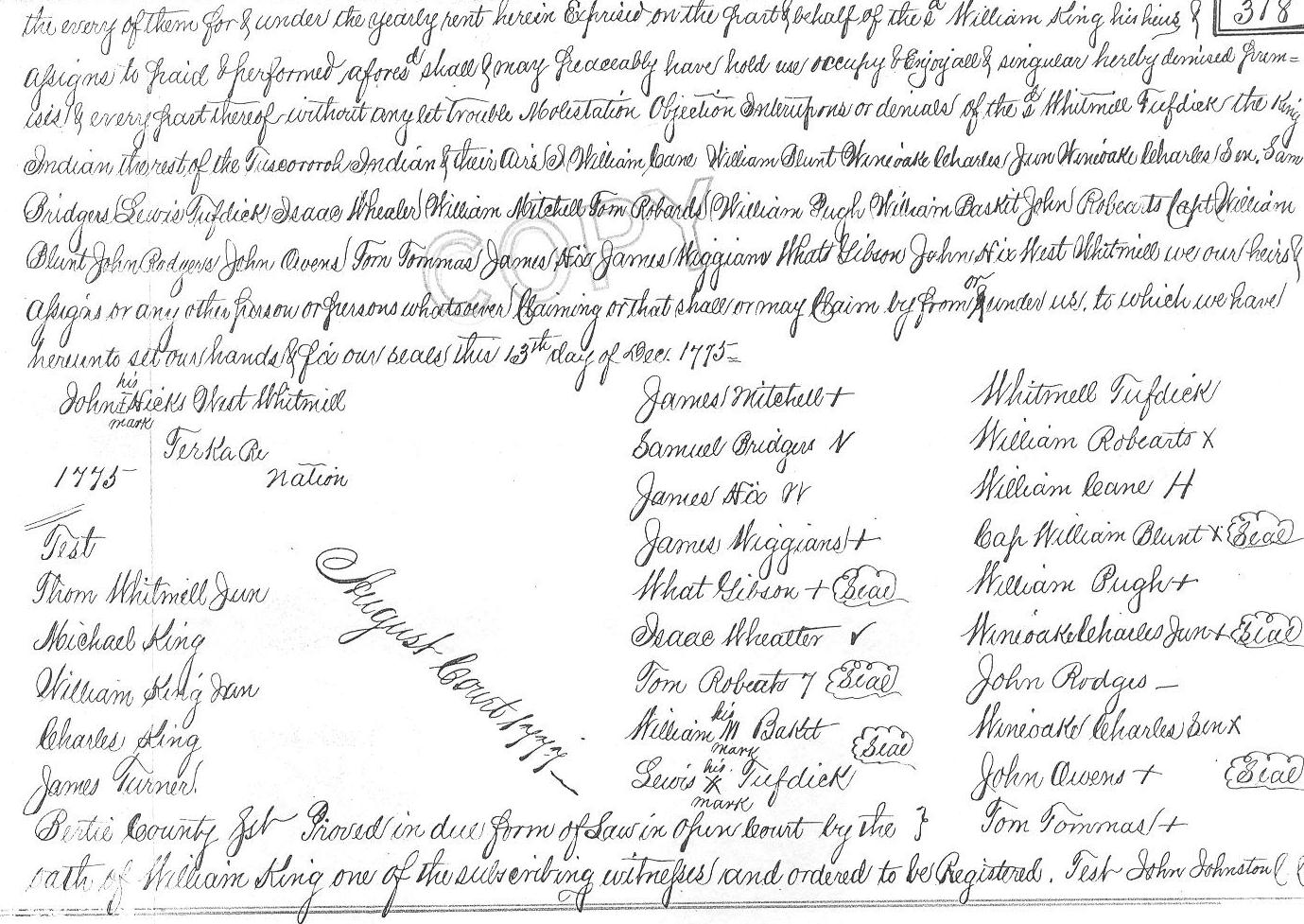
Based on the Indian petition and the date on this deed, this would be the original, valid, deed.

I find it curious that both West Whitmell ad West Whitmell Jr. can both sign their names.

—–

1777 – Book S page 676-678, Indians to Johnson

“Headmen of the Tuscarora” to John Johnston, (land description only partially readable in photo,) …Whitmel Tufdick field…Willie Williams, Willie Jones, ? Pugh….200 acres.

Whitmell Tufdick

Lewis (x)Tufdick

William (x) Roberts

William (x) Cain

William (x) Pugh

William (x) Basket

Wineoak (x) Charles

John (x) Randolph

Benjamin (x) Smith

James (x) Mitchell

Thomas Roberts

Charles Roberts

John Owens

Sarah Basket

William Blount/Blunt

Walter Gipson

Samuel Bridgers

West Tufdick and signed as West Whitemeal

Witness William Williams

——-

1777 – Book S p 679-680, Indians to Hunter and others

Chiefs of the Tuscarora Indians to Thomas Hunter, yearly rent 8# proclamation money,…Pugh, Williams and Jones corner…head of Chocawench gut….Roanoke River, no acreage given

Tuscarora signers:

Whitmeal Tufdick

Lewis Tufdick

William Roberts

William Pugh

John Smith

William Cain

Wineoak Charles

On the signature page but not mentioned in the body of the deed:

William Rash (the ash is clear, the R is not)

Witness William Williams and Thomas Pugh Jr., registered January 1786

—–

The above two deeds were transcribed from photographs of the deeds.  The balance were from copies of the deeds and were much clearer.

—–

1777 – Book M page 314/315, Indians to Stone

Articles of agreement between Whitmell Tufdick, William Roberts, William Cain, William Blount (did not sign below), Tom Smith, John Smith and Lewis Tufdick of Bertie Co., Chieftans of the Tuscarora Indians on Roanoke River to Zedekia Stone of same. 10 Feb 1777. Sd chieftains were desirous that said Stone should clear land, joining Coniack Neck, Titus Edwards, Cesars Island, the river. Said Stone agrees not to disturb Joseph Lloyd & Thomas Smith & Sarah Hicks. Said Stone will be permitted to occupy the said land for the space of 99 years.

Signed by: William Basket, Molley Smith, Benja. (I) Smith, Sarah Hicks, Sarah (I) Baskett, Watt & Gibson (the & could be his mark), Whitmell Tuffdick, Thomas (x) Smith, John Rodgers, Samuel (7) Bridgers, William Roberts, Wineoak (S) Charles, Zedekiah Stone, John Owens (x), Thomas Roberts, William (x) Caine, Edward (x) Blount, John (x) Smith, James (x) Mitchell, John (I) Randle, William (x) Blount, Lewis (x) Tufdick, William (x) Pugh, West Whitmell (says mark but no mark made) Tuffdick. Witnesses: Thomas Pugh, Jr., Titus Edwards, Thos. Pugh, Sr.. May Court 1777. John Johnston Clerk of Court

Who are Joseph Lloyd, Thomas Smith and Sarah Hicks that are to remain undisturbed?  Both a Thomas Smith and Sarah Hicks sign documents, so it could be interpreted that these two people are tribal members who are living on this land, but what about Joseph Lloyd?

——

1777 – Book M page 315/16, Indians to Pugh

Whitmell Tufdick, William Roberts, William Blount (signed as Billey), Lewis Tufdick, John Randal (Randel), William Pugh, James Mitchel, Wineoak Charles, William Basket, John Owens (did not sign below), Thomas Roberts, Walter Gibson, Billy Cane, Chieftans and head men of the Tuscarora Indians in Bertie County to Thomas Pugh Sr. of same. 28 May 1777. The lease for 99 years at 8 pounds per year, land joining Black Gut Neck on Town Swamp…Roanoke River, 100 acres more or less.

Signed by:

Billey (x) Blunt

Wineoak (+) Charles

Ben (x) Smith (not listed above)

Walter (X) Gibson

Thomas (X) Roberts

John (R) Randel

Whitmell Tuffdick (signed)

Billy (X) Cane

Lewis (mark looks like a fish) Tufdick

Billey (x) Baskit

William (x) Pugh

Williams (x) Roberts

James (S) Mitchell.

Witnesses: Zedekiah Stone Jr., Thomas Whitmell Jr., May Ct 1777.

—–

1777 – Book M page 316/317, Indians to Pugh and others.  This document is also found in the Lewis Thompson Papers at UNC in collection 716.

Note – the list of names is repeated 4 times in the body of the deed.  I have written then once here with notes if they varied.

Whitmell Tufdick, Chief of the Tuscarora and Wineoak Charles Sr., Wineoak Charles Jr., Billie Roberts, Lewis Tufdick, West Tufdick (signed as West Whitemell), Bill(i)e Blunt Sr., Bill(i)e Blunt Jr., John Rodgers, John Smith, Billie Pugh, Billie Baskit, John Hicks, Samuel Bridgers, John Owen(s), James Mitchell, Isaac (says James on third list of names) Cornelius (does not sign below), Tom Tomas (says Thomas on most iterations, does not sign below), & Walter (Walterly or Walterby on fourth iteration, does not sign below) Gibson, Chieftans of the Tuskarora Indians to Thomas Pugh, Willie Jones & William Williams. 2 Dec 1775. For the yearly rent of 80 Duffield Blankets, 80 Oznatrig Shirts, 80 pairs of boots to be made of half thicks which said shirts and boots to be suitable for the said Indians according to their different sizes, 50 pounds of powder & 150 pounds of shot to be paid to them… 2000 acres which was part of the land called the Indian Lands, joining Town Swamp at Sam Williams line, the old path that leads to Unarowick Swamp, swamp where James Wiggins lives called Unrintaroud, Unrinta Road, Quitana Swamp, Rocquist, Jones, Williams, Pugh, excepting 300 acres Wm. King now tends.

Some of the men appear to have signed their names.  The rest sign with an X or a mark.

Bille (/) Cain (not shown above)

John Hicks (signed) (not shown above)

John Rogers (signed)

John (xx) Owen

James (/) Hicks

Bille (S) Smith (not shown above)

Bille (/) Mitchell (not shown above)

Bille (x) Pugh

Wineoak (7) Charles Sr.

James (mark looks like u laying on its left side) Mitchell

Bill (+) Blount Jr

Samuel (//) Bridgers

Tom Roberts Jr. (unusual mark under his name looks like two fishhooks crossed) (not shown above)

Whitmell Tufdick (signed) (not shown above)

John (/) Smith

Bille (S) Roberts (signed)

Bille (c)Blunt Sr.

West Whitmell (signed)

Wineoak Charles Jr. (space says his mark but no mark made)

Lewis (x) Tufdick

Witnesses Henry Bate, John Pugh Williams and William Williams Jr.

In the above document, some men are listed who don’t sign, and some sign who aren’t listed.  West Tufdick/Whitmel seems to use both surnames interchangeably.

——

Book M page 318/319, 1777 Indians to King, recorded November Court 1777

April 7, 1777, between Whitmill Tufdick, William Roberts, Tom Smith (does not sign below), John Smith, Lewis Tufdick, William Cane and Tom Roberts (does not sign below) Chieftains and Headmen of a nation of Tuscarora Indians inhabiting on Roanoke River in Bertie County and William King, planter, beginning at the mouth of a branch at the lower end of Sesars [Ceasar’s] Neck, up the branch by Tom’s old field….in consideration of the labor by him performed clearing a part of the land within the boundaries…authorized to possess “a certain quantity” of land for 99 years, no acreage given.

Wineoak (X) Charles

Wot (backards N) Gibson

John (~) Rogger

Sarah(X) Dennis (says his mark like the rest)

Bette (X) Yollone

Molley (X) Wineoak (her mark)

Molley (X) Cain (her mark)

Michael King Jr. (probably white witness)

William King Jr. (probably white witness)

Tom (elll in script, all loops, may be more of a scribble) Roberts

James (X) Mitchell

Bethey or Athey (X) Blunt (doesn’t say his or her mark, no caps)

*John (X) Smith

John (X) Oin

Ben (X) Smith

*Thomas (X) Smith

Molley (/) Smith (her mark)

*Whitmill Tufdick (he signs)

*William (X) Cane

*Lewis (R) Tufdick

William (X) Blunt

*William (J) Roberts

William (+) Basket

William (II) Pugh (his mark looks like two capital Is with the top and bottom lines connecting)

Sarah (X) Basket (her mark)

Nane (X) Owens (her mark)

Betty (X) Blunt (her mark)

Samuel (X) Bridgers

Michael King Jr.

William King Jr.

Registered at the November 1777 court proven under the oath of subscribing witnesses Michael King Jr and William King Jr.

By the oaths of Michael King and William King, two subscribing witnesses, ordered to be registered, Nov Court 1777.

Many more people signed this document than were listed in the verbiage section.  The people with an * before their name were listed in the deed verbiage, the rest were not bud signed anyway, including several women.

Based on the information in the Indian petition, and the dates, this would be the second, fraudulent lease.

——

1777 – Book M page 319 – Indians to Edwards

July 7, 1777

Whitmell Tufdick, William Roberts, William Cain(e), William Blount, Thomas Smith, Lewis Tufdick, West Tufdick, chieftains of the Nation of Tuscarora Indians living on Roanoke River to Titus Edwards in consideration for the labor he will have to expend to clear the 60 acres of land, to inhabit the land for 99 years.

Witnesses

William (x) Pugh

West Whaell Tufdick (rs squiggle)

John (IR) Randell

Benjamin (x) Smith (not listed above)

William (x) Blount

Samuel (x) Bridgers (not listed above)

John (+)Smith? (not listed above)

William (x) Roberts

Wineoak (+) Charles (not listed above)

Whitmell Tufdick (signed)

Lewis (squiggle) Tufdick

William (x) Baskett (not listed above)

What (x) Gibson (not listed above)

Thomas (x) Smith

William (x) Cain

John (x) Cain (not listed above)

There is a note on page 320, Nov 1777 court, that the foregoing deed was not registered “in course being wanted.”

Witness Zedekiah Stone Jr.

Registered November 1777 by the oath of Zedekiah Stone, a subscribing witness.
Posted in History, Tuscarora | 4 Comments

Tuscarora People Identified by Land and Other Transactions – Part 6

General Assembly Act Confirming Land Sale

1769 – Records of the Executive Council Papers, 1769

Order in Council – January 11 1769 – At the Court at St. James’s the 11th day of January 1769.

Acts of the North Carolina General Assembly, 1766

North Carolina. General Assembly November 03, 1766 – December 02, 1766 Volume 25, Pages 494-509

http://docsouth.unc.edu/csr/index.html/document/csr25-0049

Whereas the Governor of His Majesty’s Province of NC with the Council and Assembly of the said Province did in 1766 pass an Act which hath been transmitted in the words following.

CHAPTER XXIX.

An Act for confirming a lease made by the Tuscarora Indians to Robert Jones, Jun., William Williams and Thomas Pugh, Esquires.

I. Whereas, a number of the Tuscarora Indians, being desirous of moving themselves from their lands on Roanoke river, in Bertie county, in this province, and settling and incorporating themselves with the nations of Indians on the River Susquehannah; and whereas, the said Tuscarora Indians, in order to defray the expence of removing themselves and their effects from this province to the settlements on the river Susquehannah, did, on the twelfth day of July, in the year one thousand seven hundred and fifty-six [should be sixty-six], for the consideration of fifteen hundred pounds, proclamation money, before that time paid and advanced to them, the said Tuscarora Indians, by the said Robert Jones, William Williams and Thomas Pugh, by an indenture under the hands and seals of James Allen, John Wiggins, Billy George, Snip Nose George, Billy Cain, Charles Cornelius, Thomas Blount, John Rogers, George Blount, Wineoak Charles, Billy Basket, Billy Owen, Lewis Tuffdick, Isaac Miller, Harry, Samuel Bridgers, Thomas Seneca, Thomas Howit, Billy Sockey, Billy Cornelius, John Seneca, Thomas Basket, John Cain, Billy Dennis, William Taylor, Owens, John Walker, Billy Mitchell, Billy Netop, Billy Blount, Tom Jack, John Lightwood, Billy Roberts, James Mitchell, Captain Joe and William Pugh, chieftains and headmen of the said nation of Tuscarora Indians, for and on behalf of themselves and the rest of the Indians of the said Tuscarora nation, on the one part, and the said Robert Jones, William Williams and Thomas Pugh, of the other (p 508) part, did demise, grant and to farm let, a certain dividend of land, situate and lying on Roanoke river, in the county aforesaid, containing about eight thousand acres, be the same more or less, and bounded as follows, to-wit: Beginning at the mouth of Deep Creek, otherwise called Falling Run, thence running up the said creek to the Indian head line; hence by the said line south fifty seven degrees east one thousand two hundred and eighty poles; thence a course parallell with the general current of the said creek to Roanoke river aforesaid, and up the river to the beginning; together with all trees, timber trees, woods, underwoods, ways, waters and appurtenances whatsoever, to the said dividend, tract or parcel of land belonging or in any wise appertaining; to have and to hold the said dividend, tract or parcel of land, with all and singular the appurtenances unto the said Robert Jones, William Williams and Thomas Pugh, their executors, administrators or assigns, without impeachment of waste, to be by the said Robert Jones, William Williams and Thomas Pugh, respectively, their executors, administrators and assigns, held and enjoyed in severalty; that is to say, one third part of the said dividend, tract or parcel of land, into three equal parts to be divided, unto the said Robert Jones, his executors, administrators and assigns; one other third part thereof, the same into three equal parts to be divided, unto the said William Williams, his executors, administrators and assigns; the remaining third part thereof, the same into three equal parts to be divided, unto the said Thomas Pugh, his executors, administrators and assigns; from the said twelfth day of July, in the year aforesaid, for and during the term of one hundred and fifty years from thence next ensuing, and fully to be compleated and ended, the said Robert Jones, William Williams and Thomas Pugh, their executors, administrators and assigns, yielding and paying therefor yearly, and every year during the said term, to the said Tuscarora Indians and their assigns one pepper corn, if demanded, at or upon feast of St. Michael the Archangel.

II. And whereas, the said nation of Tuscarora Indians are desirous that the indenture of the lease made between the said James Allen, John Wiggins, Billy George, Snip Nose George, Billy Cain, Charles Cornelius, Thomas Blount, John Rogers, George Blount, Wineoak Charles, Billy Basket, Billy Owen, Lewis Tuffdick, Isaac Miller, Harry, Samuel Bridgers, Thomas Seneca, Thomas Howit, Billy Socket, Billy Cornelius, John Seneca, Thomas Basket, John Cain, Billy Dennis, William Taylor, Owens, John Walker, Billy Mitchell, Billy Netop, Billy Blount, Tom Jack, John Lightwood, Billy Roberts, James Mitchell, Captain Joe and William Pugh, Chieftains and headmen of the said nation of Tuscarora Indians, and the said Robert Jones, William Williams and Thomas Pugh, should have the force and validity of the Assembly; and that it shall be lawful for the said Robert Jones, William Williams and Thomas Pugh, their executors, administrators and assigns, to enter upon, occupy, possess and enjoy the said dividend, tract or parcel of land, demised as aforesaid, without let, hindrance or molestation of any person or persons whatsoever, and without incurring any penalties whatsoever by reason of their so entering upon, occupying, possessing and enjoying the said tract or parcel of land, without impeachment for waste.

III. And whereas, the said Robert Jones, since the said twelfth day of July, in the year aforesaid, hath departed this life, having first made his last will and testament, and therein and thereby bequeathed his proportion and share of the said tract or parcel of land, demised as before said, unto his sons Allen Jones and Willie Jones, their executors, administrators, and assigns; (p 509)

IV. Be it therefore Enacted by the Governor, Council and Assembly, and by the Authority of the same, and it is hereby Enacted, That the said indenture of the demise is hereby ratified and confirmed; and that it shall and may be lawful for the said Allen Jones and Willie Jones, in right of the said Robert Jones, the said William Williams, and Thomas Pugh, their executors, administrators, and assigns, to enter upon, occupy, possess, and enjoy the said dividend, tract or parcel of land, according to the form and effect of the said indenture of the demise; that is to say, that it shall and may be lawful for the said Allen and Willie Jones, their executors, administrators, and assigns, to enter upon, occupy, possess, and enjoy, one third part of the said dividend, tract or parcel of land, the same to be divided into three equal parts, for, and during the term aforesaid; the said William Williams, his executors, administrators and assigns, to enter upon, occupy, possess, and enjoy, one third part thereof, the same into three equal parts to be divided, for and during the term aforesaid; and the said Thomas Pugh, his executors, administrators and assigns to enter upon, occupy, possess, and enjoy, the remaining third part thereof, for and during the term aforesaid.

V. And be it further Enacted, by the Authority aforesaid, That the said Allen Jones, Willie Jones, William Williams, and Thomas Pugh, their executors, administrators, and assigns, are hereby exempted from the penalties of an Act of Assembly, passed at New Bern the fifteenth day of October in the year of our Lord One Thousand Seven Hundred and Forty-eight, intituled, An Act for ascertaining the bound of a certain tract of land formerly laid out by treaty for the use of the Tuscarora Indians, so long as they or any of them shall occupy or have the same and to prevent any other person or persons taking up land, or settling within the said bounds by pretence of any purchase or purchases made or that shall be made from the said Indians; and that shall and may be lawful for the said Allen Jones and Willie Jones, William Williams, and Thomas Pugh, their executors, administrators, and assigns, to occupy, possess and enjoy, the said dividend, tract or parcel of land demised as aforesaid, during the term aforesaid, without impeachment of waste, and without the let, molestation, or hindrance, of any person or persons whatsoever.

VI. Provided always, and be it Enacted, by the Authority aforesaid, That nothing herein contained shall be construed as to invalidate the title or titles of any person or persons who have obtained in a grant or grants for any tract or parcel of land within the limits or boundaries of the lands of the said Tuscarora Indians, before the fifteenth day of October, one thousand seven hundred and forty eight.

VII. Provided also, and it is hereby Enacted, by the authority aforesaid, That the said Allen Jones, Willie Jones, William Williams, and Thomas Pugh, their executors, administrators, and assigns, shall yearly and each year, during the term aforesaid, on the twenty first day of March pay the right honourable Earl of Granville, his heirs and assigns, a quit rent of four shillings, Proclamation Money, for every hundred acres of land contained within the limits or boundaries of the lands demised as aforesaid: and in case the said quit rents shall be in arrear at any time within the term aforesaid, that then it shall and may be lawful for the Earl of Granville, his heirs and assigns, to sue for and recover all such arrearages of rent, of and from the said Allen Jones, Willie Jones, William Williams, and Thomas Pugh, their executors, administrators and assigns, by all lawful ways and means whatsoever.

And whereas the said Act together with a Representation from the Lords Commissioners for Trade and Plantations thereupon, having been referred to the consideration for the Committee of the Lords of His Majesty’s most Honourable Privy Council for Plantation affairs, the said Lords of the Committee did this day report as their opinion to His Majesty that the said Act was proper to be approved.  His Majesty asking the same into consideration was pleased with the advice of this Privy Council to declare his approbation of the said Act and pursuant to his Majesty’s Royal pleasure thereupon expressed, the said Act is hereby confirmed, finally enacted and ratified accordingly.  Whereof the Governor or Commander in Chief of his Majesty’s said Province of NC for the time being and all others whom it may concern are to take notice and govern themselves accordingly.  Steph.  Cottrell

Recorded Sept. 27 1769

John London Deputy Sec.

Posted in History, Tuscarora | Leave a comment

Tuscarora People Identifed in Land and Other Transactions – Part 5

Original Land Transactions

William L. Byrd, III, in his book, Against the Peace and Dignity of the State, North Carolina Laws Regarding Slaves, Free Persons of Color and Indians, extracted Indian records from the North Carolina General Assembly.  These records, combined with the deed records, governor’s letters and other correspondence provide details not otherwise available.

1748 – An act for ascertaining the bounds of a certain tract of land formerly laid out by treaty to the use of the Tuskerora Indians so long as they or any of them shall occupy and live up on the same and to prevent any person or persons taking up lands or settling within the said bounds by pretense of purchase from the said Indians.  …..lands formerly alloted to the Tuskerora Indians by solemn treaty lying on the Morattock river in Bertie Co being the same whereon they now dwell butted and bounded as follows…beginning at the mouth of Quitsnoy swamp running up the said swamp 430 poles to a scrubby oak near the head of the said swamp by a great spring then north 10 degrees east 1850 poles to a persimmon tree on the Raquis Swamp then along the swamp and pocoson main course north 57 degrees west 2640 poles to a hickory on the east side of the Falling Run or Deep Creek and down the various courses of the said run to Morattock Rover then down the said river to the first station…is confirmed and assured into James Blount, Chief of the Tuskerora Nation and the people under his charge, heirs, successors, forever, by law, usage or grant to the contrary notwithstanding.  If the Indians desert or leave the land and persons who formerly obtained grants  within the bounds may then take the land.  Charging quit rents is not lawful within the Indian bounds to the Indians but if the Indians have deserted, they may be charged to the patentee in possession.  No person for any consideration whatsoever shall purchase or buy any tract or parcel of land from any Indian or Indians and they are declared null and void.

The above bolded verbiage is important for two reasons.  First, it explains why, here, and in other locations, we don’t find Native people on tax lists.

Secondly, and more important to the Tuscarora, this verbiage, found here and elsewhere, paves the way, anticipates it actually, for the whites to take the Indian lands.

I have often wondered why the Tuscarora who went to New York would in effect, disown the Tuscarora who did not move and who were left behind.  If the Tuscarora had to leave the land in order to dispose of it, what better way to eliminate those who remained.  They simply were no longer Indians, not Tuscarora, so not a problem because they remained.  If you couldn’t convince them to move North, then they could be eliminated from the Tuscarora population, thereby not posing a legal problem relative to the land.  It’s somehow ironic that 150 years later, the tribe would have gladly found any reason, including remaining tribal members, to claim a right to the land their ancestors had sold the reversionary rights to.  They could not have sold those rights had any Tuscarora remained on the land.

1757 – Petition of the Tuscarora – North Carolina State Archives – Governor’s Papers

“We the Tuskarora Indians petition your Excely and council to grant a pattent or some beter title for our land for the white folks tells this is good for nothing and the come and settle without leave, fall our timber and drive stocks of all sorts: We hope care will be taken to protect us in quiet possession of our land and from the white people abusing us.”

Signed James Blount by order for the Tuskarora Nation

Sept 5th 1757

——–

1758 – North Carolina State Archives, Nov. 29, 1758, Petitions rejected or not acted on

The Petition of Humphrey Bates

“At a council held at Edenton Nov. 7th 1723, King Thomas Blount Chief Man of the Tuscarora and some of their other Chieftains appeared before the said council and prayed that a tract of land containing about 600 acres lying in Bertie County and known by the name of Quitsney’s Meadow joyning on the Chyahick Swamp which they had made over unto one William Charlton for some favours done by him for them might be confirmed by that board and it was accordingly confirmed by that board to the said William Charleton and ordered that thenceforth that the said indians should make no sale of any part of their lands and that no white person should purchase any of the same from them but that William Charleton should be at liberty to settle on said land.

Your petitioner purchased of George Charleton the son of William Charleton 300 acres of the land aforementioned.

That at general assembly in 1748 an act passed entitled An Act for Ascertaining the Bounds of a Certain Tract of Land Formerly Laid out by Treaty to the Use of the Tuskarora Indians so long as they or any of them shall occupy and live upon the same and to prevent any person or persons taking up lands or settling within the bounds by pretence off any purchase or purchases made or that shall be made from said Indians.  Among other things enacted that all and every person or persons other than the said Indians who then were dwelling on any of the lands within the bounds prescribed for the said Indians should on or before March 25 next ensuing ratification of the act remove him or herself and family off the said land under penalty of 20 pounds proclamation money…[with further penalties added over time].

The petitioner has been in continuous possession of the 300 acres he purchased of he above George Charlton without interruption of the Indians who your petitioner is informed are endeavoring to dispossess him by virtue of the above recited act.”

Hum: Bate

——–

1766 – Bertie Co. Deed Book L pg 56-58 July 12, 1766

Indians to Jones and others

Between James Allen, John Wiggins, Billy George, Snipnose George, Bille Cain, Charles Cornelius, Thomas Blount, John Rogers, George Blount, Wineoak Charles, Bille Basket, Bille Owens, Lewis Tuffdick, Isaac Miller, Harry Samuel, Bridgers Thomas, Senicar[1] Thomas Howett, Bille Sockey, Bille Corelius, John Senicar, Thomas Baskett, John Cain, Billy Denis, William Taylor, Owins John Walker, Bille Mitchell, Bille Netop, Billy Blount, Tom Jack, John Litewood, Billy Robert, James Mitchell, Capt. Joe and William Pugh, Chieftains and Principal persons of that part of the Nation of Indians commonly called Tuskarora Indians dwelling in the county of Bertie in the Province of NC on the one part and Robert Jones, Jr., his majesty’s attorney general of the province aforesaid and William Williams and Thomas ??? of the said province, gentlemen of the second part.  Witnesseth that the said Tusckarora Indians as well for and in consideration of the sum of 1500 pounds proclamation money to them in hand paid or secured to be paid for their own use and for the use of the rest of that part of the said Nation of Tuscarora dwelling in the county and Province aforesaid.  As for the yearly rents and covenants herein after mentioned have demised granted and to form let and by these presents in behalf of themselves and their said nation to demise ??? and to form let unto the said Robert Jones Jr., William Williams and Thomas Pugh, all that dividend or tract of land lying and being on the North side of Roanoke River in Bertie County and bounded as follows, to wit.  Beginning at the mouth of Deep Creek otherwise known as Falling River then running up the sand creek to the ?? or head line thence by the said line south 50 ?? degrees East 1280 poled thence with the course of said Creek to Roanoke River and the River to the beginning….together with appurtenances….unto the said Robert Jones, William Williams and Thomas Pugh….8000 acres of land to be enjoyed severally, each holding one third equal part…for the term of 150 years….to be paid yearly every year one peppercorn if demanded on the feast of St. Michael.  This deed was registered in the September Court of 1767.

This deed repeats the names of the Tuscarora three times, but the list of names does not match all three times.  The third listing fortunately has more punctuation so that we can sort some of the names out that were difficult before.

Here is the list of names by combining the three lists.

James Allen

Thomas Blunt/Blount

John Rogers

Capt. George Blunt/Blount

John Wigans/Wiggins

Wineoak Charles

Bille Baskett

Bille Owens

Bille George

Lewis Tuffdick

Isaac Miller

Harry, Henry or Harvey Whealer

Snipnose George

Samuel Bridgers

Thomas Senicar/Senecar

Thomas Howett/Hewett

Bille Cain

Bille Sockey

Billy Cornelius

John Senicar

Charles Cornelius

Thomas Baskett

John Cain

Bille Denis

William Taylor

Owins

John Walker

Bille Blount

Thomas Jack

Billie Mitchell

William Pugh

John Litewood

Bille Roberts

James Mitchell

Capt. Joe

Bille Netop

Witnesses David Standley, Samuel Grymes, James Bate, registered Sept Court 1767 – note that no actual signatures are given or shown, so we can’t tell who could write and who could not.

An act was passed in the General Assembly confirming this sale.

—–

Relative to this and following deeds and the surname Senicar/Senica, note that in a 1711 letter from Governor Spotswood in Virginia to an unnamed party, he notes the following: “You no doubt heard of the Massacre committed last fall in North Carolina by their neighboring Indians….South Carolina Indians commanded by Col. Barnwell fell upon those Rogues and cutt off 6 towns of the Tuscaroras and are now in search of the rest.  They have taken abundance of prisoners and found among them a considerable booty of English goods and by the blow have I hope disappointed their designs of carrying on a formal war against the Province and us, in conjunction with the Senequas in having your frontier, who it is said prompted them to this villany by promises of supplys of arms and ammunition from your government and of the assistance of the whole strength of that Nation.  There were about 30 of the Senequas among them, some few days before Col. Barnwell arrived, who is like to have had the same fate with the rest.”

Von Graffenreid also testified that there was a Seneca among the Tuscarora who tried him.

Several Tuscarora surnames were obviously adopted from white neighbors.  These would minimally include Blount, Rogers, Taylor, Hix, Pugh and later, Williams.  A review of the Bertie County records would probably reveal others as well.

Another Tuscarora name which may hold some significance in terms of heritage is Wineoak Charles.  The name Wineoak may be a derivative of the Wayanoke Indian tribe who historically lived across the Chowan River in the area where Edenton is now located.  There are reports that the Wayanoke moved to the Bertie County location, but I have no documentation that this occurred.


[1] The punctuation on this deed is very poor.  Other sources suggest that these names should be Harry, with no surname, Samuel Bridgers, Thomas Senicar, Thomas Hewett. Also Owins John Walker should be Owins (with no other name), John Walker.

Posted in History, Tuscarora | 1 Comment

Tuscarora People Identified in Land and Other Transacations – Part 4

The Land Dispute Resolution

The issue of the land ownership and payments was not resolved until a 1972 case before the Indian Claims Commission, 29 Ind. Cl Comm. 194, Tuscarora Indian Nation vs the United States of America, docket 312, decided Nov. 29, 1972.  The opinion of the commission states, in part:

The Tuscarora Indian Nation has claimed damages, comensable under the Indian Claims Commission Act, 60 stat. 1049, resulting from the rental and subsequent sale of its equity in 41,113 acres of land located in Bertie County, NC for an alleged unconscionable consideration.  The commission previously concluded that the Tuscarora Indians were not adequately compensated in 1802 when by an act of the North Carolina legislature they were deprived of their reversionary right in such land, and that the United States is liable if the subsequent sale in 1829 of the reversionary interest and payment in 1832 of the proceeds to the Tuscarora Indians was not fair and adequate compensation for such interest.

Prior to 1802, 38,351 acres of the Tuscarora tract had been leased to private persons in violation of state statute.  The leases were due to expire at various times between 1874 and July 12, 1916.  Pursuant to an act of the NC legislature in 1778, such leases were validated and provision was made for title to the land to revert to the state if at any time the Tuscarora Nation should become extinct or if all members should entirely abandon or remove themselves from every part of the tract.

Under the existing treaty of December 4, 1802, between the US and the Tuscarora Indians, all the existing leases were renegotiated and extended to July 12, 1916.  A portion of land not previously leased, totaling 917.5 acres was also leased until July 12, 1916 for the sum of $20,966.60.  In addition, the parties to the treaty agreed that the Indians’ interest in the entire tract would “…cease and determine and shall be held and deemed extinguished forever” as of July 12, 1916, in favor of the State of NC.

In 1829 a committee appointed by the state legislature concluded that the consideration received in 1802 did not constitute compensation for the surrender to the State of the possibility of reverter, whereupon the state advertised and sold, mostly to the lessees in possession, the said interest. The sum of $3,220.71 was paid to the plaintiff in 1832 who in exchange conveyed all its estate, right, title, interest, claim and demand in said land to the state.

The Commission concludes that the fair market value of the 41,113 acres of the plaintiff’s land on March 1, 1803 to be the sum of $295,602.47. [The 1803 date is the date the treaty was ratified.]

The value of right to reversion is measured by the present value less the value of the land at the end of it’s term.

We find therefore that the US is liable under the Trade and Intercouse Act for the disparity between the rents received for the extensions of the existing leases and that received from similar and adjacent lands.  The Tuscaroras should have received rentals at least equal to those they received for the portions of the 3411 acres first leased after the 1820 treaty, namely, $0.0636 per acre per year.  We find the amount the plaintiff should have received to be $99,790.36 (38,351 acres times 0.0636 per acres times 41 years).

In recapitulation, we determine that the Tuscarora Indian Nation was fairly and adequately compensated by the State of NC for the relinquishment of a possibility of reverter, and that no liability attaches to the US by reason of its participation in the negotiations which resulted in the alienation of that interest.  We further conclude that the sum of $8,381.66 which was the consideration paid to the plaintiff for the extension of leases of 38,351 acres of plaintiff’s land was grossly inadequate and unconscionable within the meaning of Clause 3 section 2 of the Indian Claims Commission Act.  The fair rental value of such land at the time of the extension of the leases was $99,790.46.  Therefore the plaintiff is entitled to recover from the defendant under the Indians Claims Commission Act the sum of $99,790.46, less the consideration fo $8,361.66 received for a net amount of $91,428.80, subject to deductions for such gratuitous offsets as may be allowable.

The next section of this document includes transcribed original records which serve to illuminate the picture of the Tuscarora and the battles they fought, not on the ground, but in the hallowed chambers of the General Assembly and with the pen.

Posted in History, Tuscarora | Leave a comment

Tuscarora People Identified in Land and Other Transactions – Part 3

The Land Dispute

In 1916, 150 years after the original leases were signed, a contingent of Tuscarora returned to North Carolina believing the land would revert to their ownership.  Judging from the letter below, the preparations for that 150th anniversary were in the works before 1916.  This 1911 letter provides an excellent summary of the events that transpired.  Following this letter, many of the original documents are included.

On April 5, 1911, J. Bryan Grimes, the NC Secretary of State wrote a letter to Mr. Luther Wm. Jack, the Secretary of the People’s Rights Society in Lewiston, NY.  This letter is found in the Secretary of State papers in the NC Archives, call number S.S.1033, and is transcribed below.

State of NC, Dept. of State, Raleigh, April 5, 1911

Dear Sir: Your communication to the Governor has been referred to me with the request that I give you information concerning the claim of the Tuscarora Indians to a reversionary interest in certain lands in Bertie County.

After the Tuscarora Indian War, about 1712-1715, most of the that Nation moved to join the Iroquois in New York.  A part of the Tuscaroras in this State were friendly to the whites and aided them in the war.  The chief of this branch of the tribe was known as “King” Tom Blount and in recognition of his services to the whites he was on the 5th day of June 1717 (see colonial records of NC Vol 2 page 283) granted by the province of NC certain lands on Morratock (later Roanoke) River in NC.

In 1748 the General Assembly passed an act, chapter 3 (see State records of NC Vol 23, page 299), entitled: An Act for ascertaining the bounds of a certain tract of land  laid out by treaty to the use of the Tuscarora Indians, so long as they or any of them shall live upon the same; and to prevent any person or persons taking up lands or settling within said bounds by pretense of any purchase or purchases made, or that shall be made from the said Indians.”  These lands were described as follows:

“Beginning at the mouth of Quitsnoy Swamp, running up the said Swamp 430 poles to a scrubby oak, near the head of the said swamp, by a great spring, then north 10 degrees east 850 poles to a persimmon tree on the Raquis swamp; then along the swamp and pocoson main course, north 57 degrees west 2640 poles to a hickory on the east side of the Falling Run or Deep Creek and down the various courses of the said run to the Morratock River, then down the River to the first station.”

This was “confirmed and assured” unto James Bount, “Chief of the Tuscarora nation and the people under his charge, etc.”  Section 3 of this act provided that parties who had taken up grants in that area could enter and occupy and enjoy the same upon the said Indians deserting or leaving the said lands.

In 1766, chapter 29 (see state records of NC vol 25 page 507), the General Assembly passed “An act confirming a lease made by the Tuscarora Indians to Robert Jones, Jr., William Williams and Thomas Pugh, Esquires.”  The lease to Jones, Williams and Pugh was for a large part of the Indian lands on Deep Creek, the consideration being 1500 pounds proclamation money.  It was signed by about 40 of the chieftains and head men of the Nation on behalf of themselves and the rest of the Tuscarora Indians.  The term of the lease was for 150 years and was to secure money “in order to defray the expense of removing themselves and their effects from this province to the settlements on the River Susquehanna.”  This act was also for the protection of the Indians to the enjoyment of the use and rights to their lands.  Section 6 of this act provided that nothing contained therein should be so “construed as to invalidate the title or titles to any person or persons who have obtained a grant or grants for any tract or parcel of land within the limits within the boundaries of the land of the said Tuscarora Indians before the 15th day of October, 1748.”

In 1778 the General Assembly of NC passed an act (see State Records of NC vol. 24, Acts of 1778, chapter 16, page 171) entitled “An act for quieting and securing the Tuscarora Indians and others claiming under the Tuscaroras in the possession of their lands.”  This act confirmed a lease made by the Tuscaroras to Robert Jones, Jr., William Williams and Thomas Pugh, Esquires, for 150 years.  It provided that Whitmell Tufdick, Chief or head man of the Tuscarora Nation, and the Tuscarora Indians now living in Bertie County, should hold and occupy, possess and enjoy all the lands lying in Bertie County, which had heretofore been assigned to them.  It forbade the leasing or purchasing of lands from Indians except by consent of the General Assembly.  It confirmed the lands leased, demised, granted, or “farm let” to sundry persons between July 12, 1766 and December 1777, except such as were obtained by fraud.  It appointed William Williams, Thomas Pugh, Willie Jones and Simon Turner and Zedekiah Stone commissioners for the Indians and empowered the said commissioners to hold courts, etc. for the redress of the grievances of the Indians.  It further enacted that the land leased by the Tuscarora Indians to Jones, Williams and Pugh and to other persons prior to ’77 “shall revert to and become the  property of the State at the expiration of the terms of the several leases mentioned, if the said Nation to then extinct.  And the lands now belonging to and possessed by the said Tuscaroras shall revert to and become the property of the State whenever the said Nation shall become extinct, or shall entirely abandoned or remove themselves off the said lands and every part thereof.”

In 1780 an act was passed amending the act of 1778 as to penalizing jurors and witnesses failing to respond when summoned by the commissioners mentioned in the act of 1778.

In 1798, chapter 17 (Martin’s Laws, page 122), two other commissioners – William Williams of Martin and Samuel Johnston, Jr. of Bertie – were added to the number of commissioners named in the act of ’78.

On November 3, 1801 (Letter book, page 95). H. Dearborn, Secretary of War, in a letter to Governor Benjamin Williams, informs him that a deputation from the Tuscarora Indians, accompanied by an interpreter, was on the way to Raleigh to wait on him with the object “to procure from the State of NC for the sale and cession of the right, which they suppose still to possess a sum of money with which to purchase the lands in the vicinity of those in which they now reside.”  He further notified Governor Williams that the President of the United States had appointed Hon. William R. Davie commissioner for the Indians, and that the United States gave its consent and sanction to such bargain and agreement as the State and the Indians might make.

In November, 1801, Governor Williams (letter Book, page 18) recommended to the General Assembly the appointment of a commission to treat with the Tuscarora Indians.

This visit of 1801 seems to have been unsuccessful, for on October 18, 1802 (Letter Book, page 195), another letter from the Secretary of War, Mr. Dearborn to Governor Benjamin Williams, recites the fact that the chief of the Tuscaroras, with an interpreter, is on his way to Raleigh to “renew the negotiation,” and that “the authority that he now brings from his Nation will be deemed sufficient for authorizing the sale.”  He further states that the Hon. W. R. Davie “is commissioned with full powers to attend the negotiation and give the necessary sanction and consent of the United States to such terms as the Legislature of the State or their agents and the Chief may agree on.”

The General Assembly of 1802 (Martin’s Laws, chapter 4, page 194) passed “An act for the relief of the Tuscarora Nation of Indians.”  This act authorized the chief’s to lease the lands and extend leases already made, which leases were to be confirmed by an act of the General Assembly in such manner that the whole of the leases on said land should terminate at the same period.  (After the Jones-Williams-Pugh lease for 150 years subsequent leases had been made for 99 years.)  The act authorized the Governor to appoint commissioners for carrying the act into effect.  The act further recites that “Whereas the Chiefs, Sacarusa and Longboard, and Samuel Smith, being duly and severally authorized and empowered by said Tuscarora Nation, have consented that the Indian claim to the use, possession and occupancy of said lands shall cease and be extinguished when the said lease made in the year 1766 to Robert Jones and others shall expire:  Be it further enacted.  That from and after the 12th day of July which shall fall in the year 1916 the whole of the lands allotted to the said Tuscarora Indians by an act of the General Assembly passed at New Bern on the 15th day of October in the year of our Lord one 1748, shall revert to and become the property of the State and the Indian claim thereto shall from that time to be held and deemed forever extinguished.”  Section 6 of this act related to entries and rights of individuals.  Under this act the Governor appointed commissioners to lease and sell those lands.

On the part of these commissioners, Jeremiah Slade and William Hawkins made a report to Governor James Turner dated June 20, 1803.  This report can be found in the Governor’s letter book for that year at page 80, and is too long to copy here.  The commissioners acted in cooperation with Chiefs Sacarusa and Longboard.  They sold the lands, or the undemised portions of them, which amounted to less than 4000 acres, for $21,146.23.  Settlement for these lands was made with the Secretary of War.

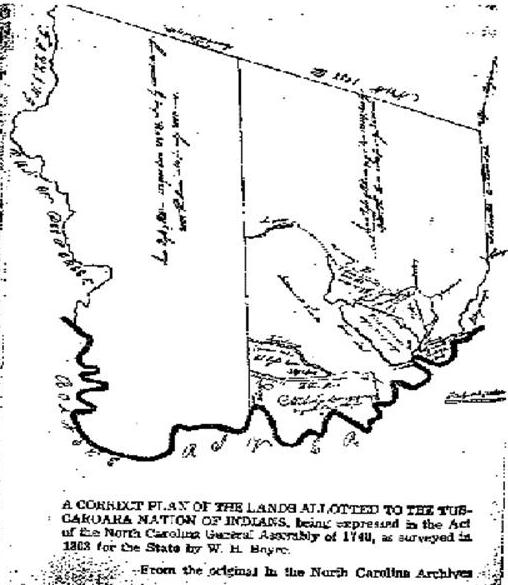
A map of the Indian land, dated June 17, 1803, was made by these commissioners, showing an areas of 41,113 acres and showing the various leases, with lengths of term, and filed in this office, which can be exhibited to interested parties.  The metes and bounds of the map are as follows:  ” Beginning on Roneoke (sic) River at the mouth of Quitney Swamp, then up the various courses of the said swamp to an oak near the head at the great spring, thence No. 10 E 904 poles to a posseman on Rockquis swamp, thence N 57 W 2888 poles to a Hickory at the head of Falling Run or Deep Creek, thence down the various courses of said creek to Roneoke River, thence down the River to the first station, containing 41,113 acres.”

The report, map and papers accompanying them are unique and interesting documents.

All the acts in reference to the Tuscarora Indian land provided that the reversions after the expiration of the leases in 1916 should be vested in the State.

In 1816 the Supreme Court of NC held in the case of Sacarusa and Longboard against William King’s heirs, that the grant made by Governor Eden in 1717 to the Tuscarora Tribe of Indians was absolute and unconditional and that the Indians had a fee-simple right to the lands and not an “Indian title.”  (See Supreme Court Reports of NC, vol. 4, p 316.)

In 1825, the General Assembly passed an act, Chapter 13 page 13, entitled “An act concerning the lands held in leases from the Tuscarora Tribe of Indians.”  The preamble of the act stated that persons holding these leases were subject to great inconvenience from their estates “being mere chattel interest.” And for the remedy thereof the General Assembly enacted a law declaring that the land should be considered as real estate in fee simple for the term of their leases, but “Provided, that nothing in this act shall be so construed as to give to the individuals holding the said terms of years a right to enjoy the same for a longer period than is designated in the leases executed by the Tuscarora Indians.”

On November 12, 1828, P. B. Porter, Secretary of War, notified Governor James Iredell that Sacarusa and Longboard, two principal Tuscarora Chiefs, with the grandson of the former, were on their way to NC “for the purpose of adjusting some claim which that Nation supposed itself to have on the lands within our State, from which they formerly emigrated.”  He further says: “I feel confident they will receive from your excellency and the other constituted authorities of NC that consideration which is due to that people who have no other means of enforcing their rights than the moral obligations which such right when established impose.”  (See Governor’s letter book, 1828, page 160.)

On November 26, 1828, Governor Iredell transmitted to the General Assembly a memorial from the Chiefs of the Tuscarora nation.  This memorial was referred to a special committee of the House and Senate and the report of that committee, signed by George E. Spruill, chairman, is to be found in the Journal oj the General Assembly of NC, beginning at page 275.  Acting upon that memorial and report the General Assembly (see Laws of NC session 1828-1829, chapter 19, page 11) passed “An act concerning the lands formerly occupied by the Tuscarora Tribe of Indians lying in Bertie on the south side of Roanoke River.”  This act recited that “Whereas the Tuskarora Indians have for more than a century been the firm and undeviating friends of the white people of this country, insomuch that the State of NC is disposed not only to render them full and complete justice, but also to exercise towards them that spirit of generosity which their conduct has merited, therefore, etc.”  In this act, William R. Smith of Halifax, Simmons J. Baker of Martin and William Brittain of Bertie were appointed commissioners for the purpose of advertising and selling these lands.  “The title so sold by the said commissioners shall be understood to extend only to the reversion of the State in said lands after the expiration of the leases of the Indians from which they are now held.”  The Public Treasurer was to collect the money due on the lands and to pay the money over to the tribe or nation of Indians, or other properly authorized agent or agents: upon which the Indians surrendered and made “a full and complete release of all such claim or pretense of title as they now make or ever may have to aforesaid tract of land.”  Under this act these lands were sold and the Treasurer in 1832 paid to Bates Cook, he being appointed agent o the Tuscarora Indians, the sum of $3.220.71.  The record of this voucher, No 258, is to be seen in the Treasurer’s office, book of 1832, page 377.

The Treasurer’s reports show two other small items paid to the Tuscarora Indians about this time, the reason for which payment I have not looked into.

On the 19th day of November, 1831, William Chew, Nicholas Casie, George Warchief, Jonathan Printup, Mathew Jack, William Johnson and Isaac Miller, Chiefs of the Tuscarora Nation of Indians, of the first part, in consideration of $3250 lawful money of the US to them in hand paid, executed to the State of NC a deed by which they granted, bargained, sold, remised, released, aliened and confirmed unto the people of the State of NC, “In their actual possession now being and to their assigns forever, all their lands, tenements, and hereditaments situate, lying and being in the County of Bertie in the said State of NC, together with all and singular the appurtenances thereunto belonging or in any wise appertaining and the reversion and reversions, remainder and remainders thereof, and the estate, right, title, interest, claim and demand whatsoever of the said parties of the first part, either in law or equity, of in, and to the above bargained premises, with the hereditaments and appurtenances.”  This deed was properly witnessed by the Indians in person coming before Robert Fleming, First Judge of the Niagara County Court of Common Pleas of New York.  The signature of Judge Fleming was authenticated by Enos. T. Throop. Governor of the State of NY.

These are all the leases and papers that I find that I think will be of use to you in determining the status of your claim for the reversionary interest in the Tuscarora lands in Bertie Co.

If you desire an investigation of this matter by an attorney representing the Indians, it seems to me that it would be wise for you to select some man of standing in this State who can go into the details of the matter very carefully for you.  I shall be glad to assist him in finding all records connected with this transaction.  I understand from Chief Mount Pleasant that an attorney at Washington City has been employed, which probably means useless expense to you all in the prosecution of an untenable claim.

Respectfully,

J. Bryan Grimes

Secretary of State [end of letter]

Posted in History, Tuscarora | Leave a comment

Tuscarora People Identified in Land and Other Transactions – Part 2

The Tuscarora in Colonial Records

In the Colonial Court Records, Misc. Papers 1695-1705 – Mr. Brice, his petition…recovered an order at a counsell held at Mr. Thomas Blountt in Chowan against one Thomas Blount, an Indian, for ye returning of a mare within ye tirm of 3 months after ye said date or to pay fifty doe skins….

1721-1722 – Indictment of John Copes, a Christian Indian belonging to King Blount’s tribe, for committing burglary by breaking into the house of Colonel Thomas Pollock, Esq., President of this province at Chowan in the county of Albemarle, in the night of 4 August, Pollock being in the house at the time. Back says “Not guilty.” No year is given, but affiliated depositions and records indicate that this was either 1721 or 1722.

In 1721, Mr. Robert Hicks power received from Albemarle County, a Tuskarooroe Indian named James having in council been ordered a reward for some services done publicly.

In 1722, 300 fighting men along with their wives, children, and the elderly, resided at Indian Woods.

In 1723, a reservation of 53,000 acres is laid out for the Tuscarora in Eastern NC.

In 1723 in Albemarle Co., NC., in a deposition, John Gardner says that Mr. Dudley broke the arm of an Indian named Lighaea Blount who wanted to hunt beaver.  He is later referenced as Sighacks: Blount.  King Blount is referenced so is still living at this point.

By 1731 the original 800 Indians under King Tom Blunt, the Tuscarora chieftain, were  reduced to 600.  Of that 200 were fighting men.

In 1738 –1739, a smallpox epidemic decimated the Indian population in NC, especially in the eastern part of the colony and the Cherokee. It is projected that this epidemic decreased the number of Cherokee by about 50 percent.  There are no records of how it impacted the Tuscarora, but it may well have had similarly devastating effects.

Chief Tom Blount is reported to have died in 1739.  If this is accurate, he may have succumbed to the smallpox epidemic.

The census of 1754, undertaken to determine what strength could be mustered from the Tuscarora and used in the French and Indian War for the British, placed the Tuscarora  population in eastern North Carolina at an estimated total of 300, 100 men and 201 women and children. This reflected a loss of about 700 during the previous forty years.  An average of one child per couple also suggests a population in crisis, unable to reproduce themselves.  The rule of thumb for early populations is typically 4 children, sometimes 5 and in some unstressed populations, more.

A combined group of Meherrin, Nottaway and Tuscarora was sent to Winchester, VA for guard duty on the frontier. During this time, the North Carolina Assembly voted forty pounds proclamation money for support of wives and children of Tuscarora, Nottoway and Meherrin warriors.

When in 1752 Moravian missionaries visited the Tuscarora reservation, they noted “many had gone north to live on the Susquehanna” and that “others are scattered as the wind scatters smoke.”

In 1757, in Bertie County, an Indian names James Strawberry murdered a white woman by the name of Elizabeth Knott.

In 1763 and 1766 additional Tuscarora migrated north to settle with other Iroquoian peoples in Pennsylvania and New York.

On May 17, 1766,  Diagawekee, sachem of the NY Tuscaroras and a delegation of the  Six Nations arrived in NC. He had come to lead all the Tuscaroras that were willing to march and join the Six Nations. Thus during the first week in August of that year Diagawekee led 155/160 Indians northward, leaving about 100 older Indians behind.

This would indicate that there was a total of about 255 Tuscarora living in Bertie County at that time, before departure.  On July 20th, just before leaving in August, the “Chieftains and Principal Persons” of the Tuscarora signed a deed.  Of these people, we have a list of 36 of them.  If you presume that the average family size was 5 people, we appear to have about three-fourths of the heads of households represented on the signature list.

We are told in a letter from Sir William Johnson, writing to the Earl of Shelburne on Dec. 16, 1766, referencing the letters that the interpreter to the Indians gave him, that during their journey, their lives “were several times attempted by the frontier people, who assembled for that purpose, to prevent which for the future, one of my officers that way, was necessitated to put the Crown to the charge of an attendant white man, and that on their return, having sold part of their lands in Carolina, and purchased sundry horses, wagons, etc., for carrying some effects, they were again used ill at Paxton in Pennsylvania and robbed of several horses, etc., valued at 55; of this the Tuscarora chiefs complained to several of the Six nations and I have just now with difficulty prevented them from making a formal complaint to the whole Confederacy, on promising them that it should be inquired into.”

By 1767, about 104 individuals continued to reside on the reservation in Bertie Co.

By 1775 the number of 104 seems to have dwindled to about 80.

On the 1777 deeds, of which there were eight, we have between 7 and 23 signers on each deed.  Combined, we have the names of 51 or 52 different individuals on these 1777 deeds, including a few women.  Most of those people, except for the three that the purchasers promised “not to bother,” probably moved north. If their population was 80 just two years earlier, then we may very well have all or nearly all of the signatures of the adult males in the tribe, and a few females as well.  If this is the case, then that population number of 80 was likely only adults, without children being counted.  In that day and time, many, if not most children were not expected to live to adulthood, so perhaps counting children was considered a waste of time and unproductive.

In 1802 the Tuscarora negotiated a treaty with the United States, by which land would be held for them which they could lease. As the government never fully ratified the treaty, the Tuscarora viewed the treaty as null and void.  However, records from 1802 and 1803 in both the United States House and Senate indicate that both ratified the treaty, the Senate last on March 1, 1803, but the President never signed the document.

By 1804, the migration from  North Carolina  to New York was finally concluded.  By then, approximately 20 “old families” remained at Indian Woods, NC.

Finally, an 1831 deed signs away the remainder rights of the Tuscarora to the State of North Carolina.

Posted in History, Tuscarora | 3 Comments

Tuscarora People Identified in Land and Other Transactions – Part 1

This is the first in a series of blogs about the Tuscarora people as identified in land and other transactions, primarily in North Carolina.  These blogs are taken from my paper by the same title.  It is too lengthy to publish in one piece, so I’ve broken it into segments.  It will be published in the future, in one piece, in the February 2013 issue of the Lost Colony Research Group Newsletter.  www.lostcolonyresearch.org

When I began this article, my intention was to extract the names of the Native people for the Native names project.  I am also always cognizant of any connection to the Lost Colony project, especially given the oral history of the Tuscarora in relation to the colonists.  As I compiled additional information, this project evolved into something different.  It’s the documentation of the journey of the Tuscarora in North Carolina, as told in court records and land transactions.  This does omit the military history, specifically the details of the Tuscarora War, although I did review those documents for names and included what I found.

Let’s start with a little history.  The English began to settle North Carolina, mostly from the Virginia frontier, about 1654.  The Native people began to feel crowded, especially as the trickle of settlers turned into flow and then a flood who settled on their lands with no regard for the Indians.

Tuscarora Timeline

By 1700, tensions were high and both sides accused the other of a variety of infractions.

There were two primary contingents of Tuscarora at this point, a Northern group led by Chief Tom Blunt (also spelled Blount) and a Southern group led by Chief Hancock. Chief Blunt occupied the area around what is present-day Bertie County on the Roanoke River; Chief Hancock was closer to New Bern, North Carolina, occupying the area south of the Pamplico River (now the Pamlico River). Chief Blunt became close friends with the Blount family of the Bertie region, and likely adopted his name from them.  Chief Hancock, on the other hand, found his villages raided and his people frequently kidnapped and sold into slavery. Both groups were heavily impacted by the introduction of European diseases, and both were rapidly having their lands infringed upon by the encroaching settlers. Ultimately, Chief Hancock felt there was no alternative but to attack the settlers. Tom Blunt did not become involved in the war at this point.

In 1711, tensions escalated when Baron von Graffenreid evicted the Tuscarora from an Indian village he wanted for his Swiss and German settlers.  Following that, John Lawson, the surveyor, and von Graffenreid went on a canoe trip and were captured by the Tuscarora and tried.  Initially both were to be set free, but while von Graffenreid was busy negotiating his way out of the pickle he found himself in, Lawson became argumentative and chastised the Indians for harassing the men.  They executed Lawson, but set von Graffenreid free with a message that they were planning to attack the English.

In 1712, in the midst of the Tuscarora War which began in 1711, a treaty was attempted.  On Nov. 25th, several chiefs, all with Native names, except Tom Blount, treated on behalf of the Tuscarora.  Among other things, they agreed to make war on the other Indian Nations of Catashny, Core, Nuse, Bare River and Pamlico.  They would not shelter male Indians over the age of 14 from those tribes or bands and they would sell off and dispose of the males under 14.  They promised to join the English and cut off and destroy the Matchepungo Indians.  They agreed to limit their hunting range and not hunt in groups larger than 3.  They agreed that they would attempt to bring into their towns alive several people listed by Native names, then their English names; “called John Pagett, Ehehosguos called Lawson, Coresniena called Barber, Colsera called Henry, Lysle Ounskininenee called Squarehookis…and Young Tyler.”  Six chiefs signed, Tom Blount the only one with an English name.

Following the Tuscarora War which ended in 1713, about 1500 of the defeated Tuscarora migrated north and joined the Iroquois, their ancient cousins.  Those who stayed in NC, mostly those of “King” Tom Blount’s band who remained neutral during the war, would initially be directed to live with the Machapunca/Mattamuskeet in Hyde County, but were eventually granted their own reservation, Indian Woods, in Bertie County.

Under the leadership of Chief Tom Blunt/Blount, known as King Blount, the Tuscarora who remained in North Carolina signed a treaty with the colony in June 1717 that  granted a 56,000 acre tract of land on the Roanoke River in what is now Bertie County.

The smallness of their number disabling them from resisting the attacks of the South Carolina Indians. Governor Charles Eden, of North Carolina, and the council, on the 5th day of June, 1717, entered into a treaty, by which the Tuscarora land on Pamplico River was abandoned by the Tuscarora and another tract granted to them, on Roanoke River, in the present county of Bertie, in consideration of which they relinquished all claims of any other land in the province, butted and bounded as follows, viz.:

“Beginning at the mouth of Quitsnoy swamp, running up the said swamp four hundred and thirty five poles, to a scrubby oak near the head of the swamp, by a great spring; then north ten degrees east, eight hundred and fifty poles, to a persimmon tree on Raquis swamp; then along the swamp and Pacosin main course north fifty-seven degrees west, two thousand six hundred and forty poles, to a hickory tree on the east side of the Falling Run, or Deep creek, and down the various courses of the said run to Morattock; then down the river to the first station.”

The Morattock is the present day Roanoke River.

Bounded by the Roanoke River and Roquist Creek, the reservation contained some of the more fertile land of the county, and it was not long before settlers began to encroach upon this territory.  As early as 1721 interlopers threatened to “create Feuds and disturbances.”  This contributed to overall circumstances that made reservation life less than satisfactory.

Various pieces of information collected along the way give us a picture of the Tuscarora as their numbers declined, precipitating the final migration north for the majority of the tribe.

Posted in History, Tuscarora | 9 Comments

Lost Trail of Tears Segment Discovered

Google Earth has helped with a lot of things.  I’ve used it to locate potential archaeology dig sites, to find historical locations, and of course, to look at my own house.

Now we can add to that list that it has been used to discover a segment of the Trail of Tears that had been lost to history.  This isn’t a spur, either, but one of the main roads where thousands crossed the Stones River on the way to their ultimate fate.

An article in Indian Country gives the details:  http://indiancountrytodaymedianetwork.com/2012/09/20/lost-trail-of-tears-segment-discovered-using-google-earth-134920

The good news is that this segment is already being preserved, albeit, inadvertently.  The land is owned by the Army Corps of Engineers and part of it is a horse trail today.  This makes access easy for the public.

The segment has been confirmed as part of the Trail of Tears National Historic Trail by the National Park Service.

Hat tip to Steve for this great piece of news!

Photo copyright and compliments of www.nativehistoryassociation.org.

Posted in Uncategorized | 3 Comments

Counting Coup

Counting coup – I’ve known this phrase so long that I don’t ever remember not knowing it.  It’s one of the cultural artifacts that somehow was handed down in my family. It wasn’t until I was an adult that I realized two things:  First that everyone didn’t know what that meant and second, that it might be significant.  In my family it was said as “counting coo” with the p being silent.

Counting coup was additive.  Those little numbers never “went away.”  Indeed, it was a very “Native” thing although I never realized it. It was just “normal” to us, a way of saying “Gotcha.” War without the blood.  Made Mom happy.

But counting coup has a much deeper history beginning long ago and perhaps on both sides of the Atlantic.  The Cheyenne or Arapaho pictograph below demonstrates the act of counting coup.

Counting coup refers to the winning of prestige in battle, rather than having to prove a win by injuring one’s opponent. Its earliest known reference (by act, not by that name) is from Shakespeare’s “Hamlet” (Act 5, Scene 2) where Laertes and Hamlet conduct a mock swordfight before King Claudius and Queen Gertrude. Hamlet strikes Laertes with his sword lightly, not enough to wound, and remarks, “Another hit; what say you?” To which Laertes responds, “A touch, a touch, I do confess.”

The point of counting coup was to avoid bloodshed during practice (or during the real battle). Otherwise, if a partner refused to be honest in acknowledging a strike, the practice could very quickly escalate into real bloodshed as the better opponent “proved” his point by actually sticking his sword into the naysayer. Thus, counting coup was considered the honorable thing to do for all concerned.  Oh yes, and people kept track.  If you killed your opponent, you only could add one notch to your belt, so to speak, but counting coup took more bravery and you could add several notches to your coup stick over time.

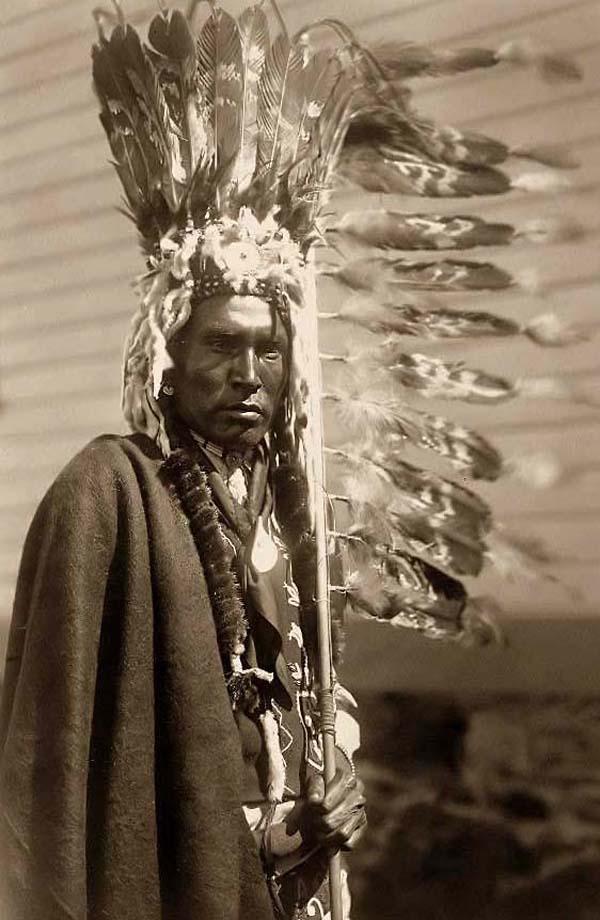
The photo above taken in 1910 by Edward Curtis shows a Piegan warrior wearing a war bonnet and holding a coup stick.

By other accounts the Plains Indians of North America also used a form of counting coup. Warriors won prestige by acts of bravery in the face of the enemy, and these acts could be recorded in various ways and retold as stories. Any blow struck against the enemy counted as a coup, but the most prestigious acts included touching an enemy warrior with the hand, bow, or with a coup stick then escaping unharmed.  Touching the first enemy to die in battle or touching the enemy’s defensive works also counted as coup.  Counting coup could also involve stealing an enemy’s weapons or horses tied up to his lodge in camp. Risk of injury or death was required to count coup.

A Piikuni (Blackfeet) coup stick from the 1800s is shown above.

Escaping unharmed while counting coup was considered a higher honor than being wounded in the attempt.  A warrior who won coup was permitted to wear an eagle feather in his hair.  If he had been wounded in the attempt, however, he was required to paint the feather red to indicate this.

After a battle or exploit, the people of a tribe would gather together to recount their acts of bravery and “count coup.” Coups were recorded by putting notches in a coup stick. Indians of the Pacific Northwest would tie an eagle feather to their coup stick for each coup counted, but many tribes did not follow this tradition.

In the photo above, taken in 1907, also by Curtis, High Hawk is dressed in a war bonnet and also holds a coup stick.

Posted in History | 9 Comments

Chowan Indians – Petition of 1790

The Digital Library on American Slavery holds a lot of information about Native as well as mixed people.   http://library.uncg.edu/slavery/index.aspx

In the petition below, presented to the North Carolina General Assembly, and subsequently rejected, we catch a glimpse of the remnants of Chowan Indians in 1790.

PAR Number 11279002

State: North Carolina Year: 1790
Location: Gates Location Type: County

Abstract: William Lewis and Samuel Harrell ask that a law be passed validating the title to a tract of land acquired by a group of people descended from American Indians and blacks. They state that in 1724 the Chowan Indians received 11,360 acres of land from “the true and absolute Lords proprietors of North Carolina” lying in Chowan County, now Gates County. Noting that “the whole of the Said Chowan Indian Men is dead,” they point out that that left “a parcel of Indian Women, which has mixed with Negroes, and now there is Several freemen and Women of Mixed blood as aforesaid which have descended from the Sd. Indians, who consider themselves “intitled to the Small Remnants of the aforesaid Tract of Land that was not sold nor conveyed by the aforesaid Indians in their Lifetime.” Lewis and Harrell state that the said freemen “have for a valuable Consideration Conveyed the Said Remnants of Land to your Petitioners,” whereby they pray that a law may be passed “authorizing the said free men of mixed blood as aforesaid to sell and make titles” to the said land and that said titles “shall be good and valid in Law.” Supporters of Lewis and Harrell aver that “the freemen aluded to in the petition Did in the late Contest with Great Brittain behave themselves as good and faithful soldiers in behalf of this and the United States.”

Posted in Chowan | 1 Comment