Records Chronology of the Five Civilized Tribes

This chronology was developed from “Records Relating to Native American Research: The Five Civilized Tribes” by George J. Nixon and printed on pages 535 to 557 of THE SOURCE, First Edition.

The five civilized tribes are the Cherokee, Choctaw, Chickasaw, Creek and Seminole.

*********************************************

If anyone finds copies or transcriptions of these records online, please e-mail me at robertajestes@att.net.

From the website of Kathie M. Donahue, AG, now defunct.  http://www.amerindgen.com/IndianTrade.html

There are four primary repositories for the records pertaining to these tribes:

The Family History Library, Salt Lake City, UT (FHL)*

The National Archives (NA)

The National Archives Records Center in Fort Worth, Texas (NARCFW)

The Oklahoma Historical society (OHS) in Oklahoma City

*In the following list the initials of the repository of the record mentioned will follow the description.  Seven-digit numbers following names of records, with or without “FHL” are film numbers for records in the collection of the Family History Library at Salt Lake City, UT.  Such items can be ordered into local LDS Family History Centers (FHC).  To find a local FHC, use the search engine at the LDS site, FamilySearch.org.

Abbreviations Used

****************************************************

– The Chronology –

1800-1815 – Records of the Agent of Dept. of War in TN FHL 1024431; Correspondence & Misc. FHL 1024418; ditto 1803-4 FHL 1024419; ditto 1805-7 FHL 1024420; ditto 1808-9 FHL 1024421; ditto 1810-1812 FHL 1024422; ditto 1813-1815 FHL 1024423; ditto 1816-1818 FHL 1022424; ditto 1819-20 FHL 1024425; ditto 1821-23 FHL 1024426; ditto 1823-1835 1024427; Fiscal 1801-1817 FHL 10224428-1022430

1801-1835 – Records of the Cherokee Agency in TN by Marybelle Chase FHL 1750756 item 23

1817: Cherokee Treaty of Turkey Town Rolls –Old Settlers NA (NDL) – Lists individuals (old settlers) who moved west from NC to MO

1817 – Cherokee – Register of Persons…under Treaty of 1817 (Tahlequah) – FHL 1666295 item 1

1817 -1819: Cherokee Register of Indians wishing to Remain in the East,

2 Vols. NARCFW NA(BIA-IRR) FHL 982251 item 4

1817-1821 – Records of Joseph McMinn, Agent for Cherokee Removal FHL 1024431

1817- 1838: Cherokee Register Indians Wishing to Migrate, 18 Vols.

NARCFW

1819 Feb 27 – Robert Armstrong’s Survey of Cher Lands by James L. Douthat FHL 1598122 item 11

1819: Cherokee Applications for Reservations NARCFW NA(BIA-IRR)

1825-1906: Choctaw Removal Records NA(BIA-IRR)

Includes 1831 census list of reserves, 1856 census, emigration lists, claims of reservations, statements of sales of Choctaw orphan lands, miscellaneous.

1819-1838 Brainerd Mission of United Brethren, Hamilton Co., TN

1828: Cherokee Removal Records ~- Old Settlers NA(NDL) As a result of 1828 Treaty ceding land in AR for lands in OK.

1881-1882 – E. Cherokee Seminaries, Register of, 1881-1882 FHL 1025299 item 1

1828-1834 – Cherokee Phoenix 1828-1834 – New Echota, GA – FHL 825726

1831: Choctaw Census Before Removal NARCFW

1831 -1857: Choctaw Emigration Roll NARCFW

1832 -1836: Apalachicola, Seminole, Kickapoo, Ottawa, Potawatomi, Quapaw

Includes letters, census and muster rolls, abstracts of locations of lands, reports of land sales and deeds, journal of expenditures, statements of land sales.

1833: Creek Census NARCFW

1833- 1886: Creek Removal Records NA (BIA-IRR)

Includes 1833 census, index to reserves, location registers, contracts and certificates, abstracts of contracts, reports on land of deceased reserves, and remarks. Only list of whole Nation east of Mississippi.

1834-1894 – Cherokee Sec. X Removal to the West

1835 E. Cherokee Census of Indians East of the Mississippi River with Index – TN, AL, NC, GA (AKA Henderson Roll) FHL 1036829 item 8

1835- 1869: Cherokee Records of the First Board of Cherokee Commissioners

NA (BIA-IRR)

Includes letters, property valuations and changes, property abstracts and returns, reservation claims and decisions, spoliation claims, debts and judgements, certificates, etc.

1835 -1869: Indian Census Rolls NA(RCD)

1835 Henderson Roll Index FHL 1036829 item 8; Henderson Roll FHL 847743

1835 Henderson Roll TN List FHL 1728882 item 3

1837 -1839: Chickasaw Census and Muster Roll NARCFW

1837- 1845: Cherokee Records of the Second and Third Boards of Cherokee

Commissioners NA(BIA-IRR) (See First Board details)

1841 -1949: Payments to Indian Tribes & Individuals NA (BIA-RFD)

959 Volumes including annuity payment rolls and miscellaneous unbound papers

1842-1853 – Records Relating to Claims (p. 118, Hill); claims against the Old Settler Cherokee for services rendered, good furnished, and damages suffered, 1842-53 (including claims for compiling the Drennen Roll for per capita payment in 1851) – NARA

1844-1856 – Cherokee Advocate 1844-1856 Tahlequah  FHL 989202 item 7; 1865-1l11 OKHS

1846- 1847: Cherokee Records of th Fourth Board of Cherokee Commissioners

NA (BIA-IRR) (See the First Board details)

1847- 1873: Indian Traders’ Register of Licenses NA (BIA-RMD)

1848: Cherokee Mullay Roll NARCFW

First census of Eastern Band of Cherokee after removal; listed individuals and families in NC in 1836 who had not removed to the West or had not received commutation for removal and subsistence; children born after 1836 not included; whites married to Cherokees after 1836 not included; Cherokees outside NC in 1836 not included; persons who had died since included and deathdate given; includes1557 Cherokees; number, name, age remarks; family relationships, date of death, conditions.

1851: Cherokee Drennan Roll NARCFW

1851: Cherokee Emigrant Roll NARCFW

Enumeration of Eastern Cherokee who moved west after 1835 and resided in Indian Territory by 1851.

1851: Cherokee Old Settler Roll NARCFW

Lists individual by district with children unless mother was emigrant Cherokee; if migrant, children were listed with mother on Drennan Roll; 44 families listed as non-residents; used by Guion Miller.

1851: Cherokee Silar Roll NARCFW – FHL 847743

Census of Cherokees east of Mississippi to see who would be eligible for per capita payment based on 1835 treaty; lists 1959 individuals by state and county in NC, TN, AL, GA; also includes disputed cases; categories; number ,name, age, relationship to head of household, sex, blood, remarks.

1851: Cherokee Chapman Roll NARCFW

List of payments made as result of Silar Roll; lists 2134 individuals; categories; number, name, amount received, signature of recipient; individuals listed by family groups and state and county; these individuals included on Guion Miller Roll.

1851 – Cherokee Emigration Roll – John Duncan’s List of Illinois District for Payments at Ft. Gibson – FHL 1666295 item 11

1851 – Cherokee Emigration for Saline Dist with some Illinois Dist, IT – FHL 1666218 item 12

1852 – Cherokee of Flint Dist., IT, Emigrants FHL 1666295 item 9; 1666218 item 9; Going Snake Dist. item 13

Cherokee Emigration from NC (Tahlequah) – FHL 1666218 item 3,5

1856: Choctaw Cooper Census Roll NARCFW

1861-1864 – Indian Home Guards – Indian Territory – FHL 1666295 item 16

1865-1887 Intermarried Whites in Cherokee Nation by A.H. Murcheson FHL 6038979 (1)

1865- 1898: Indian Traders’ Licenses NA (BIA-RMD)

1866: Choctaw and Chickasaw claims for Civil War Damages NA (BIA-RRICWC)

1867: Chickasaw Annuity Roll NARCFW

1867- 1869: Creek Census of Freedmen NARCFW

1867: Cherokee Powell Roll  – List of Cherokees in the Cherokee Nation – NARCFW

1867: Cherokee Index to Freedmen on Tompkins’ Roll NARCFW

1868: Choctaw and Chickasaw Receipt Book for Civil War Claims NA (RRICWC)

1868: Cherokee Swetland Roll NARCFW – FHL 847743

List based on Mullay Roll to enroll individuals living and heirs or legal representatives of deceased; includes separate census of all Eastern Cherokees living in NC and adjoining states; appraisals of value of property, farm products, horses, cattle, etc.; categories; families, number, name, age sex, blood, estate, horses, mules, cows, oxen, cattle, hogs, sheep, wheat, corn, oats, rye, literacy, parents living or dead, remarks.

1868- 1879: Creek Index to Freedmen NARCFW

1869: Creek Claims for Civil War Damage NA (BIA-RRICWC)

1869 -1870: Creek Annuity payments on the Union Side NARCFW

1869 -1870: Creek Abstracts of Civil War Claims NA (BIA-RRICWC)

1869 -1871: Cherokee Swetland enumeration of Sequoyah District of Cherokee

Nation in Indian Territory NARCFW

1870: Creek Orphans and Payments to be Made NA (BIA-RFD)

1870: Creek Census of Orphans and Heirs NARCFW

1873: -1875: Indians, Soldiers & Citizens Killed or Captured NA (BIA-RCD)

of Entries Under Settlers Relief Act NARCFW

1875 -1876: Cherokee Census Roll NARCFW

1875- 1889: Cherokee Citizenship Letters NA (BIA-RLD)

1876-1897 – Cherokee – Letters – Removal to the West

1876- 1882: Indian Trader’s Licenses NA (BIA-RMD)

1878: Chickasaw Annuity Roll NARCFW

1878- 1880: Indian Traders’ Licenses NA (BIA-RMD)

1878- 1880: Cherokee Commission on Citizenship list of rejected claimants

NARCFW

1878- 1884: Choctaw Letters Received Relating to Freedmen NA (BIA-RREEC)

1879- 1880: Cherokee  Receipt Roll NARCFW

1880: Cherokee Census of 1880 NARCFW – FHL 989204 (includes a few Delaware)

Important in preparing Dawes Rolls; any Indian or intermarried white listed was accepted without challenge; notation on 1902 census card showed location and name by which enrolled on 1880 census. Arranged by District within Cherokee Nation; categories; Cherokee citizens including native, adopted white, Shawnee, Delaware, freedmen, orphans under sixteen; persons rejected; citizenship claims pending; “intruders;” permitted squatters; name by family group, age, race, occupation, sex, roll number.

1880 – Cherokee – Supplemental Roll of those left off the roll of 1880, Tahlequah per capita (1883) – FHL 1666218 item 6

1881 – Cherokee – Receipt Roll of Per Capita Payment 14 May – FHL 1666218 item 2

1882: Cherokee Hester Roll NARCFW

An accounting of all persons on the Mullay, Siler, Chapman and Swetland Rolls noting relationship to head of family, age, ancestor on previous rolls, relationship to ancestor, present place of residence, remarks; used by Guion Miller.

1881 – Cherokee – North Carolina Immigrants Allowed Per Capita Under Act of 1881

1883: Cherokee Census of 1883 NARCFW

Authorized for base of per capita payment of monies received from leased land; arranged by districts like 1880 Census; includes orphans’ roll, those in national prisons, supplemental roll with name and age of individuals; receipt roll shows individual’s name and roll number, total number in household, total amount paid each household, name of person receiving payment, name and witness to payment.

1883: Cherokee Freedmen Roll: AKA Wallace Roll NARCFW

1885-1895 – Other Records of the Land Div. (p. 97, Hill); printed matter concerning attorneys’ claims against the Old Settler Cherokee 1885-1895- NARA

1885: Choctaw Freedmen Roll NARCFW

1885- 1898: Roster of Licensed Traders NA (BIA-RMD)

1885- 1909: Roster of Licensed Traders NA (BIA-RMD)

1886: Cherokee census of 1886 NARCFW

Virtually the same as the Cherokee Census of 1883 with the following important additions: gives relationship of individuals to head of household.

1886: Cherokee Delaware payroll NARCFW

1888- 1897: Choctaw miscellaneous court cases and marriage licenses

NARCFW

1889: Cherokee Rolls of Shawnee Cherokee NA (BIA-RLD)

1889- 1890: Cherokee Citizenship Affidavits NA (BIA-RLD)

1889- 1890: Cherokee Census Roll Drafts NA (BIA-RLD)

1889 -1891: Cherokee Citizenship Affidavits of Questioned Freedmen

NA (BIA-RLD)

1889- 1905: Indian Traders’ Licenses NA (BIA-RMD)

1890 -1893: Cherokee Indexes to revised Wallace Roll Freedmen NA (BIA-RLD)

1890 -1896: Cherokee revised Wallace Rolls NA (BIA-RLD)

1890: Cherokee Census NARCFW

Arranged by district and includes six categories: native Cherokees and adopted whites, Shawnees, Delawares; orphans under sixteen; those denied citizenship; citizenship claims pending; “intruders;” permitted squatters; 105 columns of detailed information.

1890: Cherokee census NARCFW

1890: Cherokee Delaware payroll NARCFW

1890: Cherokee receipt roll NARCFW

1890: Cherokee Welfare Rolls NA (BIA-RLD

1890: Chickasaw Census of Pickens & Pontotoc Counties NARCFW

1890: Choctaw index to enrollment cases NARCFW

1890: Creek Annuity Roll NARCFW

1891 -1892: Cherokee Supplemental Census Rolls NA (BIA-RLD)

1891 -1893: Cherokee Citizenship Affidavits NA (BIA-RLD)

1892- 1899: Indian Traders’ Applications for Licenses NA (BIA-RMD)

1893: Cherokee Census NARCFW

Lists Cherokee citizens by blood, adopted whites, freedmen, Shawnees, Delawares, intermarried persons, Creeks; arranged by district; categories: individual’s name, age, sex, admission reference, name of guardian.

1895 – Records Concerning Tribal and Individual Indian Moneys and Payments to Indians – Census Roll of Old Settlers in I.T., 1895- NARA

1895: Cherokee Old Settler Census Roll NA (BIA-RFD) + 1851 Payroll FHL 1698148 item 6

1895: Creek Census of Coweta, Deep Fork, Eufala, Muscogee, Okmulgee and

Wewoka Districts NARCFW

1895: Creek Census by Towns NARCFW

1895 -1896: Creek Citizenship Cases NARCFW

1896: Cherokee Index to Old Settler Payment Roll NA (BIA-RLD)

1896: Cherokee Rolls of Shawnee Cherokee NA (BIA-RLD)

1896: Cherokee Payment Roll NARCFW

1896: Chickasaw Census NARCFW

Based on 1851 Old Settler Roll; names of those still living listed first; then, those who died and their heirs each heir’s relationship; categories.

1896: Choctaw Census with index NARCFW

Choctaw national warrants (no date) NARCFW

1896- 1897: Cherokee Roll of Freedmen NA (BIA-RLD)

1897: Cherokee Index to Freedmen Payment Rolls NA (BIA-RFD)

Cherokee Freedmen Payment Roll NA (BIA-RFD)

1897: Cherokee Index to Supplemental Payment Roll for Freedmen NA (BIA-RFD)

1897: Cherokee supplemental Roll for Freedmen NA (BIA-RFD)

1897: Cherokee Exhibits for Freedmen Payment Rolls NA (BIA-RFD)

1897: Cherokee Roll NARCFW

Taken from 1894 “Strip Payment” roll; lists enrollment number, name, age, sex, occasionally mentions deceased parents or names used on earlier rolls.

1897: Cherokee list of Colored Persons NARCFW

BIA Censuses – Cherokee, Eastern

FHL 573868 – 1898, 1899, 1904, 1906, 1909-1912, 1914

FHL 573869 – 1915-1922

FHL 573870 – 1923-1929

FHL 573871 – 1930-1932

FHL 573872 – 1933-1939

1899: Choctaw Indexes and Records of Testimony by Mississippi Choctaw

NARCFW

1899: Creek Citizenship Admissions NARCFW

1900: Seminole Census NARCFW

Listed by blood (clan) bands of Thomas Palmer, Echo Emarthoge, Simon Brown, Yaha Harjo, Tusekia Harjo, Kinkehe, Thomas little, Obtiarche, Echoille, William Cooper, Nuthcup Harjo, Asaske Harjo; freedmen listed in Doser Barkus and Caesar Bruner bands.

1901: Choctaw Additional Evidence to 1899 Testimonies NARCFW

Choctaw Index to Mississippi Choctaw children (undated) NARCFW

1901: Seminole Annuity Payroll NARCFW

1901 -1907: Choctaw Applications for Admission to Mississippi Choctaw NA

(BIA-RREEC)

1900: Cherokee equalization payroll NARCFW

Cherokee index to Delaware Cherokees payroll NARCFW

1900: Choctaw Rolls and Lists of new Choctaw citizens in South McAlester and

Ardmore NARCFW

1902 -1907: Choctaw and Chickasaw Indexes NARCFW

1902: Choctaw “proceedings of identity” for Mississippi Choctaws NARCFW

Includes alphabetical index, index to applications, rejected appeals for citizenship (Choctaw & Chickasaw)

1902: Choctaw Roll of Freedmen NARCFW

1903: Choctaw Roll and Index NARCFW

1904: Cherokee per capita payroll for Delawares NARCFW

1904: Creek Roll of Original Emigrants and Heirs NARCFW

1904: Creek Annuity Payments on Union side NARCFW

1905: Chickasaw Roll for the “leased district” NARCFW

1906: Choctaw per capita payrolls NARCFW

1906: Creek Annuity Payments on Union Side NARCFW

1907 -1908: Choctaws & Chickasaws at Murrow Indian Orphan Home NARCFW

1907 -1908: Choctaw Land Lottery NARCFW

1908: Cherokee Churchill Roll of Eastern Cherokee NA (BIA-RREEC)

Contains fewer names than Miller roll; roll was disputed due to exclusion of some people and inclusion of others.

1908: Seminole Miscellaneous Roll NA (BIA-RCFW)

1909: Cherokee Guion Miller Roll of Eastern Cherokee NA (BIA-RREEC)

29 volumes of which ten are transcripts of testimony listed chronologically, exceptions to findings; printed copy of completed roll with two 1910 supplements; copies of Drennen, Chapman, “Old Settler” rolls; consolidated index for Chapman and Drennen rolls; separate index for Old Settler Roll; listed under Records of the United States Court of Claims; roll of Eastern Cherokee 1909; correspondence, reports, Eastern Cherokee Enrollment 1907- 1916; index to council roll of Eastern Band of Cherokee

1907- 1908.

1910: Cherokee Supplement to the Guion Miller Roll NA (BIA-RREEC)

1910 -1928: Choctaw and Chickasaw Per Capita Payments NARCFW

1913: Choctaw Per Capita Payrolls NARCFW

1917 -1929: Choctaw Annuity Payrolls NA (BIA-NDL)

1918: Creek Annuity Roll NA (BIA-NDL)

1925- 1928: Eastern Cherokee Applications and Related Records

NA (BIA-RREEC)

1926 -1928: Eastern Cherokee Decisions on Enrollment NA (BIA-RREEC)

1927- 1928: Eastern Cherokee Transcripts of Testimony NA (BIA-RREEC)

1928: Eastern Cherokee Roll NA (BIA-RREEC)

1929: Eastern Cherokee Index to enrollment Records NA (BIA-RREEC)

1929: Eastern Cherokee Alphabetical Index to Names Appearing in Testimony

NA (BIA-RREEC)

1930: Eastern Cherokee Report of the Commissioners of Indian Affairs

NA (BIA-RREEC)

********************************************************************

ABBREVIATIONS

FHL = Family History Library micro film or fiche number or book call number

NA = National Archives, Washington, D.C.

NARCFW = National Archives Record Center, Fort Worth, TX

OHS = Oklahoma Historical Society, Oklahoma City, OK

(BIA  = Bureau of Indian Affairs section of National Archives

(RREEC) = Records Relating to Enrollment of the Eastern Cherokee

(RFD) = Records of the Finance Division

(RLD) = Records of the land Division

(RMD) = Records of the Miscellaneous Division

(RRICWC) = Records Relating to Indian Civil War Claims

(IRR) = Indian Removal Records
Posted in Cherokee, Chickasaw, Choctaw, Creek, Seminole | 4 Comments

Weyanoake Indian Tom Freeman

By Fletcher Freeman

The Colonial Records of North Carolina, Second Series, Volume VII entitled “Records of the Executive Council,” on page 416, has a deposition given by Richard Booth in which he states that in the year 1667  he took a canoe with trade goods to the Meherrin Indian Town down the Blackwater River.  On his right the Weyanoake River joined in about 13 miles north of the Meherrin River.  Accompanying him on this journey was “a Certain Weyanoake Indian Called Tom Freeman.”  Also accompanying him was a man named John Browne.

Our John Freeman, is first mentioned as being a landowner in Norfolk County,Va. in 1675.  Could he be related to Indian Tom Freeman?

In his deposition, Richard Booth states that the Weyanoake Indian Town was very near a plantation owned by Colonel Harrison.  There was a William Harrison who owned a 600 acre plantation due west across the Great Dismal Swamp from our John Freeman who owned a 400 acre plantation on the Eastern side of the swamp.

1708 deposition by Robert Lawrence of Nansemond County, VA. told of “ a large Creek on the said South west side of Chowan (river) commonly called and known both by the English and Indians by the name of Weyanoake Creek Which Creek issueth into Chowan about twenty five miles above Morattock Rivers mouth and according to the best of this Deponents Judgement about twenty miles below the mouth of Maherine River.”

The Weyanoake River or Creek is apparently known today as the Nottaway River.

Later maps of North Carolina indicate that the Meherrin Indian Town was in what is now North Carolina and was on the west side of the Chowan River opposite the Chowan Indian town.

The Weyanoke’s lived for a while in Bertie County, NC south of Meherrin Indian Town and west of the Chowan River and Chowan Indian Town.

The son and grandson of John Freeman of Norfolk, Va. moved to Chowan County NC and in fact bought land from the Chowan Indians.  It is further theorized that his grandson, John Freeman, married the daughter of the Chiefman of the Chowan Indians, Tabitha Hoyter.

The Weyanoake Indians were part of the Powhatan Confederacy as early as 1607 and were members in the Algonquian Language Group.  The name Weyanoake, in Algonquian, means “Land of the Sassafras.”

John Freeman of Norfolk had three known children—William, John, and Thomas.  Was Thomas named after his grandfather or uncle?

Another coincidence relates to the John Browne who accompanied Weyanoke Indian Tom Freeman in the canoe.  John Browne was the son of Col. Tom Browne who owned over 1200 acres of land on the west bank of the Elizabeth River in Norfolk Cty., VA.  John had a sister named Anne Browne. She married Richard Cording and had a son Thomas Cording.  He had a daughter, Mary Cording who married William Freeman, Sr., the son of John Freeman of Norfolk, VA who is first shown there in 1673.  John Freeman also owned land on the west bank of the Elizabeth River.  Hence William married the Great-Niece of John Browne and, if related, would have been the Grandson or great nephew of Indian Tom Freeman.

Posted in Chowan, Meherrin, Weyanoke | 12 Comments

Family Tree DNA Conference 2012 – Native American Focus Meeting

Wow. Talk about drinking from a firehose. From the minute we arrived in the lobby Friday afternoon until we got back to the airport Sunday evening, we barely had time to breathe.

This was an amazing conference in many ways. I’ll try to hit the high points in a separate blog at www.dna-explained.com, but in this posting, I want to cover the Native American Focus meeting and talk a little bit about the interests of the different attendees.

The first conference event, at 4 on Friday afternoon, was a small meeting of people who are administrators of Native related projects or have a specific interest in Native American heritage.

Unfortunately, many projects that are focused on or include Native results did not have a project administrator here and were not represented.

Peter Roberts is the administrator of the Bahamas project. The Bahamas are rich with Native history, but evidence they existed in the DNA record is slim. The Lucayan Indians were removed from the Island by the Spanish. While we know they existed, their results, surprisingly, are not showing up directly in the yline or mtdna results. We also know that some Seminoles arrived later from Florida and others came from the mainland as well. Low levels of Native heritage are showing up in autosomal testing.

David Pike discovered his Native heritage quite by accident. His father turned out to be 3.4% Native. He believes it is probably MicMac (Mi’kmaq) or perhaps Beothuk, a now extinct tribe, in Newfoundland, but is still researching. Dave mentioned an opportunity for tribal membership in Canada for those who can prove Micmac heritage and will be providing that information. I will blog it when that arrives.

Marie Rundquist is the administrator of the AmerIndian Ancestors out of Acadia project which began in 2006. I love this project, somewhat from a selfish perspective, since I’ve connected so many of my Acadian ancestors, and Native ancestors, through this project. This is also one the most successful mitochondrial DNA projects, if not the most successful, there is. Marie’s project has served to prove or disprove several Native rumors, and has found other Native people quite by accident. She wrote a book, titled Revisiting Anne Marie and I’ve blogged about her success with the Doucet results. This project is not just for Acadians in Canada, but reaches to Louisiana, and families with Acadian heritage outside of the primary relocation areas.

Kathy Johnson’s cousin came back with haplogroup Q, Native, results. Subsequent testing revealed 4 new SNPS (genetic locations) in her sample, previously unknown markers. This Pembrook family is believed to be from the Mohawk River area in New York.

Georgia and Tom Bopp, administrators of the Hawaii project, from Hawaii, attended. Frankly, I had never thought about them and Native ancestry, but certainly Hawaii did have a Native population. They had a very interesting situation where one of their early tester’s mitochondrial results came back as haplogroup B. They were told they were Native American, then they were told they were Polynesian. Native was reasonable, but Polynesian somewhat confounding given that their ancestor was a slave in Maryland. Eventually, it was discovered their maternal ancestor was from Matagascar. Georgia will send the information and we’ll do a blog about this in the future. How very interesting.

Rob and Dyann Noles administer the Lumbee Tribe and Wiregrass Georgia projects. Rob maintains a data base of over 250,000 individuals related to these projects. While the Lumbee project is named as such, it is not endorsed by the Lumbee tribe itself. However, numerous individuals descended from those who are early tribal founders have tested.

As haplogroup Q project administrator, Rebekah Canada has been instrumental in the ongoing testing of haplogroup Q individuals. Many members have been SNP tested and more than a few have participated in the WTY (Walk the Y)) which has resulted in many new haplogroup subgroups being discovered. We’ve made more progress in the past two years than in the previous 10 in haplogroup Q. Someday, I hope we’ll be able to identify at least members of different Native language groups by results. Maybe I’m dreaming here, but goals are good!

I shared my work with the Native Heritage project and my ongoing transcriptions into the Native Names data base. We now have over 8,000 different surnames and well over 30,000 people, and I’m no place near “done.” Of course, it’s always a great day when I find a proven Native surname of someone who has tested Native in our haplogroup Q project.

We discussed the reluctance of recognized tribes to test and their concerns. We all respect their decisions, although from a genetic genealogy perspective, we are glad when descendants test.

I suspect that many of the Native genetic lines have become extinct. The Native people, aside from having to survive in a harsh, cold climate upon arriving from Asia, have had to endure multiple genocidal attempts (Native as well as European) in addition to many epidemics. Some epidemics wiped out entire tribes. In 1838, a smallpox epidemic took half of the powerful Cherokee. No one was immune. That combined with intermarriage, assimilation, and adoption through either traditional cultural means or kidnapping have caused the “Native” DNA results to not always be what we expect.

We are hopeful that ancient DNA will shed a light on extinct lines as well as answer the ever-present question about whether European or perhaps African DNA was present in the Native population before the traditional dates of European contact

If you’d like to take a DNA test, click here.

Posted in Uncategorized | Leave a comment

Lost Colony, Hyde County and Lumbee Berry Families

I am very hopeful that one of our subscribers can help solve this mystery.  As you will see, several of the Lost Colony Research Group are working on this project, but we currently need Berry family members from both Robison and Hyde Counties to DNA test.

There are two Berry families who claim descent from the Lost Colonists, Henry and Richard Berry, who are presumed to be related to each other, likely brothers.

One line is the line that includes the Lumbee and the progenitor is Henry Berry or O’Berry who is first found owning land in the 1730s in what is today Robison County, NC.  This is also the Lumbee Berry line.  Priscilla Berry Lowery, the supposed sister of Henry Berry/O’Berry reportedly talked about her family’s oral history of descending from Henry Berry, the colonist.  I began writing a report about the various pieces of oral history and documentation that surround this legend and that is what started this whole little Berry comparison project.  That report is lengthy and will follow in a future newsletter.

We do have two people who believe they descend from this Berry line and their DNA does match.  We are working with the Berry Family DNA project.  This is the group known as the English Colony Berry’s by the Berry family DNA project.  Scroll down on this link to find “English Colony Berry Family” — there are seven men in this group, our ID #43, 61, 107, 112, 138, 140, 181]

http://freepages.genealogy.rootsweb.ancestry.com/~langolier/BerryDNA/family_dna_results.html  

We do not have a Berry from the confirmed Lumbee line, but one of our members is attempting to find one. I do believe this is the correct line.  We have one person from Craven County where Henry Berry’s son inherited his land and one from SC where other families from this group were known to have moved.

A second Berry line carries a very strong oral history of descent from Richard Berry, the second Berry colonist.  This family is from the New Bern/Hyde County region.  Faye “Mary” Fulford Moore descends from this line.  This family was introduced in 1937 when the Lost Colony play opened as the living descendants of the colonists.  Unfortunately, Mary has no living Berry people to test.  However, her father used to go to Hyde County when she was young and visit the Berry family there whom he claimed to be related to.  One of them was a mortician.  Mary’s father also duck hunted with a Mr. Stotesbury whom he also referred to as “cousin.”

Sharron Brace’s father was a Berry.  They are from Hyde County and this line has DNA tested.

In the Berry DNA project, this is known as the Spartanburg line and it does not match the English Colony Berry Family line.  http://freepages.genealogy.rootsweb.ancestry.com/~langolier/BerryDNA/Family_yAncestry/spartanburg_co_sc_yancestry.html

Sharron tracked down the line of the mortician’s family and she cannot prove that this line descends from or is related to her line using documentation alone.  We need someone to DNA test that we can prove is genealogically connected to the same line as the mortician, whom Mary’s father said they were related to.

Here is what Sharron found about the mortician’s line:

The funeral director in Swan Quarter in 1944 was Dan Berry. In the 1930 census I found Daniel Berry, age 44, living on Main Street in Swan Quarter with his wife Noi. At that time he was a general store merchant. He died in September 2, 1959. His father was listed in the death record as James Edward Berry Sr. and his mother was Evelyn Benjamin Williamson. According to Jim Berry’s website James Edward Berry Sr. is the son of John Berry Jr. and Sally Stotesbury. That John is the son of John Berry Sr. and Rebecca Benson. John and Rebecca had a son Richard Thomas Berry born in December 1813. And that John born in 1778 is the son of William Berry and Sarah Green.

The John Berry born in 1778 may or may not be the brother of Sharon Brace’s ancestor, William Berry born in 1786-88 so we still don’t know if the two BERRY lines were related.

So, we need a Berry male to take the DNA test who descends from John born in 1778 through any of his son’s lines.  I expect this line will match Sharron’s line, but it may not.

If Henry Berry and Richard Berry, the colonists, were indeed brothers or from the same paternal line (like uncle/nephew, etc.) their DNA will match each other, and their descendants DNA will match each other as well.

Sharron’s line does not match that of the Henry Berry line.  Her line is grouped by the Berry project as the Spartanburg, SC line.  The John 1778 Hyde County line could match Sharron’s line, or could match Henry Berry’s line, or could be a completely different line.

What we need is someone to test from the John 1778 line.  Because we know that Faye “Mary” Fulford Moore’s Berry family claimed to be related to this Berry line, the person who tests from the Swan Quarter John 1778 Berry line is representing the Richard Berry potential colonist line.

You can read more about the Hyde County Berry family at this link:  http://freepages.genealogy.rootsweb.ancestry.com/~langolier/Swan_Quarter/wc_toc.html

You can see John Berry’s genealogy and his children at this link: http://freepages.genealogy.rootsweb.ancestry.com/~langolier/Swan_Quarter/wc01/wc01_019.html

We have it within our power to solve this mystery!

Posted in History, Lost Colony, Lumbee | 26 Comments

“My Shame is as Big as the Earth” – Massacre at Sand Creek

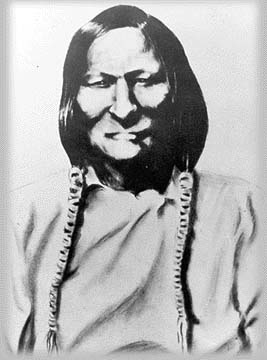
Cheyenne Chief, Black Kettle, above, tried to make peace with the whites..  The results was the betrayal of the Indians by the whites and the bloody and horrific Sand Creek Massacre in 1864.  Black Kettle somehow survived, and afterward, in relation to his attempts to make peace, he said “My shame is as big as the earth.  I once thought that I was the only man that persevered to be the friend of the white man, but it is hard for me to
believe the white man any more.”  He felt that he had betrayed his people by attempting peace.

The Sand Creek Massacre was one of he darkest pages in the history of white/Indian relations.  The story is so horrific that I almost can’t bear to write about it at all.

This atrocity occurred on November 29, 1864, when a 700-man force of Colorado Territory militia attacked and destroyed a village of friendly Cheyenne and Arapaho encamped in southeastern Colorado Territory, killing and mutilating between 70 and 163 Indians, about two-thirds of whom were women and children. The soldiers subsequently removed and desecrated body parts of the Indians, even the children, as mementos.

The painting above depicting the Sand Creek Massacre was completed by warrior, Howling Wolf, who, at age 15, defended the Indians against the unprovoked attack along with his father, Eagle Head.  Later, imprisoned along with other Cheyenne, he became famous for his “ledger art.”

The events leading up to this massacre all began with the discovery of gold.

By the terms of the 1851 Treaty of Fort Laramie between the United States and seven Indian nations, including the Cheyenne and Arapaho, the US recognized that the Cheyenne and Arapaho held a vast territory encompassing the lands between the North Platte River and Arkansas River and eastward from the Rocky Mountains to western Kansas. This area included present-day southeastern Wyoming, southwestern Nebraska, most of eastern Colorado, and the westernmost portions of Kansas.

In November 1858, the discovery of gold in the Rocky Mountains in Colorado, then part of the Kansas Territory, brought on the Pikes Peak Gold Rush. There was a flood of European-American migrants across Cheyenne and Arapaho lands. They competed for resources and some settlers tried to stay. Colorado territorial officials pressured federal authorities to redefine the extent of Indian lands in the territory, and in the fall of 1860, A.B. Greenwood, Commissioner of Indian Affairs, arrived at Bent’s New Fort along the Arkansas River to negotiate a new treaty.

On February 18, 1861, six chiefs of the Southern Cheyenne and four of the Arapaho signed the Treaty of Fort Wise with the United States, in which they ceded most of the lands designated to them by the Fort Laramie treaty. The Cheyenne chiefs included Black Kettle, White Antelope, Lean Bear, Little Wolf, and Tall Bear; the Arapaho chiefs included Little Raven, Storm, Shave-Head, Big Mouth, and Niwot, or Left Hand.

Above, a delegation of Cheyenne, Kiowa, and Arapaho chiefs in Denver, Colorado on September 28, 1864.  Black Kettle is 2nd from left front row in this photo.

The new reserve, less than one-thirteenth the size of the 1851 reserve, was located in eastern Colorado between the Arkansas River and Sand Creek. Some bands of Cheyenne, including the Dog Soldiers, a militaristic band of Cheyenne and Lakota that had evolved beginning in the 1830s, were angry at the chiefs who had signed the treaty. They disavowed the treaty and refused to abide by its constraints. They continued to live and hunt in the bison-rich lands of eastern Colorado and western Kansas, becoming increasingly belligerent over the tide of white migration across their lands. Tensions were high particularly in the Smoky Hill River country of Kansas, along which whites had opened a new trail to the gold fields.

Cheyenne who opposed the treaty said that it had been signed by a small minority of the chiefs without the consent or approval of the rest of the tribe; that the signatories had not understood what they signed; and that they had been bribed to sign by a large distribution of gifts. The whites, however, claimed that the treaty was a “solemn obligation.”  Officials took the position that Indians who refused to abide by it were hostile and planning a war.

The beginning of the Civil War in 1861 led to the organization of military forces in Colorado Territory. In March 1862, the Colorado men were mounted as a home guard under the command of Colonel John Chivington.  Chivington and Colorado territorial governor John Evans adopted a hard line against Indians, whom white settlers accused of stealing livestock. Without any declaration of war, in April 1864 soldiers started attacking and destroying a number of Cheyenne camps, the largest of which included about 70 lodges, about 10% of the housing capacity of the entire Cheyenne nation. On May 16, 1864, a force under Lieutenant George S. Eayre crossed into Kansas and encountered Cheyenne in their summer buffalo-hunting camp at Big Bushes near the Smoky Hill River. Cheyenne chiefs Lean Bear and Star approached the soldiers to signal their peaceful intent, but were shot down by Eayre’s troops. This incident touched off a war of retaliation by the Cheyenne in Kansas.

“Damn any man who sympathizes with Indians! … I have come to kill Indians, and believe it is right and honorable to use any means under God’s heaven to kill Indians.”

—- Col. John Milton Chivington, U.S. Army

As conflict between Indians and white settlers and soldiers in Colorado continued, many of the Cheyenne and Arapaho, including bands under Cheyenne chiefs Black Kettle and White Antelope, were resigned to negotiate peace. The chiefs had sought to maintain peace in spite of pressures from whites. They were told to camp near Fort Lyon on the eastern plains, and that their people would be regarded as friendly.

Black Kettle, a chief of a group of around 800 mostly Northern Cheyenne, reported to Fort Lyon in an effort to establish peace. After having done so, he and his band, along with some Arapaho under Chief Niwot, camped out at nearby Sand Creek, less than 40 miles north. The Dog Soldiers, who had been responsible for many of the raids on whites, were not part of this encampment.  Assured by the U.S. Government’s promises of peace, most of the warriors were off hunting buffalo, leaving only around 60 men, and women and children in the village. Most of the men were too old or too young to hunt. Black Kettle flew an American flag over his lodge, since previously the officers had said this would show he was friendly and prevent attack by U.S. soldiers.

Setting out from Fort Lyon, Chivington and his 700 troops of the First Colorado Cavalry, Third Colorado Cavalry and a company of First New Mexico Volunteers marched to Black Kettle’s campsite. On the night of November 28, soldiers and militia drank heavily and celebrated their anticipated victory.

The Sand Creek Massacre site is shown above.  Archaeologists have found evidence, such as bullets, that the massacre occurred at this location.

On the morning of November 29, 1864, Chivington ordered his troops to attack. Two officers, Captain Silas Soule and Lieutenant Joseph Cramer, commanding companies D and K, respectively, of the First Colorado Cavalry, refused to follow Chivington’s order and told their men to hold fire.  Other soldiers in Chivington’s force, however, immediately attacked the village.  Disregarding the American flag, and a white flag that was run up shortly after the soldiers commenced firing, Chivington’s soldiers massacred many of its inhabitants.

“I saw the bodies of those lying there cut all to pieces, worse mutilated than any I ever saw before; the women cut all to pieces … With knives; scalped; their brains knocked out; children two or three months old; all ages lying there, from sucking infants up to warriors … By whom were they mutilated? By the United States troops …”

—- John S. Smith, Congressional Testimony of Mr. John S. Smith, 1865

“Fingers and ears were cut off the bodies for the jewelry they carried. The body of White Antelope, lying solitarily in the creek bed, was a prime target. Besides scalping him the soldiers cut off his nose, ears, and testicles-the last for a tobacco pouch …”

—- Stan Hoig

“Jis to think of that dog Chivington and his dirty hounds, up thar at Sand Creek.  His men shot down squaws, and blew the brains out of little innocent children. You call sich soldiers Christians, do ye? And Indians savages? What der yer ‘spose our Heavenly Father, who made both them and us, thinks of these things? I tell you what, I don’t like a hostile red skin any more than you do. And when they are hostile, I’ve fought ’em, hard as any man. But I never yet drew a bead on a squaw or papoose, and I despise the man who would.”

—- Kit Carson

Some of the Indians cut horses from the camp’s herd and fled up Sand Creek or to a nearby Cheyenne camp on the headwaters of the Smokey Hill River. Others, including trader George Bent, fled upstream and dug holes in the sand beneath the banks of the stream. They were pursued by the troops and fired on, but many survived. Cheyenne warrior Morning Star said that most of the Indian dead were killed by cannon fire, especially those firing from the south bank of the river at the people retreating up the creek.

In testimony before a Congressional committee investigating the massacre, Chivington claimed that as many as 500–600 Indian warriors were killed. Historian Alan Brinkley wrote that 133 Indians were killed, 105 of whom were women and children. White eye-witness John S. Smith reported that 70–80 Indians were killed, including 20–30 warriors, which agrees with Brinkley’s figure as to the number of men killed. George Bent, the son of white William Bent and a Cheyenne mother, who was in the village when the attack came and was wounded by the soldiers, gave two different accounts of the Indian loss. On March 15, 1889, he wrote to Samuel F. Tappan that 137 people were killed: 28 men and 109 women and children. However, on April 30, 1913, when he was very old, he wrote that “about 53 men” and “110 women and children” were killed and many people wounded. Bent’s first figures are in close accord with those of Brinkley and agree with Smith as to the number of men who were killed.

Before Chivington and his men left the area, they plundered the tipis and took the horses. After the smoke cleared, Chivington’s men came back and killed many of the wounded. They also scalped many of the dead, regardless of whether they were women, children or infants. Chivington and his men dressed their weapons, hats and gear with scalps and other body parts, including human fetuses and male and female genitalia. They also publicly displayed these battle trophies in Denver’s Apollo Theater and area saloons. Three Indians who remained in the village are known to have survived the massacre – George Bent’s brother, Charlie Bent, and two Cheyenne women who were later turned over to William Bent.

One of the women, Mochi, below, later became a warrior as a result of her experience at Sand Creek.

After hiding all day above the camp, in holes dug beneath the bank of Sand Creek, the survivors there, many of whom were wounded, moved up the stream and spent the night on the prairie. Trips were made to the site of the camp but very few survivors were found there. After a cold night without shelter, the survivors set out toward the Cheyenne camp on the headwaters of the Smoky Hill River. They soon met up with other survivors who had escaped with part of the horse herd, some returning from the Smoky Hill camp where they had fled during the attack. They then proceeded to the camp, where they received assistance.

The Sand Creek Massacre resulted in a heavy loss of life, mostly among Cheyenne and Arapaho women and children. Hardest hit by the massacre were the Wutapai, Black Kettle’s band. Perhaps half of the Hevhaitaniu were lost, including the chiefs Yellow Wolf and Big Man. The Oivimana led by War Bonnet, lost about half their number. There were heavy losses to the Hisiometanio (Ridge Men) under White Antelope. Chief One Eye was also killed, along with many of his band. The Suhtai clan and the Heviqxnipahis clan under chief Sand Hill experienced relatively few losses. The Dog Soldiers and the Masikota, who by that time had allied, were not present at Sand Creek, as they were not seeking peace. Of about ten lodges of Arapaho under Chief Left Hand, representing about fifty or sixty people, only a handful escaped with their lives.

The massacre disrupted the traditional Cheyenne power structure, because of the deaths of eight members of the Council of Forty-Four. White Antelope, One Eye, Yellow Wolf, Big Man, Bear Man, War Bonnet, Spotted Crow, and Bear Robe were all killed, as were the headmen of some of the Cheyenne military societies. Among the chiefs killed were mature men, most of those who had advocated peace with white settlers and the U.S. government.  The net effect of the murders and ensuing weakening of the peace faction exacerbated the social and political rift developing. The traditional council chiefs, mature men who sought consensus and looked to the future of their people, and their followers on the one hand, were opposed by the younger and more militaristic Dog Soldiers on the other.  The Dog Soldiers viewed the massacre as confirmation that they were right and that it justified their militant position.

The events at Sand Creek dealt a fatal blow to the traditional Cheyenne clan system and the authority of its Council of Chiefs. It had already been weakened by the numerous deaths due to the 1849 cholera epidemic, which killed perhaps half the Southern Cheyenne population, especially the Masikota and Oktoguna bands. It was further weakened by the emergence of the separate Dog Soldiers band.  Sand Creek was the final blow.

After Sand Creek, Black Kettle continued to want and advocate for peace, but few others did.  Many joined the Dog Soldiers and the Cheyenne, Sioux and Arapaho joined forced and declared war on the whites.

Initially, the Sand Creek engagement was reported as a victory against a brave opponent. Within weeks, however, witnesses and survivors raised a controversy about possible massacre. Several investigations were conducted – two by the military, and one by the Joint Committee on the Conduct of the War.

Statements taken by Major Edward W. Wynkoop and his adjutant substantiated the later accounts of survivors. These statements were filed with his reports and can be found in the Official Records of the War of the Rebellion, copies of which were submitted as evidence in the Joint Committee of the Conduct of the War and in separate hearings conducted by the military in Denver. Lieutenant James D. Cannon describes the mutilation of human genitalia by the soldiers, “men, women, and children’s privates cut out. I heard one man say that he had cut a woman’s private parts out and had them for exhibition on a stick. I heard of one instance of a child, a few months old, being thrown into the feed-box of a wagon, and after being carried some distance, left on the ground to perish; I also heard of numerous instances in which men had cut out the private parts of females and stretched them over their saddle-bows, and some of them over their hats”.

During these investigations, numerous witnesses came forward with damning testimony, almost all of which was corroborated by other witnesses. One witness, Captain Silas Soule, who had ordered the men under his command not to fire their weapons, was himself murdered in Denver just weeks after offering his testimony.

The investigative panel declared:

“As to Colonel Chivington, your committee can hardly find fitting terms to describe his conduct. Wearing the uniform of the United States, which should be the emblem of justice and humanity; holding the important position of commander of a military district, and therefore having the honor of the government to that extent in his keeping, he deliberately planned and executed a foul and dastardly massacre which would have disgraced the verist [sic] savage among those who were the victims of his cruelty. Having full knowledge of their friendly character, having himself been instrumental to some extent in placing them in their position of fancied security, he took advantage of their in-apprehension and defenceless [sic] condition to gratify the worst passions that ever cursed the heart of man.

Whatever influence this may have had upon Colonel Chivington, the truth is that he surprised and murdered, in cold blood, the unsuspecting men, women, and children on Sand creek, who had every reason to believe they were under the protection of the United States authorities, and then returned to Denver and boasted of the brave deed he and the men under his command had performed.

In conclusion, your committee are of the opinion that for the purpose of vindicating the cause of justice and upholding the honor of the nation, prompt and energetic measures should be at once taken to remove from office those who have thus disgraced the government by whom they are employed, and to punish, as their crimes deserve, those who have been guilty of these brutal and cowardly acts.”

While it is somewhat vindicating to see this in print, in essence, nothing ever happened to punish Chivington.  He was never held accountable.  Despite the Joint Committee on the Conduct of the Wars’ recommendation, no charges were brought against those who committed the massacre. The closest thing to a punishment Chivington suffered was the effective end of his political aspirations.

I would like to tell you that somehow there was a happy ending in some way, but there wasn’t.  Justice was never served.  Not only that, but the genocidal killing wasn’t over.

In response to the continued raids and massacres, General Philip Sheridan devised a plan of punitive reprisals. He planned to attack Cheyenne winter encampments, destroying both supplies and livestock, and killing any people who resisted. At dawn on the morning of November 27, 1868, George Armstrong Custer led troops to attack Chief Black Kettle and his village. They were camped along the Washita River. Custer’s troops killed more than 100 Native Americans, mostly Southern Cheyenne. While trying to cross the Washita River, Black Kettle and his wife were shot in the back and killed.

The Sand Creek Massacre site, on Big Sandy Creek in Kiowa County, is now preserved by the National Park Service. The Sand Creek Massacre National Historic Site was dedicated on April 28, 2007, almost 142 years after the massacre.

The Sand Creek Massacre Trail in Wyoming follows the paths of the Northern Arapaho and Cheyenne in the years after the massacre. It traces them to their wintering on the Wind River Indian Reservation near Riverton in central Wyoming, where the Arapaho remain today. In recent years, Arapaho youth have taken to running the length of the trail as endurance tests to bring healing to their nation. Alexa Roberts, superintendent of the Sand Creek Massacre National Historic Site, has said that the trail represents a living portion of the history of the two tribes.

The Sand Creek Massacre National Historic Site web page holds lots more information.

http://www.nps.gov/sand/index.htm

http://en.wikipedia.org/wiki/Sand_Creek_Massacre_National_Historic_Site

http://www.sandcreeksite.com/

http://www.enotes.com/sand-creek-massacre-reference/sand-creek-massacre

Posted in Arapaho, Cheyenne, Sioux | 5 Comments

Dalles Indians

In the Carlisle Indian School records, Victor H. Johnson was listed as a member of the Dalles Tribe, a tribe I had never heard of.

Searching the internet provided nothing, so I initially wondered if there was a mistake.  However, turning to Frederick Hodges Handbook of American Indians North of Mexico provided information, although not a lot.

He described the Dalles thus:

The Chonookan tribes formerly living at the Dalles, Oregon and on the opposite side of the Columbia river.  While tribes of other stocks, notably Shahaptian, frequently visited The Dalles during the summer, they were not permenent residents.  Of the Chonookan tribes, the Wasco were important and the term is sometimes limited to that tribe.

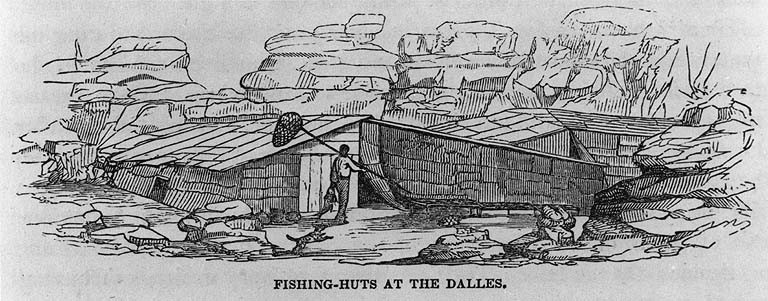
Lewis and Clark references them as the La Dalle Indians in 1842 and in Parker in 1846 names them as La Dalles Indians.  The woodcut above was created in 1841.

He gives sources for the Dalles as:

US Indian Treaty 1855 and 1873

Lee and Frost, Oregon, 1844

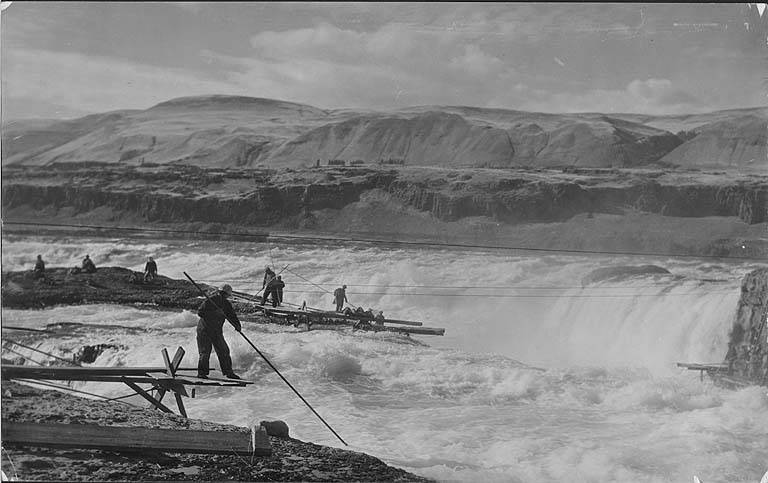
This area of the Columbia River was rich in salmon.  Native people would fish from piers and spear the fish as they swam past.  This photo from the University of Washington Library, shows this process in the region known as “The Dalles.”  Later, dip netting was used.

The area was flooded in 1957 and no longer exists.

http://www.historylink.org/index.cfm?DisplayPage=output.cfm&file_id=10010

This site shows the location as well as a mural depicting fishing in ancient times.

http://www.waymarking.com/waymarks/WM4ZF1_Ancient_Indian_Fishing_Grounds_The_Dalles_OR

Posted in Chinook, Dalles | Leave a comment

Native American DNA News

It’s a good DNA day for Native American DNA research.

Yesterday, I was talking to Bennett Greenspan at Family Tree DNA.  He knows of my interest in Native heritage.  Our conversation turned to the new Geno 2.0 chip, now called the GenoChip, and the expected ethnicity results relative to Native heritage.

It turns out that Bennett and Spencer Wells had just been talking about the same thing.  Spencer said that the GenoChip is exceptionally good at picking up Native American ancestry and that it’s one of the key features built into the autosomal SNPs they chose and the resulting admixture analyses.  Spencer says that as long as the admixture is above 2%, we’ll see it.

Two percent equates to between 5 and 6 generations.

I can’t wait to compare Geno 2.0 results of people who previously tested at 23andMe and with Family Tree DNA’s Family Finder, and especially those who showed the Middle Eastern percentage with the Family Finder test.

This information dovetails nicely with a new paper to be published in the American Journal of Human Genetics, the February 10th edition.

In this new paper, Dr. Theodore Schurr has used Y and mitochondrial DNA evidence collected from 500 Siberian people living in remote villages and more than 2500 Native Americans from Canada, the US and Mexico.  The paper confirms the homeland of the Native people in the Americans was originally the Altay Mountains in Siberia (photo above).  This isn’t new news, but it’s nice to have confirmation and it will be interesting to see the details in the paper.

In an article published this week by the National Geographic Society titled “Is this Russian Landscape the Birthplace of Native Americans?”, they mention that there is one marker in a male Y-line that mutated about 18,000 years ago and is still carried by Native men today.

http://news.nationalgeographic.com/news/2012/01/120203-native-americans-siberia-genes-dna-science/

I know that many recently discovered Y-line SNPs were included for haplogroup Q on the new GenoChip.  I’m very hopeful that the DNA of the Siberian people was vetted for new autosomal SNPs and included as well.  It’s likely, as Dr. Schurr, in addition to his work at the University of Pennsylvania is also the North American Director for the Genographic Project.

Update: While the Genographic Project no longer sells kits to the public, Family Tree DNA continues to be the best place for people with Native heritage to test. If you want to take a DNA test, click here.

Posted in Anthropology, DNA | 4 Comments

Mapping Indian Town on Hatteras Island

Baylus Brooks and I’ve been working for the past three years or so on reassembling the early land grants from the part of Hatteras Island where the Indian town was located.  I did a lot of the original land grants and deeds records extractions and Baylus did the mapping, plus additional research, many times obtaining the original records for clarity.  This was not a straightforward project, by any means, and still isn’t.

This land was granted to the Hatteras Indians in 1759 after they complained to the State Legislature in 1756 that whites were encroaching on their land.  The people involved, descendants of one of the original grantees, Henry Davis, said they weren’t encroaching and besides, the Indians didn’t legally own any of the land anyway as they didn’t have a patent.  That was remedied in 1759 when William Elks and the Hatteras Indians were granted the land where their village was located.

Colony of NC 1735-1764 Abstracts of Land Patents, Volume One – B by Margaret M. Hofmann:

Page 382, pat 5398, page 268, book 15, William Elks and the rest of the Hatteras Indians March 6 1759, 200 ac in Currituck including the old Indian Town, joining the sound side, the mouth of King’s Creek and Joseph Mashue.

Unfortunately, the original survey doesn’t exist, but later references do, such as there were.  What do I mean, “such as there were?”  For starters, the Indians sold more land than they were granted.  Even though they sold pieces of thier land, the deeds with the metes and bounds description still read exactly the same, obviously just having been copied from earlier deeds (or the missing grant survey) with no thought given to the fact that part of that land had been previously sold.  And that’s just for starters.  In short, things are just never quite what they seem.

Take a look at what Baylus wrote on his blog about what he had to do to try to map even a part of this area surrounding the Indian’s land grant.

http://bcbrooks.blogspot.com/2012/10/early-north-carolina-surveys-hatteras.html

It’s no wonder that the exact location of Indian Town has remained so elusive.

Posted in Hatteras, History | Leave a comment

John Lawson Legacy Days

We’re not sure when John Lawson was born, because we know little about him before he arrived in the fledgling colony of Carolina in August of 1700.  He was obviously quite literate, judging from the fact that he wrote a book, which means he was educated, which means he was well placed in society.  John was not a poor immigrant.  He came to Carolina, arriving in Charleston, after being told in London that “Carolina was the best country.”

After his arrival he began immediately to explore and to record his findings.

Beginning December 28, 1700 Lawson led a small expedition out of Charleston and up the Santee River by canoe and then on foot to explore the Carolina backcountry. Along the way he took careful note of the vegetation, wildlife and, in particular, the many Indian tribes he encountered. He traveled nearly 600 miles through the wilderness, ending his journey near the mouth of the Pamlico River.

After his expedition, Lawson settled near the Pamlico River and earned a living as a private land surveyor. In 1705 he was appointed deputy surveyor for the Lords Proprietor of Carolina. In 1708 he succeeded Edward Moseley to become surveyor-general.

Lawson played a major role in the founding of two of North Carolina’s earliest permanent European settlements–Bath and New Bern. On March 8, 1705, Bath was the first town incorporated in what was to become North Carolina. Part of the incorporated land was owned by Lawson. He became one of the first town commissioners. Later he became clerk of the court and public register for Bath County.

Lawson published an account of his adventure in 1709, in which he described the native inhabitants and the natural environment of the region. The book was an instant success, and several editions were published, including versions in German and French. The resulting publicity attracted many settlers to the colony of North Carolina. In 1709 Lawson returned to London to oversee the publication of his book, A New Voyage to Carolina.

While in London he represented the colony in a boundary dispute with Virginia. He also organized a group of Germans, Electorate of the Palatinate, to settle in Carolina and returned with them in 1710 to found New Bern on the Neuse River. The government of Queen Anne had invited the refugees to England for passage to the colonies. They were fleeing extended hardship in their homeland, due to a record cold, and French invasions.

Lawson was involved with a land deal on behalf of the Germans with von Graffenreid wherein he sold the Tuscarora Indian village to von Graffenreid, either without the approval of the Indians, or without their understanding of what a “sale” meant.  In any case, the Tuscarora were not keen on the idea of moving away from their village and felt that Lawson had betrayed them.

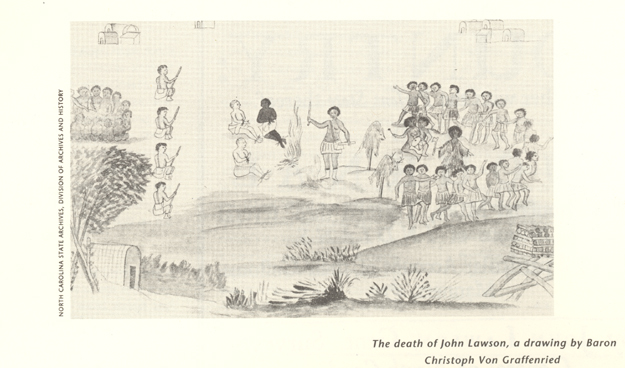
In September 1711, Lawson and his associate Christopher von Graffenried were captured by Tuscarora Indians while ascending the Neuse River. The Tuscarora eventually released von Graffenried, but they tortured and killed Lawson.  They initially were going to release Lawson too, but he became argumentative and reprimanded the Indians for taking them captive in the first place.  The situation deteriorated and Lawson lost his life.

Shortly thereafter, tensions between Indians and settlers erupted into a bloody conflict known as the Tuscarora War.

Fortunately, for us today, Lawson’s book remains, as do several other original manuscripts having to do with this timeframe.  Von Graffenreid wrote about the incident and the founding of New Bern.  The drawing in the article is Von Graffenreid’s depiction of the death of John Lawson.  http://docsouth.unc.edu/nc/graffenried/graffenried.html

Lawson of course left us his New Voyage to Carolina in which he gives us one of the first in-depth descriptions of the Native people in the region.  http://docsouth.unc.edu/nc/lawson/menu.html

In addition, Colonel Barnwell, who played such a pivotal role in the Tuscarora war maintained a journal as well, although parts of it are missing.  http://www.ncpublications.com/colonial/Bookshelf/barnwell/journal.htm?

Today, John Lawson days are celebrated in Grifton, NC in October.  Their webpage holds an assortment of historical and cultural links, including a number about the Tuscarora and early settlements in that region up through and including the Tuscarora War.

http://www.johnlawsonlegacydays.org/JLLD_Links_and_Resources.html

Posted in History, North Carolina, Tuscarora | 1 Comment

Houmas Indians of Terrebonne Parish, Louisiana

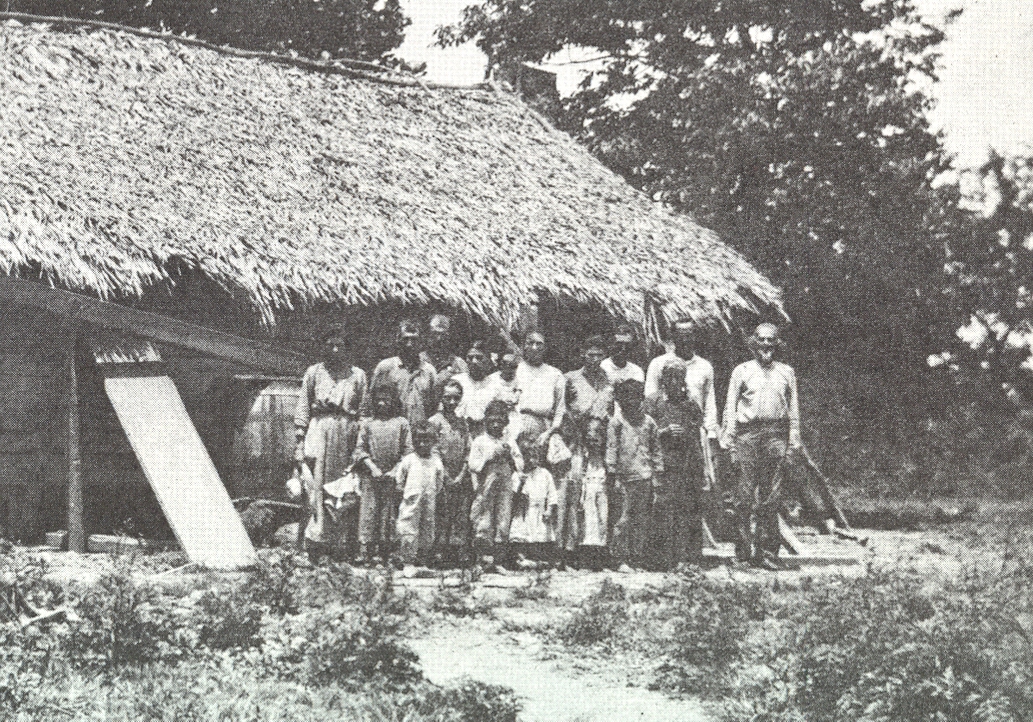
The photo above is a group of mixed Houmas Indians in Bayou Lafourche in 1907

The Draft Registration for WWI was really a wonderful historical opportunity.  While other documents, such as the Indian Census, were taken only of tribal members, the draft asked each individual their race.  They got to decide what they said, not as dictated by another body, such as a tribe or a school or a registrar of some sort.  Some claimed mixed race.

In Louisiana, probably half of the people who claimed they were Indian came from Terrebonne Parish.  The rest were scattered in other parishes, and New Orleans, of course, but Terrebonne probably had as many as all the rest put together.  So I set about trying to discover who these Indians were.  Ironically, the history of Terrebonne parish doesn’t say anything about Indians, which I found unusual, but I did find information in some other places.

It turns out that the Houmas Indians were the primary group found there in the 1800s and early 1900s, but they weren’t there earlier.  Sometimes given as Ouma (French) or Huma. The name translates literally as “red” and is apparently a shortened form of Saktci-homma, the name of the Chakchiuma meaning “red crawfish.” Houma in southern Louisiana are sometimes referred to as Sabine, a derogatory term usually intended as a racial insult.

The first mention of the Houmas Indians is found in LaSalle’s report of the existance of the “Oumas” village in March of 1682, though he didn’t actually visit the location. (B.F. French, ed., Historical Collections of Louisiana, 1846, V. 1, p. 47-49) In 1686, Chevalier de Tonti went up the Mississippi River and found the “Oumas tribe, the bravest of all the savages. The location of the tribe at this time was east of the Mississippi River in West Feliciana Parish … near present-day Angola state prison. (Chevalier de Tonti, Relation De La Louisianne et de Mississippi, 1734, p. 45) In 1699, Bienville noted the conflict between the Houmas and the Bayougoula Indians, who lived further south. (Swanton, Bulletin 43, p.287-288) The two tribes had set up a red pole (from which the city “Baton Rouge” got its name) to mark the boundary of their hunting areas. (Richebourg Faillard McWilliams, Fleur de Lys and Calumet, 1953, p. 25) By the following year, the conflict had been resolved and the tribes made peace. (B.F. French, ed., Historical Collections of Louisiana and Florida, 1869, p. 55)

In 1700, the Jesuit Father Paul Du Ru joined Iberville in a trip to the Houma village. He left his servant, who directed the Indians in building a Catholic church … the first Catholic church in the Mississippi Valley. It was 50 feet long and had a cross almost 40 feet tall. (Roger Baudier, The Catholic Church in Louisiana, 1939, p. 2) On a later trip (1701-1702) to the village, Iberville counted 150 families in the tribe. (Margry, Decouvertes, Vol IV, p. 418)

About 1706, the Houmas and nearby Tunicas were feeling threatened by northern tribes from Mississippi. The Tunica settled in with the Houmas, only to later turn on them and kill over half of the tribe. The remaining Houmas moved southward. They probably settled around the mouth of the Lafourche. Some say that they moved to Bayou St. John, but is seems that they only visited that area seasonally. (Bernard de La Harpe, Historical Journal, p. 100-101) It is thought that their hunting area extended from the Lafourche eastward to Lake Ponchatrain. The main movement of the Houmas down the Lafourche probably came after 1770. The oral tradition of the Houma Indians says that one branch of the tribe settled at present-day Houma … which was in the center of their hunting land from Atchafalaya to Barataria. The village was named Chufahouma. (Oral History, Curry: # 2, #6, #15)

The following years saw the Houmas making peace … with the Chitimacha in 1716, and the Tunica and Natchez in 1723. Bienville noted in 1723 that “this nation (Houma) is very brave and very laborious.” It was reported in 1749 by Joseph De LaPorte that the Houmas lived in two villages located about six miles south of the Lafourche. De Kerlerec noted in 1758 that their location was about 66 miles upriver from New Orleans.

The latter half of the century was not a good time for the tribe. In 1771, John Thomas reported that there were 46 Houma warriors. In the latter half of the 18th century, a number of small conflicts between the Houmas and other tribes were reported. Their land, for which they had received a verbal guarantee, was sold out from under them. Legal battles were attempted … some lasting for decades … but failed due to a lack of a written document. The tribe was still on the land in 1785 and refused to move.

In 1803, Daniel Clark reported that there were 60 Houmas living on the east bank of the Mississippi River, about 75 miles upriver from New Orleans. John Sibley reported in 1806 that there were just a few Houmas living on the east side of the Mississippi just south of Bayou Manchac. Sibley also noted that some of the Houmas had traveled west and intermarried with the Attakapas tribe.

At this point, the story becomes somewhat clouded. Oral tradition of the Indians says that Alexander Billiot, the Houma chief, was living at the site of present-day Houma when the “white man came.” The traditions states that he was later given a grant for the land, though no proof of this grant exists. When they applied for the land (without a written grant), it was rejected (in 1814). They applied for “a tract of land lying on Bayou Boeuf, or Black Bayou.” This is the area between present day Houma and Morgan City. Without tribal land, the Houmas had to acquire land as private citizens.

The documented proof of Houmas Indian migration to Terrebonne Parish is lacking. The tribal identity and specifics of the Indian presence in Terrebonne Parish is still being looked into by the Bureau of Indian Affairs who issued a report which you can see at this link:   http://www.rootsweb.ancestry.com/~laterreb/houmaindians.htm

In the mid 1990s, BIA came out with their genealogical report on the Houmas tribe. To summarize, they found only 3 progenitors that could be clearly identified as Native American:  Joseph Houma Courteau, Jeanet, and Marie Gregoire. Courteau’s daughter married Jacques Billiot.  Jeanet married his brother Joseph Billiot. Marie Gregoire married Alexander Verdin.  Courteau was said to be an “Indian of the Biloxi nation.

There are several others with possible connections. In the late 18th and early 19th centuries, several other French men married Indian brides. Many of the names of these men are still recognized as being (primarily) Indian names. The surnames include: Billiot (see above), Verdin (see above), Solet, Verret, Parfait, Dardar (Michel Dardar, a Frenchman, married Adelaide Billiot, non-Indian daughter of Jean Baptiste Billiot & Marie Enerisse, in 1809), , , Naquin (Acadian Charles Naquin arrived in LA in 1785; his grandson Jean-Marie Naquin married Pauline Verdin, a daughter of Alexander Verdin & Marie Gregoire), Chiasson (Andre J. Chaisson married Felicite Isilda Billiot, non-Indian daughter of Jean Billiot & Manette Renaud).

The earliest Indian settlements in Terrebonne Parish were along Bayou Terrebonne and Little Caillou. By 1850, the settlements had spread to Pointe Aux Chenes and Bayou DuLarge.  As the English, French, Acadian, etc. came into the parish, the Indians were forced further south. In 1907, John Swanton counted almost 900 people in several settlements. These included 175 at Bayou Sale (below Dulac), 160 at Pointe Aux Chenes, 117 at Isle de Jean Charles, about 90 at Bayou DuLarge, and 65 at Pointe Barre. (Swanton, Bulletin 43, p. 291) The Indian population was reported at 2,000 by Franklin Speck in 1941. (Speck, “Report … on Historical and Economic Background of Houma Indians,” p. 14-16)

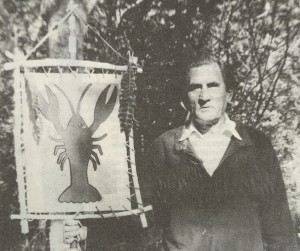
The Houmas war emblem was the crawfish, representing both honor as it wouldn’t back down from anything, even unto death, and the most abject poverty if you ate it.

You can read more about the history of the Houma at this link: http://www.dickshovel.com/hou.html

To read about the Confederation of Biloxi, Chitimacha and Choctaw, tribes of Terrebonne and Lafourche Parishes, visit this site:  http://www.biloxi-chitimacha.com/

You can read more about their history here:  http://www.biloxi-chitimacha.com/history.htm

Interviews and photographs:  http://oralhistory.blogs.lib.lsu.edu/tag/houma-indians/

Sources:  http://www.rootsweb.ancestry.com/~laterreb/indian.htm

Posted in Houmas | 146 Comments