Still Part Redman Deep Inside

Do you have a persistent story of Native American heritage in your family?

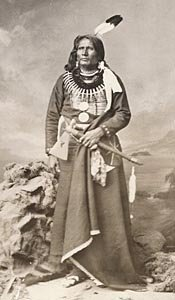
Standing Bear, Ponca, 1877Mark Green’s wife did.  Her ancestor Nancy Pittman’s mother was supposed to be a Cherokee Indian.  If your family was from the south, chances are you have some similar story.

Mark tracked her story both through DNA and the Cherokee records.  Her DNA showed 1% Native Ancestry, but the records pertaining to the Guion-Miller Roll provided additional information.  It’s most interesting, because although the paperwork having to do with her 1907 application is ambiguous, with the application subsequently denied, the DNA, some 100 years and a few generations later, isn’t.

Here’s Mark’s article about the family story, his research and what he found.  Sometimes a little footwork goes a long way – and there are lots of records available having to do with the Cherokee and 5 Civilized Tribes who were removed to Oklahoma.

http://southerngreens.blogspot.com/2013/04/im-still-part-redman-deep-inside.html

Posted in Cherokee | 6 Comments

Digitizing War of 1812 Records, a Quilt and NY Indian Service Records

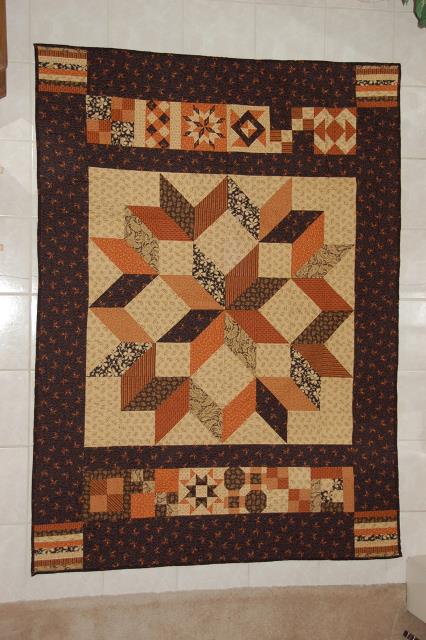
1812 quilt

The War of 1812, which lasted from 1812 to 1815, is probably the War we know the least about, and one for which an astounding number of pension and bounty land records still exist for veterans who served.  If your ancestor was between the ages of about 16 and maybe 60, there is a good chance that they served in this War, at least for a little while.

If so, they have a military pay record and if you’re lucky, a pension application and a bounty land application as well.  If they died but their widow outlived them, then she could have applied using his service record.

However, in order for these precious records to be preserved and available to us all, they are in the process of being digitized, but this project is not funded by any grants or institutions, it’s being crowdsourced.  Hint – that means you and me.

Right now, in order to encourage donations to preserve and digitize the War of 1812 pension and bounty land papers, The Federation of Genealogical Societies is entering one ticket into a drawing for this lovely period appropriate quilt for every dollar donated to the preservation project.  In addition, Ancestry is matching every donation, so in essence, your contribution preserves twice as many pages.

Take a look at this site and if you can, please donate.  So many of our ancestors served.

http://www.preservethepensions.org/blog/

You can see records already digitized, for free, at: http://go.fold3.com/1812pensions/

How does this connect with Native American history?  Well, in a number of ways.  This war was no respecter of race.  Native people and people descended from Native ancestors served in militia units just like everyone else.  Well, except for some of the Native people who lived in the north, in New York, by way of example.  Those folks fought FOR the British and against the US as a result of constant pressure from Europeans and broken treaties and promises.  The British promised to do better.

The Native groups in New York were on the front lines of the northern theater of the war.  However, the Tuscarora Indians stepped between the terrified frontier families and the British who were burning their homes in an all-out effort to kill them and win the war.  The odds were quite lopsided, about 25 Tuscaroras faced about 1500 British.  The good news is that their intervention bought the settlers enough time to flee, and the British, not knowing how few Tuscarora there really were, halted their attack.

The town of Lewiston did burn, but lives were saved thanks to the Tuscarora Heroes.  This December 19th, a statue will be dedicated commemorating the bravery of the Tuscarora and cementing the friendship of Lewiston and the Tuscarora.

Many people think that the Indian tribes of NY fought only AGAINST the Americans, but that’s not true.  In fact, there is a long list of Native people who fought alongside the Americans, risking their lives, giving their lives, and suffering the consequences of having their villages burned in retaliation.

The following link is to an index from the Awards of Claims of the Soldiers of the War of 1812 compiled by the New York Adjutant General’s office and the claims were presented for payment by members of tribes mustered into service of the US for the War of 1812.  The columns represent the claim number, the warrior, the claimant, often their estate, and the amount awarded to them.  This includes long lists of people by tribe; the Seneca on the Allegany Reservation, the Cattaraugus Reservation and Cornplanter’s Reservation, the Onondaga Nation, the Oneida Nation and the Tuscarora Nation.

The original declarations of claims from which this index was compiled are on file in the Bureau of War Records maintained by the Division of Military and Naval Affairs, Public Security Building, Albany, NY 12206. The declaration indicates the claimant’s name and military grade, his inclusive period of service and the land warrant, if any, granted as a result of his service. Researchers desiring additional information should contact the Bureau of War Records at the above address.

http://www.rootsweb.ancestry.com/~nyrensse/indians.htm

In addition, these individuals may be eligible for pensions and land through the federal government as well.  The digitization project will preserve those records and make them available to their descendants.  So, please, donate now.  Any amount is helpful and who knows, the records you save may be your own ancestors’!

http://www.fgs.org/cstm_PreserveThePensions.php?md=ptp

And you just might win that quilt!!!

Hat tip to El for the Tuscarora article and list of names.

Posted in Military, Oneida, Onondaga, Seneca, Tuscarora, War of 1812 | Leave a comment

A Buck By Any Other Name

buck

A Buck by any other name might be Hogan, Logan or Williams.  I think we have a case of surname schizophrenia.  We have four surnames involving 3 people.

Do you sometimes wonder why you or one of your relatives matches a whole group of people by a different surname, and none by the surname you expected them to match?

This 1888 Indian Census page for the Seneca on the Allegany Reservation in New York just might give you a clue as to why you’re not matching whom you think you should be matching..

Not matching who you expect to match is sometimes called a Nonpaternal Event (NPE) or I prefer the term undocumented adoption.  But this case doesn’t seem to be undocumented at all…it’s well documented….it’s just that we can’t understand it.

So let’s say this is your family and the husband, I presume is Augustus Buck.  So far, that looks normal.  But this is where normal ends.

Your name is Acsah.  If you’re married to Augustus Buck, your name would be Acsah Buck.  This is how all of the other families are recorded, so you would be too.  Except you have this little note that says either (Logan was) or Hogan was).  Is that a maiden name?  No one else’s maiden or other names are listed.  Is Acsah maybe not the wife of Augustus and the mother of Alfred noted below?  If that is the case, then why are they listed as Buck now?

And Alfred has his own set of problems.  He is noted as Alfred Buck, age 2. One would assume the child of Acsah and Augustus Buck, judging from the rest of the entries.  But Alfred had this note that says (was Williams.)  What does that mean?  It’s certainly not his maiden name.

Does that mean that Alfred isn’t a Buck at all?  Is Alfred even the son of Acsah?  Is Alfred really a Williams.  Was Acsah married to a Williams before Augustus?  That would seem to be pushing it given that she is only 18 and Alfred was born when she was 16.  Did she have time to be married earlier?

So, if Alfred’s descendants were to DNA test, would they match a Buck, a Williams, a Hogan or a Logan?  Or maybe none of the above if Acsah had Alfred before she married Augustus by someone not listed on the “was” list.  Maternal naming was a very common Native American occurrence and what is today considered to be illegitimacy was not viewed through the lens of colonial or Victorian America.

And just think, if you are Alfred’s great-grandson and you took the Yline DNA paternal line test, expecting to match a Buck, and you were instead matching a Williams, Hogan or Logan, and if you never saw this census page, you would have no clue as to potentially why.  Of course, if you aren’t matching a Buck or a Logan, Hogan or Williams, then all bets are off.  But at least, there is a clue here that something is not like the rest of the families recorded in the census.  It’s something to work with.

Of course, this makes me wonder how many more census entries warrant notes and of course never received them.  And of course, a legend to interpret the note would be nice too:)

Posted in DNA, Seneca | 2 Comments

1887 Croatan Indian Petition Signers

In 1887, the Croatan Indians, now the Lumbee, petitioned the state legislature to establish a normal school to train Indian teachers for the county’s tribal schools. With state permission, they raised the requisite funds, along with some state assistance, which proved inadequate. Several tribal leaders donated money and privately held land for schools.  The Croatans built the Indian Normal School which evolved into the University of North Carolina at Pembroke.

The petition submitted to establish the school was signed by 67 Croatans and 6 “white citizens.”  The Croatan signers are shown below.

First Last
James Oxendine
Alamander (sic) Locklear
Isham Locklear
J.H. Harris
James Braboy
B.J. Chavis
James Bullard
Robert Collins
Machire Locklear
Evander Blue
Malakiah Locklear
Nelson Locklear
Alexander Locklear
J.P. Locklear
Neill Oxendine
Solomon Oxendine
Jordan Oxendine
Purvie Jacobs
Murdoch Chavis
A.J. Lowrie
Peter Dial
Thomas Dees
Thomas Sanderson
Hector Locklear
J.W. Oxendine
Magilbra Braboy
William L. Locklear
Harrison Ransome
James Dial
Soliman Locklear
Winslow Locklear
Isham Locklear
Peter Bullard
Isaac Brayboy
Turner Lowerie
W.L. Moore
Zion Lowrie
Hugh Oxendine
J.L. Monroe
Asbury Oxendine
N.A. Locklear
Henry Brayboy
A.J. Revels
Nelson Chavis
A. Bullard
William Goins
Archie Oxendine
G.W. Lowrie
Isac Braboy
John E. Oxendine
Wesley Bullard
Thomas Locklear
James I. Lowrie
J.J. Oxendine
Preston Locklear
J.C. McEachin, Jr.
Willey Jacobs
Joseph Locklear
Brown Lowerie
Alva Oxendine
J.W. Willis
Jack Oxendine
Wm. Jacobs
Hector Sanderson
Israel Rodgers
Paisly Sanderson

Thanks to Jazzy Jeff for finding this list of names.

Posted in Croatan (Later Lumbee), Education, History, Lumbee, North Carolina | 2 Comments

Metlakahtlan, Alaska

I’m still working on transcribing the Carlisle Indian School records, although I’m nearing the end of all 18,000 records found in three sources that have to be integrated.  This project has been way beyond the magnitude I ever expected.

One thing I’ve noticed is that there are a significant number of students with Alaskan noted as their tribe.  Keep in mind that this was long before Alaska became a state of the Union.

The gold rush in Alaska brought prospectors in the 1890s and early 1900s, but it wasn’t until 1912 that Alaska became a territory and not until 1959 that it became a state.  The Carlisle School opened in 1879 and closed in 1918 in the wake of WWI.  We don’t know exactly when most of these students attended, but it was certainly between those dates.

Some students, or students with the same name, are designated as Alaskan and then as another tribe in a different record.  For example, Anna Kittail in one record was shown as Alaskan and in another, Apache.  Those two are pretty hard to confuse, and two students with the name of Anna Kittail would be quite unusual as well.  Maybe someone misinterpreted Apache as Alaskan or vice versa.  Another was William Jackson, Alaskan and Chippewa and yet another, Clara Hall, Gros Ventre and Alaskan.  In some records, a state was given, in others, not.  You would think Alaskans would be from Alaska.

Now I don’t want to give the impression that only students with Alaska tribal designations had multiple tribes listed.  That’s not at all the case, but some of the others make more sense, like Mohawk and St. Regis, which could indeed be used interchangeably.

So I began to wonder about the Alaskan designation, all things considered.  Then I found the record of Edward Marsden.  In one record, he is listed as Alaskan, from Alaska.  Good, so far this makes sense.  In another record, he was listed as Metlakahtlan.  I’ve never seen that tribal designation before, so I decided to take a look.

Sure enough the Metlakahtlan people were Alaska Tsimshian indigenous people.  Furthermore, we now know where Edward was from – a village in far southeastern Alaska, shown on the map below.

Metlakahtlan map

In fact, it turns out that Metlakahtlan has a very interesting history.

Metlakatla comes from Maxłakxaała, a Tsimshian word meaning “Salt Water Passage.” Metlakatla was named after another village of the same name (“Old Metlakatla”) in British Columbia, which is on Metlakatla Pass, near Prince Rupert. In a more ancient time, it was a Tlingit hunting ground known as “Taquan”. The Tsimshians were granted permission to own the land by Chief Johnson of the Tlinget tribe.

In 1886, William Duncan, an English tannery employee and lay minister of the Anglican Church, had a doctrinal dispute with the Church authorities in Metlakatla, B.C. He and a devoted group of Tsimshian followers decided to leave Metlakatla. Duncan went to Washington, D.C., in the United States and asked the U.S. government to give his group land in Alaska. The U.S. under President Cleveland gave them Annette Island after a search committee in seagoing canoes discovered its calm bay, accessible beaches, nearby waterfall, and abundant fish.

In 1887 the group arrived on the island and built a settlement in the Port Chester area of the island. The town was laid out in a neat grid pattern and contained a church, a school, a tannery, and a sawmill. They named the town New Metlakatla, after the town they had left behind, but later dropped the “New”. In 1888, William Duncan returned to Washington and lobbied the U.S. Congress for an Indian reservation on Annette Island. Although the reservation system had not been used in Alaska, this request was granted in 1891. Annette Island and its surrounding islands today comprise the only Indian reservation in Alaska. Duncan remained at Metlakatla until his death in 1918.

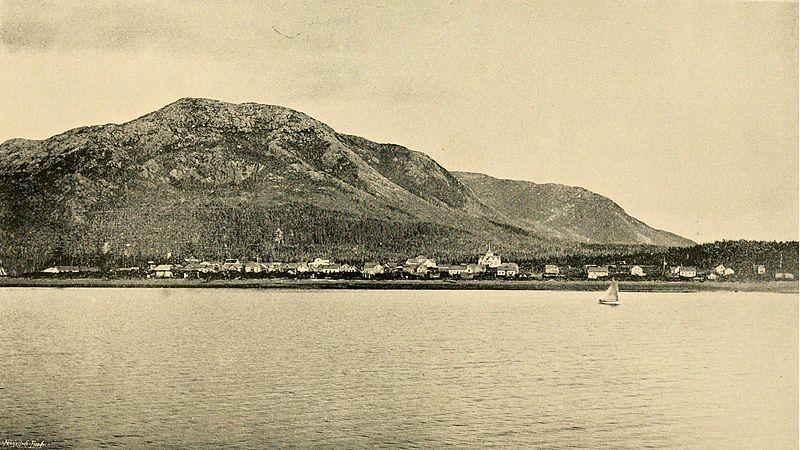
Metlakahtlan 1890s

This photo shows Metlakahtlan in the 1890s, about the time Edward Marsden would have been born or living there.

Indeed today, Metlakahtlan is a thriving Native community.  You can see more on their webpage at http://www.metlakatla.com/index.html.

Posted in Alaska Natives, Tsimshian | 9 Comments

Native Study Website

native study

I recently came across the Native Study website.

http://www.nativestudy.com/index.html

This site has several books of transcribed original records.  For the most part, records deal with the following tribes:

  • Cherokee
  • Chickasaw
  • Choctaw
  • Creek
  • Seminole
  • Blackfeet
  • Delaware
  • Hopi
  • Navajo
  • Sioux

However, a second set of records, Native American Will and Probate Records, deals with a different set of tribes and records.  The website states:

“In accordance with federal statutes enacted in 1910 and 1913, the Law and, subsequently, the Probate Divisions of the Bureau of Indian Affairs were responsible for determining the heirs of deceased Indian trust allottees.  Ultimately, Native Americans submitted more than 2,500 pages of wills and probate records to the Bureau. These records span the period 1911 to 1921 and, with a few exceptions, pertain to Indian families living in the Plains and several western states.”

For information about Indian Trust Allotments and the division of tribal land, visit this link:

ftp://ftp-fc.sc.egov.usda.gov/MI/AI/AI_land_def.pdf

Posted in Blackfoot, Cherokee, Chickasaw, Choctaw, Creek, Delaware, Hopi, Navajo, Seminole, Sioux | Leave a comment

Carolina Indian Boy for Sale in Boston – 1713

Indian for sale

“A Carolina Indian Boy about 11 years old, to be sold, inquire as the post office in Boston.”

In 1713, the Boston News-Letter carried this advertisement for a “Carolina Indian Boy” to be sold as a slave. The boy had, presumably, been captured during the Tuscarora War.

Hat tip to Derek for this article.

It’s sad to see this in print.  I surely wish we knew more about who this young man was, who he was sold to and what happened to him.  Most of the captives from the Tuscarora War were taken south and sold in South Carolina or into the West Indies.  I wonder how he came to be found in Boston.

Posted in North Carolina | 2 Comments

Cameron’s Letter Regarding Survey of 1763 Proclamation Line

I want to thank our friend Mavis again for finding this wonderful document.  She says she reads Documenting the American South every morning over coffee.  I, for one, am very glad that she does.  Keep up the good work Mavis.

Today’s find is a letter from Alexander Cameron, Indian Agent, regarding the surveying of the Cherokee boundary.

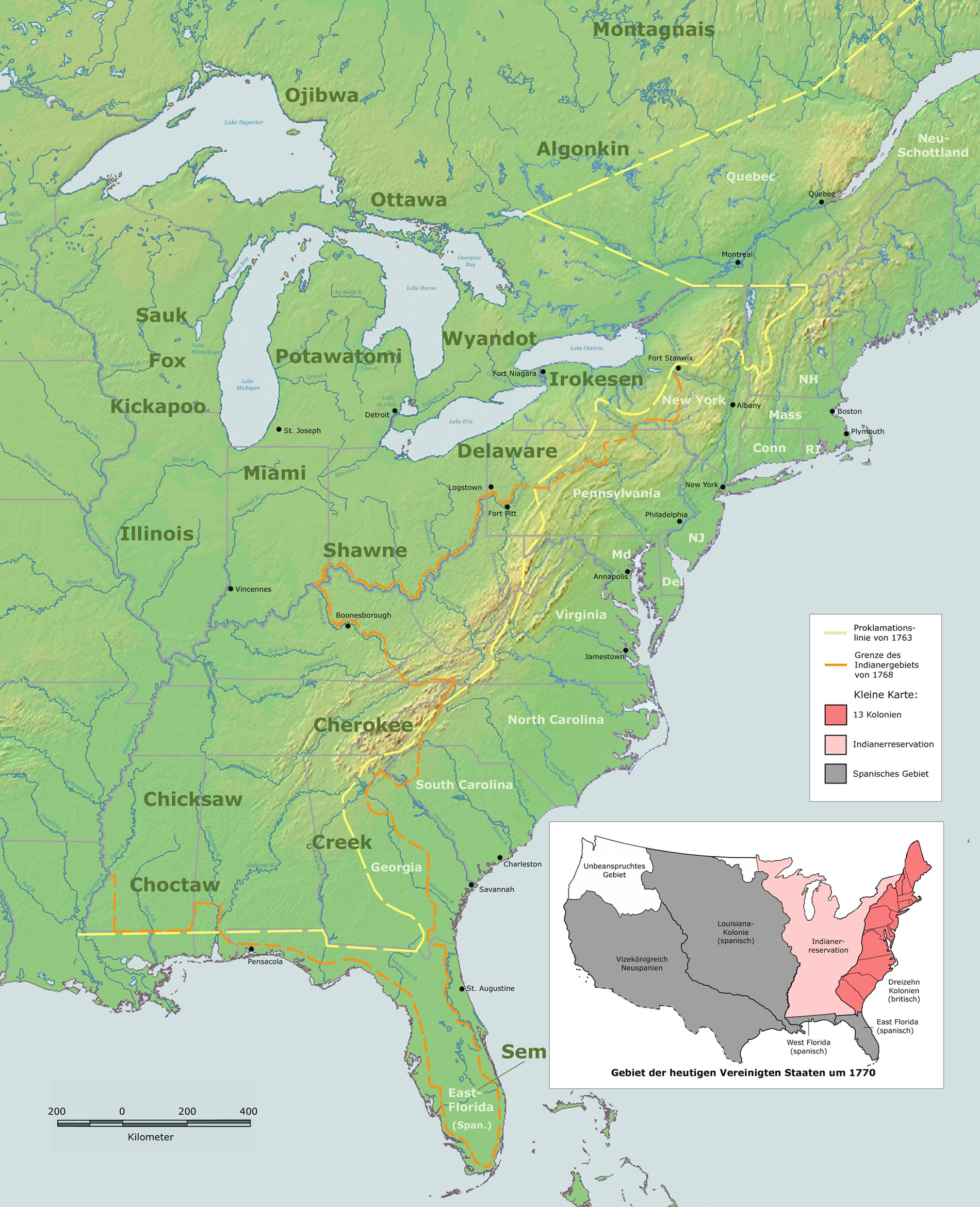
Given the dates of this letter, and the followup research on the locations, this had to be the survey of the Proclamation line of 1763.
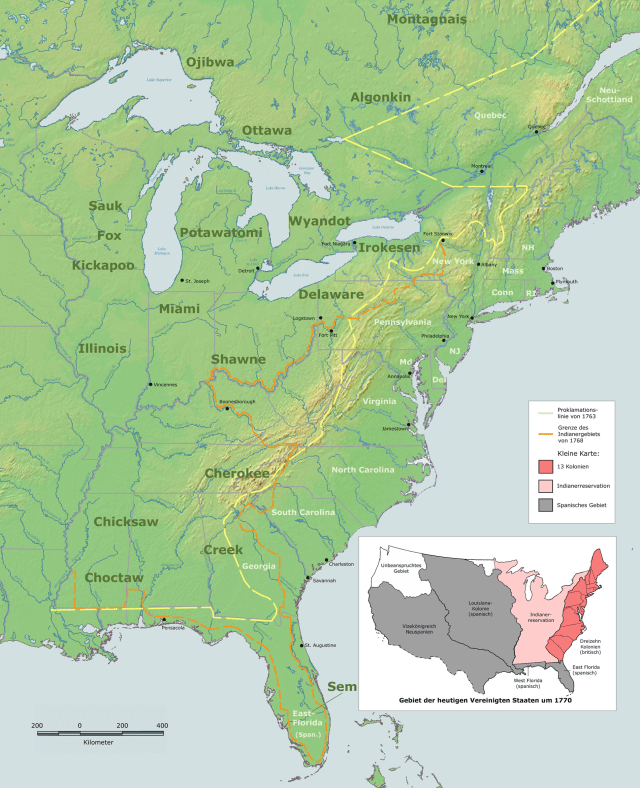
Proclamation 1763 map

Letter from Alexander Cameron to [John Stuart]

Cameron, Alexander

May 10, 1766

Volume 07, Pages 207-213


[B. P. R. O. A. & W. I. Vol. 269.]
Fort Prince George 10th May 1766.

Sir,

Agreeable to your Instructions to me, I set out the 21st ultimo, to see the Cherokee boundary line surveyed, I was accompanied by the Prince of Chote, Jud’s Friend, Tiptoe Emy and the Wolf, with thirty young men, and we arrived at Dewis’s Corner on the 24th following.

Mr Wilkinson was appointed Commissioner by the Governor and Council, to see the line run, and Mrf Pickens, the Surveyor, attended us. We began the line at Dewis’s Corner and proceeded southwest 50 miles to Savannah River, the Indians blazed the Trees as we went, and made the Boundary very clear and strong as they term it.

I could not learn that we took in any land, that had been surveyed by any white man before, but there is one Atkins, settled

——————– page 208 ——————–

within four miles of the Line, near to Savannah. The distance from Dewis’s Corner to the River (as near as we could make it) is 27 miles; The course of the Line, from Dewis’s Corner to Reedy River where the Line terminates, is N. E. 50 miles[?] and the distance 18 miles. About Saludy there are several houses within four miles of the Line, and one House within one mile of it.

On the North Carolina side of Reedy River there are three or four families settled: and even if the Indian boundary be run a north course, these settlements will fall five or six miles above it.

One William Turner on Saludy, below Ninety six, has settled a Cowpen and Plantation on the above Indian Lands, altho’ he very well knew, that, Mr Wilkinson by Governor Bull’s order, removed a settlement off the same tract of Land last year. I have sent a warning to remove without loss of time, otherwise I should take upon me to drive them off, & distribute part of their cattle among the Indians as a Tax belonging to them, &c.

The Cherokees propose running the line from where it terminated a straight course, to Colonel Chiswell’s Mines, which I believe will be north, as nigh as I could make it; They say, that it must be very evident, that as they have given all their claims of Lands in Virginia, below Chiswell’s Mines, and in South Carolina, below Dewis’s Corner, that a straight line, from Reedy River to the Mines, must consequently cut off a great deal of their land in North Carolina; that part of their Hunting Ground lies 40 miles eastward of where they now nominate their boundary; but they do not love disputing with the White People concerning a trifle, therefore they made them a present of it.

It would be very necessary that a Surveyor should first sight the Line, from Reedy River a north course, in order to know where it will terminate in Virginia, and whether or not, it will take away any of the settlements.

Your Express, George Redd, arrived at Dewis’s Corner the 6th inst. as we returned from marking the Line; I read to the Indians what part of your Dispatches concerned them, for which they return you their thanks; they likewise return you thanks, for your trouble and assiduity, in having their Boundary Line fixed, as they are very sensible, it is of great importance to them, they were however chagrined, that Governor Bull had sent no presents, for the Lands they ceded to the Province of South Carolina; and more especially, as they were a poor People, & prevented from Hunting, by the numerous

——————– page 209 ——————–

parties of their enemies, that lurk continually about them. Inclosed you have a Talk from the head beloved Man Kittagusta dictated to him, by many men & warriors of his Nation. I inclose you likewise, an instrument, certifying their being present, as well as myself, at the surveying of the division Line of South Carolina as already mentioned.

I have distributed most part of the Ammunition among the Indians, for their Defence, as well as the greatest part of the other presents you have sent them.

I would be glad that you would renew the Indian Commissions which I conveyed to you, and send them, with the Medals, by the first opportunity, as they are at present much wanted to be given, as a memorial of our Friendship toward the Cherokees which the Creeks endeavour to depreciate, as much as possible. One dozen Medals is the least that is necessary for them, and if you think proper to be distributed as follows, to Ononnastotah, Kittagusta, Attacullahcedlah, Willnianwah, Otassatch, of the Overhills; Moitoy, of the Valley; the Mankiller of Miccassie who now lives in little Ohoteh, to the southward of the Valley, Tiptoe, Emy, Saludy and the Wolf lower Towns, and Tugooloo.

In my letter of the 2nd of April, I informed you that Emy, or the old warrior of Estatoe, was ready to set out to war against the Norwards, with a party of Cherokees and twenty Creeks; upon their march on the frontier of North Carolina, they met two white Beaver Hunters, and it was with great difficulty Emy prevented the Creeks from Hatcheting them; but after a strong and long talk from him to the Creek Head Man (the Buck) he prevailed upon them to return the white men their Guns, which they had taken from them; Emy told them that he would proceed no further with them, as they determined to bring him into a scrape: and that he could not be present at shedding the blood of any of his Brothers the English; he instantly returned home and the Creeks followed.

Mr Price and I shook hands with and thanked Emy, at a Public Meeting for his behaviour, and made him small presents; I however explained to him that he did no more than his duty, for his own Interest, and the good of all his Nation.

Tiptoe had pretty good success in his expedition: he routed the enemy in two different engagements, he brought home 3 scalps, skulls and all, in the first skirmish, the Seed of Settico was wounded, of which he died in six nights after; Tiptoe relates that when he

——————– page 210 ——————–

received his wounds, he told them he should die in six nights and desired they would not think it troublesome to carry him so long. On their arrival in Camp, after the sixth days march, the Seed told them he was now going to die, that he was a man and warrior, that he did not die like a woman, in bed, that he died in war, but, said he, you must not bury me under the ground, to be smothered, tye me up with vines to a pretty high tree, where the enemy cannot find my scalp, but I can see them when they are going to war against you, and if I can do no more, I shall bring you intelligence thereof; One more of the party was killed & three wounded, one of which died since.

The Cherokees were surprised in Camp, and most of them ran away; but upon Tiptoe’s animating them by a strong and bold speech, throwing off all his cloaths, & Killing the Head Warrior on the first onset his party rallied and beat off the enemy.

Mr Taylor writes me from over the Hills that the rogue Mankiller, and his Brother Trennilitah are employed as Ambassadors between the Mortar of the Creeks, and Onomastotah; and that the Mortar engages to reinforce the Cherokees with 700 on one days warning, provided they will go to Virginia and fall on the back settlements &c.

The following is an extract of a letter from Mr Alexander Boyd of Virginia, to me, dated Tenassie 2d April 1766.

“The Great Warrior & Attacullabiculla, want to see the Great King, and seem extremely desirous to embark from Virginia, and were they to solicit our Governor and Council for leave (as they seem inclined to do) they would undoubtedly obtain it, adding their Agents and your concurrence thereto; for there are none of the murderers, that killed a party of their People, yet apprehended, neither can they without imminent danger, for the whole body of Crackers, to a man, have unanimously declared, publickly, that they will espouse their cause at the expense of their lives, so that Proclamations and great rewards answer no purpose. And should these head men be allowed to take a voyage, the expence of conducting them to, and from England, would not exceed the premiums offered for bringing the other villains to justice. Our Colony is now about building and fixing a large store at the great Island on Houlston, for carrying on an extensive Trade and supplying them on the most reasonable terms possible; and at their request to our Governor and Council, they design to make overtures of peace, to the northern Tribes, in their behalf; which, if they can effect, great influence

——————– page 211 ——————–

will be used with those living on the Ohio, to bring their commodities also to this grand Magazine, and be supplied with clothing &c. All this is possible but I fear their views are too sanguine.

“I have been interrogated by several of the Warriors, why the Governor and his beloved men, did not catch the rogues, and hang them that killed their People; and indeed of late, rumours prevailed here of some of the disaffected having been busy sowing bad talks among them, and they are threatening revenge for their losses; therefore, your presence here is much wished for.”

We had accounts some time ago that Mr Boyd was killed, going into Virginia, but I am glad to understand that our information was groundless.

Numerous are the fearful & dreadful stories, the Traders report of the Cherokees, and the continual attempts of the Creeks upon them, to alienate their minds from us, and sow the seed of contention among us, if possible, but I am not afraid of settling everything in its proper channel, & making all straight.

I must observe to you, that should the great Warrior and Attacullahculla be allowed to go to England from Virginia, and pay his passage backward and forward, it would never be a sufficient acknowledgement to the relations of the Indians that had been murdered, but if the perpetrators of the murder cannot by any means be brought to justice, then they must send large presents for the Relations of the murdered and endeavour to make up matters that way; I am informed the whole Body of them intend to pay me a visit on my arrival as I had been all along promising them satisfaction, I am upon my word affraid of them, but I hope to be able to waive the affair still longer.

I think Sir, it lies with you, to send home the great Warrior, and little Carpenter, as it would be of the greatest service to the Public, I do not in the least doubt but they will be sent home from Virginia, (unless you will suppress them) as I am convinced the Carpenter will leave no stone unturned to effect it.

In an engagement between the Northwards and the Hunting Party of Cherokees down the Tenassie, four of the former were killed, and three of the latter, and several wounded on both sides; the Cherokees threw themselves into a Block House (made by the Carpenter last Winter for his own defence) which prevented their being mostly cut off, as the enemy were much superior in number.

——————– page 212 ——————–

A few days after, a Norward Indian came close to the Island Town and snapt his gun three times at a Cherokee Indian that was cutting of wood, the former ran up to the Cherokee with his Tomahawk and made a stroke at him which the latter partly parried, they grasped each other but the Norward oversett his antagonist, upon which the Cherokee called out, and a wench, that was nigh to them, ran to her friend’s assistance oversett the Norward in his turn, tied him neck and heels and brought him in. His trial soon came on and Attacullahculla who was Chief Justice, ordered him to be burnt after cutting off some of his Members, which orders were soon executed, the fellow behaved with great undauntedness, and smiled at his torture.

On the 21st ult. Old Welsh, daughter (whom Mr Wilkinson keeps) & grand child were going to. Tugooloo, and were met by six Norward Indians; Welsh had his grandchild in his arms, and his daughter coming behind he shook hands with the Indians, & asked what Country, but he finding them seizing of him, and making up to his daughter, knew they were enemy, and called to her to make her escape: upon which, she turned her horse about and gave him the whip, the enemy flung two spears at her, and wounded her in the side, and arm; Welch, and Wilkinson’s child, were both killed, and their brains knocked out with a war club, which was left by them with shame signs upon it; No Trader will venture into this Nation, if the enemy are permitted to kill white People, as well as red.

Mr Wilkinson notwithstanding his good economy, expended to the amount of £600 currency in making small presents to the Indians, and supplying them with provision, altho’ I bore a part of the expence, I am however well convinced, that no man in the Province of South Carolina, could have done it at so little expence.

The Traders with one voice join and request, that you would apply to Sir William Johnson in order to suppress the insolence of the Norward Indians, contrary to the last treaty of Peace; the consequence of that breach of theirs will be, that the Cherokees will follow their example, & knock up as many of their Traders as they can, which they already begin to insinuate.

His Highness the Prince shakes hands with you, and begs that you’ll send up an Union Flag to be displayed on particular occasions, in the head beloved Town of Chotch Ottassatch as Jud’s Friend, holds you fast also, and desires, that you would give a strong talk, to Henry Young at the Forks of Edisto, concerning three Negroes of his, who were taken in the time of war by some of the

——————– page 213 ——————–

Cherokees, who were going with them to the French in order to sell them; when Jud’s Friend spoke, and said, that altho’ they were at war with the English at present, they would have a peace with them by and by and that he would not suffer the Negroes to be sold to the French, that he himself would purchase them, and give him 3001bs of leather for them; they were afterwards sent down here, and the Jud left it to his own generosity what to give, but he never had a farthings worth, a couple of cows would satisfy them.

I am Sir &c

ALEXr CAMERON.

http://docsouth.unc.edu/csr/index.html/document/csr07-0108

Note that Chiswell’s Mines, mentioned in the document above, are located today near Shot Tower State Park in Virginia, shown below.
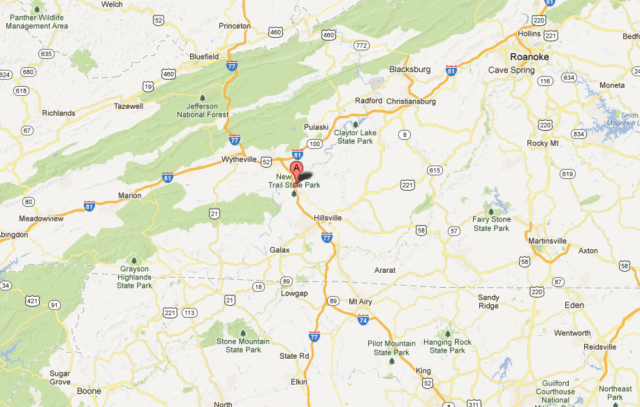
chiswell's mines

Posted in Cherokee, Creek, Maps | Leave a comment

Broken Tennessee Treaties

One of our subscribers, Don, spotted this great site provided by the Tennessee State Museum.  Thanks Don.

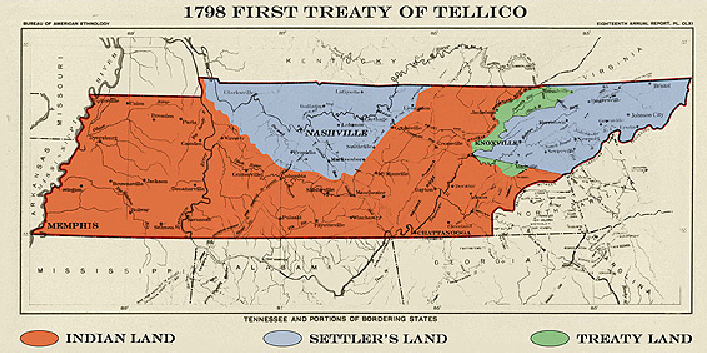
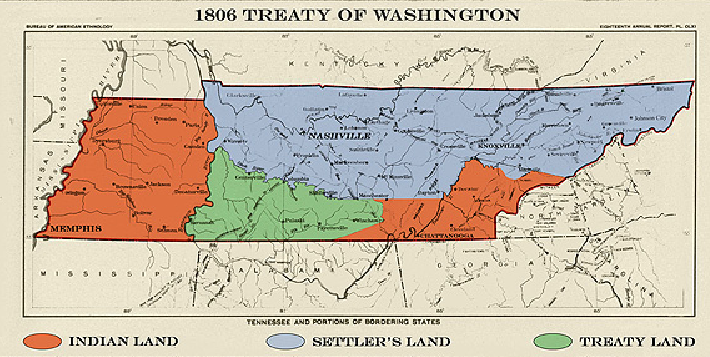
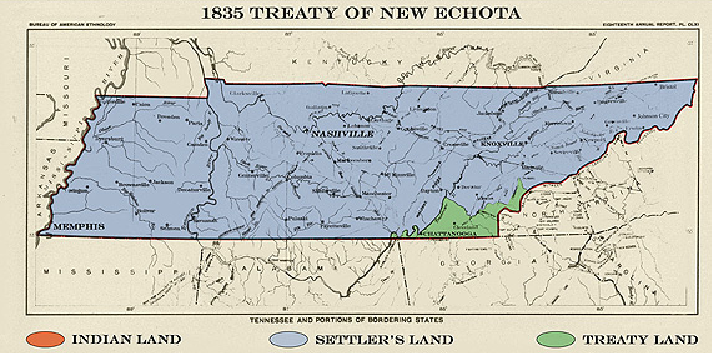
On the site itself, there is additional information, but what struck me was the visual representation of what happened to the Indian lands in Tennessee in the short time between 1770 and 1835 when the Indians were forcibly removed on the Trail of Tears.  That is only a total of 65 years from complete ownership to forced removal via 12 broken treaties.

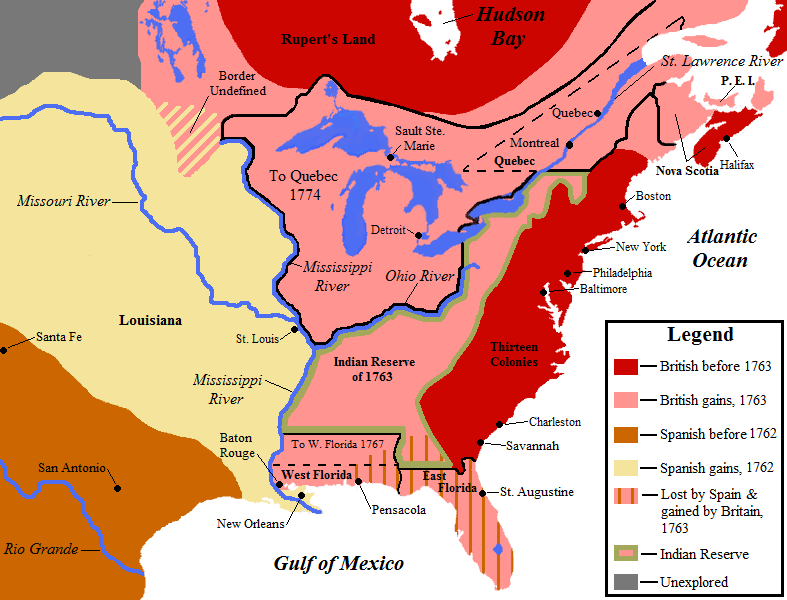
The first treaty actually preceeded 1770 by 7 years. The Proclamation of 1763 reserved all of Tennessee for the Indians, as shown below.

1763 map

The slippery slope of land cession began in Tennessee in 1770 when the Proclamation of 1763 was broken.

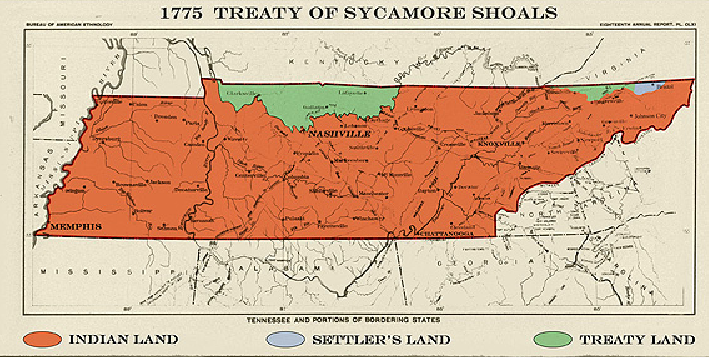
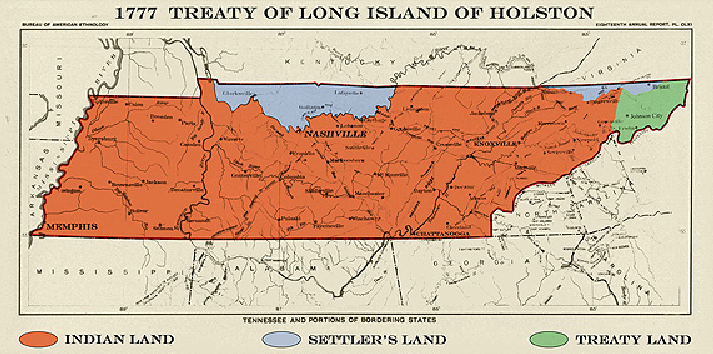
So, without further words, just look for yourself.  Land owned by the Indians is orange, land owned by the settlers is blue and land being ceded in this treaty by the Indians to the settlers is green.

1770                Treaty of Lochabar

Broken 1

1775                Treaty of Sycamore Shoals

broken 2

1777                Treaty of Long Island of Holston

broken 3

1785                Treaty of New Hopewell

broken 4

1791                Treaty of Holston

broken 5

1798                First Treaty of Tellico

broken 6

1805                Third Treaty of Tellico & Chickasaw Cession

broken 7

1806                Treaty of Washington

broken 8

1817                Jackson and McMinn Treaty

broken 9

1818                Jackson Purchase

broken 10

1819                Calhoun Treaty

broken 11

1835                Treaty of New Echota

broken 12

http://www.tn4me.org/minor_cat.cfm/era_id/2/major_id/7/minor_id/15

Thank you to the Tennessee State Museum for creating the maps and allowing noncommercial, educational use.

Posted in Cherokee, Maps, Tennessee, Treaty | 10 Comments

Memoirs of Henry Timberlake – Cherokee Emissary

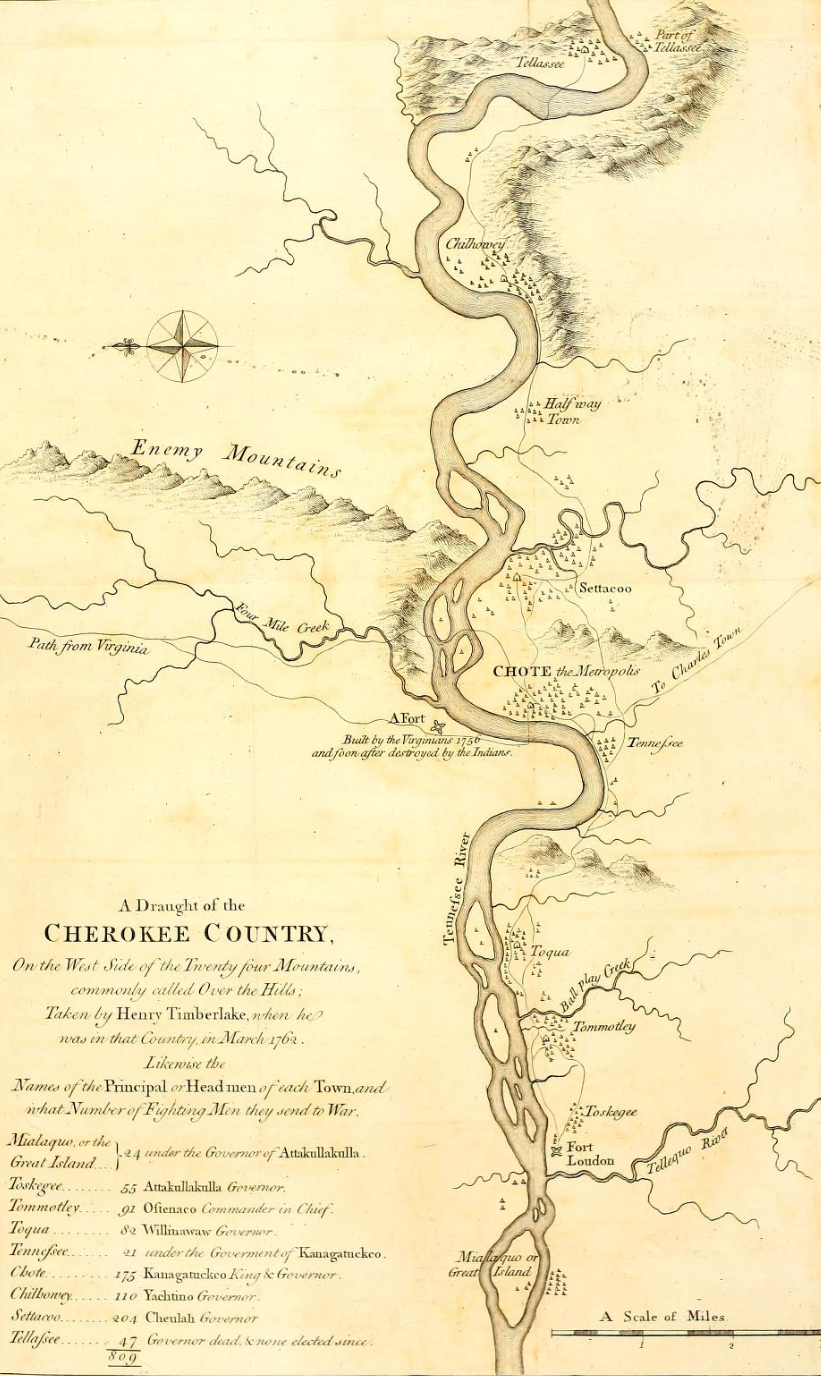
Timberlake map from bookI love digitization projects.  They bring history, especially long out-of-print documents to all of us.  The Memoirs of Henry Timberlake is one of these documents and it’s downloadable through the Internet Archive.

Henry Timberlake (1730 – September 30, 1765) was a colonial Anglo-American officer, journalist, and cartographer. He was born in Virginia in 1730 and died in England. He is best known for his work as an emissary to the Overhill Cherokee during the 1760s.

http://en.wikipedia.org/wiki/Henry_Timberlake

Timberlake’s account of his journeys to the Cherokee, published as his memoirs in 1765, became a primary source for later studies of their eighteenth-century culture. His detailed descriptions of Cherokee villages, townhouses, weapons, and tools have helped historians and anthropologists identify Cherokee structures and cultural objects uncovered at modern archaeological excavation sites throughout the southern Appalachian region.

During the Tellico Archaeological Project, which included a series of salvage excavations conducted in the Little Tennessee River basin in the 1970s, archaeologists used Timberlake’s “Draught of the Cherokee Country” to help locate major Overhill village sites.

The University of Pittsburg digitized this book, described thus:

The memoirs of Lieut. Henry Timberlake : (who accompanied the three Cherokee Indians to England in the year 1762) ; containing whatever he observed remarkable, or worthy of public notice, during his travels to and from that nation ; wherein the country, government, genius, and customs of the inhabitants, are authentically described ; also the principal occurrences during their residence in London ; illustrated with an accurate map of their Over-hill settlement, and a curious secret journal, taken by the Indians out of the pocket of a Frenchman they had killed (1765).

They note that the map is missing, but it isn’t. It’s actually in the first images, and above.  The Frenchman’s Secret Journal is missing, however.  Interesting how the words “secret journal” make you want to see it in the worst of ways:)

So here you go….download and enjoy.

http://archive.org/details/memoirsoflieuthe00intimb

Hat tip to Min for finding this document.

Posted in Cherokee | Leave a comment