First Footprints: Episode 3: The Great Flood 18,000 to 5,000 Years Ago

Aboriginal people have lived in Australia for over 50,000 years, and none of that time has been easy.

aboriginal carving

These people survived the longest drought in human history.  Next, with warming, they would face flooding, worse flooding than they could imagine.  The sea raised 130m and covered one fourth of the Australian continent.  100k of land was lost every generation, for 11,000 years, from 18,000 years ago until 6,700 years ago when the rising sea finally stopped.

The Great Flood is remembered in the aboriginal stories.  Stories from 18,000 years ago, handed down generation by generation  to the present in Dreaming Stories.  Some stories are sacred and cannot be told, but the stories of the Great Flood were shared by the aboriginal people in this documentary.

kangaroo rock

Above, a kangaroo rock carvings from 12,000 years ago.  The rock carvings changed 7,000 years ago and began to include fish, turtles and sea animals and kangaroos were no longer carved.  The Aboriginal people had become sea people as their plains became coastline.

Enjoy part 3 of this wonderful documentary.

Posted in Aboriginal, Australia | Leave a comment

Papagoes Indians of Arizona

Papagoes

In 1871, a document titled “Resources of Arizona Territory with a Description of the Indian Tribes; Ancient Ruins, Cochise, Apache Chief; Antonio, Pima Chief; Stage and Wagon Roads; Trade and Commerce, Etc.” was published by the authority of the Legislature.  In a section titled “Indians of Arizona,” it tells us the following:

The Papagoes Indians occupy a section of country about 70 miles south of the Pima reservation, near the Sonora line, and in fact their settlements extend some distance into Sonora.

They speak the same language as the Pimas but have mostly embraced the Catholic religion, and are much further advanced in civilization.

They live by cultivating the soil and raising stock.  They are peaceable, well-disposed and have never asked for or received but little assistance from the government.  They are at peace with all the world except the Apaches, but toward them their hate is intense.  They are docile and kind in their intercourse with the people.  Many of them are employed by farmers and stock raisers and are considered excellent laborers.

Their women are virtuous and industrious.  The men, like most Indians, engage in polygamy and sometimes drink too much liquor.

Note:  Today the Papago are known as the Tohono O’odham.  The photo shows traditional basketmaking in 1916.

Posted in Papagoes, Tohono O’odham | Leave a comment

First Footprints: The Great Drought 30,000 to 15,000 Years Ago

lion marsupial

FIRST FOOTPRINTS: Episode 02 “The Great Drought 30,000 to 15,000 years ago”

In part 2 of this series, we start with Australian cave drawings of the marsupial lion – a huge predator supposedly extinct for more than 40,000 years, shown above, and we end with glaciers, drought and flooding.

In between we visit Aboriginal people who were born before contact with whites and they share with us their religious rituals which are part of what enabled survival for tens of thousands of years in conditions so difficult that no one should have been able to survive at all.

This is a wonderful series.

Posted in Anthropology, Australia | Leave a comment

Fort San Juan – Joara – Xuala- The Berry Site

xuala

All of these are names for the same place, the primary fort built by Juan Pardo during his 1566-1567 foray into heartland America, near present day Morgantown, NC, in Burke County.  But in case you thought he was the first, he wasn’t.  Spanish conquistador Hernando De Soto beat him by more than 20 years.  He visited this area in 1540, almost 70 years before the English settlement at Jamestown and 47 years before sir Walter Raleigh’s “Lost Colony” at Roanoke Island.

The map above shows the Joara site, spelled Xuala, from a 1584 Spanish map of La Florida.  The map below shows DeSoto’s believed route.

de soto map

The site, known at the Berry Site, has been being excavated in the summers now for several years, beginning in 2000.  Recently , the New York Times published an update on this year’s dig.  In July of 2013, archaeologists announced that they have found the actual Spanish fort itself, shown below.  Be sure to watch the video in the article.

joara fort excavation

Archaeological finds from excavations have established evidence of both substantial Mississippian and sustained Spanish 16th-century settlement at the Berry site.

Established about AD 1000, Joara was the largest Mississippian culture settlement within the current boundaries of North Carolina.  In 1540, Spanish conquistador Hernando De Soto encountered the people at this chiefdom site.  It was still thriving in January 1567 when the Spanish soldiers under Captain Juan Pardo arrived.  Pardo established a base there for the winter, called the settlement Cuenca, and built Fort San Juan. After 18 months, the natives killed the soldiers at the fort and burned the structures down. That same year, 1568, the natives destroyed all six forts in the southeast interior and killed all but one of the 120 men Pardo had stationed in them. As a result, the Spanish ended their colonizing effort in the southeastern interior and the Native people apparently abandoned this site.

The Warren Wilson College site has a wonderful page on the dig, pictures of several artifacts and maps of Pardo’s expedition.

This Science Daily article shows a photo with the moat and other features overlaid over the excavation shown in the photo above.

Hat tip to Doug for the NY Times article and to Joy for the Science Daily article.

Posted in Archaeology, Berry Site, Joara | 3 Comments

Yuma and Mohave Indians of Arizona

Yumas

Painting above: Yumas. In: “United States and Mexican Boundary Survey. Report of William H. Emory…” Washington. 1857. Volume I.

In 1871, a document titled “Resources of Arizona Territory with a Description of the Indian Tribes; Ancient Ruins, Cochise, Apache Chief; Antonio, Pima Chief; Stage and Wagon Roads; Trade and Commerce, Etc.” was published by the authority of the Legislature.  In a section titled “Indians of Arizona,” it tells us the following:

The Yumas and Mohaves live along the Colorado River, are and have been for some time at peace with the whites and have received the largest portion of the appropriation made annually for the benefit of the friendly Indians of this Territory.  They have received just enough assistance from the government to cause them to believe that they can live without work, but too little to keep off the gnawings of hunger.  The results is that they are reduced to the lowest stages of degradation.  Licentiousness and disease are doing their work, and soon these Indians will pass away from the face of the earth.

Charley - Mojave

Charley-Arri-Wa-Wa (Mohave), 1872

Note:  Today the Yuma are known as the Quechan people.

Posted in Mohave, Yuma | 3 Comments

Pima and Maricopa Indians of Arizona

Pima

In 1871, a document titled “Resources of Arizona Territory with a Description of the Indian Tribes; Ancient Ruins, Cochise, Apache Chief; Antonio, Pima Chief; Stage and Wagon Roads; Trade and Commerce, Etc.” was published by the authority of the Legislature.

In a section called “Indians of Arizona,” it says:

The Pima and Maricopa Indians occupy a reservation on the Gila River about 200 miles east of Arizona City, and number about 4000.  They have occupied this locality as far back as we have any written knowledge of them.  Many years ago, they cultivated fields, also in other localities, though not far distant from the reservation, but the continued raids made upon them by the Apaches compelled them for self-protection to draw their settlements close together.

They live in round huts, made by placing poles 10 to 12 feel long in a circle of 10 and 12 feet in diameter at the bottom and pointed together at the top.  These poles are then covered with hay and earth, only a small opening is left for a door.

Their principal occupation is agriculture and stock raising.  Although their mode of agriculture is rude, still they raise all the vegetables, wheat, barley and corn necessary for use, and sell annually about 2 million pounds of wheat.

They are at peace with the whites and all Indian tribes except the Apaches, which whom an uncompromising feud exists.  In their warfare no quarter is asked or given so far as the male adults are concerned.  The women and children are generally made captives.  The Apache captives are treated as well as their own people, and very soon become so attached to their captors that they cannot be induced to again live with their own people.

In religion, they believe in a Great Spirit, and future rewards and punishments, but, like all other people, worship a deity and imagine a place of rewards and punishments peculiarly suited to their intellects and condition in life.

They are very superstitious and believe in witches; often make great sacrifices of property to find and destroy the evil one that is generally in the form of a stick of stone.  They work with great energy and excitement until the mischievous object is found and destroyed.  They then return to their legitimate labors with a sense of feelings that a great calamity has been averted.  Sometimes they imagine that one of their people is bewitched and in such cases his or her life pay the forfeit.

At the death of the head of a family, all personal property is either eaten, burned or destroyed.  If the deceased had been in good circumstances and had horses and cattle, then all the tribe is invited to the feast which lasts until his stock is eaten up.  The balance of his earthly goods are placed in a pile and burned.  The property destroyed and eaten is supposed to be placed in the unknown world for the benefit of the deceased.

They are simple minded, and have but little knowledge of the world beyond what they have seen. A few years ago their head chief, Antonio, was induced to visit Washington and our great eastern cities.  He was much beloved and confided in the tribe and the many months he was absent left a void in their midst.   Sometimes unpleasant rumors were put in circulation that he was dead, and when the time approached that he was soon expected, the days and hours were counted with anxious solicitude.  Finally, the glad news came that Antonio was coming, and but a few miles away, and large numbers hurried forth to welcome him home again, and there was joy throughout the tribe.

After the excitement of meeting was over, the tribe gathered round to listen to his recital of the wonders he had seen.  He told them of the immense oceans and rivers; of untold thousands of ships sailing for months between given points at rapid speed; of the iron horse fed on wood and water; of the immense loads he drew; and how he fairly flew over mountains and valleys and never tired; of curious machines by which men instantly talked together though thousands of miles apart; of the immense towns and cities he had passed through, and of the countless thousands of men under arms (it was during our Rebellion) he had seen at one time.

They listened in silence, until he had finished and then waited for him to tell them that he was merely relating a fancy story – the creation of his own imagination; but Antonio remained serious, and when given an opportunity to regain his reputation for veracity, he firmly declared and insisted that every word he had said was true.

Then the truth began to flash upon the Pima mind that by long contract with the whites, the tongue of their beloved chief had become forked and he was no longer to be believed.  It was a sad day to the poor Pimas, and an unfortunate day for Antonio.  He is still their chief, but has never regained their entire confidence, though he studiously avoids relating any more of the marvelous things he saw during his travels.

Their disputes are generally settled by arbitration or a council of judges; and although they are not supposed to be governed or influenced by the common law of England or the decisions of eminent jurists, still in a decision made recently by one of these tribunals it will be observed that if the decision was not in accordance without enlightened practice, the reasoning was good.

It seems that a man and his wife, having but one child, disagreed to separate, and the terms were all amicably arranged, except as to who should have the child.  The wife plead that the tender youth needed a mother’s fostering care – that the tendrils of affection clung more closely to a mother’s heart; but the husband insisted that it required his strong will to launch the frail bark properly on the stormy sea of life.  The difference of opinion was finally decided to be irreconcilable and it was brought before the council of judges.  Both sides plead their case with all the ardor of parental love, and each showed strong claims for the custody of the child.  The judges having no precedents to govern them, and being only desirous of doing right, were sorely perplexed and hesitated in their own mind which side of the scales had the most weight.  Finally an old, gray-headed, patriarchal looking fellow arose and said that it was certain fact and admitted by all that the women was the mother of this child but there was no positive evidence showing that the man was his father and under these circumstances he felt constrained to give the child to the mother.  This decided the case, and the mother was awarded the child.

Their morals are not good; like all Indian tribes that come in contact with the whites, they adopt all of our vices and few of our virtues.  Rev. Mr. Cook has established a school among them and seems much encouraged in the progress he has made during the brief period he has been there.  If an earnest Christian desire to elevate and educate them will avail anything, then we will succeed.

The Maricopas occupy the lower portion of the Pima reservation and in habits are similar in every respect to the Pimas.  They are friendly with the whites and at war with the Apaches.  They formerly were part of the Yuma tribe, but many years ago a feud sprang up among them, and they were driven from the Colorado river and obliged to seek a new home.  The Pimas offered them a part of their reservation and it was accepted.

You can see additional photos of the Pima Indians here.

Posted in Maricopa, Pima, Yuma | 2 Comments

Baptiste Bahylle, Pawnee Chief

The ancestral homeland of the Pawnee is Kansas and Nebraska on the Platte River and the Republican Fork of the Kansas River.  However, one branch of the Pawnee, the Skidis, removed to Indian Territory in 1875.  Their chief was Baptiste Bahylle.

Baptiste is listed as one of the chiefs who visited the Carlisle Indian School in Pennsylvania.

In 1884, in testimony taken by the Committee on Indian Affairs of the Senate, Baptiste is stated to be half Mexican and half Pawnee and there are allegations that he is working with cattle companies, along with Nelson Rice who claimed to be a full-blood, who were trying to take possession of the traditional Pawnee lands.  Baptiste accepted 160 acres of land in settlement for his Indian land claim, sold the land and then “stole back to the tribe  and has been receiving full rations and annuity and official pay ever since, and as interpreter for most of the time.”  It also mentions that he went by the name of Bat.

Born about 1830, it appears that Baptiste spent most of his youth in Mexico, according to family genealogical records and oral history.  Baptiste apparently married twice, first to a white woman and second to a Pawnee who was also part Spanish.  Baptiste died on October 25, 1897.

The Echo-Hawk family who descends from Baptiste has put together a wonderful document about the Pawnee removal to Oklahoma.  Included are many first hand accounts of the removal the encampment there and their life afterwards.

One thing I found interesting is this excerpt about the adoption of names from an interview with Nora Pratt in 1982.

“My mother was Lucy Tilden, and she was 107 years old when she passed away in 1965. Everyone knew her as “Grandma Tilden.” She was Skidi, and she and my brother were members of Pahukstatu Clan, Pumpkin Vine. My father, Ezra Tilden, put me and my half-sister into his clan, Tuhwahukasa, Camping On a Hill Clan. My father was also part Kitkahahki and Pitahawirata, and we used to have a lot of visitors from down south.
I call my mother’s family the Washingtons, even though there were a number of names among the different family members and they all had Indian names in Nebraska. Several families were related together. The Lone Chiefs, for instance, are connected to us. A lot of us are related.

I call my grandmother, “Grandma Washington”; she had a mud lodge right up here on the hill. After she passed away, my mother stayed with Lizzie Washington, her aunt. I remember my mother and some of the others used to always talk about a George Washington. One family member might have been named that – but whether he was one of the uncles or my grandmother’s husband, I don’t know. But they used to always talk about a George Washington. That’s who my mother and the others got their name from.”

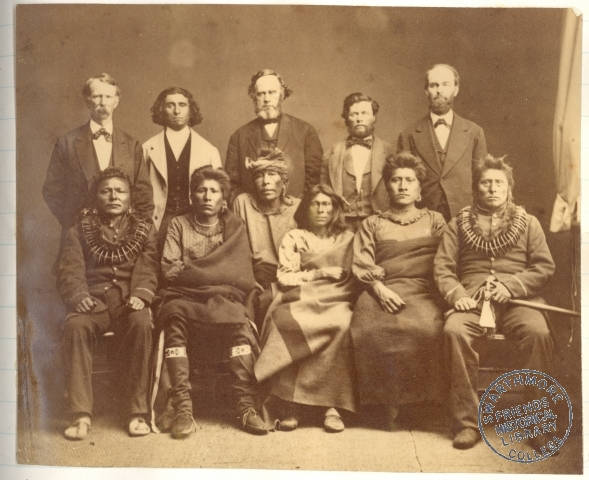
These photos show Baptiste Bahylle at various points in his life.

bayhlle 1

Standing: Baptiste Bayhylle (aka The Heavens See Him As A Chief, Pawnee/French interpreter)
Sitting L-R: Man Who Left His Enemy Lying In The Water, His Chiefly Night (aka Night Chief), One Who Strikes The Chiefs First, Sky Chief – Pawnee – 1868

From: http://amertribes.proboards.com/thread/404

Another photo can be found here.

Bayhlle 2

from left to right, top row:
Champion S. Centennial Mayor of Omaha Counsel for prisoners
Baptiste Bayhylle, US indian interpreter for Pawnees
Barclay White, Supt. Indian Affairs Artipit
Henry M. Allis, White interpreter, born 1839, first White Man born in Nebraska
Jacob M Troth, US Indian Agent for Pawnees
bottom row:
Strikes Chief Tie-ta-cha-cod-ie
Horse Driver Te-ca-rix-ta-pah-ra
Yellow Sun Tah-co-re-cah
Little Wolf Sket-de-kitty butck
Blue Hawk Go-tow-we-couts-la-re-use
Sky Chief Telah-wah-la-sha-ro

Photograph probably taken in 1871 of a group of Pawnee prisoners that were accused of the murder of a white man, McMurtie, along with their chiefs, interpreters, legal counsel, and Quaker indian agents.

From:  http://amertribes.proboards.com/thread/260/sky-chief?page=1&scrollTo=1287

bayhlle 3

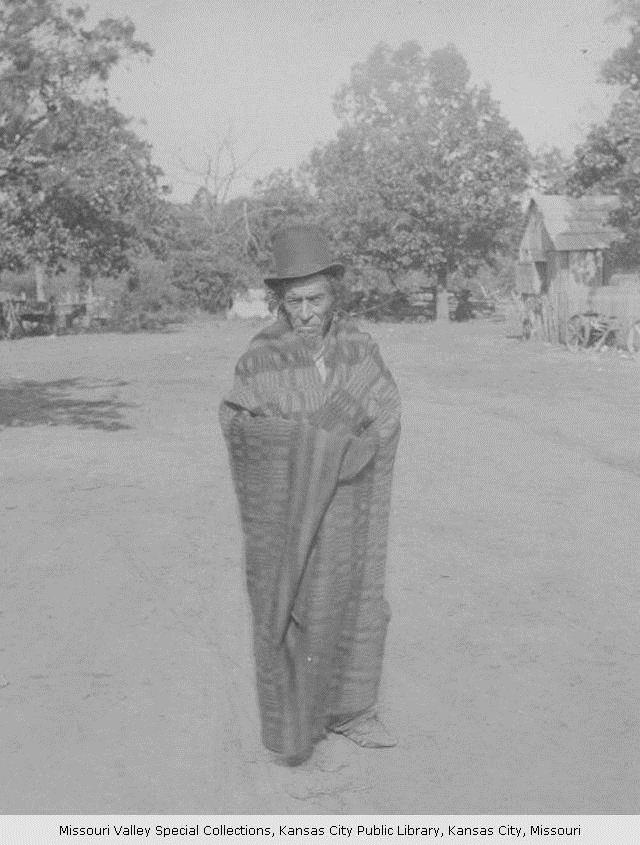
Baptiste “at about 100 years of age” in 1885.

From:  http://www.kchistory.org/cdm4/item_viewer.php?CISOROOT=/Native&CISOPTR=31

Additonal stories have been recorded on Roger Echo-Hawk’s website, Pawnee Tales.  Enjoy!

Some of the chiefs who visited the Carlisle School were invisible, with no historical information found about them.  Baptiste Bahylle was anything but invisible.  He was colorful and lived during a transitional period in American and Native history.

Posted in Pawnee | Leave a comment

First Footprints – Super Nomads – Founders of Australia

This is the first of 4 episodes airing in Australia about their aboriginal people.  I found this fascinating and am somewhat envious of someone who can stand in the same rock shelter their ancestor stood in 40,000 years ago – and know positively that it was their ancestors who were in that same rock shelter.  Some of these structures, painting and stories are nothing short of amazing.  Enjoy.

Posted in Aboriginal, Australia | Leave a comment

Antonio, Apache and/or Pima Chief

In the Carlisle School records in Pennsylvania, the Apache Chief, Antonio is listed as having visited the school.  School records don’t say when this happened.

The Apache was one of the last tribes to be subdued.  They maintained Native ways long after most of the more Eastern tribes had resigned themselves to the inevitable.  This also meant that the Apache and other southwest tribes were much less familiar with white men’s ways and certainly unfamiliar with their cities.

In 1871, a document titled “Resources of Arizona Territory with a Description of the Indian Tribes; Ancient Ruins, Cochise, Apache Chief; Antonio, Pima Chief; Stage and Wagon Roads; Trade and Commerce, Etc.” was published by the authority of the Legislature.

Most of what little is available about Antonio is found within this and the following document.  However, in both documents, the Antonio recorded as an Indian chief is Pima, not Apache.  I wonder if this Antonio, or his son, is indeed the same man as visited the Carlisle School.  To people in Pennsylvania, there would be little difference between the Pima and Apache, and the word Apache was much better known than Pima.  If the Pima Chief, Antonio, is not the same man as the Apache Chief, Antonio, then I can find no existent records of Antonio, the Apache Chief.  Ironically, the Pima and the Apache were close neighbors but long sworn enemies.

“A few years ago the [Pima] head chief, Antonio, was induced to visit Washington and our great eastern cities.  He was much beloved and confided in the tribe and the many months he was absent left a void in their midst.  Sometimes unpleasant rumors were put in circulation that he was dead, and when the time approached that he was soon expected, the days and hours were counted with anxious solicitude.  Finally, the glad news came that Antonio was coming, and but a few miles away, and large numbers hurried forth to welcome him home again, and there was joy throughout the tribe.  After the excitement of meeting was over, the tribe gathered round to listen to his recital of the wonders he had seen.  He told them of the immense oceans and rivers; of untold thousands of ships sailing for months between given points at rapid speed; of the iron horse fed on wood and water; of the immense loads he drew; and how he fairly flew over mountains and valleys and never tired; of curious machines by which men instantly talked together though thousands of miles apart; of the immense towns and cities he had passed through, and of the countless thousands of men under arms (it was during our Rebellion) he had seen at one time.  They listened in silence, until he had finished and then waited for him to tell them that he was merely relating a fancy story – the creation of his own imagination; but Antonio remained serious, and when given an opportunity to regain his reputation for veracity, he firmly declared and insisted that every word he had said was true.  Then the truth began to flash upon the Pima mind that by long contract with the whites, the tongue of their beloved chief had become forked and he was no longer to be believed.  It was a sad day to the poor Pimas, and an unfortunate day for Antonio.  He is still their chief, but has never regained their entire confidence, though he studiously avoids relating any more of the marvelous things he saw during his travels.”

From the website, The Baldwin Project, Famous Indian Chiefs I Have Known, by Oliver Otis Howard, we find some additional information about Antonio, excerpted below.  It appears, based on the record above, and the Carlisle records, that there may have been two generations of Antonios and/or the names Antonio and Antonito have been intermixed.  One thing we do know is that the Carlisle Indian school was not open during the Civil War, so Antonio could not have visited it at that time.  The Carlisle visitor may have been his son Antonio/Antonito.

“When Ursuth grew too old to lead the warriors, Antonio took his place and became the war chief. Soon afterward there came a year when there was no food in all the Gila Valley, so the Pimas took their wives with them to the San Pedro River. Here they made a camp for the women, and the men mounted the few Indian ponies and rode off in search of food. When they returned the camp and all the women were gone, for the wild Apaches had stolen in and taken everything. This was a fearful return, but Antonio lost no time; he and his warriors did not rest till they had overtaken the robbers in the Sierra Mountains. Here they had a terrible battle, but the Pimas won, and rescued the women who had been taken captive.

Later the government built a fort near where the Pima Indians lived, and sent General Alexander to take care of it.

After a while, in the year 1868, this officer was obliged to make war upon some Apaches, for they were stealing cattle and horses from the Pimas and white people. A hundred Pima Indians went with General Alexander and helped him make many charges over hills, rocks, and streams. Their wild ways and brilliant dresses delighted him during his great march into the mountains.

The Pimas are proud of the fact that they have never killed a white man. They hate the Apaches and make war against them, but have always been the white man’s friend.

General Alexander and his wife were great friends of these Indians, but were sorry to see that they believed in many foolish things; Antonio as well as all the rest. They tried to cure sick people by rapping on rude drums or shaking rattles day and night beside them. Some of the chief men of the tribe taught the warriors to get drunk at their feasts, and to play games which made it possible for a few Indians to gain all the property of the tribe. They also performed rituals which the white men perceived as silly in time of famine, to bring food.  Three years later, a German missionary arrived to convert and educate the Indians.  He began by learning the Indian language using the services of an Indian interpreter, Louis.
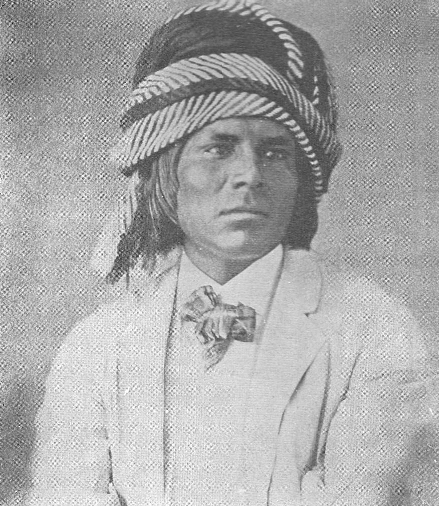
Louis, Pima interpreter

Ursuth, very old, was still living when I first visited the Pimas. Antonio never learned to speak English, but learned something new every day, for Mr. Cook, the German missionary, taught the children and they told him.

When I first saw him, the chief, Antonio, was a lame old man, of medium height, with a bright, intelligent face; his black hair, a little mixed with gray, hung in two short braids down his back. His forehead was clear and high, and his dark eyes, always gazing straight at you, were steady and searching. With him was his son, Antonito, about twenty-five years old. He was stouter than his father, and kept his eyes always on the ground until we were better acquainted, when he would look into my face.

We met in the office of the Indian agent, Mr. Stout; and Mr. Cook was there with Louis to help as interpreter. Mr. Cook told Antonio who I was. He said he would like to show me his house, so we walked three or four hundred steps to Antonio’s house. It was like a big beehive outside, of rounded form and twenty or thirty feet across. The roof seemed to be made of hard clay such as is called by the Spanish word adobe. One side was square, and a door about four feet high and three feet across opened into it. As we entered after Antonio we stepped down two feet to the floor of hard sand and clay. On one side blankets were rolled up and placed against the wall. Saddles, guns, and belts hung opposite, and between were benches and some two or three Indian dogs. The Pimas have always lived in villages and built this kind of house, not as do other Indians, who live in tents. We talked a while but did not stay, for without any window or chimney the smell and smoke were too much for a white man to stand very long.

After our first talk Antonio opened his heart to me. He told me that wicked men had led his young people away and taught them bad ways. He said his people had been on the war-path in the past, but that they loved best to cultivate the land, raise fruits, and be at peace. “Some of our young men,” he said, “now want to fight these bad white men who steal our water.

Some time after this, a hundred miles west of Antonio’s village, I gathered part of five tribes of Apaches, two tribes of the Pueblos (those Indians who live in houses), many Mexicans, white citizens, and some American soldiers. This was to be a great peace meeting, and I wanted Antonio, who was my friend, to come and tell the other Indians about me. But he was too old and lame, so Mr. Cook and Louis (the interpreter) came, and Antonio, the chief of the Pimas, sent his son, Antonito, to the council in his place. He said his son would soon have to speak everywhere for the tribe and “might as well begin now.”

At the end of the council the old enemies, Apaches and Pimas, embraced each other, while tears of joy ran down their cheeks. One strong active warrior said to Louis: “Look on the man you killed in battle many suns ago.” It was indeed an Indian Louis had left for dead on the battle-field, and seeing him, he was greatly frightened, for he was very superstitious. But when he realized that this man was quite alive they embraced each other in promise of future good fellowship.

Later Antonito went with me to New York and Washington with a party of ten Arizona Indians, and the new and startling experiences did much to bind them forever to the interest of this great peace.

I made a second trip to Arizona later and on my way north visited the old Chief Antonio. Mr. Cook and Louis with Antonito had returned safely from the East, and Antonio never tired of hearing about the marvels they had seen and heard.”

Posted in Apache, Pima | 3 Comments

Taylor Family Research – A Fine Example

One of our blog followers posted a link to the Taylor family research page in a comment.  I took a look, and it’s a really good example.

http://freepages.genealogy.rootsweb.ancestry.com/~craventaylors/

I wanted to point out three things.

Widen the Net

First, this kind of “surround and conquer” research is necessary, not just for Native research, for which the records can be painfully scarce, but for non-Native research as well.  Some folks call this widening the net.  When I’m researching a surname in a particular area, I use every available resource and make a spreadsheet of all occurrances of the name – including seemingly unimportant things like when someone that surname witnesses wills or deeds.  Those hints can tie the family to another family, and a location, which may turn out to be VERY important.  So, sometimes the sum of the parts is the most important piece, especially if there is no “smoking gun” for your ancestor.

Cluster Mapping

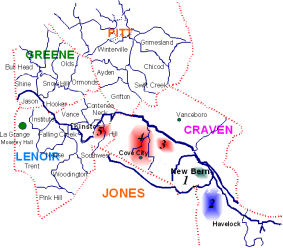
taylor cluster mapThis leads me to my second point and that is the important of mapping.  I spent about 5 years doing this type of research on the Estes, Moore and Combs families of Halifax Co., VA.  In the end, mapping groups of families and where they lived turned out to be key to recreating or assembling those families, which turned out to be the key to determining which family my John R. Estes belonged to.  The Taylor cluster map along with its key is excellent.

Native Research

The third point I’d like to make is related to Native research.  Native people were not born with English names.  English names were assigned to them in some fashion.  Often, they adopted the name of someone they respected, a trusted neighbor or someone with whom they had forged a “brother” relationship.  In this case, the first Taylor mentioned was King Taylor, a Native man, in 1711.  He had to have obtained the name Taylor from someplace.  I typically survey the neighborhood as well as looking at traders.  Sure enough, the second mention is of another Taylor, Jacob, a claimant as a result of the Tuscarora War, which occurred between 1711 and 1713, implying that he was of European heritage.  So, it’s possible that Jacob was in the area when King Taylor obtained his name.  Additional research might shed more light on this subject, or not.

One conclusion that cannot be reached is that because King Taylor and Jacob Taylor, or any other European Taylor, shared a surname implies that they were related.  Surnames were adopted by, or given to, Native people for any number of reasons and in any number of ways.

Another issue is that even if a Native person carried a European style name, such as John Taylor, for example, that doesn’t mean his sons carried the surname Taylor.  Many Native tribes were matrilineal and they did not use their European name within the tribe, only when dealing with Europeans.  So their sons could have adopted different surnames.  In other words, we cannot assume the traditional surname continuity when dealing with Native people, especially not during the time when European names were first adopted, but they were still living in tribal cultural units.

After intermarriage, assimilation and adoption of European customs, surnames were typically passed in a European fashion, but when that occurred varied widely by location, tribe and family.

Additional Taylor Records

Checking my Taylor records in the Native Names project, I found a couple more items that may be relevant to the Taylor family.

In 1704, a Thomas Taylor was living adjacent the Yawpim Indians on the North side of the Albemarle Sound when he was authorized with other men to lay out a 4 mile square parcel of land for the Indians.  This could be the person from whom the Indians adopted the Taylor surname.

In 1733 on the Mosely map, a Taylor family is settled in Beaufort County, near Beaufort Town as well.

In 1766 and again in 1769, a William Taylor signed as a Tuscarora chief in Bertie County on land sale documents.

I found this Taylor page that summarizes the early records, creates a cluster map and referenced DNA testing (even though some of the DNA info is a bit out of date) to be a great research format and I certainly wish that all of my family lines had a page like this.  Kudos to the Taylor family and webmaster!!!

Posted in Tuscarora, Yawpim | 23 Comments