Mexican Women’s Mitochondrial DNA Primarily Native American

Amy Tilden

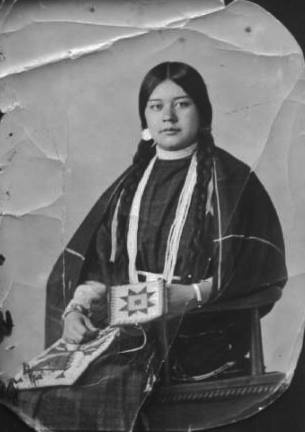
 Mitatwe’eptes (aka Amy Tilden) – Nez Perce – circa 1910

In the paper, “Large scale mitochondrial sequencing in Mexican Americans suggests a reappraisal of Native American origins,” Kumar et al provide a piece of information I find extremely interesting.

“For mtDNA variation, some studies have measured Native American, European and African contributions to Mexican and Mexican American populations, revealing 85 to 90% of mtDNA lineages are of Native American origin, with the remainder having European (5-7%) or African ancestry (3-5%). Thus the observed frequency of Native American mtDNA in Mexican/Mexican Americans is higher than was expected on the basis of autosomal estimates of Native American admixture for these populations i.e. ~ 30-46%. The difference is indicative of directional mating involving preferentially immigrant men and Native American women. This type of genetic asymmetry has been observed in other populations, including Brazilian individuals of African ancestry, as the analysis of sex specific and autosomal markers has revealed evidence for substantial European admixture that was mediated mostly through men. In our 384 completely sequenced Mexican American mitochondrial genomes, 12 (3.1%) are of African ancestry belonging to haplogroups L0a1a’3’, L2a1, L3b, L3d and U6a7; 52 (13.6%) belong to European haplogroups HV, JT, U1, U4, U5; and K and the majority (320, 83.3%) are of Native American ancestry.”

Posted in DNA, Mexico | 4 Comments

Locklayer and Burt of “Indian” Color

Found in the Halifax County, NC, Minutes, County Court, 1847-1865

A Minute of the Free Papers issued to Free Persons of Colour April A. D. 1848 viz March 8, 1848

Gabriel LOCKLAYER is of a coffee or Indian complexion thirteen years of age four feet nine inches high & has a scar on the right side of his mouth and big right toe.

Cornelius BURT is of a coffee or Indian colour fourteen years of age four feet eleven inches high & has a scar on his jaw & left foot on toes.

http://files.usgwarchives.net/nc/halifax/court/free01.txt

Thanks Elaine for this info.

Posted in Uncategorized | 2 Comments

Acadian Maryland Historical Marker Unveiling

Fort Royal

Acadians, as we know, are a French-Canadian people who settled at Port Royal, Nova Scotia, in 1605 (replica above) and intermarried with the Native people, primarily Mi’kmaq. They were expelled from Canada by the British in 1755 and set adrift, winding up literally dispersed to the winds, landing in various places in the US, Europe and in the Caribbean, before they congregated in Louisiana and became known as Cajuns.

A group of about 650 these displaced people, now refugees with nothing to their name, arrived in Maryland, a Catholic colony, and spent several years living there, many trying to make their way back to Canada.  With the end of the war in 1763, these Acadians desperately wanted to settle among their own people.  Some did return to Canada, but the rest found their way to Louisiana, the last group leaving in 1769.

Marie Rundquist, an Acadian descendant and founder of the Amerindian – Ancestry Out of Acadia DNA project, lobbied for 2 years for a sign commemorating this forgotten episode in Acadian and Maryland history.

Marie says, “One of my personal goals is to assign dignity to the heritage that I have learned is truly mine.  To have a sign like this brings an Acadian history into the mainstream, and recognizes a people whose ancestry has not always been held in the highest esteem, and whose integral role in early American history has been largely dismissed by traditional scholars.

That the DNA of Native Americans of Canada rolled into Louisiana, and other parts of the United States, by way of this diaspora is at the heart of the Amerindian Ancestry out of Acadia project.  The British didn’t pick and choose among whom they would toss into the Ocean…all went; it mattered not if your family had been in the area 150 years or 18,000!”

On July 28th, 2013, on the day of the Acadian Memorial and Remembrance, when Acadians around the world recall the expulsion of 11,000+ Acadians from Nova Scotia in 1755, Marie celebrated by unveiling the sign in Princess Anne, Maryland.  Way to go Marie!!!

To read more about Marie’s activities, DNA projects and Acadian research, click here.

Posted in Acadian, Canada, Louisiana, Maryland, Micmac, Migration | 2 Comments

Jack Goins New Blog – Melungeon and Appalachian Research

Jack's blog

Web sites come and web sites go.  Jack is replacing his old website, www.jgoins.com, now defunct, with a new blog, Melungeon and Appalachian Research.  Blogs are much easier to update and keep current, don’t require any knowledge of web programming, and tend to be much more spontaneous.  The good news is that Jack is bringing over the information from his former website as well as writing new articles.

jack goins portrait

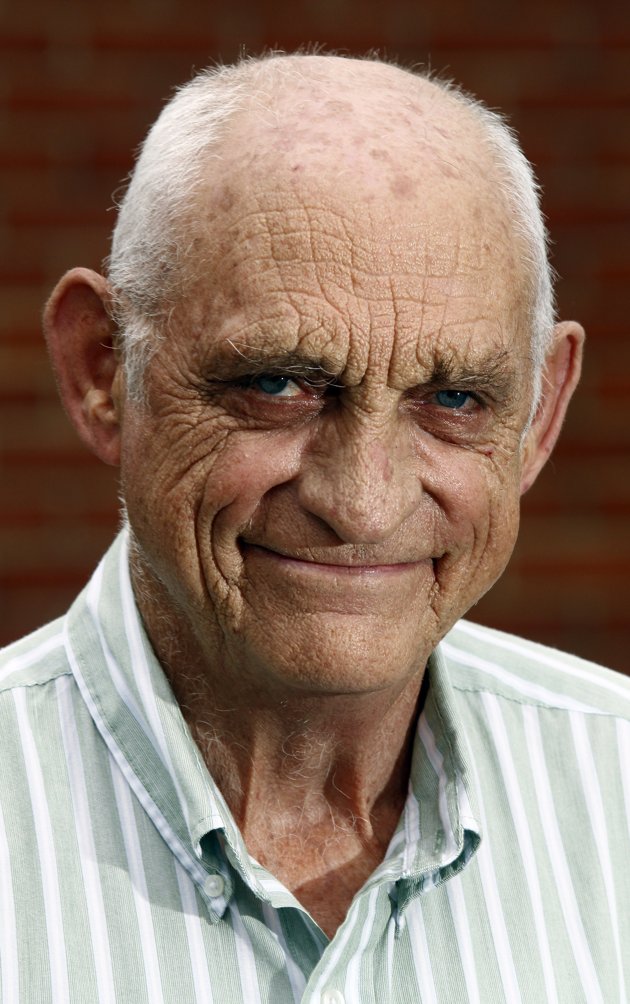
Jack Goins is the patriarch of Melungeon research.  He is the Hawkins County, TN archivist, has written 2 books on Melungeons, “Melungeons and Other Pioneer Families,” now out of print, and “Melungeons, Footprints from the Past.”  Additionally, Jack founded both the Y-DNA, mitochondrial (maternal) DNA and autosomal Families of Interest DNA Melungeon projects.  Jack is a co-author of the academically published paper, Melungeons, a Multi-Ethnic Population and has been a featured speaker in many locations.

Articles already on his blog include:

Newman Ridge Gang

Update on Stony Creek Church Minutes

Newman Ridge

Maybe Melungeon

Micajer Bunch

Zephaniah Goins Fought in Yorktown Campaign

Hawkins County Archival Project

Union 6 Presentation by Jack Goins

Creeks, Rivers and Streams

There’s lots more to come.  You can subscribe to his blog by scrolling down past the list of links on the right hand side to the “Follow by E-Mail” option.

Enjoy!

Posted in Melungeon | 46 Comments

The Curtis Act of 1898

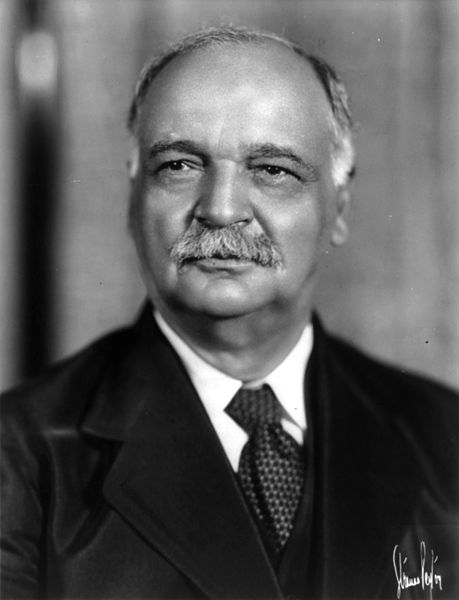
charles curtis on time

Charles_Curtis_Signature


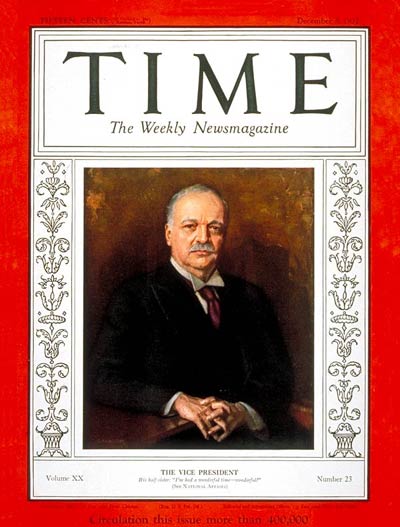
Charles Curtis, 31st Vice President of the United States, is probably best remembered for the Curtis Act of 1898.

The Curtis Act of 1898 was an amendment to the United States Dawes Act that brought about the allotment process of lands of the Five Civilized Tribes of Indian Territory: the Choctaw, Chickasaw, Muscogee, Cherokee, and Seminole. These tribes had been previously exempt from the 1887 General Allotment Act, also known as the Dawes Act (also known as the Dawes Severalty Act, named for its sponsor and author Senator Henry Laurens Dawes), because of the terms of their treaties. Prior to the Curtis Act, each of these tribes had sole authority to determine the requirements for tribal membership. The act transferred this authority to the Dawes Commission. Thus, members could be enrolled without tribal consent. By effectively abolishing tribal courts and tribal governments in the Indian Territory of Oklahoma, the act enabled Oklahoma to attain statehood, which followed in 1907.

Officially titled the “Act for the Protection of the People of Indian Territory”, the Act is named for Charles Curtis, its original author. He was of Kansa, Osage, Potawatomi, and French descent, was raised on the Kansas Reservation, and was a member of the United States House of Representatives. Although Charles Curtis was the author of the original draft of the Act, by the time the bill HR 8581 had gone through five revisions in committees in both the House of Representatives and the Senate, there was little of Curtis’ original draft left to become law. In his own hand-written autobiography, Curtis noted that he was unhappy with the final version of the Curtis Act. He believed that the Five Civilized Tribes needed to make changes. He thought that the way ahead for Native Americans was through education and use of both their and the majority cultures, but he also had hoped to give more support to Native American transitions.

The Curtis Act called for the abolition of tribal governments on March 6, 1906. It was intended to establish the concept of individual land holdings. The act also provided for the establishment of public schools.

The Act incorporated the basic points regarding land allotments and termination of tribal governments that had earlier appeared in the Atoka Agreement between the Choctaw and Chickasaw Nations. The Atoka Agreement had been rejected by a popular vote of the Chickasaws, but accepted by the Choctaws. The Curtis Act required that the Atoka Agreement be resubmitted to a vote of both nations. The agreement was approved in a joint election on August 24, 1898.

The Curtis Act also scrapped the enrollments performed under the Dawes Act and ordered that new enrollments be performed.

This Act extended all provisions of the Dawes Act to the lands of the Five Civilized Tribes, making large parts of these lands open to settlement by whites. It resulted in removing an estimated 90 million acres of land formerly reserved for Native Americans.

The Curtis Act also provided for the incorporation of towns in Indian Territory. This meant that towns had a legal basis to be laid out, surveyed and platted. Any individual could obtain title to the lot in fee simple . The title owner of a lot had the legal right to sell or mortgage the property. An incorporated town or city had the right to self regulation and levy taxes, allowing them to establish public services. By 1900, the largest towns in Indian Territory had incorporated. These included: Ardmore. with 1,500 residents; Muskogee 4,200; McAlester 3,500; Wagoner 2,300; Tulsa 1,300 and Eufaula 800.

The Act also provided that residents could vote for city officials, even though it did not allow territorial residents to vote for national office.

charles curtis tombstone

Posted in Cherokee, Chickasaw, Choctaw, Muscogee, Seminole | Leave a comment

Charles “Indian Charley” Curtis – 1st Native American in the White House

Charles_Curtis-portrait

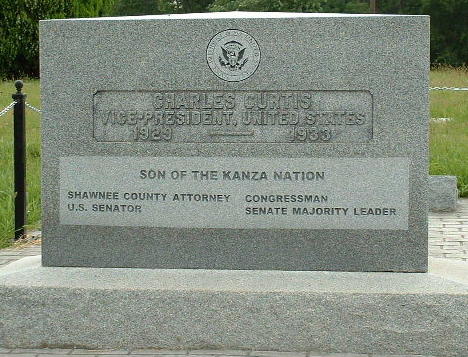
Charles Curtis (January 25, 1860 – February 8, 1936) was a United States Representative, a longtime United States Senator from Kansas later chosen as Senate Majority Leader by his Republican colleagues, and the 31st Vice President of the United States (1929–1933). He was the first person with significant acknowledged Native American ancestry and the first person with significant acknowledged non-European ancestry to reach either of the two highest offices in the United States government’s executive branch. He was enrolled in the Kaw tribe and his maternal ancestry was three-quarters Native American: Kaw, Osage and Pottawatomie.  His father was European-American. Curtis spent years of childhood living with his maternal grandparents on their Kaw reservation.

Born on January 25, 1860 in Topeka, Kansas Territory, prior to its admission as a state in January 1861, Charles Curtis is notable as an Executive Branch officer born in a territory rather than a state of the Union. Curtis was nearly half American Indian in ancestry. His mother, Ellen Papin (also spelled Pappan), was one-fourth French, one-fourth Kaw, one-fourth Osage, and one-fourth Pottawatomie.  His father, Orren Curtis, was an American of English, Scots and Welsh ancestry. His paternal grandparents were William Curtis and Permelia Hubbard. William’s parents were Thomas Curtis and Eunice Peet from early Connecticut. On his mother’s side, Curtis was a descendant of the chiefs White Plume and Pawhuska, of the Kaw and Osage, respectively.

From his mother, Curtis first learned French and Kansa. As a boy living with his mother and her family on the Kaw reservation, he started racing horses. Curtis was a highly successful jockey in prairie horse races.  On June 1, 1868, one hundred Cheyenne warriors invaded the Kaw Reservation.  Terrified white settlers took refuge in nearby Council Grove. The Kaw men painted their faces, donned their regalia, and rode forth on horseback to meet the Cheyenne. The two Indian armies put on a military pageant featuring horsemanship, war cries, and volleys of bullets and arrows. After four hours, the Cheyenne retired with a few stolen horses and a peace offering of coffee and sugar by the Council Grove merchants. Nobody was hurt on either side. During the battle, the mixed-blood Kaw interpreter, Joe Jim, galloped 60 miles to Topeka to request assistance from the Governor. Riding along with Joe Jim was eight-year old Curtis (also called “Indian Charley”).

Curtis’ mother had died in 1863 when the boy was three. His father remarried and divorced, then married again. The elder Curtis was imprisoned because of an event during his service in the American Civil War. During this time, Charles was cared for by both sets of grandparents. His Curtis grandparents helped him gain possession of his mother’s land in North Topeka, which he inherited despite his father’s attempt to gain control of the land.

Curtis was strongly influenced by both sets of grandparents. After living on the reservation with his maternal grandparents, Julie Gonville and M. Papin, Curtis returned to Topeka. He lived with his Curtis grandparents while attending Topeka High School. Both his grandmothers encouraged him to get an education.

Afterward Curtis read law in an established firm and worked part-time. Curtis was admitted to the bar in 1881. He commenced practice in Topeka and served as prosecuting attorney of Shawnee County, Kansas from 1885 to 1889.

As an attorney, Curtis entered political life at the age of 32, winning multiple terms from his district in Topeka, Kansas, starting in 1892 as a Republican to the US House of Representatives. He was elected to the US Senate first by the Kansas Legislature (in 1906), and then by popular vote (in 1914, 1920 and 1926), serving one six-year term from 1907 to 1913, and then most of three terms from 1915 to 1929 (when he became Vice President). His long popularity and connections in Kansas and national politics helped make Curtis a strong leader in the Senate; he marshaled support to be elected as Senate Minority Whip from 1915–1925 and then as Senate Majority Leader from 1925–1929. In these positions, he was instrumental in managing legislation and accomplishing Republican national goals.

Curtis ran for Vice-President with Herbert Hoover as President in 1928. They won a landslide victory. Although they ran again in 1932, the population saw Hoover as failing to alleviate the Great Depression, and they were defeated by Franklin D. Roosevelt and John Nance Garner.

Charles Curtis married Annie Elizabeth Baird (1860–1924), with whom he had three children: Permelia Jeannette Curtis, Henry “Harry” King Curtis and Leona Virginia Curtis. He and his wife also provided a home for his half-sister Theresa Permelia “Dolly” Curtis and then after her mother died in 1924.

A widower when elected Vice President in 1928, Curtis had his half-sister “Dolly” Curtis Gann live with him in Washington, DC and act as his hostess for social events. To date, Curtis is the last Vice President who was unmarried while in office.

Curtis decided to stay in Washington, D.C. to resume his legal career as he had a wide network of professional contacts from his long career in public service.

He died there on February 8, 1936 from a heart attack. By his wishes, his body was returned to his beloved Kansas and buried next to his wife at the Topeka Cemetery.

Posted in Cheyenne, Kaw, Osage, Potawatomi | 4 Comments

Black, White or Red – Changing Colors

henry finding your roots

The Root recently published the article, “Did My White Ancestor Become Black?”, written by Henry Louis Gates Jr. and Eileen Pironti.  We all know who Henry is from his PBS Series, Finding Your Roots.

America is the great mixing bowl of the world, with Native American, European and African people living in very close proximity for the past 400 years.  Needless to say, on the subject of admixture and race, things are not always what they seem.

Henry Gates sums it up quite well in his article, regardless of what your ancestor looked like, or your family looks like today, “the only way to ascertain the ethnic mixture of your own ancestry is to take an admixture test from Family Tree DNA, 23andMe or Ancestry.com.”

Interestingly enough, in an earlier issue of The Root, Henry talks about how black are Black Americans.

In that article, Henry provides this information.

* According to Ancestry.com, the average African American is 65 percent sub-Saharan African, 29 percent European and 2 percent Native American.

* According to 23andme.com, the average African American is 75 percent sub-Saharan African, 22 percent European and only 0.6 percent Native American.

* According to Family Tree DNA, the average African American is 72.95 percent sub-Saharan African, 22.83 percent European and 1.7 percent Native American.

* According to National Geographic’s Genographic Project, the average African American is 80 percent sub-Saharan African, 19 percent European and 1 percent Native American.

The message is, of course, that you never know.  Jack Goins, Hawkins County, Tennessee archivist,  is the perfect example.  Jack is the patriarch of Melungeon research.  His Goins family was Melungeon, from Hawkins County, Tennessee.  Jack founded the Melungeon DNA projects several years ago which resulted in a paper, co-authored by Jack (along with me, Janet Lewis Crain and Penny Ferguson), cited by Henry Louis Gates in his above article along with an associated NPR interview, titled “Melungeons, A Multiethnic Population.”

jack goins melungeon

Jack, shown above with the photo of his Melungeon ancestors, looks white today.  His family claimed both Portuguese and Indian heritage.  His ancestors and family members in the 1840s were prosecuted for voting, given that they were “people of color.”

But Jack’s Y DNA, providing us with his paternal link to his Goins male lineage, is African.  No one was more shocked at this information than Jack.  Jack’s autosomal DNA testing confirms his African heritage, along with lots of European and a smidgen of Native in some tests.

When in doubt, test your DNA and that of selected relatives to document your various lines, creating your own DNA pedigree chart.  For a broad spectrum picture of your DNA and ethnicity across of all of your heritage, autosomal DNA testing is the way to go.  Without all of these tools, neither Jack nor Henry would ever have known their own personal truth.

If you’d like to take a DNA test, click here.

Posted in DNA, Melungeon, Portuguese | 9 Comments

The Cobell Case and Indian Reservation Ownership

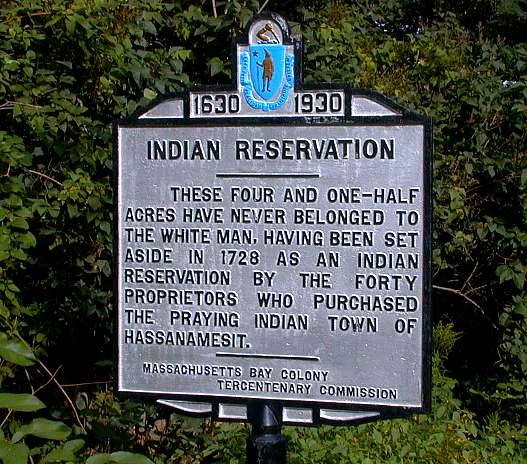
reservation sign

The Cobell Case, known my many different names, was a class action suit filed by Native American representatives against two departments of the United States government. The plaintiffs claim that the U.S. government has incorrectly accounted for the income from Indian trust assets, which are legally owned by the Department of the Interior, but held in trust for individual Native Americans (the beneficial owners). The case was filed in the United States District Court for the District of Columbia. The original complaint asserted no claims for mismanagement of the trust assets, since such claims could only properly be asserted in the United States Court of Federal Claims.

The case is sometimes reported as the largest class-action lawsuit against the U.S. in history, but the basis for this claim is a matter of dispute. Plaintiffs contend that the number of class members is around 500,000, while defendants maintain it is closer to 250,000. The potential liability of the U.S. government in the case is also disputed: plaintiffs have suggested a figure as high as $176 billion, and defendants have suggested a number in the low millions, at most.

The case was settled for $3.4 billion in 2009, with $1.4 billion going to the plaintiffs and $2 billion allocated to repurchase land that was distributed under the Dawes Act and return it to communal tribal ownership.  A documentary movie was made about this landmark case.

However, the most interesting part of this suit is the ownership of the Reservation land and the relationship between the government, the tribes and the individuals involved.

The history of the Indian trust is inseparable from the larger context of the Federal government’s relationship with American Indians, and the policies that were promulgated as that relationship evolved.  At its core, the Indian trust is an artifact of a nineteenth-century Federal policy and its current form bears the imprint of subsequent policy evolutions.

During the late 1800s, Congress and the Executive branch believed that the best way to foster assimilation of Indians was to “introduce among the Indians the customs and pursuits of civilized life and gradually absorb them into the mass of our citizens.”

Under the General Allotment Act of 1887 (the Dawes Act), tribal lands were divided and assigned to heads of households as individually owned parcels 40–160 acres (0.16–0.65 km2) in size.  The Dawes Rolls are the records of the members of each tribe who were registered at the time.  The total land area that was allotted was small compared to the amount of land that had been held communally by tribes in their reservations at the passage of the Act.  The government declared Indian lands remaining after allotment as “surplus” and opened them for non-Indian settlement.

Section 5 of the Dawes Act required the United States to “hold the land thus allotted, for the period of twenty-five years, in trust for the sole use and benefit of the Indian to whom such allotment shall have been made…”

During the trust period, individual accounts were to be set up for each Indian with a stake in the allotted lands, and the lands would be managed for the benefit of the individual allottees.  Indians could not sell, lease, or otherwise encumber their allotted lands without government approval.  Where the tribes resisted allotment, it could be imposed.  After twenty-five years, the allotted lands would become subject to taxation.  Many allottees did not understand the tax system, or did not have the money to pay the taxes, and lost their lands and European settlers were waiting to scoop them up for next to nothing.

The early Indian trust system evolved from a series of adjustments to a policy that was gradually abandoned, then finally repealed. The allotment regime created by the Dawes Act was never intended to be a permanent fixture; it was supposed to transition gradually into fee simple ownership over a period of 25 years, about one generation. The theory that Indians could be turned into farmers, working their allotted lands was folly, not the least because much of the land they were allotted was unsuitable for small family farms. Within a decade of passage of the Dawes Act, the policy began to be adjusted because of government concerns about Indian competency to manage land and avoid predation by unscrupulous settlers. As late as 1928, the overseers were extremely reluctant to grant fee patents to Indians – the Meriam Report of that year advocated making Indian landowners undergo a probationary period to prove competence.

By passage of a series of statutes in the early 1900s, the government’s trusteeship of these lands increasingly was made a permanent arrangement; Interior’s trusteeship is sometimes referred to as an “evolved trust.”  Little thought was given at the time to the consequences of making permanent the heirship of allotments.  Lands allotted to individual Indians were passed from generation to generation, just as any other family asset passes to heirs.  Probate proceedings commonly dictated that land interests be divided equally among every eligible heir unless otherwise stated in a will.  As wills were not, and are not, commonly used by Indians, the size of land interests continually diminished as they were passed from one heir to the next.  An original allotted land parcel of 160 acres may now have more than 100 owners.  While the parcel of land has not changed in size, each individual beneficiary has an undivided fractional interest in the 160 acres.

The allotment policy was formally repealed in 1934, with passage of the Indian Reorganization Act of 1934 (IRA).  However, the wheels already set in place continued to turn until the lawsuit was filed in 1996.

If you thought that the Indians “owned” the reservations outright, they didn’t.  Even in earlier circumstances, in the early 1700s in North Carolina, the Tuscarora Indians were required to obtain approval of the legislature before they could “sell” their reservation lands.  By that time, there had already been too many examples of Indians being taken advantage of, especially after becoming under the influence of alcohol, and signing their lands away.  In addition, they didn’t understand the concept of value in terms of monetary value as compared to similar land elsewhere.  Unethical people were all too willing and ready to take advantage of the Indians, often under the guise of “brotherhood,” so these laws were originally put in place to protect them, both from those who would be less than honest with them as well as from their own ignorance of white man’s society.

Hat tip to Rod for the link to the Cobell Case article.

Posted in Uncategorized | 1 Comment

Arizona’s Ancient Ruins

casa grande 1902

Casa Grande Ruins about 1902

In 1871, a document titled “Resources of Arizona Territory with a Description of the Indian Tribes; Ancient Ruins, Cochise, Apache Chief; Antonio, Pima Chief; Stage and Wagon Roads; Trade and Commerce, Etc.” was published by the authority of the Legislature.  In a section titled “Indians of Arizona,” it tells us the following:

This territory is covered with ancient ruins which prove conclusively it was once densely populated by a people far in advance, in point of civilization, to most of the Indian tribes.  There is no written record of them, and it is only a matter of conjecture who and what they were.  Occasionally a deserted house is found sufficiently well preserved to ascertain the character of the architecture.  The walls of the Casa Grande, situated on the Gila, near Sanford, are still two stories above the ground.  In size, the structure is about 30 by 60 feet, the walls are thick and made of mud, which was evidently confined and dried as it was built.  It is divided into many small rooms, and the partitions are also made of mud.  The floors were made by placing sticks close together and covering them with cement.  Around and near the Casa Grande are the ruins of many other buildings, but by the lapse of time the decay of vegetation has formed earth and nearly covered them, and all that now marks the place where once a stately mansion stood is the elevation of the ground.

Near the Ancha Mountains are ruins not so extensive, but in far better preservation than the Casa Grande, and near these ruins are old arastras, for the reduction of silver ores, which indicate that this old people were not unmindful of the root of all evil.  On the Verde River are immense rooms dug in from the side of high perpendicular sandstone banks that can only be reached with ladders.

Very little information is obtained by excavating these ruins.  Pottery of an excellent quality and ornamented with paints is found everywhere and occasionally a stone axe is unearthed, but nothing to indicate that they were a warlike people; on the contrary, scarcely an implement of defense can be found, though there are reasons to believe, from the numerous lookouts or places for observation to be seen on the tops of hills and mountains, and the construction of their houses, that they had enemies, and that they were constantly on the alert to avoid surprise; and also that by the hands of these enemies they perished.  It is not improbable that the Apaches were the enemies who caused their destruction.  Indeed, the Apaches have a legend that such is the case, and I believe the time will come when they will be able to exterminate or drive us from the country.  When we consider that they have fought all other Indian tribes, and have so far successfully resisted the military power of Spain, Mexico and the United States, this does not seem like a very unreasonable anticipation.  The ruins of towns, farms and irrigating canals that are to be seen on every hand over this vast territory give abundant proof that this country was once densely inhabited and that the people who lived here maintained themselves by cultivating the soil, and that is probably about all we shall ever know of them.  Many hieroglyphics are to be seen on rocks in different portions of the territory, but who made them, or what they mean, no one knows.

In excavating a well between Tucson and the Gila, at the depth of 150 feet, pottery and other articles, the same as are found in the vicinity of ruins, were taken out.

Note:  Today, the Casa Grande ruins is a National Monument.

casa grande 1889

Casa Grande Ruins – 1889

Note:  These ruins were built by the Ancient Sonoran Desert People.

Posted in Anasazi, Apache | 2 Comments

Dasemunkepeuc, Algonquian Village Location To Be Dedicated

On August 10th, 2013, the location of the Algonquian Indian village, Dasemunkepeuc will be honored with a highway sign near Mann’s Harbour, NC, directly across the bridge from Roanoke Island.  This is part of Roanoke Island Cultural Festival and Powwow taking place the same weekend.

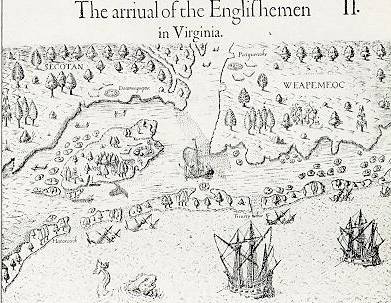
dasamonquepeu map

The Algonquian village of Dasemunkepeuc, near present-day Mann’s Harbor, is central to the story of the Roanoke colonists. On the mainland shore of the Roanoke Sound, it was the scene of conflict between European explorers and the native people in 1586. A N.C. Highway Historical marker will be dedicated in memory of the attack and its consequences Aug. 10, at noon, at the Roanoke Airport on Airport Road. The sign then will be installed at US 264 and US 64, south of Mann’s Harbor.

The village was the principal home of Pemisapan, a regional leader well-known to Thomas Harriot, John White and Ralph Lane, settlers of the North Carolina colony. Indian guides Manteo and Wanchese also knew the Indian leader. Ralph Lane and his party attacked Dasemunkepeuc in June 1586, and Pemisapan was injured. Though he escaped into the woods he was pursued by colonist Edward Nugent, who emerged from the woods with Pemisapan’s head in his hand. Shortly afterward, Lane’s colonists returned to England with Sir Francis Drake.

white's map

It was into this environment that Sir Walter Raleigh’s colonists settled on Roanoke Island in 1587.  Shortly thereafter, colonist George Howe was killed, precipitating in turn an attack by the English on the Native people.  Unfortunately, the story that we know ended at that point, because John White returned to England to obtain supplies, and was detained by the English war with Spain.  When he returned in 1590, the colonists were “lost,” had moved, left the words “Cro” and “Croatoan” as signs to White, signifying the Croatoan Indians who lived on Hatteras Island.  White was literally blown back to England in a storm, unable to visit Hatteras Island to search for the colonists, who we continue to search for today.

If you would like to attend the dedication ceremony, please contact Marvin Jones at marvin@marvintjones.com. For information on the N.C. Highway Historical Marker Program, please call (919) 807-7290. The Highway Marker program is within the N.C. Department of Cultural Resources and a joint program with the N.C. Department of Transportation.

For information about the powwow and events, visit www.chowandiscovery.org or call 202-726-4066 or 757-477-3589.

dasemunkepeuc dedication

Posted in Algonquian, Chowan, Hatteras, Lost Colony | Leave a comment