Salt and Water

Some English translations of Native names are obvious.  And some, well, I’m left to believe that something just didn’t make it in the translation.  Here’s an example:

Information on this page is from Index of Awards on Claims of the Soldiers of the War of 1812, compiled by the New York Adjutant General’s Office. The following list is an index of claims presented by members of Indian tribes mustered into the service of the United States in the War of 1812. Information is presented as follows: Claim number, name of warrior, claimant and amount awarded.

Seneca Nation – Cattaraugus Reservation

13,911   Salt and Water                    By Administrator    100.00

So I’m left wondering how this person got this name and if it meant something besides the obvious two elements.  I keep thinking in terms of what happens when you mix salt and water and I can’t think of much except that you get an ocean eventually.  Any thoughts on this one???

Posted in Names, Seneca | 1 Comment

Roster of the NC 69th Cherokee Regiment – Civil War

This is the second hat tip in one day to Beverly for finding the roster of the Cherokee regiment online.  I couldn’t download the pdf to print it, but it’s certainly readable on the screen.  The Cherokee roster begins on page 151 and goes through 156.  Please note that the link in the previous post, which I am removing, by the way (the link, not the post), is NOT to 84 Cherokee men.  There were many other units in the NC 69th, not just the two Cherokee companies.

Roster of NC Troops in the War between the states, vol 4 by NC General Assembly  http://books.google.com/books?id=XAsTAAAAYAAJ&pg=PA1&dq=roster+of+north+carolina&hl=en&ei=ja0vTILmLsL58Aab88y7Aw&sa=X&oi=book_result&ct=result&resnum=1&ved=0CDAQ6AEwAA#v=onepage&q&f=false

Posted in Cherokee, Military | Leave a comment

William H. Thomas’s Cherokee Legion of the 69th NC Regiment of the Civil War (Confederate)

William H. Thomas was the only known white Chief of the Cherokee.

http://www.cherokee-nc.com/index.php?page=65

His legion of 400 Cherokee men was a part of the larger 69th North Carolina regiment and fought bravely in the Civil War. They did not own slaves, so their choice to fight for the Confederacy was not connected to slavery.

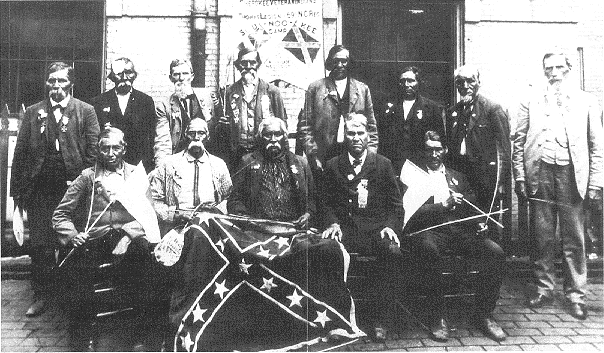
This wonderful photograph was taken in 1903 in New Orleans at the Confederate Reunion.  These are the remaining men of the Cherokee unit of the 69th NC.  Their banner says “Cherokee Veteran Indians of Thomas’ Legion, 69 NC Regiment, Suo-Noo-Kee Camp U.C.V 4th Brigade, NC Division.”

The men’s identities are given as, left to right:

Front Row: Usai, Kimson Saunooke, Jesse Ross, Jesse Reed, Sevier Skitty. 

Back Row: Bird Saconita, Dave Owl, Lt. Col. William Williams Stringfield, Lt. Luatie (Suyeta) Own (Owle), Jim Cag, Wesley Crow, Jessan, Lt. Calvin Cagle.  Cagle is often reported as a member of this Legion, but no records confirm it.  However, his presence appears to connect him.  Names were furnished by the late James R. Thomas, son of William H. Thomas. 

I hate the ads on this site, but the information is great. Try to ignore the ads. http://thomaslegioncherokee.tripod.com/

This next link is about the 69th NC Battalion itself: http://thomaslegion.net/regiment.html

The full roster begins in this book on page 151 and goes through 156.

Roster of NC Troops in the War between the states, vol 4 by NC General Assemblyhttp://books.google.com/books?id=XAsTAAAAYAAJ&pg=PA1&dq=roster+of+north+carolina&hl=en&ei=ja0vTILmLsL58Aab88y7Aw&sa=X&oi=book_result&ct=result&resnum=1&ved=0CDAQ6AEwAA#v=onepage&q&f=false

There are other photos from the Thomas Legion at the Museum of the Cherokee.  http://thomaslegion.net/thomaslegionphotos/

Hat tip to Beverly for the lead to this information!!!

Posted in Cherokee, Military | 2 Comments

Waccamaw Legacy – “We was always Indians.”

There are a few books I consider foundation book for the library of anyone who is researching mixed families of color in Virginia, North Carolina and South Carolina.  The book “Waccamaw Legacy, Contemporary Indians Fight for Survival” by Patricial Barker Lerch is assuredly one of them.  This book in on the Fundamental Research List.  I will be reviewing each of these resources, in turn.

Waccamaw Legacy provides an excellent tutorial of the history of this area, being the Lumber/PeeDee River Basin, in terms of politics and culture, and the clash of the two, without interjected anger or any personal agenda found in some books covering this region and people.  Patricia Lerch, a professor of anthropology, the author, was hired by the Waccamaw in 1981 to perform the research necessary to file for tribal recognition under the Bureau of Indian Affairs Federal Acknowledgment Program.  Unfortunately, this did not occur, but Patricia has recorded this information, and more, for us in this book. 

The information herein does not apply only to the Waccamaw.  The same social, political, cultural and legal environment applied to the other Native people and people of color in the Lumber and PeeDee River Basin in both North and South Carolina, although the legalities varied between the two states and how the laws were applied varied by county and political whim.

The Waccamaw differentiate themselves from the Lumbee.  The Waccamaw believe that their ancestors “have always lived here” as opposed to the Lumbee who migrated from other regions.  The old Waccamaw claimed the tribe is Siouian. 

Patricia spends a great deal of time acquainting us with the history of the people of the region where the Waccamaw are found.  The Waccamaw settlement is found in both Columbus and Bladen Counties of NC. 

The events surrounding the schools in North Carolina beginning in 1885 affected the Native families in Columbus County as much as it did the people who would become Lumbee in Robeson County.  The difference was that the state provided funding for separate Indian Schools in Robeson Co., but declined, several times, to do so for the Native families in Columbus County.  Several lawsuits were filed relative to his topic. This process and these lawsuits serve to document a great deal about the people involved.

Patricia walks us through this difficult time and into the later 1900s, where we put all of the pieces from earlier generations together to obtain a better understanding of both the internal and external forces at work that would, together, form the later history of the Waccamaw people.

This book should be mandatory reading for anyone who is beginning research on families of color.

Note:  The books I review I have purchased and I receive no compensation or “perks” of any type from the author or publisher.  These reviews are solely for educational purposes and to help researchers establish a reliable educational baseline.

Posted in Fundamental Research List, North Carolina, Waccamaw | 28 Comments

Names That Make Me Smile

Some of these Native names just make me smile.

How about Grand John, a St. John’s Indian.

Or Many Greets.

How do you think that Pierre Joe Stutterer got his name?

Or maybe, better yet, Sam Bananas.  Now you know that he wasn’t named after the banana itself, so I can just sort of hear Sam trying to say his last name and someone thinking “sounds like bananas to me!”  So Sam Bananas it became.

Did Native people have a sense of humor?  How did Augustin Littlebreeches receive his name?  Maybe he wasn’t quite as fortunate as Luis Luccaduck.

And then there’s Tomo Squatpan.  What, exactly, was a squatpan?  I’m betting it has something to do with what the Indians called the European’s idea of bathroom facilities…but I’m just guessing.  I’m sure Tomo could have told us all about it.

Posted in Names | 1 Comment

Fundamental Research List

For new and seasoned researchers both, I have put together what I consider to be a fundamental core list of books and resources absolutely essential to understanding the free people of color in colonial and post-colonial America.  The books are shown below and have been added as a permanent page on the blog. 

Please note that each of these is written from the individual perspective of each author, and I’m not endorsing one over any other.  I don’t always agree with any of these authors.  However, as a body of work, they provide researchers with the fundamental core set of understanding of the people, the cultural forces at work, and the situations that influenced the making of “mixed” America.  By the time we find our ancestors with surnames in the 1600s, 1700s and 1800s, they had been influenced by European colonization, slavery and assimilation pressure for decades to hundreds of years.  These books impart an understanding of how these situations came to be, why, the results and how to work with what we have.  These books help make sense of, and in some cases, dispel, a great number of internet myths, especially relating to Native American and African-American mixed ancestry including “tri-racial” isolate groups and various exotic ancestry myths.

Most of these books are available and currently in print.  Otherwise, utilize your local library, interlibrary loan and/or the used book marketplace.  www.bookfinder.com

I can’t say this strongly enough – these books are essential for serious researchers.

  1. The Birth of Black America: The First African-Americans and the Pursuit of Freedom at Jamestown by Tim Hawshaw
  2. www.africanamericans.com – Paul Heinegg’s site and his accompanying book, Free African-Americans of North Carolina, Virginia and South Carolina from the Colonial Period to about 1820, Vol 1 and 2 (current edition)
  3. Indian Slavery in Colonial America by Alan Gallay
  4. Mixed Blood Indians, Racial Construction in the Early South by Theda Perdue (2003)  University of Georgia Press
  5. American Indian Holocaust and Survival: A Population History since 1492 by Russell Thornton
  6. Living Indian Histories: Lumbee and Tuscarora People in North Carolina by Gerald Sider (2003). University of North Carolina Press 
  7. Waccamaw Legacy: Contemporary Indians Fight for Survival by Patricia Barker Lerch (2004), University of Alabama Press
  8. Native Americans in the Carolina Borderlands: A Critical Ethnography by Michael Spivey (2000), Carolina Press
  9. Pocahontas’s People: The Powhatan Indians of Virginia Through Four Centuries by Helen Roundtree

Of course, there are many books available.  I have selected these as a core group because they are well written and researched, relatively unbiased, highly educational in nature and will prepare you to understand and evaluate other books, documents and opinions expressed elsewhere.

Posted in North Carolina, Resources, South Carolina, Virginia | 1 Comment

Drammacho Mongy – Chickahominy Chief

In James City County, Va., in the Acts of Assembly, we find what may be the first instance of an Indian chief with a surname in the colonial records.

Drammacho Mongy, chief Ruler of the Chickahominy, petitioned that lands in Pamunkey Neck should, by the Articles of Peace May 1677, belong to them. Any sales they had should be confirmed. The Committee rejected the claim on the grounds that only land “within 3 miles of the Indian Town was Indian property.” Sales made by them are thus null & void, except in cases for lands they hold by his Majesties’ subjects by exchange and confirmed.

Posted in Chickahominy, Virginia | Leave a comment

Michigan Native Resources

I think I’ve hit the proverbial goldmine. 

This site has several very important rolls, including one as far back as 1836 showing the amount of admixture.  Here’s the link to the primary site.

http://www.mainlymichigan.com/nativedata/

If you take a look at the Ottawa/Chippewa Halfbreed Census, you’ll see that it gives the people’s names, where they live, their family and the amount of admixture.  What we wouldn’t give for something like this from the 1600s or 1700s in Virginia, North Carolina and South Carolina.

http://www.mainlymichigan.com/nativedata/1836OttChipCensus/1836OttChippPaging.aspx

Another resource is the Durant Roll from 1870 and 1908, again, with full information.

http://www.mainlymichigan.com/nativedata/DurantRoll/FullCensus.aspx

Patricia Hemp, the compiler and page author tells us that the four rolls of this microfilm publication, M2039, have reproduced the 1908 census roll (known at the “Durant Roll” for its compiler, Horace B. Durant) of the Chippewa and Ottawa tribes of Michigan, with Durant’s field notes, and related correspondence. The Durant Roll contains the names of all members or descendants of members enrolled with the Ottawa and Chippewa tribes of Michigan in 1870 who were living on March 4, 1907. The roll also serves as an index to Durant’s field notes. The field notes provided genealogical information used to determine if an individual was eligible to be listed on the census. The correspondence consists of letters received and sent by the Commissioner of Indian Affairs and Horace B. Durant which concern the enrollment process, procedures, and policy. These records are part of the Special Agent Files, 1807-1948, in the Records of the Bureau of Indian Affairs, Record Group (RG) 75, and are housed at the National Archives Building in Washington, DC.

Also included are Indian Land Allotments resulting from the Dawes Act of 1887 that allowed tribal lands to be split up and divided into individual allotments for tribal members.

http://www.mainlymichigan.com/nativedata/LandAllotments/Land.aspx

Posted in Chippewa, Michigan, Ottawa | Leave a comment

When a Mohawk is not a Mohawk

Some things seem elementary.  If you found an ancestor with the surname of Mohawk, you’d immediately think Native, or at least seriously ponder the possibility.  If you knew you were dealing with a Native family named Mohawk, you’d know you had found the tribe, and you’d do a little happy dance, hoping no one is watching.

And you’d be…..wrong!

End of happy dance.  Hope no one saw.

Indeed, we have two instances in Maine Revolutionary War Service records where men with the Mohawk surname were not members of the Mohawk tribe.  We know this because their tribe was given.

Served in the Revolutionary War in Maine:

  • Piel Mohawk/Mowhawk, Penobscot Indian
  • Pierre Mohawk, St. John’s Indian, lived at St. John’s

Does this mean that they didn’t have Mohawk ancestors?  Surely not, but that is speculation.  Might they have been kidnapped and adopted from the Mohawk tribe?  Certainly, they might have been.  These are all good possibilities.  But what we actually know is that these two men were not of the Mohawk Tribe when they served in the Revolutionary War.  They were Penobscot and St. John’s Indians.

Y’all know that old saying about assume:)

Posted in Mohawk, Penobscot, St. John's Indians | 2 Comments

Atteanis and Attean – Revolutionary War to WWI

Sometimes decisions about how to use one word Indian names is difficult.  When the names are hyphenated, such as the Seneca name, Dah-gis-wus-heh, I don’t use the name.  Chances of someone finding this name as an English name are pretty small.

However, names like Atteanis are somewhat different.  It’s not an English or European looking name, but still, it’s one word and I’ve seen several instances where one person is listed by a word like this, and another from the same location is listed with it as a surname.  A good example is a patriot in Maine who served by the name of Ambroice/Ambroise, and another was Frank Ambroise who served.  With a one word name that is fairly easy to pronounce, it’s easy to anglicize it by giving the person a European first name. 

It’s nice however, sometimes to find confirmation of the decision.  One of the interesting aspects of this project is that as I build the file, which is well over 1000 pages now, I add to each surname.  So in this case, I was able to see that I had an entry for a very similar surname, also in Maine, in WWI.

Here are the entries:

Attean/Attian

WWI Draft Registration Cards – 1917-1918 – registered as Indian

In Penobscot Co., Maine

  • Leonard Weld Attean b 1899
  • Joseph Stanley Attian b 1895 Maine

Atteanis

Atteanis, Penobscot Indian

Forgotten Patriots: African-American and American Indian Patriots in the Revolutionary War

http://www.dar.org/library/publications/Forgotten_Patriots_ISBN-978-1-892237-10-1.pdf

Presuming this is the same family, I have to wonder if the men who registered for the draft in 1917 knew that they had an ancestor who volunteered and served in the Revolutionary War, some 135+ years earlier.

Posted in Military, Penobscot | 4 Comments