Tecumseh – Shooting Star – Panther Across the Sky

John and Eliza Tecumseh were the only two households in the Cherokee West 1869 census to use the surname of Tecumseh.  They are also listed as Mexican Indians.  Initially, I thought that Mexican Indians meant Indians who had joined the Cherokee from Mexico, but I later learned that a group of Cherokee had settled across the border in Mexico after surviving the Trail of Tears in the 1830s.  These people could well be those Indians and their descendants.

Regardless, I was surprised to see the name Tecumseh, as I knew he was a revered Shawnee leader.  I didn’t expect to see his name among the Cherokee.  Let’s take a look at Tecumseh’s life and see if we can glean any hints as to why.
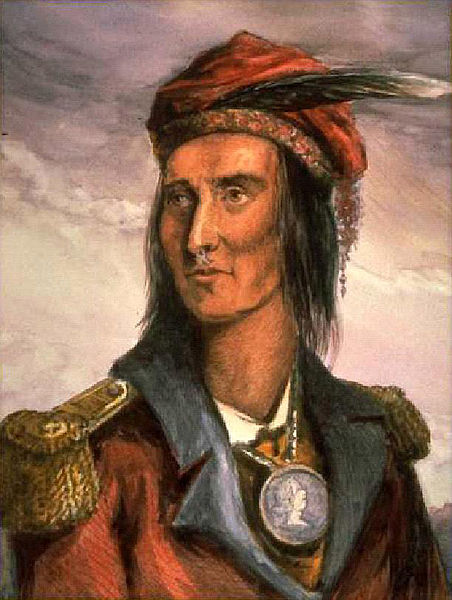
Tecumseh (March 1768 – October 5, 1813) was a Native American leader of the Shawnee and a large tribal confederacy (known as Tecumseh’s Confederacy) which opposed the United States during Tecumseh’s War and the War of 1812. Tecumseh has become an icon and heroic figure in American Indian and Canadian history.

Tecumseh grew up in the Ohio Country during the American Revolutionary War and the Northwest Indian War where he was constantly exposed to warfare.  With Americans continuing to encroach on Indian territory after the British ceded the Ohio Valley to the new United States in 1783, the Shawnee moved farther northwest. In 1808, they settled Prophetstown in present-day Indiana.

Tecumseh’s father was Puckshinwa (in Shawnee, Puckeshinwau, meaning “Alights from Flying”, “Something that drops” or “I light from flying”), a minor Shawnee war chief of the Kispoko (“Dancing Tail” or “Panther”) band and the Panther Clan of the tribe. Puckshinwa’s father was Muscogee (Creek) and his mother was Shawnee. Either because his father died when he was young or because among the Creeks a husband lives with his wife’s family, Puckshinwa was considered a Shawnee.

Tecumseh’s mother was Methotaske (in Shawnee, Methoataaskee, meaning “[One who] Lays Eggs in the Sand” or “A turtle laying eggs in the sand”), Puckshinwa’s second wife. She is believed to have been Shawnee through her father and her mother, possibly of the Pekowi band and the Turtle Clan.  Some traditions hold that she was Creek, because she had lived among that tribe prior to marriage; some hold that she was Cherokee, having died in old age living among that tribe; still others hold that she was a white captive, as family stories claim that Puckshinwa had been married to a white captive. Shawnee lineage was recorded paternally, which made Tecumseh a member of the Kispoko.

The fact that Tecumseh’s mother lived among, and died among, the Cherokee may well be the clue we need as to why we find Tecumseh’s name among Cherokee families, regardless of his mother’s original heritage.

At the time Tecumseh’s parents married, their tribe was living somewhere near modern Tuscaloosa, Alabama. The tribe had lived in that region alongside the Creek tribe since being driven from their homes in the Ohio River Valley by the Iroquois (based in New York and Pennsylvania) during the 17th-century Beaver Wars.

About 1759, the Pekowi band decided to move west into the Ohio Country. Not wanting to force his wife to choose between him and her family, Puckshinwa decided to travel north with her. The Pekowi founded the settlement of Chillicothe where Tecumseh was likely born. During the 1760s, Puckshinwa took part in the French and Indian War.

Tecumseh (in Shawnee, Tekoomsē, meaning “Shooting Star” or “Panther Across The Sky,” also known as Tecumtha or Tekamthi) was born about March 1768. His birthplace, according to popular tradition, was Old Chillicothe, the present-day Oldtown area of Xenia Township, Greene County, Ohio, about 12 miles east of Dayton.

As Old Chillicothe was not settled by the Shawnee until 1774, it is believed that Tecumseh may have been born in a different “Chillicothe,” which was the tribe’s name for its principal village, wherever it was located. Tecumseh is believed to have been born in a Chillicothe along the Scioto River, near the present-day city of Chillicothe, Ohio.

“As Pucksinwah stared at the sky on this night, he saw a huge meteor streak across from the north, leaving a trail of greenish-white flame. It lasted for fully 20 seconds and was unlike anything he had ever seen before. This was the Panther spirit that the old men sometimes spoke of, and a good sign indeed. As the women around the fire talked excitedly and pointed to the heavens, a baby’s cry came from the shelter. Usually a child was not named for several days while the parents waited for a sign to indicate what the great spirit Moneto wished the child to be called, but this child must surely be named Tecumseh, “The Panther Passing Across”. ”

—- Tecumseh: Xenia Township’s Most Famous Native, Alan King, 2000

Not long after Tecumseh’s birth, the family moved to the village of Scioto.

When Tecumseh was a boy, his father Puckshinwa was “brutally murdered” by white frontiersmen who had crossed onto Indian land in violation of a recent treaty, at the Battle of Point Pleasant during Lord Dunmore’s War in 1774. Tecumseh resolved to become a warrior like his father and to be “a fire spreading over the hill and valley, consuming the race of dark souls.”

At age 15, after the American Revolutionary War, Tecumseh joined a band of Shawnee who were determined to stop the white invasion of their lands by attacking settlers’ flatboats traveling down the Ohio River from Pennsylvania. In time, Tecumseh became the leader of his own band of warriors. For a while, these Indian raids were so effective that river traffic virtually ceased.

In early 1789, Tecumseh traveled south with Cheeseekau to live among, and fight alongside, the Chickamauga faction of the Cherokee. Accompanied by twelve Shawnee warriors, they stayed at Running Water, in Marion County, Tennessee. 

Tecumseh returned to Ohio in late 1790, having fathered a Cherokee daughter before leaving, according to Cherokee oral tradition.

Aha, a second clue as to why Tecumseh’s name might be found among the Cherokee.

Tecumseh spent the rest of his life attempting to congeal a Native Confederacy to oppose the whites and their relentless advances upon the Indian lands.  Tecumseh was a great orator and gave several speeches.  These excerpt sums his thoughts up pretty succinctly.

“As Tecumseh Brothers, When the white men first set foot on our grounds, they were hungry; they had no place on which to spread their blankets, or to kindle their fires. They were feeble; they could do nothing for themselves. Our father commiserated their distress, and shared freely with them whatever the Great Spirit had given his red children. They gave them food when hungry, medicine when sick, spread skins for them to sleep on, and gave them grounds, that they might hunt and raise corn. Brothers, the white people are like poisonous serpents: when chilled, they are feeble and harmless; but invigorate them with warmth, and they sting their benefactors to death.

Where today are the Pequot? Where are the Narragansett, the Mochican, the Pocanet, and other powerful tribes of our people? They have vanished before the avarice and oppression of the white man, as snow before the summer sun … Sleep not longer, O Choctaws and Chickasaws … Will not the bones of our dead be plowed up, and their graves turned into plowed fields?”

A comet appeared in March 1811. Tecumseh, whose name meant “shooting star”, told the Creeks that the comet signaled his coming. Tecumseh’s confederacy and allies took it as an omen of good luck. McKenney reported that Tecumseh claimed he would prove that the Great Spirit had sent him to the Creeks by giving the tribes a “sign.”

On December 16, 1811, the New Madrid Earthquake shook the South and the Midwest. While the interpretation of this event varied from tribe to tribe, one consensus was universally accepted: the powerful earthquake had to have meant something. For many tribes it meant that Tecumseh and the Prophet must be supported.

Tecumseh’s warriors fought with the British in the War of 1812.  On October 5, 1813, the Americans attacked and won a victory over the British and Native Americans at the Battle of the Thames, near Moraviantown near present-day Chatham, Ontario. During the battle, Tecumseh was killed, and shortly afterward, the tribes of his confederacy officially surrendered to Harrison at Detroit.  In 1837, in part because of reports that it was he who had killed Tecumseh, Richard Mentor Johnson was elected vice-president of the United States, to serve with Martin Van Buren.

Looking a bit further, quite a bit of scholarly research has been done as to the ancestry of Tecumseh.  No consensus has been reached, although the research is fascinating, but it’s clear that both the Creek and Cherokee were anxious to claim Tecumseh as their own, in addition, of course, to the Shawnee.  There are notations about people in both the Creek and Cherokee tribes being named for him.

You can read more about Tecumseh and his mother’s heritage at these links:

http://www.fantasy-epublications.com/shawnee-traditions/Genealogy/Tecumseh_Family/Tecumseh.html
http://en.wikipedia.org/wiki/Tecumseh

Posted in Cherokee, Chickamauga, Creek, Shawnee | 3 Comments

Tassell – Corn, Old, Young and George

The name of Tassell is legendary in Cherokee history.  I’m not surprised to find three families using that surname in the 1869 Cherokee West census.  Better stated, I’m surprised there were only three families using that surname.  One used just the name Tassell, and there were also a John and Aaron Tassell as heads of households. 

The “First Beloved Man” known as Corntassell or Old Tassell was the chief of the Overhill Cherokee after 1783.  He was murdered under a flag of truce in 1788 in the State of Franklin, along with another chief.  This was viewed as an atrocity by the Cherokee and certainly did nothing to facilitate peace.

Old Tassell’s brothers were Pumpkin Boy and Doublehead.  His maternal nephew was John Watts, also known as Young Tassell.

John Watts was a “mixed-blood” son of a Scots-Irish trader (who was also named John Watts, and was the official British government Indian interpreter for the area —until his death in 1770).  Young Tassell, a warrior, became very militant after the murder of his uncle.  In 1792, he was called to succeed as Chief of the Lower Overhill Cherokee after Dragging Canoe’s death.  In 1802, Young Tassell died and was succeeded as Chief by his uncle, Doublehead.

In 1830 in Georgia, a man named George Tassell, possibly a son of Old Tassell, was tried, convicted and executed for the murder of a white man on Indian land, while drunk. Since the Cherokee Nation was sovereign, Tassel deserved to be tried in a Cherokee court. The Cherokee Nation won a stay of execution from the United States Supreme Court, but the State of Georgia ignored the stay and executed him anyway. His legal case became the first Cherokee legal document to set precedence on behalf of Cherokee sovereignty. This case is still considered an important precedent for Indian sovereignty today.

The three Tassell families in the 1869 census are likely related to these famous Tassell Cherokees.  Genetically, John Watts descendants of course would carry the Watts Yline DNA, while Old Tassell’s descendants would carry his Yline DNA, which could well be haplogroup Q, or Native.

Posted in Cherokee | 8 Comments

Shotpouch

In the 1869 Cherokee West Census, there are two families who took the surname Shotpouch.  It’s interesting that before the European settlement, the Indians didn’t have firearms, so the word shotpouch would have been culturally new to them, 200 years after becoming armed, they took the Shotpouch surname.

What was a shotpouch?

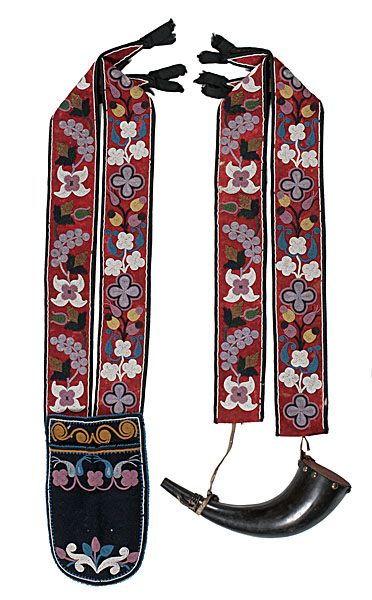
The earliest weapons required black powder which was carried in a powderhorn.  The shotpouch was the accessory that held the tools with which to load the gun from the powderhorn. 

I found some examples of Native shotpouches, but none as beautiful as this beaded Cree shotpouch and powderhorn set.  I do believe, given that it came through the family of the governor of Ohio, that it was probably given as a gift. 

This item was sold at auction for a measly $15,000 plus change.  You can read more about it here:

http://www.cowanauctions.com/auctions/item.aspx?ItemId=90953

Posted in Cherokee, Cree, Names | 1 Comment

Sequoyah

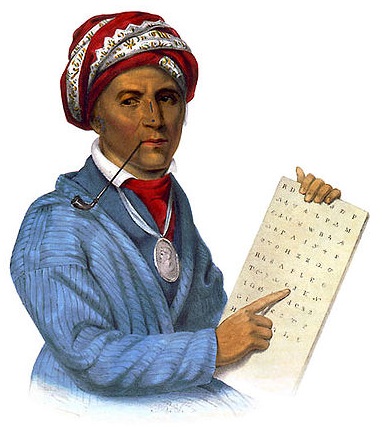
Most people have heard of Sequoyah.  He was arguably one of the most famous Cherokee.  He created a Cherokee alphabet in 1821, allowing the Cherokee language to be recorded and setting the stage for Cherokees to begin to be able to read in their own language. 

While working with the 1869 Cherokee West Census, I came across 4 families with that or a version of that surname.

  • Spirit Sequoh
  • Thomas Sequoh
  • John Sequohi
  • Sequoyah

Recognizing the name, it made me wonder if this was the original Sequoyah.

The original Sequoyah was born to a Cherokee mother, a member of the Red Paint Clan, in the village of Tuskegee sometime between 1760 and 1776.  The identity of his father has never been clear, but some sources say that it was Nathaniel Gist.  Sequoyah took the English name of George Guess also recorded as George Gist, so that is certainly possible.  Other various sources said his father was a Scotchman, a fur trader and a half breed. 

In 1825, Sequoah walked to the Cherokee lands in Arkansas and Oklahoma, setting up a silvershop there, as we was a silversmith.  In 1828 he accompanied a delegation to Washington DC to negotiate for land in the planned Indian Territory.

Sequoah died between 1843 and 1845 on a trip to Mexico seeking the Cherokee who had settled the during the Indian Removal in the 1830s.  Sequoah dreamed of a reunited Cherokee Nation.

So the people with that surname in 1869 could not have been the original Sequoah.  Sequoah did have children, at least 7, and had at least three wives and perhaps as many as 5.  He may have been polygamous as polygamy was accepted in the Cherokee Nation at the time.

Of the Sequoyah families living in Indian Territory in 1869, the families had 9 male children listed.  It would be very interesting to see if any of Sequoyah’s descendants, if any are known, or the descendants of these 1869 Sequoyah families, were they to DNA test, would match the Gist family.  If so, it would confirm the father of Sequoyah and that these families were his descendants.

Posted in Cherokee | 16 Comments

Polly Cooper, Oneida Heroine

Polly Cooper was an Oneida woman who repeatedly helped the soldiers serving in the US military, beginning with the Revolutionary War.  US records neither confirm or deny this oral history – but the Oneida people treasure the shawl given Polly Cooper for her selfless service in the face of adversity.

In the fall and winter of 1777/1778, the soldiers at Valley Forge were starving.  Oneida Chief Shenandoah (also spelled Skandoah and a number of other ways) arranged for corn to be delivered, and Polly was one of the women who delivered the corn, walking hundreds of miles to do so.  In addition, she stayed and nursed the sick men, teaching them about food and nutrition.  She showed the troops how to make a white corn soup to supplement their diets.   The Oneida’s corn made the difference between life and death for many men.

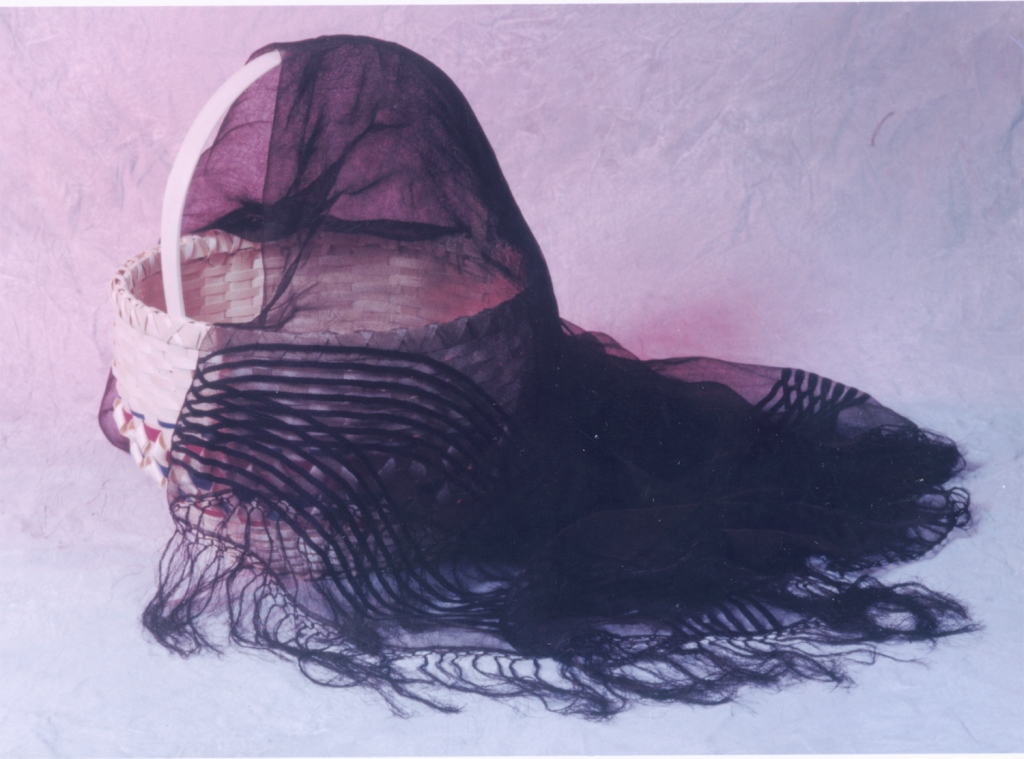
The legend says Polly would accept nothing for her services, so Martha Washington purchased a black shawl that Polly had admired and gave it to her.  That shawl, shown below, is still cherished today by her descendants and the Oneida Nation as well. 

But Polly wasn’t done.  The government records do confirm that one Polly Cooper cooked for the troops during the War of 1812 as well.  Oneida history tells us that this is one and the same person. 

You can read more about Polly Cooper here:  http://www.oneidaindiannation.com/culture/shako/exhibits/27015199.html

Posted in Military, Oneida | 8 Comments

Melungeons: A Multi-Ethnic Population

Congratulations to my co-authors Jack H. Goins, Penny Ferguson, and Janet Lewis Crain for the publication of our paper ‘Melungeons, A Multi-Ethnic Population’ published in the Journal of Genetic Genealogy, an academically peer reviewed publication.

I don’t know if many of our readers are familiar with the academic publishing process, but the peer review cycle is just brutal, often taking 18 months or so and many iterations before everyone is satisfied.  However, that cycle is intended to assure that the scientific evidence presented is sound, presented accurately without bias (intended or othewise) and has the blessing of the relevant academic scientific community.  Outside of academia, anyone can publish anything, but within the academic structure, certain scientific standards of evidence must be maintained, assuring the consuming public (as well as other academics and researchers) that they can have confidence in what has been published.  This is why we chose this route for publication.

The core Melungeon group themselves, as defined within the paper, does not have direct evidence of Native heritage using Y-line and mitochondrial DNA.  However, the Sizemore family is ancestral to some of these families, and the Sizemore line is genetically Native, although there is no traditional paper documentation.  Conversely, the Riddle family, also ancestral to some of the Melungeon families does have the paper documentation, but genetically proves to be of European origin.  Both of these families and several more are discussed within the paper.

Paper Abstract

Melungeon is a term applied historically to a group of persons, probably multiethnic, found primarily in Hawkins and Hancock Counties, Tennessee, and in adjoining southern Lee County, Virginia.  In this article we define the Melungeon population study group, then review the evidence from historical sources and DNA testing–Y-chromosome, mitochondrial DNA, and autosomal DNA–to gain insight into the origin of this mysterious group.

Paper Introduction

The Melungeons were a group of individuals found primarily in Hawkins and Hancock Counties of Tennessee and in the far southern portion of Lee County, Virginia which borders Hawkins and Hancock counties in Tennessee.  At one time isolated geographically on and near Newman’s Ridge and socially due to their dark countenance, they were known to their neighbors as Melungeons, a term applied as an epithet or in a pejorative manner.

As the stigma of a mixed racial heritage dimmed in the late 20th century and was replaced by a sense of pride, interest in the genealogy and history of the Melungeon people was born.  With the advent of the internet and popular press, the story of these people has become larger than life, with their ancestors being attributed to a myriad of exotic sources: Sir Walter Raleigh’s Lost Colony, Ottoman Turks, The Lost Tribes of Israel, Jews, Gypsies, descendants of Prince Madoc of Wales, Indians, escaped slaves, Portuguese, Sir Francis Drake’s rescued Caribbean Indians and Moorish slaves, Juan Pardo’s expedition, De Soto’s expedition, abandoned pirates and Black Dutch, among others.  Melungeon families themselves claimed to be Indian, white and Portuguese.

Furthermore, as having Melungeon heritage became desirable and exotic, the range of where these people were reportedly found has expanded to include nearly every state south of New England and east of the Mississippi, and in the words of Dr. Virginia DeMarce, Melungeon history has been erroneously expanded to provide “an exotic ancestry…that sweeps in virtually every olive, ruddy and brown-tinged ethnicity known or alleged to have appeared anywhere in the pre-Civil War Southeastern United States.

Formation of Melungeon DNA Project

The Core Melungeon DNA Project was formed at Family Tree DNA in July of 2005 with the goal of testing the Y-line and mitochondrial DNA of families identified as Melungeon.  The first step was to define which families were Melungeon and were eligible to be included.

The popular press has extended the definition of Melungeon dramatically.  The project administrators researched various records to determine where the label of Melungeon was actually applied, and to whom.  They found the word first recorded in 1810 and used for the next 100 years or so, primarily in Hawkins and Hancock Counties in Tennessee, and slightly into neighboring counties where the Melungeon family community reached over county and state boundaries into Claiborne County, Tennessee, and Lee, Scott and Russell Counties in Virginia.  The project was subsequently broken into Y-line and mitochondrial DNA projects, and in 2010, a Melungeon Family project was added with the advent of the Family Finder product.

The paper can be read/downloded here:

PDF Format:

http://www.jogg.info/72/files/Estes.pdf

HTML Format:

http://www.jogg.info/72/index.html

If you’d like to take a DNA test, click here.

Posted in Melungeon | 7 Comments

Freeman

The slaves of the Cherokee who were freed after the Civil War were called the Freedmen.  Therefore, I expected the surname Freeman or similarly spelled names to be rampant in the 1869 Cherokee West Census but they weren’t.  Not only that, but there is a great irony at play here.

There were three Freeman families, one that is Indian (not negro), one that is white, and one that is noted as “colored persons not entitled to citizenship.”  Of these people, not one is a black person entitled to citizenship within the tribe.

Posted in Names | 29 Comments

Decisions, Decisions – What Constitutes a Native Name??

In these old records, it’s sometimes hard to distinguish a Native name versus a name that is being used as a last name, or a name in transition between the two.  It really doesn’t matter which records you’re working with, the decisions are the same.

From the 1869 Cherokee West Census, here are three examples and what I’ve done with them.

When there is no first name and the names are still spelled with hyphens, I am counting them as Native language names and not including them.  Keeping in mind my goal is for people to be able to take a surname and look it up, these seem very unlikely to be productive.  An example would be the single name Ar-Qua-Ta-Kee.

When there is a first name with a second name, regardless of whether there are hyphens or not, I’m counting it as a surname.  Often, the hyphens simply disappear with time and the Native name or something similar becomes the last name.  While this isn’t always true, I’ve seen it often enough that when a first name is in evidence, it shows that the “name adoption” process is taking place.  Worst case, I’ve typed way too many names.  Best case, it really should be included, and it is.

In the third case, where there is a first name only, I’m recording it as a surname.  While this seems counter-intuitive, I’ve seen several cases where I was able to follow individuals through time when dealing with chiefs signing treaties and such, that what was initially the first name becomes the last name, probably in the second generation when “Jack” had two sons and one became Bob Jack and the second one Billy Jack. 

Is this the right decision?  I’ll probably never know for sure….but that’s what decisions are about….trying to create some order out of disorder.

Posted in Names | 1 Comment

Allison Family in the 1869 Cherokee West Census

The Allison family isn’t particularly unusual in these records, that’s why I’m using them for an example.

There were 4 families with that surname.  We have no way of knowing if they are related to each other, based on the census.

There were several census districts, and these families are found in three different districts.

Jack Allison is simply called a colored person. From this we can conclude that he is a Freedman because it does not say he is ineligible for citizenship.  He may have belonged to one of the other Allison families before obtaining his freedom….or not.

In another district, we find James Allison with 1 female adult 1 male child and 2 female children.  He is designated as “whites with Cherokee families.”  So from this, we know that James is white and his wife is Cherokee.  His female children will carry their mother’s Native mitochondrial DNA, assuming her mother is genetically Native, and their male child will carry his non-Native DNA.  Based on what this record says, we’ll assume his DNA is European. 

The next two are in the same district, which is a different district from the two above.

J.R. Allison is noted as “whites not entitled to citizenship.”  So from this, we know that he is not married to a Native woman, or a Cherokee tribal member.  Remember that whites can be adopted into the tribe, and if he was married to a white woman adopted in to the tribe, she would be considered Native and he would be eligible for citizenship based on her tribal status.

Another person, M.T. Allison is noted as a “Cherokee who is not citizenized – NC.”  This means that they are a member of the Eastern Cherokee band, not the Western band.  This could prove quite confusing for someone looking for M.T. and his tribal membership. One would not think to look in the West for an eastern band member, or vice versa. 

Of these four people, we know that one is “colored” but would later be found among the Cherokee as a Freedman.  One is white but has a Native family and will therefore be found in the tribal records as well.  One is white and will not be found among the records and one is Native but won’t be found in the western records, but the eastern band instead.  Of course, those two using initials only will be devilishly hard to find anyplace.

It’s nice to be able to analyze this type of information.  However, it tells us a lot about the pitfalls of making assumptions when we don’t have this type of detailed information.  What this information doesn’t tell us is anything about admixture. It’s very likely that some of these people who are labeled “white”, “Native” and “colored” are already admixed.  That, unfortunately, we will never know from these records.  That information, if available at all would be on the 1900 Indian census schedule or, in some cases applications such as for the Guion Miller rolls and the Eastern Cherokee Applications.

Posted in Cherokee | Leave a comment

Indian Pioneer Papers Collection – Oklahoma

This fully indexed collection is available to everyone online.  This is what my friend and I call “candy.”  That’s because when you start, you can’t stop.  So I hope you don’t have anything else that has to be done today, cause once you click….it’s all over.

http://digital.libraries.ou.edu/whc/pioneer/

The Indian-Pioneer Papers oral history collection spans from 1861 to 1936. It includes typescripts of interviews conducted during the 1930s by government workers with thousands of Oklahomans regarding the settlement of Oklahoma and Indian territories, as well as the condition and conduct of life there.

The great thing is that the collection is indexed by every name in the document, so you may find information about your family buried in someone else’s interview.

Enjoy!

Hat tip to Elaine for sending this and for keeping me up half the night in the candy store:)  Guess I can’t complain too much because she was up doing the same thing!

Posted in History, Oklahoma | Leave a comment