Fayetteville Observer 1885 Croatan Article

This article was written by Roberta Estes and originally published in the Lost Colony Research Group Newsletter. www.lostcolonyresearch.org

Thanks to our member Chris for posting this article in our Yahoo group.  I’ve taken the liberty of transcribing it here.  Please note that at that time the Lumbee were known as the Croatan Indians.  The article appeared in the Fayetteville Observer on Feb. 12, 1885 and reads, in part, as follows:

“The colony had disappeared leaving no trace except the word Croatan cut into the bark of a tree.  No authentic record of the colony has ever been found.  It disappeared from history as if it had never been.

Now Mr. McMillan says that these Croatan Indians of Robeson County claim to be the descendants of the white colony by intermarriage with the whites.  They say their traditions say that the people we call the Croatan Indians (though they do not recognize that name as that of a tribe, but only a village, and that they were Tuscarora) were friendly to the whites; and finding them destitute and despairing of ever receiving aid from England, persuaded them to leave the island and go to the mainland.  They intermarried with the whites, learned the English language and abandoned their own tongue.  They gradually drifted away from their seats and at length settled in Robeson, about the center of the county.  The first deed extant for that county was issued in 1732 to Henry Berry and James Lowery, progenitors of the famous Henry Berry Lowery.

Mr. McMillan says they preserve the English language in the way spoken in the days of Chaucer using many words obsolete or only spoken in the rural districts.”

Posted in Croatoan, Hatteras, Lumbee | Leave a comment

Melungeon Myth of Drake Dropping Off Passengers on Roanoke Island

This article was written by Janet Crain and originally published in the Lost Colony Research Group Newsletter in August, 2012.  www.lostcolonyresearch.org

A myth exists on the Internet that the Melungeons, a group of dark skinned persons of mysterious origins found living in East Tennessee two hundred years ago descended from Turkish prisoners and sundry other non-English persons said to have been rescued by Sir Francis Drake during the sacking of Cartagena and then deserted on Roanoke Island in 1586. In truth, there is NO evidence there were any left behind there, much less several hundred. This myth was introduced in a book published in the 1990’s by Brent Kennedy titled The Melungeons: The Resurrection of a Proud People : An Untold Story of Ethnic Cleansing in America.

This book might have languished in obscurity on the shelves of a few libraries and book stores had it not been for the Internet and the new found surge of interest in genealogy. Suddenly everyone fancied him or herself a Melungeon.  Several Unions were held of people from various mailing lists and persons attending were happily discovering knots on the back of their head, thought to indicate Turkish ancestry. Having someone in your Family tree who possessed six fingers was a definite plus. These traits were all described in the afore-mentioned book.  No one ever looked closely into the incident said to have occurred in 1586. But that is precisely what this paper intends to do.

In the sixteenth century, Sir Francis Drake was one of the most famous men in England, indeed the English speaking world and beyond. He could do no wrong in his Queen’s eyes. He had brought her an enormous return on her personal investment in an earlier voyage. A brilliant man in many ways, Drake was ruthless, but highly admired by the captives he had freed and the Maroons who came to his aid to help him fight and share in the rewards. 

Drake was returning home from the sacking of Cartagena when he decided to visit Roanoke and dispose of some of the freed prisoners and Maroons he had acquired during his adventures.  He was carrying a human cargo of some several hundred.  Ivor Noel Hume in “Virginia Adventures” contends Drake highly inflated the numbers. The voyage had not been financially successful in spite of his daring and flamboyant actions. It is quite likely he was advancing his case by sending back reports of greater exploits than actually had occurred. There were reports of many nationalities released from the
Spanish prisons as well as Maroons who had come in from their strongholds in the surrounding areas to help Drake as he was known to be generous with the spoils of his marauding. Alas this voyage would not compare to previous ones.

This voyage is of great interest to Melungeon researchers because this voyage in 1586 is the basis of the Turkish connection first started by statements in Brent Kennedy’s book.  It is, in fact, the keystone of the Turkish Connection Theory.

Remove it and the rest crumbles. That is what I propose to do.

It is known that many of the people with Drake never reached Roanoke.  Many died of  strange fevers in Florida. These fevers were the scourge of sea travel at that time. Caused in part by the crowding together of humans in the cargo holds of ships where the fetid air trapped and spread any contagious disease like wildfire, and probably exacerbated by nutritional deficiencies. 

In any case, reports contend that anywhere between 350 and 750 people died of these fevers. Apparently Drake intended to leave the rest of the freed Africans and South American Indians to furnish labor for the new Colony on Roanoke which he expected to have grown to some 600 English by then. In truth there were only about 100 men, badly in need of food and suffering the ill effects of their bad treatment of the local Indians.

Ralph Lane was in charge at Roanoke and he accepted Drake’s offer of minimal food supplies (Drake had been out a long time and was running low himself) and a ship, the
Francis, capable of navigation into the bay plus other pinnaces, etc. And armament. All the supplies were loaded onto the Francis along with Lane’s best naval officers. Lane wanted to stay a few more weeks exploring the Chesapeake.

Hume states:

“When on June 11, the two men (Francis Drake and Ralph Lane) exchanged their unsettling news, several truths became evident; Drake was not there (as the Roanoke settlers had first hoped) to resupply the Colony; he was short of food himself and so was better able to supply guns than butter. Futhermore, Lane could not have had any desire or ability to house 250 blacks who would out number his white settlers two to one.”

They came to an agreement whereby Drake would leave skilled workers, artisans, two pinnaces, several small boats and a large ship, the Francis.  All the supplies were loaded onto the Francis along with the skilled mariners needed to sail such a ship. Immediately a terrible hurricano struck and it was every man for himself. The ships standing out in the roadway (deep water significantly offshore) cut and ran, scurrying out to the deep ocean to get away from the treacherous shoals and currents, dangerous enough in good weather. The Francis was among those who sailed on to England.

Ralph Lane then accepted Drake’s offer to transport the first colonists back to England. Most of the small pinnaces carrying the extra passengers had been dashed to pieces on the shoals during the storms. The Turks, known to have been with Drake, were apparently better safeguarded. They were valuable as trade for English prisoners languishing in Ottoman prisons. Some 100 Turks were, in fact, ransomed to their homeland after Drake’s return to England.

So, just who might have gone ashore before the storm hit? Many people have a hard time visualizing the scene at Roanoke. Roanoke is surrounded by very shallow waters, hence the name; Shallowbag Bay. The only way to get there was by laborious offloading of men and supplies to shore boats and threading through the one pass, Fernando Pass, and the treacherous shoals and currents made worse at times by Northeastern winds blowing directly into the Bay. The shore boats were large by our standards and equipped with a mast and sail. They require a skilled pilot and several strong sailors to row. People didn’t just hop on one and go sight seeing. Only those with important business such as Sir Francis Drake and Ralph Lane who negotiated several times were transported back and forth. The rest of the fleet with the passengers onboard stood out in the roadway, the navigable waters off the Outer Banks, which wrap around this area like protecting arms.

I am saying this to lay to rest the idea of a huge number of the passengers disembarking and perhaps being caught off guard by the storms and staying behind. Hume and David Beers Quinn are the authorities on this period and both say there were no Turks left.  Hume says no one else, Quinn, at most a very few. Left with no supplies on the Outer Banks what would they have found to eat? If the Indians had not killed them, they would have starved.

It should be noted that the Native Americans communicated by a “grapevine” so efficient that Indians in Canada knew of happenings in the Virginias. No mention of any dumped off passengers was ever made.

Additionally, there was plenty of room for these passengers to sail with Drake. Hundreds had died in the battles in Florida, from fevers, and in the hurricane. Drake was returning with more ships than he left England with, having captured many more than he had lost. These men would have furnished badly needed labor to help sail these ships back to England.

Add to this the extreme difficulty of unloading these passengers in addition to loading the Roanoke settlers, which the crew deeply resented for the delay and extra work and danger this imposed and it is highly unlikely Drake would have taken such actions in the middle of a three day hurricane.

Ivor Noel Hume says:
 
“Thus the hurricane of June 1586 may have ripped away the first page from the history of blacks in English America.

A cruel and terrible fate for these forgotten people that historians of the time did not consider important enough to even record their fate.”

Two weeks later an emergency supply ship sent by Sir Richard Grenville arrived and found no one although they searched diligently. They left to return to England.

Another one or two weeks later a big supply ship arrived with Grenville on board. They were as mystified at the deserted condition of the island as the men on the earlier supply ship. They searched even further “into the main” (mainland) and as far as Chesapeake. Grenville was heavily invested in this first colonization effort, having sold an entire estate (consisting at this time as a manor house and every type of supporting industry needed to run the estate; mills, stables, barns, houses, dairies, animals, tools, even small villages) to finance the settlement of over 100 men for over a year. It was a
requirement of Raleigh’s patent from Queen Elizabeth that the area be occupied  continuously by English people. Finding no one and not knowing where the original colonists had gone, he left some 15 soldiers to hold the fort. Based upon later interviews with Indians, they all perished.

It is quite clear they found no one who could have been the passengers Drake was previously carrying.

As previously stated the Indians had a very effective rumor mill which carried news far and wide. It is just inconceivable that these people could have survived unnoticed when their appearance would have been a matter of great curiosity among people who had never seen African natives.

Thus it seems there is no evidence that any people were left behind in the Colony and documented evidence that 100 Turks were returned to their homeland.
 
Resources:

The Virginia Adventurers by Ivor Noel Hume Copyright 1994 p. 53
Corbett, Spanish War. Refers to the return of 100 ex-galley slaves to the
Turkish dominions.

William S. Powell, North Carolina through Four Centuries, p. 42. Refers to
Queen Elizabeth’s reason for returning the Turks.

David Beers Quinn, Roanoke Voyages. Cites Wright in footnote regarding Turks

Wright, Further English Voyages. Source of Quinn’s information about Turks.
Hakluyt Society for 1975, Second Series, No. 148, p. 202, Note 3.

Sir Francis Drake’s West Indian Voyage, 1585-1586. A detailed and authoritative
account.

Acts of the Privey Council, 1586-87, PP. 205-206. (Public Record Office
[London]), PC 2/14:169) Contains a letter from the Queen’s Privey Council
addressed to a merchant in London, who traded with Turkey, that asks him to
make arrangements for the return of 200 Turks to Turkey.

Document 10, The Primrose Journal (British Library Royal MS.7C,xvi, folders
166-173. Capt. Frobisher’s journal of the 1586 Drake-led voyage. Mentions
Turks being aboard his ship.

David Beers Quinn Set Fair for Roanoke

David Beers Quinn The Roanoke Voyages 1584-1590

Posted in History, Lost Colony, Melungeon, North Carolina, Virginia | 2 Comments

The Riven Coffins

This article was written by Roberta Estes and originally published in the Lost Colony Research Group Newsletter in August, 2012.

I have attached a short compendium of information about the coffins discovered in Beechland in Tyrrell County, NC.  The one mention of a coffin found at Brigand’s Bay on Hatteras Island has been refuted and appears to be in error.

1950s – Beechland Riven Coffins

In “A Search for the Lost Colony in Beechland” by Phil McMullan, on page 15, he discusses the Riven Coffins accidentally excavated there.  From “Legends of the Outer Banks and Tarheel Tidewater” by Judge Charles Whedbee in 1966:

“Within the memory of men still living, there was at Beechlands (sic) a tribe of fair-skinned, blue-eyed Indians.

A few years ago when the West Virginia Pulp and Paper Company was doing some excavating for timbering purposes, they had to dig into a rather large mound near Beechland.  In this mound, in the heart of the wilderness, they found numerous Indian artifacts, arrowheads, works of pottery, and potsherds.

They also found riven coffins that were made from solid cypress wood.  They were in a form that can best be described as two canoes – one canoe being the top half of the coffin and the other canoe being the bottom half.

On top of each of these coffins was plainly and deeply chiseled a Roman or Latin cross, the type that has come to be universally and traditionally accepted as the cross of Christianity.  Beneath each cross were the unmistakable letters I N R I.  These are thought to represent the traditional “Jesus Nazarenus, Rex Judaeorum” or translated, “Jesus of Nazareth, King of the Jews”, the inscription which adorned the cross of Christ at the time of the crucifixion.  It was common practice in Elizabethan times to write the letter I for the letter J. It was simpler and was accepted by the literate people of that day.  A riven coffin with English carving buried in the midst of a wilderness in an Indian burial ground – is that coincidence?”

McMullan goes on to say:  “Although there were several known 19th century graveyards in the Beechland and Sandy Ridge Vicinity, no one had ever before reported a graveyard near this site.”

McMullan discussing Mary Wood Long’s work, “The bottom section was carved so that a wooden pillow was provided for the headrest.  The coffin was wider at the shoulder section, narrower toward the foot.  Mr. Kemp decided that 5 of the coffins had been damaged and torn apart by his machine.  There were no descriptive marks on the coffins other than the tool marks struck into the wood as the coffins were built.   If anything had remained within the coffin, it was washed out into the swamp water when the scoop cut through the top section.  The cemetery was on a high knoll approximately 30 feet in diameter surrounded by swamp water and marsh at a depth of 5 feet.  The men decided it was a family burial plot dating from the time of the first settlers of Beechland.  Mr. Mann selected a site on high ground near the canal and reburied the portions of the old casket.”

Another report from David Mann, a supervisor at the site said that high water prevented the observation of the coffin remnants reported to be protruding from the canal bank.

P 18 – Bill Sharp in his 1958 “New Geography of North Carolina” states that there was once a thriving community in Beechland on Mill Tail Creek where planters cultivated a 5000 acre tract on which corn, a wheat like grain and a variety of tobaccos were harvested.  Shingles were cut from the forest and a canal dug by slave labor was used to move them to Alligator River from Beechland.

Cattle roamed 25,000 acres of reed lands.  Sharpe said the settlement disappeared before the Civil War.  His sources believed that a cholera epidemic caused its disappearance.

Victor Meekins, a journalist interviewed Beechland descendant Marshal F. Twiford for a 1960 article printed in the Raleigh News and Observer.  Twiford, born in 1876 told Meekins:

“Old people always told me that older people before them said that the Beechland settlement was founded by the English who ran away from Roanoke Island.  (RJE note – could this be Grenville’s 15?)  My grandfather who came over from Kitty Hawk much later lived there and married a full blooded Indian from Beechland.  When I was a boy, there never seemed to be any mystery about this settlement, for the old folks took it for granted that everyone knew it.  I used to go up there when I was a boy, and there were still several houses standing in Beechland. Most of the houses were log houses, and some had dirt floors.  You reached it by paddling up Milltail Creek about 10 miles from the Alligator River.”

Twiford recalls Beechland families with names similar to the colonists such as Dutton, Sutton, Paynes, Paines, Whites and Sanderlins.  He also remembered families of Sawyers, Edwards, Owens, Basnights and Ambroses.  In the article, Meekins said that he has heard similar stories over the 50 years that he had been a reporter in Dare County.  “It has been told by many people and a dozen old citizens of East Lake who would not be close to 100 years old have repeatedly told the story as Twiford tells it.”

In the 1960 Virginia-Pilot article itself Twiford said, “I saw one of those coffins opened.  It had been dug up accidentally by a bulldozer.  The top and bottom had been fitted together and fastened with pegs.  All I saw inside was a little ashes or dust.  It ought to have been examined for buttons or other objects but it wasn’t.  The men reburied it and the bulldozer crew circled around the graveyard.”

P 93 – 1950s – In “The Five Lost Colonies of Dare” by Mary Wood Long, she says that “the most dramatic discovery has been the coffins unearthed during a canal dredging operation, as West Virginia constructed its excellent series of roads and canals as part of its forest reclamation and development.

M.F. Kemp was operating the drag-line near the site of ancient Beechland when he struck a section that had been used as a burial ground.  His scoop brought up board-like tree sections and had moved forward into the site before Mr. Kemp realized what had happened.  He stopped the machine as it held a long object which he identified as a coffin.  This coffin was almost complete although the top had been broken by the dragline.  It was about 4 feet long and was hand carved from 2 sections of a log, one serving as the bottom of the coffin and one as the top; these were pegged together.  The bottom section was carved so that a wooden “pillow” was provided for the headrest.  The coffin was wider at the shoulder section, narrower toward the foot.  Upon examination of the other boards or coffin sections, Mr. Kemp decided that 5 other coffins had been damaged and torn apart by his machine.

There were no descriptive marks on the coffins other than the tool marks struck into the wood as the coffins were built.  If anything had remained within the coffin, it was washed out into the swamp water when the scoop cut through the top section.  Mr. Kemp stopped work, and returned to the West Virginia office, where he reported what he had found.  James Mann returned with him to the site, and together they investigated the area.  The cemetery was on a high knoll approximately 30 feet in diameter.  It was surrounded by swamp water and marsh at a depth of 5 feet.  The men decided it was a family burial plot dating from the time of the earliest settlers of Beechland.  Mr. Mann selected a site of high ground near the canal and the portions of the old coffins were reburied.

Mr. Mann inquired about the burial site and none of the older residents of the Mann Harbor or East Lake area could remember every hearing of a cemetery at that spot.  If the site had been known, said Mr. Mann, the road and canal would have been routed about it rather than desecrate a burial site.  All the residents he talked with felt that the type of coffin and its construction could have come only from the early settlers of the 18th century.”

Posted in History | Leave a comment

Hatteras Live Forked Oak Stump

This article was written by Roberta Estes and first published in the Lost Colony Research Group Newsletter in July, 2012. 

The Indian Village on Hatteras Island was granted to William Elks and the Hatteras Indians in 1759.  They were already living there as had been demonstrated in a 1756 NC legislative record wherein Thomas Elks complains that Thomas Robb is infringing on the Indian’s lands.  Robb’s response was that he wasn’t infringing on anything because the Indians didn’t have a land grant or patent.  In 1759, that small detail was taken care of when William Elks was granted the 200 acres on Hatteras Island where the Indian town was located.

In 1771, William Elks sold 50 acres of this land to George Clark, and the beginning survey marker was a forked live oak stump.

Currituck Deed book 3 deed [406], p. 340: 25 July 1771, Dec [–], 177[–]; WILLIAM ELKS of CT, planter to GORGE CLEARK of CT, cons. 50 pounds proc., 50A, on Hatarass Banks, beg at a forked live oak stump, “running ye sd: Courses of the patron;” wit: THOMAS OLIVER, JOHN SCARBROUGH, THOMAS MILLER, Junr., jurat; signed: WILLIAM [E] ELKS.

So, ask yourself, what are the chances of that forked Oak stump still existing today?  We do know where this land is today and we know the approximate location of this stump, but could we find it? 

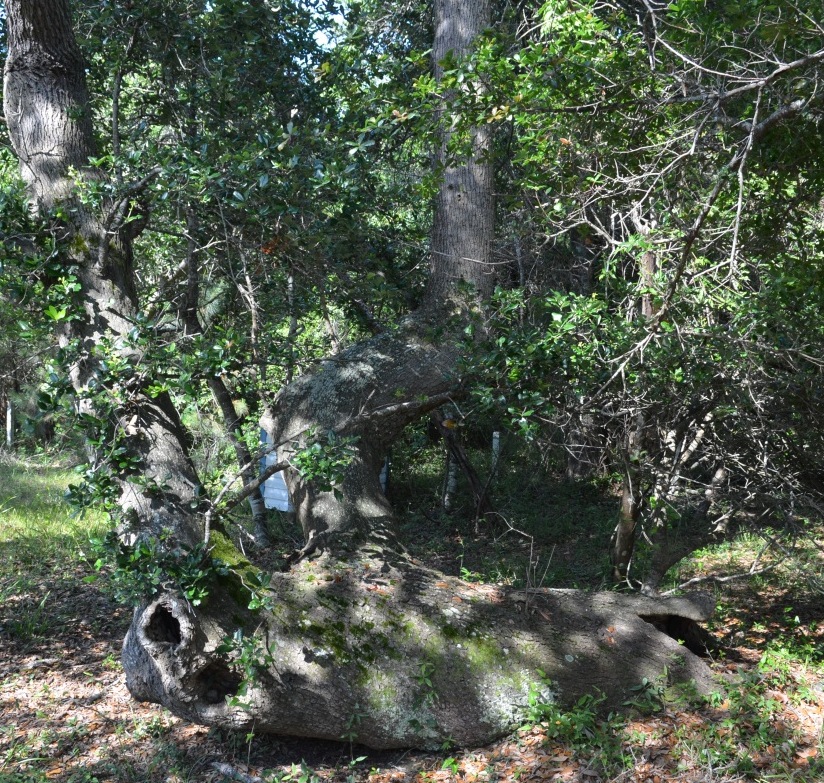
In the photo below, this tree is exactly where, using today’s property lines, we think the forked stump should be.  But it’s not a stump and it doesn’t appear to be old enough, although we’ve been cautioned by tree experts not to compare Hatteras trees to other trees when determining age because the environment tends to stunt Hatteras trees, so they are older than they appear.


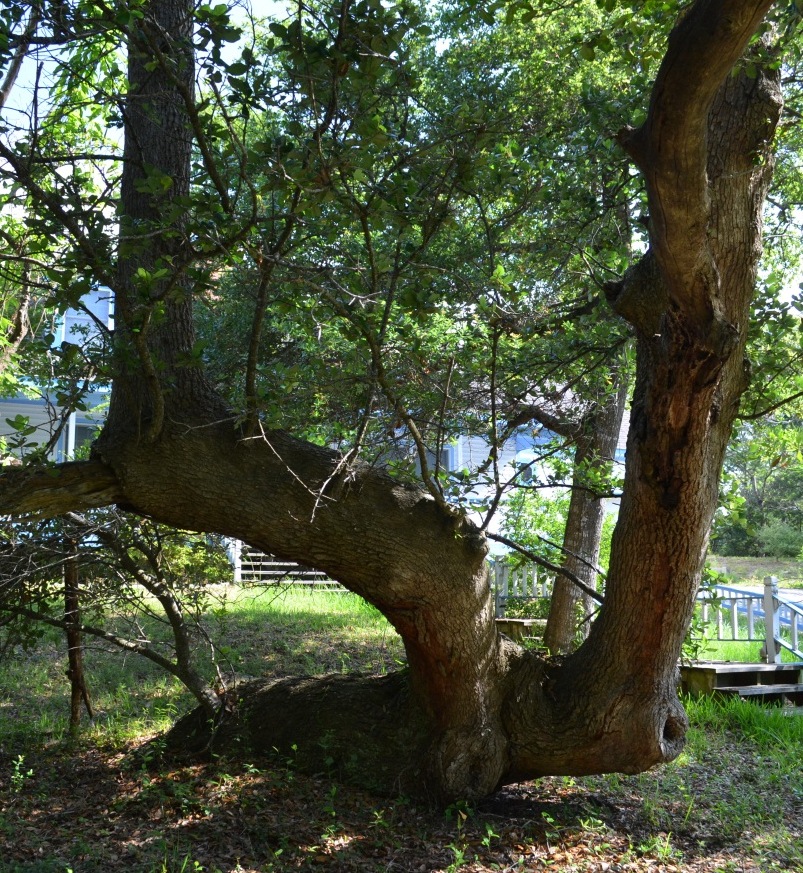
However, look what we found just a few feet away, not exactly where we thought it should be, but very close.  We also have to take into consideration that the survey equipment of the 1600s wasn’t as accurate as what we have today, nor were the surveyors as precise.  It appears that the 200 acre land grant actually contained significantly more acreage.

This surely looks like a forked live oak stump, and it’s old, quite old.  Could this be the actual boundary marker tree in question?  You can see the fork quite well in the next photo.  What tales and secrets this tree could tell if it could only talk.


Posted in Hatteras | Leave a comment

Fort Branch on the Tuscarora Indian Reservation

This article, written by Roberta Estes and Baylus Brooks, was first published in the Lost Colony Research Group Newsletter in July, 2012.

“Are you up for a challenge?”, I asked Baylus.  “Actually, this might not be much of a  challenge for you.” 

The hubbub related to the discovery of the fort icon on John White’s map had died down and it had nearly been forgotten as yesterday’s news, when a discovery in a document brought it to the forefront again.

I had been transcribing Tuscarora deeds in Bertie County and guess what I came across?  A reference to “Fort Branch.”  I’d really like to know where this Fort Branch is/was in relation to the Tuscarora reservation in relation to John White’s map with the fort.  Maybe it’s a different fort….or maybe it’s not.  So I asked Baylus, “Do you want the info to work with?  Is this tempting to you????”  Of course, I knew the answer.

Here’s the deed that started this little expedition:

Book S, p 690/691 – Indians to Johnston – June 15, 1803 Sacarusa and Longbeard, Chief of the Tuscarora Nation to Samuel W. Johnston – beginning on the bridge on the Fort Branch, up the said branch to the mouth of a branch, down the branch to a maple near Mrs. Pughs…containing 10 acres…to pay yearly one cent on demand on Dec. 25th. – leased until 1916.

Signed Sacarusa and Longboard (sealed, no Xs), witnesses William W. Johnston and Frances Pugh (X).

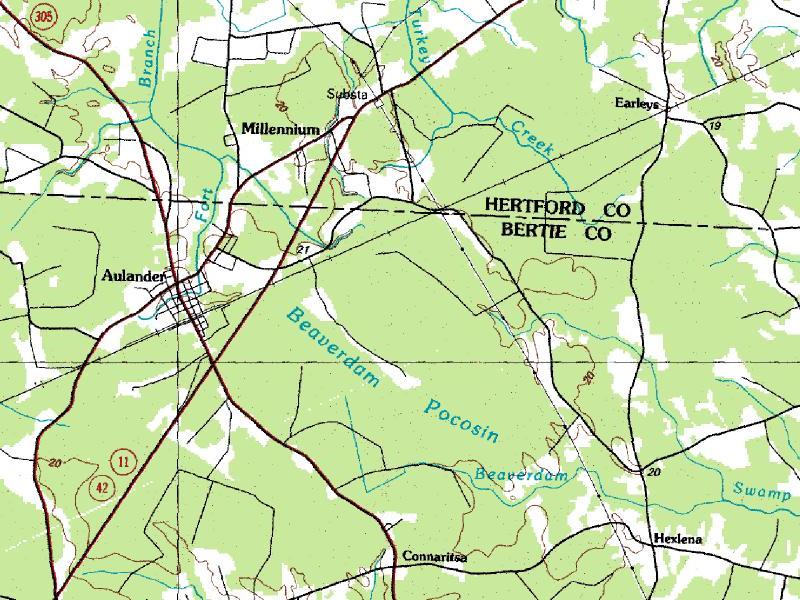
Baylus says, “I’m finding “Fort Branch” as a reference to a waterway/creek near the town of Aulander at the Bertie/Hertford County line, about 25 miles NW from the location of the fort on White’s map.  I’ve included a topo map showing it. 

The reference in the deeds is similar to the reference to “Cow’s Branch” that’s often mentioned with it and I think the “branch” parts is just a reference to a branch of water.  I believe this is a creek, but it may refer to an earlier fort built on that creek or branch.  It’s just west of Ahoskie, though and not a place that Ralph Lane would have visited (too far inland).” 

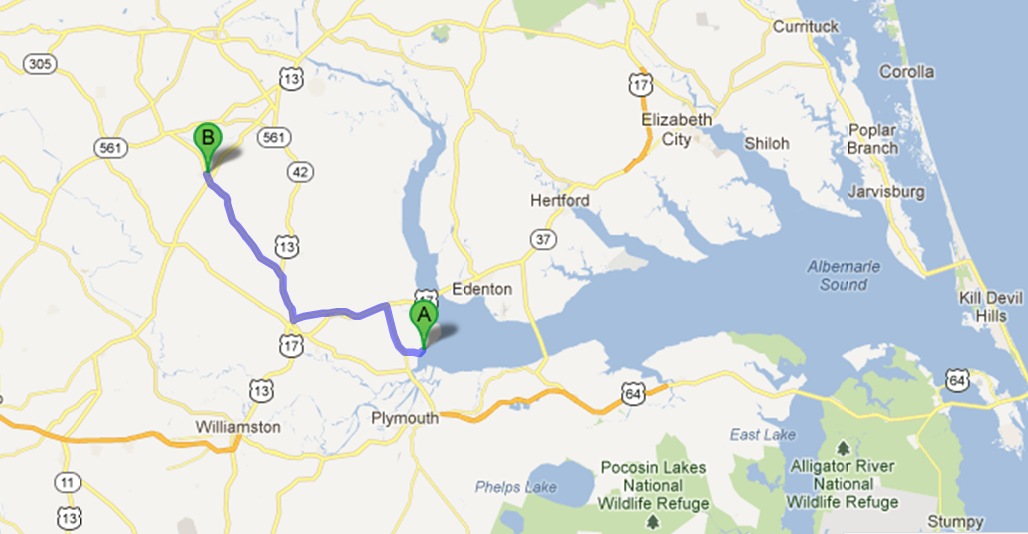
On the google map below, you can see that it’s about 35 miles today, as the car travels, from Aulander, which is location B, to the area where the fort icon on the map was located, balloon A.

Then, there’s an actual military “Fort Branch” on the Roanoke River built by the Confederates in 1861: http://www.albemarle-nc.com/martin/fortbranch/  This site has a map of Fort Branch on it, located between Williamston and Plymouth on Hwy 64. 

The fort on Fort Creek might be explained (as a Nottoway Indian fort) by the following:

William Byrd’s Westover Manuscript, p.34-36:

[April] 7th [1728]. The next day being Sunday, we ordered notice to be sent to all the neighbourhood that there would be a sermon at this place, and an opportunity of christening their children. But the likelihood of rain got the better of their devotion, and what, perhaps, might still be a stronger motive of their curiosity. In the morning we despatched a runner to the Nottoway town, to let the Indians know we intended them a visit that evening, and our honest landlord was so kind as to be our pilot thither, being about four miles from his house. Accordingly in the afternoon we marched in good order to the town, where the female scouts, stationed on an eminence for that purpose, had no sooner spied us, but they gave notice of our approach to their fellow citizens by continual whoops and cries, which could not possibly have been more dismal at the sight of their most implacable enemies. This signal assembled all their great men, who received us in a body, and conducted us into the fort. This fort was a square piece of ground, inclosed with substantial puncheons, or strong palisades, about ten feet high, and leaning a little outwards, to make a scalade more difficult. Each side of the square might be about a hundred yards long, with loop-holes at proper distances, through which they may fire upon the enemy. Within this inclosure we found bark cabins sufficient to lodge all their people, in case they should be obliged to retire thither. These cabins are no other but close arbours made of saplings, arched at the


Page 35

top, and covered so well with bark as to be proof against all weather. The fire is made in the middle, according to the Hibernian fashion, the smoke whereof finds no other vent but at the door, and so keeps the whole family warm, at the expense both of their eyes and complexion. The Indians have no standing furniture in their cabins but hurdles to repose their persons upon, which they cover with mats and deer-skins. We were conducted to the best apartments in the fort, which just before had been made ready for our reception, and adorned with new mats, that were very sweet and clean. The young men had painted themselves in a hideous manner, not so much for ornament as terror. In that frightful equipage they entertained us with sundry war dances, wherein they endeavoured to look as formidable as possible. The instrument they danced to was an Indian drum, that is, a large gourd with a skin braced tight over the mouth of it. The dancers all sang to the music, keeping exact time with their feet, while their heads and arms were screwed into a thousand menacing postures. Upon this occasion the ladies had arrayed themselves in all their finery. They were wrapped in their red and blue match coats, thrown so negligently about them, that their mahogany skins appeared in several parts, like the Lacedæmonian damsels of old. Their hair was braided with white and blue peak, and hung gracefully in a large roll upon their shoulders.

        This peak consists of small cylinders cut out of a conch shell, drilled through and strung like beads. It serves them both for money and jewels, the blue being of much greater value than the white, for the same reason that Ethiopian mistresses in France are dearer than French, because they are more scarce. The women wear necklaces and bracelets of these precious materials, when they have a mind to appear lovely. Though their complexions be a little sad-coloured, yet their shapes are very strait and well proportioned. Their faces are seldom handsome, yet they have an air of innocence and bashfulness, that with a little less dirt would not fail to make them desirable. Such charms might have had their full effect upon men who had been so long deprived of female conversation, but that the whole winter’s soil was so crusted on the skins of those dark angels, that it required a very strong appetite to approach them. The bear’s oil, with which they anoint their persons all over, makes their skins soft, and at the same time protects them from every species of vermin that use to be troublesome to other uncleanly people. We were unluckily so many, that they could not well make us the compliment of bed-fellows, according to the Indian rules of hospitality, though a grave matron whispered one of the commissioners very civilly in the ear, that if her daughter had been but one year older, she should have been at his devotion.

        It is by no means a loss of reputation among the Indians, for damsels that are single to have intrigues with the men; on the contrary, they account it an argument of superior merit to be liked by a great number of gallants. However, like the ladies that game, they are a little mercenary in their amours, and seldom bestow their favours out of stark love and kindness. But after these women have once appropriated their charms by marriage, they are from thenceforth faithful to their vows, and will hardly ever be tempted by an agreeable gallant, or be provoked by a brutal or even by a careless husband to go astray. The little work that is done among the Indians is done by the poor women, while the men are quite idle, or at most employed only in the gentlemanly diversions of hunting and fishing. In this, as well as in their wars, they use nothing but fire-arms, which they purchase of the English for skins. Bows and arrows are grown into disuse, except only amongst their boys. Nor is it ill policy, but on the contrary very prudent, thus to furnish the Indians with fire-arms, because it makes them depend


Page 36

entirely upon the English, not only for their trade, but even for their subsistence. Besides, they were really able to do more mischief, while they made use of arrows, of which they would let silently fly several in a minute with wonderful dexterity, whereas now they hardly ever discharge their fire-locks more than once, which they insidiously do from behind a tree, and then retire as nimbly as the Dutch horse used to do now and then formerly in Flanders. We put the Indians to no expense, but only of a little corn for our horses, for which in gratitude we cheered their hearts with what rum we had left, which they love better than they do their wives and children. Though these Indians dwell among the English, and see in what plenty a little industry enables them to live, yet they choose to continue in their stupid idleness, and to suffer all the inconveniences of dirt, cold and want, rather than to disturb their heads with care, or defile their hands with labour.

        The whole number of people belonging to the Nottoway town, if you include women and children, amount to about two hundred. These are the only Indians of any consequence now remaining within the limits of Virginia. The rest are either removed, or dwindled to a very inconsiderable number, either by destroying one another, or else by the small-pox and other diseases. Though nothing has been so fatal to them as their ungovernable passion for rum, with which, I am sorry to say it, they have been but too liberally supplied by the English that live near them. And here I must lament the bad success Mr. Boyle’s charity has hitherto had towards converting any of these poor heathens to Christianity. Many children of our neighbouring Indians have been brought up in the college of William and Mary. They have been taught to read and write, and have been carefully instructed in the principles of the Christian religion, till they came to be men. Yet after they returned home, instead of civilizing and converting the rest, they have immediately relapsed into infidelity and barbarism themselves.

        And some of them too have made the worst use of the knowledge they acquired among the English, by employing it against their benefactors. Besides, as they unhappily forget all the good they learn, and remember the ill, they are apt to be more vicious and disorderly than the rest of their countrymen. I ought not to quit this subject without doing justice to the great prudence of colonel Spotswood in this affair. That gentleman was lieutenant governor of Virginia when Carolina was engaged in a bloody war with the Indians. At that critical time it was thought expedient to keep a watchful eye upon our tributary savages, who we knew had nothing to keep them to their duty but their fears. Then it was that he demanded of each nation a competent number of their great men’s children to be sent to the college, where they served as so many hostages for the good behaviour of the rest, and at the same time were themselves principled in the Christian religion. He also placed a school master among the Saponi Indians, at the salary of fifty pounds per annum, to instruct their children. The person that undertook that charitable work was Mr. Charles Griffin, a man of a good family, who, by the innocence of his life, and the sweetness of his temper, was perfectly well qualified for that pious undertaking. Besides, he had so much the secret of mixing pleasure with instruction, that he had not a scholar who did not love him affectionately. Such talents must needs have been blest with a proportionable success, had he not been unluckily removed to the college, by which he left the good work he had begun unfinished. In short, all the pains he had taken among the infidels had no other effect but to make them something cleanlier than other Indians are. The care colonel Spotswood took to tincture the Indian children with Christianity produced the following epigram, which was not published during his administration, for fear it might then have looked like flattery.

So, all in all, it appears that the Tuscarora Fort on Fort Creek was very likely not the fort on White’s map.  It was too far inland.  If the fort on White’s map ever existed, it was close to, but not on, the actual land that would one day become the Tuscarora Indian Woods Reservation.

Posted in Tuscarora | Leave a comment

Blunt – An Indian Interpreter

The Jamestown project, which documents the history of Jamestown and surrounding area for the first hundreds years, holds some very interesting information. 

On July the 4th, 1693, in the Acts of Assembly, we find that Thomas Blunt and the Nottoway and Weyonoke Indians are mentioned.  Thomas Blunt, interpreter, was to notify these Indians about marking their hogs in an act entitled “An Act concerning Indians Hoggs.”

The act empowers the court to assign a particular mark for the towns of the Nottoways and Wayonoke Indians, so that when they mark their hogs by cutting their ears, people will be able to tell whose hogs belong to whom.  The settlers routinely registered their livestock marks with the courts.

At this time in history, livestock was turned loose to graze together in the forest surrounding the settlements.

Shortly thereafter, we find the Blunt/Blount family closely allied with the Tuscarora who lived adjacent the Blunt/Blount family on the North Carolina/Virginia border region near what is now Bertie County.  At that time, it was the Craven District of Albemarle County.  Eventually, the Chief of the Tuscarora would carry the Blount/Blunt surname as well. 

The first mention of the Blount name among the Tuscarora is in some papers dating from between 1695 and 1705 in which Thomas Blount is noted as an Indian.  By the time the Tuscarora War began in 1711, Tom Blount was the chief of the more peaceable Tuscarora group, closely allied with the English, who lived in the northern part of North Carolina near the Virginia border.

Posted in Nottoway, Tuscarora, Weyanoke | Leave a comment

The Indian Path in Buncombe County

The following short booklet, written by Dr. Gail [Gaillard] Tennent, was privately printed sometime around 1950.  The University of North Carolina at Asheville, specifically the D.H. Ramsey Library, Special Collections division has attempted to contact the people who would hold the copyright, with no success.  They digitized the booklet and it is available on their website.

http://toto.lib.unca.edu/booklets/indian_path_buncombe/default_indian_path.htm

I have reprinted it here as well.  Not only is it extremely interesting for its historic value, being the first “superhighway” it seems, but because of what was found on the path.   I have to ask myself….where did English china come from?

Buncombe County lies on the western end of North Carolina in the Blue Ridge Mountains.  Before Haywood County was formed, it bordered Tennessee.  The City of Asheville lies within Buncombe County.  Swannanoa Gap located on the Buncombe-McDowell County line is one of the few gaps through the Blue Ridge.

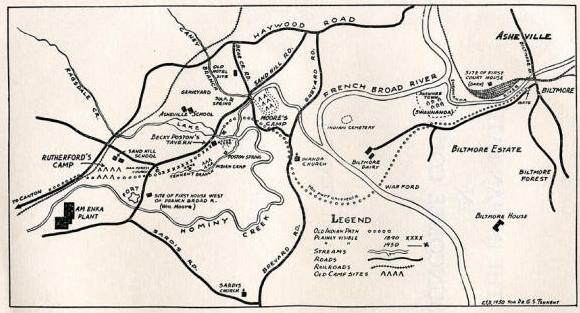
The article begins with the map that follows, with the following description of the map:

“A low ridge connecting two small elevations or hillocks once sent Hominy Creek meandering for more than a mile before returning to its present course. It was across this ridge that Col. Henry cut the new channel and a hundred feet below Bear Creek road bridge remains of the foundation of his mill still may be seen on the north bank of the creek.

Approaching the bridge from the south, 30 or 40 feet to the west of and paralleling Bear Creek road, is a well marked depression marking the road’s original track for more than a thousand feet.”

A band of white men, maybe two or three, maybe a half dozen or more, young, intrepid and fired with the urge to see what lay beyond the far “horizons, stood at the point where our present high­way crosses the divide at Swannanoa Gap. It was early in the seventeenth century and a century had passed — three generations— since the Spanish gold seekers had penetrated some parts of the wild­erness that lay before them, leav­ing only a mine shaft or two and vague descriptions of their wander­ings. These young men were the first of our Nordic race to glimpse the soft-loveliness of the hazy mountains and taste the sprightly tang in the air of the highlands.

This is only fantasy and yet among the restless youth of the early Virginia settlements, many of them restive under the bond of indenture to labor and most of them itching for adventure, reason indicates that some should slip away and press forward into the unknown.

To do this was far easier than it seems. We are accustomed to think of bands of early explorers hacking their way through a trackless wilderness. It was by no means thus that they traveled, for the Bureau of American Ethnology Reports state that apparently from remote times what is now North Carolina was traversed by an east and west highway. A highway as adequate to the needs of the time as the broad band of concrete that now passes through the gap is to our needs It must be remembered that even in the England they had left most of the travel was on foot or on horseback over roads little if any better than this high­way.

What did this band see as they rested there in the gap and what manner of land did they enter upon?

In answering this question we leave the realm of fancy and enter that of real facts, substituting for our band of thrill seekers a small party of authentic explorers.

Dr. F. A. Sondley in his history of Buncombe County states that in 1673 General Abraham Wood in command of Port Henry, now Petersburg, in the Virginia settlements, sent two white men, James Needham and Gabriel Arthur with some Cherokee Indians, who had visited at the fort, to explore the moun­tain country. From the description of the country given after their return it was his (Sondley’s) opin­ion that the crossing was made, at Hickory Nut Gap rather than at the Swannanoa. in any event these were the first white men of record to look upon our county of Buncombe. The fact that a party of Cherokee Indians had traveled upward of 400 miles to the Virginia settlements indicates a route by which men were accustomed to travel. During his stay with the Indians Gabriel Arthur traveled with his hosts once to Fort Royal, S. C.. and once to the mouth of the Kanawa River and down to Portsmouth, Ohio, making 1600 miles in five months. The highways must have been well known and good.

The nature of the landscape that met their eyes was not a dense virgin forest: it was rather that of the “Oak Openings” of the Fenimore Cooper period. Where the bot­tom lands were extensive as along the Swannanoa, lower Cane Creek, Mills River and especially along the upper French Broad, there were prairies, large for a mountain country and, wherever the terrain was low, rolling hills as in West Asheville and most of the Hominy Valley. It resembled the Kentucky scene: open pasture – nice stretches with only the steeper and rougher hills supporting heavy stands of oak. Chestnuts, black walnuts and butternuts formed a substantial part of the Indians’ food and it was only in the open­ings that these trees bore heavy crops.

The writer well remembers the woods of Hominy Valley where the stumps, only then beginning to decay after the first onslaugh [sic] of the sawmills, marked the nature of the original forest. Only in small areas the stumps of centenarian trees denoted the venerable age of ancestral oaks with here and there standing a veteran of two or three hundred years too rugged and heavy for the appetite of the one-horse sawmills.

The “Indian Path” that is the object of this study crossed from the east into the present Buncombe County at Swannanoa Gap. According to an article by Myer in the 42nd annual Report of the American Bureau of Ethnology, it was the western end of the only ancient route that crossed the state from east to west beginning at the coast.

In his introduction to the report he gives only a single paragraph to the origin of this and other paths, stating that all over America these paths had existed from prehistoric times, having been made and kept open by the larger animals in their passage from one feeding ground to another. John Arthur in his “History of Western North Carolina” quotes Bishop Spangenburg’s diary that in early settlement days the only roads were buffalo trails. To cite only one of the numerous references to the presence of buffalo in our state, Audubon, in his Quadrupeds of North America, states that they had been killed as far to the east as the Cape Fear River, indeed, a buffalo bull was killed at Bull Gap only nine miles northeast of Asheville in 1815. In former times, in herds small in comparison with those of their kin on the western plains, they roamed from one to another of the larger pastures where they could hide themselves in the cane-brakes and thickets; thus keeping open the paths. The main part of our present city was within the edge of the region of rough forested hills and mountains that extended with few small openings to the East Tennessee Valley, so the path of our study by-passed it.

For a detailed description of the course of the path through Buncombe County we will quote from the same article in the 42nd volume of the Ethnology reports under the caption of “Rutherford’s “War Trace”:

“On September 1st. 1776 the army of North Carolina, 2.400 strong, under General Griffith Rutherford crossed the Blue Ridge at Swannanoa Gap following the main trail almost along the present line of the railway down the Swannanoa to its junction with the French Broad, crossing the latter at Warrior Ford , . . thence up Hominy Creek and across the ridge to Pigeon river … a few miles below the junction of the E and W forks, thence to Richland Creek . . . until they came to the first Cherokee town, Stekoa.” [Stecoa]  just  above  Whittier. It is our object to focus attention on our own portion of the path that lies between Biltmore and Enka. 

Beginning at the old entrance gate to Biltmore Estate, the route closely follows that of the Approach Road. The point where this road enters the large meadow is on the south side and across the Swan­nanoa River from the site of the Davidson barn. Here the first Buncombe County Court was  held. The meadow itself marks the location of the only Indian town known to have been in the county, and this was the town of the Shawnees in their first stay in our Carolina Mountains after taking over the Cherokee hunting grounds. Rutherford it is supposed was the first one to give it the name “Swannanoa.”

Following the Approach Road route a short distance it turned S. W. along the present road to the Biltmore Dairy as far as the gap in the hills where it turned somewhat southward to the “War Ford” of the French Broad.

From this point to the junction of the present Brevard Road with the Bear Creek Road the route is uncertain, but it follows approxi­mately the latter road to the Hominy bridge. Two or three hundred yards before reaching the bridge a field lies to the west of the road and through the dense growth of locusts on this flat the original route of the Bear Creek Road may be seen paralleling the present one which probably displaced the older one when Henry’s mill was built. A little hill rises to the southeast of the bridge and this little hill and the bottom surrounding it are of great historic interest. Early in the 19th century William Henry, son of Robert Henry of Kings Mountain fame, built a mill where Caney Creek joins Hominy and cut a new channel for the latter creek. Before this, Hominy Creek had made a big loop around the hill and it was in the protection of this loop that Captains William Moore and John Harden camped in September, 1776, awaiting orders from Rutherford-

Accounts of the timing of these two forays against the Cherokees are somewhat confused, but both are known to have engaged the Indians with losses on both sides and both seem to have enjoyed the then popular pastime of burning Indian towns and probably carrying off women and children for slaves though records are silent about this phase of the war. It may be that the Indians could run faster.

One tradition of this encampment survives as told by a grandson of Robert Henry. The late Edward Henry, an employee or the Asheville Post office said that Capt. Moore, annoyed by dogs that came at night and stole venison brought in by hunters, proceeded to poison some meat or offal. Instead or dogs, an old Indian spy got the poison and in his death agony laid a curse on the land around Sulphur Springs, thinking the water had poisoned him. The curse held until the beginning of our century, no fewer than three or more hotels built on the land having burned the last one in 1893. It is presumed that this curse, like all re­spectable and self-respecting curses, has long since petered out, not be­ing active after the third generation. It has now been nearly 60 years since the last manifestation, the area is thickly settled and there are no reports of even false calls from the fire department.

The first of these hotels, built by the Henry family early in the century was the pioneer of the many that later dotted the mountain country. It and its successors, taking advantage of the universal craze for mineral waters in the 19th century, catered to the wealthy planters of the South.

In the woods midway between the Asheville School and the spring is the secluded old cemetery whose markers bear the names or many families of the old South.

On a little knoll on the left. of Sand Hill Road at its first bend after crossing Caney Branch stands an ancient white oak at whose root until recent times two unlettered tombstones marked the graves either of Indians or of two mem­bers of Moore’s army.

Following Sand Hill Road going west we are to the north or the Path and at the point where the road turns south to descend to the dam of the school lake, the Path parallels it on the left only a matter of ten or 15 yards away. The last 400 feet of the descent to the dam is the real center of interest in connection with this study, for it is here in the thicket of small pines, where in places a mat or honey­suckle vines carpets the ground, that the course of The Path down hill to Ragsdale Creek is plainly evident to the experienced eye.

The close embrace of the tangled vines has so checked the natural erosion that one only needs to dis­regard the depressions left by lit­tle gullies that had set in before the viney carpet was laid and keep to the straight course down which we were wont in childhood to drive the cows home from the far pas­ture. We come upon it immediately to the south of a lot of ground which at this time, 1950. is evidently being readied for building and it is marked by a depression two or three feet below the general level. Many years ago one of the ancients told us that he had heard an early settler say that in his youth the path was worn down in places “shoulder deep”. By virtue of this childhood knowledge we are able at this late date to point out the last remaining vestige of the great high­way that for unknown ages served different races of man and beast. Twenty or thirty feet below the dam The Path crossed Ragsdale Creek where the first settler, John Poston, built a mill about the turn of the 19th century.

At some early date a man was murdered or at least done to death on the raceway to this mill. It is a commentary on the changed at­titude of the public to note that, in a day when. violence of this kind was supposed to be more common, tradition of this act persisted for at least two generations.

But thereby hangs a tale. This mill was built primarily for the use and behoof [sic] of the owner, but. it is known that he operated a dis­tillery near the mill or maybe a quarter mile to the south across the hill where John Poston lived near the “Poston Spring.” In our day no trace of furnace rocks re­mained. If he ground for custom he probably added the toll he col­lected to the large crops he raised by the labor of the slaves he had brought with him from the Catawba country. Five hundred yards away to the S. E. on the top of a hill known to us as “the Grave-yard Hill” were nearly a score of graves reputed to be those of the slaves and marked only with uncut field stones. In ‘possum hunting we avoided this spot. In those early days the spotlight of the county was focused on a point some hundred yards immed­iately south of the southern abut­ment of the present dam on a quarter acre level area in the cen­ter of which now stands a barn.

We knew it only as “Becky Postons” and it was only a heap of chimney stones, but it had been “Becky Poston’s Tavern”, in its heyday the only public house west of the river, the forerunner of the many night spots of today. It must have been patronized by some of the travelers who passed along The Path, still the main highway to the west. As for local patronage and the manner in which it was run, two things must be considered: its proprietor and that of the distillery were irked by no excise taxes nor by the presence of inspectors, and, in the second place, most of the settlers were straight laced Scotch-Irish from the Piedmont.

A single episode will serve to bring to life the presence of the same old opposing social forces we have today. Recently one of our prominent citizens, in looking up some ancestors, was shown an un­marked grave just outside the family burying ground with the comment that its occupant, a collateral relative, had been taken ill and died at Becky Poston’s tavern.

Passing up the hill south of Ragsdale Creek The Path was still our cattle path and lay close to the left of the present road and alter it turns to the westward along the top of the ridge one may see down in the little valley to the left the home to which we drove the cows. The cow barn is gone, but there stands the house where this writer was born and which was built by one of the forebears of our attorney, G. Lyle Jones.

This is only mentioned as a point whereon to hang another tale. In our childhood in front of the house was a gently sloping field where we not only plied the hoe. but where in leisure moments we searched the up-turned furrows’ where rains washed out arrowheads, bits of pottery and charcoal. All denoting that it had once been an Indian camp along the stream now known as “Tennent’s Branch” (spelled wrong on the tva map.)

One curious reward of this hunt was the finding of occasional bits of old English china, a problem for the archaeologists.

Some hundred yards  before reaching the Oak Forest Church, founded by four or five of our families in 1875, The Path, deviating from the road, was quite plain to us as we crossed it by a short­cut path to Sunday School. An older brother of lively imagination transformed Washington Irving’s Headless Horseman into an Indian who stalked the trail at night with his head in his hand, the only fly in the pleasant ointment of Christmas trees and other night entertainments we enjoyed.

A slight linear depression of a hundred or so yards in the forest carpet can still be made out if one looks closely enough.

Back of the church it began to bear to the right and by a track long ago lost passed through the small bottom lands northeast of Enka marked on the map as General Rutherford’s camp. Here our map ends at the Murphy Line railway which follows its probable course all the way to Canton where we leave it at the head of the “Locust Field.”

“A “War Ford” of Hominy Creek is mentioned in some land grants, but its location is not definite. Tradition is also confused as to the actual course of The Path for upward of a mile after leaving the point back of the church where it ceased to be positively located by our generation. Had it followed a straight course in the same direction it would have crossed the creek twice and missed the spot where Rutherford is known to have camped and the Indians disliked fords.

General Rutherford made his camp here, probably the first, after leaving Swannanoa Gap. He was here to meet forces from the South approaching along the present Sardis Road.

Traveling the Sand Hill Road one comes to a crossroad just be­yond the church. It has long been as at present a sort of flat plaza where the original Sand Hill School house stood. Built early in the last century this schoolhouse was the community center for several generations of Hominy people where many leaders of the time picked up the rudiments, some even getting all their formal education within its walls.

From here on down the hill and all the way to Enka it is known as the Enka Road. Just before it reaches the bridge it passes be­tween two points of real historic interest. On the last eminence to the left of the road before it reaches the creek stands now a bungalow on the spot where Captain William Moore built the first permanent residence set up to the west of the French Broad.

Soon after his expedition against the Cherokees, having obtained title to the land, he returned with some of his slaves whom he left to clear land and raise a crop. Lat­er he came back and built the log house that stood for more than a century. In our time it had been covered over with a skin of weather-boarding and for many years housed the family of the late Dr. David Gudger.

We used to play in an outbuilding known as the “block house”. This was so named because its timbers had once formed part of Capt. Moore’s fort.

The fort was built subsequent to the war above referred to and stood some 200 yards to the right of the Enka Road just before it reaches the creek and probably straddled the small stream that crosses the bottom.

We have seen no reference to this matter in any of the records avail­able and the reason for the secrecy is not clear but it probably sprang from some feeling of jealousy long forgotten. The reason for the fort’s existence is plain enough. The settlers and prospective settlers wanted security and were afraid that the authorities at Raleigh would not see eye to eye with them and so took matters into their own hands and raised their own army and built their own forts.

They achieved security for many of the well-known family names of the Catawba valley prevail in the Hominy valley today and more of them are found in the early land records of the county — those who were afflicted with the “land fever” that followed the frontiers westward.

The Path, alas, whose beginnings were in antiquity, though probably not until long after the ice cap had receded from the Ohio, is now approaching a period when it will no longer be even a memory.

Before it has entirely disappeared, it is the intention of the State De­partment of Archives and History to perpetuate at least the tradition of The Path by setting up one or more of the bronze markers we are accustomed to see along the highway.

On our part we would like to note for future generations at least what sort of use was made of it.

For many centuries it appears that it was the trail of the American buffalo and the elk. The presence of this game there began to attract the first humans whose identity we leave to the ethnolo­gists; that is to say, whether or not they were the ancestors of our modern American Indians. Well within the period following Columbus our Cherokee Indians moved in only to be run out by the more warlike and nomadic Shawnees. The Shawnees moved out within the period of the eastern settlements and the Cherokees returned, sharing with the game the use of this superhighway.

Then for a time an occasional, wandering party of irresponsible hunters slipped along it.

They were followed by a mere handful of authorized explorers. Then came the armies of the Indi­an raids to be followed immediately by the first settlers and the pioneers going west.

After the county of Buncombe was formed one of the first things the authorities set in motion was the movement for roads that would carry wheeled vehicles. Even this would not have so quickly put our old Path into the background but for one thing. Pact or fancy there is a well-known tradition about the choice of present day Asheville as the site of the county seat. It is said that it was chosen, instead of the much more favorable land along The Path near West Ashe­ville. because someone had set up a distillery on the west side of the French Broad and it was several years before Poston’s time.

From this time on The Path rapidly fell into disuse and it gradually grew into the forest except where the local settlers made use of sec­tions of it as farm roads. In our time we so used a part of it.

Before the building of the Asheville School dam it performed its last service as the route of certain small boys whistling to keep up their courage against the gathering dark­ness as they drove home the cows. With uncanny premonition they peopled The Path with the ghosts of long slain warriors and pioneer settlers that today, or, should we say, “tonight”, are its only travelers.

Posted in Cherokee, History, North Carolina | Leave a comment

Native and African American Houses – University of Illinois at Urbana-Champaign

This week I was honored to speak at the University of Illinois at Urbana-Champaign.  These speaking engagements were different than anything I’ve ever participated in.  I’ve done quite a bit of university speaking, but generally conferences.  These events were different because the students themselves from these two Houses invited me and funded my visit.  To say I felt a great obligation to find a way to connect to them is an understatement.    

Normally my audience consists of genealogists, and sometimes civic groups, but generally not young people ranging in age from 18 to 22 or so, plus grad students.  These folks were born in the 1990s for the most part and ancient history to them is anything before cell phones.  They were only about 10 years old when social networking in the form of My Space was launched, so they’ve never know a world without the internet, electronic gadgetry and social networking.  I was extremely glad I had my two blogs to offer them.

I thought about how they might perceive DNA and genealogy, and I changed the presentation entirely, approaching it from a different perspective – that of personal genetics.  While this new field started in 1999 as a genealogical endeavor (thank you Bennett Greenspan), it has moved far from its original genesis.  Today we have a toolbox full of tools that can answer different questions for us, in various ways.  For these bright young people full of potential, personal genetics will be with them their entire lives and it won’t be a frontier like it is for us, but a way of life.  My presentation was entitled “The Gift of You” and it discussed genealogy of course, but deep ancestry, health, ethnicity and “cousinship” using fun examples.  I also passed out candy when I got answers, which helped a lot:)  Food, the most common denominator.

While all 4 sessions were sponsored by both the African American and Native American Houses, 2 sessions were held at the Bruce B. Nesbitt African American Cultural Center, 1 at the Native American House and the final presentation in a larger auditorium venue.  All sessions were open to all students and the public as well, and indeed were attended by a wide variety of people with very interesting and diverse backgrounds. 

I was particularly impressed with the regular luncheon, with speakers, held by the African American House, entitled “Food for the Soul.”  I wish I lived close enough to attend as many of the topics are very interesting.  This event was very well attended. 

After each of the 4 sessions, several people stayed and discussed various aspects of genetic testing, genealogy and career paths.

I can’t even begin to express how hopeful this trip made me.  These young people who attended these sessions are bright and forward thinkers.  They are involved in supportive and nurturing programs through the two Houses as well as the academic curriculum at the University of Illinois.  They are encouraged to reach beyond the known horizons.  And yes, some of them are interested in genealogy too.  I’m hopeful that there will be someone to pass that torch to someday!

I want to share with you a conversation I had with one young man who stayed after the session at the Native American House.  He is mixed Caucasian, Peruvian, Chinese and Jewish, born in California, an extremely culturally diverse place.  He is a graduate student in the Communications/Medical program meaning at the end of 8 long years, he comes out the other end with an MD degree and a PhD.  And he is bright, very, very bright, compassionate and pleasant.  I don’t know where he’s going to practice, but I want him to be my doctor!

He shared with me part of his story.  Between his undergrad and graduate school, he embarked on a journey of discovery.  He tracked his grandmother’s life backwards. He began at her grave in Israel, journeyed through China where they sought refuge from the holocaust, and where his grandmother’s mother died of a “female disease.”  From there he went back to Germany where the family had escaped the holocaust.  During this time he discovered that his mother and he both carry the BRCA1 gene which produces a hereditary breast-ovarian cancer syndrome.  Another family member indeed has this disease today.  His profound interest in his family history and this mutation led to a discussion about epigenetics and the ENCODE project which revealed that what was once considered to be junk DNA isn’t junk afterall.  And then, the question:

“What if we could use epigenetics to turn OFF the BRCA1 gene?” 

I told him, I’m way beyond my level of expertise, but the fact that this extremely talented young man is pondering this question, and has a very personal impetus to answer it is one of the most promising and hopeful events I’ve witnessed in a very long time.  This truly is the gift of our ancestors, in so many unseen and unspoken ways.

The art at the beginning of this article, titled “Elevator”, by Sol Aquino, 2003 (acrylic on canvas) featured on the SACNAS brochure I picked up at the Native American House portrays this connection is a most profound way. 

During these two days, I got to spend time with Rory James, the Director of the Bruce B. Nesbitt Center, and with Jamie Singson, the Director of the Native American House, and the staff and volunteer students at both facilities.  I was extremely impressed with the knowledge of both of these gentlemen and their heartfelt concern for the students, their education and their futures.  I know that these men and their staff will shepherd these students and provide them with ongoing opportunities to learn about their history and how it connects with their futures as they complete their more structured academic studies.  I wish facilities like this had been in place when I was a student.

The attendees were extremely diverse, in terms of racial and cultural makeup, in terms of student versus community members, age, and in terms of their interests relative to personal genetics.  Their stories were both amazing and inspirational.

I think that Jamie Singson summed it up perfectly at the end of the final session as we walked through the cool evening air back to the Native American House from the auditorium.  People had stayed for an additional couple of hours after the presentation and a small group of about 5 of us had a very enlightening and lovely discussion.  Jamie said, “What I take away from this is how much everyone wants to belong and to find the place where they fit in.”

Posted in Education, History | 2 Comments

John and Thomas Hoyter, the Chowan Indian Chiefs

This article was originally published in the Lost Colony Research Group Newsletter in June, 2012.  www.lostcolonyresearch.org

Fletcher Freeman during the process of his research on the Chowan Indians has compiled all of the information existent on the Chowan Indian Chief, John Hoyter or Hiter as well as his successor, Thomas Hoyter, possibly his son.  These documents provide us with a very rare glimpse of Native life across a 50 year window, half of a century, and certainly, a half century that marked dramatic change for the Native people of North Carolina as Virginians streamed across the border and settled in North Carolina.

John Hiter is first mentioned by name in his 1703/1705 petition to council on which he complains that the Chowan Indians have been confined on a narrow strip land too poor for them to support themselves.  He appears in numerous records, the last of which is in 1730 where he is one of a number of men to convey Indian land.  On the next deed, in 1733, John is absent as he is thereafter, probably having died, and instead we find Thomas Hoyter acting as one of the Chief men and referred to as King on some documents.  Thomas is initially found in the records in 1712 and is subsequently found until 1745/46 when he too disappears from all records.

We want to thank Fletcher for his contribution of these records and his permission to print them.

November 26, 1694 – November 30, 1694 Minutes of the General Court of North Carolina,

     “Upon complaint of the Chowan Indians that they are much injured by the English seating soe near them

     Ordered that no more entry or settlemt of land be made higher then the plantac̄ons weh are alreddy seated above the old towne Creeke and yt wt entries are already made and not yett settled shall be void.”

1695 – In the “Scolding Houses”: Indians and the Law in Eastern North Carolina, 1684-1760, by Michelle LeMaster. (North Carolina Historical Review, April 2006, Volume LXXXIII, Number 2)

By order of the General Council, Indians in North Carolina had “liberty to hunt on all wastelend that is not taken up and liberty to pass through the lands that are seated in their goeing to and from the said Wasteland.” but only if they conduct themselves “sivilly and doeing noe injury.” This is a victory for the Indians as it meant they were not restricted to their reservations for hunting, and could travel to unclaimed land to hunt, theoretically without trouble from their white neighbors. It is doubtful, however, that the local whites were well respecting of the council’s order.

 March 28 1702 North Carolina Historical and Genealogical Register, Hathaway, pg 152

Benjamin Blanchard John Campbell Thos Spivey Francis Rountree Robt Rountree Robert Lassiter Georg Lassiter and Nicholas Stallings lived on Bennett’s and Gariett’s Creek in Chowan now Gates Co They had a dispute with the Chowan Indians who had their hunting quarters upon some of their land The Indians occupied about 11,000 acres of land between Bennett & Catharine Creek granted by the Government.”

1703/1705Petition to Council

North Carlin Silliset

          To the onerable Councel the humble pitison of John hiter Engon for that your pitesor under Stand that by order of his Exelency and onerebell Councell he had 6 mill Squar granted him of Land to which it was not Sorvaid accordin to order for which Resen your pitisenor prays A order It may be sorved again and that he may have his Land Layd out accordin to order or other wese ther He cannot Subsist for he is Soo Upprest with Catell and hogs of other mens and the Ground is Sow pore that He cannot make Corne to Ceep him for it was sorved upon A naro Nek of pinny Land that will not bar Corn and further your pititioner prays he may be considerd that he is not a strangr nor a foriner but in his one Netev ples and ther for prays he may have Ground to work upon ther for I Rest and pray that your pitisner may find fever In your presences and as in duty bound Your pitesner Shall pray

                                                            John Hiter

1707/1708 Petition to President and Council

           North Carolina ss To the Honorable President and Councill

          The Humble Petition of Jno. Hoyter and Rest of the Chowan Indians in all Humble Maner Complaineing and shewing

          That whereas upon the Humble Petittion of the said Indians to the Honorable Board in the time when the Honorable Henderson Walker Esqr. was President of the Councill An Order was past that the Surveyor Generall or Deputy should Lay out a tract of Land for the said Indians of six miles Square.  And also another Order in the time of the Honorable Landgrave Robt. Daniel Esqr. Pursuant to the former Order

          In pursuance of the aforesaid Orders the Deputy surveyor Viz,Capt. Luten Came and undertook the said survey and by various Courses Did Lay out a tract of Land for the said Indians but wholly Contrary to the Intent and meaneing of the said Order for the Petitioners are very Confident that the Intent of the Councill was that such Land should be layd out for them as would produce Corn for theire Support aqnd the petitioners Do say and are Ready to Averr that no part or parcel of the said Land in the said tract Layd out will produce Corn being all pines and sands and Deserts so that they have not theire Land according to the Intent and meaneing of the Honorable Board Neither for quality nor quantity it being not near six miles Square.

          Wherefore Your Humble Petitioners Do humbly Pray your Honors to take our Distressed Condition into your serious Consideration that your Petitioners may have Releife in the Premises Least they perish for Breaqd.

          And Yr. Petitioners shall Ever Pray etc.

John Hoyter

          In Behalfe of  himself and Rest of the Nation

Colonial Records, Vol 1, p 432  Prior to 1712

           Upon complaint of the Chowan Indians that they are much injured by the English seating soe near them

          Ordered that no more entry or settlemt of land be made higher than the plantations wch are alreddy seated above the old towne Creeke and yt wt entries are already made and not yet settled shall be void.

July 25, 1712 Rev. Giles Rainsford’s Letter to the SPG

          “I had several conferences with one Thomas Hoyle, king of the Chowan Indians, who seems very inclinable to embrace Christianity and proposes to send his son to school to Sarum to have him taught to read and write by way of foundation in order to further proficiency for the reception of Christianity. I readily offered my service to instruct him myself, and having the opportunity of sending him to Mr. Garratt’s, where I lodge, being but three miles distance from his town.  But he modestly declined it for the present till a general peace was concluded between the Indians and the Christians.  I found he had some notion of Noah’s flood, which he came to the knowledge of and expressed himself after this manner, “My father told me, I tell my son.”  But I hope to give the society a better account of him as well as of those peaceable Indians under his command.”

August 11, 1714 Records of the Executive Council

          “Upon petition of Jno. Hoyter on behalfe of himselfe and the rest of the Chowan Indyans therein setting forth that the said Indyans had granted to them in the Administration of Governor Archdale for their settlement a tract of Land on the Eastern side of Bennets Creek including the Meherrin Neck of Twelve Miles Square which not being laid out according to the direction  of the Order of the Councill they aplyed themselves to the Honorable President Glover and the Councill then being to have the Same laid out upon which it was ordered that a tract of Six Miles square within those bounds shoud be laid out for their settlement which yet hath not been done And further that most of the said Indyans have been upon Eight expeditions against the Indyan Enemys of this province and during the time they were in the Country Service they suffered Considerable loss in their plantations and Stocks looseing Seaventy five head of Hoggs a Mare and Colt their Corne destroyed by Horses and Catle their fences burnt and fruit trees destroyed by all which and the weareing  out of their Clothes they are reduced to verry great poverty.  And pray’s that their Land may be laid out according to the intent of the Grant and that they may have Some allowance made for their Services and Llosses Etc.  And this board having Considered the whole matter

It is ordered that Colonell Wm. Maule doe examine the former survey made by Colonell Moseley and See whether the Same be made pursuant to the former order of the Councill and whether it Conteyns the Quantity and make his report therof to this Board.

Minutes of the North Carolina Governor’s Council November 22, 1717

Upon a complaint made by John Hoyter King of the Chowan Indyans that Ephraim Blanchard and Aaron Blanchard had settled upon those Indyans Lands without their leave.

It is ordered by this Board that the said Blanchards do attend the next Council to Shew Cause for their so doing and that in the mean time they desist from doing anything further on their settlements

Minutes of the North Carolina Governor’s Council July 31, 1718

Upon a Complaint of Cap John Hoyter, king of the Chowan Indians that the neighbourhood intrude upon him and his people and take away their lands

Ordered that the Surveyor General or his sufficient Deputy at ten day s notice attend ffred Jones Esqr up to the said Indian Towne and follow his directions in laying out sd Indians Lands and that the Secty or his Deputy send him Coppys of all orders passed relating to grants made to the aforesaid Indians as soon as possible.

Minutes of the North Carolina Governor’s Council April 04, 1720

Capn Joh Hoyter a Chowan idien having produced to this Board an order from the Honble the Governor directed to James Sitterson requiring him the sd Sitterson to pay one Willowby an Indian Money due for an Indian Slave bought at Core Sound which order the sd Sitterson not having complied with.

Its Ordered that the sd James Sitterson attend this Board at the next Sitting without fail and that Willowby attend likewise.

Complaint being made by John Hoyter hief man of the Chowan Indians that several of the white people are continually intrudeing upon their Land and the same hath never been so determinatly bounded and ascertained pursuant to the grants made to them by the Government.

Its therefore ordered by this Board that all the several grants made by the Government be laid before Frederick Jones Esqr and that he determinatly and finaly lay out and Asscertaine the bounds for the sd Indians without any reguard to survey or grants made to any other claimers since the first Grants to those Indians.

October 1730 Chowan County North Carolina County Court Minutes Pleas & Quarter Sessions

John Hayter King of the Chowan Indians Jeremiah Pushin Thomas Hayter and James Bennet Great Men belonging to the said Nation came into Court and acknowledged a Deed of Sale for ffifty acres of Land to Capt. Aaron Blanchard joining on the sd Blanchards Land and the Court thereupon examined the King and the rest of the sd. Indians touching the consideration money mentd. In sd. Deed who likewise ackxnowledged they had recd. The sd money.

August 3, 1733 John Freeman purchases 200 acres “on Catherine Creek Swamp, being part of Chowan Town”  for 120 pounds current money from the Chiefmen of the Chowan Indian Tribe. (Chowan Deed Book W-1, p. 216)  Thomas Hoyter was the second signatory to this deed as a Chiefman of the Chowans.

Minutes of  the North Carolina Governor’s Council January 15, 1735—January 30, 1735


Upon reading at theBoard this day the Petition of Chowan Indians setting forth that they being possessed of a large parcel of Lands lying in Chowan Precinct and but few in number to cultivate the same or make any benefit thereby and praying leave to make sale of part thereof the same was accordingly granted.

Whereupon a Deed of Sale from Thomas Hoyter James Bennet, Charles
Beazley and Jeremiah Pushing Chief Men of said Chowan Indians to Jacob Hinton for fifty Acres of Land was read and the consideration mentioned in the said Deed being fifty Pounds the said Indians were thereon interrogated who acknowledged they had received the money and was therewith content.

Whereupon His Excellency the Governor by and with advice and consent of this Board was pleased to allow and approve of then said sale to Jacob Hinton.

A Deed of Sale from James Bennet, Thomas Hoyston, Charles Beazley and Jeremiah Pushing Chief Men of the said Chowan Indians to James Brown for one hundred acres of Land was read and the Consideration Money therein mentioned being twelve pounds the said Indians was thereon interrogated who declared they had received the full consideration money therein mentioned and were fully content and satisfyed therewith whereupon his Excellency the Governour by and with the advice and consent of this Board was pleased to allow and approve of the said Deed of Sale made by the aforesaid Indians to James Brown.

A Deed of Sale from James Bennet Thos Hoyton, Charles Beaseley and Jeremiah Pushing Chief Men of the Chowan Indians to Richard Minchen for one hundred Acres of Land was read the consideration money therein mentioned being fifty pounds and the said Indians being interrogated thereon were therewith content whereupon his Excellency the Governor by and with the advice and consent of his Majesty’s Councel was pleased to allow and approve of the said Deed.

A Deed of sale from James Bennet Thomas Hoyter Charles Beasley, Jeremiah Pushing, John Robins, John Reading and Neuse Will Chief Men of the Chowan Indians to Thomas Garret for four hundred Acres of Land was read at the Board and the Consideration money therein mentioned being One Hundred and fifty pounds the said Indians declared that they had received part thereof and that they had the said Garrets obligation for the remainder and were therewith fully content whereupon his Excellency the Governour by and with the advice and consent of his Majestys Council was pleased to allow and approve of the said Deed.

A Deed of Sale from Thomas Hoyter, Jeremiah Pushing, Charles Beasley and James Bennet Chief Men of the Chowan Indians to Michael Ward for two hundred Acres of Land the Consideration Money therein mentioned being sixty pounds and the said Indians being interrogated thereon were content. Whereupon His Excellency the Governour by and with the advice and consent of his Majesty’s Council was pleased to allow of the said Deed.

A Deed of Sale from Thomas Hoyton, James Bennet Charles Bennet and Jeremiah Pushing Chief Men of the Chowan Indians to Jacob Hinton for two hundred acres of land was read and the consideration money therein mentioned being one hundred pounds the said Indians were thereon interrogated who declared therewith content whereupon His Excellency the Governor by and with the advice and consent of this board was pleased to allow of the same.

A Deed of Sale from James Bennet Thos Hoyter, Jeremiah Pushing and Charles Beasley Chief Men of the Chowan Indians to John Freeman for two Hundred Acres of Land was read and the consideration money therein mentioned being one hundred and twenty pounds the said Indians were thereon interrogated who declared that they were therewith satified whereupon his Excellency the Governor by and with the advice and consent of his Majestys Council was pleased to allow of the same.


A Deed of Sale from Thomas Hoyter James Bennet and Charles Beasley Chief Men of the Chowan Indians to William Hill for one hundred Acres of Land was read the consideration Money therein mentioned being sixty barrels of Tar the said Indians on examination were therewith fully content Whereupon his Excellency the Governor by and with the advice and consent of his Majestys Council was pleased to allow and approve of the same.

A Deed of Sale from James Bennet Thomas Hoyton, Charles Beasley and Jeremiah Pushing, Chief Men of the Chowan Indians to Michael Ward for six hundred Acres of Land was read and the consideration Money therein mentioned being Eighty Pounds the said Indians on Examination was therewith fully satisfyed and content Whereupon his Excellency the Governor by and with the advice and consent of his Majestys Council was pleased to allow of the same.

A Deed of Sale from Thomas Hoyter James Bennet Charles Beasley and Jeremiah Pushing Chief Men of the Chowan Indians to James Hinton for one hundred Acres of Land was read and the consideration Money therein mentioned being fifty Pounds the said Indians being examined thereon were therewith content whereupon his Excellency the Governor by and with the advice and consent of his Majestys Council was pleased to allow of the said Sale.

Mr Attorney General Represented to this Board that Capt Aaron Blanchard had got into his possession and keeping a Patent belonging to the Chowan Indians for their Lands on Bennets Creek and that he had refused to deliver the said Patent to the Chief Men of the said Nation who prayed relief therein from this Board Whereupon his Excellency the Governor by and with the advice and consent of his Majesty’s Council was pleased to Order that the said Aaron Blanchard do forthwith Lodge the said Patent in the Secretary’s Office of this Province for the benefit of the said Indians and all others concerned By Order

1737 Description of King Hoyter by John Brickell in The Natural History of North Carolina:

“Dinner being ended the Glass went round very merrily and whenever they drank to the Governour they always stiled him by the Name of Brother These three Kings speak English tolerably well and are very wary and cunning in their Discourses and you would be surprised to hear what subtile and witty Answers they made to each Question proposed to them notwithstanding they are in general Illiterate People having no Letters or Learning to improve them King Blunt being the most powerful of these I have mentioned had a Suit of English Broadcloth on and a pair of Women’s Stockings of a blue Colour with white Clocks a tolerable good Shirt Cravat Shoes Hat &c King Durant had on an old Blue Livery the Wastecoat having some remains of Silver Lace with all other Necessaries fit for wearing Apparel such as Shirt Stockings Shoes &c made after the English manner.  King Highter had on a Soldiers red Coat Wastecoat and Breeches with all other conveniences for wearing Apparel like the former And it is to be observed that after their return home to their Towns that they never wear these Cloaths till they make the next State Visit amongst the Christians.

      “After this manner appeared the three civilized Kings with each of them his Queen.  The first of these Queens was drest with a Peticoat made after the European manner and had her Hair which is generally long thick and Black tyed full of bits of Stuff such as Red Green Yellow and variety of other Colours so that to an European she rather seemed like a Woman out of Bedlam than a Queen She likewise had a large Belt about her full of their Peack or wampum which is their Money and what they value above Gold or Silver but to me it seem d no better than our common Snails or other ordinary Shells the other parts of the Body from the Waste upwards were all naked.

          “…except the civilized Kings who of late have Houses fashioned and built after the manner that the Christians build theirs.”

Minutes of the Governor’s Council  March 14, 1745/46:

          Read the petition of James Bennett a Chowan Indian complaining of one Henry Hills having obtained a Deed of Sale for some of the Chowan Indian Land from some Indians who had no right to sell the same.

          Ordered that Henry Hill be summoned to attend this Board at their next sitting, And that Thomas Hoyster and John Robin the two Indians who sold the Land to the said Hill to be summoned to attend at the same time.

Posted in Chowan | Leave a comment

The Chowan Indians by Fletcher Freeman

A 1585 Map of Virginia drawn by Theodore de Bry designates several Indian tribes, one of which is the CHAWANOK. They are shown with at least five towns, being Chaunoock, Rannoushowog, Movatan, Metocuuem,and Tanduomuc. Also reflected are the SECOTAN and WEAPEMEOC Tribes. The SECOTAN area reflects 12 towns and the WEAPEMEOC area reflects 8 towns.

The 1647 map of Virginia drawn by Robert Dudley reflects several Indian tribes living along the Virginia/North Carolina eastern seaboard. One of these tribes was the CHAWONS located just south of the Chesapeake Bay near Nansemund.

The 1651 map of Virginia drawn by John Farrer prominently displays the CHAWANOKE RIVER, probably named for the Chawan Indians who lived along it.

William Byrd’s Map showing the Boundary lines of 1663 and 1665 between Virginia and North Carolina likewise prominently shows the Chowan River and Chowan Precinct, likewise named for the Chowans.

The Mosley Map of 1733 showing North East North Carolina shows Chowan Town just East of the Chowan River and south of Bennets Creek in Chowan Precinct of Albemarle County.

According to THE COLONIAL RECORDS OF NORTH CAROLINA by Saunders:

In 1707, the Chowanoke Indians own land on the South side of the Maherine ( Meherrin) River which they received from the Yawpin Indians sometime prior to 1675. It is called Chowanoke Town.

In 1715 a missionary spent 5 months in Chowan Town and learned the language.

In 1718, John Hoyter is mentioned as the “King” of the Chowan Indians.

In 1720, Captain John Hoyter of the Chowan Indians complains about someone not paying for a slave and John Hoyter, Chiefman of the Chowan Indians complains about white trespassers to the North Carolina Council.

In 1734, Thomas Hoyter, James Bennet, Charles Beazley and Jeremiah Pushing, Chief Men of the Chowan Indians sell land to JOHN FREEMAN, Thomas Garret, and 8 other white men.

In 1754, JOHN FREEMAN, John Bennet, and John Robins ( 2 headmen of the Chowan Indians) sell 200 acres of Chowan Indian land to RICHARD FREEMAN for 20 pounds.

January 4, 1755, there are 7 Chowan Indians left–2 men, 3 women, and 2 children.

THE AMERICAN INDIAN IN NORTH CAROLINA recounts an August 1585 exploration by Gov Lane which visited the Chowans:

“The Chowan Indians lived along the river bearing their name. One of their villages, called Ohanoak, situated on high land with good cornfields adjacent, was probably in Hertford County. The chief village, Chawanook, was not far from the junction formed by Bennett’s Creek, on the east side of the river. Lane estimated the number of warriors of this town to be seven hundred, certainly an exaggeration. The chief of the tribe, Menatonon, was described as being ” a man impotent in his limbs, but otherwise for a savage a very grave and wise man.” He gave Lane directions for travel by river and overland to Chesapeake Bay. His description of the abundance and fineness of the pearls of that region sounded alluring to the governor, to whom he presented a string of black beads, probably the dark colored shell beads called wampum. His son, Skyco, was retained by Lane as a prisoner and proved to be a valuable hostage.”

The book 500 NATIONS, AN ILLUSTRATED HISTORY OF NORTH AMERICAN INDIANS says that the Chowanocs, Weapemeocs, and Secotans were allied Algonquin nations. The book mentions that Gov. Lane seized Chief Menatonon of the Chowanocs and held him for ransom following which he kidnapped the Chief’s son and took him to Roanoke in leg irons to insure the obedience of the tribe.

A member of the Lane exhibition was an artist named John White. He painted 76 watercolors of the region and many are in the books referenced above. While none show the Chowans themselves, there are quite a few of the Secotan and Pomeoke who were close neighbors to the Chowans. There is a drawing in the book of the Town of Secotan which is south of Chowan Town and hence is probably similar to Chowan Town. It shows that the Indians raised corn and tobacco and lived in Quonset style huts.

Lane also drew a map of Carolina which shows the Town of Ohanoke located on the western side of the Chowan River. This map would date to 1585.

The book The AMERICAN INDIAN IN NORTH CAROLINA, has another section on the Chowan Indians as follows:

” The Chowan Indians, whose name signifies “Southerners” were still a strong tribe when settlers began to move in the Albemarle region about 1650. Their name was well known, as the following reference from early records of Virginia indicate.

On August 27, 1650, a Virginia exploring party set out from Fort Henry to reach the Tuscarora settlements. The company included Edward Bland, Abraham Wood, Sackford Brewster, Elias Pennant, two white servants, and an Appamattox Indian guide. On the way the secured a Nottoway Indian guide named Oyeocker. Some distance west of Meherrin River they came to an Indian trail.

Their narrative states:

“At this path our Apamattuck Guide made a stop, and cleared the Westerly end of the path with his foote, being demanded the meaning of it, he shewed an unwillingness to relate it, sighing very much. Whereupon we made a stop until Oyeocker our other Guide came up, and then our Appamattuck journied on; but Oyeocker at his coming up cleared the other end of the path, and prepared himselfe in a most serious manner to require our attentions, and told us that many years since their late great Emperour Appachancano came thither to make War upon the Tuscarood, in revenge of three of his men killed, and wounded, and brought word of the other three murthered by the Hocomawananck Indians for lucre of the Roanoke they brought with them to trade for Otter skins. There accompanied Appachancano severall petty Kings that were under him, amongst which there was one King of a town called Pawhatan, which had long time harboured a grudge against the King of Chawan, about a young woman that the King of Chawan had detayned of the King of Pawhatan: Now it happened that the King of Chawan was invited by the King of Pawhatan to this place under pretence to present him with a gift of some great vallew, and there they med accordingly, and the King of Pawhatan went to salute and embrace the King of Chawan, and stroaking of him after their usual manner, he whipt a bowstring about the King of Chawans neck, and strangled him; and how that in memoriall of this, the path is continued unto this day, and the friends of the Pawhatans when they passe that way, cleanse the Westerly end of the path, and the friends of the Chawans the other. And some two miles from this path we come unto an Indian Grave upon the East side of the path,: Upon which Grave there lay a great heape of sticks covered with greene boughs, we demanded the reason of it, Oyeocker told us that there lay a great man of the Chawans that dyed in the same quarrell, and in honor of his memory they continue greene boughs over his Grave to this day, and ever when they goe forth to Warre they relate this, and other valorous, loyall Acts, to their young men, to animate them to doe the like when occasion requires.”

Around 1610-1611, William Strachy, Secretary of Jamestown, was told by an Indian, Machumps, that seven survivors of Powhatan’s massacre of the colonists from Roanoke, (four men, two boys, and one young maid) had fled up the river of Choanoke and had taught the Indians in two villages how to build two-story houses and were working copper for the Chief of the Chawanoc tribe.

In 1663 the Chowans entered into a treaty with the English and “submitted themselves to the Crown of England under the Dominion of the Lords Proprietors.” This treaty was faithfully observed for a decade, but in 1675 the Susquehanna War broke out in Virginia. Through incitement of the Indians of Virginia the Chowan violated their treaty. This became known as the Chowanoc War of 1675-1677. A year of warfare followed with serious loss to the settlers. Later the Chowan were forced to surrender all of their land on the south side of Meherrin River and were assigned a reservation on Bennett’s Creek in what is now Gates County. Here they struggled along for a hundred years. Many petitions were made to the council for a survey, but nearly fifty years passed before the request was granted. Their lands gradually dwindled from twelve square miles, as first assigned, to six square miles about 1707. At this time they had only one town with about fifteen fighting men.

They were allied with the Colonists during the Tuscarora War. Chief John Hoyter petitioned the Council in 1714 for a survey of the six-mile reservation, stating that the Indians had been fighting on ” Eight Expeditions agt the Indyan Enemy of this province and during the time they were in ye Countys Service they Suffered Considerable loss in their Plantations & Stocks loosing Seaventy five head of hoggs a Mare & Colt their Corne destroyed by all wch & ye wearing out of their clothes they are reduced to great poverty”, and asked that some allowance be made for their services and losses.

In 1712 Missionary Giles Rainsford of the English Church wrote:

“I had several conferences with one Thomas Hoyle King of the Chowan Indians who seem very inclinable to embrace Christianity and proposes to send his son to school…. I readily offered him my service to instruct him myself…. where I lodge being but three miles distant from his Town. But he modestly declined it for the present till a general peace was concluded between the Indians and the Christians. I found he had some notions of Noahs flood which he came to the knowledge of and exprest himselfe after this manner–My Father told me I tell my Son.”

Three years later Rainsford reported: “I have been five months together in Chowan Indian Town & made myself almost a Master of their language.” In this same letter he offered to serve as missionary among them.

In 1718 and 1720 petitions were filed by Chief Hoyter complaining that the settlers were continually intruding upon the lands of the Indians and that the limits of the territory had never been determined. In the former petition he also asked for payment due one of his tribesmen by a settler for an Indian slave of the Core Sound region. In 1723 a reservation of 53,000 acres was laid out for the Tuscarora and the Chowan.

By the year 1731 the tribe had dwindled to less than twenty families. Two years later, in 1733, the council gave them permission to be incorporated with the Tuscarora at Indian Woods Reservation in Bertie county. In 1752 Bishop Spangenberg wrote from Edenton, “The Chowan Indians are reduced to a few families, and their land has been taken away from them.” A report of Governor Dobbs in 1755 stated that the tribe consisted of two men and five women and children who were “ill used by their neighbors.”

In 1997 a Meherrin Indian historian provided the following information to me about the Chowans:

The Chowan Reservation originally lay in what is now Gates County, on the banks of Catherine’s Creek and Bennet’s Creek, It seems to have consisted mainly of swamp land, roughly 17 square miles in 1729. The land was sold off steadily through the 1700’s until by 1790 the tribe had been reduced to nothing. In 1782 a Mr. Henry Hill gave 30 acres of land to the remaining Chowanokes. This tract, which came to be known as Indian Town, lay north of the old reservation. It appears to have been in the immediate vicinity of Old Chapel Crossroads, south of Mintonsville. The area of the old reservation is now called Indian Neck. At about the same time that they received the land from Henry Hill, several of the Indian boys were ordered bound out as apprentices to local whites. The following appear to be the bulk of the apprentice records dealing with Chowanokes:

May 25, 1781, Benjamin Robbins, Indian, 17 years of age bound to Jethro Meltear

May 25, 1781, Elisha Robbins, Indian, 11 years of age, bound to Jethro Meltear

February 10, 1781, Josiah Bennett, Indian, 12 years of age, bound to Edward Briscoe.

February 10, 1781, George Bennet, Indian, 13 years of age, bound to Henry Booth.

February, 1785, Jacob Robbins, Indian, 10 years of age, bound to Jethro Lassiter

February, 1787, Samuel Robbins, illegitimate son of Lucy Robbins, bound to Jethro Miller Lassiter.

The 1790 census of Gates County shows the following households which are probably the bulk of the Chowanoke population at that time.

Bashford Robbins, 1 white male, 2 free persons of color

George Bennet, 1 free person of color

Hardy Robbins, 1 free person of color

James Robbins, 1 white female, 15 free persons of color

Joseph Bennet, 1 free person of color

The Chowanoke population may have been as high as 30 at this time. James Robbins appears to have been the most well to do of the Chowanokes, aided in part by his pay from having served as a soldier in the Revolution.

In 1782 Henry Hill sells the 30 acres to Nancy, Elizabeth, Darkis, and Christina Robbins, all identified as Indians. Apparently by the time the sale took place, the tribe had left the area of their old reservation and had sold or otherwise conveyed it to neighboring whites. The actual deed of sale is dated April 12, 1790 and is between “James Robbins, Benjamin Robbins, George Bennett, and Joseph Bennett, Chief Men and representatives of the Chowan Indians Nation of Gates County and William Lewis and Samuel Harrell”. Shortly thereafter the Bennetts disappear from the history of the tribe, never living on the thirty acres with the Robbins. In October 1790 the Chowanokes are described in a petition to the State from William Lewis and Samuel Harrell as “several freemen and women of mixed blood which have descended from said Indians.” Obviously in April, 1790 it was to Harrell and Lewis’ advantage to have the Robbins and Bennetts being in a position of authority in the tribe so they could sell the tribal land to them. After the sale was complete, however, it then became better for the white purchasers that the Indians became “free men mixed with Negroes” in case they might ever want to reclaim the land. The State confirmed the sale of the land in 1791 effectively disposing of the last reservation land although legally the sale should have been approved by the U.S. Congress as well.

By the time of the 1800 Gates County Federal Census, the number of Chowan Indian Families is as follows:

George Bennet, free colored, 4 in household

James Robbins, free colored, 3 in household with 1 white female

Sara Robbins, free colored, 2 in household

Dorcas Robbins, free colored, 6 in household

Ann Robbins, free colored, 4 in household

In 1810 the following families are listed in Gates County:

George Bennett, free colored, 5 in household

Darcus Robbins, free colored, 4 in household

Sally Robbins, free colored, 4 in household

Lewis Robbins, free colored, 3 in household

Nancy Robbins, free colored, 5 in household

Jacob Robbins, free colored, 5 in household

James Robbins, free colored, 2 in household

Lewis Robbins, born in 1790 and apprenticed in 1800, is never called an Indian in any of the written records, but it is logical that he is a child of one of the Chowanoke families listed in 1800.

The Chowan Indian settlement is noted on the 1808 Price-Strother map of North Carolina in roughly the same area where they had been granted the reservation. This would suggest that they still maintained some form of recognizable community in the area.

In 1819, the Chowanokes living on the 30 acres of land they had acquired from Henry Hill faced a new threat in the form of efforts by a prominent white neighbor to buy them out. On February 23, 1819, John Walton bought the interest of Christian Robbins, who at the time was living in Perquimans County, in a “certain piece or parcel of land at a place called the Indian Town, joining the lands of Nancy Robbins, Elizabeth Robbins, Sara Robbins, and the said John Walton containing by estimation 5 acres.” Then in May, 1820, Walton bought out Judith Robbins, who had moved to Chowan County. She owned one acre more or less, “at a place called & known by the name of the Indian Town …that descended to me from my mother Patience Robbins.” Then in 1821 through some fancy legal maneuvering, Walton sued Sara Robbins and obtained an execution upon her land to pay the judgment. This land was in the vicinity of what is now Waltons Crossroads in Gates County.

After this last loss of tribal lands, the Chowanokes dispersed throughout the surrounding area and it is thought married into or otherwise merged with the Meherrin Tribe.

There is a Robbins family on the Meherrin tribal roll who trace back to a Noah Robbins, born 1803. There is also a group in Perquimans County known as the “Lassiter Tribe” who moved into that area around 1820 and are probably Chowanoke descendents.

Dr. Richard Dillard has described a shell mound in the former Chowan region:

“One of the largest and most remarkable Indian mounds in Eastern North Carolina is located at Bandon on the Chowan, evidently the site of the ancient town of the Chowanokes which Grenville’s party visited in 1585 and was called Mavaton. The map of James Wimble, made in 1729, also locates it about this point. The mound extends along the riverbank five or six hundred yards, is sixty yards wide and five feet deep, covered with about one foot of sand and soil. It is composed almost exclusively of mussel shells taken from the river, pieces of pottery, ashes, arrowheads and human bones…. Pottery and arrowheads are found in many places throughout this county, especially on hillsides, near streams, etc.”

There is some belief among the descendants of JOHN FREEMAN mentioned earlier, that his wife “Tabitha” may have been a Chowan Indian and the daughter of either Thomas Hoyter or John Bennet, Chowan headmen. John was born in or near Chowan Indian town and probably married Tabitha around 1733. He was the reader at the Indian Town Chapel of the Anglican Church which presumably was where the Christianized Chowans attended church.  (Remember that in 1712 Giles Rainsford was a missionary to the Chowans and indicated that Chief Thomas Hoyle/Hoyter was inclined to embrace Christianity.)

Please join us tomorrow for Fletcher Freeman’s article about John and Thomas Hoyter, the Chowan Indian Chiefs.

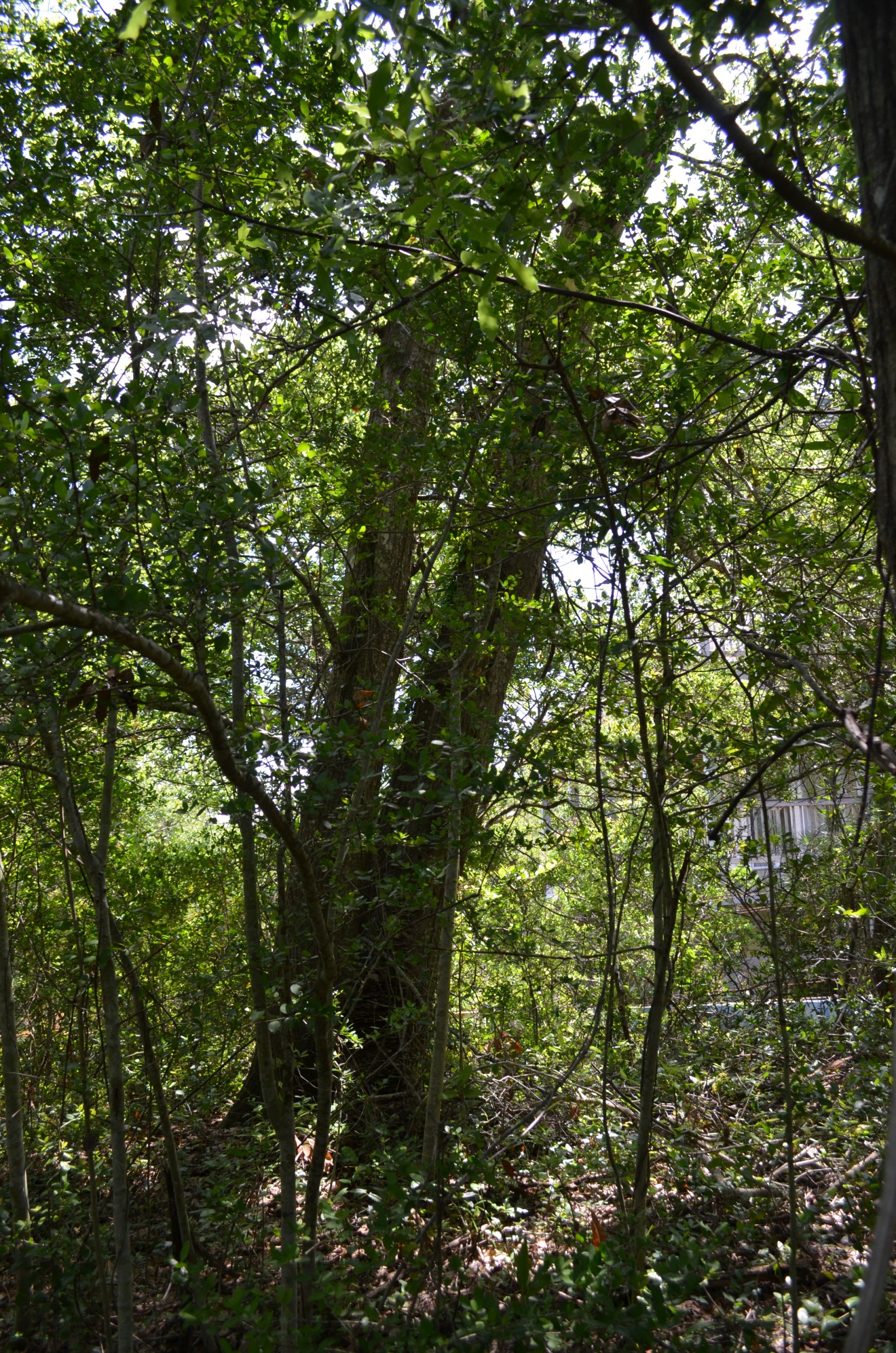
Posted in Appomattox, Chowan, Meherrin, Nottoway, Powhatan, Secotan, Tuscarora, Weapemeoc, Weyanoke, Yawpim | 12 Comments