US Indian Census Rolls 1885 – 1940

Did you know there was a special yearly Indian census from 1885 – 1940 in the US?  Well, there was, although it didn’t exactly incorporate everyone.

The US Indian Census Rolls data base is found on Ancestry.com.

http://search.ancestry.com/search/db.aspx?dbid=1059&enc=1

The database contains an index to the Indian census rolls from 1885-1940. Information contained in this database includes:

  • Name (Indian and/or English)
  • Gender
  • Age
  • Birth date
  • Relationship to head of family
  • Marital status
  • Tribe name
  • Agency and reservation name

Other information about an individual, such as degree of Indian blood, as recorded in the later census years, may be available on the original record. Be sure to view the corresponding image in order to obtain all possible information about an individual.

The Indian Census schedules are census rolls usually submitted each year by agents or superintendents in charge of Indian reservations, as required by an act of 4 July 1884 (23 Stat. 98). The data on the rolls varies to some extent. For certain years – including 1935, 1936, 1938, and 1939 – only supplemental rolls of additions and deletions were compiled.

There is not a census for every reservation or group of Indians for every year. Only persons who maintained a formal affiliation with a tribe under federal supervision are listed on these census rolls.

Most of the rolls for the year 1940 were retained by the Bureau of Indian Affairs and are not included in this database. Rolls were not required to be submitted after 1940 so only a few post-1940 records are included here.

Notes about Searching the Censuses:

When browsing or searching this large collection, it is important to note the following:

1) Family groups are listed together and are sometimes listed alphabetically by surname of the head of the family, but often there is often no discernible order to the listing of families.

2) Currently accepted spellings of tribal names have been used in the index. In the census rolls themselves, obsolete spellings are often used; and the name of a tribe may be spelled several ways in different rolls. Sometimes even the name used for a tribe was changed from year to year.

Some of the above information was taken from:

  • Curt B. Witcher and George J. Nixon, “Tracking Native American Family History,” in The Source: A Guidebook of American Genealogy, ed. Loretto Dennis Szucs and Sandra Hargreaves Luebking (Salt Lake City: Ancestry, 1997).
  • Publication Details of Indian Census Rolls, 1885-1940, National Archives, Washington, D.C.

This information is not being used at this time in the Native Names project because these records are only relevant to individuals who are tribal members.  The native names project seeks to discover early records of individuals who may not be associated with tribes, so their records are likely not available through “normal” resources, but who are still considered Indian.  Additionally the Native Names project is focused on earlier records and those not online and not generally available.

Posted in History | 6 Comments

Leander Gansworth – Tuscarora or Seneca?

In the Carlisle Indian School records, I often find the same stuent name with a different tribe association.  Some are very close, like Mohawk and Saint Regis.  Those most likely are the same person because the St. Regis are a tribe of Mohawk Indians.  Some are quite different, from differing parts of the country, and those are either errors or two different people.  Some are simply questionable.  I decided to take one of those and see what I can find.

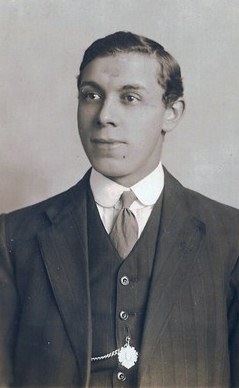
Trying to track females is difficult because of surname changes, so I selected a male with a unique name, Leander Gansworth, pictured above.  He is listed as both Tuscarora and Seneca.

There is an amazing amount of information available about Leander Gansworth, over 100 different records not including family trees.

We discover, through various sources that he was born about 1877 and died in 1950 in Iowa.  He is on the US Indian Census rolls when they began in 1885 through 1924.  He is found on the 1920, 1930 and 1940 Federal census.

He also applied for a passport.  That application, after he had moved to Davenport, Iowa as a printer, was to go to Canada for war related work and tells us that his father’s name was John and that Leander was born on Nov. 22, 1878 in Lewiston, NY.  From this application we also discover that his middle name was Newton.

There is absolutely no evidence that there were two Leander Gansworths during that timeframe, so the Carlisle records appear to be in error.  In every one of the Native census records, he is shown living on the Tonawanda Indian Reservation in New York which is a Seneca reservation.

The Seneca Nation is Iroquoian, as are the Tuscarora, and are in the Iroquoian Confederacy, but they are not the Tuscarora tribe who had their own reservation.

However, at Ancestry.com, someone has attached a “story” to his record that provides history of the Tuscarora tribe, so there may be some unknown facts at play here.  I did notice that there are some Gansworths who are Tuscarora.

Looking at other Ancestry records, his father and grandfather are shown as having been born on the Tuscarora Reservation and the last name morphing from Gansevoort to Gansworth.

http://trees.ancestry.com/tree/31103134/person/12366634823

So maybe the Carlisle records were right after all, and he was originally Tuscarora through his parents but was from the Seneca Reservation where he had spent most, if not all, of his childhood before enrolling at Carlisle.

Posted in Seneca, Tuscarora | 2 Comments

Tuscarora Identified by Land and Other Transactions – Part 15 – Final

In Summary

These transactions, sales, petitions and letters tell a long a sordid history of the land transactions between the Tuscarora and their “good friends,” the white people across three centuries.  Included are stories of betrayal, by the whites and their own people alike, tragedy, opportunity and some exploitation as well, befitting of any best-selling mystery plot.  However, it is because of all of this turmoil that we have the records we do have.  Without the records, we would have no names of any of the Tuscarora people and no ability to piece much together about their lives.  This tragedy gave us the opportunity to hear the voices of their people.

A total of 407 mentions of individual Native people occurred in the records, most of which were names and related signatures on documents, and most of whom removed to New York between 1766 and 1777.  A few more left in the early 1800s.  Of course, many of these signatures are duplicates.  There appear to be about 157 different individuals.

We know what they sold, where and why.  We know that they drank too much and that they wanted blankets, shirts, boots, powder and shot in exchange for their land, enough for each family, which is how we know there were 80 Tuscarora families in 1775.  We know they were twice betrayed by their own tribal members, both times by members of the Cain/Cane family.

We know that the Tuscarora were mistreated even while moving to New York from North Carolina.  Of course, the reason they left North Carolina was due to chronic mistreatment there.  We know they tried once again to purchase land, in the 1820s, and history tells us that chapter in their history was as brutally disappointing as the North Carolina chapter, relative to land acquisition and their relationship with both whites and the federal government.

Mostly what this gives us is a small window through which to peer back into time, to get a glimpse of the lives, and the people, from the details we can glean from the paper trail they left behind.

———

In Grateful Appreciation

  • To Cathy Roberts for photographing the deeds in the Bertie Co., Courthouse.
  • To Jennifer Sheppard for copying the deeds at the Bertie Co., Courthouse.
  • To Elaine Jones for the 1911 letter, the 1972 court case, the timeline and other resources.
  • To William L. Byrd III for writing his book “For So Long As The Sun And Moon Endure: Indian Records from the North Carolina General Assembly Sessions and Other Sources.”
  • To William L. Byrd III for writing his book “Against the Peace and Dignity of the State, North Carolina Laws Regarding Slaves, Free Persons of Color and Indians.”
Posted in History, Tuscarora | Leave a comment

Tuscarora Identified by Land and Other Transactions – Part 14

The Final Bertie County Transactions

1831 – Bertie County Deed book 163 page 418

William Chew et als, Indians, to the People of North Carolina

This indenture made this 19th day of November in the year 1831 between William Chew, Nicholas Casie, George Warchief, Jonathan Printup, Matthew Jack, William Johnson and Isaac Miller, Chiefs of the Tuscarora Nation of Indians, of the first part and the people of North Carolina of the second part witnesseth that the said parties of the first part for and in consideration of the sum of $3250 lawful money of the US to them in hand paid at and before the ensealing and delivery of these represents, the receipt whereof is hereby acknowledged have granted, bargained, sold, remised, released, aliened and confirmed and by these presents do grant, bargain, sell, remise, release, alien and confirm unto the said parties of the second part in their actual possession now being and to heir assigns forever, all their lands, tenements and hereditaments, situate, lying and being in the County of Bertie in the State of NC, together with all and singular the appurtenances thereunto belonging or in anywise appertaining and the reversion, and reversions, remainder and remainders thereof and the estate right, title, interest, claim and demand whatsoever of the said parties of the first pat either in law or in equity of in and to the above bargained premises, with the hereditaments and appurtenances.

To have and to hold the said lands, tenements and hereditaments, to the said parties of the second part, and their assigned to the sole and proper use, benefit and behoof of the said party of the second part and their assigned forever.

In witness whereof the said parties of the first part have hereunto set their hands and seals the day and year above written.  In the presence of Haratio J. Stow and R. Fleming, State of NY, County of Niagara.

Signed by:

William Chew

Nicholas Casie

George Warchief X his mark

Jonathan Printup

Mathew Jack X his mark

William Johnson X his mark

Isaac Miller X his mark

Note that in the above document, William Chew, Nicholas Casie and Jonathan Printup can sign their own names.

Note that this deed was not registered in North Carolina until Nov 20th 1832 after it was certified by the governor of NY Dec. 3, 1831.

In  April 1911, there are further notes about this deed certifying it to be a legitimate deed, two days before the letter was penned from Bryan Grimes to Luther William Jack.

——

1837 – Bertie Co. Deed Book CC pg 150 – February 2, 1837

Poor quality, extracted, not exactly transcribed.

Nicholas Cusick, Solomon Longboard and William Chew, Chiefs of the Tuscarora Nation of Indians, for divers good reasons and considerations hereunto moving appoint Alfred M. Slade of Martin Co. NC lawful attorney to receive money and debts due and demanded and to lawfully recover…

Witnesses difficult to read, but look like William Sladd or Gladd [probably Slade] and William Sutton.

Signed by Nicholas Cusick

Solomon (his X mark) Longboard

William Chew

Registered in Bertie County Court, Feb. Term 1837.

The Sun Sets on the Tuscarora Tribe in North Carolina

In an undated suite between Joseph H. Burnett vs John Thompson, from the North Carolina Archives, North Carolina Reports, vol 51, p 210-216 a suit about the cutting of timber for shingles gives us the following information:

The action was brought cutting cypress trees and making them into shingles.  The plaintiff claimed the premises south of the line between Town Swamp and Conoit Swamp, marked in the diagram as “swash” and the defendant owns the lands to the north of it marked “Ceasar’s Island.”

Ceasar’s Island was once the home of the Tuscarora Chief Samuel Smith.  This record clearly occurs after the Tuscarora land has been sold.  With this record, after the Tuscarora proper have departed, the sun sets on most of the Tuscarora in North Carolina in Bertie County, at least the official tribal members.  A new chapter has opened in the history of the Native people.  It is those ones that the Moravian missionaries describe as scattered as smoke to the wind that we still seek, the ones who remained, stripped of their tribal membership, assimilating into other ways of life.

Of these, we know of only 6 individuals:

  • A 1777 deed from the Indians stipulates that Joseph Lloyd, Thomas Smith & Sarah Hicks cannot be disturbed upon the land the Indians are leasing to the whites.  They may have been part of the final group to leave in 1803.
  • In 1805, the support of one Indian girl was mentioned in the records, but not by name.
  • Esther Gibson, who may have been elderly, is mentioned twice in financial records before 1810, and not thereafter.
  • John Cain, a young Tuscarora man who remained and was schooled in NC, only to betray the trust of his tribe as their power of attorney in 1817, is given money to go to Raleigh in 1818, and disappears from the records thereafter.
Posted in History, Tuscarora | 5 Comments

Tuscarora Identified by Land and Other Transactions – Part 13

The Tuscarora Attempt to Purchase Land Again

Between 1818-1831, the Tuscarora in New York were attempting to purchase land.  To do so, it appears that they sold the balance of their land in NC.  The following is found under NC laws 1827-1831:  http://www.accessgenealogy.com/native/legends/northcarolinalaw.htm

This act was passed by the General Assembly in the 1828-1829 session, pages 11-13.

“An act concerning the lands formerly occupied by the Tuscarora tribe of Indians lying in Bertie County, on the north side of Roanoke river.
“Whereas the Tuscarora Indians have for more than a century been the firm and un-dividing friends of the white people of this country, insomuch that the people of North Carolina not only render to them full and complete Justice, but also to exercise towards them that spirit of generosity which their conduct has merited: Therefore,
Article I. Be it enacted by the General Assembly of the State of North Carolina, and is hereby enacted by the authority of the same, that William R. Smith of Halifax, Simon J. Barker, of Martin and William Brittin of Bertie, be, and they are hereby appointed commissioners for the purpose of advertising and selling in manner hereinafter directed, the above named tract of land bounded as follows, to wit: beginning at the mouth of Quitsnoy swamp; running up the swamp 430 poles to a scrubby oak, near the head of said swamp by a great spring; thence north 10 degrees east 850 poles, to a persimmon tree, on Raquis Swamp; thence along the swamp and Pocasin main course north 57 degrees west 2,640 poles, to a hickory on the east side of Falling Run on Deep Creek, and down the various courses of said Run to Roanoke River; then down the river to the first station.
Article II. And be it further enacted, That the title so to be sold by said commissioners shall be understood to extend only to the reversion of the State in said lands after the expiration of the lease from the Indians, under which they are now held, and after the ratification of this act, and notice thereof to the commissioners, it shall be their duty to proceed forthwith to advertise in the newspapers most convenient to the premises, and also in five of the most public places in the counties of Bertie, Halifax and Martin, including the court houses in said counties, that a sale of said lands, according to the provisions of this act, will take place on Tuesday of the ensuing March term of the Superior Court of Birtie county, that is, on the 17th day of March next; and it shall be the duty of the said commissioners to attend to the aforesaid time and place, and offer in the court house yard, at public sale to the highest bidder, the said lands, according to advertisement, subject however to the lease aforesaid, and the commissioners shall have power to continue or postpone the sale from day to day until the end of the week, and should they, by unavoidable accident or otherwise be prevented from selling all or any part of the lands during the same week, it shall be their duty to advertise in like manner, for two months next preceding the following September term of the Bertie court, and to sell at said term, as is heretofore directed, at the March term, and said commissioners shall be empowered to put up said lands in such parcels as they may deem most advantageous for selling, and that they shall give the purchasers a credit of twelve months on one-half the purchase money, and a credit of twelve months on the other half; Provided always, that the purchaser shall deliver to the commissioners bonds with good and sufficient security for the same, payable to the Governor of the State.
Article III. And be it further enacted, That should the commissioners upon offering said lands as aforesaid perceive that they were likely to be sacrificed, or to sell for an amount greatly below their value, it shall be their duty forthwith to discontinue the sale, and it shall be the duty of the commissioners after making sale, or if no sale be made, immediately after September next to make report to the public Treasurer of the State of all such proceedings that they may have had under this act and also to hand over to him all such bonds as they may have taken from purchasers; and it shall be the duty of the Secretary of State, upon a certificate from the Treasurer of payment of the purchase money and a certificate from the commissioners of the boundaries of the land so purchased, to grant a title of release from the State of North Carolina to such persons as may be reported purchasers by said commissioners under the act of Assembly.
Article IV. And be it further enacted, That it shall be the duty of the public Treasurer to collect the money on said lands when they shall become due and hold the same subject to the order of the Tuscarora tribe of Indians; and whenever such order shall be presented, properly and duly authenticated, by said tribe or nation of Indians, it shall be his duty to pay the same over accordingly; Provided always that upon paying such monies, the Public Treasurer shall take from said Indians or agents, a full and complete release of all such claim, pretence of title, as they now make or ever may have to the aforesaid tract of lands.
Article V. And be it further enacted, That the commissioners shall be allowed each the sum of three dollars for every day that they shall necessarily be employed in examining said lands, or in attending the sale of same, to be paid out of the funds arising from the sale.
Article VI. Be it further enacted, That if it should appear at any time thereafter that the said Indians have parted with their claims, or contracted for the same, so that in fact the benefit of the sale shall, agreeable to the provisions of this act, revert to the State.”
Governor John Owen, Esq., appointed as commissioners, William R. Smith, of Halifax; Simon J. Baker, of Martin; and William Brittain, of Birtie; to sell the Tuscarora lands in pursuance to the lease effected by the help of the General Assembly, Nov. 17, 1823, of which they reported to William Roberts, Public Treasurer in bonds the sum of $2977.87, payable in installments of one and two years from the 17th day of March, 1829, which are on file in the Public Treasurer’s Office. And on Nov. 21, 1831, William S. Mahon, the Public Treasurer, re-reported cash in bonds for sale of Tuscarora lands

Principle…………………………. $1400.27.
Interest………………………….. 30.74. Total……………………………..$1431.01.

Another report of the same man January, 1832, that all has been collected, and remains in the treasury, subject to the order of the Indians.  $3,220.71-1/4.

Paid on May 3ist, 1831, and found on file.

“For this amount paid Bates Cooke, being their agent to receive the same under the Act of Assembly of 1828, $3,220.71-1/4.”

In about the year 1818, the New York Indians, (which includes the Tuscarora), were engaged in a stipulation, to buy a tract of land from the Menomonee and Winnebago, which was questioned in Congress about the validity of a contract on purchases of lands between Indian nations. But Congress did concur in the stipulation made between the New York Indians of the first part, and the Menomonees and Winnebago of the second part, for lands lying in Green Bay, Wisconsin, bought and paid for by the former according to the stipulation concluded in the year 1822.

For the payment of the said land above, I can only speak for the Tuscarora. The precise amount paid I am unable to state. But a tax was made on the nation; children paid twenty-five cents each, adults paid more according to their ability; the amount obtained in this way I am unable to state. They also gave their annuities of two years, which they drew from the government, and also two hundred dollars in money which they loaned from the Oneida Indians (which they afterwards refunded).

All those goods and moneys were paid to the Menomonee and Winnebago, as their part of the Green Bay lands. These facts I obtained of the widow of Jonathan Print up, an honorable chief of the Tuscarora nation, by whom was entrusted with the goods and money for the payment of said lands, which he faithfully performed, and was accompanied as delegates by Dr. John Patterson and James Cusick, who were appointed to the honorable office of purchasing a tract of land for a future home of their people. I am indebted to the widow of Dr. John Patterson, and also his brother Harry, for information which corroborates with that of the widow above mentioned, and also of other old people.

In a short time afterwards, the Menomonee denied the contract in various ways, they denied the efficiency of the Chiefs who signed the treaty, and also denied of having received any payment, and also denied the boundary of the land ceded. This naturally created difficulty and discord between them, and kept growing worse from year to year. But the Winnebago never denied any of the denials of the Menomonee.

In a treaty of the United States and the Menomonee and Winnebago, of Feb. 6th, 1826, in Article 8th, it was acknowledged that there existed some uncertainty in consequence of the cession made by the tribes upon Fox River and Green Bay, to the New York Indians. Finally the Menomonee made their complaint before the President, concerning the New York Indians, which has reference to the case, in the treaty by the United States, with the several tribes of Green Bay on Feb. 23rd, 1829, in Article 2nd, which read as follows, viz:

“Much difficulty having arising from the negotiations between the Menomonee and Winnebago tribes and the various tribes and portions of tribes of Indian of the State of New York, and the claims of the respective parties being much contested, as well with relation to the tenure and boundaries of the two tracts claimed by the New York Indians, west of Lake Michigan, as to the authority of the persons who signed the agreement on the part of the Menomonee, and the whole subject having been fully examined at the council this day concluded, and the allegations, proofs, and statements of the respective parties having been entered upon the Journal of the commissioners, so that the same can be decided by the President of the United States, it is agreed by the Menomonee and Winnebago, that so far as respects their interests in the premises, the whole matter shall be referred to the President of the United States, whose decision shall be final. And the President is authorized, on the parts, to establish such boundaries between them and the New York Indians as he may consider equitable and just.”

Posted in History, Menominee, Tuscarora, Winnebago | Leave a comment

Tuscarora Identified by Land and Other Transactions – Part 12

Accounting

An 1805 accounting shows two entries of interest:

Cash paid Joseph B. Littlejohn assistant for the Indians – $24

Cash Paid Esther Gibson the Indian – $10

Another accounting shows:

1805 – Cash paid J. C. Guion and Joseph Littlejohn – atty – $44

1807 – cash paid Esther Gibson at different time $40.14

Schooling of John Cain from July 1803-June 1808 – $312

Nov 29, 1808 – Cash Paid Sacarusa and William Printup

The receipt for the 1808 payment to the Indians was also signed by Nicholas Cusick.

The “atty” probably means power of attorney.

————-

An 1808 letter from the Nicholas Slade papers at Duke University contains the following fragmentary quote “the whole or a part of the said Nation continued to live on the said land until the year 1802.”  He further notes that the Indians have now sold all of the undemised land and signs the letter as their agent.

This would suggest that any Native families remaining are not living on the Tuscarora lands.

In December 1808, Jeremiah Slade writes another letter which says that the Tuscarora lived on the lands in Bertie county “until July in the year 1803” and “the Nation having after the sale of their undemised lands all (except John Cain) removed to Niagara.”

An 1809 letter says the Indians feel they have been wronged.

——–

An 1816 accounting in Williamston from Jeremiah Slade for John Cain as follows (without amounts):

4 yards drab cord

2.5 yards casimere (black)

1 rist patron

1 rist patron

3.5 yards homespon

2 doz mose

1 doz mose

5 skeins silk

2 s. twist

Thread

Thread

14 yards shirting

1.5 doz shirt buttons

1 pair shoes

————–

In an 1816 letter from Jeremiah Slade to the Tuscarora, he states that he has not heard from them since December 1809 and he is concerned.  He mentioned that the Indian boy John Cain had stayed with him and that the chiefs were concerned about that.  In a very similar second letter that is partly missing, Slade says that he has furnished John Cain with clothes and money to make the trip to New York to deliver his letter in person.  The letter goes on to detail money matters regarding the leases and various lawsuits involved.

In November, a letter is returned by John Cain from the Tuscarora to Jeremiah Slade.  They gave John Cain a power of attorney to collect their back rents.  This letter is signed by Sacarusa and Nicholas Cusick.  Longboard appears to have died.  In December Slade writes to the Indians and asks about Longboard and Printhrop, if they have died.

Slade also says the he “has often pressed” John Cain “to settle with his friends and the Nation, but I fear that his attachments to the place of his Nativity is so strong that he never will quit it.  I shall however continue to urge him to settle with you.”

——

In the North Carolina Papers, vol 4 page 336-340, an opinion is given in the suit Sacarusa and Long Board vs William King’s heirs.  Apparently William King’s heirs said that the Indians, since they vacated the land, had in essence voided their ownership and the King’s heirs did not have to pay the sums called for in the leases.  The finding was in favor of the Indians.  Additionally, one paragraph states:

“Some of the Indians of the aforesaid tribe remained in actual possession of part of the land comprehended in the grant of June 5th, 1717 until June, 1803, when they finally removed from the said land to the state of NY, leaving one of their tribe in the county of  Martin (not on the lands granted to them) to attend to their concerns, receive their rests, and c.”

The above statement confirms that none of the Tuscarora who may have remained were living on the Bertie County lands.  Where did those “20 old families” live and who were they?  Why are they not mentioned in addition to John Cain.  We know that Esther Gibson is Tuscarora and remained.

——————-

From the William Slade papers at Duke

July 11, 1817

Know all men by these presents that we Saccarusa and Nicholas Cusick chiefs of the Tuscarora Nation of Indians residing in the County of Niagara and the State of New York by our Letter of Attorney bearing date some time in the year 1816 did make constitute and appoint John Cain one of he said Nation of Indians resident in the State of North Carolina our attorney for recovery of rents of land due to the said Nation from divers persons.  Know ye that we the said Saccarusa and Nicholas Cusick for that the said John Cain hath abused the authority by us in him reposed have revoked, countermanded, annulled and made void and by these presents to revoke, countermand and make void the said letter of attorney and all power and authority thereby given to the said John Cain.

Signed by Saccarusa and Nicholas Cusick and witnessed and filed in NY

The same day, the Chiefs, from Lewiston, NY, wrote a letter to Jeremiah Slade.

“Brother, Your letter of June 18 we have received and the contents have been made known to the Nation, it is accepted.  Sire, as an additional evidence o the interest you have taken in our behalf – receive our most hearty thanks and through us the thanks of the Nation – although we are in extreme want of the money and anxiously await its arrival yet we are sensible you have done all you could co to expedite it.  We hope the Secretary of War will comply with your request – if he should not our situation would be deplorable – all you propose to the settlement of accounts we are satisfied with and hope to have the pleasure of seeing you the next fall or beginning of winter.  With respect to John Cain we wish him to return to us end request you to furnish him with the necessary means, if he refuses to return we wish to deprive him of the chance of receiving and expending the money belonging of right to the Nation and in order that you may do so we enclose you a revocation of the power of attorney we gave him.  We are sorry he has abused the trust reposed in him  – may the Great Spirit preserve your valuable life and afford you the means of doing good is the anxious prayer of your much oblidged friend.”

Signed by Sacarusa by his mark and Nicholas Cusick.

On Sept 20, 1817 a receipt from “we the Sachems and Chiefs” for money received from the War. Dept. from Jeremiah Slade.  Signed by Sacarusa, William Prantup and Solomon Longboard.  Witnesses were H.B. Potter, Young King (his mark), Colonel Pollard (his mark) and Horatio Jones.  The witnesses may or may not be Native.

In October 1817, the Tuscarora authorize Nicholas Cusick and Solomon Longboard, two principal chiefs, power of attorney to recover and receive funds from North Carolina.

Signed Sacarissa, Sachem

William Printup, Sachem

Thomas, Sachem

Abraham Chief Warrior

Paulus: War Chief

Obediah ditto

William ditto

Jacob War Chief

Big Fish Warrior

William ditto

David Cusick Warrior

Jacob ditto

George Lovedenny War Chief

John Mountpleasant ditto

Edward Johnson Warrior

Isaac Green ditto

Lewis ditto

Sam Patterson ditto

John Billy ditto

Solomon Longboard ditto

John Green ditto

Witnesses James Young – Teacher among the Tuscaroras

James C. Crany – Missny to Tuscaroras

Robert Fleming

Jasper Parrish – Sub-Agent to the Six Nations of Indians

Signed and file in Niagara County and in Buffalo.

A partial letter from Jeremiah Slade to the Tuscarora dated Feb. 4th, 1818 says that the Chiefs, Nicholas Cusick and Solomon Longboard arrived with the intention to apply to the legislature to modify the 1802 law to give them fee simple interest in the land in Bertie County after the leases expire in 1916 or some compensation in lieu of that and also to collect the monies due the Nation.

———

1818 – From the William Slade papers, Jonathan Slade’s Day Book

Feb 2 1808 – paid to Esther Gibson for the Indians  – Dr. (debit) to cash paid to Mr. Stone – $30.40

Board for 3 persons, 9 days – $27

Three horses, boy and chair – $20

Cash paid John Cain to go to Raleigh $15

June 8, 1818 to John Cain $5

Settled with John Cain for 7 months work – no amount listed

William L. Byrd III notes that John Cain may have been a shoemaker.

——

Deed Bk – CC, Bertie Co., NC- Nicholas Cusick et al to Alfred M. Slade – Nicholas Cusick, Solomon Longboard and William Chew, chiefs of the Tuskarora Nation of Indians appointed Aldred M. Slade of Martin Co., NC power of attorney…Feb. 2, 1827.  Witness William Slade, William Sutton, signed Nicholas Cusick, Solomon (X) Longboard and William Chew.

—–

1828 – From the NC Governor’s papers, in a letter from Washington from P. B. Porter on November 12, 1828 to Gov. James Iredell it states that Cusack and Longboard, two principal chiefs, along with Cusack’s grandson are on the way to NC to “adjust some claim.”

Posted in History, Tuscarora | 2 Comments

Tuscarora Identified by Land and Other Transactions – Part 11

How Ugly is Ugly?

In 1803 the lands of the Tuscarora were surveyed.  William L. Byrd III, in his book, makes the following observations:

1.  James Pugh, Williams 1766 150 year lease calls for 8000 acres but is 21,752.5 acres by actual survey.

2.  James Pugh’s and Williams 99 year lease for 2000 acres surveyed at 12,533.5 acres

3.  Churton’s lease for 200 acres – 478 acres by survey

4.  Edward’s lease for 10 acres -117 by survey

5.  Col. Pugh’s lease for 100 acres – 547 acres by survey

6.  Stone’s lease for 100 acres – 670 acres by survey

7.  McCaskey’s lease for unspecified amount – 1934 acres by survey

8.  Undemised claimed by David Stone – 151 acres

According to Jeremiah Slade, one of the Indian commissioners. Stone’s claim was illegal and unfounded.

I find it exceedingly difficult to believe that none of these men realized that they were actually getting 200% to 1000%, 2 to 10 times more land than they had legitimately leased.  The commissioners felt the same way.  In a letter to the Governor written in 1803 they reported on the survey and the collection of funds.  They are still attempting to collect the back rents.  Their final two paragraphs state the following:

“After defraying all the expences of surveying the lands, refunding money which Chiefs Sacarusa and Longboard had borrowed, paying some accounts, furnishing money to purchase horses, carts and for the expenditures of the Chiefs and their charge on the road, we have sent to be deposited in the bank in Norfolk $2000.

We deem it unnecessary to make remarks on the unfairness of any of the leases, or on the unjust claim set up by David Stone, Esq, to a part of the undemised lands, as we expect that the validity of them will be ascertained by a judicial determination.”

A December 1803 letter from David Stone accuses the commissioners of wrongdoing by not reporting the total sale amount correctly and by commissioner Slade and by his family purchasing land at the sale and not abiding by the terms of payment which included 25% down at the sale and payment of the balance within a certain length of time.  Stone says that a man kept track of the sales which were more than the $20,966.60 reported by the commissioners.  The commissioners replied by letter showing the totals which were actually more than that amount if two columns were added together and said that Mr. Stone was bidding for the land, and lost, that Slade’s purchased.

Posted in History, Tuscarora | 1 Comment

Tuscarora Identified by Land and Other Transactions – Part 10

The 1803-1805 Land Leases

Bertie County, NC Deed Book S begins a series of leases in 1803 and continues through 1805.  These leases are all contracted with Sacarusa and Longboard as the chiefs, many with Jeremiah Slade, their power of attorney, signing on behalf of the chiefs.

1803 – Book S, p 690/691 – Indians to Johnston – June 15, 1803 Sacarusa and Longbeard, Chief of the Tuscarora Nation to Samuel W. Johnston – beginning on the bridge on the Fort Branch, up the said branch to the mouth of a branch, down the branch to a maple near Mrs. Pughs…containing 10 acres…to pay yearly one cent on demand on Dec. 25th. – leased until 1916.

Signed Sacarusa and Longboard (sealed, no Xs), witnesses William W. Johnston and Frances Pugh X

—–

Book S p 718 Indians to Pugh 1803 – Sacarusa and Longboard, chiefs of Tuscarora Nation to John Hill Pugh beginning at run of Town Swamp opposite the mouth of a branch running thense …metes and bounds…Indian path…200 acres more or less – for 150 years, one cent on demand every year on Christmas Day.  Signed by Sacarusa and Longboard, witness Sam. W. Johnston, William W. Johnston, signed June 11 1803, registered August 1803

—–

Book S p 737 Indians to Johnson June 11, 1803 – Sacarusa and Longboard, Chiefs of the Tuscarora Nation of Indians, to Samuel W. Johnston of Bertie Co., NC messauge tenement or lot of land….Robert Bunchs….Betty Caustus (?)….200 acres…one cent per year until July 20, 1916.  Witness J. H. Pugh and William W. Johnston, signed Sacarusa and Longboard.

—–

Book S p 792 – Indians to Pugh – June 11, 1803 – Sacarusa and Longboard to Thomas Pugh for $8918 beginning at stake in Colonel Pugh’s field…Town Swamp…Island Swamp just below the ground bridge….Robert’s branch….Betty Carter…977 acres…til 12th of July 1916.  Witnessed J. H. Pugh, Sam W. Johnston, signed Sacarusa and Longboard.  Signed John M. Bindford, J. Slade and William Hawkins, commissioners.  Registered Nov term 1803.

—–

Book S p 797 – Indenture by Indians, Tuscarora Chiefs Sacarusa and Longboard to Ebinezer Slade, Thomas Speller and John Griffin for $1717 plus one cent due Christmas Day each year, if demanded, by estimation 409 acres, June 16, 1803, lease until July 12, 1916

—–

Book T p 68 – Indians to William Williams – Sacarusa and Longboard, Chiefs of the Tuscarora Nation of Indians, being duly empowered and authorized, and William Williams of Martin County, NC, 3000 pounds current money…swamp near the bridge that leads into Cesars Islands….Mirey Branch…Town Swamp…Coneat Swamp…796 acres…farm let until the 12th day of July 1916 paying yearly one cent Dec. 25th if demanded, witness Samuel W. Johnston, signed Sacarusa (x) and Longboard (x)

—–

Book T p 69 – Indians to William Williams – July 11, 1803 – Sacarusa and Longboard, Chiefs of the Tuscarora Nation, to William Williams of Martin Co, NC, $1576 in hand paid, farm let messauge tract…head of Unerawet Swamp…Cullin Cooks land….Blunt’s field…200 acres…until July 12, 1916…one cent due every Dec. 25th if demanded.  Witness Sam W. Johnston.  Signed Sacurusa and Longboard by marks.  Signed by William M. Binford and William Hawkins, commissioners.

—–

Book T p 184 Indians to Johnson, 1803 (index entry, not copied)

—–

Book T p 184 Indians to Slade 1803 – Sacarusa and Longboard, Chiefs of the Tuscarora, to Jeremiah Slade of Martin Co., NC, power of attorney, June 18, 1803.  Sacarusa signs with X and Longboard with +.  Registered February term 1805.

—–

Book T p 201 Indians to Samuel Johnston – Aug 18, 1804 – Sacarusa and Longboard, Chief of the Tuskarora nation of Indians to Samuel W. Johnston of Bertie Co., NC, $500, quitclaim to Samuel Johnston all that tract or piece of land lying in Bertie County which is embraced by the bounds mentioned in a lace to John Johnston, decd, dated March 18, 1777 containing by estimation 528 acres.  Sacarusa and Longboard authorized to sell by an act of the Assembly at Raleigh in the year 1802.  In witness whereof they the said Sacarusa and Longboard by Jeremiah Slade (their attorney duly authorized as well appear by a power of attorney recorded in the registers office of Bertie County) have hereunto set their hands and seals.  Signed Sacarusa and Longboard by J. Slade, attorney.  Registered February term 1805.

Note:  Appearing in the margin of the first part of the deed are the words: “Note: The Five & Twenty was altered in the original from four & Seventy before signed”

Book T p 201 Indians to Slade – Sacarusa and Longboard, Chiefs of the Tuskarora Nation, appoint Jeremiah Slade of Martin County, NC their true and lawful attorney and authorize him to, in their names, “for our own proper use and benefit ask, demand sue for recover and receive of and from all persons within the State of NC all such sum or sums of money debts dues and demands whatsoever which are now due and owing unto us or which may or shall hereafter become due and owing and to have and use and take all lawful ways and means in our names and otherwise for the recovery thereof,” goes on to mention rents.  Sacarusa signs with X, Longboard with +, witness William Wilson, William Hawkins, registered Feb term 1805

Book T 201 Indians to Pugh – Sacarusa and Longboard, Chiefs of the Tuskarora nation to Thomas Pugh of Bertie County, NC, $650, quit claim into Thomas Pugh all that land in a lease from Indians to said Pugh the 28th of March 1777 containing 547 acres more or less by estimation.  Sacarusa and Longboard are authorized to sell by an act of the General Assembly in Raleigh in the year 1802.  Signed Sacarusa and Longboard, also by J. Slade, Attorney (their power of attorney), witnesses Augustin Pugh, John King, August 1804, registered at court in Feb Term 1805 by their attorney Jeremiah Slade

—–

Book T p 304 Indians to Jones 1805 – Sacarusa and Longboard by attorney Jeremiah Slade of Martin Co., NC for sum of $2000 have released and forever quitclaim one third part the rent due the Tuscarora Indians on their lease to Msrs Jones, Pugh and Williams for 99 years to Willie William Jones, and Robert Allen Jones, Witness William Drew?, Sacarusa and Longboard by J. Slade, Atty.

—–

Book T p 313 Indians to McCaskey 1805 – Jan. 20, 1805 Sacarusa and Longboard, Chiefs of the Tuscarora Indians to John McCaskey, $236.11, quit claim a certain tract of land in Bertie Co., beginning at a cypress in the edge of the swash adjoining Ceasars Islands, thence to the head of Chacawenah Gut. Along said gut to Roanok River, up the river to a beach the upper corner of the land given by John McCaskey decd to his son John McCaskey, thence north to the back line mentioned in the decd John McCaskey’s will, thence along the said back line to the beginning, containing 600 acres more or less, until the 12th day of July, 1916.  Sacarusa and Longboard signed by their attorney, Jeremiah Slade, registered Nov. Term 1805

Book T p 413 Indians to Pugh 1805 – June 17, 1805 – Sacarusa and Longbaord, chiefs of the Tuskarora nation and Col. Thomas Pugh of Bertie County, NC, $1400, demise lease to farm, one third part of all the lands embraced within the bounds mentioned in the lease from the Tuskarora Indians to Messrs Jones, Pugh and Williams dated December 25, 1775 for the term of 99 years and more particular designated by the bounds mentioned in the deed of partition from Willie Jones and William Williams dated the <blank space> March 1779.  To have and hold the said one third above described to him the same Thomas Pugh and to assign from the expiration of the term of 99 years from the day of December 25, 1775 to the 12th day of July in the year1916.  In testimony whereof they the said Sacarusa and Longboard by Jeremiah Slade their attorney duly authorized by a power of attorney duly registered in the office of Bertie County aforesaid have set their hand and seal…Signed Sacarusa and Longboard by J. Slade, Attorney.  Registered May Term 1806

Posted in History, Tuscarora | Leave a comment

Tuscarora Identified by Land and Other Transactions – Part 9

The 1802 Treaty

1801 letter from the Governor’s Papers – dated Dec. 4, 1801

“Dear Sir,

I wished to have had an opportunity of conversing with you before you set out to Raleigh upon a subject which I find a very unexpected event has brought to the notice of the Assembly I mean the Indian lands in this County.

This portion of County denominated Indian land in this County was by an Act of Assembly in the year 1744 (I believe) confirmed to the Indians so long as they should continue to occupy it – In the year 1764,5 or 6 a Tuscarora chief from the Mohawk Nation either came of his own accord or was brought by the procurement of the persons interested who prevailed up on the half of the tribe living here to go with him to Canada.  Those who removed wished to sell their interest in the land and the persons who after became.”

Based on the above letter, it might suggest that the people who stayed did not wish to sell, but the land was sold anyway since more than half removed to NY.  From various records, the total who removed was either 155 or 160 and the number remaining was about 100, many of whom followed in the 1770s.

———

In 1802, a treat was negotiated between the Tuscarora and the State of NC, but it was never fully ratified, passed by both the House and Senate, but never signed by the President, Thomas Jefferson.  Whether this was intentional or an oversight, we’ll never know.  The Tuscarora consider it null and void.

TREATY WITH THE TUSCARORA NATION OF INDIANS, 1803.

Gentlemen of the Senate:

The Tuscarora Indians, having an interest in some lands within the State of North Carolina, asked the superintendence of the Government of the United States over a treaty to be held between them and the State of North Carolina, respecting these lands. William Richardson Davie was appointed a commissioner for this purpose, and a treaty was concluded under his superintendence. This, with his letter on the subject, is now laid before the Senate for their advice and consent, whether it shall be ratified.

TH: JEFFERSON.

FEBRUARY 21, 1803.


ARTICLES OF A TREATY BETWEEN THE UNITED STATES OF AMERICA AND THE TUSCARORA NATION OF INDIANS.

December 4, 1802.—Unratified. American State Papers, Indian Affairs, p. 685.

Whereas a large part of the Tuscarora nation of Indians reside at so remote a distance from the State of North Carolina that they are unable to derive any benefit from the lands, the use of which had been granted to the nation by the Legislature of that State, so long as they should occupy and live upon the same:

And whereas the legislature of the State of North Carolina, in directing the use of the said lands, had heretofore permitted certain leases to be made of part thereof, and difficulties have arisen in the payment and receipt of the rents becoming due thereon:

And whereas, for the purpose of preventing any disputes that might arise respecting the future occupancy of said lands, or the direction of the use thereof, and to remove the difficulties aforesaid, the President of the United States, by and with the advice and consent of the Senate thereof, hath appointed William Richardson Davie, of North Carolina, commissioner on the part of the United States, for the purposes aforesaid; and the said William Richardson Davie, on the part of the United States, and the undersigned chiefs, in their own names, and in behalf of the whole Tuscarora nation, have agreed to the following articles, namely:

ARTICLE 1.

In consideration of the agreement, on the part of the legislature of e State of North Carolina, that they will, by certain acts of the General Assembly of said State, facilitate the collection of the rents due, or to become due the leases of said lands heretofore made: And on the condition that an act or acts of the General Assembly of the said State shall be passed, authorizing the said Tuscarora nation, or the chiefs thereof, in behalf of said nation, to lease, on such terms as they may deem proper, the undemised part of the lands allotted to them in the county of Bertie, in the said State, as well as other parts thereof, now under lease, or leases, for years, so that the term or terms of the leases made of the whole or any part thereof, may extend to the 12th day of July, which shall be in the year of our Lord one thousand nine hundred and sixteen:

And upon condition, also, that the Legislature of the said State shall, by an act or acts, for the purpose, remove, as far as the same can be done by legislative interposition, any difficulties or disputes that might arise respecting the future occupancy of said lands, either by the Indians of the said tribe or nation of Tuscaroras, or their lessees and assigns, until the said twelfth day of July, which shall be in the year of our Lord one thousand nine hundred and sixteen: and also declare and enact, that the occupancy and possession of the tenants, under the said leases, heretofore confirmed by act or acts of the General Assembly, and such leases as may be made under the act or acts made in pursuance of this treaty, shall be held and deemed, in all cases whatsover, the occupancy and possession of the said Tuscarora nation, to all intents and purposes, as if they, the said nation, or the Indians thereof, or any of them, actually resided on said land:

The undersigned chiefs, in their own names, and in behalf of the whole of the Tuscarora nation, hereby stipulate and agree, that, from and after the said twelfth day of July, which shall be in the year of our Lord one thousand nine hundred and sixteen, all the right, interest, and claim, of the said nation, or any of the Indians thereof, by act of the General Assembly of the State of North Carolina, or otherwise, to the use, possession, or occupancy, of a certain tract of land, allotted to them by the Legislature of the said State, situated in the county of Bertie, in the State aforesaid, bounded and described as follows, viz: Beginning at the mouth of Quitsnoy swamp, running up the said swamp four hundred and thirty poles, to a scrubby oak, near the head of said swamp, by a great spring; then ten degrees, east eight hundred and fifty poles, to a persimmon tree, in R swamp, and along the swamp and pocoson, main course north fifty-seven degrees west, two thousand six hundred and forty poles, to a hickory on the east side of the Falling run or Deep creek, and down the various courses of the said run. Moratlock, or Roanoke river; then down the river to the first station; shall cease and determine, and shall be held and deemed extinguished for ever.

ARTICLE 2.

This treaty shall be considered as a final and permanent adjustment and settlement of all differences, disputes, and claims, between the State of North Carolina and the said Tuscarora nation of Indians, as soon as the conditions stipulated in the foregoing article shall be fulfilled on the part of the State of North Carolina, and the treaty shall be ratified by the President of the United States, by and with the advice and consent of the Senate of the United States.

In witness of all and every thing herein contained, the said William Richardson Davie, and the undersigned chiefs, in behalf of themselves and the Tuscarora nation, have hereunto set their hands and seals.

Done at the city of Raleigh, in the State of North Carolina, on the fourth day of December, in the year one thousand eight hundred and two.

W. R. DAVIE. (L. S.)
And a number of Indians.


1803 – HALIFAX, February 3, 1803.

SIR: The severity of the season, and the badness of the roads, prevented my return from South Carolina to this place, before the 21st of January; and I have delayed forwarding the treaty made with the chiefs of the Tuscarora nation of Indians, until I should receive the act passed by the Legislature of North Carolina, to carry the treaty into effect. They are both herewith enclosed, and the commissioners have been appointed by the Governor, agreeably to the provisions of the said act of Assembly.

The agents of the State chose the form of the first article, as you will find in the treaty, stipulating for the final extinguishment of the Indian claim, in preference to a cession of the lands, on the ground that the Indians had only a kind of usufructuary possession granted to them, so long as they should live upon the same; and that the legal title was, and had always been, in the State; they were substantially the same in effect, and it seems a matter of no moment to the Government of the United States, which mode was preferred.

By your letter of the 28th of December, 1801, I was informed that the President approved of the arrangement I had made in the business of the Tuscarora lands. I am happy that the benevolent views of the Government, with respect to this nation of Indians, are now completely effected; they will dispose of their lands at their real value, and a little will also operate an extinguishment of their claim, without any expense to the State or the United States.

I have the honor to be, &c.

W. R. DAVIE.


An act for the relief of the Tuscarora nation of Indians.

Whereas the Indians composing the Tuscarora nation, have, by their chief, Sacarusa, and others, regularly deputed and authorized, requested the concurrence of the General Assembly of the State, to enable them to lease or demise, for a number of years, the residue of their lands, situate in the county of Bertie, in such manner that the whole of the leases on said land shall terminate at the same period:

Be it enacted by the General Assembly of the State of North Carolina, and it is hereby enacted by the authority of the same, That the said chief, Sacarusa, Longboard, and Samuel Smith, or a majority of them, be, and they are hereby, authorized to lease and to farm let the undemised residue of the lands allotted to the Tuscarora nation, in Bertie county, for a term of years, that shall expire and end when the lease made by the Tuscarora nation to Robert Jones and others in the year one thousand seven hundred and sixty-six, shall end and expire; and, also, to extend the term or terms of the leases already made or granted for a shorter term, to a term or terms which shall expire at the same time with said lease, made in the year one thousand seven hundred and sixty-six, in such parcels, and on such rents and conditions, as may be approved by the commissioners appointed in pursuance of this act, and which may best promote the interest and convenience of the said Indian nation.

And whereas some difficulties have arisen, respecting the receipt and payment of the rents, on some of the present leases,

Be it further enacted, That the said chiefs, or a majority of them, be, and they are hereby, authorized to make such alterations, by covenant and agreement, respecting the payment and receipt of any of the rents due, or that may become due, on any of the existing leases, as the commissioners appointed in pursuance of this act, or a majority of them, shall approve.


56773°—S. Doc. 719, 62–2——45


Whereas the said Indian chiefs are ignorant of the usual forms of business, and may want advice and assistance, in transacting the business respecting their lands: For remedy whereof, and to prevent their being injured.

Be it further enacted, That the Governor shall appoint three commissioners, for the purpose of carrying the provisions of this act into effect; and no lease, grant, demise, covenant, or agreement, made by said Indian chiefs, as aforesaid, respecting said lands, or the rents thereof, shall be good or valid in law, unless the same shall be approved by said commissioners, or a majority of them; and such approbation shall be expressed in writing, and annexed or endorsed on such lease, covenant or agreement, and registered in the Register’s office of the county of Bertie, together with said lease or agreement; and the said commissioners shall receive the sum of twenty-five shillings per day, for their compensation and expenses, to be paid out of the money received by the said chiefs, on leasing said lands.

And be it further enacted, That the occupancy and possession of the tenants, under the said leases, heretofore confirmed by act or acts of the General Assembly, and such leases as may be made under this act, shall be held and deemed, in all cases whatsoever, the occupancy and possession of the said Tuscarora nation, to all intents and purposes, as if the said nation, or the Indians thereof, or any of them, actually resided on said lands.

Whereas the said chiefs, Sacarusa. Longboard, and Samuel Smith, being duly and fully authorized and empowered by the said Tuscarora nation, have consented that the Indian claim, to the use, possession, and occupancy of said land, shall cease to be extinguished, when the said lease, made in the year one thousand seven hundred and sixty-six, to Robert Jones and others, shall expire.

Be it enacted, That, from and after the twelfth day of July, which shall be in the year one thousand nine hundred and sixteen, the whole of the lands allotted to the said Tuscarora Indians, by an act of the General Assembly, passed at Newbern, on the fifteenth day of October, in the year of our Lord one thousand seven hundred and forty-eight, shall revert to, and become the property of, the State, and the Indian claim thereto shall, from that time, be held and deemed forever extinguished.

And be it further enacted, That, after the said lands shall revert to the State, if the same, or any part thereof, shall be vacant, the same shall not be liable to the entries of any person or persons, without an express act of the Legislature to that effect: Provided, always, That it shall not be lawful for any person or persons to make any entry or entries on the said lands, after the passing of this act: Provided, always, That nothing in this act contained shall be construed so as to affect the title of any individual: Provided, nevertheless, That no lot or parcel of lands, laid off under the direction of said commissioners, shall exceed two hundred acres. And provided further, That no lease shall be made, but by public auction, of which due notice shall be given in the Halifax and Edenton newspapers.

Read three times, and ratified in General Assembly, the sixteenth day of December, Anno Domini 1802.

JO. RIDDICK, S. S.
S. CABARRUS, S. H. C.

STATE OF NORTH CAROLINA:

SECRETARY’S OFFICE, 6th January, 1803.

This certifies that the foregoing act of the General Assembly, entitled “An act for the relief of the Tuscarora nation of Indians,” is a true copy, taken from the original, deposited in this office.

Given under my hand, at Raleigh, the date aforesaid.

WILL. WHITE, Secretary.

The copy of this treaty in the North Carolina Governor’s papers shows that it was signed by three chiefs, Saccorusa, Longboard and Samuel Smith.

This treaty was also read into the General Assembly records in the Nov-Dec 1802 session as “A Bill for the relief of the Tuscarora Nation of Indians”

——–

1802 – In 1802, in the NC General Assembly, “An Act for the relief of the Tuscarora Nation of Indians”, pages 965-967 was read into voted by the General Assembly.  In this act, it says that chiefs Sacarusa, Longboard and Samuel Smith or a majority of them are authorized to leave and to “farm let” the undemised residue of the lands allotted to the Tuscarora Nation in Bertie County for a term of years that shall expire and end when the lease made by the Tuscarora Nation to Robert Jones and other in 1766 shall end and expire, and also extend the term or terms of leases already made or granted for shorter terms to expire  at the same time.

Due to problems involving receipt and payment of the rents on some of the present leases, the Indians asked for 3 commissioners to be appointed on their behalf.

The Chiefs consent “that the Indian claim to the use, possession and occupancy of the said lands shall cease and be extinguished when the said lease made in the year 1766 to Robert Jones and others expires.”

“Be it enacted that from and after the 12th day of July 1916, the whole of the lands alotted to the said Tuscarora Indians, by an act of the General Assembly passed at Newbern on Oct. 15th, 1748 shall revert to and become the property of the state and the Indian claim thereto, shall, from that time, be held and deemed forever extinguished.”

———

1802, Nov-Dec – General Assembly Records, Box 1

The Memorial of the Chiefs of the Tuscarora Nation of Indians

A Resolution in favor of the Chiefs deld [delivered] Jere. Slade by J. Hunt

To the Honorable the General Assembly of NC

“Brothers, we the undersigned Chiefs of the Tuscarora Nation of Indians Beg Leave to address your Honorable Body in behalf of our Selves and Nation.

Brothers, we feel Sensibly the obligation your Honorable Body Layd us under the past year in Discharging our Ball. of Expense while in this town, as well as for the Sum of Money Granted us by your Honorable Body to help us on our way home and in Pertinkler for the Pains and Troble your Honorable Body has ben att the present Year on passing a Law to Enable us to Dispose of our Lands in the State to the Best Advantage.

Brothers we beg you to accept of Senecar thanks for the above favours and be asured that you Shall have our prayer to the Great Spirit for your wellfair and Happyness.

Brothers we are Short of money, we have therefore to Request your Honorable Body to Consider us and Grant us a small Sum to help Defray our Expence, Since we have been in this place.

Your Honorable Bodys Complience with the above Request will Lay us your Brothers under a new obligation.”

Signed by Sacarusa, Longboard, Samuel Smith, all by their marks.

One item of note is their reference to the “Great Spirit” which may suggest these men were not yet Christianized.  Also, the fact that they are not using European names, except for Samuel Smith, may also suggest this same thing.  Generally, when Indians were baptized they were given English names.  Of course whether they used them or not is another matter entirely.

———–

1803 – North Carolina State Archives, Private Manuscript Collection, David Stone Papers

Indian Woods May 23rd 1803

This letter is apparently to Mr. Stone, from John Binford, J. Slade and William Hawking, the three commissioners appointed, and says that a group of men are going to meet on May the 26th “with the Chiefs, meet in Ceasar’s Islands at the residence of the late Samuel Smith” to negotiate commuting the rents from the 1766 lease and settling the rent arrearage.

On June 17th 1803, Sacarusa and Longboard both signed for $750.50 from the Commissioners appointed, it being a part of the money arising from leasing their lands.  Samuel Smith does not sign, so the “late Samuel Smith” was apparently the chief who still lived in Bertie County and had apparently not moved to New York.  His death may have been a precipitating factor in the removal of many of the remaining Tuscarora.

————–

1803 – A June 1803 accounting by the commissioners shows that a total of $23,832 was due the Indians, and they had collected most if it with only $6800 plus change outstanding.  Another column shows a total of $30,608 due the Indians.

One interesting entry is “cash paid Indian girl for support” in the amount of $10.

Posted in History, Tuscarora | Leave a comment

Tuscarora Identified by Land and Other Transactions – Part 8

The Fraudulent Land Sale

1777 – Lewis Thompson Papers – UNC Collection 716

Petition of 1777 to Gov. Richard Caswell at New Bern

The petition for the Tuskarorah Nation of Indians living in Bertie Co. humbly sheweth that our Brothers the White people after their Landing in this Country and a Long and Bloody Warr between our fathers and them was ended were please’d by a treaty in writing now in our possession on our giving up all pretentions to every other part of this country to allow us a certain tract of land in this country mentioned the said treaty since which the same land has been confirmed to us and our posterity to the latest generation by sundry acts of your assembly and we the said Tuskarorah Indians have ever since peaceably and quietly possessed and enjoyed the same under the protection of our good Brothers the White people all but that we have voluntarily and of our own free will when sober and not intoxicated with rum or other spirituous liquors spared and leased out to sundry of our good brothers of this country for which they have and do fully satisfy us after all which we had not more land than we thought absolutely necessary for the support and maintenance of our wives and children in provisions, as the rents of lands that we have leased out are not more than sufficient to supply us with blankets, clothing and with powder and shott for the young men to hunt with.

Notwithstanding all which one William King of this county having before obtained a lease for a large tract of our said land being not yet satisfyed did on the blank day of blank in this present year most wickedly and perfidiously contrive and intend into an agreement with one William Cane an Indian of the said nation to cheat and defraud the rest of the Tuskarorah Indians of another large tract of land more valuable than the first by calling them the said Indians together under pretence of giving them a treat did after he had got them all quite drunk and intoxicated with strong liquor cause and prevail by that means upon them to  subscribe a ready drawn lease for that purpose for a long term unto him the said tract of land mentioned in the said lease to contain but 200 acres when in act there is within the limits and bounds mentioned in the said lease as your petitioners are informed by many of our white Brothers not less than 1000 acres by means whereof it the said lease should be confirmed your petitioners will not have land sufficient left for cultivation or to subsist themselves and their wives and children with all but will be reduced to great necessity and want in so much that they will be under the necessity of becoming burthensome to the good Brothers the White people which they would willingly by every means in their power indeavor to avoid as much as possible.  Wherefore your petitioners do must humbly pray that after duly considering the premises you would be please do to pass some publick act of your assembly to disallow, disannull and totally make void the above mentioned lease so fraudulently obtained from us by the said William King or otherwise relieve your poor distressed and unhappy petitioners as in your Great Wisdom you shall think fit.

Whitmell Tufdick

William Roberts

Lewis Tufdick

Thomas Roberts

Molley Roberts

W. Whitmell

John Randel

William Pugh

James Mitchell

William Blount

Wineoak Charles

William Baskitt

John Smith

Walter Gibson

Molley Pugh

In 1781, it was found that this lease was fraudulent and the land was given back to the Indians.

———–

1778 – Document written in 1778 but found in the Laws of North Carolina. A. D. 1878, chapter 136, page 359, vol. I. By Potter, Taylor & Yancey.
“An Act for quieting and securing the Tuscarora Indians, and others claiming under the Tuscarora, in the possession of their lands.
” Indian lands secured to the Indians.
Article I. Be it enacted, &c., That Whitmell Tuffdeck, Chief or head man of the Tuscarora nation, and the Tuscarora Indians now living in the county of Birtie, shall have, hold, occupy, possess and enjoy, all the lands lying in the county of Birtie aforesaid, whereof they are now seized and possessed, being part of the lands heretofore allotted to the Indians aforesaid by solemn treaty, and confirmed to them and their successors by act of assembly, in the year one thousand seven hundred and forty-eight, without let, molestation or hindrance, clear of all quit-rents, or any public demands by way of tax whatever, to them the said Tuscarora Indians, and their heirs and successors: and that they, the said Tuscarora, and their heirs and successors, shall forever be clear and exempt from every kind of poll tax.
” No purchases to be made of the Indians, nor their lands cultivated .
Article II. And whereas, the said Tuscarora Indians, by nature ignorant, and strongly addicted to drinking, may be easily imposed on by designing persons, and unwarily deprived of their said lands: Be it enacted. That no person, for any consideration whatever, shall hereafter purchase, buy or lease, any tract or parcel of land now claimed by, or in possession of the said Tuscarora Indians, or any of theirs; nor shall any person settle on or cultivate the said lands, or any part thereof, in his own right, or under pretence as acting as overseer for the Indians: and if any person shall hereafter purchase, buy or lease lands of the said Indians, or settle on or cultivate any part thereof in his own right or as overseer for the Indians, all such purchases, sales, leases or agreements shall be and they are hereby declared null and void; and the person so purchasing buying or leasing, settling on or cultivating such lands, or any part thereof, shall forfeit and pay the sum of three hundred pounds current money for every hundred acres by him so purchased, bought or leased, settled on or cultivated as aforesaid, one-half to the use of the Tuscarora Indians, the other to the use of him or her who shall sue for the same: to be recovered by action of debt, bill, plaint or information in any court having cognizance thereof. Provided that the said Tuscarora Indians may sell or dispose of their lands or any part thereof, with the consent of the general assembly first had and obtained.
” Former purchases from the Indians under the sanction of the Assembly, secured .
Article III. And whereas, the chieftains and head men of the Tuscarora Indians living in the county, did, on the twelfth day of July, in the year one thousand seven hundred and sixty-six, for the consideration of fifteen hundred pounds to them paid by Robert Jones, Jun., William Williams and Thomas Pugh, by indenture under their hands and seals, demise, grant and to farm let, unto the said Robert Jones, William Williams and Thomas Pugh, a certain tract of land lying in the county aforesaid, containing about eight thousand acres, more or less, bounded as follows, to wit: Beginning at the mouth of Deep creek, otherwise called Falling Run; thence running up the said creek to the Indian head line: thence by the said line south seventeen degrees east, twelve hundred and eighty poles: thence on a course parallel with the general current of the said creek to the Roanoke river and then up the river to the beginning, together with the appurtenances thereto belonging, to be held and enjoyed by the said Robert Jones, William Williams and Thomas Pugh their executors, administrators and assigns in severalty for and during the term of one hundred and fifty years as may more fully appear by the said indenture, registered in the count of Birtie aforesaid and ratified by act of Assembly, passed at Newbern, in the year one thousand seven hundred and sixty-six: Be it enacted, That each and every of the persons entitled to claims under the demise aforementioned, or by grants from the persons claiming under the same, or either of them, and their heirs and assigns, shall and may have, hold, occupy, possess and enjoy the several shares, dividends or parcels of the said land to them belonging, in as full, free and absolute manner, and with the same legal privileges and advantages in every respect, and subject to the same taxes as if the said land had been originally granted to the said Robert Jones, William Williams and Thomas Pugh by Lord Granville or by this State.
” Regulations in regard to former demises .
Article IV. And whereas, the said Tuscarora Indians, for good and sufficient reasons, and for valuable consideration, have, since the twelfth day of July, one thousand seven hundred and sixty-six, and previous to the first day of December last, demised, granted and to farm let sundry tracts or parcels of land lying in said county of Birtie to sundry persons, as by indentures duly executed may more fully appear: Be it enacted. That all the land contained in the last mentioned demises, if the said demises were fairly, bona fide and without fraud, made by and obtained from the said Tuscarora Indians since the year one thousand seven hundred and sixty- six, and previous to the first day of December last past, shall not be deemed vacant lands, or be liable to be entered as such in the Land Office, unless the General Assembly shall hereafter so direct, but nevertheless shall be subject to the same taxes as other lands in this State are liable to.
” Method of trial for demises alleged to have been unfairly obtained .
Article V. And whereas, it is suggested by the Tuscarora Indians, that unfair dealings have been used in obtaining one or more of the demises aforementioned, and that they, the said Indians have at present no mode of obtaining redress in such cases. Be it therefore enacted, that the commissioners herein mentioned or a majority of them, shall and may, upon complaint of the said Tuscarora Indians, in court or meeting assembled, that a person or persons has or have unfairly or fraudulently obtained any grant or demise for lands to them belonging since the year one thousand seven hundred and sixty-six, and previous to the first day of December last, summon the person or persons so complained against, or cause him or them to be summoned to appear before them on a certain day on the land in dispute (giving at best ten days’ notice previous to the day in such summons appointed), then and there to answer the complaint of the Indians for having fraudulently or unfairly obtained a grant or demise of the land in question; and shall also summon, or cause to be summoned, a jury of twelve men, being freeholders in the county of Birtie and not resident on or owners of any lands purchased of the said Tuscarora Indians; and the said commissioners, or a majority of them, shall attend at the time and place appointed, with the jury aforesaid, and having first sworn the jury to try and determine fairly between the said Indians and the person or persons complained against, shall and may cause witnesses to be examined on both sides, receive the verdict of the jury and return the same, with the panel, to the next County Court of the said county of Birtie, to be entered upon the record; and such verdict shall be as good and effectual as if obtained in any court of record; and if the same be general the said commissioners, or a majority of them, shall and may appoint one or more persons to carry the same into execution; but if special, then the court shall decide thereon, and cause the Sheriff of the county to carry such decision into execution.
” Commissioners for Indian affairs.
Article VI. And whereas the said Indians are often injured by horses, cattle and hogs, driven on their lands by white people, the said horses, cattle and hogs breaking into the enclosure and destroying their corn and other effects, and are also frequently deprived of their property, and abuses by ill disposed persons; for remedy whereof, and also for recovery of suits or demands now due, or which may hereafter become due and owing to the said Tuscarora Indians; Be it enacted, that William Williams, Thomas Pugh, Willie Jones, Simon Turner and Zedekiah Stone, be, and they are hereby appointed commissioners for the said Indians, and they, or any three of them, shall and may inquire into the complaints made by the said Indians, summon the persons complained against, before them, and award such restitution and redress as to them shall seem just and necessary; and may appoint an Officer or Officers to serve subpoena as, and to execute such awards and determinations as they shall or may make in regard of the premises; and the court of said county of Birtie, is hereby authorized and required to fill up, from time to time, by new appointments any vacancies which may happen among the commissioners by death or resignations; and upon complaint of the chiefs or head men of the nation, and the rest of the Indians, in court or meeting properly assembled, against any of the commissioners for misbehavior, may inquire into the conduct of the person or persons complained against, remove him or them if necessary, and appoint another or others in his or their stead.
” Reversion of Indian lands.
Article VII. And be it further enacted, that the lands leased by the said Tuscarora Indians to Robert Jones, Jr., William Williams and Thomas Pugh, and to other persons, shall revert and become the property of the State, at the expiration of the terms of the several leases mentioned, if the said nation be extinct; and the lands now belonging to, and possessed by the said Tuscaroras, shall revert to and become the property of the State, whenever the said nation shall become extinct, or shall entirely abandon or remove themselves off the said lands, and every part thereof. Provided, that no person shall have any preference of entry to any of the said lands by virtue of any lease or occupancy whatever, since December, one thousand seven hundred and seventy-six, whenever the general assembly shall declare the said lands to be vacant.”
Read three times and ratified in general assembly, the 2d day of May, A. D. 1778.
Signed by Whitmill Hill, S. S. Thomas Benbury, S. C.

———

1780 Petition – NC State Archives General Assembly Session Records

Whitmell Tufdick, head man and the rest of the Tuskarorah Nation living in Bertie Co.,  – The Tuscarorah are complaining that while the assembly passed a measure in 1778 to help remedy their situation, that not enough jurors will show up to hear a trial due to “artful persuasion” by the people who contend with the Indians, and they are asking the assembly to compell jurors to attend sessions.

Lewis Tufdick

John Randolph

William Blount

James Mitchell

Walter Gibson

John Roggers

Whitmell Tufdick

Benjamin Smith

Billey Pugh

John Pugh

West Tufdick

Thomas Thomas

William Roberts

The general assembly did pass an act penalizing jurors who did not show up.


Posted in History, Tuscarora | Leave a comment