Fourth Generation Inclusive

News travels fast.  One of our blog subscribers, Joy, recently sent me a link to a new blog that’s just a few months old, Fourth Generation Inclusive.  I’ve already found a couple of things involving Native heritage to repost and I will in the upcoming weeks.

As you know, many people who carried Native ancestry, especially if they were mixed, were lumped in with mulatto and sometimes, simply listed as colored or negro, especially if there were only two choices and those choices were white and “something other.”  The would always have been the “something else.”

The Native Heritage project is only listing individuals who we find documented as Native, in some way or other, including designations such as mustee, but Lisa Y. Henderson includes a lot more in her very interesting historical blog about North Carolina’s free people of color.

Anyway, I hope you’ll subscribe and enjoy.  I have.  Great job Lisa and keep up the good work!!!

Posted in Uncategorized | 2 Comments

Thick Hair, Small Boobs, Shovel Shaped Teeth and More

Yep, there’s a gene for these traits, and more.  The same gene, named EDAR (short for Ectodysplasin receptor EDARV370A), it turns out, also confers more sweat glands and distinctive teeth and is found in the majority of East Asian people.

This is one of the results of the National Geographic’s Genographic project.  This mutation found at location rs3827760 on chromosome 2 occurred about 35,000 years ago.  It apparently has conferred some advantage to its carriers, because it is found in the majority of Asian people today.  We don’t exactly know why that happened, but maybe ancient male Asians preferred thick haired, small boobed and sweaty women.  Or maybe those women survived when women with more body fat (yes, boobs are fat, sorry guys) and who could sweat less perished.

This New York Times article discusses the experiments performed to verify that this gene in fact does confer those traits.  The scientific article itself is available in the journal, Cell although it’s behind a paywall.

Want to know if you carry this trait?  If you’ve tested with either Family Tree DNA or 23andMe, you’re in luck.

Download your raw results file and open the file using any tool.  Generally, a spreadsheet or Notepad will be your preferred methods.  Then using the search function of the tool you’ve selected (ctl+f for Notepad or Excel’s find function) search for rs3827760.  You will see two letters comprised of either T, A, C or G.  If you have a G shown for either letter at this location, then you carry this particular mutation.

If you carry this mutation, you’ve probably already headed for the mirror.  You’ll know already if you have small breasts, if you’re a female, believe me.  You may never have thought about thick hair shafts, which isn’t to be confused with lots of hair.  And your level of sweatiness is just what it is.  I’ve never even considered that there were different sweatiness levels.  But what about Asian teeth?  Well, that trait is called sinodonty and here’s a nice wiki article and another nice article, with examples, here.  If your teeth are shovel shaped, meaning the backs of your upper 4 teeth are shaped like a spoon as opposed to straight, then you have this trait.

Asian teeth

So are you wondering what this might have to do with genetic genealogy?  Well, if you carry this gene, then you obtained it from some Asian ancestor.  If you’re in America and not of Asian ancestry, then there are pretty much only two routes.  One would be Native American ancestry and the second would be the population or invasion of Europe by Asian groups, such as the Mongol Hordes and the Huns.  Your genealogy will have to be your guide as to which source contributed this gene to your ancestors, and ultimately to you.

Oh yes, and one last thing, this mutation isn’t the only one involved in at least some of these traits, specifically the teeth.  I don’t carry the G and I do have some of the Asian teeth characteristics.  I don’t have thick hair shafts which makes sense since EDAR is primarily associated with this trait.  And, well, I’m just not discussing the boobs and sweaty traits (and my husband is utterly forbidden to comment)…..TMI:)

Posted in Uncategorized | 12 Comments

Attamuskeet and Mustee Children Baptized 1767

Reverend Stewart’s last letter tells us that be baptized more Attamuskeet Indian children and that by this time, some were mustee.  A word no longer is use, at that time mustee meant admixed with Indian, and possibly Indian and black.

Colonial and State Records of North Carolina

Letter from Alexander Stewart to Daniel Burton

Stewart, Alexander, 1725-1772

October 03, 1767

Volume 07, Page 522


[N. C. Letter Book S. P. G.]

Letter from Mr. Stewart to the Secretary.

Bath North Carolina October 3rd 1767

Reverend Sir,

Since my last in April I thank God I am recovered from my tedious lameness beyond the expectation of every one that saw me I have since that baptized in this County 54 white and 13 black Infants and at Attamuskeet 154 white and seven indian and Mustee Children belonging to that place; Roanokes Island Hatteras Occacock &c and I have not much further to add (the state of my parish being much the same as last year) but to beg the indulgence of the Society in my drawing so often quarterly, for the province in general is so poor and this branch in particular that the Taxes are not to be collected for want of some circulating medium

I am Revd Sir &c

ALEX STEWART

http://docsouth.unc.edu/csr/index.html/document/csr07-0225

Hat tip to Sharron Brace for this document.

Posted in Altamuskeet | Leave a comment

Two Hyde County Indian Boys Baptized 1765

Colonial and State Records of North Carolina

Letter from Alexander Stewart to Daniel Burton

Stewart, Alexander, 1725-1772

November 22, 1765

Volume 07, Pages 126-127


——————– page 126 ——————–

[N. C. Letter Book S. P. G.,]

Mr Stewart to the Secretary.

Bath No Carolina. November 22nd 1765.

Reverend Sir

I received your favor of the 26th of November last some time in the latter end of Sept. which was the first and only letter I have received since you have been appointed Secretary to the society.—But Charlestown is the worst passage for letters you can send by to the Missionaries of the Northern parts of this province, it being above 320 miles distant from this place and no correspondence by Vessels or otherwise between them—There are frequently Vessels advertised for Bath, Newbern and Edenton and the Brig Berwick Peter Copeland Master (by whom this goes) consigned to Mr William Hunter Fenchurch Street will return here as soon as she has discharged. Norfolk in Virginia is by much the highest place of Trade being but 80 miles from this place and a post goes regularly once a fortnight. I recovered my health so well after a fit of sickness, I had this last spring that hearing nothing from the society I determined to spend another summer in this province and I accordingly did and performed my duty in this and Hyde County as much.—I baptized in this Parish 52 white and 17 black Infants and two Indian boys and administered the sacrament to 107 Communicants—The number of our Inhabitants increases but slowly since the division of our County, we are about eleven hundred souls (besides black) all of whom except a few new lights profess themselves of the Church of England. In Hyde I baptised 72 white and thirteen Black Infants and administered the sacrament to 55 Communicants so that this half year I have baptized 124 whites 40 black infants and 2 indian boys and administered the sacrament to 162 communicants. I was in hopes that I should have been able to have gone into the other half of Hyde and into Pitt County this Fall, but I was taken ill the 11th day of October of a Fever which at once deprived me of the use of my limbs and tho’ I have in a great measure got the better of my fever, yet I can no more walk than a new born Infant—my pains are fixed in my right thigh and knee and tho’ it is now two months almost since I have been taken and I use the Cold Bath constantly yet I am nothing the better—the business of my function exposes me to unavoidable hardships by water in this Eastern part of the

——————– page 127 ——————–

Country my parish is divided by a river five miles over. I am obliged to serve one Sunday on the South and the other on the North side of this River and the variety of Seasons here renders it frequently very difficult to cross and the latter end of this summer has been very tempestuous by which means I believe I have acquired that disorder I now am afflicted with being frequently in an open boat for six hours together and wet most of the times So that though I have not hitherto I shall as soon as able, make use of the Societies Indulgence for at present I am only a dead weight to them.

It grieves me that my letters of late should be so full of complaint but I trust in God that a few months absence will renew my health and restore me once more a useful missionary to this province.

I am &c

ALEXr STEWART.

http://docsouth.unc.edu/csr/index.html/document/csr07-0042

Hap tips to Sharron for this document.

Posted in Altamuskeet | Leave a comment

Roanoke, Hatteras, Attamuskeet Indians Baptized 1763

Colonial and State Records of North Carolina

Letter from Alexander Stewart to Daniel Burton

Stewart, Alexander, 1725-1772

November 06, 1763

Volume 06, Pages 995-996


[From North Carolina Letter Book. S. P. G.]

Mr. Stewart to the Secretary

Glebe near Bath N. Carolina Nov 6 1763

Revd Sir:

As soon as my health would permit, I set out for the benefit of the sea air, to a part of Hyde County called Atamuskeet (this Place I formerly informed the society) is separated by an impassable morass from the other parts of that county and is only to be come at by water and upwards of 70 miles from Bath, while I was there I preached twice at the Chapel and baptized 64 white children one Adult white, 11 black adults and 11 do. infants, and at the other chapels in Hyde County 42 white infants and 5 black do. the remains of the Attamuskeet, Roanoke and Hatteras Indians, live mostly along that coast, mixed with the white inhabitants, many of these attended at the Places of Public Worship, while I was there & behaved with decency seemed desirous of instruction & offered themselves & their children to me for baptism. & after examining some of the adults I accordingly baptized, 6 adult Indians, 6 Boys, 4 Girls & 5 Infants & for their further instruction (at the expence of

——————– page 996 ——————–

a society called Dr. Bray’s associates, who have done me the Honor of making me Superintendant of their schools in this Province, have fixed a school mistress among them, to teach 4 Indian & 2 negro boys & 4 Indian girls to read & to work & have supplied them with Books for that purpose & hope that God will open the eyes of the whites everywhere that they may no longer keep the ignorant in distress but assist the charitable design of this Pious society & do their best endeavours to increase the kingdom of our Lord Jesus Christ.—The baptisms in this Parish have been since I wrote last 63 white infants & 2 adult whites. 17 Black infants & 1 adult, number of communicants, inhabitants &c. as much as usual, so that the number baptized by me in all is 236.—I have nothing to add to the society but that I am now living in the 1st Glebe House ever finished in this Province, & tho’ I have much impaired my health, by fatigues & duty in so large a district, yet that I go thro’ with it cheerfully, as I hope for a more lasting inheritance for myself hereafter & if it please God to spare me, but a little to put every thing in order in this Parish that my successor may find a comfortable subsistance

I am Revd Sir your obdt & humble Servant

ALEX. STEWART.

http://docsouth.unc.edu/csr/index.html/document/csr06-0281

Hat tip to Sharron Brace for this document.

Posted in Altamuskeet, Hatteras, Roanoke | 2 Comments

The Creeks Murder the Traders – 1760

Colonial and State Records of North Carolina

Letter from Arthur Dobbs to William Pitt, Earl of Chatham

Dobbs, Arthur, 1689-1765

June 14, 1760

Volume 06, Pages 263-264


[B. P. R. O. Am. & W. Ind. Vol. 72.]

Letter from Governor Dobbs.

Brunswick 14th June 1760

Sir, [Secretary Pitt.]

Having wrote to you a long letter the 30th of May of which I have herewith a Duplicate I have only this further to add by this Conveyance, that I have received Dispatches from Lieutenant Governor Bull of the 31st May, that the Upper Creeks have killed our Traders; and declared war against South Carolina and Georgia by the Instigation

——————– page 264 ——————–

of the French; and they fear that the lower Creeks and Cherokees may be also drawn into War; Upon which I summoned a Council to meet me here yesterday, and by their advice have by proclamation summoned the Assembly to meet at Wilmington the 26th instant, and have sent off dispatches by Express with it to avoid Delay; to try if the spreading of the Flame of war will induce them to give a supply and raise Men without Clogs or Delay now the storm approaches; which, I hope, will put a stop to the Attorney General’s Infernal Schemes of inflaming the Province.

By this further proof of our future Danger, if the French continue in Possession of Louisiana, his Majesty must think it necessary to avoid a future war in America, to drive the ffrench from thence; and in case the Spaniards should take Umbrage at our increase of power in their Neighborhood; and it may be prudent at present not to have any Brangles with them, would it not be better to have that settlement entirely vacated by both, or even given up to the Spaniards, than allow it to remain in the hands of the ffrench. I have such an entire Dependance on Providence continuing to protect the Protestant Cause against Papacy, that I make no doubt of an happy Issue to the war in Germany; and by Dispossessing the French of the Northern Continent of Civilizing and Converting these Misled Indian Nations by the Jesuitical French missionaries. Pardon my Zeal and Enthusiasm in predicting these things from your active administration under the best of Kings in support of the Apostolic Religion and cause of Liberty.

I am, with the greatest Respect and highest Esteem,

Sir your most &cp

ARTHUR DOBBS.

http://docsouth.unc.edu/csr/index.html/document/csr06-0083

Letter from Arthur Dobbs to William Pitt, Earl of Chatham

Dobbs, Arthur, 1689-1765

July 21, 1760

Volume 06, Pages 266-267


[B. P. R. O. Am. & W. Ind. Vol. 72.]

Letter from Governor Dobbs

Brunswick, 21st July 1760

Sir, [Secretary Pitt]

I acquainted you in my last of the 13th June, that upon the Creeks killing our Indian Traders, and Lieutenant Governor Bull’s informing me that they apprehended a General Creek war, in which they expected that the Choctaws would join them, by the Instigation of the French; expecting a Supply from this Province I appointed the Assembly to meet at Wilmington on the 26th of June.

The Session is now over, and by the Non-attendance of Mr. Child the Attorney General and his Northern Junto, who staid away, hoping that we could not make up a Sufficient Number to do Business without them; the Assembly have passed an unexceptionable Aid Bill to raise and pay 300 Men, until the 1st of Decr next, for which, and to pay for Scalps, Contingencies, and other Claims, I am to Issue notes for £12000 this Currency: I have a power of sending them out of the Province, or as many as can be spared from the Defence of the Frontiers; but as the Cherokee war is likely to be Bloody upon the Retreat of Colonel Montgomery’s Troops from the ffrontiers I am afraid we can spare few or none to assist our Neighbours. As the ffrench Influence over the Indians seems to Increase in Louisiana, we can never be safe while they possess that part of the Continent, I hope if the war is not over at the End of this Campaign that his Majesty will think of driving the ffrench from this Continent. God grant an Happy Issue to this Campaign in Germany, upon which our safety and American Acquisitions depend.

——————– page 267 ——————–

I heartily wish you Success to your Active Administration, and an Happy conclusion by a Glorious peace.

I am, with due Respect, Sir &c

ARTHUR DOBBS

http://docsouth.unc.edu/csr/index.html/document/csr06-0085

Hat tip to Sharron for these documents.

Posted in Cherokee, Creek, Military | Leave a comment

The Autosomal Me – Who Am I???

This is Part 3 of a multi-part series.

Part 1 was “The Autosomal Me – Unraveling Minority Admixture” and Part 2 was “The Autosomal Me – The Ancestors Speak.”  Part 1 discussed the technique we are going to use to unravel minority ancestry, and why it works.  Part two gave an example of the power of fragmented chromosomal mapping and the beauty of the results.

This series focuses on answering the questions of identity through autosomal testing, in particular, for minority ancestry.  By minority, I mean any small, elusive amount of any type of ancestry you are seeking to discover in your heritage.  In my case, that’s both Native American and African.

This segment, Part 3, focuses on using pedigree charts to gauge expected results, how autosomal ethnic groups are determined and how fragmented minority admixture mapping is different from other techniques.  This leads us into Part 4 which shows the various results from different testing companies and how they differ.

Part 5 features third party analysis tools and Part 6 begins the analyses of the data that parts 3, 4 and 5 provide.

Let’s hope that with all of this information, we can answer at least part of the question: Who am I?  I was reminded on Christmas day, that I still don’t have the answer to that question.  On Christmas afternoon, our family saw Les Miz, again.  Nothing reduces me to tears as quickly.  In Les Miz, Jean ValJean certainly knew who he was……24601.

http://www.youtube.com/watch?v=TrPCWfB-Jdo

His assurance of who he was reminded me that I still don’t’ know.  Who am I really?  I don’t have the conviction that Colm Wilkinson sings with.  And let’s face it, I don’t have his voice either, but I still want to answer that burning question.  Surely there must be better tools today.  I resolved to reevaluate what we can do with current technology and tools.  Hence, this series.

A lot of who I am has to do with who my ancestors were, where they lived, what they did, choices they made.  Did they fight in the American or French Revolution?  On which side?  Were they Native?  Were they African?  Were they slaves?  So, who were they?

One of the reasons I began with genetic genealogy more than a decade ago was to confirm or disprove the persistent family history of Native American heritage that I had been unable to resolve using only traditional genealogy tools.  I have made inroads with that, in unexpected ways and places, because of and in addition to genetic genealogy.  Genetic genealogy and traditional genealogy go hand in hand.

It’s difficult tracking down each line to perform mitochondrial or Yline DNA tests.  Sometimes, it’s beyond difficult and it’s impossible.  Lines die out, people refuse to test or you simply can’t find the right people.  We need other tools.

Enter autosomal genetics. From the beginning, early in genetic genealogy, we had the CODIS type forensic and paternity type tests.  I reviewed the results of those early tests relative to my pedigree chart in a paper I wrote, “Revealing American Indian and Minority Heritage UsingY-line, Mitochondrial, Autosomal and X-ChromosomalTesting Data Combined with Pedigree Analysis,” published in JoGG in the Fall 2010 Issue.  We’ve come a long way since then.

In that article, I dissected my pedigree chart to determine how much of different types of ancestry I carried and how that compared with the testing that had been performed at that time.

Using the end of line ancestors pedigree analysis method described in the paper, which determines the percentage of ethnicity that each end-of-line ancestor contributed to me, my origins totals were follows:

Geographic Origin Chart

Geographic origin chart

(1) The ethnic heritage of several lines could probably be inferred by surname or ethnicity of marriage partner.  However, I have avoided the temptation to make inferences within the United States, as the Native or African ancestry may well lie with one of these ancestors.  These are in fact the perfect candidates and to eliminate them from consideration by inferring origins would be a disservice.

In broader categories, and combining those that are similar, we find:

geographic origin summary

This is a useful exercize, not just for minority admixture, but to help evaluate the results you receive from the various testing companies.  For example, you might notice that there is no Scandinavian showing in my pedigree chart, which makes Ancestry’s 80% British and 12% Scandinavian suspect right off the bat.  It also makes results as high as 25% Native American reported in one of the earlier tests impossible.  This pedigree analysis tool helps you understand what is reasonable to expect in terms of ethnicity breakdown.

Now that we know what the majority ancestry looks like and any minority ancestry that we are aware of, let’s take a look at the various types of autosomal testing available.

Tests and Population Markers

In the paper, I reviewed the older results from companies using either CODIS or proprietary markers.  These low resolution tests are out of date now (although many are still being sold) and have been replaced by the much more thorough wide spectrum tests using chip based technology, allowing hundreds of thousands of DNA locations to be tested and evaluated.  Of course, the word evaluated is the loose cannon in that sentence, because the quality of the evaluation is key here.  And the evaluation is dependent upon accurate and widespread data bases to compare DNA results against to determine which populations have higher and lower frequencies of specific alleles (markers) occurring in their populations.

For example, let’s compare a population in Siberia that shows 100% of a specific marker value, let’s say a value of 10 at marker location ZZZ.  Now let’s compare that result to a population from Africa at that same marker location, but with a value never found in Siberia, let’s say a value of 7.  Each of thousands of markers are evaluated this way, creating patterns.  Now, you have a tester who doesn’t know where their ancestors are from, whose results at marker location ZZZ have a value of 10.  Would you say they are more likely to have ancestry in Siberia or Africa?

This participant’s marker results for ZZZ go in the “very strongly Siberia” bucket.  Of course, other markers they carry might indicate Africa, or Europe, or elsewhere, because we are a Heinz 57 mix of all of our ancestors.  But this is, in essence, how our ethnicity is determined by autosomal DNA testing.  Needless to say, you can be a lot more accurate with thousands of markers than with the 15 or 21 CODIS markers, or even the 300+ in some of the proprietary tests.

BGA Testing

Using autosomal results to determine ethnicity is called BGA testing, or Biogeographical Ancestry testing.  It has been used for years to determine percentages of ethnicity.  So, how is what I’m doing different and what makes it unique and new to genetic genealogy?

1. Traditional BGA testing deals in percentages of ethnicity, meaning generally 1% or more.  Small amounts are difficult to track in the best of circumstances.  When dealing with small amounts of admixture, not all tests will be able to identify the minority ethnicity in question.  We’re using these tests, plus additional BGA chromosomal painting tools combined with some spreadsheet comparison techniques to cross that 1% threshold.

2.  The prevailing winds in this industry have been that anything smaller than 1% was undetectable, and that any amount of admixture less than 7cM, 5cM or 3.5cM (depending on the source) was usless.  While this is relatively accurate (but not always) when determining a genealogical relationship within the past few generations, it’s not true when looking beyond the accepted 6 to 7 generation threshold where the 1% ethnicity issue comes into play.  At that point, we know we can’t identify the minority ancestor genealogically, so we have to identify them by their membership in a minority population group.  I am using a variety of tools and techniques to reach across that threshold.

3.  Instead of using these various tools to try to establish a genealogical relationship with another tester (such as we share a common great-grandfather), I am using these tools to attempt to identify which line or lines carry minority admixture.  If you already know who in your family tree contributes that admixture, you don’t need this technique.  If you are looking to confirm minority admixture below 1%, searching for the minority admixture contributing line, or trying to figure out which of your known ancestors contributed minority admixture, then this technique is for you.

Typically these tools have been used to track segments from known ancestors, like a Jewish grandmother, for example.  These segments are large and evident.  That’s not the case with small amounts of minority admixture.  Using several BGA tools together helps to eliminate the possibility of one tool picking up on these small segments and another one missing it.  We are bringing all of the resources from various camps together to bear on the situation.  This is the ultimate form of recycling, using the shreds that were left on the cutting room floor and deemed to be usless when in actuality, they are diamonds in the rough.  We’re reassembling them and looking at them from a different perspective.  It’s a new kind of quilting!

A New Name

As I’ve worked through this process, it seems that Minority Admixture Mapping best suits what we are doing, so MAP it is.  It makes sense and you can say it.

I still want to know who I am, so in Part 4, we begin our data analysis by looking at the autosomal ethnicity results of the various testing companies and how they compare.

If you would like to take a DNA test, click here.

Posted in DNA, Education | 3 Comments

Fort Dobbs and the Indian Attack – 1760

fort dobbs

Twenty-seven miles west of modern-day Salisbury, North Carolina, Fort Dobbs is located in Iredell County.  In 1756, colonial Governor Arthur Dobbs commissioned the construction of the fort to protect Piedmont settlements during the French and Indian War (1754-1763).  At that time, Fort Dobbs was North Carolina’s only frontier fort; all others were on the coast.

Captain Hugh Waddell led forty-six soldiers in constructing Fort Dobbs so that colonists could be protected from possible French, Cherokee, and Catawba attacks.  Francis Brown and Richard Caswell were sent by the Legislature to inspect Ft. Dobbs in December 1756.  They reported that the fort was a “good and Substantial Building . . . it contains three floors, and there may be discharged from each floor at one time and the same time about one hundred Musketts.”

The drawing depicts Fort Dobbs and you can read more at the following link.

http://www.northcarolinahistory.org/commentary/37/entry

On February 27, 1760, the Fort was attacked by the Cherokee.  What follows is Hugh Waddell’s letter to Arthur Dobbs describing the attack.

Colonial and State Records of North Carolina

Letter from Hugh Waddell to Arthur Dobbs [Extract]

Waddell, Hugh, 1734?-1773

February 29, 1760

Volume 06, Pages 229-230


[B. P. R. O. Am. & W. Ind. Vol. 72.]

Extract of Major Waddell’s Letter 29 Feby 1760

In Return to your Excellency’s News I shall give you a little nigher home, for several Days I observed That a small party of Indians were constantly about the fort, I sent out several small parties after them to no purpose, the Evening before last between 8 & 9 o’clock I found by the Dogs making an uncommon Noise there must be a party nigh a Spring which we sometimes use. As my Garrison is but small, and I was apprehensive it might be a Scheme to draw out the Garrison, I took out Capt Bailie who with myself and party made up ten: We had not marched 300 yds from the fort when we were attacked by at least 60 or 70 Indians I had given my party Orders not to fire until I gave the word, which they punctually observed: We recd the Indian’s fire: When I perceived they had almost all fired, I ordered my party to fire which We did not further than 12 Steps each loaded with a Bullet and 7 Buck shot, they had nothing to cover them as they were advancing either to tomahawk or make us Prisoners: They found the fire very hot from so small a Number which a good deal confused them; I then ordered my party to retreat, as I found the Instant our skirmish began

——————– page 230 ——————–

another party had attacked the fort, upon our reinforcing the Garrison the Indians were soon repulsed with I am sure a considerable Loss, from what I myself saw as well as those I can confide in they cou’d not have less than 10 or 12 killed and wounded, and I believe they have taken 6 of my horses to carry off their wounded; The next Morning we found a great deal of Blood and one dead, whom I suppose they cou’d not find in the night. On my side I had 2 Men wounded one of whom I am afraid will die as he is scalped, the other is in a way of Recovery, and one boy killed near the Fort whom they durst not advance to scalp. I expected they wou’d have paid me another visit last night, as they attack all Fortifications by Night, but find they did not like their Reception.

To His Ecy Govr Dobbs.

http://docsouth.unc.edu/csr/index.html/document/csr06-0063

Thanks to Sharron for the Hugh Waddell letter.

Posted in Uncategorized | Leave a comment

The Autosomal Me – The Ancestors Speak

This is Part 2 in the series, “The Autosomal Me.”  Part 1 was “The Autosomal Me – UnRaveling Minority Admixture.”

Every Sunday, I write something called a Sunday Story.  I’ve done this for years.  I send them to my kids and I delude myself into thinking they read them.  I’m really writing them for my grandkids someday and hopefully, some as yet unborn descendants I’ll have that will care about finding out about the life and times of their a-few-greats grandmother who lived along with the dinosaurs in the last half of the 1900s and first half of the 2000s.  I know, I’m optimistic.

I decided that perhaps I would share this weeks Sunday story with all of you.  This way, I know that at least someone will read it.  Actually, aside from my husband, it’s my daughter-in-law who comments the most often.  So welcome to my Sunday Story!  You are all honorary cousins!

**********

I know that a great deal of what I do with genetics is lost on my friends and family members.  That’s OK, because it’s very specialized.  However, I wanted to take a little bit of time to share with you an aspect of the genetics I work with that I think is very beautiful in both a literal and a spiritual way.

The point of genetic genealogy, of course, is to learn about our ancestors, who they were and our connection to them.  There are various ways to do this, but most of the time it’s through various matches to other people who share a common ancestor either recently or perhaps further back in time.

Of course, therein lies the rub – how long ago are two people related and who was their common ancestor?  Some people who carry minority ancestry are at a distinct disadvantage, because the testing that provides matches and ethnicity generally relies on amounts in excess of 1%, which equates to about 6 or 7 generations.  While many of us know that we carry minority ancestry, we would be hard pressed to say that our “pure” Native (or other minority) ancestor fell into that 6 or 7 generation bracket.  Six or 7 generations equates to about 150-175 years before our birth, or about 1775-1800 for most of us.  By then, many Native people were already admixed and many already lived outside of a traditional tribal unit.  Some people carry Native heritage from multiple lines, but since it comes from multiple ancestors, it too is often quite fragmented, so it doesn’t really improve the situation much unless some of those fragments happen to fall together to make larger segments.

Therefore, we are looking for very small amounts of admixture that often don’t show on traditional tests, or if they do, it’s in miniscule amounts.

Enter chromosome painting.

Without going in to boring detail, I’ve recently been working with a new methodology of identifying these fragmented and very small segments.  I am using several chromosome painting tools.  I’ll be blogging soon enough about how all of this is done, but I just wanted to share with you a couple of beautiful pieces of DNA, through which our ancestors are speaking, and we can see them, in a manner of speaking.

On the graph below, which is my chromosome painting of one a small part of one of my chromosomes on the top, and my mother’s showing the exact same segment on the bottom, the various types of ethnicity are colored, or painted.  You can see that both of us have a primary ethnicity of North European, shown by the teal.

ancestors speak

The grid shows location 120 on the chromosome.  Think of this number as a house number on a street.  It’s numbered so we can keep track of where we are on the chromosome.  For genealogy purposes, the smallest segment normally considered as relevant is 7 mb or marker segments long.  Each tick mark equals one segment or address, so a segment 7 mb long would be from 120-127 which takes you right over to the legend.  As you can see, the primary ethnicity has no problem reaching way beyond the contiguous 7 threshold, but the minority ethnicity would not be counted because it’s too small.

However, by the very definition of what minority ancestry is, these small segments are not only present, providing critical information, they are essential in our search and very informative.  Let’s see what they are saying to us.

First, let’s talk for a minute about ancestry.  There is no line in the sand very often between populations.  There are generally only degrees of difference.  So in the case of Native American, which is yellow on this chart, we also expect to see it “drift back in time” by being found in conjunction with Siberian (putty), South Asian (red) and East Asian (emerald green).  Native Americans were not dropped from alien spaceships, they evolved over time from these other Asian populations, so we would expect to see some of their genetics in Native American people.

So let’s take a look at what we do actually see in the DNA.

The first brightly colored segment in the top band is mine.  It includes Native American (yellow), South Asian (red), a big chunk of East Asian (emerald Green), a little bit from the Caucus (ginger) which is the Middle East area, and a piece of West African (light green).

There are two messages from the ancestors in this piece of DNA.  First, this segment absolutely, positively does NOT come from mother.  We can see this clearly because she has nothing but North European (teal) in that section of her DNA.  So, this little gem came from Dad.

The second piece of information is that the ancestor who provided this DNA to Dad was very likely admixed, Native and African.

Of course, if you’re thinking ahead at this point, you’ll be asking, “Which one of your Dad’s other relatives has this same segment?” because, yes, that’s exactly how we will tell which of his lines contributed the Native ancestry.  But you’re getting ahead of the story, and well, that is a story for another time.  This story today, is about the direct messages of the ancestors and the beauty of our DNA itself.

Let’s look at the next segment of minority DNA.  It starts about location 123.  Mom’s is much more pronounced than mine and much richer.  This tells us that I didn’t receive much of Mom’s.  Instead I received mostly North European (teal), along with some East Asian (emerald).

Mom has almost a perfect Native segment here.  By perfect, I mean we find a progression from Native back through time through all 4 categories I would expect to find.  I consider this entire segment “Native” because it indicates Native heritage.  You can see the emerald green (East Asian), putty (Siberian), red (South Asian) and yellow (North American Indian and Arctic) nestled together with no other minority ancestry in close proximity.  This means it’s not part of a different kind of Asian segment.  Remember, part of Europe was settled by the Mongol Hordes and the Huns, so we do see Asian and western Asian DNA in Europe, along with DNA from the Caucus, but we don’t see isolated segments like this, with just eastern Asian DNA and Native American.  So this little beauty is the perfect Native indicator, positively, even though it is only about 4 segments long.

Now take a look at my DNA in that same region in the top row.  It’s kind of hard to see the emerald green against the teal, but I only inherited the East Asian (emerald) segments from Mom.  Of note, however, is that I also have an East Asian (green) segment that Mom doesn’t have.  My East Asian starts about 122 where hers doesn’t begin until 123.  So good old Dad contributed a bit here as well.  Again, we know this because Mom only has North European at that segment.

And now of course for the kicker.  Your DNA looks this same way.  How boringly teal it is, or how beautifully rainbow multi-colored depends on how much minority ancestry you have, from how many different lines, and which of your parents you received it from.

I hope you can see why I’m so excited to be developing this new technique to work with highly fragmented DNA to find our ancestors.  They are there, they have a voice, and they are speaking to us.  All we have to do is figure out how to listen.

I am simply in awe of the beauty of this technique, literally as well as figuratively.  While I certainly understand and appreciate logically that matching other people means we’re related, there is something awe-inspiring and tangible about being able to see the painted graphs and view the layers of ancestry nestled together, life forces reaching through time, protecting that DNA with its precious message for us over many generations.  All this time, just waiting for us to be able to understand the most personal message from our ancestors, delivered, from them, in our genes, to each of us.  This is the voice of our ancestors.

If you would like to take a DNA test, click here.

Posted in Uncategorized | 4 Comments

When Did Humans Come to the Americas?

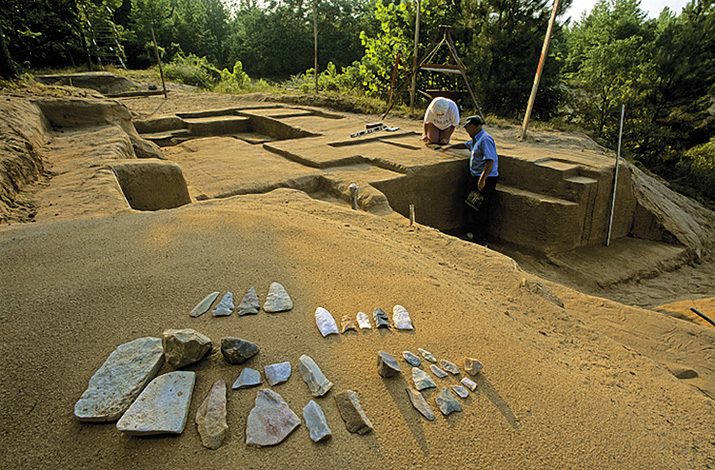
cactus hill virginiaThis article (and photo of a Cactus Hill, Va. archaeology dig) in the current Smithsonian online magazine proves quite interesting.  It has been widely accepted for a number of years that the Clovis point people were the original inhabitants of America and that they crossed over Beringia about 12,000 or 13,000 years ago.  Some people push that date somewhat earlier, but not by much.  DNA evidence collected in contemporary Native people from the Americas also indicates a common ancestor about that same time, from Asian, so that information confirms the Clovis data as well.  So we have a nicely tied package….or do we?

There has always been a fringe of people who believe or at least proposed that another group of people, called the Solutreans, who arrived from Europe 10,000 years or so before the Clovis people were the first “Native people.”  Their artifacts are found in pre-Clovis sites, meaning before the Clovis were here, or at least before we believe they were here, based on numerous kinds of archaeology dating from known Clovis sites.

That theory is getting a new review as more sites come to light and dating technology develops into a more exacting science.

The Smithsonian wrote what I feel is a very balanced article on this matter.  This topic really isn’t resolved and the jury is clearly still out.  Emotions in the scientific field and in some Native communities run very strong regarding this topic, and many viewpoints have been set forth that are biased in their information presented and opinions.

I look forward to new information which will help us better understand our ancestors and the landscape in which they lived.

Be sure to click on the photo gallery in this story for artifact, location and map images.

http://www.smithsonianmag.com/science-nature/When-Did-Humans-Come-to-the-Americas-187951111.html?c=y&page=1

Posted in Clovis | 3 Comments