Tuscarora – The Ones That Stayed Behind
…and Followed the River for Days and Days and Days…
I think this is the most difficult introduction I have ever written, because it’s so hard to describe the sacred with mere human words. Most Native tribes have a Storyteller or Sacred Memory Keeper, a sacred position and entrusted person to preserve and pass the history from the Ancestors to the youth – to assure that the lessons learned aren’t lost – and through those stories to connect the present and the future to the past. In Native culture, our Ancestors and our Stories are both Sacred.
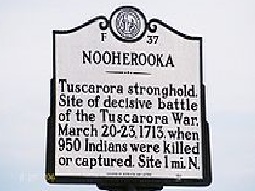
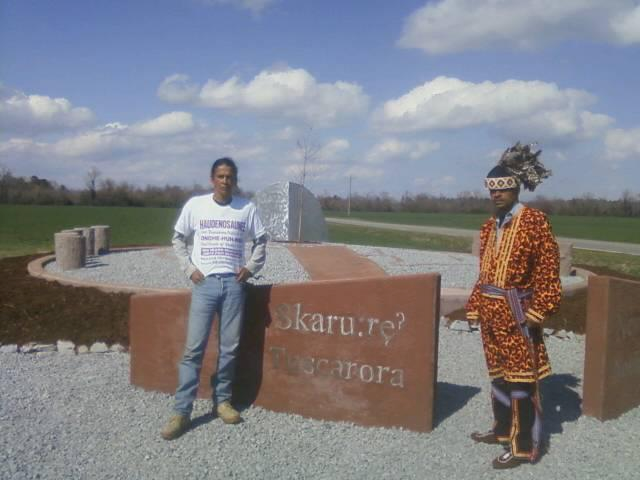
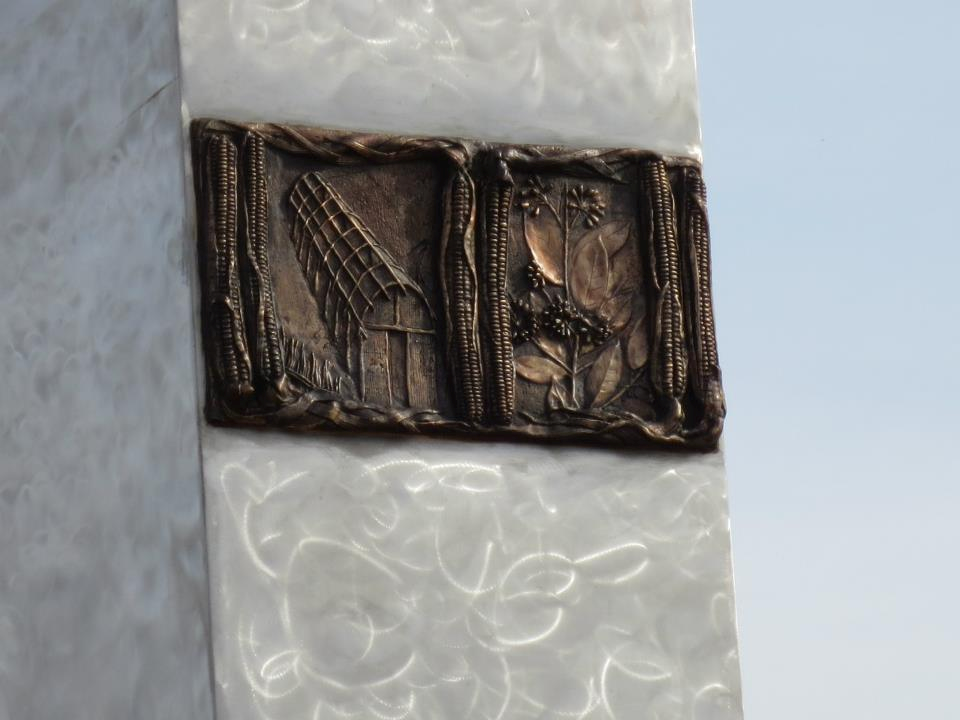
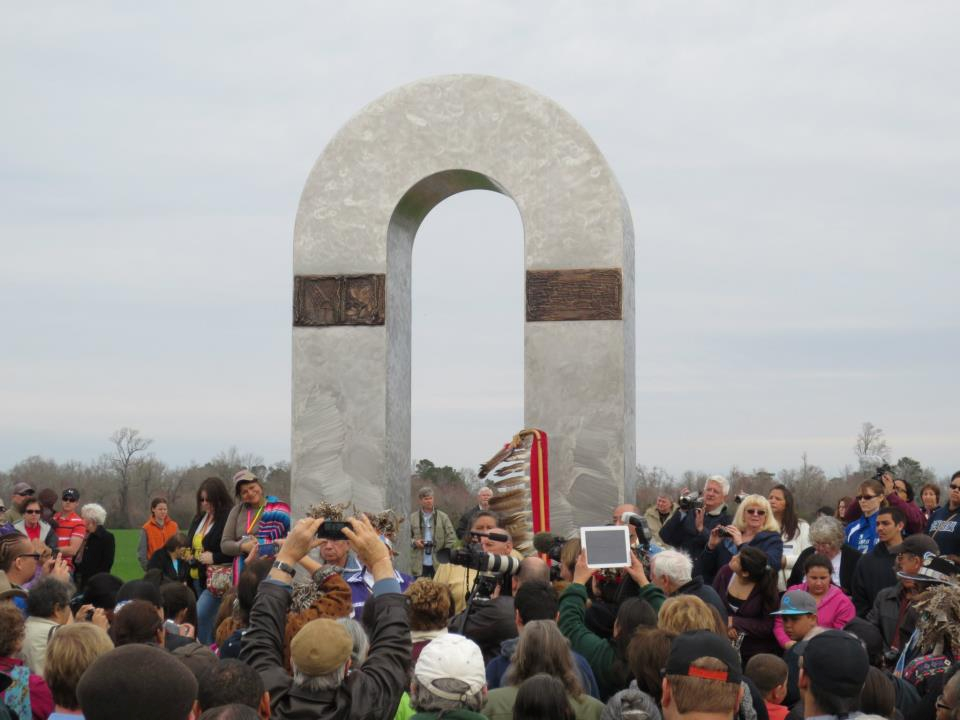
The series of events in the past few days and months have come together to offer a wonderful opportunity to preserve the heritage of the Tuscarora people as a whole, with the dedication of a memorial at Fort Neoheroka, commemorating and honoring the Tuscarora who fell there 300 years ago. But not all fell, and not all died. Not all went north in the migration that spanned the next 90 years. The stories of those who stayed are written in the blood of the people, their descendants, in the obscured records and in the stories, still maintained by those Sacred Memory Keepers who we all know and love as both distant and close family members today.

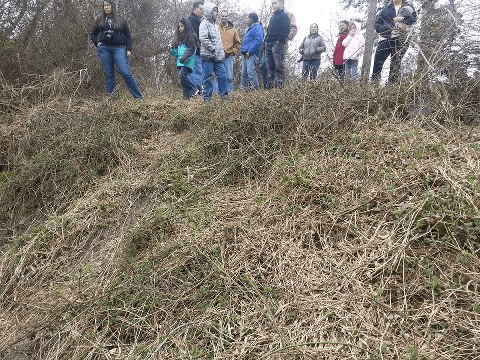
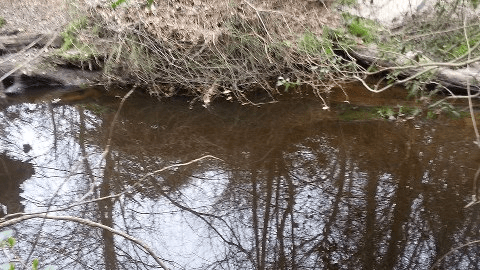
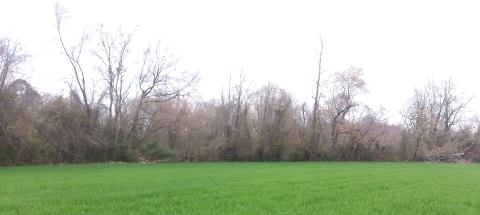
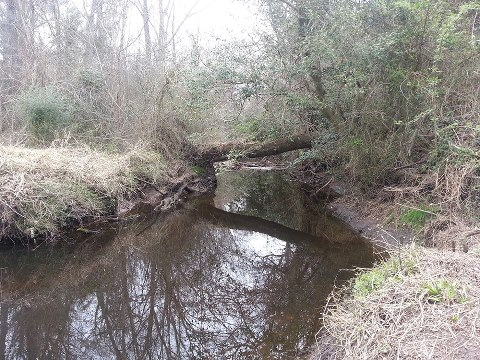
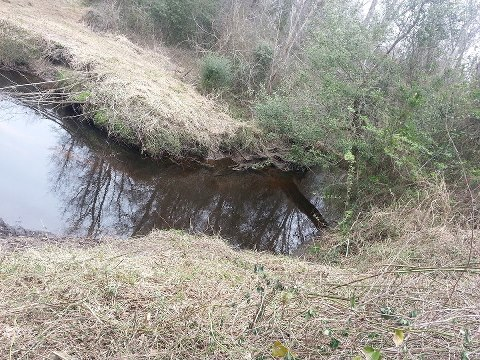
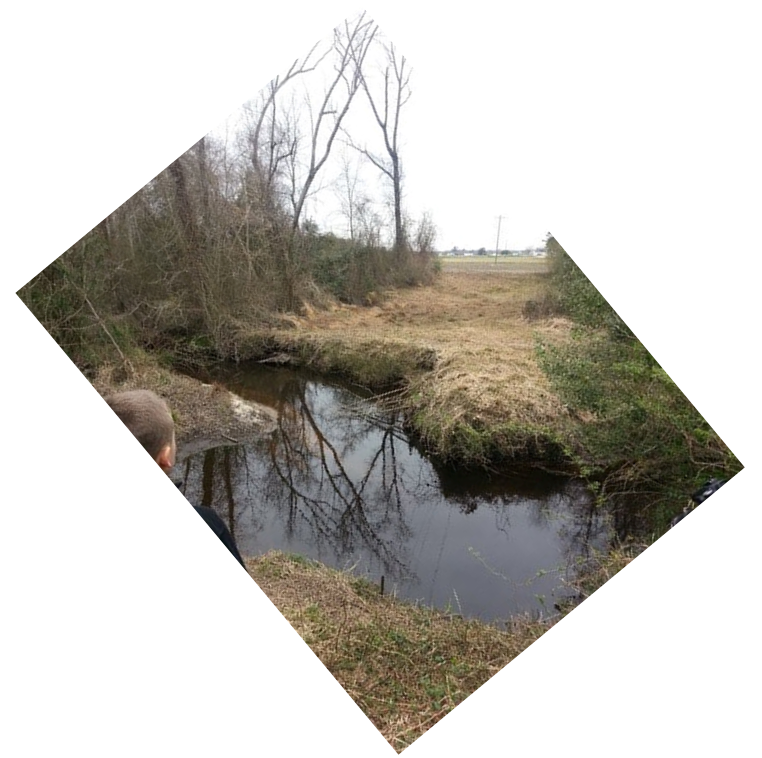
Robert Chavis, a Tuscarora from North Carolina attended the Fort Neoheroka commemoration events and braved the briers to make his way to the creek, the approach shown above, that sacred creek that served as salvation for a few Tuscarora who managed to escape the massacre in the Fort. Robert has graciously agreed to share his photos and they are used throughout this article. Thank you Robert. The Ancestors voices through Robert’s photographs combined with Pine Dove’s story are extremely moving and powerful. Nyaweh to both!
A tunnel existed, between the Fort and the Creek, and a few fortunate Tuscarora made it out alive and avoided capture.

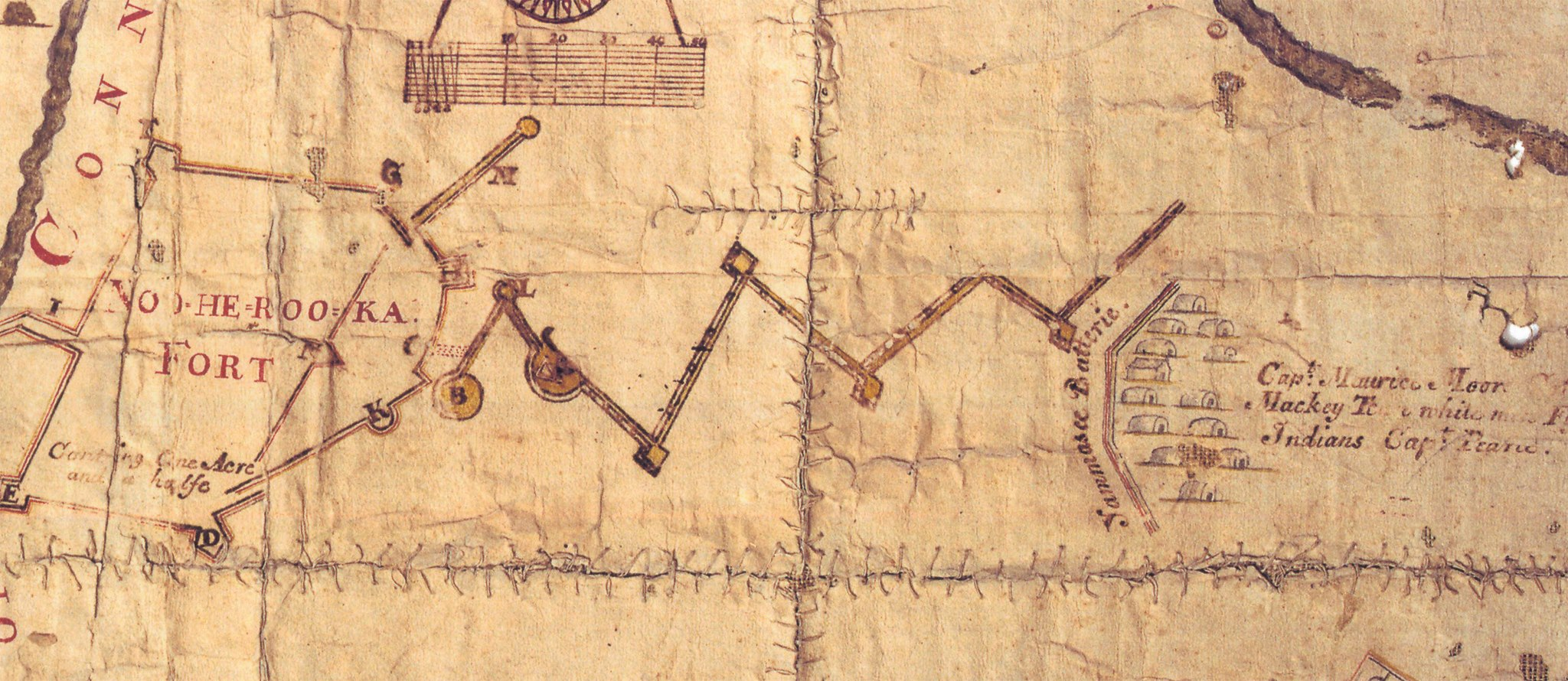
On the map above, Moore’s battle map, you can clearly see Captain Moore’s encampment to the right, and the Fort to the left.
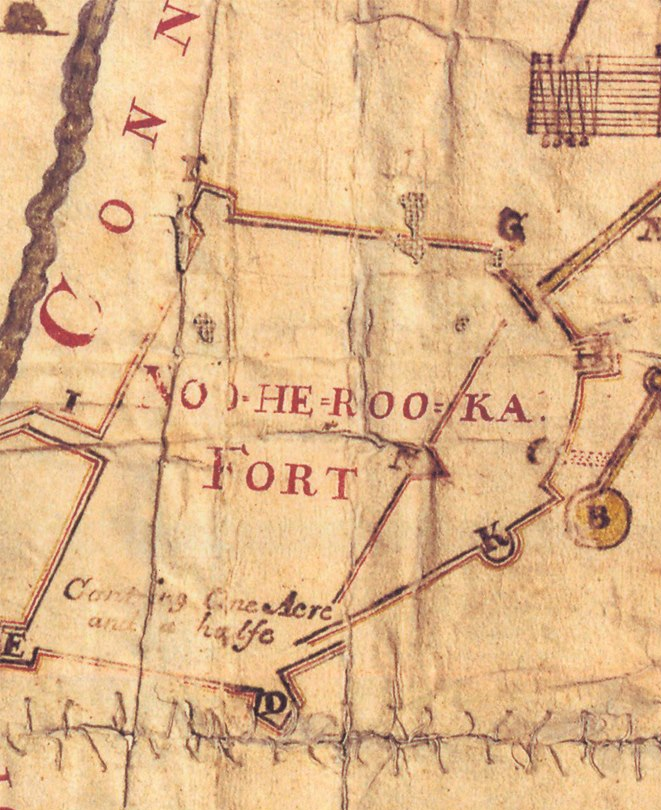
Fort Neoheroka was an irregularly shaped enclosure of one and one-half acres contained within a palisaded wall. Along this wall, at strategically located points, were bastions and blockhouses. Within the enclosure were houses and caves. An enclosed passageway, or “waterway,” led to the nearby branch of Contentnea Creek.
When Moore arrived before this impressive fortification, he began careful preparations to destroy it. Three batteries were constructed nearby and from Moore’s Yamassee Indian Battery facing the fort, a zig-zag trench was dug to within a few yards of the front wall. This trench provided protective cover for men to approach and build a blockhouse and battery near the fort. Both of these structures were higher than the walls of the fort so that the enemy within might be subjected to direct fire.
A tunnel also extended from the trench to the front wall so that it might be undermined with explosives.

To the left, above, you can clearly see the tunnel that leads from Fort Neoheroka to Conntentnea Creek.
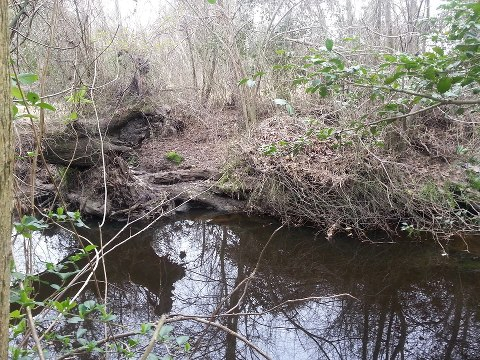
The following photo, taken by Robert this past weekend, shows the entrance to the tunnel, the “waterway,” that led to the creek.
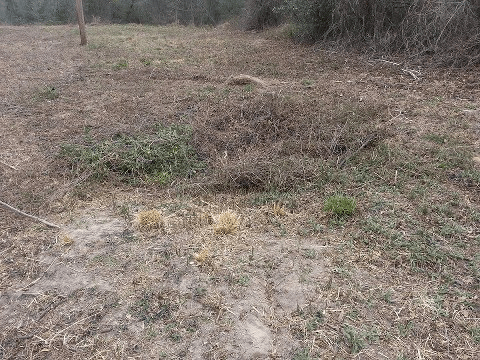
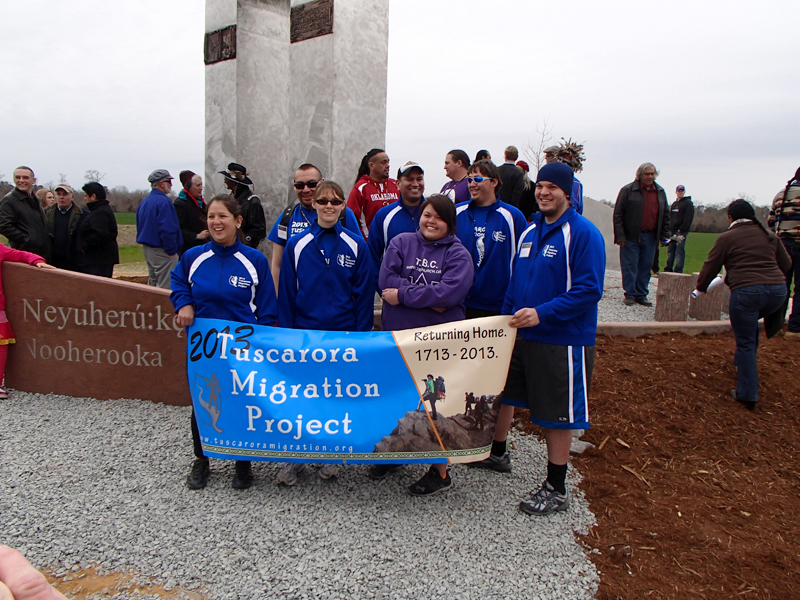
Below, the tunnel exit in the bank beside the creek along with Tuscarora returning home for the commemoration this past weekend.
Below, the Contentnea Creek below the tunnel exit.

“On the morning of March 20th, [1713] every man was at his post when a trumpet sounded the signal for the attack. Three days later Fort Neoheroka lay a smoldering ruin and the enemy acknowledged defeat. The Indian loss was 950, about half killed and the balance taken into slavery. Moore’s loss was fifty-seven killed and eighty-two wounded. With this one crushing blow, the power of the Tuscarora nation was broken.”
Well, that’s the official story, but it’s not the whole story, nor was the Tuscarora Nation broken.
DeGraffenried writes of the Tuscarora: …“The Savages showed themselves unspeakably brave, so much so that when our soldiers had become masters of the fort and wanted to take out the women and children who were under ground, where they were hidden along with their provisions, the wounded savages who were groaning on the ground still continued to fight.”
Not all died or were captured. The remaining Tuscarora fled deep into the interior toward the Virginia border, many of them eventually going to New York where they joined the Five Nations.
The war was not over, however, for at the same time Moore was attacking Ft. Neoheroka, the Machapunga and Coree had been striking at settlements along the Pungo River. Moore’s troops were requested to hunt them down.
Moore gathered the 120 or 130 of his Yamassee Indian forces who had not returned to South Carolina with plunder and captives, and marched to the Pamlico where, in June 1713, he attempted to crush these remaining Indians. He was only partially successful, for as one contemporary account states, the trackless wilderness from which these Indians operated lay “between Matchapungo River and Roanoke Island which is about 100 miles in length and of considerable breadth, all in a manner lakes, quagmires, and cane swamps, and is . . . one of the greatest deserts in the world, where it is almost impossible for white men to follow them.” In September 1713, Colonel Moore gave up and returned to South Carolina.
By the spring of 1714, one or two small bands of Indians were once more terrorizing the Bath County plantations. One account describing their activities explained that “they rove from place to place cut off two or three families today and within two or three days do the like a hundred miles off from the former. They are like deer — there is no finding them.”
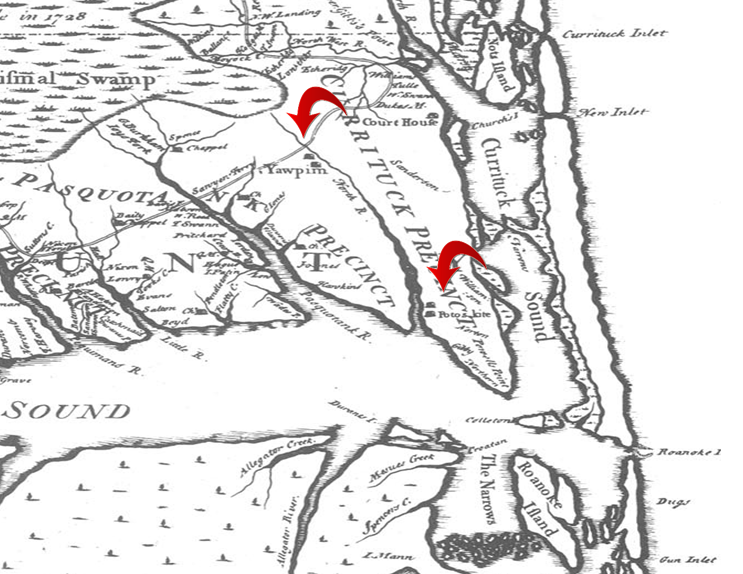
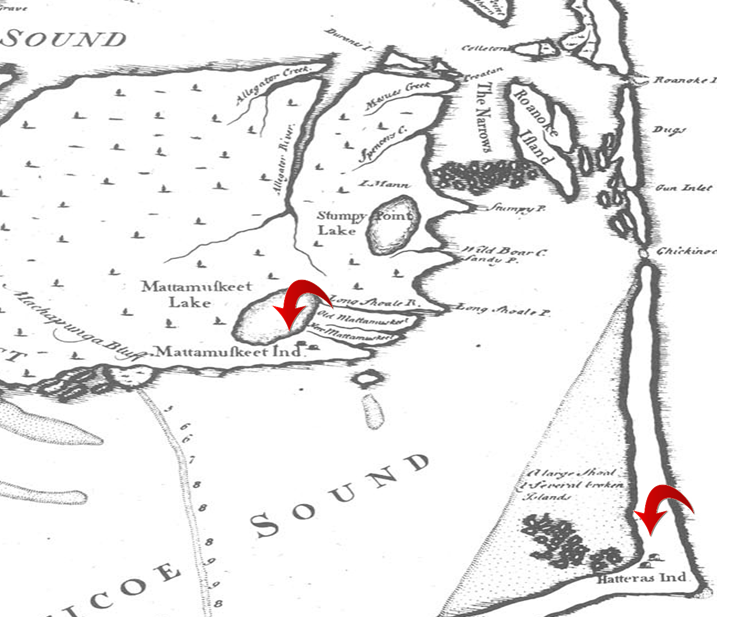
There were originally thought to be about 50 “hostile” Indians left, but even after 30 Indian scalps were taken, additional Indians had joined to expand the band. After a couple of years, the government finally gave up trying to exterminate them and concluded a peace with the surviving hostile Indians in January of 1715 and they were assigned to what would become the Mattamusukeet Indian reservation on Lake Mattamuskeet in present day Hyde County. Several Tuscarora were among them. In 1724, the Tuscarora, under Chief Blount were awarded their own reservation in Bertie County.
The Tuscarora were not gone, they had learned how to become invisible. They lived in the swamps and traveled the creeks and rivers. Many never joined their brethren on the reservations. Although cast in the mists of time, their memory is not dead.
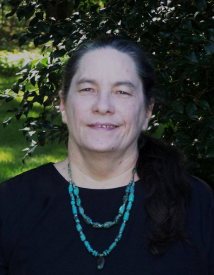 With this, I would like to introduce to you, Pinedove the Younger, Keeper of Memories, Tuscarora Daughter of the Carolinas. Pinedove was named honoring an earlier Keeper of Memories who carried the same name. I want to thank her for sharing, in her own words, this most personal, sacred, family story, never told publicly until now, but passed from her ancestors lips for generations, ever since that fateful day.
Find a quiet place….
THE ONES THAT STAYED BEHIND
Tuscarora War
~~1711~~
It is not lightly that I choose to share this most sacred legacy of memory that has been passed down through my family for more lifetimes than we know. At this point in time this is what has been left to us, anything more now only heard through the whispers of the Refugee Ancestors or written in the Creator’s Hand…….
On this, the 300th Anniversary of the fall of Ft. Neoheroka, I have been asked if I would share this story. After listening to the Creator and viewing pictures of the miraculous opening in the ground and tunnel that led some of our People to safety I know this is the time I am meant to share this memory with other descendants…those that also carry the guardianship of this Place of Lasting Tears within their hearts.

So now it seems, the loving and right thing to do is to dedicate that enduring memorial within the Earth to all Tuscarora families whose ancestors lived this same journey, The Ones Who Stayed Behind.
I also sincerely ask and invite any children of Native Ancestors with similar stories, to add your own voice to the litany. If you have family echoes of these unique and fleeting smoke-like words from your own Ancestor Mothers and Fathers, I urge you to come forward and share those Sacred Memories.
Based On the Memories of
Hattie Brigman Magee
1870 SC-1949 NC
Tuscarora Descendant of Wolf Pit,
Pee Dee River,
Richmond County, North Carolina
The story I record here lies in that thin misty veil of disappearing oral history. It is a gift to the past generations that still had living memory of Great-grandmothers and Ancestors that will only be remembered to the rest of us through the breath of their words.
Women and men born near the eastern North Carolina and South Carolina border well toward the end of the nineteenth century. Their Daddies were farmers, soldiers, and Prisoners of War. Grandfathers that were healers and herb doctors, tenant farmers, river rafters. Legends of many repeated names within several connected families. Men that lived out their lives often unrecorded, unseen, but in plain sight.
The story of Grannies, widows that peacefully Crossed Over in the 1930’s and 40’s not many miles from where they were born. Grandmothers that wrapped their quiet spirits around beloved granddaughters. Like fond warm sweaters their memories have been passed on…..
This is a tribute to the powerful oral tradition maintained generation after generation, even as the voices grow more dim. The faithfulness through their lifetimes to understand shadowy answers searched for, but never found in this time and place….only found through the pieces and riddles left behind. Stories repeated time and time again. Sometimes meaning almost faded, in words that must never be lost.
Thankfully they were spoken by many whispered voices often, always in the same melodic way, repeated over and over, fragments, phrases that would become imprinted on children, grandchildren, and great-grandchildren.
These saved memories had to remain until such time that technology could assist in piecing together the clues the Old Ones left behind. Until those words could eventually be tied to actual preserved records.
These Wolf Pit, Pee Dee family lines are ones of the early Carolina wilderness. They are now recorded as ancestors of the ancient Tuscarora, survivor families of the Tuscarora War of 1711.
As these refugees arrived from Bertie and Halifax Counties, North Carolina, near Virginia, and the coast of NC, they were Indian and part Indian. Many lived as Shadow People in the cultural and racial no-man’s-land of colonial times.
They settled along the Catawba Path, the Chawsaw Path and the Cheraw Path, part of that ancient set of trails that linked various lndian Nations.
One of these paths would eventually become Old Highway One connecting Rockingham, North Carolina to Cheraw, South Carolina along the Pee Dee River. Within this area of the “Cheraw Old Fields” lies the settlement of Wolf Pit, early traditional homes of Native related families since the mid 1700’s.
Early immigrant and Native families came together here on the frontier. Women of the Tuscarora, Pee Dee, and Cheraw Indian tribes. Within these families were Strong Native women.
Mothers who have crossed the mystery of generations without last names, often identified in records only with distinctive first names. But just as often, nothing is ever evident to be found as to Native or European names. As these women reared daughters and sons, they taught them their own unique code of frontier survival and a cultural blend of Native ways.
Families that lived on the fringe of Indian, colonial, and established society, floating in and out between two cultures.
Numerous documents and official court records of the Revolutionary period attest to their independent and nonconformist ways. Richmond County, NC and Marlboro County, South Carolina records create a picture of free agents, Revolutionary War loyalists, War of 1812 guerilla scouts and patriots. Later, Civil War conscriptees and POW’s: soldiers by necessity, not by design.
As the 1800’s unfolded, some moved away to other states trying to find a life that was easier. Some at times, changed the spelling of their name. Many remained private and silent, never speaking of their heritage of Native blood even to their own children and grandchildren.
As hardships dictated, often their heritage and identity was lost. It would only be found again in obscure forgotten archive records, by a modern generation of great-great- grandchildren. The old ones had created a kinder gentler cultural identity, but had left a mystery of family history and unspoken heritage to be unraveled.
This record celebrates the miracle of that shadowy oral history which managed to survive, finding that fragile ancient link back to the Ancestors and special gifts of the Spirit that came from them…..a strong survivor spirit in the face of immeasurable adversity. A storytelling and preservation tradition more ancient than established written records.
In closing, this is a personal account that documents what is still unspoken and unrecorded in many respects. It is a family history. Our mothers’ faithful memories tell us to preserve what is left before it is lost to our own children and family yet to come…they, the next generation of Tuscarora descendants of The Tuscarora That Stayed Behind.
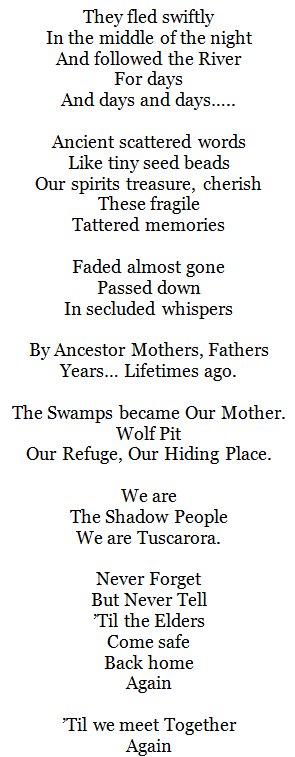
The Ancestors’ voices, repeated through the lips of many generations tell us that….
“We fled somewhere quickly in the middle of the night…..
We followed the River,
Sheltered by the River.
Always the River.”

The Mystery of Great Grannie Ghee’s Words
Repeated many times over many days, many years.
A puzzle she in her own life, never fully understood. But by faith as it had been taught to her as a child, repeated and passed it on…….
First told to her daughters Alena and Zula. Then passed onto her granddaughter Naomi as she sat up late at night and listened…..
Who passed it on to her daughters and son. Who now tell their children. So they can grow up, remember the words and pass them on once more.
TO REMEMBER:
THE ONES THAT STAYED BEHIND
Tuscarora War
~~1711~~


Oral History Supporting Resources:
BAE–Bureau of American Ethnology, Washington, DC. [now part of National Anthropological Archives, Washington, DC]
Chavis , G.L. History and Oral Traditions of the Chavis Trading Post and Cheaves Mill, Tarr River, Granville Co., NC, Tuscarora of South Carolina, 2008.
Collett, John, et al A Compleat map of North-Carolina from an actual survey, S. Hooper, Ludgate Hill, London,1770
William P. Cumming, The Southeast in Early Maps, Third Edition. Chapel Hill: University of NC Press, 1998. Map 394.;LC Maps of North America, 1750-1789, no.1500. Repository NC Collection Gallery, University of North Carolina, Chapel Hill, NC
England, T. B. , Anson Co., NC, Land Grant Research , Grants, 26 Oct 1767
and 8 Dec 1770 Survey: No. 60. Thomas Brigman Location Terms: Marks Creek, Spring Branch, Chawsaw, Gum Branch, Chawsaw Road.
Feeley, Stephen D. Tuscarora Trails: Indian Migrations, War, and Constructions of Colonial Frontiers, Vol.1, page 259-260 , The College of William and Mary, 2007. Oral tradition of Tuscarora survivors [documented from 19th century memories] Escape across the river on rafts.
Mouzon, Henry “An Accurate Map of North and South Carolina With Their Indian Frontiers, Shewing in a distinct manner all the Mountains, Rivers, Swamps, Marshes, Bays, Creeks, Harbours, Sandbanks and Soundings on the Coasts, with The Roads and Indian Paths…by Henry Mouzon and Others, Published, The American Atlas John Bennett, Robert Sayer, London, England, 1775. Repository, North Carolina State Archives
Referenced from “Tuscaroras Leave N.C.” Gatschet after Adam Williams, 44 Tuscarora., ca. 16 Sept 1885. Free Rendering by A. [Anthony] F.C. Wallace, BAE Box 372b in Extracts BAE Tuscarora Collection, F.R. [Roy] Johnson Papers, NCSA. [NC State Archives]
Roberta Estes resources:
http://www.nchistoricsites.org/bath/tuscarora.htm
http://www.carolana.com/Carolina/Noteworthy_Events/tuscarorawar.html
http://blog.ecu.edu/sites/nooherooka/
Contentna Creek photo journal graciously provided by Robert Chavis.









 Native Heritage Project