Hugh Waddell’s Castaway Indians – 1756

waddellI’m ever so grateful for subscribers who are intensely interested in Native American history.  Clay read one of my articles, and contacted me regarding a question I asked.  He also provided much of the information below.  Thanks Clay.

Roberta Estes: “It would certainly be interesting to see the list of men serving in Hugh Waddell’s army of SC Indians.  If have not been able to locate the list, if it exists.  If anyone has knowledge of this, please let me know.”

https://nativeheritageproject.com/2012/08/06/a-report-on-research-of-lumbee-origins-by-robert-k-thomas-part-15-lumbee-identify-their-view-of-themselves/

Clay wonders whether Hugh Waddells’ list might be in the SC archives, not in NC, since Anson included parts of SC at one time. The article below identifies Hugh as affiliated with the Catawba Indians whose primary village was in South Carolina.  We know that some of the Catawba, during this timeframe, also were living on William Eaton’s land in Granville County, NC as well.

From the Fort Dobbs history page, we find the following information:

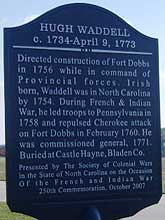
“Captain Hugh Waddell (1734-1773) was given the NC provincial frontier company to defend the North Carolina western frontier in 1755 by Governor Arthur Dobbs. Governor Dobbs found Waddell to be in “every way qualified for such a command, as he was young, active and resolute.”

Earlier that year, Governor Dinwiddie of Virginia offered Waddell any service in his power. The Frontier Company, forty to fifty in number, were uniformed in “blue with turned up red collars.” In 1756, Waddell served as a commissioner of peace, the only NC representative negotiating peace with the Catawbas and Cherokees.

Captain Hugh Waddell led forty-six soldiers in constructing Fort Dobbs so that colonists could be protected from possible French, Cherokee, and Catawba attacks. Following the construction of Fort Dobbs in 1756, the Frontier Company began construction of a fort for the Catawbas in present day Fort Mill, SC. However, the fort was never completed due to border disputes with South Carolina.

Dobbs continued Waddell as a captain and under General Forbes sent Waddell to the Ohio River Valley where he commanded three companies, including his own frontier company. At that time he was given commission of major to command those provincials.

During the Forbes expedition, Waddell excelled in leadership, military skills and tactics. His sergeant, John Rogers, took the only Indian prisoner who gave General Forbes intelligence concerning Fort Du Quesne. Using that intelligence, Forbes proceeded to the fort. Upon return, Waddell was given a colonel’s commission and was ordered to command the militia from Rowan, Anson and Orange counties to act along with the provincials. At that time, Waddell’ s company consisted of fifty-two provincial soldiers and thirty-four Castaway Indians.”

Waddell’s militia lists, if they could be found, would be extremely informative.  Anyone close enough to search at either the NC or SC archives?  We already know that 34 of his 86 soldiers were Native.  And what, exactly, does “Castaway Indians” mean?  Were they disconnected from their original tribe(s)?  A militia list and a few more words about the genesis of Waddell’s Indians then could answer a slew of questions today.
Posted in Catawba, Cherokee, Military | 2 Comments

1756 Dinwiddie Letter to George Washington

The Dinwiddie letter to George Washington is in relation to the French and Indian War.  Another relevant article is a letter from George Washington himself recruiting the Tuscarora, who are referenced here.  Hat tip to Fix for this GenWeb article.

Bertie  COUNTY  NC  History  Letter - R. Dinwiddie

File contributed for use in USGenWeb Archives by calexeditor@mail.nucleus.com 
Deborah Cavel-Greant 

Robert Dinwiddie to George Washington, December 27, 1756 

Letters to Washington and Accompanying Papers. Published by the Society of
the Colonial Dames of America. Edited by Stanislaus Murray Hamilton.--vol. 02

WILLIAMSBURG Decr. 27th: 1756

SIR

Yours of the 19th: by Jenkins I recd: last Night & do
observe You have ordered the Garisons on the Branch
to Perceall's, to escort the Flour to Fort
Cumberland.

The Provisions lying in Bulk at the different Forts
if possible shou'd be Smoked, which wou'd be a great
Saving to the Country, & I hope You have ordered it
so.--As we have had great Rains lately I hope a
sufficient quantity of Flour may be secured, as Mr.
Walker told me he & his Assistant had contracted for
as much as wou'd serve our Forces twelve Months. The
Orders given You at first, were on Capt. Mercer's
repeated Assurances of Your having 160 enlisted Men
at Winchester, which, with the Servants You mention'd
to be enlisted, I conceived You cou'd march 100 Men
from Fort Loudoun to Fort Cumberland, but by the
Return You write of only 85 Men at Fort Loudoun--It
was thought proper to call in the Forces from the
Stockade Forts to garison the above Forts compleatly;
but not knowing Your Numbers in those Out-Forts I
gave general Orders to call them all in, however
after Garisoning Fort Cumberland & Fort Loudoun
properly, the Surplus Men You are to fix at any Forts
You think proper between the above two Forts, & where
You think they may be of most essential Service.

I am surpriz'd Mr. Walker shou'd leave his Duty after
the Assurances made me (last Time he was inTown) of
discharging that Duty with all Diligence. I fear he
was not properly countenanc'd, his Probity, Knowledge
& Experience makes him as equal to that Service as
any in the Country, & as he & his Assistant have made
so large Contracts, I shall not appoint another till
I have his Reasons for resigning.

Colo: Stephens had the Keys where the Indian Goods
were lodged, & he must render an Acct. Of them; I
have a Copy of the Invoice from Colo. Innes. I am of
Opinion that Capt. Mc.Neill is a proper Person to
conduct the Catawbas Home (if you cannot prevail with
them to remain some Time longer) & he probably may
engage some of their Warriors to come in the Spring.-
-Capt. Pearis & 20 Men, were employ'd to escort the
Cherokees and Catawbas, but You may observe how I am
disappointed.1 [Note 1: 1 In the number of Indians
escorted, "six Cherokees and two squaws."] 

I sent Capt. Mc.Neill 500£ to pay the Masters for the
Servants enlisted, & order'd him to engage as many as
that Money wou'd answer & send them up to You; but I
cannot give Directions for enlisting more till I see
the Treasurer, to know what Money he may have
applicable to that Service. Fort Cumberland is to be
kept as Defensible as You can till the Spring, when I
expect Lord Loudoun will give Directions therein, but
not to be made Cannon proof unless it can be done at
a small Expence, which the Country must pay unless
Lord Loudoun otherways directs. The paragraph of Lord
Loudoun's Letter to me, is entirely confin'd to Fort
Cumberland, he was affraid You wou'd have evacuated,
& dismantled thatFort before his Letter reached me,
which wou'd have had a bad Effect as to the Dominion,
& no good Appearance at Home--As to the String of
Forts he knows Nothing of, or can You, from the
Paragraph sent You, think that he either prejudges or
has any bad Opinion of Your Conduct, & as Fort
Cumberland is reinforc'd he will be much pleas'd.1
[Note 1: 1 The governor afterwards thought to add a
palliative by this assurance.--SPARKS.] 

I confirm my
former Leave of Your coming here when his Lordship
arrives, as You will be able to give him a good Acct.
of our Back Country; & I desire You will give the
necessary Orders to Your Lieut. Colo. before You
leave Fort Cumberland--And I expect You left
Directions with Ct: Mercer to continue the
Constructing of Fort Loudoun, & that with all
possible Expedition. I was in hopes the Interpreter
for the Catawbas would have serv'd for the Cherokees;
however I have sent up the Country to engage an
Interpreter--You must keep the Indians employ'd in
Scouting, if idle they will be thinking of Home. I
approve of the Leave You have given to Lieutts. Baker
& Lawry, & I shall be glad to see them - I have paved
the Way & I expect a good Number of the Tuscaroras &
Nottaways early in the Spring, & I think Lieut. Baker
will be of great Service with those People. I am in
Pain & greatly uneasy for the poor Men's Cloathing--I
understand the Treasurer appointed Colo. Carlyle &
Mr. Chas. Stewart to provide them, & I hope the first
Vessell from London will bring them; the Severity of
the Weather & the Work they haveto do gives me
Concern when I think of their naked Condition,--I
wish You cou'd purchase some Blankets for the present
tho' I think it cannot be long before they arrive;
endeavour to keep them in Spirits for a short Time
longer.

You do right in writing to the Treasurer to provide
Money You know I am only to grant my Warrant, & when
I see him I shall speak to him on that Head. I shall
be glad to have a regular Return of Your Strength to
lay before Lord Loudoun when he arrives--I wish You
Health & I remain

... Sir
... Your humble Servant
... ROBT. DINWIDDIE

========================
USGENWEB NOTICE:  In keeping with our policy of providing
free information on the Internet, data may be freely used
by non-commercial entities, as long as this message
remains on all copied material. These electronic pages
cannot be reproduced in any format for profit or other
presentation. The submitter has given permission to the
USGenWeb Archives to store the file permanently for FREE
access. ==============
Posted in Catawba, Cherokee, Military, Nottoway, Tuscarora | 1 Comment

5,500 Year Old Native Grandmother Found Using DNA

???????????????????????????????????????????????????????????????????????????????????????????????????????????????????????????????????????????????????????????????????????????????????????????????????????????????????????????????????????????????????????????????????????????????????????????????????????????????????????????????????????????????????????????????????????????????????????????????????????????

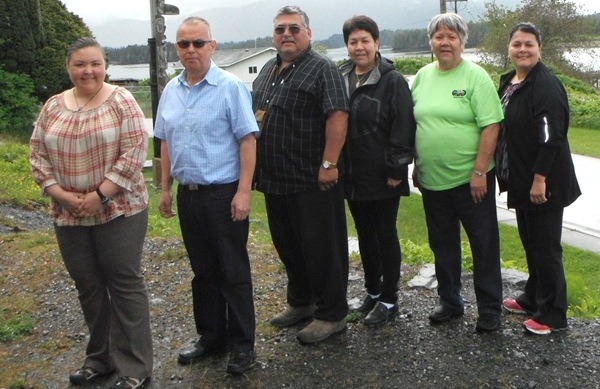
Members of the Metlakatla First Nation Community near Prince Rupert, BC who collaborated with an international team of scientists in a genetic study of aboriginal people, including excavated remains that link them to their 5,500 year old Grandmother.  Photograph/handout courtesy of the Metlakatla Treaty Office.

Over the past decade or so, there has been a lot of debate about tribal participation in DNA testing.  Without getting into the politics of the situation which is deep and dangerous water, many tribes see absolutely no possibility that DNA testing could help them, and a significant potential that it might hurt them, one way or another.

For example, we know that the Eastern tribes were heavily admixed with Europeans quite early and we know that the Southwest tribes are equally admixed with the Spanish.  Yet, they are still Native tribes, carrying on the Native customs and cultures, including their own creation and other sacred stories.

Let’s say that a few tribal members test, and their DNA turns out not to be Native, but is European, or African.  Granted, the DNA would only be representative of one genealogical line, either the direct paternal (surname) line for males and the direct maternal line for both males and females, but still, if you expect Native and you get something else – it could be bothersome, and perhaps troublesome.  Add to that a historical situation filled with distrust for a government that routinely broke treaties and you have a situation where tribes would just as soon not open Pandora’s box, thank you very much.

However, not all tribes think this way.  For the past several years, people from Canada’s First Nations tribes have been working with scientists not only to test their DNA, but that of their ancestors as well.  Recently, a paper was published detailing the findings, but those findings didn’t really say much about the effects of the results on the currently living people and tribes involved.

The Vancouver Sun recently carried a human interest story focused on the Metlakatla First Nation Community and the people who were found to be related to the 5,500 year old bones that DNA was extracted from.

The people involved who descend from either this woman or a common ancestor with her are thrilled to be able to make that connection from some 220 generations ago, to be able to honor her as their Grandmother, and the connection cements the fact that these people’s ancestors were indeed on this same land at least 5,500 years ago, not far from where they live today.

This kind of information has great potential to help the tribes involved with land claims and treaty rights.  These deep rooted links to the region simply cannot be denied.  So the First Nations people stand to benefit, the people who match the Grandmother are thrilled, science benefits and they have the ability to confirm their own stories told by the Ancestors for centuries, indeed, for thousands of years.  Sounds like a win-win situation to me.

Congratulations to these First Nations people for this wonderful link to a Grandmother, for their brave participation and leadership role in scientific study, and for not being afraid of finding the truth, whatever it is.  The Ancestors would be proud of you!

Posted in Canada, DNA, First Nation, Metlakatla, Uncategorized | 5 Comments

1911 Map of NY Onondaga Indian Reservation

1911 Onondaga REservation

1911 Map of the Onondaga Reservation in New York.

Source:  New York State Archives. Education Dept. Division of Visual Instruction. Instructional glass lantern slides, ca. 1856-1939. Series A3045-78, No. 88.

http://iarchives.nysed.gov/dmsBlue/viewImageData.jsp?id=1479

Posted in New York, Onondaga, Reservation | 2 Comments

The Ket People of North Asia – Ancestors of Native Americans

ket lecture

Enjoy this lecture, “The Peopling of the Americas and the Dene-Yeniseian Connection”  by Dr. Edward Vadja who visited, lived among and studied the very remote Ket people in far northern Russia.  The Ket are ancestral to the Na-Dene and Athabaskan people in the Americas and live so remotely that not even the Russians could penetrate that region to build concentration camps.  Today, there are only about 1200 Ket people in total, of which there are only about 50 Native Ket speakers left, the rest speaking Russian.  They share genetics, haplogroup Q and a common ancestral language with Native American people along with other similarities.

http://www.youtube.com/watch?v=ETm2e4M7T4c

Posted in Athabaskan, Ket People, Na-Dene | 1 Comment

1910 NY Map of Indian Reservations

1910 NY Indian Reservations

1910 map of NY with locations of Indian Reservations

Source: New York State Archives. Education Dept. Division of Visual Instruction. Instructional glass lantern slides, ca. 1856-1939. Series A3045-78, No. 42.

http://iarchives.nysed.gov/dmsBlue/viewImageData.jsp?id=1478

Posted in New York, Reservation | Leave a comment

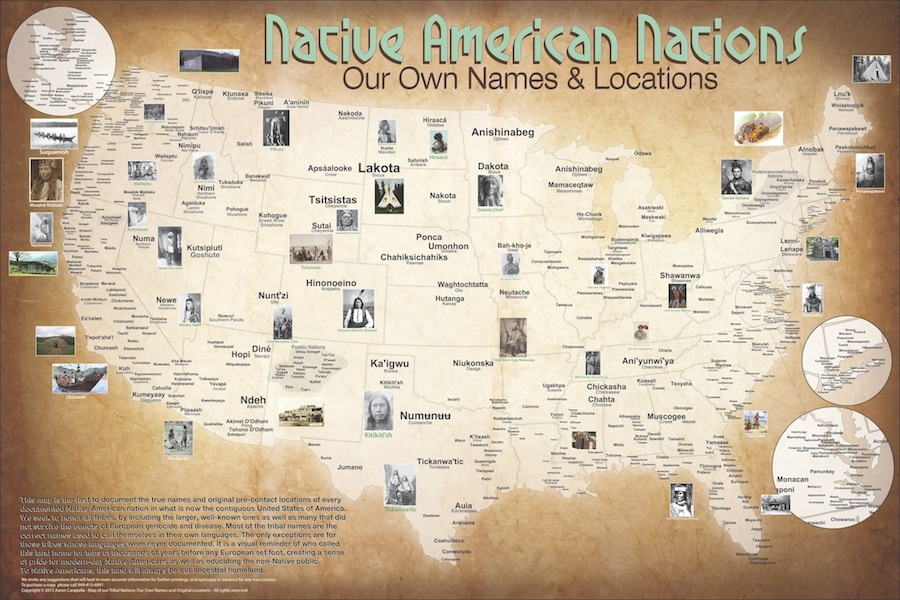
Native Nations Map – 1491 Census

carpella native nations mapIndian Country reports that Aaron Carpella, of Cherokee lineage, created a map that shows the locations of the various tribes at first contact, along with their original names.  Aaron says that it took him 14 years to do the research to complete the map.

On Aaron’s website, you can see two or three closeups of various sections of the map, which includes the Albemarle Sound area at the North Carolina/Virginia border.  I am fairly familiar with the tribes in that region, and there are a couple of names here that I haven’t seen before.  I hope that he has someplace documented the sources and context of the Native Nation names he has found.

1491 map albemarle closeup

I wrote to Aaron asking about the source of tribal names, and he was very responsive.  He does provide a spreadsheet on his website for all of the tribes listed with their indigenous given name and a translation.

His next project, the same type of map for Canada.

You can purchase this map on his website.  Depending on the paper and finish, maps begin at $89.

Hat tip to Linda for the link to this article.

Posted in Maps | 3 Comments

1793 Map of Six Nations Boundary in New York

1793 Six Nations Map

Map Source:  New York State Archives, A0448-79, Recorded Indian treaties and deeds, 1703-1871 (bulk 1748-1871). Vol. 1, p. 45.

This early map of NY from 1793-1794 shows the Six Nations borders, marked in yellow, as well as Indian paths, mountains, waterways, roads, place names and drainage.

Note on map says “Boundary of the Six Nations is taken from an Old Map in Doc. History.”  See Johnson’s Map (torn) Hist. Vol.

This image shows only part of this map.  Online, the map is high quality and sections are enlargeable.

http://iarchives.nysed.gov/dmsBlue/viewImageData.jsp?id=153506

Posted in New York, Six Nations | Leave a comment

Ancient DNA Analysis From Canada

malhi ripan in lab

Recently a new academic paper focused on Native American ancestry hit the news.  Ripan Malhi’s molecular anthropology and ancient DNA lab at the University of Illinois, shown above, in Urbana, Illinois has successfully extracted DNA from remains of individuals whose bones were found in an ancient trash heap in British Columbia and has successfully matched the DNA with living people today, confirming of course that today’s people were related to these ancient people and are a part of the same base population that lived there 5000-6000 years ago and remains today.

malhi paper map

Ripan’s paper, “Ancient DNA Analysis of Mid-Holocene Individuals from the Northwest Coast of North America Reveals Different Evolutionary Paths for Mitogenomes” discusses this in detail.  If you’re not up to this level of detail, a nice article in LiveScience covers the discovery as well.

Ripan has successfully connected the dots between the fossilized remains and currently living members of several Native tribes local to the region where the bones were found.

As part of this study, three new mitochondrial haplogroups were discovered in the Native population.  Two haplogroups, A2ag and A2ah are found alive and well today.  However, another, D4h3a7 has only been found one other time, in remains found in a cave in Alaska, and may have gone extinct.  It has not been found in living people to date, although a lot of people have yet to be tested.

The area where the remains were found is indigenous to the Tsimshian, Haida and Nisga’a tribes.

Today, local tribes are participating in additional research with Dr. Malhi in order to better understand their ancestry and to see if the genetic data supports their extensive oral history which suggests multiple migration waves from Asia into the Americas within the past 5000 years.

Hat tip to Charlie and Jane for this article.

Posted in Alaska Natives, Anthropology, Archaeology, Canada, DNA, Haida, History, Nisga'a, Tsimshian | 1 Comment

Chief Dan George Laments Canada’s 100th Birthday

Chief Dan George

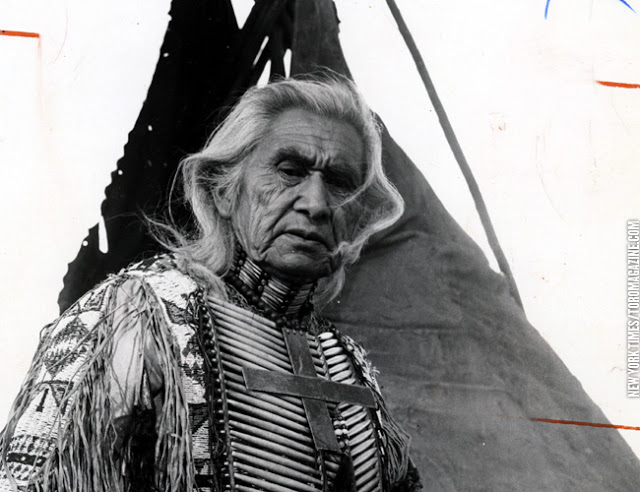
Chief Dan George (1899-1981) was an Indian Chief, an activist, an actor and a poet.  His best-known written work was “My Heart Soars.”  In this YouTube video, the poem is read by his son, Chief Leonard George.

Former Chief of the Salish Indians in Vancouver, Dan George, in his 70s at the time, went on to win an Academy Award nomination for his role in Little Big Man as well as other awards.

Always an activist, he silenced a stadium of 32,000 people in 1967 at an event to celebrate Canada’s 100th birthday with this lament.

“Today, when you celebrate your hundred years, oh Canada, I am sad for all the Indian people throughout the land.

Oh Canada, how can I celebrate with you this Centenary, this hundred years? Shall I thank you for the reserves that are left to me of my beautiful forests? For the canned fish of my rivers? For the loss of my pride and authority, even among my own people? For the lack of my will to fight back? No! I must forget what’s past and gone.

Oh God in heaven! Give me back the courage of the olden chiefs. Let me wrestle with my surroundings. Let me again, as in the days of old, dominate my environment. Let me humbly accept this new culture and through it rise up and go on.

Oh God! Like the thunderbird of old I shall rise again out of the sea; I shall grab the instruments of the white man’s success-his education, his skills- and with these new tools I shall build my race into the proudest segment of your society.

Before I follow the great chiefs who have gone before us, Oh Canada, I shall see these things come to pass. I shall see our young braves and our chiefs sitting in the houses of law and government, ruling and being ruled by the knowledge and freedoms of our great land.

So shall we shatter the barriers of our isolation. So shall the next hundred years be the greatest in the proud history of our tribes and nations.”

Take a look and make sure to watch the video, “Chief Dan George,” in spite of the irritating commercials.  The video is excellent and the end is worth waiting for.

Posted in History, Salish | Leave a comment