Native American DNA Projects

Native DNA in Feathers

I’m often asked about DNA projects at Family Tree DNA that are for or include Native American or aboriginal DNA results.  Please note that different project administrators have different criteria for admission to a project.  Some require definitive proof of descent, some require no documentation at all.  This is entirely left to the discretion of the project administrators.  Therefore, you should NEVER assume that because you match someone in one of these projects that you have Native heritage.  There are various ways to prove Native heritage using DNA which I’ve discussed in the article, “Proving Native American Ancestry Using DNA.”

Furthermore, some of these projects aren’t exclusively for Native American descendants, but you may find Native descendants or families among the project members because of the topic or where the project is focused.

Regarding haplogroup projects.  Some haplogroups include both people who are and who are not Native.  Check with the particular project to understand the nuances.  In many cases, research through the projects is ongoing.

If you know of additional projects which should be added to this list, please let me know.

Native American, First Nations or Aboriginal DNA Projects

Acadia Metis Mothers
http://www.familytreedna.com/public/AcadiaMetisMothers/default.aspx

Algonquian East DNA Project
http://www.familytreedna.com/public/algonquian_east/default.aspx

American Indian DNA Project
http://www.familytreedna.com/public/AmericanIndian/

AmerIndian Ancestry out of Acadia Project
http://www.familytreedna.com/public/AcadianAmerIndian/

Cherokee DNA Project
http://www.familytreedna.com/public/CherokeeDNAProject/default.aspx

Lumbee Tribe Regional DNA Project
http://www.familytreedna.com/public/LumbeeTribe/

Mexico and Southwest USA Native Y
http://www.familytreedna.com/public/MexicoAmerindian/

Mitochondrial American Indian Founder Project
http://www.familytreedna.com/public/AmerindFoundermtDNA/default.aspx

Mothers of Acadian mtDNA Project
http://www.familytreedna.com/public/mothersofacadia/default.aspx

Native People of Southwest Virginia
http://www.familytreedna.com/public/napeopleofswvirginia/

North Carolina Native Heritage Project
http://www.familytreedna.com/public/NorthCarolinaNativeHeritage

Piqua/Shawnee – no public website – contact admins below
cavetank@aol.com, tankerkh@uc.edu, ewest14@woh.rr.com

Tuscarora
http://www.familytreedna.com/public/Tuscarora/

Waccamaw DNA Project
http://www.familytreedna.com/public/CapefearIndians/default.aspx

Wesorts-Piscataway
http://www.familytreedna.com/public/Wesorts-Piscataway

Wiccocomico Native American DNA Project
http://www.familytreedna.com/public/wiccocomico/default.aspx

Mitochondrial DNA Haplogroup Projects

Haplogroup A Mitochondrial DNA
http://www.familytreedna.com/public/haplogroupAmtDNA/
Note – Native American DNA is a subgroup of haplogroup A.  See this link for specifics.

A2 Mitochondrial DNA Project
http://www.familytreedna.com/public/mtDNA_A2
A2 is known to be Native.

A4 Mitochondrial DNA Project
http://www.familytreedna.com/public/A4-mtDNA/
Haplogroup A4 is known to be Native.

B2 Mitochondrial DNA Project
http://www.familytreedna.com/public/mt-DNA-B/
B2 is known to be Native.

Haplogroup C Mitochondrial DNA Project
http://www.familytreedna.com/public/C_Haplogroup_mtDNA
Subgroups of haplogroup C are known to be Native.

Haplogroup D Mitochondrial DNA Project
http://www.familytreedna.com/public/D/
Subgroups of haplogroup D are known to be Native.

Haplogroup X Mitochondrial DNA Project
http://www.familytreedna.com/public/x/
Subgroups of haplogroup X are known to be Native.

Haplogroup X2b4 Mitochondrial DNA Project
http://familytreedna.com/public/x2b4mtdna
X2b4 is currently being studied to determine if it is Native or has a Native component.

Y Haplogroup Projects

Y Haplogroup C
http://www.familytreedna.com/public/Chaplogroup/
Subgroups of haplogroup C are known to be Native.

Haplogroup C-P39
http://www.familytreedna.com/public/ydna_C-P39/#sthash.cKkws2cd.dpbs
This SNP defined Native Americans within haplogroup C.

Haplogroup Q Project
http://www.familytreedna.com/public/yDNA_Q/
Subgroups of haplogroup Q are known to be Native.

American Indian Haplogroup Q1a3a1 – QM3
http://www.familytreedna.com/public/Amerind%20Y/?/publicwebsite.aspx?vgroup=Amerind+Y

Related Topics

You may find Native families listed in these projects.

Cumberland Gap Mitochondrial DNA Project
http://www.familytreedna.com/public/Cumberlandgap-mtdna/?/publicwebsite.aspx?vgroup=Cumberlandgap-mtdna

Cumberland Gap Y DNA Project
http://www.familytreedna.com/public/CumberlandGap-YDNA

Early Chesapeake
http://www.familytreedna.com/public/Early_Chesapeake

East Carolina Roots
http://www.familytreedna.com/public/eastcarolinaroots/default.aspx

Melungeon Core Y Project
http://www.familytreedna.com/public/coremelungeon

Melungeon Mitochondrial DNA
http://www.familytreedna.com/public/melungeonmtdna/

Melungeon Families
http://www.familytreedna.com/public/familiesofinterest

Mitochondrial DNA of the Middle Appalachians
http://www.familytreedna.com/public/mtDNA%20of%20Middle%20Appalachians/default.aspx?section=mtresults

New Mexico DNA Project
http://www.familytreedna.com/public/newmexicoDNA/

North Carolina Early 1700s
http://www.familytreedna.com/public/NorthCarolinaEarly1700s/default.aspx

Puerto Rico DNA Project
http://www.familytreedna.com/public/puertoricansurname/

Southwestern Virginia Roots
http://www.familytreedna.com/public/SWVirginia

Virginia 1600s
http://www.familytreedna.com/public/va-1600s

Voices in Time
http://www.familytreedna.com/public/voicesintime/

If you’d like to take a DNA test, click here.
Posted in Aboriginal, Acadian, Algonquian, Cherokee, DNA, Lumbee, Micmac, Piscataway, Shawnee, Tuscarora, Waccamaw | 9 Comments

History of Halifax Co., NC

Halifax county was formed in 1758 from Edgecombe County which in turn was formed in 1741 from Bertie County which in turn was formed as Bertie Precinct in 1722 from the part of Chowan Precinct of Albemarle County lying west of the Chowan River.

This history of Halifax County was originally copyrighted in 1918.  Digitized by Google and I extracted the portion of this book having to do with Native people.

HISTORY OF HALIFAX COUNTY

PART ONE.  CHAPTER ONE.

THE ORIGINAL INHABITANTS.

Previous to the coming of white people, the Tuscarora tribe, or nation, of Indians held sway over the whole of Halifax County. They were the dominant peoples in Eastern North Carolina before the Albemarle country was settled. It is difficult to make an estimate as to the numbers of Indians that occupied the territory of the county at the time of the first settlements in the State.

Excavations in various sections have brought to light many remains of that extinct race, which lead to the opinion that they were numerous along the banks of the Roanoke river and Fishing creek, but few and scattered in other places. Perhaps there were never more than a thousand in the county.

The country possessed by the Tuscaroras lay mostly along the Roanoke river, on both sides, and on the Neuse and the Tar. Other tribes in Eastern North Carolina were under the control to a large extent of the Tuscaroras and acknowledged their sway. Among these smaller tribes may be mentioned the Meherrins and the Yeopins, who lived in what is now Currituck, Camden, Pasquotank, Gates, and Northampton counties; the Pungos, the Chowanokes, and Croatans in what is now embraced in the counties of Perquimans, Chowan, Washington, Tyrrell, Dare, and Hertford; and the Corees, the Matchepungos, and the Mattamusketts in Hyde, Beaufort, Carteret, and Pamlico. Besides these, there were several other smaller and less important tribes; but none of them lived in Halifax County.

It is remarkable that for more than fifty years after the first settlements of white people in North Carolina there was complete peace between the races. While there were dreadful Indian wars and massacres in Virginia and the New England colonies, peace reigned in North Carolina between the white man and his red skin brother. This condition may be accounted for on the ground that the early settlers were regardful of the rights of the Indian, careful not to take their lands without recompense, paying them honestly for their furs, and abstaining from all acts of violence and hasty vengeance.

As in other parts of North Carolina, the Indians of Halifax County were living in a savage state. Their cultivation of the soil was of the rudest kind. Hardly any agricultural products were raised. Only a little Indian corn and a few potatoes, pumpkins, and melons were grown. The entire county with few exceptions was an unbroken wilderness. The women did what little agricultural work was done. The men hunted the deer, the raccoon, the buffalo, and the wild turkey. The dress of both men and women was of the simplest sort, consisting of skins and gorgeous headgear. Their homes were the wigwam made in the easiest way of poles covered with bark or skins of beasts that had been killed in the chase.

In religion, they were pagan, believing in a Great Spirit that presided over the happy hunting ground of the beyond.

Nothwithstanding the fact that these Indians were few and in the lowest savage state, they have left some impression upon the county. Besides the relics that have been found in various localities, consisting of arrow heads and tomahawks of stone and specimens of pottery, they have left some names, such as Quanky, Chockayotte, Kehukee, and Conocanara.

THE ORIGINAL INHABITANTS

It is not known how soon the Indians vanished from the history of the county, but it is fairly well conjectured that nearly all of them had departed before 1720. At the close of the Indian War in 1713, the remaining Tuscaroras left the State and went to New York except the friendly Indians under “King Blunt,” who were given lands in what is now Bertie County. It is thought that the last of the tribe in Halifax County left a few years later and joined their brethren in New York, where they united with the Iroquois, making the sixth nation of that powerful confederacy. Halifax County was thus clear of Indians at the time the white settlers began to come.

An incident is related of those early times that shows some of the traits of the red men of that day. While the Tuscaroras were occupying the “Indian Woods” in Bertie County, some of them often came to Halifax. On one of these trips, an Indian chief became desperately anxious for a bearskin blanket that belonged to Willie Jones, a prominent resident of Halifax. To make it known that he wanted the blanket, the chief told Mr. Jones that he had dreamed that the blanket was his. Indians then thought that dreams must come true. Mr. Jones readily made the chief a present of the blanket. Shortly after wards the chief came again to Halifax. Mr. Jones called the Indian to him and said, “I dreamed last night that you gave me a tract of land of 500 acres in the Indian Woods.”

“Ah! Willie, you beat me. You may have the land, but let’s not dream any more,” replied the chief.

It is not known whether or not Mr. Jones took advantage of this gift.

The balance of the book can be read here.

Posted in Chowan, Coree, Croatoan, Machapunga, Mattamuskeet, Meherrin, Pungos, Tuscarora, Yeopim | 4 Comments

Powhatan Treaty, October 1646

This information is from the Virginia Memory project at http://www.virginiamemory.com/online_classroom/shaping_the_constitution/doc/treaty

In 1646, two years after Opechancanough ordered coordinated attacks on English settlements that killed about 500 people, the government of the colony and Necotowance, on behalf of the Powhatan tribes, negotiated a treaty that ended hostilities between the remnant of the Powhatan and the English Virginians. Later in the year, the General Assembly enacted the treaty into law and adopted other laws to enforce its terms.

The Treaty of 1646 placed Indians in eastern Virginia under the control of the King of England, which, in theory, provided them protection from other tribes and also from encroaching settlers. The treaty imposed many restrictions on the Indians. It confined them to land north of the York River, prohibited them from interfering with English settlement south of that river, and required them to communicate with the government by messengers while dressed in distinctive clothing. The treaty also required the Indians to return all hostages, including “negroes,” and turn in their guns, and it required “as an acknowledgmt & tribute for such protection, the said Necotowance & his Successors are to pay unto the King’s Governor the Number of twenty beaver skin’s att the goeing away of Geese yearely.”

From that time on in Virginia and also elsewhere in the colonies, governments and Indian leaders negotiated treaties that allowed people of European origin or ancestry to settle in areas that Indians had formerly occupied. Often a part of concluding periods of open hostility or organized warfare, the treaties established a legal doctrine that Indians did not bear the same relationship to the colonial governments that free white men enjoyed. In some respects, colonial laws and practices treated Indians as foreign nations. In other respects, as when Indians resided in or near European settlements, they were not accorded the full rights of free white men. In the case of the Treaty of 1646, the affected tribes were known as tributary nations because they were required to pay tribute to the victors who had imposed the terms of the treaty. As a result, Indians were exempted from taxation, which in the popular mind was associated with the annual tribute of beaver skins paid to the government.

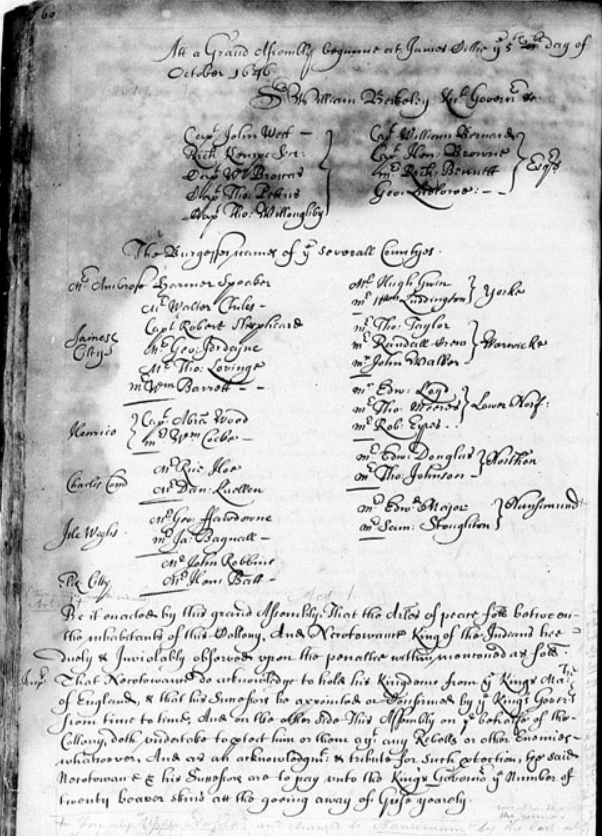
Page 1 of the treaty is shown below.  Unfortunately, this is not a signature document.

1646 treaty

Treaty Between the English and the Powhatan Indians, October 1646

Be it enacted by this grand Assembly, That the Artes of peace foll[owing] between the inhabitants of this Collony, And Necotowance King of the Indians bee duely & Inviolably observed upon the penaltie within menconed5 as foll Imps That Necotowance do acknowledge to hold his Kingdome from the Kings Ma[jes]tie of England, & that his Successors be appointed or Confirmed by the King’s Goverrs from time to time: And on the other side This Assembly on the behalfe of the Collony, doth undertake to p[r]otect him or them ag[ains]t any Rebells or other Enemies whatsoever, And as an acknowledgmt & tribute for such protection, the said Necotowance & his Successors are to pay unto the King’s Governor the Number of twenty beaver skin’s att the goeing away of Geese yearely.

That it shall be free for the said Necotowance & his people, to Inhabit & hunt on the Northside of Yorke River without any interruption from the English provided that if hereafter, It shall be thought fitt by the Governor & Council to permitt any English to Inhabitt from Poropotanke downewards that first Necotowance be acquainted therewith.

That Necotowance & his people, leave free that tract of land Betweene Yorke River & James River from the falls of both the Rivers to Kequotan to the English to inhabitt on, & tht neither he the said Necotowance nor any Indians do repaire to or make any abode upon the said tract of land upon paine of death & it shall be lawfull for any person to Kill any such Indian, And in Case any such Indian or Indians being seen upon the said tract of Land shall make an escape, That the said Necotowance shall uppon demand deliver the s[ai]d Indian or Indians to the Englishmen, upon Knowledge had of him or them, unles such Indian or Indians be sent upon a Message from the said Necotowance.

And to the intent to avoid all injury to such a messenger & that no ignorance may be pretended to such as shall offer any Outrage, It is thought fitt & hereby enacted That the badge worne by a messenger, or in Case there shall be more than one by one of the company, be a Coate of striped stuffe which is to be left by the Messenger from time to time so often as he shall returne at the places appointed for their coming in.

And it is further enacted That in Case any English shall repaire contrary to the Articles agreed uppon to the said Northside of Yorke River, such persons soe offending being lawfully Convicted be adjudged as Felons; Provided that this article shall not extend to such persons who by stresse of weather are forced upon the said Land, Provided alsoe & it is agreed by the sd Necotowance, that it may be lawfull for any Englishman to goe over to the sd Northside of haveing occasion to fall timber Trees or Cut sedge, soe as the said persons have warr[an]t for theyre soe doeing under the hand of the Govr Provided alsoe Notwitstandinge any thing in this Act to the Contrary That it shall bee free & lawfull for any English whatsoever between this present day & the first of March next to kill & bring away what Cattle or hoggs tht they can by any meanes Kill or take upon the said Northside of the said River.

And it is further enacted that neither for the said Necotowance nor any of his people, do frequent, come in to hunt or make any abode nearer to the English plantations then the Lymits of Yapin the black water & from the head of the black water upon a Straite line to the old Monakin Towne upon such paine & penaltie as aforesaid.

And it is further ordered Enacted that if any English do entertain any Indian or Indians or doe conceale any Indian or Indians that shall come within the said Lymits, such persons being lawfully Convicted thereof shall suffer death as in case of Felony, without benefit of Clergy excepted such as shall be authorized thereto by vertue of this Act.

And it is further Enacted that the said Necotowance & his people shall upon all occasions of message to the Govr for trade, doe repaire unto the Fort Royall onely on the Northside, at which place they are to receive the aforesaid Badges, which shall shew them to be Messengers & therefore to be freed from all injury in their passage to the Governor upon payne of death to any person or persons w[ha]tsoever that shall kill them, the badge being worn by one of the Company, And in case of any other affront, the offence to be punished according to the quality thereof, & the trade admitted as aforesaid to the said Necotowance & his people with the Commandr of the said Fort onely on the Northside.

And it is further thought fitt & enacted that upon any occasion of Message to the Governr or trade, The said Necotowance & his people the Indians doe repair to Forte Henery al[ia]s Appamattucke Forte, or to the house of Capt John Floud & to no other place or places of the Southside of the River, att which places the aforesayd Badges of striped stuffe are to be & remaine.

And it is further thought fitt & enacted That Necotowance, doe with all convenience bring in the English Prisoners, And all such Negroes & Guns which are yet remaining either in the possession of himselfe or any Indians and that he redeliver upon demand such Indian Servants as have been taken prisoners & shall hereafter run away, In case such Indian or Indians shall be found within the Lymitts of his Dominions provided that such Indian or Indians be under the age of twelve years at theire running away.

And it is further enacted & Consented That such Indian children as shall or will freely & voluntarily come in & live with the English, may remain without breach of the art Articles of peace, provided they be not above twelve yeares old.

And it is further thought fitt & enacted That the severall Commanders of the Forts & places as aforesaid unto which the said Indians as aforesaid are admitted to repaire In case of trade or Message doe forthwith provide the said Coats In manner striped as aforesaid.

Posted in Powhatan, Treaty | Leave a comment

Seminole Chief Osceola, Billy Powell

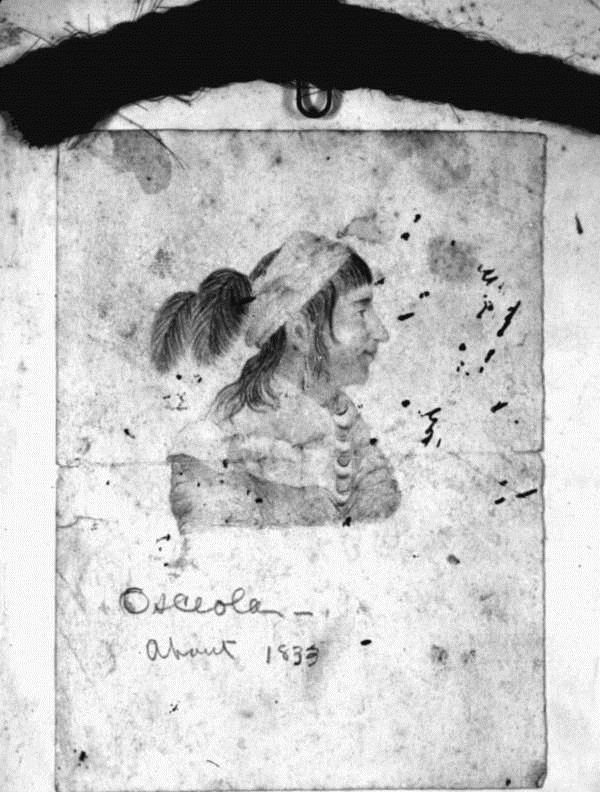
Osceola 1833

State Archives of Florida, Florida Memory, http://floridamemory.com/items/show/4370

Osceola was named Billy Powell at birth in 1804 in the Creek village of Talisi, now known as Tallassee, Alabama, in current Elmore County. “The people in the town of Tallassee…were mixed-blood Native American/English/Irish/Scottish, and some were black. Billy was all of these.” He was born to Polly Coppinger, a Creek woman, and William Powell, an English trader. Polly was the daughter of Ann McQueen and Jose Coppinger.  Because the Creek have a matrilineal kinship system, Polly and Ann’s other children were all considered to be born into their mother’s clan; they were reared as traditional Creek and gained their status from their mother’s people. Ann McQueen was also mixed-race Creek; her father James McQueen was Scots-Irish. Ann was likely the sister or aunt of Peter McQueen, a prominent Creek leader and warrior.  Like his mother, Billy was raised in the Creek tribe.

Like his father, Billy’s maternal grandfather James McQueen was a trader; in 1714 he was the first European to trade with the Creek in Alabama. He stayed in the area as a fur trader and married into the Creek tribe. He became closely involved with the people. He is buried in the Indian cemetery in Franklin, Alabama near a Methodist Missionary Church for the Creek.

In 1814, after the Red Stick Creek were defeated by United States forces, Polly took Osceola and moved with other Creek refugees from Alabama to Florida, where they joined the Seminole. In adulthood, as part of the Seminole, Powell was given his name Osceola. This is an anglicized form of the Creek Asi-yahola, the combination of asi, the ceremonial black drink made from the yaupon holly, and yahola, meaning “shout” or “shouter”.

In 1821, the United States acquired Florida from Spain. More European-American settlers started moving in, encroaching on the Seminole. After early military skirmishes and the 1823 Treaty of Moultrie Creek, by which the US seized northern Seminole lands, Osceola and his family moved with the Seminole deeper into central and southern Florida.

As an adult, Osceola took two wives, as did some other Creek and Seminole leaders. With them, he had a total of at least five children. One of his wives was African American, and he fiercely opposed the enslavement of free peoples.

Through the 1820s and the turn of the decade, American settlers kept up pressure on the US government to remove the Seminole from Florida to make way for their desired agricultural development. In 1832, a few Seminole chiefs signed the Treaty of Payne’s Landing, by which they agreed to give up their Florida lands in exchange for lands west of the Mississippi River in Indian Territory. According to legend, Osceola stabbed the treaty with his knife, although there are no contemporary reports of this.[6]

Five of the most important Seminole chiefs, including Micanopy of the Alachua Seminole, did not agree to removal. In retaliation, the US Indian agent, Wiley Thompson, declared that those chiefs were deposed from their positions. As US relations with the Seminole deteriorated, Thompson forbade the sale of guns and ammunition to them. Osceola, a young warrior rising to prominence, resented the ban. He felt it equated the Seminole with slaves, who were forbidden to carry arms.

Thompson considered Osceola to be a friend, and gave him a rifle. Later, though, when Osceola quarreled with Thompson, the agent had the warrior locked up at Fort King for a night. The next day, to get released, Osceola agreed to abide by the Treaty of Payne’s Landing and to bring his followers in to the fort.

On December 28, 1835, Osceola led an attack on Fort King (near modern-day Ocala) which resulted in the assassination of the American Indian Agent Wiley Thompson. Simultaneously, Micanopy and a large band of Seminole warriors ambushed troops under the command of Major Francis Dade south of Fort King on the road to Fort Brooke (later Tampa). These two events, along with the Battle of Withlacoochee on December 31 and raids on sugar plantations in East Florida in early 1836, marked the beginning of the Second Seminole War.

Osceola arrest

State Archives of Florida, Florida Memory, http://floridamemory.com/items/show/4369

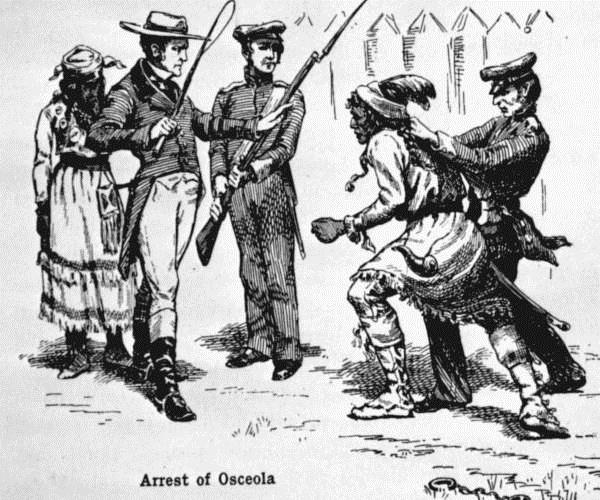
In late October 1837, Osceola contacted General Joseph Hernandez, through a black interpreter named John Cavallo (also John Horse), to arrange negotiations about ceasing hostilities. General Thomas Jesup responded by ordering Hernandez to seize Osceola and his party should he have the chance.

Osceola’s camp, located one mile south of Fort Peyton, raised a white flag of truce in order to signal their desire to negotiate. When Hernandez and his entourage reached the camp, they promptly seized Osceola and the warriors, women and children present. Osceola and his band were brought to St. Augustine and imprisoned at Fort Marion (Castillo de San Marcos).

Remarkably, on November 30, Coacoochee (Wildcat) and 19 other Seminoles escaped Fort Marion; Osceola was not among them. Coacoochee’s escape prompted Jesup to transfer the most important Seminole captives out of the area. In late December 1837, Osceola, Micanopy, Philip and about 200 Seminoles embarked from St. Augustine for Fort Moultrie on Sullivans Island, outside Charleston, South Carolina.  After their arrival, they were visited by townspeople.

Osceola’s capture by deceit caused a national uproar. General Jesup and the administration were condemned by many congressional leaders.

Osceola George Catlin

George Catlin and other prominent painters met the war chief and persuaded him to allow his picture to be painted.  The painting above is by Catlin.  Robert J. Curtis painted an oil portrait of Osceola as well. These paintings have inspired numerous prints and engravings, which were widely distributed, and even cigar store figures.

Osceola, who previously contracted malaria in Florida, became severely ill soon after arriving at Fort Moultrie.   Osceola died of quinsy (though one source gives the cause of death as “malaria” without further elaboration) on January 30, 1838, three months after his capture. He was buried with military honors at Fort Moultrie.

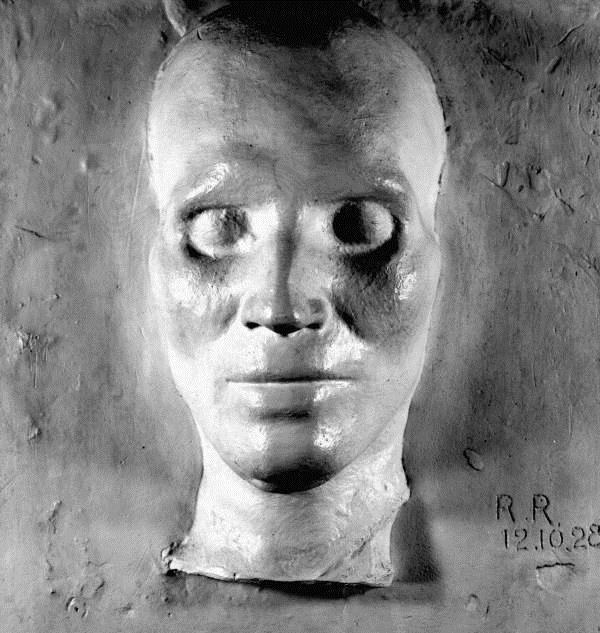
After his death, army doctor Frederick Weedon persuaded the Seminole to allow him to make a death mask of Osceola, shown below, as was a European-American custom at the time for prominent people.

Osceloa death mask

State Archives of Florida, Florida Memory, http://floridamemory.com/items/show/4299

Later Weedon removed Osceola’s head and embalmed it. For some time, Weedon kept the head and a number of personal objects Osceola had given him.

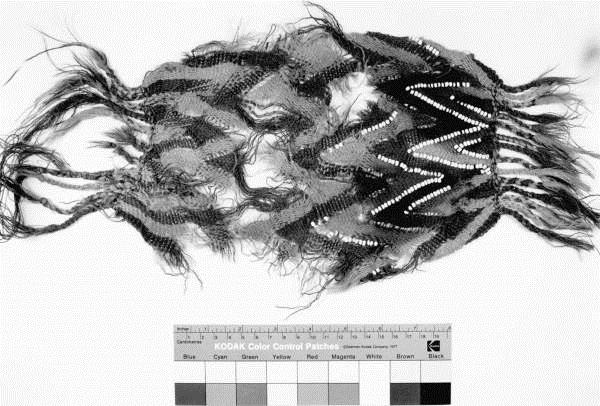
Later, Weedon gave the head to his son-in-law Daniel Whitehurst. In 1843, Whitehurst sent the head to Valentine Mott, a New York physician. Mott placed it in his collection at the Surgical and Pathological Museum. It was presumably lost when a fire destroyed the museum in 1866. Some of Osceola’s belongings are still held by the Weedon family, while others have disappeared.  One of Chief Osceola’s possessions is shown below.

Osceola possession

State Archives of Florida, Florida Memory, http://floridamemory.com/items/show/4294

Captain Pitcairn Morrison sent the death mask and some other objects collected by Weedon to an army officer in Washington. By 1885, the death mask and some of Osceola’s belongings ended up in the anthropology collection of the Smithsonian Institution, where they are still held.

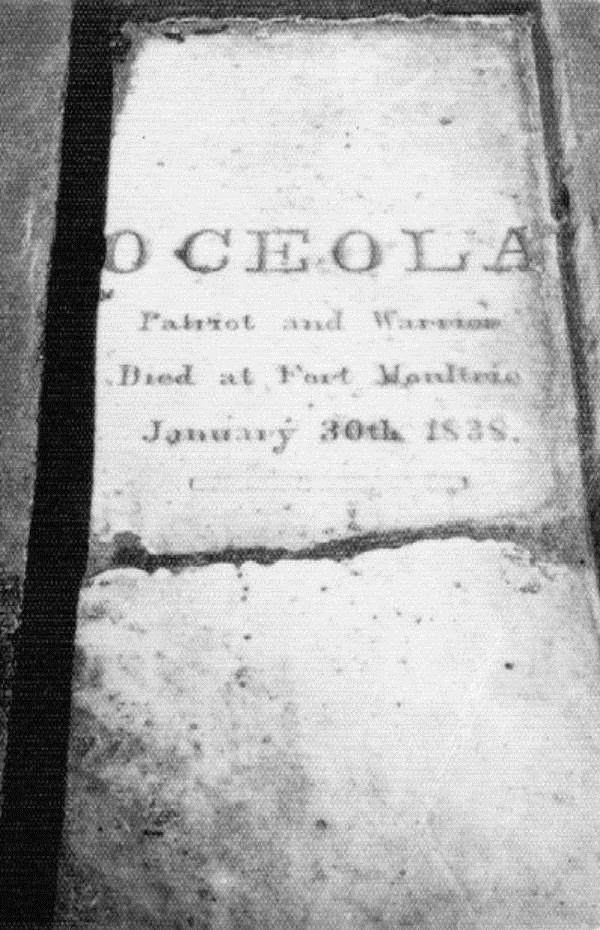
Osceola’s grave marker says, “Osceola, Patriot and Warrior, died at Fort Moultrie, January 30, 1838.”

Osceola grave

State Archives of Florida, Florida Memory, http://floridamemory.com/items/show/4295

http://www.kislakfoundation.org/millennium-exhibit/profiles6.htm

http://www.floridamemory.com/solr-search/results/?q=%28osceola%20OR%20tt%3Aosceola%5E10%29&query=osceola

http://en.wikipedia.org/wiki/Osceola

https://nativeheritageproject.com/2014/03/15/creek-indian-mound-near-fort-decatur-alabama/

https://nativeheritageproject.com/2014/03/12/osceola-powell-seminole-chief/

http://floridamemory.com/blog/2013/01/30/osceola-ca-1804-1838/

Posted in Creek, Seminole, Traders, Treaty | 48 Comments

Surviving a Scalping

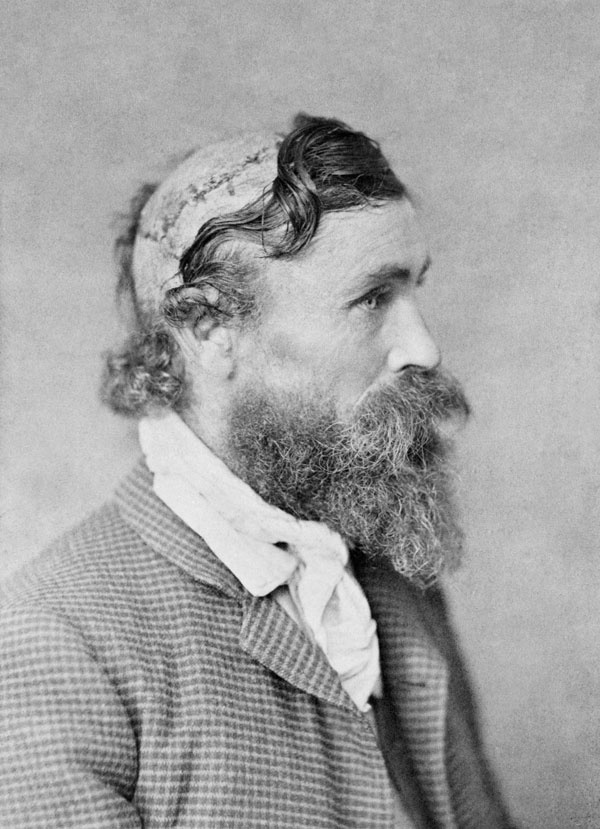
Robert McGee scalped

Scalpings on the frontier were legendary, often thought of in terms of Indians scalping Europeans.  While that certainly did happen, they didn’t have exclusive right to scalping.  Frontiersmen did it too, as did Scythians and European tribes such as the Alans.  In fact, the Massachusetts Bay Colony paid a $60 bounty for each Indian scalp.  They weren’t alone either.  In 1756 the British Scalp Proclamation was issued, and is, amazingly, still on the books today, although in the Nova Scotia government has states that it is no longer in effect.

As gruesome and final as scalping was, some people did survive scalpings.

http://www.outsideonline.com/fitness/bodywork/the-fit-list/How-to-Survive-a-Scalping.html

Kentuckian Robinson was scalped in the Ohio Valley Indian Wars and wore a scarf around his head.

Robert McGee, pictured above, was scalped by the Brule Sioux.

http://badassdigest.com/2012/04/05/robert-mcgee-scalping-survivor/

Josiah Wilbarger was scalped by Comanche and said that the entire thing was relatively painless, the removing of the scalp sounded like the ominour roar and peal of distant thunder.

http://en.wikipedia.org/wiki/Josiah_P._Wilbarger

Robert Thompson attempted to have his scalp reattached, and then made a living showing his scalped head, his scalp and telling the story.

Robert Thompson scalped

http://genealogyreligion.net/tag/scalps

In the fall of 1755, in Tulpehocken, Pennsylvania, the entire Kobel family was massacred and scalped, probably by the Iroquois, but possibly the Mohawk.  Two children who survived, one a female of 11 years of age.

Claiborne Osborn, scalped in 1841 by the Comanche in Texas, died in 1899.

http://query.nytimes.com/mem/archive-free/pdf?res=F30713FB3C5414728DDDAB0994DB405B8985F0D3

Mary Louisa Gagnier was scalped in 1827 by the Ho-Chunk, at the age of 2.  As she was being prepared for burial, it was realized that she was still breathing.  She survived, married, had children and grandchildren, and told the story

http://www.wisconsinhistory.org/odd/archives/004052.asp

Louisa always wore a cap to cover the back of her scalped head.

Mary Gagner scalped cropped

Posted in Brule, Comanche, Ho-Chunk, Iroquois, Mohawk, Sioux | 7 Comments

Jenny Wiley, Captive White Woman

Denise Smith has researched the story of Jenny Wiley, a white woman who was captured and held by the Shawnee Indians.  How long Jenny was held and what happened is a story that has many versions.  Denise tells the story, attempts to sort out the facts utilizing traditional genealogical research methods and shares her extremely indepth research in a series of articles on her website.  Thank you Denise.

Denise says:

The story of Jenny Sellards Wiley is one of great Appalachian lore. She was a pioneer woman who with her husband Thomas Wiley resided in Bland County, Virginia, was taken captive by American Indians in 1789 and taken to Kentucky. According to the story, several of her children and her brother were killed at the time. She then lost 2 more children while in captivity before she could escape.

There are even those that believe that Jenny Wiley had a Native American child by Black Wolf, when she returned from captivity.  This part of the story in the day of DNA testing would not be hard to prove or disprove. I would love for the descendants of Jenny Wiley to get their DNA tested for their common ancestor.

In the story of Jenny Wiley, the length of her captivity is going to play a role as to when this would have happened. Very few cite the true amount of time she was held captive.  In reality it was only a few months. In that short time period she had one baby and became pregnant again? If these two groups have a DNA test or begin a Thomas and Jenny Sellards Wiley DNA data bank, that could weed out the truth and also show how they are related.

Shifting now to the Cornstalk family website, we find the following:

Black Wolf fathered a child with Jenny Sellard Wiley, captive white woman. She reportedly gave their son to Black Wolf as ransom to return to the whites, then reported the Indians had tomahawked the child. That child is Chief John Black Wiley, Wiley’s Cove now Leslie, Arkansas.

There is a bit of confusion here.  If Jenny Sellard Wiley was referenced in a letter in 1790 as being released from captivity, her son cannot be Chief John Black Wiley, alive today.  He might well be her descendant.

Let’s look at the possibilities that DNA testing offers.

There are four kinds of DNA testing that apply.

The first, Y chromosome does not apply here because women don’t have or give a Y chromosome.

The second, mitochondrial DNA is given by women to all of their children, but only passed on my female children to their offspring.  So Jenny’s female children would be passing on her mitochondrial DNA, but a male child would not.  Unless a male or female in the current generation is descended from Jenny through all females between the current generation and Jenny, mitochondrial DNA will not be of use.  If a male or female in the current generation is descended through all females from Jenny, then DNA testing would tell us a haplogroup even with no one to compare to.  If there are others of Jenny’s descendants who carry her mitochondrial DNA, they can be compared against to see if the mitochondrial DNA matches.

Lastly, autosomal DNA could show common segments between Jenny’s known children and Chief John Black Wiley or other purported descendants through Black Wolf.  If these common segments don’t show through traditional means, utilizing www.gedmatch.com and lowering the match threshold could be useful.  Also, the minority admixture mapping technique utilized in “The Autosomal Me” series can be utilized.

I agree with Denise, I’d love to see the life and times of Jenny Wiley confirmed, especially whether or not she had a child with Black Wolf.  I hope that the descendants will indeed proceed with DNA testing to verify the truth, whatever it is. It’s the least we can do for the memory of the captive white woman who lost so much.  Family Tree DNA offers both mitochondrial DNA testing and autosomal and it’s easy to download their raw data files after testing to utilize other tools.

Here is a link to all of Denise Smith’s Jenny Wiley research.

If you’d like to take a DNA test, click here.
Posted in Shawnee | 57 Comments

Wakarusa River – Blue Jacket’s Crossing and Home of the Shawnees

Carlyle Henshaw has been generous again and has shared his BlueJacket family research, this time about Blue Jacket Crossing.

The three Bluejacket brothers that establish Bluejacket Crossing were George, Henry and Charles.  Henry was my great-great-grandfather.  The three brothers were grandsons of Shawnee Chief Blue Jacket, 1737-1808.  He was the last principal war chief of the Shawnee Tribe of Indians.

Carlyle explains, “My  great grandmother, Emma Bluejacket, was born at at the Crossing in 1854.  Her father was Henry Bluejacket and Henry was an older brother of Rev. Charles Bluejacket.  Along with their older brother, George Bluejacket, the three  brothers established Blue Jacket’s Crossing.  It was also called the Lower Crossing of the Wakarusa.

I still enjoy that day when Cinderalla Brown told us of her Shawnee grandparents at Blue Jacket’s Crossing.”

Wakarusa River – Blue Jacket’s Crossing and Home of the Shawnees

by Carlyle Hinshaw

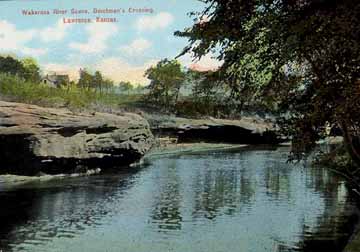
The Wakarusa arises in limestone hill country southwest of Lawrence, Kansas and flows east, passing that town just to the south of its city limits. About eight miles east of Lawrence, it empties into the Kansas (Kaw) River.

blue jacket crossing 1

The outcropping rocks at river level are the Haskell Limestone of Pennsylvanian geological age. These thick beds caused great difficulty for fording wagons. Emigrants needed to ford here to get out on the alluvial plain of the Kansas (Kaw) River, away from the limestone hills south of the Wakarusa. Thus, the reason for Blue Jacket’s Ferry operation at Sebastian, Kansas Territory, beginning in May of 1855.

The Oregon California Road headed up at Independence, Missouri, which is south of the Missouri River and east of its confluence with the Kaw. Just after passing into Kansas Territory, it went by the Shawnee Methodist Mission, now in the middle of Kansas City, Kansas. About 35 miles west, the trail passed just south of where the Wakarusa emptied into the Kaw. About two miles further west, travelers with wagons had to bite the bullet and cross the Wakarusa.

Blue jacket crossing 2

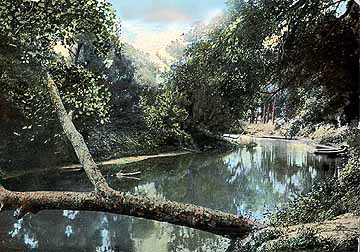
In May of 1853, wagoneers wrote of this small but formidable stream. Wagons had to be dismantled and lowered down the limestone beds, towed across and roped up the opposing bank. It was said that the Shawnee Indian, Paschal Fish, charged $5.00 to help in one of those operations.

Blue jacket crossing 3

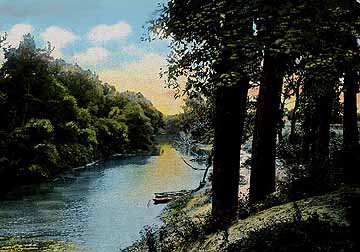
Although signed in May, the 1854 Shawnee Treaty was not ratified by Congress until November and Shawnee ferry operations at Blue Jacket’s Crossing were not initiated until May of 1855. Their installation would have had ramping on both banks to eliminate dismantling and roping and the ferry boat would have made passing a very quick trip compared with the olden days.

Blue jacket crossing 4

Not all was peaches and cream at the Blue Jacket operation however. The Lawrence Republican of February 21, 1861 reported that “James Moore in attempting to cross the Wakarusa at Blue Jacket’s crossing on Tuesday last, was drowned. He was driving a team attached to a wagon, and had his wife in with him. While crossing in the ferry, the horses got frightened and jumped over. The horses, as well as the driver, were drowned, but the lady was rescued.”

Blue Jacket’s was an important point in its day, and as early as 1855 the legislature passed an act establishing a territorial road from Shawnee Mission Church, south, to Tecumseh, by way of this crossing. Two years later, the legislature of 1857 established a territorial road from Olathe on the Santa Fe Trail, on the most direct and practicable route to the crossing of the Wakarusa at Blue Jacket’s.

With the settlement of the Wakarusa valley, there was a demand for a more expeditious mode of crossing by the old ferry. As early as 1855, the legislature authorized James Findlay to establish a bridge across the Wakarusa River at the crossing of the territorial road leading from the Missouri line to Lawrence and Tecumseh, requiring him to complete the bridge within three years. At the same session, John G. McClelland and Clarkson M. Wallace were authorized to erect a toll bridge across the Wakarusa River, where the road leading from Ft. Leavenworth to St. Bernard crosses the river. (Kansas Historical Quarterly, Vol. 6, p. 19.)

http://shawnee-bluejacket.com/Bluejacket_Folders/The_Wakarusa_River.htm

Scroll down to THE WAKARUSA RIVER, Home of the Shanees and locale of Blue Jacket’s Crossing and click on “Full Story.”

Gaylord Carlyle Hinshaw
1713 Baron Dr.
Norman OK 73071
405-364-4584

bjexploration@swbell.net

Posted in DNA, Shawnee | Leave a comment

William Hatcher, Indian Trader

William Hatcher of Virginia and his sons were Indian traders.  Of course, those words come with a whole passel of baggage.  That meant that they provided much needed services between the Native people and the colonial settlers.  It also meant that the Hatchers, if they were like other traders, provided liquor to the Indian people.  Not that the Indians didn’t like it, they did, all too much, and alcohol and its affects would be a large part of what devastated the Native American population.

Being a trader also meant that very personal alliances were formed, often sealed by “a kiss,” so to speak.  Traders had wives and children within the tribes, sometimes in multiple villages and tribes.  Many also had their European wife too, back home, wherever that was.  A few of the traders actually made their full time home with the tribes and in essence, lived with, were adopted by and “became” as Indian as a white man could.

This wasn’t the case with the Hatchers, as they clearly retain their property in Virginia, but Edward Hatcher acknowledged his daughter, Sarah Hatcher, an Indian girl.

But there is a darker side too.  Indian traders traded in Indian lives.  Of course, the Indian slaves were provided to them by the very Indian tribes they traded with.  Capture and death or enslavement was part of the Indian war culture, so ti was nothing new.  What was new was that with a bottomless market for slaves, warfare was introduced for the purpose of capturing other Native people, so slaves were no longer the results of warfare, but had become the driving purpose behind attacks.

What this tells us is that Indians from outside the region of unknown tribal provenance will be found in Virginia and all of the early colonies.

From the Hatcher family website:  http://hatcherfamilyassn.com/index.php

** Henrico Co, VA Wills and Deeds 1677-1705, p.216, 16 Jan, 1681: An agreement between Edward Hatcher, Thomas Shippey and John Davis to go on a trading expedition among the Indians.

** Henrico County, Virginia, Wills and Deeds, 1677-1705
Compiled by Benjamin B Weisinger III, p.222

Edward Hatcher for love & affection to my daughter Sarah Hatcher, an Indian girl, Kate. 1 Aug. 1682
Wit: Sam Knibb, Ben Hatcher
Signed: Edward (E) Hatcher
Recorded 1 Aug. 1682

** Henrico County, Virginia
Record Book #5 1688-1697, p. 532
LDS Film 31770
Transcribed by Cecil Q Larsen

Henrco. County December the first AD 1694
Heno. Cty.

Whereas I am credibly Informed that Edward Hatcher Senr in Company ot Joseph Tanner did on Monday night last being the 20th of this instant call at the House of Wm Puckett & that there the sd Edward Hatcher Senr. did report & divulge on his certaine knowledg that the late Mrs. Bannister & all her family were cut off by Indians & that some of them were Hanged up in Trees by the Jaws others lying Dead on the Ground and in pticular Jack came last an Indian was Cutt into four quarters. And not being there therwith content ye sd Hatcher & Tanner did Raise divers of the Horse & foot pretending they had authority to do, who by virtue of the sd Reports & false pretences did meet in Armes at the sd Wm Pucketts the next day expecting further orders. Which sd False reports are directly contrary to & in Contempt of the 91 Act of Assembly in ye Printed Laws & to ye manifest Affrighten & Terror of divers of their Majties. good subjects.
These are therfore in their Majties. names to Will & require you forthwith to cause the sd Edwd. Hatcher Senr. & Joseph Tanner to make their __soual(?) appearance before me to answer wt. shall be objected agt. them or either of them concerning ye premises. And that you sumon for evidence in the premises Wm Puckett & Anne his wife, James Westbrook, Peter Ashbrooke senr. Edward Tanner, Tho. Edwards & Thomas Chetham who all Likewise forthwith to appear & give in their evidence accordingly & hereof you are not to fail at also to make returne of this Warrant as you answer the contrary dated under my hand this 23 day of Augt. Anno 1694.
Pet. Field
To ye Sher. of Heno. Cty. or his Deputy

** Library of Virginia
Goochland Co Chancery Court online documents
075-1754-002
Transcribed by Nel Hatcher

The Deposition of Robt Napier aged Eighty ffive —- being Examined & Sworn Saith that between fifty & Sixty years ago Capt John Lydall Jr went to Henrico & he bought of one Edward Hatcher an Indian woman named Bettey wch he called Betty Hatchor & she had a reputed Daughter Called Sarah Hatcher wch was the reputed mother of Indian Jack Hatcher wch Said Indian Bettey was brought in to this Collony by the Said Edward Hatcher an Indian Trader & sold by him to Serve according to Law this Depon?t further Saith that he bought of Edward Hatcher an Indian Trader of the same company an Indian boy between Fourteen[?] & Sixteen[?] years of age & that he Expected he was to Serve only to the age of thirty one or thirty three to the best of my remembrance & further this Depon?t Saith not

[signed] R Napier

Janu?y 5th 1753
Taken before us
Sam?l Jordan
John Cobbs

Posted in Traders | 4 Comments

South Carolina Indian Traders 1750-1754

The study of traders is important to the study of Native American tribes and ancestors.  Most, if not all, traders established Native relationships, and by that, I mean marital or intimate relationships.  What that means, exactly, depends on the culture and time times.  It can mean anything from the Native cultural tradition of providing guests with a bedpartner for the night to traders who virtually forsook the white world and lived exclusively with the Native people when they weren’t back east trading their wares.

What this means to us today is that it’s very likely to find Native people who would carry the DNA of traders.  This of course has nothing to do with their “Nativeness,” because at that time in history, the Native people made no distinction between fully Native and half Native and half white.  You were what your mother was, and that was Native.  Therefore, it would not be surprising to find Native people, enrolled or not enrolled in Federally recognized tribes, that if they were to test their Y DNA, would carry the DNA of traders, even though today their surname might be something entirely unrelated.

I found a list of traders in two locations, here and here.

The source for the traders is the “Colonial Records of South Carolina: Documents Relating to Indian Affairs 1750-1754” by William McDowell.  Of course, there were traders from Virginia beginning in the 1600s, and from NC after that.  These SC traders are a drop in the bucket, but still, we do have some compiled names, which is more than we have from Virginia or NC

The second link provides additional information, where known, about the traders.

Associated Trader profiles and genealogy information are found here.

This article describes the vast interrelationships of family and politics of traders and Native people.

Traders to the Catawbas

  • Robert Steel
  • Robert Tool
  • Mathew Toole

Licensed Traders to the Cherokee from Carolina

  • James Adair
  • The Augusta Company
  • James Baldridg
  • Charles Banks
  • William Bates
  • James and Thomas Beamer
  • Samuel Benn
  • Robert Bunning
  • John Butler
  • Cornelius Daugherty
  • Anthony Dean
  • David Dowey
  • John Downing
  • John Elliott
  • Robert Emory
  • Robert Goudy
  • Ludowick Grant
  • ? Haines
  • John Hatton
  • John Hook
  • Bernard Hughs
  • Bob and John Kelly
  • Anthony L’Antignac
  • John McCord
  • David McDaniel
  • David McDonald
  • William McDowel
  • James Mackie
  • William McTeer
  • James Maxwell
  • James May
  • Daniel Murphy
  • Joseph Oliver
  • Bryan Sallamon
  • Abraham Smith
  • Richard Smith
  • John Williams

Carolina Traders to the Chickasaw

  • John Buckles
  • John Campbell
  • Cambell and Maccartan
  • Jeromy Courtonne
  • Courtonne and Brown
  • John Highrider
  • Robert Vaughan

Carolina Traders to the Choctaw

  • John Buckles
  • John Nellson

Licensed Traders to the Creeks from Carolina

  • Ephraim Alexander
  • The Augusta Company
  • Isaac Barksdale
  • ? Brown
  • Patrick Brown
  • Rae Brown and Company
  • Nicholas Chinery
  • Daniel Clark
  • John Coller
  • ? Cossens
  • Samuel Elsinore
  • John Eycott
  • ? Fitz
  • Stephen Forrest
  • George Galphin
  • James Hewitt
  • George Johnston
  • John Kennard
  • John Ladson
  • ? McCay
  • Lachland McGillvery
  • George McKay
  • Lachlan Mackintosh
  • Alexander McQueen
  • Timothy Millin
  • ? Nowley
  • Moses Nunes
  • John Pettycrew
  • John Rae
  • Peter Randle
  • Walter Rode
  • Acton Rowley
  • William Sludders
  • John Spencer
  • Joseph Wright

Traders to the Savannahs

  • Enoch Anderson
  • Richard  Anderson
  • William Anderson
  • John Anderson
  • ? McKinnie

Interpreters of Various Indian Groups (1750-1754)

  • Mary Bosomworth, a Creek woman married to a colonist.
  • ?  Brannan
  • Edward Broadway
  • Robert Bunning
  • James Gaddes
  • James Germany
  • Mr. ? Kelloch
  • Joseph O’Connor
  • Aaron Stevens
  • Samuel Thomas
  • William  Thompson
  • ? Wiggan

This list is also not exhaustive, as I’m aware of several early Virginia traders whose names are absent here.  Please feel free to add names of traders along with sources in the comments.

Hat tip to Elaine for this link.

Posted in Cherokee, Chickasaw, Choctaw, Creek, Savannah, Traders | 22 Comments

1765 North Carolina, South Carolina and Georgia Map

NC SC Georgia 1765

This 1765 map of North Carolina, South Carolina and Georgia shows the locations of Native tribes and villages.

Georgia 1765: Mintz, S., & McNeil, S. (2013). Digital History. Retrieved 26 Feb. 2014 from http://www.digitalhistory.uh.edu/

Hat tip to Yvonne for this map source.

Posted in Georgia, Maps, North Carolina, South Carolina | Leave a comment