Indians in the Revolutionary War – Choosing Sides

Who fought in the Revolutionary War?  Which side did the Indians choose, and why?

For many Indians, in particular, the Shawnee, Creeks and the very large and powerful Cherokee and Iroquois, the British seemed like a better bet.  The British knew full well that the Indians wanted to stem the tide of settlement, and they promised the Indians that if they won, the settlers would be stopped.  Of course, they hadn’t been able to arrest the tide of settlement the entire time they had been in power, but it was easy for the British to “blame” the rowdy settlers and rogue politicians…and by doing so, to strike a chord of harmony with the Indians.

Sometimes this loyalist leaning can be discerned and used as a hint relative to your genealogy research.  Was your ancestor a loyalist?  If so, was he also recorded as being “of color” in any records?  If the answer is yes, especially twice, then you might suspect that his “color” was at least partially “red.”

But not all Indians fought for the British.  Many Indians, in particular, the coastal tribes, fought for the Americans.  Why?

The answers were often personal in nature.  These tribes were the most involved with the people who would become Americans.  They had lived among them for 150 years at this point, intermarried, and formed community and personal relationships with them.  In many cases, for the Indians living among or near the white communities, the decision was a personal one.

In at least one case, the tribe believed that the Americans were right and England wrong.  The St. John’s Indian leaders in Maine made the following statement in 1778 which sheds some light on how at least some of the Indians were thinking:

“The Chiefs, Sachems and young men belonging to the River St. Johns have duly considered the nature of this Great War between American and Old England.  They are unanimous that America is right and Old England is wrong.  The River on which you are with your soldiers belongs from the most ancient times to our Ancestors, consequently is ours now and which we are bound to keep for our posterity.  You know we are Americans; that is our native country; you know the King of England with his evil councilors has been trying to take away the Lands and Libertys of our Country but God the King of our Heaven, our King, fights for us and says America shall be free.  It is so now in spite of all Old England and his Comrades can do.”

Regardless of which side each Native person took in this dispute, the war itself and the outcome would affect every person, every tribe, and all of their descendants.  As far as Native people were concerned, there were no winners.
Posted in Maine, Military, St. John's Indians | Tagged | 4 Comments

The Legend of the Petoskey Stone

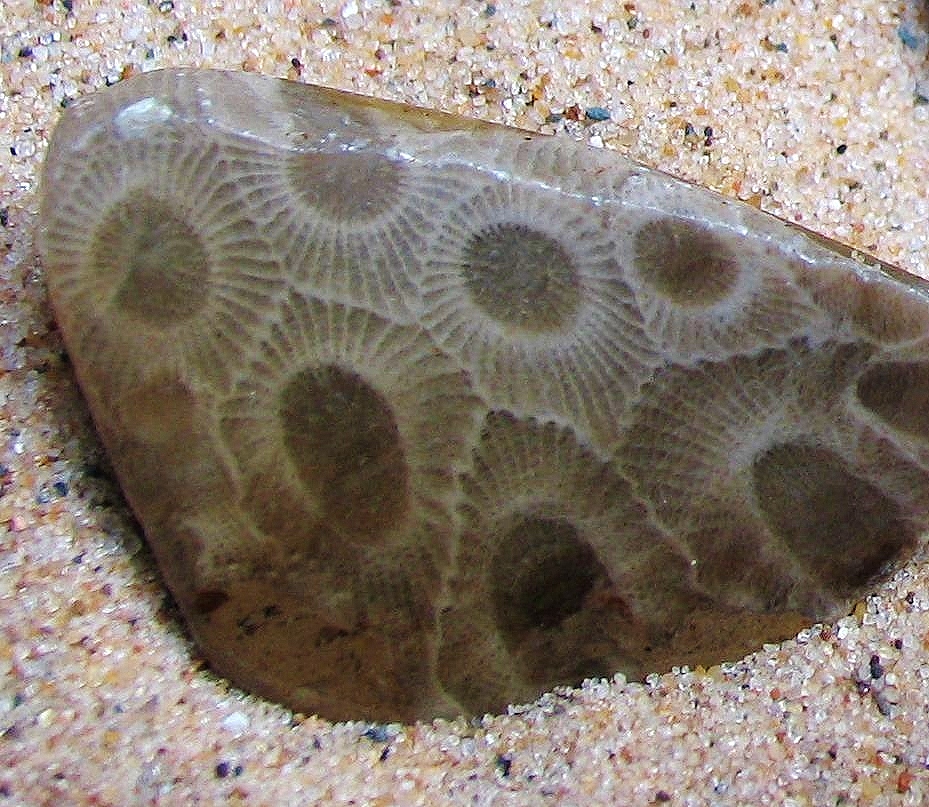
In the WWI draft registration records, I came across several men in Michigan who have the surname Petoskey from three different counties.  Living in Michigan, I know that our state stone is the very unusual Petoskey stone (fossilized coral, shown below in polished form), and there is a city named Petoskey.  Seemed to me there had to be more to the story.  And indeed, there is.

The Petoskey stone was named for an Ottawa Indian Chief, Chief Pet-O-Sega. The city of Petoskey, Michigan, is also named after him, and is the center of the area where the stones are found. The stones are commonly found on beaches and in sand dunes, often in the springtime after the winter ice and winds deposit new stones on the shoreline.

According to legend, Chief Petosegay was the child of a descendant of French nobleman and fur trader, Antoine Carre and an Ottawa princess. Petosegay, meaning “rising sun”, “rays of dawn” or “sunbeams of promise,” was named after the rays of sun that fell upon his newborn face. In keeping with his promising name, Petosegay was a wealthy fur trader who gained much land and acclaim for himself and his tribe. He was remarked upon to have a striking and appealing appearance, and spoke English very well. He married another Ottawa, and together they had two daughters and eight sons. In the summer of 1873, a few years before the chief’s passing, a city began on his land along Little Traverse Bay. The settlers christened the newborn city Petoskey, an anglicized form of Petosegay.

You can read more about the chief and his life, at this link:  http://en.wikipedia.org/wiki/Pet-O-Sega

Thanks to the Fossil Lady for the Petoskey stone photo.  Visit her wonderful blog for more photos at http://fossillady.wordpress.com/

Posted in Michigan, Ottawa | 1 Comment

Forgotten Patriots – The DAR Publications

One of our blog followers sent me a wonderful link.  It’s not even hidden, but I have never found it before.  There is much power is collaboration.  Hat tip to Elaine for this wonderful link!

The DAR has really modernized their site over the past few years and become much  more friendly.

They have two items of interest, both free, and downloadable. Nothing like instant gratification. I can hear my printer burning ink and paper as I type this.  Do be aware of the size of the book before you print it:)

The book is titled Forgotten Patriots: African-American and American Indian Patriots in the Revolutionary War.  There is also a later supplement to this work.

Both are available at their website at http://www.dar.org/library/fp.cfm

The book itself is available directly at this link, which is a pdf and you can then save to your computer.  http://www.dar.org/library/publications/Forgotten_Patriots_ISBN-978-1-892237-10-1.pdf

The supplement pdf is available at this link.  http://www.dar.org/library/publications/Forgotten_Patriots_Supplement_2008-2001_ISBN-978-1-892237-13-2.pdf

I just wish I could read faster!!!  I’ll be blogging about each state and their Indian patriots as I work through this document.

Posted in Military | Leave a comment

Application to confirm certain Indian lands in Ohio, petition of Pim-e-ne-see or William Ward, children of John Ward

The application to confirm certain Indians lands in Ohio, the petition of Pim-e-ne-see or William Ward, and others, children of John Ward, deceased is found in the US Serial set, ID ASP028 Pub.land 117, Jan 24, 1806, 1 page.

It appears from the representation of the petitioners and an accompanying certificate of Isaac Zane that they are the children of John Ward by an Indian woman with whom he cohabited as his wife.  Their father, having been made a prisoner by the Indians when very young had entirely conformed himself to their mode of living, but always entertained a wish to discover his friends and enjoined it into his children, if they should survive him to prosecute the inquiry and if they were successful in making the discovery, that they should endeavor to obtain a settlement among them, and adopt the civilized mode of living as being preferable to that of the savage state.  After the death of their father, in obedience to his injunctions, they have, by diligent inquiry found a brother of him in the State of Ohio, to whose neighborhood they have removed and made a settlement, but being wholly destitute of means to purchase land, they pray that such grants of land may be made them as will secure to them the prospect of a living, otherwise they will be under the necessity of returning to the Indians. 

The committee was looking for a precedent to do as they had asked.  They said they were unable to find any such precedent, but that there had been in April 1802 “An act for the relief of Isaac Zane.”  They said that although the lands mentioned in this act were given to Mr. Zane without any pecuniary consideration, it is believed that they were considered in the light of a compensation for various acts of kindness performed by him to such of our citizens as were in captivity with the Indians and for his service in furnishing information of the intentions of the Indians when they were hostile.

Their resolution was that the prayer of the petition ought not be granted.

I wonder if John Ward’s children went back to live among the Indians or if they managed to find a way to remain in Ohio.  It would have been immensely helpful to have been told the name of all of his children.  And where were the Indians living at that time?  Apparently, not in Ohio.

(Thanks to Min for bringing this to my attention.)

Posted in Ohio | Tagged | 1 Comment

Black Bob Indians of Johnson County, Kansas

Beginning about 1870, the Black Bob Indians of the Shawnee Tribe who lived on a reservation in Johnson Co., Kansas known as the “Black Bob Reserve” began petitioning the government to keep their lands intact.  It seems that “speculators” were trying to purchase part of the land held jointly as a tribe from some tribal members. 

Some members of the tribe wanted the land that had been awarded to the tribe as a reservation split into individuals allotments so they could sell theirs, and other members of the tribe did not want that to happen.  There were a series of three petitions filed and recorded in the US serial set.  The petition from tribal members says, among other things, that “the Indians are deriving no benefit from the sale of their lands, but squander the money they receive in drunken frolics and are led to commit murder and other heinous crimes, and reduce themselves to vagabondage and ruin.”  Pretty harsh words, but sadly, probably true, based on other records relative to Native people and alcohol.  This petition also tells us that the “band is, since the war, composed largely of women and children.”  They also say that it is not their choice to divide their land, but “is an alternative urged on them by speculators who care nothing for our people, only so far as they can use us for selfish purposes.”

In 1870, the tribe petitioned the government and signed their names to the petition using a plus mark, each one with the name written either side of the mark and witnessed by the Justice of the Peace.

The signatures look like this “James + Jacobs,” but I’m only transcribing the names themselves.

  • James Jacobs 
  • James Bob
  • Bill Bob
  • Henry Dorofy
  • Thomas Johnson
  • El-e-mos Ko-Jaw
  • Isac Bob
  • James Boone
  • Sarah Blanchard
  • Sally Johnson
  • Thomas Boone
  • Mary Boone
  • Sarah Boone
  • Louisa Boone
  • Charley Boone
  • Henry Boone
  • James Dixon
  • John Blackhoof
  • Joseph Charley
  • John Bobb
  • Isaac Dougherty
  • Che-Tum Mar-Ge-She
  • Qua-Whe Tah
  • Mary Anne Scarrett
  • Anne Scarrett
  • Frances Scarrett
  • Pele-La Qua
  • Lucy Scarrett
  • John Berry
  • Nancy Berry
  • Dick Berry
  • Samuel Berry
  • Green Grass
  • Ne-Gah Tah-Be-Shiek
  • John Dixon
  • To-Beas See
  • Choctaw
  • Thomas Bob
  • Jane Bob
  • John Day
  • Mary Posum
  • Pe-To Wa-Cum-See
  • George Williams
  • Jackson Dawerty
  • Nancy Ticumsee
  • Martha Dawerty
  • Susan White
  • Shetalia
  • Lisebeth Bob
  • Logan Susan
  • Elick Boon
  • Catharine Scarrett
  • William Henry
  • Law-Que-See
  • Co-Me-Tak
  • Nancy Blackhoof
  • Joseph Blanchard

In an 1873 petition, Charles Tucker signs as first chief, Levi Flint as second chief, witnesses (noted as councilmen) were Dudley Tucker, Joseph Flint, Jonathan Blackfeather and David Blackfeather.

It appears that the Indians did in fact sell.  Depositions include one from Thomas Milhous saying he bought land from Indian George Williams in 1869.

Charles Bluejacket, an Indian of the tribe and the tribes official interpreter says that the Indian agent from the Shawnee agency visited the tribe in 1869 to obtain the names of the Indians to be sure they all received their money for the land and the Indians told him they did not want to take the land in severalty.  Apparently, from his testimony, there were some underhanded dealings having to do with the Indian agent who was pocketing some of the funds due to the Indians. 

L.R. Carter, an Indian, said the land he lived on has been sold without his consent to the brother-in-law of the Indian agent even though Carter wanted to purchase it himself.

From further depositions, one from a Hazael Wycoff, of the Black Bob Reservation (but does not say he is an Indian), he, at the request of the Indians, visited the agency requesting food and rations, which the Indian agent withheld because the Indians would not “take their lands in severalty.’  Wycoff deposes that the Indians “are in a great state of destitution; so much so that the settlers on the said Black Bob reserve have donated and are donating large quantities of corn, pork, potatoes, flour and molasses for their support.”

According to an 1870 deposition, at a previous meeting with the Indians, the “majority of the Black Bob band of Indians, not including those who have absented themselves from the tribe, requested the agent to report to the department in Washington that they wished to go South among their brethren; that they wished to make selections down there and that they desired the government to buy their lands and remove them to their new homes.”

The Black Bob Shawnee were expelled from their land, which was sold to speculators, and moved to Northeastern Oklahoma.

(Hat tip to Min for sending the link to this information.)

Source:

Black Bobs band of Shawnee Indians against any attempt to force their people to break up their tribal organization, and against division of their lands

SERIAL-SET-ID: 1408 S.misdoc.49: Feb 11, 1870, 17 pgs. (accessed through Heritage Quest 2-28-2012)

 Full Citation:

Title:

Black Bobs band of Shawnee Indians against any attempt to force their people to break up their tribal organization, and against division of their lands

Full Title:

Memorial of members of Black Bobs band of Shawnee Indians, against any attempt to force their people to break up their tribal organization, and against a division of their lands.

Serial Set ID:

1408 S.misdoc.49

Document Date:

Feb 11, 1870

Author:

J. C. Street

Committee:

Committee on Indian Affairs. Senate

Pages:

17
Posted in Black Bob Indians | Leave a comment

Michigand – Meshigand (The Chicken or the Egg?)

In the WWI draft records from 1917-1918, in Michigan, we find entries for two very interesting men.  Richard Michigand and William Meshigand, both from Menominee Co.  Of course, seeing these two surnames, I have to wonder if perhaps if the surname and the fact that they live in Michigan in coincidence.  Let’s see what we can find.

Is the word Michigan Native?  Turns out that it is, indeed, of Native origin.  The word Michigan is a French derivative of the Ojibwe misshikama (read [mish-ih-GAH-muh] “big lake” (compare kitchikama “great lake”, pronounced [gitch-ih-GAH-ma] or Gitchee-Gumee as rendered by Henry Wadsworth Longfellow. (Reference)  Indeed, the French were the first Europeans to explore Michigan.

Death records for Menominee County, located in Michigan’s upper peninsula shows a group of Indians living in Cedarville, Michigan in the late 1800s, even though the Menominee Tribe had ceded their lands in Michigan in the 1830s.  During the draft registration in 1917-1918, many men registered in Menominee County who were Indian. 

Today, the Sioux St. Marie Tribe of Chippewa Indians is headquartered in Cedarville in Minominee County.

But back to Mr. Michigand and Mr. Meshigand.  Perhaps the word Michigan was influential in how their surnames were spelled.  If they were spoken in a phonetically similar way to Michigan, it would be natural to spell them that way as well.  And after all, they did indeed, live on one of the “big lakes,” Lake Superior.

Posted in Michigan | Leave a comment

Hatteras Indians in New Bern, NC???

In his paper, “Cherokee Communities of the South”, written in 1978 and published a year later, Robert Thomas analyzes and discussed the various groups of people of Native ancestry in the Eastern US who are not part of the official Cherokee tribe, but claim affiliation with or descent from the Cherokee.  It is a very interesting paper and can be downloaded for free at this link:  http://works.bepress.com/robert_thomas/24/

Note – if you have an original of this paper WITH page 30, please, PLEASE, send me page 30.

Mr. Thomas makes two very interesting statements in his paper.  Unfortunately, he is deceased, or I could ask him about his sources.  But since I can’t, I’m asking if any of you have any information that might be useful.  Let’s take a look at what he says.

“There is a third and early small migration of Indians into the Appalachian area.  It came into the region of Asheville, then went north along the French Broad River into east Tennessee.  It appears to have “petered out” at this point.  I am not clear as to the source of this stream.  There are some indications that it came from a settlement of largely Hatteras Indians on the Neuse River near New Bern, North Carolina, on the coast.  It may have originated in Granville County, or in both communities.  There is evidence that there was intermarriage and movement between the Indian settlement in Granville County and the one on the Neuse.  This is not an important stream in the history of Appalachia and we will have to wait for further investigation to be sure of its source.”

Given my numerous years of Native research focused on the eastern tribes, I was surprised to see this comment, as I’ve never heard of this before.  I would love to be able to find and track some confirmed Hatteras families, but who are they? 

I do know that for years, the Lumbee have claimed Hatteras ancestors of course, and that the older people could go back to the coastland and knew where their land was.  Of course, those “older people” were “older people” a long time ago, in the late 1800s, so now that knowledge, whatever it was, is long gone.  But maybe these two items are related.  If anyone knows any specifics about the Lumbee and their eastern coastal relations, please, please, let me know.

Mr. Thomas’s second statement is as follows:

“It appears that when these people from Granville County first came into Appalachia, they were known to whites as Melungeons.  In fact, some whites in southwest Virginia and east Tennessee still refer to these people as Melungeons.  I would guess that this term was used by these Indians when whites asked their nationality.  There is some evidence that his term was applied to early Indians in Robeson County, as well.  It appears to have been a term that originated around New Bern, North Carolina.  It was coined by the French speaking settlers of that section.  It connotes a population that is mixed, coming from the French word melange, “to mix”; thus, Melungeons.” 

To be sure, there are just about as many origin stories or hypothesis for the word Melungeon as there are drops of rain, but Thomas was an academic with no horse in this race.  He obviously had found something, but what?  The first written account of the word Melungeon is found in the Stoney Creek Church Minutes of Russell (now Scott) County, Virginia in 1813.  According to various court records, the term was apparently used in both the Robeson County areas of North Carolina and the adjacent border counties of South Carolina in reference to people living there in the late 1700s.  So it’s entirely possible that the term might have originated in the New Bern area.

These two statements, combined, if in fact they can be associated, certainly generate more questions than answers.  Does anyone have any research that might suggest what it was that Mr. Thomas came across?

Posted in Cherokee, Hatteras, Lumbee, Melungeon, North Carolina | 4 Comments

The Names, They Are A ‘Changin

I just love the Native names.  Working with these old records, we often see the names in transition from being Native in the Native language, then Native using English translations, then entirely English.  An example of an “in transition” name would be White Swan.  Initially, of course, White Swan would have been in the native language.  It then became White Swan in English, then eventually, perhaps became the surname White, Swan or Whiteswan.

One example of a transitional name is found in the WWI draft registration records.

Guy Pe Na Sea Mandoka was born 1890 in Union City, Michigan  He registered for the draft in Calhoun Co., Mi. which is the county where Union City is located.

I always wonder about the rest of the story for each person.  In this case, my sister and her family lived in Calhoun County, so I have some sense of the history in the region.  I know that into the 1900s, there were groups of Native people living there.  An Indian cemetery exists near the farm they once owned and the local legend is that the largest tree grows on the old chief’s grave.  I don’t know if it’s true, but the locals certainly believe, Native and white alike.

Union City sits at the convergence of two rivers, the Coldwater and St. Joseph.  This of course would have been the perfect place for an Indian village, providing water, transportation and an opportunity for trade. 

Very little is found in the history books about the Native people in Calhoun County, even though they clearly persisted as a group well into the 1900s. 

James Mooney, in 1928, did us the favor though of telling us who they were, and how many people were among the tribe.  He says that they were Potawatomi and that there we 78 in the Huron Band of the Potawatomi in Calhoun County. 

The Potawatomi were scattered as a tribe by this time.  Many were living in Kansas and Oklahoma where they were reported in the 1910 census.  Others were found elsewhere in Michigan, on Walpole Island, officially in Canada but an island in the Detroit River separating Michigan and Canada, and Wisconsin.  Others were found elsewhere in Canada.

By the 1930 census, there were only 89 reported in the entire state.  As people intermarried, and often moved away, they were less likely to report themselves as Indian and more likely, if possible, to adopt a white status.  It was certainly safer and there were more civil liberties and opportunities available to white people than those of any color.

Today, there are 28 people in Michigan with the Mandoka last name.  Several still live in Calhoun County or surrounding counties.

A little more digging produced even more interesting information.  The history books may not include him, but Find-A-Grave shows us that Native American Huron Potawatomi Chief Sam Mandoka is buried in the “Indian Cemetery,” just down the road from my sister’s farm.  Chief Mandoka was born in the Athens Township, Michigan in 1864.  After the passing of Chief Maguago, Samuel Mandoka was appointed the last Chief of the Huron Potawatomi Tribe. After Mandoka’s death in 1934, tribal leadership was passed onto the Indian Committee associated with the Methodist Church at the Pine Creek Reservation. In 1970, the Huron Potawatomi Tribe was incorporated into the State of Michigan Government and the Tribal Council was established.

Looking further at Find-A-Grave, we find even more information.  Two other chiefs are buried here as well. 

  • Moguago, Chief. John  d. 1863
    Native American Huron Potawatomi Chief. Born in the Athens Township, Michigan, he was the leading founder of the Huron Potawatomi Tribe on the Pine Creek. Reservation. Under his leadership, the tribe gained legal title to their lands and had peaceful relations with white homesteaders. After his passing, his Samuel Mandoka was appointed the last Chief of the Huron Potawatomi Tribe. 
     
  • Pamptopee, Chief. Phineas   b. 1837  d. 1914
    Chief of the Huron Potawatomi.

This leads us to the Pine Creek Reservation, no mention of which was found in the Calhoun County History I could find online. 

The Turtle Talk blog, though, tells us more.

“The Potawatomi, like many American Indians in Michigan and around the country, were forced from their land by the U.S. government to Oklahoma and Kansas in the early 1800s.

In 1840, six Potawatomi families returned to Michigan and in 1845 purchased what became Pine Creek Reservation and formed the Nottawaseppi Huron Band.

For a time, the reservation thrived, Tribal Operations Manager David ThunderEagle said, but the Great Depression hit the reservation hard. During World War II, many tribe members left to join the military and never returned.”

You can read more at this link.

http://turtletalk.wordpress.com/2007/11/27/pine-creek-reservation-huron-nottawaseppi-band-news-article/

So, a bit of fascination with a name leads us down a path to find an Indian Cemetery, to identify the tribe of the registrant, and to understand something more of the culture and the history of the people who registered for the draft as Indian in Calhoun Co., Mi.

Posted in Michigan, Military, Potawatomi | 5 Comments

Free People of Colour: Free Negroes, Indians, Portuguese and Freed Slaves by Mary B. Kegley

Every county should have a Mary Kegley.  Mary, an attorney, specializes in Wythe County, Va. records.  I love it when attorneys write books, because I know they are going to be well documented and sourced, and indeed, this one is no exception.

Her book, Free People of Colour: Free Negroes, Indians, Portuguese and Freed Slaves documents lawsuits filed in and involved with Wythe County, but the tendrils of the trees reach far back into colonial Virginia.  She does not limit the book to Wythe County records which are covered in Chapters 2, 3 and 5.  Chapter 4, Lawsuits, include families in Washington, Lee and Montgomery Counties in Virginia.    Chapter 6 focuses on Giles, Montgomery, Pulaski and Carroll Counties in Virginia.  Chapter 7, Powhatan, Chesterfield, Henry, Louisa and Goochland Counties.  There is no Chapter 8, but the pages are consecutive, so Chapter 9 is apparently simply mis-numbered.  Chapter 9 focuses on Scott Co., Va. 

But let’s let Mary tell the story.  Excerpting now, from her book:

“Indian slavery, a condition relatively unknown or written about today, was a common practice in colonial times in all of the American colonies.  It was practiced by the Indians themselves, the Spanish, French and the English.  Colonial Virginia was no exception.

Indian slaves were often obtained by warfare and barter but many were captured in the Carolinas and were taken elsewhere, including Virginia.

In 1676 the General Assembly declared, “enslavement of Indians for life to be legal,” and although this act was repealed and revived in 1691, legal enslavement of Indians was prohibited but only by implication.

The exact number of Indian slaves is impossible to determine anywhere, but this was especially difficult in the South because indians were often classified as Negroes.  And there was great treachery and betrayal by whites who refused to give up the Indians claiming that they were Negro slaves instead.  They were recognized as property and were openly bought and sold and could be transferred by will or as a distribution in connection with an estate.  Several examples are mentioned in this publication.

The number of Indians, whether enslaved or not, was greatly diminished by white man’s diseases.  In addition, there was  mixture of Indian and negro blood to such an extent that the Negro majority left the Indian marked for oblivion.

By 1780 many southern Indian tribes were extinct or greatly reduced.  For example, the Catawbas of South Carolina were reduced to only 70-80 men.  Another major reason Indian slavery diminished was because of the introduction of indentured white servants, very much desired by the colonists.  Negroes soon outnumbered Indian slaves and the sources for the Indians was greatly diminished and meant danger to the traders or those attempting to procure them.  In addition, Indians were not as valuable as Negroes.

After 1705 Indian slavery in Virginia was illegal but it was not until 1777 that it was decided by the legislature that no Indian brought into Virginia since the Act of 1705 could be slaves.  Only four colonies, Virginia, South Carolina, Rhode Island and New York declared Indian slavery to be illegal.  Several Virginia cases for freedom of the Indian slaves were interpreted under the Act of 1705, including some in Wythe County, Va.”

Mary’s book transcribes court cases and related depositions involving free people of color. 

This book and others are available on her website:  http://www.kegleybooks.com

These records are a godsend to Native researchers and genealogists. The Indian women captured after 1705 were often children, eventually married to others who were enslaved, and had passed on by the time suits were filed in the 1800s.  The suits claimed that the descendants of these women, generally grandchildren or even great-grandchildren were held illegally because they descended from an Indian woman who was illegally held in slavery.  Many suits were found in favor of the plaintiffs.  The depositions in the cases, not only of the slaves, but of the white families who bought and sold them, and the history of the families’ migrations, by choice or not, are often clearly documented.  This information would never be available any other way or for any other reason.

Often these suits are buried in the undocumented and unindexed chancery suits in Virginia Counties.  By the 1800s, many of the descendants had been dispersed far and wide, some being taken outside of Virginia.  Some slaves went so far as to ask to be taken into the possession of the sheriff while their suits were being heard because they were afraid that their masters would sell  them “down the river” or move them outside of the jurisdiction of the court.  It was risky, at best, for a slave to file a suit against their master.  In this case, the reward though, if found in their favor, was the ultimate Holy Grail….freedom….a gift from their Indian ancestor.

Posted in Slaves, Virginia | 11 Comments

Tuscarora Sent to Barbados – 1690

After the Tuscarora War in 1711, many Native people were sold into slavery in the West Indies.  However, it occurred earlier as well.  In this 1690 entry, we see an example:

Deposition of William Duckingfield: A Maherin Indian informed the Tuskaroo Indians that their two missing men were not killed by the English but that a Daniel Pugh of Nansimond County had sent four of them to Barbadoes and “other Islands.” The Tuskaroo threaten revenge but agree to have Duckingfield talk to the Governor on their behalf to prevent the English warring on them if attacked by them. They shall see the Governor themselves in warmer weather. Pugh is ordered to come to court to answer complaint.

The next month, we find another entry as well.

From Thomas Tyler, Master of the Brigantine Swallow of Barbadoes:
He carried out two Indians last year as per instructions and bill of Lading signed to Daniel Pugh of Nansimond County for these Indians. Pugh has absconded and sheriff is to find & take him into custody.

We don’t know the resolution of this case, but rest assured, those Tuscarora were never returned to the colonies.  If they survived, they melded into the slave population of the West Indies/Caribbean.

Posted in Meherrin, Slaves, Tuscarora | 2 Comments