Minority Ancestry and DNA

I originally wrote this article for the Melungeon Historical Society, but regardless of the target audience, the message is the same about how to use and interpret genetic information related to the search for minority admixture ancestors.   Hat tip to Jack Goins and other MHS members for extensive genealogical research that makes the Melungeon DNA projects possible.

The most common inquiry I receive at http://www.dnaexplain.com is from people wanting to find their Native ancestry.  Everyone in Appalachia has a story someplace in their family about having Native heritage.  This really isn’t surprising given that most everyone whose ancestors settled in the Appalachian region came through Virginia and North Carolina, and they didn’t just fly in from the coast.  Most families migrated over several generations from the coastal areas, to the piedmont, to the frontier lands, into the mountains, then finally, arriving on the other side or settling in an isolated valley.

If a genealogical generation is 25 years, then each of us today that was born in 1950 has 10 generations between us and the year 1700.  If our ancestors arrived in Jamestown, then it’s 14 generations, give or take a bit.  Remembering that the number of our ancestors doubles with every generation (you have 2 parents, 4 grandparents, 8 great grandparents, etc.), 10 generations gives us 1024 ancestors and 14 generations gives us 16,384 ancestors.  If these ancestors are mostly in the US, it’s probably more likely that we DO have Native ancestors than we don’t.

Having said this, if we have one full blooded native ancestor in 1800 at the 6th generation, they would contribute only 1.56% of our total DNA.  At the 10th generation, in 1700, one full blooded native ancestor would contribute .1%, so one tenth of one percent of our total DNA and at the 14th generation, in 1600, less than one one-hundredth of one percent (.01%) of our DNA. It’s no wonder we seek these ancestors but seldom find them.  They are the proverbial needle in the haystack.

The most direct route we have to identifying a Native ancestor is either Y-line, paternal, or mitochondrial, maternal DNA testing.  Regardless of how far back in time, the Y-line and the mitochondrial DNA haplogroups which are what we use to identify Native ancestry is unchanged because neither the Y chromosome nor mitochondrial DNA is mixed with any DNA from the other parent.

Let’s look at an example.  One of John Doe’s ancestors was among the Melungeon people who were identified in documented records as Melungeon, and they carry the oral history of having Native heritage.  Pretty much all Melungeon families carry this oral history, and if they don’t individually, certainly they do as a group.  John very much wants to recover his Native heritage and learn about his Native genealogy.

Although John himself can’t test, because his paternal (surname) line is Doe, and his maternal line is Smith, and neither are Melungeon, he finds a paternal line descendant of his Melungeon line.  Let’s say he is a descendant of Zachariah Minor and Aggy Sizemore.  I have chosen this couple because we have the Y-line DNA of Zachariah and the mitochondrial DNA of Aggy.

Zachariah Minor and Aggy Sizemore are 6 generations removed from John Doe, and sure enough, just like our model that suggests this generation would occur about the year 1800, Zachariah Minor was born in 1799.  John Doe carries about 1.56% of the DNA from Zachariah Minor and about 1.56% from Aggy Sizemore.

John Doe is just positive that this family is Native and is desperate to prove that heritage, so he asks a male Minor descended from Zachariah to test.  Zachariah’s haplogroup  from his DNA testing is determined to be E1b1a, African.  Thinking that maybe the Native heritage comes through Aggy Sizemore, John finds a descendant (through all females) of Aggy Sizemore to test, and her haplogroup is H, European.  So far, nothing that suggests Native.

Now John just knows that his ancestors would never claim Native heritage if it wasn’t true, and he just knows that in the 200 years and several generations between 1800 and 2000, that none of those ancestors would have expanded on a story or misremembered something.  He is utterly convinced that they are Native, so his interpretation of the DNA results is that because he is convinced that his ancestor are Native, the DNA results must be wrong – and that haplogroup E1b1a which is confirmed in scientific literature to be African must indeed really be Native, and the same with haplogroup H.  In fact, he surmises, so MANY people who are convinced that they have Native heritage are showing up with European or African haplogroups, as opposed to Native, that the entire scientific community must be wrong.

While John’s tenacity must be admired, especially his quest to find descendants to test, his logic is flawed by his strong desire to be Native.  However, John isn’t entirely wrong – his ancestor’s ARE Native – but he’s focused in the wrong place.

The Y-line and mitochondrial  DNA only has the ability to test one line, and only one line.  The beauty of it is that it doesn’t matter how many generations back your “Native” or “African” or “European” ancestor lived, their DNA is still there to tell you their story, undiluted by subsequent generations.  But this means that of your 64 ancestors in 1800, the Y-line and mtDNA can only report on the Y-line for the paternal line and the mtDNA for the maternal line – just those two lines – and tells you absolutely nothing about any of the rest of your ancestors.

To find out about the rest of those ancestors, the best thing to do is to find “proxy” individuals from those lines to test and build yourself a DNA pedigree chart of all of your ancestors.  In John Doe’s case, as luck would have it, he found a Sizemore male that was descended from Aggy Sizemore’s father, George Sizemore, who agreed to test. 

Lo and behold, George Sizemore’s descendant came back with results in haplogroup Q1a3a, Native American, and surprisingly, this line did NOT carry an oral history of Native heritage, so John Doe certainly was not expecting the Sizemore family to be Native.  Furthermore they aren’t Melungeon, but they are ANCESTORS of Melungeons, or at least this Melungeon family. It stands to reason that Aggy might well retain the oral history of her Native ancestor, however many generations from her he was removed. 

We know that Aggy was born in 1804, and we can track the Sizemore family back another 3 generations or so to Edward, “old Ned”, born about 1725.  He is Aggy’s great-grandfather and given that we know he unquestionably had a Native ancestor, that “full blooded” ancestor had to have been born sometime between 1600 and 1700.  

From John Doe, the oldest Sizemore in that line, Edward, is 9 generations, and John Doe carries only .20% or two tenths of one percent of his DNA – but the Sizemore males that are alive today who descend from Edward – several of whom have now DNA tested, all carry 100% of his Y-line DNA – so that story of Native ancestry is crystal clear.

It’s equally as crystal clear that Aggy Sizemore’s mother, while she was admixed Native from her father’s side, her mitochondrial DNA from her mother, haplogroup H, is European.  Just because Aggy is admixed Native from her father’s side, it does not mean that haplogroup H is Native.  The male children of Zachariah Minor and Aggy Sizemore carry lots of different DNA.  Their Y-line is African, E1b1a, their mitochondrial DNA is H, European, but their ancestors who are not represented by either the Y-line or mitochondrial DNA are Native, haplogroup Q1a3a.  This doesn’t make DNA testing “wrong”, but necessitates that the individuals interpreting the results understand how to correctly apply DNA results to genealogy.

John Doe today carries parts of all of these ancestors, no matter how miniscule.  So what does that make John Doe?

How John Doe self-identifies is up to him.  Some people choose to select that one twentieth of one percent of their heritage and claim it above all others – in this case Native.  Some choose to identify with their paternal haplogroup – in his case Doe – which hasn’t even been discussed here.  Some identify with their maternal haplogroup.  Some people complete a DNA pedigree chart and identify with all of their ancestors.  In John Doe’s case, we know he’s a small amount Native, at least part African, but based on how he looks and the majority of his ancestors as proven by both DNA and genealogy, he’s primarily European.  Many people self-identify with their primary phenotype or the cultural heritage with which they were raised.  No one but John Doe can determine how he self-identifies. 

What we can say is that science has provided him with a window into his miniscule amount of Native heritage (less than 1%), his undetermined amount of African heritage, although it too is likely about 1% based on the genealogy, that would have never been confirmed or available to him without the science of genetic genealogy.  The more lines that John Doe tests (via proxy), the more he will know about all of his ancestors.

Posted in Melungeon | 3 Comments

Following the Croatoan

This article is reprinted from the July 2011 Lost Colony Research Group newsletter.

In 2010 when the North Carolina Society of Historians awarded the Lost Colony Research Group the prestigious Malcolm Fowler Award, their question was why we weren’t following the Croatoan.  Little did they know, we were and had been for some time.  Records that touch upon the Hatteras have been scattered throughout many different types of records in many locations.  Altogether, there aren’t many. 

The Colonists left us one very clear message, in duplicate.  When they left Fort Raleigh on Roanoke Island, they disassembled the houses and left in an orderly manner.  In doing so, they also left two messages, “Cro” and “Croatoan”, carved into a fort post and into a tree, in order to tell John White on his return trip where they would be found.  They also left him another message, by omission.  He had agreed with them that if they were in distress, they would carve a cross, the cross formee, along with any message, and there were no crosses.  They were not in peril when they left.  White tell us also that, prior to his departure in 1587, there had been discussion of plans to move “50 miles into the main”, but his records are mute on any further location(s).  The Chesapeake area has been speculated, but that doesn’t match with the 50 mile criteria.

John White tells us in his journal in 1590 that he was greatly relieved that the colonists had joined their friends, the Croatoan, the tribe of Manteo, on Hatteras Island.  And with that, they disappear from the English records.  John White was blown back to England in a hurricane, never able to return.  Subsequent expeditions were sporadic and had even less success in determining whether the colonists survived or not. 

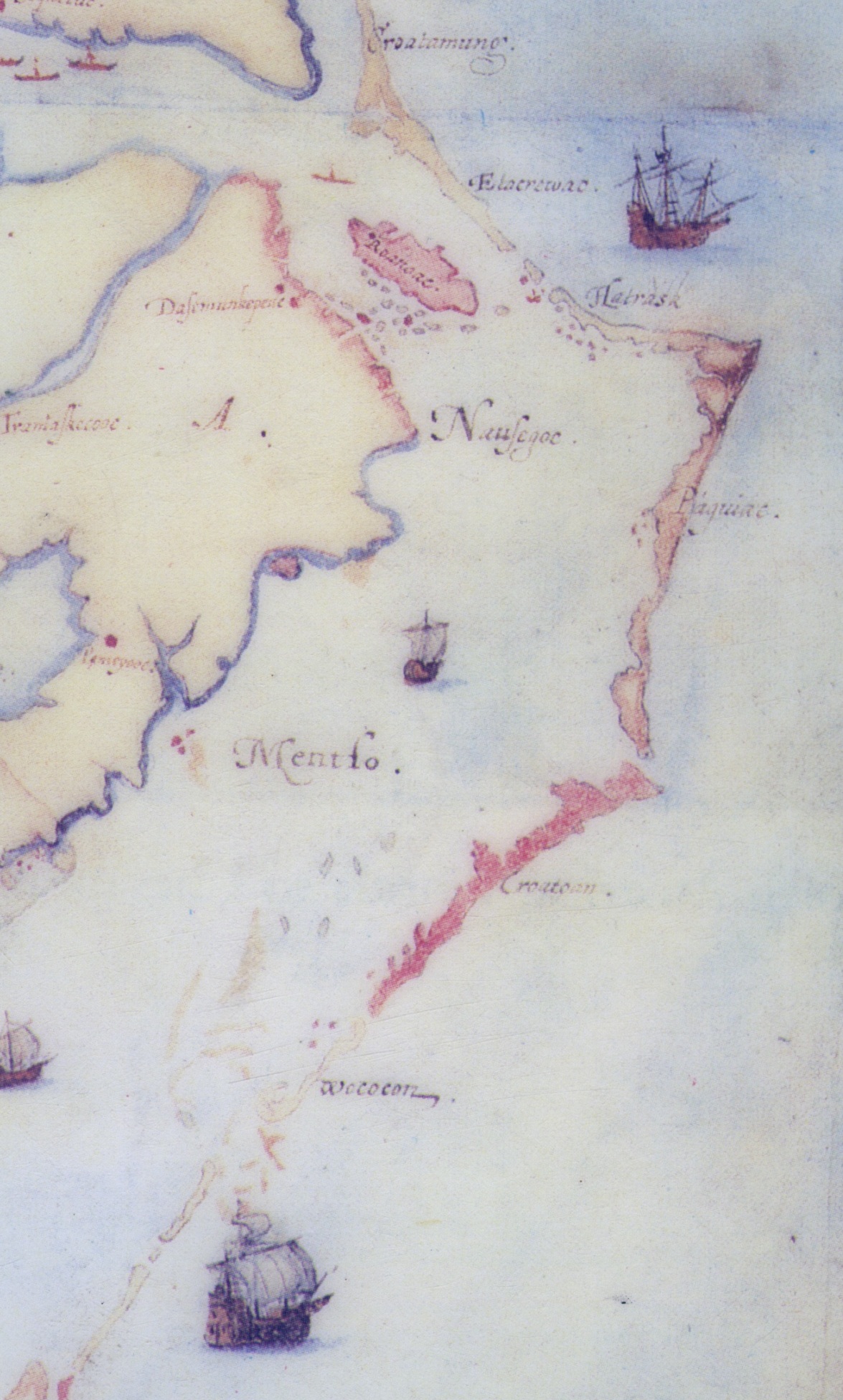
White and Harriot created a map in 1585 that showed in red the various locations of the Indian towns that were discovered during their explorations.  The depiction of the Outer Banks was somewhat distorted, and of course the geography has changed between 1585 and 2010 as a result of various storms, but in essence, White showed the entire island he called Croatoan as inhabited by Indians, as shown below.  The outlet at the top of Croatoan is now closed so that Cape Hatteras today connects the two islands of Croatoan and Paquiwoc. 


Although White was unable to visit Croatoan during his 1590 rescue trip, he reported that the colonists’ houses on Roanoke Island were removed, not torn down, destroyed or burned, and there was no evidence that the colonists had left under duress.  When White discovered the “Croatoan” and another “Cro” carving, and no crosses, he knew that the colonists had left a message containing their location, as they had also agreed to do prior to his departure.  White commented in his journal that he was “greatly joyed that I had safely found a certain token of their safe being at Croatoan which is the place where Manteo was born”, “the island of our friends.”  

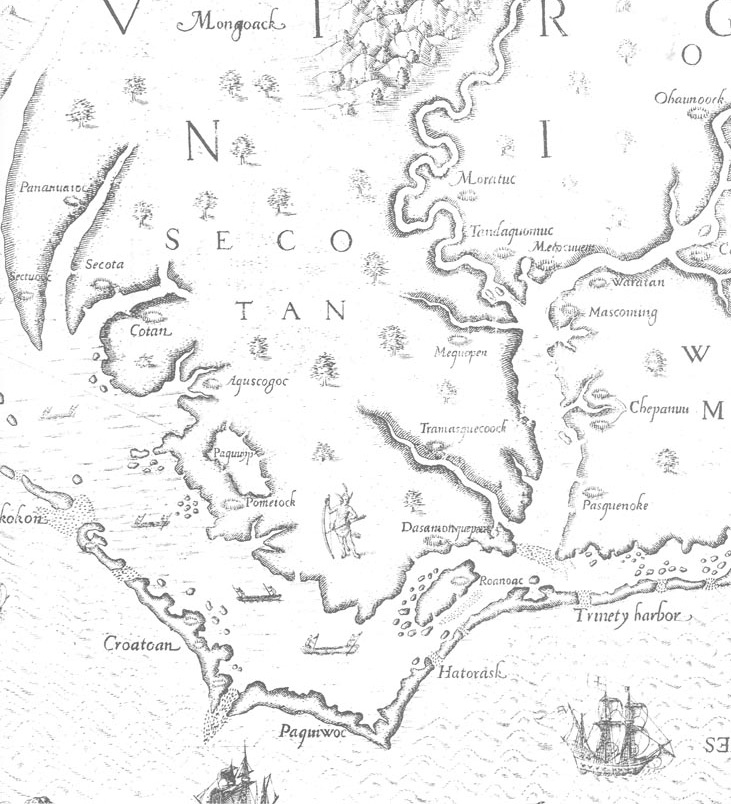
The 1590 deBry map (North is at right), taken from various maps drawn during the 1584-1587 voyages shows three Indian villages, one at Buxton and one in the general location of Frisco and third one slightly further south.

Later maps indicate three main Indian villages on what is now Hatteras Island, one in or near Avon, formerly Kinnekeet, 3 miles north of Buxton, one at Buxton and one at Frisco, where Brigands’ Bay is currently located.  The Brigands’ Bay location was the last location to have an active Indian village, into the 1800s, based on deeds and other local history.

Jamestown reported that there were a few survivors, but that most colonists were dead.  The Powhatan claim to have massacred them, but then a few pockets of some colonists who were reported to be slaves were also reported.  None were found and it’s unclear how actively they were actually sought, although at least three separate reports were received regarding colonist locations.

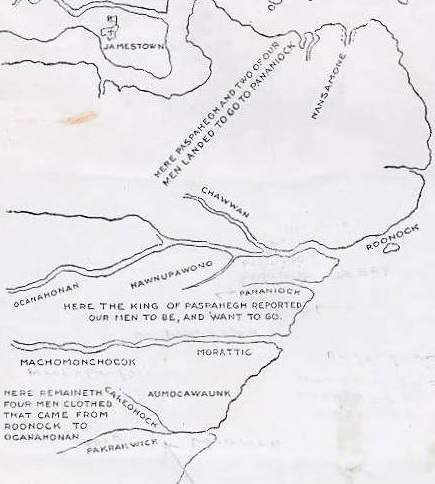
The Zuniga map was a spy map shipped to the King of Spain by one of the Jamestown associates.  On the original map, the rivers seem to be either mislabled or misplaced relative to Roanoke Island.  Regardless, it does show that in at least two locations, English remained at that time, in addition to Jamestown.  A simplified redrawing of the Zuniga map is shown below.  Neither location shown is on the outer banks islands, which are not pictured on the map at all.


James Sprunt, historian, in his book “Tales and Traditions of the Lower Cape Fear, 1661-1896” reports that the Cape Fear Coree Indians told the English settlers of the Yeamans colony in 1669 that their lost kindred of the Roanoke colony, including Virginia Dare …had been adopted by the once powerful Hatteras tribe and had become amalgamated with the children of the wilderness. 

The next documentation we find regarding the Hatteras or colonists is the 1701 journal of John Lawson published as the book “A New Voyage to Carolina” where he visited the Hatteras Indians and reported that the “Hatteras Indians these are them that wear English dress.”  He then discussed the fact that they descended from white people, the colonists, and wrote the following; “A farther Confirmation of this we have from the Hatteras Indians, who either then lived on Ronoak-Island, or much frequented it. These tell us, that several of their ancestors were white People, and could talk in a Book, as we do; the Truth of which is confirmed by gray Eyes being found frequently amongst these Indians, and no others. They value themselves extremely for their Affinity to the English, and are ready to do them all friendly Offices. It is probable, that this Settlement miscarried for want of timely Supplies from England; or thro’ the Treachery of the Natives, for we may reasonably suppose that the English were forced to cohabit with them, for Relief and Conversation; and that in process of Time, they conformed themselves to the Manners of their Indian Relations.”

Lawson adds;  “I cannot forbear inserting here a pleasant story that passes for an uncontested truth amongst the inhabitants of this place; which is that the ship which brought the first colonists does often appear amongst them under sail in a gallant posture which they call Sir Walter Raleigh’s ship; and the truth fo this has been affirm’d to me by men of the best credit in the country.”

Lawson also tells us that the Hatteras have “16 fighting men”, which in population studies is typically multiplied by 4 or 5 to obtain the village population, which, in this case, would be between 64 and 80 people in 1701.

In 1710, the Reverend John Irmstone of Bath wrote in a letter to his superior about people from Hatteras and Ocracoke who came to get baptized.  He gives no surnames, but says, “these persons, half indian and half English, are an offense to my own and I gravely doubt the Kingdom of Heaven was designed to accommodate such.  They stunk and their condition was not improved by the amounts of sacramental wine they lapped up nor by sprinkling with baptismal waters.”

In 1715, the Hatteras had fought with the English in the Tuscarora War and were given 16 bushels of corn due to their condition described as “very poor, being in great poverty”.

The earliest land grants in North Carolina for Hatteras Island were granted beginning in 1716[1] when land in this area apparently became available for ownership[2].   Men who were listed as neighbors[3] on the tax lists in this district[4] were granted land between September and December 1716, as follows; Davis, Gibbs, Johnson, Rollason (Rollinson), O’neal, Callihan and Farrow. 

The only earlier grant on the “sand banks”[5] was to William Reed in June of 1711 whose grant included the “Cape Hatteras Indian towns”.  One William Reed was very politically active and was the Governor of North Carolina from 1722-1724.  This may have been his grant which he quickly sold and/or assigned or lost.  On the 1715 tax list, Col. William Reed is the county’s largest landholder with 3370 acres.  He is likely the man who obtained the early land grant that included the Indian Towns and he probably never even saw the land.  Some of this land in Buxton was patented as late as 1760.

We know from various later records that Davis, Gibbs, Johnson and Farrow’s land abutted an Indian village.  In 1759, two hundred acres was granted to “William Elks and the Hatteras Indians”.  According to later deeds, this land abutted the original grants of Davis, Gibbs, Johnson and Farrow. The 1756 legislative proceedings leading up to Elks’ 1759 land grant are recorded in the NC State Records, and tell us that the Indian village was not new, existing prior to the surveying of the land for Henry Davis in 1716.

We know that the first available land valuation list for Currituck County in 1714[6] included many of these individuals among the 192 total.  In 1716, 1717 and 1718[7], the residents are shown grouped into their various districts and the 1720 tax list tells us the number of acres owned and whether owners obtained their land by deed or patent. 

There is a 1716 entry for concealed tithables that is extremely interesting.[8]  Generally, this means that the men had slaves or family members that they should pay tax on and they did not.  Looking at the names and looking at the Hatteras Neighborhood reconstruction project, this is the entire group living around William Elks.  If these men had “Indian” wives, daughter-in-laws or children, they would of course not want to pay taxes on them, because white men don’t pay tax on their wives, etc.  But according to the court, if you were not 100% white, you had to have tax paid on you.  This appears for all the world like a group being accused of this.  Keep in mind this is the entire list of concealed tithables for the whole county and all of them live on Hatteras and are neighbors.  We know from Job Carr’s 1756 testimony and Henry Davis’s 1716 land grant that references “ye Sandy banks on Cape Hatterass joining ye Indian Town” that in 1716, William Elks was living adjacent Henry Davis. 

The 1716 men with concealed tithables are:

John O’Neal

William Wells

Henry Gibs

Richard Jonston

John Robertson

Fran: Farow

Henry Davis

John Macuing

Thos. Spencer So. Ba:

Bryan Callehan

John Callehan

These men were all neighbors, appearing in this order on the tax list:

John Smith, a negro

Richard Ballence

John Oneall

Wm: Wells

John Lewist

Henry Gibs

David Jones Ser.

David Jones Jur.

Richard Jonston

John Robertson

Frances Farow

Henry Davis

John Mecuing

Thos: Spencer So. Banks

Bryan Callehan

John Callehan

Edward Bony

Mathew Hanna

In 1718, the tax collector did us an immense favor and he separated the “Bankers” from the rest, meaning the men who lived on the Outer Banks islands.  The rest of the tax list lived on the mainland.  The list of men who paid taxes on the “Bankes” in 1718, not just the men who owned land, were:[9]

John Oneal

John Cirk

Wm. Wells

Davd. Jones Ser.

Davd. Jones Jur.

John Maccuin

Danl. Guthree

Henr. Gibbs

Henr. Davis

William. Johnson

Fra. Faroh

John Lewis

Thos. Spencer

The list was totaled here, then the following two men added.  It is unclear whether they were added to the Sand Banks list or the larger list but at the end of the Sand Banks list.

 Robert Paumer

Foster Jervis Jur.

All of the 1718 men had only one tithe, so paid tax only on themselves.  This indicates that they had no slaves, no males over the age of 16 and their wives were not “people of color”.  This certainly interesting, because many of these men were the same men who were prosecuted just two years earlier for concealing tithes.  Apparently some kind of agreement, perhaps an early version of “don’t ask, don’t tell”, was worked out, because there is no indication of concealing tithables again and these men are not claiming more than one taxable person.  Perhaps they had Indians living on their land and the Indians were not to be taxed. 

On the 1717 Currituck Tax Levy list, we find three Elks men, none of which owned land.  There was Thomas Elkes, John Elkes and William Davis for Emannuel Elks.  In 1718, all of these men were gone except Thomas Elks who was on the insolvent list for 1717 and 1718 as well.  There were three Davis men as well, but only one, Henry Davis, lived on Hatteras Island.  The rest of these men, including the Elks, lived on the mainland.  The Elks family is known to have owned land in various locations in coastal Carolina and a later article will detail this English Elks family.  The only possible, if remote, connection is that the Henry Davis on Hatteras Island may have been related to William Davis who obviously was somehow connected to Emmanuel Elks and the Hatteras Native Elks family might have for some reason adopted the Elks surname through this connection.  This is a distant logical stretch, especially since we have nothing except speculation to base this commentary on.  They did not even live in close proximity, in fact, there was at least 30 miles of water between these families.  We do know from DNA studies that the English Elks family is exactly that, English, not Native.  We track them from Virginia at a very early date.

In 1720, we find this entry in the legislative notes for the state of NC: “To Anthony Hatch in Little River you are hereby directed and required for the use of the Hatteras Indyans that they may not be unprovided to serve the publick if occasions requires to deliver unto Capt. John Oneale on the banks and of the indyans aforesaid 20 lbs power and 40 pounds shot with 100 flints if so much be instore if noe deliver as much of each kind as you have.  John Oneale signs his mark in receipt.”

The 1733 Moseley map shows Hatteras Indian Town in the current Buxton location along with his note “Indians, none inhabiting the See Coast, but about 6 or 8 at Hatteras who dwell among the English.”  The village is marked below with two little “houses” on the sound side of Cape Hatteras.

The Indian villages are marked above with numbers corresponding to the following tribes and locations: 1. Poteskeet – Currituck County; 2. Yeopim (Weapemeaoc) – Pasquotank (now Camden) County; 3. Chowan – Chowan (now Gates) County; 4. Mattamuskeet – Hyde County; 5. Hatteras (Croatan) – Currituck (now Dare) County.[10]

In the 1730s and 1740s, the Farrow and other Hatteras families including the Gibbs, Spencers, Stows, Jones and Walls were purchasing land around Lake Mattamuskeet from the Mattamuskeet Indians.  In 1740, two transactions took place on the same day, although they were not stated to be a trade.

Currituck Deed Book 3 Deed 632, page 22 – April 2, 1740 recorded June 26, 1740 -Charles Squires, Indian, to Jacob Farrow, 100# NC money, land, [no acreage mentioned], in Aramoskeet adjoining William Browning, Joshua Wallis line, Syrpis Swamp, with Cornelius Jones, Thomas Dudley, signed John S: Squires (sic).  [S: appears to be his mark]

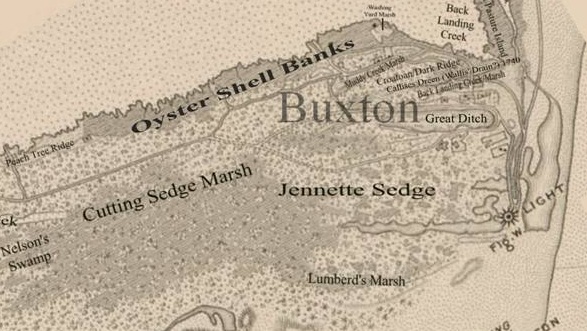
Currituck Deed Book 3 Deed 635, page 24 April 2, 1740 recorded Aug. 22, 1740 – Jacob Farrow to Charles Squires, Indian, of Arromuskeet in Currituck County, 100#, 200 acres on Hatteras Banks beginning a the north side of Cutting Sedge Marsh, by a house that Vallentine Wallis built, the sound side, Callises Dreen, sea side, witness Cornelius Jones, Thomas Dudley, signed Jacob Farrow.

The land purchased by Charles Squires is never found being sold.  It may have been lost for taxes, but it has been located at being in the Buxton area based on the location of Cutting Sedge from Baylus Brooks’ “Hatteras Place Name” map.


In the book Villany Often Goes Unpunished, Indian Records from the North Carolina General Assembly Sessions 1675-1789 by William L. Byrd III, he transcribed the following 1756 entry: 

“Job Carr about Hatteras Indian lands.  I have made diligent inquiry as to the complaint of Thomas Elks indian and I find the greatest part to be erroneous…the complaint of sundry persons that came and indeavor to disposess him and the rest of the indians which is a small number for there is but (faded) man beside himself and one small boy of he male I (faded) and I have strickly examined he said Thomas Elks what pers (faded) there were that I  (faded) the indians and he answere me none but Thomas Robb Junor and demanded of he said Robb Junor his reason of his encroachment uppon the Indian Land and Robb denied he had done it or intended to do it for he dsered no more than his one and according produced a plot and pattin for a pece of land containing 320 acres which was surveyed to his grandfather Mr. Henry Dayvis in yr 17?6 [1716] beginning at the Indian Town and rainging to the northward and for the better clearning up the matter I caused Mr Hezeciah Farrow and Capt Jacob Farrow to examine the indian boundary line…for the said indians never had any grant or patting [patent] for it as ever they were acquainted with or had any knowledg of so that I conceive they have no right to compaine seaing they have no grant or patting for any lands neither is Thomas Elks intiteled to the royelty for he is but a son in law to the late King Elks desesed and part of the Maromosceat line of indians for the tru line of the Hatteras Indians are mostly dead.  Job Carr”

In 1759, William Elks and the Hatteras Indians are granted 200 acres on Hatteras Banks that includes the Indian Town.

In John Swanton’s “Indians of North America”, he tells us that in 1761, the Rev. Alex. Stewart baptized 7 Indians and mixed-blood children of the “Attamuskeet, Hatteras, and Roanoke” tribes and 2 years later he baptized 21 more.  Reverend Stewart goes on to say that the “Hatteras and Roanoke Indians” are “newly arrived from Roanoke Island” to live with the Mattamsukeet.

In 1770 William Elks of Hatteras sells to Isaac Farrow 100 acres and in 1771, he sells 50 acres on Hatteras Banks to George Clark. 

In 1788, Mary and Elizabeth Elks sell 200 acres of land bounded by the old Indian Town to Nathan Midgett.  It does not say it includes the Indian Town.

At this point the amount of land sold by the Elks family equals 350 acres and the land granted totals 200 acres.  We don’t know how much was left in the deed to Nathan Pinkham, below.  I expect that this was the deed for the actual “Indian Town” itself, that Mary lived there until her death.

In 1802 Elizabeth Elks pens a deed to Nathan Pinkham for the “Indian lands” if her son does not reach the age of 21.  In 1823, Nathan Pinkham files that deed and margin notes indicate that all other parties are dead. 

With that, the curtain closes on the records we have concerning the Croatoan Indians.

Summary

The Hatteras Indian tribe appears to be extinct as a tribe, and was nearly so by 1756.  The last remnant appearance that we can trace is the 1823 deed filing.  Based on the 1756 legislative entry, it would appear that the last of the Hatteras married into the Mattamuskeet Indians and the tribal remnants may have gone to live among them based on Stewart’s 1761 entry.  It also appears that they were significantly admixed by this time as well and as early as 1710 based on Irmstone’s letter and as early as 1701 based on Lawson’s observations.

Are the Hatteras really extinct, or was the tribal identity actually the only thing “dead”?  Had the balance of the Hatteras assimilated into either the European or the Mattamuskeet populations, or both?  If the Hatteras were already admixed with the colonists, as reported by Lawson in 1701, their complete assimilation, meaning when they were no longer able to be identified visually as Indians, would have happened rather quickly.  Did they move to join their kin at Mattamuskeet?   Are there any discernible remnants left?  Research is underway to answer those questions. 


[1] Land grant information extracted from “The Province of North Carolina, 1663-1729, Abstracts of Land Patents” by Margaret Hofmann.

[2] Various portions of North Carolina were made available for land patents by the Royal Proprietors at differing dates.  Some very early, mostly very large, grants were made from Virginia, but Hatteras Island was not among these early Virginia grants.

[3] Neighbors were determined by being listed contiguously on the tax list and by a reconstruction of the neighborhood by using land patents and deed.  Surnames were spelled variously.

[4] Tax lists in Currituck County during this timeframe were submitted by district.  Each district had a constable whose responsibility it was to visit each resident and determine the amount of land owned and other personal property upon which the resident was to be taxed.  The constable lived in the district and was only assigned the residents in his particular area.  These constables submitted lists, some of which were labeled with a district name.  In 1718, there were two lists that were labeled with the name “bankes” included, one a larger list called “sand bankes” and a second one, smaller, but including all of the surnames of the landowners discussed, labeled “[illegible] bankes”.  In previous and subsequent years, these two districts were combined, but the 2 separate lists for 1718 provide us with groupings of two neighborhoods that were apparently distinct from each other in location.  Reconstruction of the neighborhoods from deeds and land grants confirms this division.

[5] Hatteras island was variously referred to as “the banks”, “sand banks”, “Hatteras banks”, and other similar references.  Fortunately, it makes land transactions on the island easy to differentiate from mainland transactions.  Land patents and deeds were searched from 1663-1804 inclusive for early and original land owners on contemporary Hatteras Island.

[6] NC State Archives Colonial Court Records, 1714 Currituck County Tax Records, Valuations

[7] Ibid, 1716, 1717, 1718 and 1720 various lists

[10] Map and tribal village identification site from http://homepages.rootsweb.ancestry.com/~jmack/algonqin/moseley.htm

Posted in Croatoan | 2 Comments

The Legend of Chief Kinnekeet

Historian David Stick, in 2005, prior to his death in 2009, had begun to write a series of biographies of “Outer Banker” families.  Unfortunately, he discovered a computer virus on is system which wiped out all of his work.  He had information he was compiling for an additional 160 families as well.  In 2007, he managed to obtain copies of the original 18, and retyped them, but by then his interest had waned, and he put aside the biographies.  His intention was for them and his research work to be donated to the Outer Banks History Center, but it is unknown if that actually occurred or not.

Some of these histories have been donated to the Hatteras Island Genealogy and Preservation Society by families.  In the biography for Charles Thomas Williams Sr. (1865-1941) and Charles Thomas Williams Jr. (1892-1984), we find a very interesting piece of information about Kinnekeet.

“Among the tales passed down from the earlier generations, Williams said there was one about an Indian village where Kinnakeet is located.  “The Big Chief Indian was named Kinnakeet and his tribe was called Kinnakeet in his honor”, he recounted.  However, the definitive Handbook of American Indians North of Mexico makes no mention of Kinnakeet, the closest being “Kinikinnick” an Indian preparation of tobacco, sumac leaves. And the inner bark of a species of dogwood, which the natives used for smoking.”

The former village of Kinnakeet is currently named Avon and is located just north of Buxton on Hatteras Island.

Posted in Hatteras, History | 4 Comments

The Tuscarora Eye

Dr. Arwin Smallwood is an associate professor of history at the University of Memphis.  He is also of mixed-blood Tuscarora heritage.  His focus on Bertie County history, where his family is from, is natural, and we are all beneficiaries of his research.  Bertie County is the home of the Tuscarora Reservation, Indian Woods.  While many of the Tuscarora departed for New York and northern states between 1713 and 1805, not all left.  Some were enslaved and could not.  Some pockets of free Tuscarora had formed communities elsewhere. 

The Tuscarora too have a legend about what happened to the Lost Colonists and a Tuscarora trait attributed to them, the Tuscarora Eye.  Scattered though his book “Bertie County: An Eastern Carolina History” are several references which I’ve extracted.

You can see more about the book and purchase it at this link.  http://www.arcadiapublishing.com/9780738523958/Bertie-County–An-Eastern-Carolina-History

Page 28 – The Tuscarora legend answers with certitude what happened to the colony.

Page 29 – According to legend, the Tuscarora, on one of their foraging missions to Roanoke, took the English women as prisoners and killed most of the men, according to custom.  They allowed three men and one woman to go free because they had red and blonde hair, which caused the Tuscarora to be fearful of their spirits, believing them to be children of the sun god.  It is believed that these individuals were taken in by the Croatan Native Americans and intermarried with them, creating the Lumbee of North Carolina.

In further support of this legend, colonial records and written statements from French Huguenots note that they saw Tuscarora with blonde hair and blue eyes s early as 1696.  These Huguenots were settled along the Tar River in 1696 and the Neuse River by 1708, and they were the closest white settlers to the Tuscarora.  Since there were no significant European settlements near the Tuscarora until 1660, and any attack by the Tuscarora on Virginia where whites would have been captured would have been recorded by the Virginians at Jamestown, this legend offers a plausible explanation to the perplexing question of “What happened to the Lost Colony?”

Page 45 – After the Tuscarora War (1711-1713) and the loss of nearly one-quarter of their people to enslavement and death, Tuscarora survivors recalled a threat made against them by white colonists in 1587 after they absorbed the Roanoke settlement.  This threat was passed on orally among the Tuscarora for over a century.  In the threat, as Geroux, a descendant of the Tuscarora who emigrated to New York, noted after the war, the Tuscarora were told by the whites in 1587 that if they (the whites) were harmed, the mother boat would return and would “make thunder and spit fire at them”, a reference to the ships’ cannons that could have been used to defend the settlement.  Whether this threat was remembered by the Tuscarora during the war with North Carolina is not clear, but the Tuscarora were reportedly terrified of colonial artillery, which “spit fire and made thunder.”  After the war, the Tuscarora began to repeat this threat and blamed the mixed-blood descendants of those responsible for the Roanoke colony’s destruction for their misfortune.  Thus, many Tuscarora in 1713 believed they were being punished by their ancestors and the Great Spirit as a result of the abduction of the colonists in 1587.

Dr. Hamilton of East Orange, New Jersey, who was part-white, part-African American, and part-Tuscarora, confirmed Geroux’s story with one of his own before he died in the 1930s.  He noted that not only did the Tuscarora believe they were being punished for what they had done at Roanoke, but certain members of their tribe were cursed with the “Tuscarora Eye” or “Evil Eye”, which ran in his family.  These Tuscarora, who may have been descendants of the white women taken from Roanoke island, were born with blue, green or gray eyes.  As time passed, the eye became more prevalent throughout the tribe, along with problems with white settlers.  In fact, in 1707, French Huguenots, who settled near the Tuscarora along the Tar River, reported that the Tuscarora had many members with blue, green and gray eyes.

Page 49 – Although many clans blamed Chief Blount and those of their nation that carried the “Tuscarora” or “Evil Eye” for their defeat, clearly all of the Iroquois (Mohawks, Oneida, Layuga, Onondaga, Seneca, and Tuscarora) must share the blame for what happened.  They all in one way or another violated or ignored the teachings of their ancestors.

After the war, the Tuscarora began to blame those among them who carried the Tuscarora Eye for their downfall, further fragmenting their already weakened nation.  This only accelerated the breakup of the nation and caused many Tuscarora to isolate themselves in various parts of eastern North Carolina from the larger nation.

Page 59 – By 1750, there were a number of residents in Bertie County who were either African-Tuscarora mix, English-Tuscarora mix, or African-Tuscarora-English mix.  Many Tuscarora women after the Tuscarora War had even married whites, runaway slaves or African slaves they were enslaved with on plantations.  Most Tuscarora women, however, preferred to marry African men to eliminate their European characteristics, particularly the Tuscarora Eye in their children.  These marriages succeeded in eliminating the Tuscarora Eye, with the exception that every other generation children would often be born with green, blue or grey eyes.

Posted in Tuscarora | 5 Comments

Pamunkey Indians of Virginia

This article about the Pamunkey Indians was found at  http://www.bigorrin.org/archive73.htm and was originally published by the Bureau of Ethnology of the Smithsonian Institution in 1894. To the best of my knowledge it is in the public domain, so it is being reprinting it here. Note that this text is quite dated and contains some insulting stereotypes. The text is reproduced here exactly as the original appeared for historical and linguistic purposes. The spelling has not been standardized.

PREFACE
By W. J. McGee

The most conspicuous stock of American Indians in early history is the Algonquian. Not only was the area occupied by the Algonquian peoples larger than that of any other stock, but the tribes and confederacies were distributed along the Atlantic coast and the rivers, estuaries, and bays opening into this ocean from Newfoundland to Cape Hatteras. The Pilgrim Fathers of New England, the Dutch traders and merchants of Manhattan island and the Hudson, the Quaker colonists of Pennsylvania, the Jesuit missionaries and Cavalier grantees of Maryland and Virginia, all encountered the native tribes and confederacies of this great stock. Further northward and in the interior Champlain, le Sieur du Lhut, Pere la Salle, and other explorers, came chiefly in contact with related peoples speaking a similar tongue. So the American Indian of early history, of literature and story, is largely the tribesman of this great northeastern stock.

One of the most prominent among the confederacies of Indian tribes belonging to the Algonquian stock, in the history of the settlement of our country, was the Powhatan confederacy of tidewater Virginia and Maryland. The prominence of this confederacy in our early history is partly due to the fact that Capt. John Smith was writer as well as explorer, arid left permanent records of the primitive people whose domain he invaded; but these and other records indicate that Powhatan was a chief of exceptional valor and judgment, and that the confederacy organized through his savage genius was one of the most notable among the many unions of native American tribes; also that Powhatan’s successor, Opechancanough, was a native ruler of remarkable skill and ability, whose characteristics and primitive realm are well worthy of embalming in history. Capt. John Smith was followed by other historians, and England and the continent, as well as the growing white settlements of America, were long interested in following the fortunes of the great tribal confederacy as the red men were gradually driven from their favorite haunts and forced into forest fastnesses by the higher race; and in later years Thomas Jefferson and other leaders of thought recorded the movements and characteristics of the people, while John Esten Cooke and his kind kept their memory bright with the lamp of literature. So the native king Powhatan, the ill-starred princess Pocahontas, and the people and the land over which they ruled, are well known, and the Powhatan confederacy has ever been prominent in history and literature.

The leading tribe of the Powhatan confederacy was that from which Pamankey river in eastern Virginia takes its name. Strongest in numbers, this tribe has also proved strongest in vitality; a few trifling remnants and a few uncertain and feeble strains of blood only remain of the other tribes, but the Pamunkey Indians, albeit with modified manners, impoverished blood, and much-dimmed prestige, are still represented on the original hunting ground by a lineal remnant of the original tribe. The language of Powhatan and his contemporaries is lost among their descendants; the broad realm of early days is reduced to a few paltry acres; the very existence of the tribe is hardly known throughout the state and the country; yet in some degree the old pride of blood and savage aristocracy persist-and it is undoubtedly to these characteristics that the present existence of the Pamunkey tribe is to be ascribed.

By reason of the prominent and typical place of the Powhatan confederacy in history and literature, it seems especially desirable to ascertain and record the characteristics–physical, psychical, and social–of the surviving remnant of the men. It was with this view that John Garland Pollard, esq., of Richmond, a former attache’ of the Smithsonian Institution, was encouraged to make the investigation recorded in the following pages; and it is for this reason that the record is offered to the public.

———————————————————————————

THE PAMUNKEY INDIANS OF VIRGINIA.
By Jno. GARLAND POLLARD

INTRODUCTORY NOTE.

The information here given to the public concerning the present condition of the Pamunkey Indians was obtained by the writer during recent visits to their reservation. He wishes to acknowledge his indebtedness to the tribe for the kindness with which they have treated him, and to make special mention of Mr. Terrill Bradby, Mr. William Bradby, and Chief C. S. Bradby, who have made a willing response to all of his inquiries.

As to the past condition of the tribe, the authorities consulted were the following:

The True Travels, Adventures, and Observations of Captain John Smith: Richmond, 1819.
Notes on the State of Virginia, by Thomas Jefferson: Philadelphia, 1801.
Historical Recollections of Virginia, by Henry Howe: Charleston, 1849.
Virginia, by John Esten Cooke: Boston, 1883.

RICHMOND, Va., October 5, 1893.

EARLY HISTORY OF THE PAMUNKEY INDIANS.

At the time of the settlement of Jamestown, in 1607, that region lying in Virginia between Potomac and James rivers was occupied by three great Indian confederacies, each of which derived its name from one of its leading tribes. They were (1) the Mannahoac, who lived on the headwaters of Potomac and Rappahunnock rivers; (2) the Monocan, who occupied the banks of the upper James, and (3) the Powhatan, who inhabited all that portion of the tidewater region lying north of the James. The last-named powerful confederacy was composed of thirty warlike tribes, having 2,400 warriors, whose disastrous attacks on the early settlers of Virginia are well known to history. The largest of the tribes making up the Powhatan confederacy was the Pamunkey, their entire number of men, women, and children, in 1607 being estimated at about 1,000 or one-eighth of the population of the whole confederacy.

The original seat of the Pamunkey tribe was on the banks of the river which bears their name, and which flows somewhat parallel with James river, the Pamunkey being about 22 miles north of the James. This tribe, on account of its numerical strength, would probably front the beginning have been the leader of its sister tribes in warfare, had it not been for the superior ability of the noted chief Powhatan, who made his tribe the moving spirit of attack on the white settlers.

On the death of Powhatan, the acknowledged head of the confederacy which bore his name. he was succeeded in reality, though not nominally, by Opechancanough, chief of the Pamunkey. John Smith, in his history of Virginia (chapter 9, page 213), gives an interesting account of his contact with this chief whose leadership in the massacre of 1622 made him the most dreaded enemy which the colonists of that period ever had. In 1669, 50 persons, remnants of the Chickahominy and Mattapony tribes, having been driven from their homes, united with the Pamunkey. The history of these Pamunkey Indians, whose distinction it is to be the only Virginia tribe1 that has survived the encroachments of civilization, furnishes a tempting field of inquiry, but one aside from the writer’s present purpose, which is ethnologic rather than historical.

PRESENT HOME.

The Pamunkey Indians of to-day live at what is known as “Indian-town,” which is situated on and comprises the whole of a curiously-shaped neck of land, extending into Pamunkey river and adjoining King William county, Virginia, on the south. The “town” as it is somewhat improperly called, forms a very small part of their original territory. It is almost entirely surrounded by water, being connected with the mainland by a narrow strip of land. The peculiar protection which is afforded in time of war by its natural position in all probability accounts for the presence of these Indians in this particular spot; and, indeed, I doubt not that to this advantageous situation is due their very existence.

Indiantown is about 21 miles east of Richmond immediately on the line of the York river division of the Richmond and Danville railroad. It consists of about 800 acres, 250 of which are arable land, the remaining portion being woodland and low, marshy ground. This tract was secured to the Pamunkey Indians by act of the colonial assembly, and they are restrained from alienating the same.

From a census taken by the writer in 1893 there were found to be 90 Indians then actually present on the reservation. There are, however, about 20 others who spend a part of the year in service in the city or on some of the steamers which ply the Virginia waters. There are, therefore, about 110 Pamunkey Indians now living.

The population of the “town” has varied little in the last century. Jefferson, writing in 1781, estimated their number to be 100, and Howe, nearly seventy years later, placed it at the same figure.

INDIVIDUAL CHARACTERISTICS.

No member of the Pamunkey tribe is of full Indian blood. While the copper-colored skin and the straight, coarse hair of the aboriginal American show decidedly in some individuals, there are others whose Indian origin would not be detected by the ordinary observer. There has been considerable intermixture of white blood in the tribe, and not a little of that of the negro, though the laws of the tribe now strictly prohibit marriage to persons of African descent.

No one who visits the Pamunkey could fail to notice their race pride. Though they would probably acknowledge the whites as their equals, they consider the blacks far beneath their social level. Their feeling toward the negro is well illustrated by their recent indignant refusal to accept a colored teacher, who was sent them by the superintendent of public instruction to conduct the free school which the State furnishes them. They are exceedingly anxious to keep their blood free from further intermixture with that of other races, and how to accomplish this purpose is a Serious problem with them, as there are few members of the tribe who are not closely related to every other person on the reservation. To obviate this difficulty the chief and councilmen have been attempting to devise a plan by which-they can induce immigration from the Cherokee Indians of North Carolina. The Indian blood in the Pamunkey tribe is estimated at from one-fifth to three-fourths.

The Pamunkey, as a tribe, are neither handsome nor homely, long nor short, stout nor slim; in fact, they differ among themselves in these respects to the same degree found among the members of a white community of the same size. They are not particularly strong and robust, and their average longevity is lower than that of their neighbors. These facts are perhaps in a measure attributable to the frequent marriages between near relatives.

The average intelligence of these Indians is higher than that of the Virginia negro. With a few exceptions the adults among them can read and write. In view of their limited advantages they are strikingly well informed. A copy of one of their State papers will serve to give an idea of the maximum intelligence of the tribe. It reads as follows:

PAMUNKEY INDIAN RESERVATION,
King William County, Va., June 26, 1893.

We, the last descendants of the Powhatan tribe of Indians, now situated on a small reservation on the Raintinkey river, 24 miles from Richmond, Va.. and one mile east of the historic White House, where Gen. George Washington was married to his lovely bride in the St. Peter’s Church. We are now known as the Pamunkey tribe of Indians, following the customs of our forefathers, hunting and fishing, partly with our dugout canoes.

We hereby authorize Terrill Bradby to visit the Indian Bureau in Washington and in all other Departments and Indian tribes, and also to visit the Columbian Exposition in Chicago.

We, the undersigned, request that whenever this petition is presented, the holder may meet with the favorable approbation of the public generally.

C. S. BRADEY, Chief
J. T. DENNIS
W. G. SWEAT
R. L. SIMPSON,
T. BRADBY,
Council
H. W. MILES
Town Clerk
JAS. H. JOHNSON,
W. T. NEAL,
B. RICHARDS, M.D.,
Trustees
E. R. ALLMOND,
A. J. PAGE,
G.M. COOK,
W. A. BRADBY,
T. T. DENNIS
Members of the Tribe

The Pamunkey Indians are temperate, moral, and peaceable. Ill feeling between the tribe and their neighbors is almost unknown. They are exceeding proud of their lineage, and love to tell how bravely and stubbornly their forefathers resisted the encroachment of the whites. Opechancanongh is their hero. They take special delight in relating the familiar story of how this noted chief; when old and infirm, was carried on a litter to battle, that his presence might inspire his well to deeds of bravery.

It may not be amiss to give here a tradition concerning this tribe, which is related as explanatory of the name of a certain ferry that crosses Pamunkey river about ten miles above the reservation. The name of the ferry is Pipe-in-tree, now spelled Pipingtree. The tradition runs thus: On one occasion the Pamunkey braves met a committee of white settlers at this place and negotiated a treaty. When all the terms had been agreed to, the consummation of the treaty was solemnized in usual Indian fashion by handing around the same pipe to the representatives of both nations, each taking a puff as indicative of friendship and good faith. The pipe was then deposited in a hollow tree near by, and ever afterward, when the colonists disregarded their agreement, the poor Indians would remind them of “pipe-in-tree.”

Aside from their mode of subsistence there is nothing peculiar in the manners and customs of these people, except, perhaps, an inclination to the excessive use or gaudy colors in their attire. Their homes are comfortable and well kept. The houses are weatherboarded, and are, as a rule, one-story-and-a-half high, and consist of from one to four rooms. The best structure on the reservation is their church building, where services are held every Sabbath. The church receives the hearty support of the whole tribe, the membership of the church and that of the tribe being almost coextensive. As to their creed, they are all of one mind in adhering to the tenets of the Baptist denomination.

LANGUAGE.

One visiting Indiantown at the present day would not find a vestige of the Pamunkey language, even in the names of persons or things. In 1844 Rev. E. A. Dalrymple collected the following seventeen words,2 which, so far as the writer can ascertain, are all that remain of the language of the Pamunkey Indians proper:

Tonshee, son Nikkut, one.
Nueksee, daughter Orijak, two.
Petucka, cat Kiketock, three.
Kayyo, thankfulness Mitture, four.
O-ma-yah, O my Lord Nahnkitty, five.
Kenaanee, friendship. Vomtally, six.
Baskonee, thank you Talliko, seven.
Eeskut, go out, dog. Tingdum, eight.
Yantay, ten

The vocabulary recorded by Captain John Smith3 as that of the Powhatan people is of interest in this connection. This vocabulary, with its original title, is as follows:

Because many doe desire to know the manner of their Language, I have inserted these few words.

Kakatorawines yowo. What call you this
Nemarough, a man.
Crenepo, a woman
Marowanchesso, a boy
Yehawkans, Houses
Matchcores, Skins or garments
Mockasins, Shoes
Tussan, beds
Pokatawer, Fire
Attawp, A Bow
Attonce, Arrowes
Monacookes, Swords
Aumoughhowgh, A target
Pawcussacks, Gunnes
Tomahacks, Axes
Tockahacks, Pickaxes
Paesacks, Knives
Accowprets, Sheares
Pawpecones, Pipes
Mattassin, Cooper
Vssawassin, Iron, Brasse, Silver, any white mettall.
Musses, Woods
Attasskuss, Leaves, weeds, or grasse.
Chepsin, Land
Shacquohocan, A stone
Wepenter, A cookold
Suckahanna, Water
Noughmass, Fish
Copotone, Sturgeon
Weghshaughes, Flesh
Sawwehone, Bloud.
Netoppew, Friends
Marrapough, Enemies
Maskapow, the worst of enemies
Mawchick chammay, The best of friends
Casacunnakack, peya quagh acquintan vttasantasough, In how many daies will there come hither any more English Ships.
Their Numbers:

Necut, 1, Ningh 2., Nuss, 3, Yowgh 4. Paranske, 5. Comotinch, 6, Toppawoss, 7, Nusswash, 8, Kekatawgh, 9, Kaskeke, 10.
The count no more but by tennes as followeth

Case, how many.
Ninghsapooeksku, 20
Nussapooeksku, 30
Yowghapooeksku, 40
Parankestassapooeksku, 50
Comatinchtassapooeksku, 60
Nusswashtassapooeksku, 70
Keekataughtassapooeksku, 90
Necuttoughtysinough, 100
Necuttwevnquaogh, 1000.
Rawcosowghs, Dayes
Keskowghes, Sunnes
Toppquough, Nights
Pawpaxsoughes, Yeares.
Pummahumps, Starres
Osies, Heaves.
Okees, Gods
Ouiyougcosoughs, Pettie Gods and their affinities.
Righcomoughes, Deaths
Kekughes, Lives
Mowchick woyawgh tawgh noeragh kaqueremecher, I am very hungry? What shall I eate?
Tawnor nehiegh Powhatan, Where dwels Powhatan.
Mache, nehiegh yourowgh, Orapaks. Now he dwels a great way hence at Oropaks.
Vittapitchewayne anpechitchs nehawper Werowacomoco. You lie, he stayed ever at Werowacomoco.
Kator nehigh mattagh neer vttapitchewayne. Truely his is there I doe not lie.
Spaughtynere keragh werowancemawmarinough kekate wawgh peyguaugh. Run you then to the King Mawmarynough and bid him come hither.
Vtteke, e peya weyack wighwhip. Get you gone, and come again quickly.
Kekaten Pokahontas Patiaquagh niugh rawrencok audowgh, Bid Pokahontas bring hither two little Baskets, and I will give her white beads to make her a chaine.

For purposes of comparison the meager vocabulary of the Pamticough (Pamlico) Indians, collected by Lawson, may be introduced. The Pampitcough tribe were the southernmost tribe of the Algonquian stock in the middle Atlantic slope. The list4 (excluding the “Tuskeruro” [Iroquoian] and “Woccon” [Siouian]) is as follows:

One, Weembot.
Two, Neshinnauh.
Three, Nish-wonner.
Four, Yan-Ooner.
Five, Umperren
Six, Who-yeoc.
Seven, Top-po-osh
Eight, Nau-haush-shoo.
Nine, Pach-ic-conk.
Ten, Cosh.
Rum, Weesaccon.
Blankets, Mattosh.
White Wop-poshaninuth.
Red, Mish-Cosk.
Black or Blue, idem, Mow-cotto-wosh.
Gunpowder, Pungue.
Shot, Ar-rounser.
Ax, Tomma-hick.
Knife, Rig-cosq.
Tobacco, Hoolipan.
Hat, Mottan-quahan.
Fire, Tinda.
Water, Umpe.
Goat, Tans-won.
Awl or Needle, Moc-cose.
A Hoe, Rosh-shocquon.
Salt, Ohuwon.
Paint, Mis-kis-‘su.
Ronoak, Ronoak.
Peak, Gan hooptop.
Gun, Gun tock seike.
Gun-lock, Hinds.
Fbnts, Rappatoc.
A Flap, Maachone.
A Pine Tree, Onnossa.
Englishman, Tosh-shoute.
Indians, Nuppin.

The most extended known vocabulary of the. Indians of the Powhatan confederacy is that of Strachey, published in the Hakinyt collections; but, like that of Smith, it includes various dialects.

MODE OF SUBSISTENCE

The Pamunkey Indians make their living for the most part in true aboriginal style. Their chief occupations are hunting and fishing, and although they do not neglect their truck patches, they cherish a hearty dislike for manual labor and frequently hire negroes to come in and work their little farms. The deer, the raccoon, the otter, the muskrat, and the mink are captured on the reservation. As many as sixteen deer have been killed in this small area in one season. The skins of all these animals are a good source of income, and the flesh, except of the mink and otter, is used for food. Perch, herring, bass, chub, rock, shad, and sturgeon are caught in large numbers by means of seines Sora (reedbirds), wild geese, ducks, and turkeys are abundant.

In the autumn sora are found in the marshes in great numbers, and the Indian method of capturing them is most interesting: They have what they strangely call a “sora horse,” strongly resembling a peach basket in size and shape, and made of strips of iron, though they were formerly molded oat of clay. The “horse” is mounted on a pole which is stuck in the marsh or placed upright in a foot-boat. A fire is then kindled in the “horse.” The light attracts the sora and they fly around it in large numbers, while the Indians knock them down with long paddles. This method is, of course, used only at night. Every year, many white hunters visit the reservation and employ the Indians as their guides in hunting this same toothsome bird. They, however, use the slower but more sportsmanlike method of shooting them on the wing.

One of the clay “sora horses” above referred to may be found in the National Museum as part of a collection which the writer made from the Pamunkey in behalf of the Smithsonian Institution.

The Pamunkey farm on a very small scale. They do little more than furnish their own tables. They also raise a few horses, cattle, sheep, and hogs.

A general merchandise store is conducted on the reservation by a joint stock company, composed of members of the tribe. Their fish, game, flits, and the few farm products not consumed at home, find market in Richmond and Baltimore.

GOVERNMENT

In government the tribe is a true democracy, over which, however, the State of Virginia5 exercises a kindly supervision. The State appoints five trustees to look after the interest of the Indians. No reports of these trustees could be found on file at the office of the governor of Virginia, and their only function that could be ascertained to have been performed was the disapproval of certain sections in the Indian code of laws. Laws thus disapproved are expunged from the statute book. The tribe is not taxed, but they flay an annual tribute to the State by presenting through their chief to the governor of Virginia a number of wild ducks or other game.

As regards the internal government of the Pamunkey, the executive power is vested in a chief; while the legislative and judicial functions are performed by the chief together with a council composed of four men. The chief was formerly elected for life, but now both chief and council are elected every four years by vote of the male citizens. Their method of balloting for their executive officer is unique. The council names two candidates to be voted for. Those favoring the election of candidate number 1 must indicate their choice by depositing a grain of corn in the ballot-box at the schoolhouse, while those who favor the election of candidate number 2 must deposit a bean in the same place. The former or the latter candidate is declared chosen according as the grains of corn or the beans predominate.

The chief and council are the judge and jury to try all who break the law, and to settle disputes between citizens. Their jurisdiction is supposed to extend to all cases arising on the reservation and which concern only the residents thereon, with the exception of trial for homicide, in which case the offender would be arraigned before the county court of King William county. The Indians claim, however, that it would be their privilege to use the courts of the commonwealth of Virginia to settle such difficulties as could not be efficiently dealt with by their own courts, provided such difficulty arose from a breach of a State law. The writer does not know on what this claim is based. As may be seen from the printed transcript (verbatim et literatim) of the written laws of the Pamunkey which follows, they impose only fine or banishment as penalties. There is no corporal punishment either by chastisement or incarceration.

TRIBAL LAW

The Laws of the Pamunkey Indian Town written here in Sept. 25 1887

The following Laws made and approved by chief and council men Feb. 18th 1886. For the Rauling of the Pamunkey Tribe of Indians.

1st Res. No Member of the Pamunkey Indian Tribe shall intermarry with anny Nation except White or Indian under penalty of forfeiting their rights in Town.

2nd No non-resident shall be allowed to be hired or sheltered more than 3 months and if anny person are known to hire or shelter anny sutch persons shall pay 50c pr. day for every day over the above mentioned time. Amendment. Should sutch person persons be quiet and agrecable they may be hire 30 or 60 day under good behavior.

3rd Anny person slandering another without suficient evidence shall be fined in the 1st offence $5 Second $10 and in the 3rd they are to be removed from the place by the Trustees chief and councle men.

4th No non-resident shall be taught in our free school except the concen of chief counclmen or any other Indian Tribe.

5th Anny party or person found guilty of stealing anny thing belonging to anny one else they shall pay the party for the amt. that are stolen from them and also shall be fined from $1 to $5. 3rd time they are to be removed from the place.

6th If anny person shall depridate or Trespass on another ons premises and shall break down gates or destroy fences or anny other property shall be made to pay or replace all damages and if any miner are engaged in sutch, their parent shall be responsible for their acts and each and anny that are found guilty Shall be fined from $1 to $5.

7th be it known that each road of Indian Town shall be 30 ft. wide and all person that has moved their fence in the road shall have 30 days to move them out and if they are not moved they are to be moved by the chief and the council men and the expence paid by the Trespasser.

8th if anny citizen are notifide to attend anny meeting and fails to do so with without sufficient excuse shall be fined from $1 to $1.50.

9th be it known that all the citizens age 16 to 60 of Indian Town shall work on the road as far as red hill and anny member refuse to work shall be fined 75c and Jacob Miles to be Road Master and he to be paid $1 pr. year.

l0th Be it known that no person be allowed to swear on the high way of Indian Town and if so they are to be fined from $1 to $2. (Amendment) 1st offence 25 2nd 75 3rd 100.

11th. Be it known that anny person or persons seen or known to be fighting upon the highways or else where of Indian Town in the Town the one found guilty of first breaking the peace shall be fined not less than $3. nor more than $5 dollars.

12th. Resolve that each male citizen of Indian Town owning a piece of land shall pay $1.00 pr. year or the value in produce to the Treasurer of Indian Town yearly for her benefits.

13th Be it known that the Hall Sein Shore of Indian Town shall be rented out yearly for the benefit of the Treasury of Indian Town and if anny person are known to set anny obstruction in the way shall be fined $5 in each offence.

14th If anny person owning a piece of land and do not build and live upon it in 18 m it shall be considered as town property and the person shall be allowed 20 days to move what they has thereon off; then it shall be considered as Town Property and the Town can allow any one else the same privelege under the obligations.

15th Anny person that become rude and corrupt and refuse to be submissive to the Laws of Indian Town shall be removed by the Trustees, chief and councilmen.

16th Anny person that are in debt to the town and refuse to pay the amt, enoug of their property shall be sold to satisfy the claim.

17th be it known that we shall have a fence law and it shall be 4ft. high on a ditch Bank and 5 ft. high on a levil and the holes are to be 1 foot 4 in hole 2 ft 6 in holes 3 ft 8 in hole and Remainder to the judgement of the fencer.

l8th An amendment to Resolution all male citizens of Indian from 18 year upward shall pay $1.00 pr. year and until the amt is paid they will not be given no land.

Besides these written laws, there are others which have not been committed to writing, the most important of which relate to the tenure of land. The reservation belongs to the tribe as a whole. There is no individual ownership of land. The chief and council allot a parcel or cleared ground of about 8 acres to the head of each family. The occupant is generally allowed to keep the land for life, and at his death it goes back to the tribe to be realloted, unless the deceased should leave helpless dependents, in which case the land is rented for their benefit. The houses on the reservation are individual property and can be bought and sold at pleasure.

ARTS.

In 1891 the writer was sent by the Smithsonian Institution to visit the Pamunkey Indians and make a collection of specimens of their arts. Few articles could be found which were distinctively Indian productions. Of their aboriginal arts none are now retained by them except that of making earthenware and “dugout” canoes.

Until recent years they engaged quite extensively in the making of pottery, which they sold to their white neighbors, but since earthenware has become so cheap they have abandoned its manufacture, so that now only the oldest of the tribe retain the art, and even these can not be said to be skillful. The clay used is of a dirty white color, and is found about 6 feet beneath the surface. It is taken from the Potomac formation of the geologic series, which yields valuable pottery clays at different localities in Virginia and Maryland, and particularly in New Jersey. Mr. Terrill Bradby, one of the best informed members of the tribe, furnished, in substance, the following account of the processes followed and the materials used in the manufacture of this pottery.

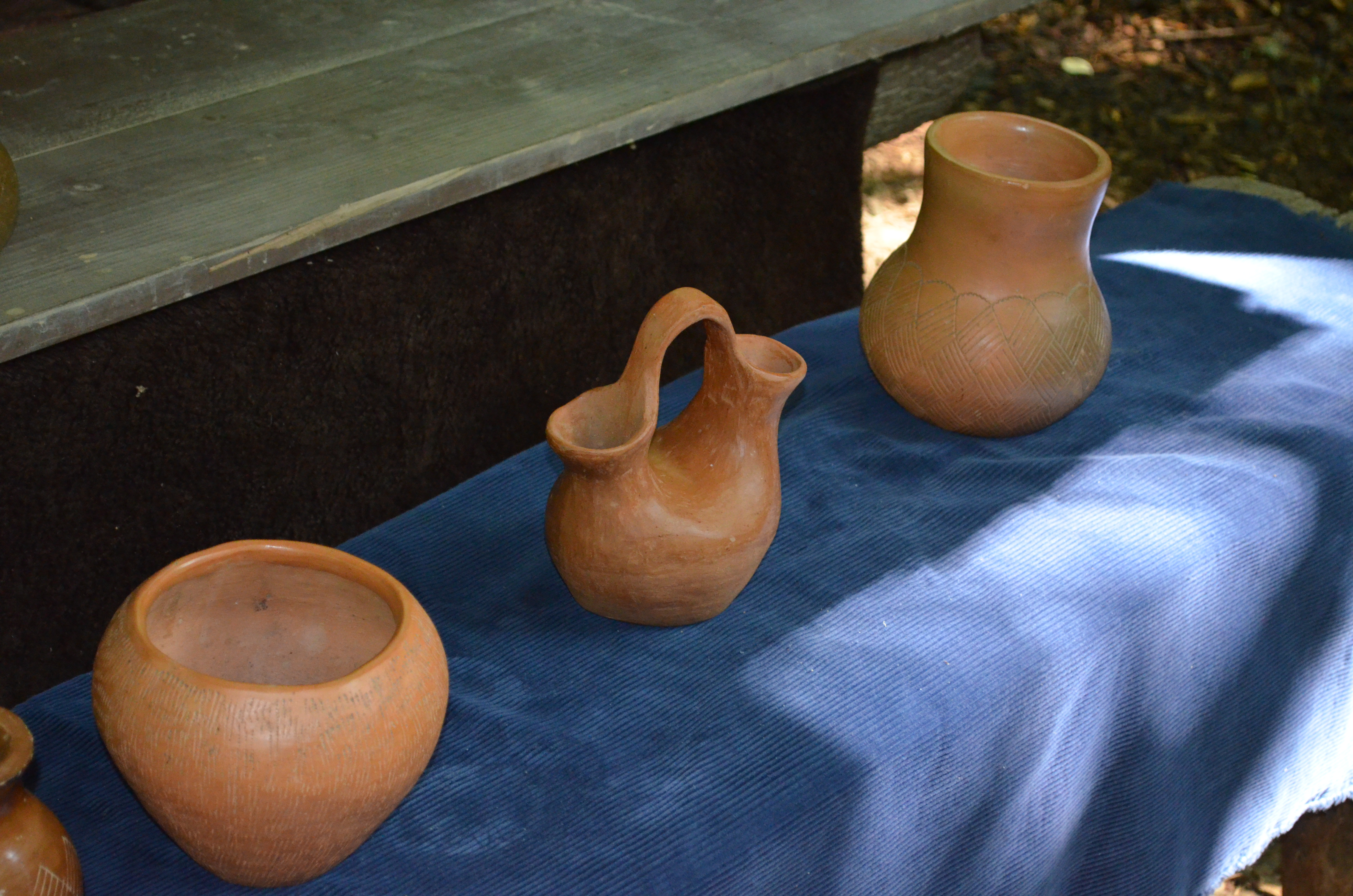
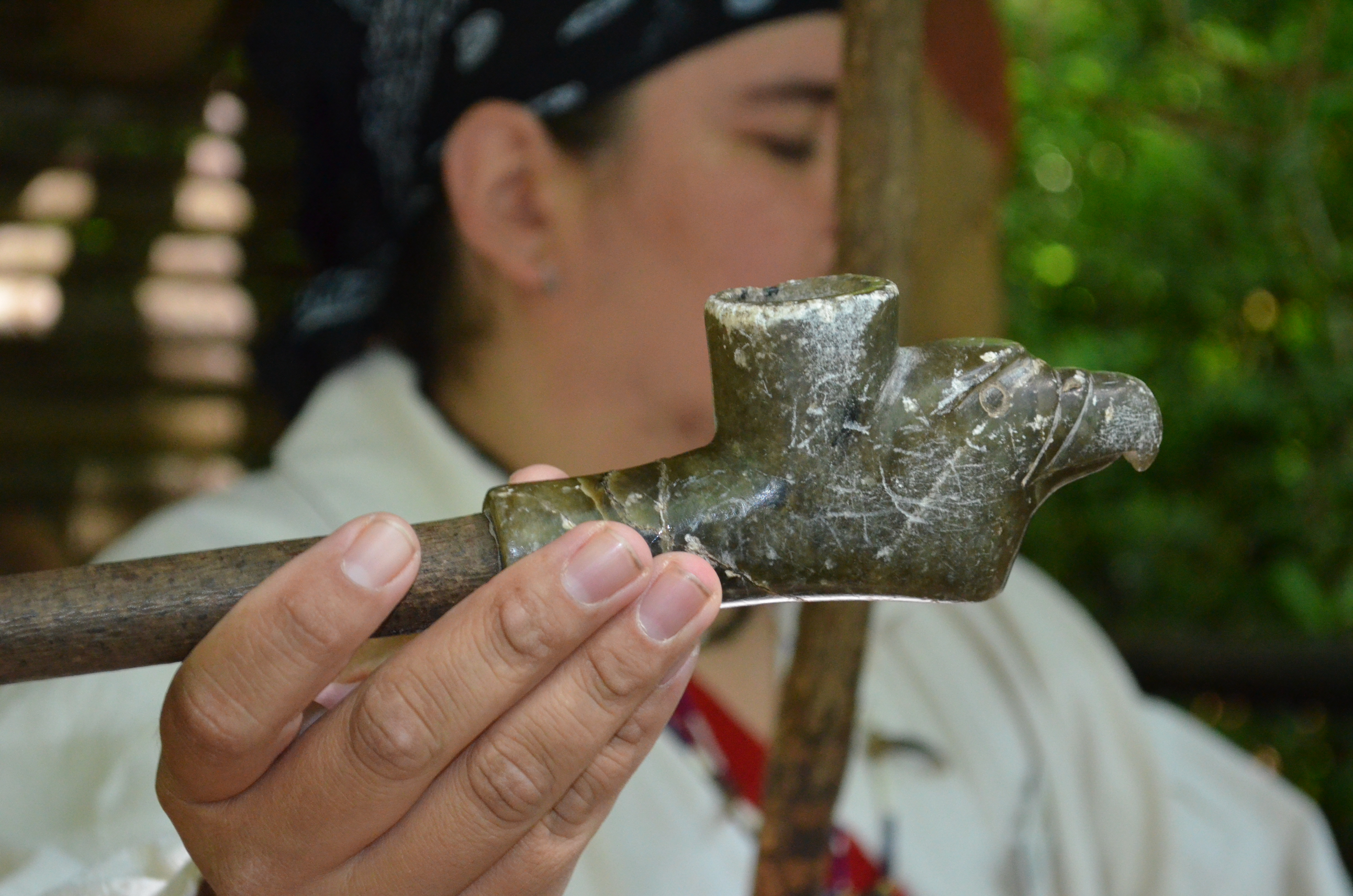
In former times the opening of a clay mine was a great feast day with the Pamunkey. The whole tribe, men, women, and children, were present, and each familv took home a share of the clay. The first steps in preparing the clay are to dry it, beat it up, pass it through a sieve, and pound it in a mortar. Fresh-water mussels, flesh as well as shell, having been burnt and ground up, are mixed with the clay prepared as above, and the two are then saturated with water and kneaded together. This substance is then shaped with a mussel shell to the form of the article desired and placed in the sun and dried; then shaped with a mussel shell and rubbed with a stone for the purpose of producing a gloss. The dishes, bowls, jars, etc., as the case maybe, are then placed in a circle and tempered with a slow fire; then placed in the kiln and covered with dry pine bark and burnt until the smoke comes out in a clear volume. This is taken as an indication that the ware has been burnt sufficiently. It is then taken out and is ready for use. The reasons for the successive steps in this process, even the Indians are unable to explain satisfactorily. The collection above referred to as having been made for the Smithsonian Institution was put on exhibition at the World’s Columbian Exposition. It consists almost altogether of earthenware. Besides the various articles for table and kitchen use, there are in the collection (1) a “sora horse” made of clay, and already described under the head of mode of subsistence, and (2) a “pipe-for-joy,” also made of clay. In the bowl of this pipe are five holes made for the insertion of five stems, one for the chief and one each for the four council men.  Before the days of peace these leaders used to ‘celebrate their victories by arranging themselves in a circle and together smoking the “pipe-for-joy.”  [Photo at right, on display at the National Museum of the American Indian.] The collection comprised also a “dugout” canoe, made of a log of wood, hollowed out with metal tools of white man’s manufacture. Such canoes were formerly dug out by burning, and chopping with a stone axe.

A mortar, used in pounding dry clay as above referred to, could not be obtained for the collection. They are, however, made of short gum logs, in one end of which the basin of the mortar is burnt out. The pestle accompanying it is made of stone.

Of the arts of the white man the Pamunkey Indians have not been ready imitators. There is hardly a skilled artisan among them.

NOTES

1. There are a few Indians (Dr. Albert S. Gatschet found 30 or 35 in 1891) 1iving on a small reservation of some 60 or 70 acres on Mattapony river, about 12 miles north of the Pamunkey reservation. They are thought by some to be the remnant of the Mattapony tribe, but the writer is of a different opinion. He believes that the territory of the Pamunkey once extended from the Mattapony to Pamunkey river, and that the land between gradually passed into the possession of the white man, thus dividing the tribe, leaving to each part a small tract on each of the above named rivers.
2. Historical Magazine (New York), first series, 1858, Vol. II, p. 182
3. Travels, etc., Richmond, 16, 1819, Vol. 1, pp. 147, 148.
4. Lawson. History of North Carolina, reprint by Strother and Marcom, Raleigh, 1860, pp. 366- 369.
5. The writer has been unable to find any statute or judicial decision, fixing the relation of the tribe to the State. What is here stated on this subject is the view taken by the chief and council men of the tribe.

You can download the original booklet here.

Posted in Pamunkey | 6 Comments

The Chowan Indians

Thanks to Fletcher Freeman for contributing part of the following information.  In addition I used resources found in The American Indian in North Carolina (1947) by the Rev. Douglas Rights hosted at http://homepages.rootsweb.ancestry.com/~jmack/algonqin/rights.htm and the book  Villany Often Goes Unpunished, Indian Records from the North Carolina General Assembly Sessions 1675-1789 by William L. Byrd III along with the ever popular Wikipedia .  This article was originally printed in the Lost Colony Research Group February 2011 Newsletter.

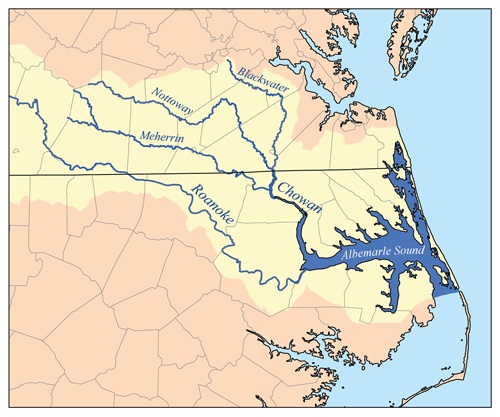
The Chowan Indians were found in North Carolina when Sir Walter Raleigh’s military expedition visited in 1585 -1586.  At that time, they were documented as the “Chowanook”, or Chowanoke.  Later, the name was shortened to Chowan and today, the Chowan River is one of the few rivers left that memorializes a Native tribe on the Eastern seaboard.

According to Ralph Lane, Raleigh’s expedition leader in 1585, the Chowanoke had 19 villages, with the capital being the town of Chowanoke near present-day Harrellsville in Hertford County, NC.  They were the most numerous and most powerful of the Algonquian tribes in North Carolina. Lane described the town as being large enough to muster 700-800 warriors, which meant their total population was likely more than 3000. Another later account by Harriot, from the same expedition, estimated that all the villages could muster 800 warriors. Lane’s account was quite accurate in terms of his description of the town, its location and structures. 

Archaeological excavations at the site of Chowanoke in the 1980s confirmed Lane’s report of its location. The town had been occupied by humans for 800 years, with radiocarbon dating establishing 825 AD as the earliest date of culture related to the Chowanoke.  Including large agricultural fields, the town was a mile long and was home to several hundred Chowanoke people and possibly as many as 2100. It contained a precinct for the ruler and nobility or elite residences, public buildings, temples and burials near the north end of what the archeologists called Area B. This may have been the 30-longhouse cluster observed and reported by Harriot.  Evidence of other residences was found in areas of erosion on the edges of the peninsula.

Other earlier inhabitations were found as well, predating the Chowanoke.

Dr. Richard Dillard has described a shell mound in the former Chowan region:

One of the largest and most remarkable Indian mounds in Eastern North Carolina is located at Bandon on the Chowan, evidently the site of the ancient town of Chowanokes which Grenville’s party visited in 1585, and was called Mavaton. The map of James Winble, made in 1729, also locates it about this point. The mound extends along the river bank five or six hundred yards, is sixty yards wide and five feet deep, covered with about one foot of sand and soil. It is composed almost exclusively of mussel shells taken from the river, pieces of pottery, ashes, arrowheads and human bones . . . Pottery and arrowheads are found in many places throughout this county, especially on hillsides, near streams, etc.

It is probable that diseases from the first English contact, such as measles and smallpox, considerably weakened the Chowanoke, as they did other coastal Carolina  peoples. None had natural immunity to European diseases.

The neighboring Tuscarora, who had inhabited areas to the inland, expelled the remaining Chowanoke from the territory along the river.

In 1607 an English expedition, in the area on orders from Captain John Smith of Jamestown, found that hardly any Chowanoke people were left along the Chowan River. They had been reduced to one settlement across the river in present day Gates County on Bennett’s Creek. 

Several decades later, in 1644 and 1675-77, the Chowanoke had strengthened enough to wage two wars against English settlers. They met defeat each time. After these wars, the English designated the Chowanoke settlement on Bennett’s Creek as the first Indian Reservation in the present-day United States.

On August 27, 1650, a Virginia exploring party set out from Fort Henry to reach the Tuscarora settlements. The company included Edward Bland, Abraham Wood, Sackford Brewster, Elias Pennant, two white servants, and an Appromattox Indian guide. On the way they secured a Nottoway Indian guide named Oyeocker.

Some distance west of Meherrin River they came to an Indian trail. Their narrative states:

At this path our Appamattuck Guide made a stop, and cleared the Westerly end of the path with his foote, being demanded the meaning of it, he shewed an unwillingness to relate it, sighing very much. Whereupon we made a stop untill Oyeocker our other Guide came up, and then our Appamattuck journied on; but Oyeocker at his coming up cleared the other end of the path, and prepared himselfe in a most serious manner to require our attentions, and told us that many years since their late great Emperour Appachancano came thither to make War upon the Tuscarood, in revenge of three of his men killed, and one wounded, and brought word of the other three men murdered by the Hocomawananck Indians for lucre of the Roanoke they brought with them to trade for Otter skins. There accompanied Appachancano severall petty Kings that were under him, amongst which there was one King of a Towne called Powhatan, which had long time harboured a grudge against the King of Chawan, about a young woman that the King of Chawan had detayned of the King of Powhatan: Now it happened that the King of Chawan was invited by the King of Powhatan to this place under pretence to present him with a guift of some great vallew, and they met accordingly, and the King of Powhatan went to salute and embrace the King of Chawan, and stroaking of him after their usual manner, he whipt a bowstring about the King of Chawans neck, strangled him; and how that in memoriall of this, the path is continued unto this day, and the friends of the Powhatans when they passe that way, cleanse the Westerly end of the path, and the friends of the Chawan the other.

And some two miles from the path we come unto an Indian Grave upon the east side of the path: Upon which Grave there lay a great heape of sticks covered with greene boughs, we demanded the reason for it, Oyeocker told us, that “there lay a great man of Chawan that dyed in the same quarrell, and in honor of his memory they continue greene boughs over his Grave to this day, and ever when they goe forth to Warre they relate this, and other valorous, loyall Acts, to their young men, to animate them to doe the like whan occasion requires.”

In 1663 the Chowan entered into a treaty with the English and “submitted themselves to the Crown of England under the Dominion of the Lord Proprietors.” This treaty was faithfully observed for a decade, but in 1675 the Susquehanna War broke out in Virginia. Through incitement of the Indians of Virginia the Chowan violated their treaty. A year of warfare followed with serious loss to the settlers.

The tribe was largely extinct by the late 1600s; with many deaths likely due to diseases, including a smallpox in 1696.

The Chowan were forced to surrender all of their land on the south side of Meherrin River and were assigned a reservation on Bennett’s Creek. Here they struggled along for a hundred years. Many petitions were made to the council for a survey, but nearly fifty years passed before the request was granted. Their lands gradually dwindled from twelve square miles, as first assigned, to six square miles about 1707. At this time they had only one town with about fifteen fighting men.

In March of 1702, the area was beginning to be settled, and a group of settlers petitioned the North Carolina General Assembly, as follows:

Petitioners have right to considerable tracts of land on Bennet’s Creyke now known as Caret’s Creyke via patents and conveyances.  Chowan Indians have their hunting quarters upon petitioners lands and pretend the land is theirs and destroy the stock of the petitioners and burn their houses saying they are under the protection of the English and that no Englishman ought to seat within 4 miles of their town…we implore the Indians lands be laid out for them accoriding to the aforesaid order of coucill and if petitioners hold land within the limits it shall be diserted and left to the said Indians.  Signed by Benjamin Blanchard, John Campbell, Thomas Spivey, Francis Rountree, Robert Rountree, Robert Lacitar, George Laciter, Nicholas Stallings

In 1712 Missionary Giles Rainsford of the English Church wrote:

I had conference with one Thomas Hoyle King of the Chowan Indians who seem very inclinable to embrace Christianity and proposes to send his son to school . . . I readily offered him my service to instruct him myself . . . where I lodge being but three miles distant from his Town. But he modestly declined it for the present till a general peace was concluded between the Indians and the Christians. I found he had some notions of Noahs flood which he came to the knowledge of and exprest himselfe after this manner – My father told me I tell my Son.

Three years later Rainsford reported: “I have been five months together in Chowan Indian Town & make myself almost a Master of their language.” In this same letter he offered to serve as missionary among them.

Chief John Hoyter petitioned the council in 1714 for a survey of the six-mile reservation, stating that the Indians had been “fighting on Eight Expeditions against the Indyan Enemy of this province and during the time they were in ye Countys Service they Suffered Considerable loss in their plantations & Stocks loosing Seaventy five head of hogs a Mare & Colt their Corne destroyed by which ye wearing out of their clothes they are reduced to great poverty, and asked that some allowance be made for their services and losses.”

Apparently the land was surveyed, because in this 1714 petition request to the General Assembly, we find that Chief Hoyter is petitioning on behalf of the Chowan Indians for a resurvey:

John Hoyter Petition for himself and the rest of ye Chowan Indians.  Upon ye humble petition of ye said indians to this honorible board in the time when Honorable Henderson Walker Esq. was president was past that ye governor or deputy should lay out a tract of land for ye said indians of 6 miles square and another order in the time of honorable Landgrave Robert Daniel Esqr persuant to ye order.  In pursuance deputy Gov .Capt Luton came and undertook said survey and did lay out a tract of land but wholly contrary to the intent and meaning of said order for ye petitioners are very confident that ye intent of ye council was that such land should be layd out for them as would produce corn for their support and the petitioners do pray and averr that none other parcel of ye said land in ye said place will produce corn being all pines and deserts so they have not their land according to ye intent and meaning of the board, neither for quality nor quantity it being not near 6 miles squiare.  We pray for relief.  John (I, his mark) Hoyter for himself and the rest of the nation.

In 1718 and 1720 petitions were filed by Chief Hoyter complaining that the settlers were continually intruding upon the lands of the Indians and that the limits of the territory had never been determined. In the former petition he also asked for payment due one of his tribesmen by a settler for an Indian slave of the Core Sound region.

In 1717, Chief Hoyter complained to the governor and council that his people were starving, being kept off their land by the settlers.

According to notes by Fletcher Freeman, the N.C. council set aside the 53,000 acre Indian Woods Reservation in 1723 along the Roanoke River in Bertie County for the Tuscarora under Chief Blount and the Chowan who had sided with the colonists in the Tuscarora War of 1711.

By the year 1731 the tribe had dwindled to less than twenty families.

In 1733, the Bennett name is located on the East side of the Chowan River, but none of the other names mentioned are, including Freeman.

In 1733, just 10 years later, the Chowan and Tuscarora petitioned to merge.  This citation is found in the Minutes of the North Carolina Governor’s council dated April 3, 1733, Vol. 3, pages 537-538 of the Colonial and State Records of North Carolina.    The council authorized the “Suponees “to live with the “Tuskarooroes” and went on to say “ and that the Chowan Indians have leave to live with the Tuscarooroes Indians provide King Blount will receive them.”  This is somewhat unusual since the Chowan were Algonquin speaking and the Tuscarora were Iroquoian, although they were allies during the Tuscarora war beginning in 1711.  However, it appears from the Council records that the Chowan under Chief Hoyter stayed on their Indian town reservation in Chowan County until at least 1751 when they sold their land.

In May of 1733, we find our next document, as follows:

We James Bennett, Thomas Hit(t)er, Charles Beazley, Jeremiah Pushen (Pushing), John Robins, John Reding, Nuce Will, Indians of Chowan precinct in the county of Albemarle in NC for 150# NC money in hand on ? to be paid by Thomas Garrett whereof we the said Indians hereby acquit exonerate and discharge Thomas Garrett, heirs and assigns forever having sold all that part and parcell of land lying in Chowan precinct being part of a patent bearing the date 1724 for land beginning at the mouth of a branch known as Gum Branch up the swamp to a branch to Capt. Aron Blansherds line, along his line to a branch by his plantation at a bridge then from thr bridge along the path to the Gum Branch then down the branch to the first station containing 400 acres and we the said indians (names repeated) have good right and lawful authority to sell….bind ourselves for 1000#.  Signed James Bennett, Thomas Hitter, Charles Beazley, Jerrmiah Pushing, John Robins, John Reding, Nuce Will, in the presents of Michael Ward, Henry Hill May 20 1733

In September 1733, the Chowan are leasing their land. 

James Bennett, Charles Beasley, Thomas Hittor, Jereme Pushen, Thomas Pushen, John Reding of Chowan precinct to Thomas Tailor of Chowan let to farm Thomas Tailor 100 acres lying between the Myrey branch and the Poplar branch upon the pocoson side lying (torn) Chowan precinct belonging to the Jowan indians called the Rain Gras neck with land  and all the profetes and preveledges there unto belonging to said Thomas Taillor from Sept 10 full term 13 years.  Two yeares went free firm and fully completed and ended yealding and paying unto said indians aforesaid the rent or sum of 250# tobacco to them and asignes to be paid yearly after 2 years rent free now to the performance of these artikles and 200 pounds to be paid upon the nonperformance of this agreement.  And if sold Thomas Taillor to have the refuse of ye said land.  James Bennet, Charles Besly, Jereme Pushing, John Freeman, Walter Droughan, William ?, John Reading.  There appear to be no witnesses.

Note that in this instance, John Freeman seems to be included at the end with the Indians, but not in the first sentence.  The same situation occurs with Walter Droughan and William ?, and Thomas Hittor who is in the first sentence is missing from the last reference. 

On January 30,  1734, the Chief Men of the Chowan, petitioned the North Carolina Assembly regarding the abuses against their people.  Petitioners were Thomas Hoyter, John Robins, John Reading, Neuse Will, James Bennett, Charles Beasley and Jeremiah Pushing.

Later, in 1734, the Chowan Indian chiefs, James Beard, Tomas Hoyter, Charles Beazley and Jeremiah Pushing sold land to John and Tabitha Freeman (Chowan Deed book W-1 p 216). 

In April 1734, the Chowan sold land to Thomas Garrett.  The deed from James Bennett, Thos. Hiter, Charles Bearley (sic, probably Beasley), Jeremiah Ruffin, John Robins, John Reding, Hull Will, Indians of Chowan Precinct in the County of Albemarle to Thos. Garrett of the same precinct and county for land in Chowan Precinct, part of patent dated 1724 on Gum Br., bordering Capt. Aron Blansherds (full description is included). 7 Apr. 1734. Witnesses Mitchell Ward, Henry Hill.

All grantors signed with a mark, except Hull Wills.

In 1751, the headmen of the tribe, James Bennett and John Robbins, Indians, and John Freeman, planter sold the Chowan land to Richard Freeman, in the following deed:

Chowan County – To all to whom these presents shall come we James Bennet & John Robins Chowan Indians & John Freeman Planter of the County and Province aforesaid Know Ye that we the aforesaid James Bennet, John Robins  & John Freeman for and in consideration of the sum of Twenty Pounds Lawfull money of Great Britain to us in hand paid by Richard  Freeman of the county and Province aforesaid, Planter, the receipt of which we do hereby acknowledge have granted bargained sold  conveyed confirmed & deliver and do by these presents grant Bargain Sell Convey Confirm and Set Over unto the aforesaid Richard Freeman one certain tract or parcel of land &  pocoson lying on the No. side of Bennets Creek commonly called & known by the name of the Chowan Indian Land Two Hundred acres by Estimation beginning on Blanchards Line running then west … together with all and singular the appurtenances thereunto belonging unto the said Richard Freeman, his heirs and assigns forever hence they yielding and paying  to our Sovereign Lord  the King the yearly quit rents of and by(?) required for every hundred acres hereby granted by the said James Bennet, John Robins and John Freeman as aforesaid to the said Richard Freeman his heirs..the aforesaid James Bennet, John Robins, & John Freeman and do bind ourselves and each of our heirs and by these presents to forever  warrant and defend unto the said Richard Freeman his heirs and the above mentioned tract or parcel of land and pocoson from all manner of persons whatever…whereof we the aforesaid Ja. Bennet, Jn Robins Chowan Indians and John Freeman, Planter have hereunto set our hand and seals this — of January, 1751

Signed & Sealed & Delivered in the presence of Richard Garret, Reuben Hinton, George S. Outlaw – Chowan County  for January County Court 1751

These may testify that the within Deed of Sale of Land from James Bennet, John Robins, & John Freeman to Richard Freeman was duly proved in open Court by the oath of Richard Garret and on motion is ordered to be registered.  Registered January 23, 1751

Signed Sealed & Delivered in the presence  of:

Richard Garret                    James B. Bennett

Reuben Hinton                     John R. Robins

George S. Outlaw                  John Freeman

Chowan County       January County Court 1751

Present His Majesties Justices These may codify that the within Deed of Sale of Land from James Bennet John Robins & John Freeman to Richard Freeman is hereby proved in open Court by the oath of Richard Garret & on Motion is ordered to be Registered.  Registered Jan 23, 1751

It is unclear from this extraction whether or not James Bennett or John Robins could sign their names, but I strongly suspect from the B. initial and the R. initial above, that these were not initials but “marks” made by the native men.  In this timeframe, European men by and large did not have middle names.  These men were clearly stated to be Indians.  John Freeman, on the other hand, appears to have signed his name and was not stated to be an Indian.  I wonder what his relationship to the Chowan Indians was.  Did he marry a female of the tribe?  And how was Richard Freeman related to John?

Fletcher Freeman believes that Tabitha, the wife of John, was a Native female, possibly the daughter of Chief Hoyle.  She could well have been, but there is no proof of such.  One possibility is that Chief Hoyle had himself become Christian (given the 1712 record) and with him, his children, including Tabitha, who would also have been given a Christian name upon baptism.  This would have enabled her to marry John Freeman, as he would not have been marrying a “savage”

Fletcher Freeman found records indicating that John Freeman was a reader at the Indian Town Chapel  in 1733 and again in 1743.  Interestingly, Edward Mosley who drew the famous Mosely Map of 1733 was also a member there and had been Thomas Hoyter’s attorney in 1723 according to the North Carolina Records.  Another member of Indian Town Chapel was Tom Blount, probably the man after whom Tuscarora Chief Tom Blount named himself, signifying kinship.  If this is not the case, how did John Freeman come to be listed with the Chowan Indians, although one deed record is somewhat ambiguous with his name omitted in one listing and included in another in the same document?  It is possible that he was a witness, not a conveyor in one deed, but in the second deed, he is clearly a conveyor.

In 1752 Bishop Spangenberg wrote from Edenton, “The Chowan Indians are reduced to a few families, and their land has been taken away from them.”

Due to colonists’ encroachments and violations of treaties, by 1754 only two Chowanoke families: the Bennetts and the Robbinses, remained in the Bennett’s Creek settlement.

A report of Governor Dobbs in 1755 stated that the tribe consisted of two men and five women and children who were “ill used by their neighbors.”

Bennett and Robbins males served in the Revolutionary War.  By 1790, European guns and disease was reduced the Chowan from thousands to a handful of people.  Their leaders had European names.  John Robbins was one of them and a lovely website documenting his family is found here – http://www.roanoke-chowan.com/Stories/MarvinTJonesStories/AChowanokeFamily.htm

During a sale of Chowanoke land in 1790, it was written that the Chowanoke men had died, “leaving a parcel of Indian women, which have mixed with Negroes, and now there are several freemen and women of Mixed blood as aforesaid which have descended from the s[ai]d Indians.”

In the 1790 census, there are two Robbins and two Bennett families listed as “free people of color” in Gates County, but none of the other surnames mentioned above as Native are found in that location.  In Tyrrell County, an Elizabeth Will is found, but the rest of the surnames seem to have disappeared.

By 1810, only Robbins families were left at the Bennett’s Creek settlement. They seemed to have assimilated by 1822, having dispersed and married their more numerous white and black neighbors.

Many Robbinses migrated to the free states of Ohio and Indiana after Nat Turner’s Slave Rebellion of 1831.

Noah Robbins stayed, but he was classified as “colored” in the fear-born backlash from the failed 1831 rebellion and possibly to remove any residual treaty obligations.  All colored, even if they were born free as Indians, were required to register and carry their “paper”, as follows, at all times.

“State of North Carolina, Gates County August Court of Pleas, 1831…

..It was then and there ordered that the Clerk of said Court should [grant] to the said Noah Robbins a certificate certifying that he is a free man of colour and a native of said County and there in entitled to all rights and privileges of free persons of colour. Given under my hand and seal of office the 25th day of August Anno Dom 1831.”

Some of the Bennetts moved further south in Anson County, North Carolina with Native American trading families. Their descendants can be found there; some are members of one of the several Pee Dee Indian tribes.

One group of Robbinses remained intact. They first moved to Colerain in Bertie County, downriver on the Chowan. Many Robbins family descendants have since become members of the Meherrin tribe, based in Hertford County.

Fletcher Freeman mentions that he has seen another record that indicates that at least some of the Chowan merged with the Meherrin.  He feels this makes more sense because both were Algonquian speaking and both lived near each other on the Chowan river. 

Sadly with the end of these records, the Chowan disappear from the historical records, as Indians. 

We don’t have any known descendants of any of these Chowan surnames who have taken the Y DNA test.  Looking through the projects, there are no Native haplogroups for any of these surnames except for one Beasley gentleman from Texas and Freeman from Texas, Tennessee and Virginia.  There is no indication that any of these individuals are from the Chowan families.

A Lost Colony DNA project member who does descend from the John Freeman family of Gates County is haplogroup R1b1b2, a European haplogroup, which is exactly what we would expect to see from a European man who married a Native woman.  If they had daughters, and someone descends through all females from a daughter, indeed, we could test their mitochondrial DNA to see if Tabitha was a Native Chowan woman.

Posted in Chowan | 138 Comments

Who Am I Related To? – Using Family Tree DNA’s Tools to Compare Within Projects

While this may not seem like a Native topic, it is.  I am the volunteer administrator or co-administrator of several DNA projects that are either focused on or include people with Native heritage.  The goal of DNA testing is to find out and document your heritage and part of that is discovering who you match and what kinds of information they might have that could be useful to you, and vice versa, of course.

One of the most common questions I receive is how to figure out who you’re related to within projects.

For example, the Cumberland Gap project is massive with over 4000 members.  In the past, people would go and look at the project page to see who they are related to, but with over 4000 people, that’s just impossible. Not to mention that as an administrator, I have to group them all individually, by haplogroup, and given that takes a minute or so each, that equates to over 66 hours, which I simply don’t have.  So, participants need to use tools to see who they are related to.  Thankfully, Family Tree DNA provides those tools.

First, sign on to your personal page.  You can see who you are related to in any project by using the Advanced Matching tool that is available for Yline, mtDNA and Family Finder results.

Click on Advanced Matching.  You will see several options.

First, select the type of test you’re interested in matching.  If you’re interested in only the Family Finder test, then just select that one.  If you’re interested in seeing who matches you BOTH on Family Finder and your Yline, then select Y-DNA 12, where there are generally more matches than at higher levels, plus the Family Finder, then click the box that says “show only people I match in all selected tests.”  As you can see, by using combinations, this is a very powerful tool.

In addition to the tests, you can also select how to compare your data.  You can compare to the entire data base, or you can compare to only people within certain projects.

For this example, I’m going to compare my results with the entire data base, asking for anyone who I match on Family Finder and on the HVR1 region of my mtDNA as well.  You can see my selections below.

Hey, look, I have one match.  That means that she may be related to me on my maternal line.  I hate to run, but I need to e-mail this person and see if we can find some common genealogy, or maybe just some common geography on my mother’s side.  Wow, the power of DNA combined with the right tools….amazing!!!  Happy hunting.

If you’d like to take a DNA test, click here.

Posted in DNA | 3 Comments

Cape Fear, Machapunga, Coree, Tuscarora and Mattamuskeet Indians

James Sprunt, born in Glasgow, Scotland in 1846, was an entrepreneurial cotton merchant, author, philanthropist and a major figure in Wilmington, North Carolina from the time of the Civil War until his death in 1924.  Active in the N.C. Literary and Historical Association and the North Carolina Folklore Society, Sprunt completed several volumes of memoirs and wrote extensively on local history.  He endowed several publications through the University of North Carolina. His most important book, “Chronicles of the Cape Fear,” published in 1914 and substantially revised in 1916, remains an important source for the region’s colonial history. His other books include “Tales and Traditions of the Lower Cape Fear”, published in 1896, and “Tales of the Cape Fear Blockade.” “Derelicts,” his account of Civil War blockade running, was republished in 2006 by Dram Tree books of Wilmington.

In his book, Tales and Traditions of the Lower Cape Fear, James Sprunt shares a story about the Cape Fear Indians beginning on page 54.

Cape Fear Indians

By James Sprunt

It is an interesting fact that the descendants of these Indians live in the same locality to the present day, and illustrates an unusual condition – the amalgamation of white, black and Indian races.  The Indian characteristics, however, predominate.  The men are thrifty, industrious and peaceable: engaged principally in fishing during the shad season and in cattle raising upon the same range that was occupied 200 years ago by their savage ancestors.

Large mounds of oyster shells, many pieces of broken wicker pottery, arrow heads and other relics of the red men are still found on the peninsula below Carolina Beach.  During the late war these remains of an Indian settlement were frequently unearthed by the Confederated engaged up on the entrenchments around Fort Fisher and here are buried the last of the Corees, Cheraws and other small tribes occupying the land once inhabited by the powerful Hatteras Indians.  They were allies of the Tuscaroras in 1711 and in an attack upon the English suffered defeat, and have now disappeared from the earth and their dialect is also forgotten.  The Hatteras tribe numbered about 3000 warriors when Raleigh’s expedition landed on Roanoke Island in 1584, and when the English made permanent settlements in that vicinity 80 years later, they were reduced to about 15 bowmen.  The Cape Fear Coree Indians told the English settlers of the Yeamans colony in 1669 that their lost kindred of the Roanoke colony, including Virginia Dare, the first white child born in America, had been adopted by the once powerful Hatteras tribe and had become amalgamated with the children of the wilderness.  It is believed that the Croatans of this vicinity are descendants of that race. 

Note:  The Fort Fisher State Historic site (red balloons), near Wilmington NC, is open to the public, and Carolina Beach is noted on the map below as well. 


You can read more about Fort Fisher at http://www.nchistoricsites.org/fisher/fisher.htm

The map below shows the Fort Fisher site in relation to Roanoke Island where Manteo is located on the upper right.  Hatteras Island, where the Croatoan Indians were known to live, and where the colonists indicated on the fort post on Roanoke Island was their destination, is the triangle shaped island where the Outer Banks Island chain bends westward, to the right of Okracoke, shown by the red arrow below.  Lake Mattamuskeet is shown by the yellow arrow.

We know that the Mattamuskeet, the Machapunga, the Cape Fear and the Corree Indians were living and moving along the eastern Carolina seaboard.  They are found from the Alligator River in Albemarle Sound southward to Cape Fear.  We know that these tribes and the Tuscarora were eventually relegated to the Lake Mattamuskeet area, but from historians like Sprunt and other records, we also know that many remnants did indeed survive, and not necessarily at lake Mattamuskeet. 

The primary Tuscarora Towns in the early 1700s were located between Greenville, Farmville and Winterville, shown with the blue arrow.  During the Tuscarora War, some Tuscarora fought against the settlers, some were neutral, and some were allies of the English.  After the War, the Tuscarora who remained in North Carolina were sent with the other remaining tribes to the Lake Mattamuskeet Reservation, shown with the yellow arrow above. Lake Mattamuskeet and the surrounding area became the ultimate “mixing bowl’ for the eastern North Carolina tribes in the first half of the 18th century.

In 1718, the Tuscarora were given their own reservation which by 1722 was known as “Indian Woods”, in Bertie County, noted above by the green arrow.


Posted in Cape Fear, Coree, Machapunga, Mattamuskeet, Tuscarora | 1 Comment

Visiting the Eastern Cherokee on the Qualla Indian Reservation in Cherokee, NC

Today was a wonderfully inspirational and educational fun day.  Come on along!!  We’re visiting the Eastern Cherokee Tribe on the Qualla Reservation.  You can read about them here:  http://nc-cherokee.com/ 

Here’s the tourism site:  http://visitcherokeenc.com/

Drove over the Smokies from Gatlinburg to Cherokee, NC.  Nothing on the TN side of the mountain looks anything like I remember it.  Gatlinburg was always commercial, but nothing like Pigeon Forge is today.  Wow.  Unrecognizable.  But once you cross the line from Gatlinburg to the National Park, it changes immediately and becomes peaceful.  It’s really a good thing they made it a park, otherwise it would all be developed.

Flowers blooming along the road, above.

On the NC side, the park abuts the Cherokee Indian Reservation.  You’d never know you were on a reservation if you didn’t know. It doesn’t resemble the western reservations whatsoever.  This just looks like a normal Appalachian town, with a focus on Native culture, of course.

I visited three locations, in addition to several stores.  The first was the reconstructed Indian Village.  This was simply pure joy.  The people here were exceptionally friendly and were all Native people living on the reservation today.  They were anxious to share about their culture and heritage.  My hour visit quickly turned into more than half a day and includes lots of extras.  They were very generous with their time.

Here is the village link, but I’ll tell you, this does not even begin to do it justice.  If you have to select just one thing to do in Cherokee, this is it!

http://visitcherokeenc.com/attractions/the-village/

The village is a reconstructed historic village, to scale, which includes several houses where traditional crafts and activities are being practiced.  In addition, there is a council house and a traditional town center where dancing occurs.

I went to the village first hoping to avoid the heat that was sure to be present in the afternoon.  Tribal members there doing traditional things like beads, pottery, carving, basketmaking, etc. 

The next photos shows the undercoat of a buffalo having been woven with beads during the weaving.  This was extremely soft.  I never thought of a buffalo being soft, but these are.  The mountain bison were smaller than western buffalo and became extinct in the 1790s.

Today the beadworkers use contemporary beads like the rest of us, but traditionally the cornbead was used.  It grows on a plant called the cornplant and it is hard when harvested.  There are some traditional beaded items, before the advent of European beads.  The cornbeads are the grey stand near the left.

Pottery of course was a village staple of all Native people.  Pots were used for everything from carrying water to cooking to being decorative and celebratory, like with the marriage vessel below.  The bride and groom would each drink from opposite sides, then the pot would be broken.


The carvers were quite interesting.  Everyone here knew a great deal about their history and heritage.  These men carve wood, bone and even feather shanks.  Notice the beautiful masks, below, one with a copper gorget.  The shells shown below are not carved.  They are crushed and used in the whitewash for their body paints.  On the coast, they aren’t used this way.  The difference in both use and culture was very interesting.

 The pipe below is carved in the shape of an eagle.

The prepwork involved in basket-making and weaving is unfathomable.  By the time they begin the basket itself, much of the work is done.   Some baskets are actually watertight.

If I ever thought I wanted to do basketwork, this cured me and instilled a great respect for those who do.

The flintknappers were very interesting.  Of course, most of the food supply was dependent on arrowheads.  Some were squared off and some were round.  The ones meant for food were rounded at the shank so they could be pulled out.  The squared ones were meant for enemies and removing by pulling them out wasn’t possible.  The man below is knapping flint by knocking off the edges to achieve a sharp blade type edge.

This man also demonstrated the use of a blowgun.  Poisons weren’t used, because the animal was to be used for food.  He was quite accurate. 


Above the village on the mountainside is a botanical gardens.  This was a lovely half hour hike.  You cross several streams and they also have a homestead with a Native garden.  The stream crossing below is not a bridge, but a walk across the stream itself.  Very unique.

In spite of the heat, there was lots of moss growing in the cooler forests.

In a clearing, but really almost undetectable, was a small dwelling surrounded by Native food and medicinal plants.

As I was descending, the dancing and drumming was beginning, and listening to the vocables alone in the forest was a very spiritual experience.  It was easy to reach back in time to how it would have been long ago. 

The dances they performed are not powwow type of dances, which is what I expected and am familiar with.  These are called traditional dances.  They emulate natural things.  One is the corn dance which is about gathering corn, one is the bear dance and one is about a confused fowl of some sort, but quite funny as he struts around trying to impress the females of his species.  These were obviously for fun, and except for the heat, the performers were having fun dancing.

I found the traditional dancing very interesting.  It’s not the same as powwow dancing, not at all.  What fun.  Took lots of photos.  When the dancing started, I was up on the mountain in the botanical gardens and hearing the dancing, alone in the woods was quite moving.  Harkened back to another time and place.  I do love the vocables.  Because you don’t understand the “words” you respond to the very beat of the earth.

After the dancing, they offered a lecture from one of the Beloved Women in the Council house and that was very interesting.  She is shown above dancing with the purple apron.  She explained how the council house was divided into 7 sections for the 7 clans, and how their tribal government worked.   

She told me afterwards that when the Cherokee took refuge in the mountains, pre-contact, they were known to the other tribes as the “white Indians” because their skin was lighter, their hair curly and they were taller.  Interesting.

In the photo of the inside of the Council House below, the mound in the lower center which is about 3 feet high is the eternal fire.  Each year the women extinguish their fireplace fires and clean out the fireplace and them come to the Council House and get a new fire.  The fire in the Council House is never allowed to go out but the ashes are removed once a year as part of the renewal ceremonies.

The Eastern Cherokee tribe’s current blood quantum requirement is 1/16th.  Many have been quantumed out. 

I spent quite a bit of time there visiting.  From there I went to the museum, which was OK, but not remarkable, especially not after the village.  The thing I found moving in the museum was a lifesize mural of the Trail of Tears.  The museum in Talequah in Oklahoma has something similar as well.  The individual and tribal pain of this genocidal action, not only for the Cherokee, but all of the organized tribes that were removed were almost unfathomable, especially after they trusted the whites.  Would the betrayal ever stop?

From the Museum, I went across the street to the handcraft store.  I had purchased a beautiful small carved bone eagle from the carvers in the village, so I passed on items in the store, but they were certainly beautiful.  Not all are Cherokee though.  I visited a  few more stores, a bookstore, Talking Leaves, which was nice, a Cherokee coffee shop and a rock store off the res along the road.  I passed on the casino, although I understand the shops in the casino hotel are nice too.  I was glad that I spent most of my time in the village with the people and the handcrafts.  It was a lovely day and I’d certainly stop to visit again.  The people were most gracious and sharing.

The photo below is from the museum and serves to represent two different perspectives within the historical Native community.

Posted in Cherokee | 11 Comments

A Report of Research of Lumbee Origins by Robert K. Thomas

Robert K. Thomas was hired by the Lumbee Regional Development Association, apparently in the 1970s.  The report was completed sometime after 1976.  It is not readily available.  In June of 2012, I visited the Wilson Library in Chapel Hill and photographed the entire report.  The following information was at one time available on a Lumbee webpage and is now only available as a cached copy.  The website it no longer in existence, unfortunately, although it was at  http://linux.library.appstate.edu/lumbee/16/THOM001.htm and may reappear at some future time.  It was copyrighted to Glenn Ellen Starr Stilling, but I have not been able to locate this individual.  It was a wonderful website and its loss, if permanent, is profound.

At the present time, by Googling the word grouping “copyright © 2002-2007, Glenn Ellen Starr Stilling” you can find several of these archived pages which include such things as Native herbal medicine and more.

I am repeating it here, exactly, except for a couple of my notes in brackets [].  I will in future blogs quote several sections from Thomas’s report verbatim.

Thomas, Robert K. “A report on research of Lumbee origins.” Unpublished manuscript, 1976?  71 pages.

Access: The only publicly available copy is housed at the North Carolina Collection, one of the University of North Carolina at Chapel Hill’s libraries.  The report is noncirculating (i.e., it cannot be checked out or borrowed through interlibrary loan). A photocopy of the report can be obtained for purposes of research and scholarship from UNC Library Photographic Service for approximately $19.60 (check with the library for current cost).  [Note, as of 2012, the library will not photocopy or otherwise distribute this report, including interlibrary loan.  You must visit the library in person.]

Publication type: Report (unpublished)

Introduction

Thomas begins by saying that he is submitting this confidential report to Lumbee Regional Development Association (LRDA) rather than writing an article for the Smithsonian because he has only a “limited amount of data,” most of it “indirect evidence” (p. 1).  Because of the “big furor in Robeson County about Lumbee origins and about the correct tribal designation for the Lumbee people” in recent months (p. 1), Thomas did not want to exacerbate the situation “by publishing a premature article which did not have the ‘iron-clad’ evidence needed to make a definitive scientific and historical argument” (p. 1).  Following this caveat, he discusses and evaluates each of the hypotheses for Lumbee origin, beginning with Hamilton McMillan’s Lost Colony theory

Lost Colony Theory (Hamilton McMillan)

Thomas’s opinion is that (1) the similarity of Lumbee surnames to those of the Lost Colonists, (2) the archaic dialect spoken by the Lumbee people McMillan talked to in the 1880s, and (3) the tradition of the Lumbee at that time that they had once lived on the coast of North Carolina and migrated inland amount to “very slim evidence of a Lost Colony connection” (p. 3).  Thomas adds that the Lumbee probably were not “in place” in Robeson County until the 1770s (rather that the 1730s, as McMillan initially claimed) and that McMillan was more interested in accounting for the white blood in the Lumbee than in figuring out the Indian roots. 

Cherokee theory (Angus W. McLean)

Thomas then discusses Angus W. McLean’s theory that the Lumbee are descendants of the Cherokee. Thomas asserts that “there is no evidence whatsoever that Cherokees ever got as far east as Robeson County” (p. 6) and believes that the Lumbee picked up the Cherokee-origin idea from local whites in the first half of the 1800s (p. 6).  He offers several reasons why the Robeson County environment would have been unattractive to Cherokees and surmises that McLean may have meant to say Cheraw and simply got the names confused.  Thomas calls the hypothesis that the Lumbee are descendants of the remnants of several Siouan tribes “a pretty good guess” (p. 8), since there is “no direct evidence for the hypothesis” (p. 8). 

Tuscarora theory (Mary W. Norment)

Thomas believes that the Tuscarora theory of tribal origins is based solely on evidence in Mary Norment’s book on the Lowery Gang, The Lowrie history (see item 1083).  Norment gives detailed accounts of the history of the Lowery family and of Robeson County Indians, presumably based on conversations with elderly people (in the 1880s) who knew the Lowerys well.  Norment speculates that Robeson County Indians are a combination of Indian, black and white (p. 8).  In the first edition of her book she uses the term “mulatto” and does not speculate on the tribal origins of the Indian blood.  In a later edition she drops the term mulatto, mentions Portuguese as part of their background, and adds that many early Robeson County Indians were part Tuscarora (p. 9). Thomas notes that W. McKee Evans used Norment’s book as a source for his book,To die game (see item 1118), furthering the Tuscarora identification.  Although some Tuscarora say that “a few Tuscaroras were left behind in North Carolina,” Thomas doubts that the Lumbee are descendants of Tuscaroras (although he says it is “within the realm of possibility”) (p. 10).  Thomas became less convinced by the Tuscarora hypothesis as he read and thought more about Lumbee origins, although he believes North Carolina’s Haliwa Indians may be partly descended from Tuscaroras.

Waccamaw theory (Wesley Taukchiray)

Thomas discusses a more recent theory of Lumbee origins based on Wesley White’s (now Wesley Taukchiray) research.  White found a map showing a village of Waccamaw Indians on the Lumbee River, a few miles west of the  present-day town of Pembroke, in 1725.  He also found a document written by Colonel Rutherford, head of the Bladen militia (Robeson County was then part of Bladen County) in 1754, referring to a “mixed crew” living on Drowning Creek as lawless, violent squatters (that part of the Lumbee River was called Drowning Creek in those days).  White believes that Waccamaw Indians left South Carolina in 1718, had established their village west of Pembroke by 1725, and were the “mixed crew” referred to by Colonel Rutherford in 1754. Thomas disagrees with his analysis of the evidence, however.  Thomas thinks the “mixed crew” were not ancestors of the Lumbee.  He thinks “mixed” does not mean “racially mixed,” or the term mulatto would have been used.  Rather, he thinks the phrase refers to highland Scots who had migrated from Fayetteville to Laurinburg and then to Drowning Creek.  They seemed “mixed” because they were probably speaking Gaelic as well as English.  He adds that Michelle Lawing’s research (see item 562) did not find any present-day Lumbee surnames in Bladen County in the 1750’s. [Note: Lawing’s report is dated 1978, but Thomas refers to her research. He may have had access to it before her report was officially submitted.]

Tri-racial isolates and refugee communities

Thomas then discusses two hypotheses of Lumbee origin that were not put forth by historians and anthropologists.  The first came from Edward Thomas Price, who did his dissertation on mixed-blood communities in the Eastern United States (see The Lumbee Indians: an annotated bibliography, item # 705).  According to Thomas, Price believes the Lumbee “are basically the descendants of an old strata of free blacks which came into being before the Revolution, who have absorbed a lot of white blood over time and a small but incidental amount of Indian blood” (p. 14). Thomas points out what he feels are flaws in this hypothesis.  The second hypothesis put forth by non-historians and non-anthropologists  is the idea, promoted by some sociologists and demographers, that the Lumbee and similar Southeastern communities are “refugee communities which are formed by social deviants clustering up together—free blacks, loose Indians, Latin sailors, whatever” (p. 18). Thomas does not agree with the hypothesis that the Lumbee grouped and stayed together because of the racial caste system in Robeson County which assigned them to a middle ground between whites and blacks. He believes that a caste system hardly ever established a new community of people.  It may develop a group of individuals who share the same rank, but it wouldn’t cause them to form a social group.  Thomas adds that the racial caste system in the South didn’t begin to develop until 1800, with the laws which moved it along being passed in the 1820’s and 1830’s.  The Lumbee, and other “tri-racial isolate” communities, formed much earlier.  Calvin Beale (see The Lumbee Indians: an annotated bibliography, items # 708 and 716) and Brewton Berry (see The Lumbee Indians: an annotated bibliography, item # 711) wrote about this triracial isolate and caste system hypothesis.

Lumbee oral traditions of migration

Thomas, in his research, thought about four different migration patterns in the Carolinas, including Wesley White’s (now Taukchiray) historical sketch on Indians of North Carolina during the first half of the eighteenth century and Michelle Lawing’s genealogical research.  Thomas feels his main contribution to research on Lumbee origins has been to analyze Lumbee oral history—the people’s own accounts of their origins.  Besides studying the oral history accounts used by Hamilton McMillan and Angus McLean between 1880 and 1915, Thomas interviewed older Lumbees (including Jim Chavis) and studied oral history accounts collected by Lumbee Regional Development Association (LRDA).  From his careful analysis of these statements (cross-checked with maps and historical records from the 1700’s), Thomas discovered three tribal traditions. 

Hatteras Indians

The strongest one was Lumbee descent from Hatteras Indians. Thomas says that what was known of them at the time of his research was that they lived at Cape Hatteras and were a very small tribe (only a dozen families in the early 1700’s). They were still at Cape Hatteras in 1754, but an account from a missionary in 1761-63 placed then near Lake Mattamuskeet in Hyde County, N.C., living with the Mattamuskeet Indians.  There are no references to them after that.  By tracing family names Thomas believes one can follow Lumbee families from Lake Mattamuskeet to the Neuse River to the Black River to the Cape Fear River to Robeson County.  He points to the Lumbee tradition, up until World War II, of going to the coast every summer and camping for two or three weeks to fish.

Cheraw Indians

The second tradition Thomas found was descent from the Cheraw Indians around Cheraw, South Carolina.  Some of the Chavis families among the Lumbee are descended from Ishmael Chavis, who came from the Cheraw area.  Claude E. Lowery, a local historian, believes that many of the Lumbee families in the Red Springs area came into Robeson County around 1820-1830 from Cheraw, S.C.  The Lumbee have a tradition that many of their ancestors fought with Barnwell against the Tuscarora in the Tuscarora War.  Since Barnwell’s army was composed predominantly of South Carolina Indians, particularly Cheraw, this would fit with Cheraw origins for the Lumbee. 

Saponi Indians

Another oral tradition in Lumbee descent from the Saponi, but Thomas considers this theory the weakest.  It comes from writers who stated that Lumbee elders said they came from “Roanoke in Virginia,” which McMillan took to mean Roanoke Island.  McMillan said he had discovered that Lumbee elders called the Pamlico Sound area Roanoke.  Thomas doubts that they would have called Pamlico Sound “Roanoke in Virginia,” however.  The other possibility is that by Roanoke the Lumbee meant the Roanoke River region, which in early times was in Virginia but later was just over the border in North Carolina.  The Saponi always lived on or near the Roanoke River.

Migration from Edgecombe/Granville Counties

Thomas then puts these oral traditions together with Wesley White’s and Michelle Lawing’s research. Lawing discovered that in 1750 a cohesive social group of 25-40 families with some of the surnames now found in Robeson County was living in Edgecombe and Granville Counties, North Carolina.  Most were listed on legal documents as mulattos, meaning one White and one nonwhite (either Black or Indian) parent.  Thomas believes the cohesion in the group developed because they considered themselves Indian.  Since the area was a frontier in 1750, it was socially fluid, permitting racial intermarriages.  Thomas believes the group was a concentration of refugee Indians from Virginia as well as from areas to the east in North Carolina.  The Indians were remnants of three small groups— the Yawpim and Potoskite of northeastern North Carolina, and the Nansemond of Virginia.  Before they lost their land and moved to the frontier region of Edgecombe and Granville Counties, North Carolina, Thomas believe they intermarried a good deal with Whites and perhaps a smaller amount with Blacks and became fairly acculturated.

Lumbee surnames/core families

Thomas presents several details regarding family names.  He also notes that in the 1700s, many Indians were moving from the Granville-Edgecombe area directly to Robeson County. He also notes that Indians were moving in and out of Robeson County throughout the late 1700s and early 1800s—including Locklears and Oxendines who moved to the mountains of North Carolina and East Tennessee (although most returned to Robeson County around 1830). 

Thomas generalizes that the present Lumbee conception of their own history is that they originally “came” from “Roanoke in Virginia,” although this idea isn’t particularly relevant for their identity now.  This happened sometime before the Revolutionary War, and it began with the “core families”: Locklears, Braveboys, and Oxendines.  Other families, such as Ishmael Chavis’s, the Woods, and the Stricklands, are representative of other tribes who joined the Robeson County settlement later.  Although various families came in from various places, according to Lumbee belief, the central fact is that the Lumbee people were “born” in Robeson County.

Beginnings of Lumbee identity as Indian

In addressing the question of how long the Lumbee have conceived of themselves as Indian, Thomas notes that there is simply no documentation to verify this belief among the refugee Indians on the Edgecombe and Granville County frontier in 1750.  Some of these people who migrated into Tennessee (including Maynors and Thompsons) were enrolled on the Cherokee rolls of the 1840s and 1850s.  Some of these same families, who moved to Newman’s Ridge on the Virginia-Tennessee border and then to the Letcher County, Kentucky area, had Indian first names (such as Black Fox and Tecumseh).  Thus, there were clues of Indian identity among the descendants of the 1750 frontier settlers. 

Thomas considered it direct evidence of belief in Indian identity that the families who migrated to Newman’s Ridge were, in 1890, referring to themselves as Melungeons (a mixture of Portuguese and Indian). 

As some point, Thomas believes, many of these people left the Edgecombe/Granville County frontier, moved to the Robeson County area, and intermarried with Hatteras and Cheraw people, making their identity more strongly Indian than mixed race.

Indian presence in Cumberland County

Thomas then reviews evidence of Indian identity for Lumbee ancestors that can be gathered from White sources.  In Cumberland County, in the Fayetteville area around 1700, there were place names such as Indian Wells, Indian Walls, and Old Indian Stonehouse.  In the late 1880’s, Fayetteville absorbed an area including an Indian community of the same stock as the Lumbee. Thomas also mentions clues in Mary Norment’s The Lowrie history and the writings of A.W. McLean. He concludes that “before 1800 a great many Lumbees, at least, thought of themselves as Indian and that after 1800 the vast majority identified as Indians” (p. 70).

Tribal name changes

Thomas discusses the various tribal names changes among the Lumbee and the fact that “this does not mean that the Lumbees do not have a strong sense of peoplehood.  Among themselves, they call themselves Our People or The Indians but it is in presenting a public face to the outside that there is disagreement” (p. 70). He explains the causes of the disagreements over the years on a tribal name. 

As an appendix, Thomas discusses the origins of other Indian groups in the region —the Haliwa, Coharie, Waccamaw Siouan, Indians of Person County, and others.

Further research needed

In the conclusion, Thomas explains some avenues of inquiry in historical records that he feels still need to be pursued. Included in his list is additional research on modern Lumbee culture, such as study of Lumbee healing practices and religion; Lumbee personality; Lumbee language; and social organization (or settlements). 

This article on the original webpage was copyright © 2002-2007, Glenn Ellen Starr Stilling.  All rights reserved.

Posted in Lumbee | 1 Comment