This paper was originally published in the Lost Colony Research Group newsletter in November, 2011. The original had colored tables which did not copy correctly to the blog. Apparently multiple highlighted colors are not supported. To see the original colored district tables, please my website and download the pdf: http://www.dnaexplain.com/Publications/PDFs/BeechlandOralHistoryvsHistoricalRecords.pdf
The oral histories of the families that lived in and near Beechland in early Tyrrell (now Dare) county are indeed robust and involve four critical elements of content:
- An oral history of Beechland being the first settlement inDareCounty
- An oral history of the inhabitants of Beechland being initially the Lost Colonists. Their descendants were reported to be “blue-eyed blonde-haired” Indians.
- An oral history that the inhabitants of Beechland deserted the area in the 1840s, or between the 1830s and 1840s and that by 1850 only one family remained.
- An oral history that the Beechland residents moved away before the census takers, the tax collectors or historians knew about them, which infers that they were therefore anonymous and unrecorded.
This paper will attempt to reconcile these various oral histories with census and other historical records.
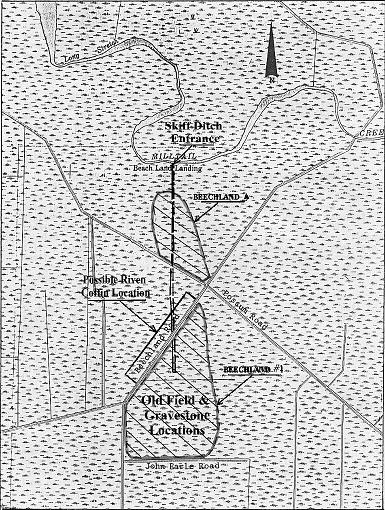
Phil McMullan in his paper “A Search for the Lost Colony in Beechland” records the various oral histories that he has collected from various sources. His expertise garnered from his time spent with Prulean Farms and in particular his project with the U.S Corps of Engineers preparing an Environment Impact Statement for their proposed 22,000 acre farm on theDareCountymainland provides him with valuable insight. Many important historical and archaeological finds were discovered during that project and Phil collected various supporting information. An area known as Beechland that Phil described and mapped has been confirmed by archaeological survey and the local residents to be the location of a high piece of timbered land that at one time supported a number of families.
In an excerpt from his report, McMillan discusses the riven coffins accidentally excavated onBeechland Roadin the 1950s. He quotes from “Legends of the Outer Banks and Tarheel Tidewater” by Judge Charles Whedbee written in 1966:
“Within the memory of men still living[1], there was at Beechlands (sic) a tribe of fair-skinned, blue-eyed Indians.
A few years ago when the West Virginia Pulp and Paper Company was doing some excavating for timbering purposes, they had to dig into a rather large mound near Beechland. In this mound, in the heart of the wilderness, they found numerous Indian artifacts, arrowheads, works of pottery, and potsherds. They also found riven coffins that were made from solid cypress wood which is resistant to wood rotting fungi. They were in a form that can best be described as two canoes – one canoe being the top half of the coffin and the other canoe being the bottom half.
On top of each of these coffins was plainly and deeply chiseled a Roman or Latin cross, the type that has come to be universally and traditionally accepted as the cross of Christianity. Beneath each cross were the unmistakable letters I N R I. These are thought to represent the traditional “Jesus Nazarenus, Rex Judaeorum” or translated, “Jesus of Nazareth, King of the Jews”, the inscription which adorned the cross of Christ at the time of the crucifixion. It was common practice in Elizabethan times to write the letter I for the letter J. It was similar and was accepted by the literate people of that day. A riven coffin with English carving buried in the midst of a wilderness in an Indian burial ground – is that coincidence?”
McMIllan goes on to say, “Although there were several known 19th century graveyards in the Beechland and Sandy Ridge vicinity, no one had ever before reported a graveyard near this site.”
McMullan quoting historian Mary Wood Long’s comments about the coffins, “The bottom section was carved so that a wooden pillow was provided for the headrest. The coffin was wider at the shoulder section, narrower toward the foot. Mr. Kemp [the machine operator] decided that 5 other coffins had been damaged and torn apart by his machine. There were no descriptive marks on the coffins other than the tool marks struck into the wood as the coffins were built.[2] If anything had remained within the coffin, it was washed out into the swamp water when the scoop cut through the top section. The cemetery was on a high knoll approximately 30 feet in diameter surrounded by swamp water and marsh at a dept of 5 feet. The men decided it was a family burial plot dating from the time of the first settlers of Beechland. Mr. Mann selected a site on high ground near the canal and reburied the portions of the old casket.
Another report from David Mann, a supervisor at the site said that high water prevented the observation of the coffin remnants reported to be protruding from the canal bank.” Others have stated that when the water level is low, one could see the ends of coffins protruding from the canal bank.
McMillan quotes Bill Sharp in his 1958 New Geography of North Carolina where he states that there was once a thriving community on Beechland on Mill Tail Creek where planters cultivated a 5000 acre tract on which corn, a wheat like grain and a variety of tobaccos were harvested. Shingles were cut from the forest and a canal dug by slave labor was used to move them to Alligator River from Beechland. Cattle roamed 25,000 acres of reed lands. Sharpe said the settlement disappeared before the Civil War. His sources believed that a cholera epidemic[3] caused its disappearance.
McMillan then discussed Victor Meekins, a journalist who interviewed Beechland descendant Marshal F. Twiford for a 1960 article printed in the Raleigh News and Observer. Twiford, born in 1876 told Meekins:
“Old people always told me that older people before them said that the Beechland settlement was founded by the English who ran away from Roanoke Island.[4] My grandfather who came over from Kitty Hawk much later lived there and married a full blooded Indian from Beechland. When I was a boy, there never seemed to be any mystery about this settlement, for the old folks took it for granted that everyone knew it. I used to go up there when I was a boy, and there were still several houses standing in Beechland. Most of the houses were log houses, and some had dirt floors. You reached it by paddling up Milltail Creek about 10 miles from the Alligator River.”
Twiford recalls Beechland families with names similar to the colonists such as Dutton, Sutton, Payne/Paine, White and Sanderlin.[5] He also remembered families of Sawyer, Edwards, Owens, Basnight and Ambrose. In the article, Meekins said that he has heard similar stories over the 50 years that he had been a reporter in Dare County. “It has been told by many people and a dozen old citizens of East Lake who would not be close to 100 years old have repeatedly told the story as Twiford tells it.”
Mary Wood Long says “on a high sandy ridge known as Beechland there once lived a large village of people numbering at one time 70 families or roughly 700[6]….All had English names, many found at East Lake today. Living with their white neighbors were Indians of the Croatoan or Machapungo tribe. During the 1840s all but one family left Beechland. Soon this family moved away and the forest covered the site of this once active village.” She goes on to report that the men routinely sailed in their large juniper log canoes to Barbados, the West Indies and Jamaica to barter their shingles for sugar, salt, flour, coffee, cloth and other items.
In the 1830s a preacher from Mann’s Harbor went to Beechland and discovered no evidence of a church, a Bible or of the Christian religion and told the people that if they didn’t build a church and turn to God that the devil would take them. Then a terrible plague called the Black Tongue plague appeared and the people were stricken and many died. When it was over the settlement was decimated and the people remembered the preacher and his warnings. People began moving away and by 1850 only Trimmergin Sanderlin’s family remained.
Several of the families moved northward onto the mainland onto the neck betweenEastLakeandSouthLakes. Some came back toSandyRidgeand their descendants remained there until the purchase of the Blount survey by West Virginia Pulp in 1953. They built a church of the Disciple doctrine and a few years later in the 1880s theKehukeePrimitiveBaptistChurchwas founded with a local man, Manley Twiford as its first preacher.
By fact of possession rather than deed Beechland was soon inherited by Trimmergin’s son Thomas who kept his cattle there. John Gray Blount obtained a patent to the entire peninsula after the American Revolution but his company never attempted to develop the interior. McMillan says that Blount’s surveyor reported people living on his land without a grant or deed. When John L. Roper laid claim to the Blount patent[7] after the Civil War the NC Attorney General had to intercede to secure the property rights of Thomas and his sister Polly Sanderlin.
Thomas Sanderlin was the great-grandfather of both Frank Cahoon and R.D. Sawyer Sr. who were important sources of Mary Wood Long’s oral history. Frank Cahoon, former sheriff of DareCounty, was born in EastLakein 1907. He could trace his lineage back to a sister of Malocki Paine who was a son of Henry Paine, one of the blue-eyed, blond-haired Indians of early Beechlands. The word Malocki[8] is probably an Indian corruption of the Old Testament name of Malachi. It is said that both Malocki and his sister were blue-eyed and blonde-haired. Other descendants of the original Beechland settlers still live atEastLake, onRoanoke Island, and in the surrounding counties. The names of many are the same as those of the first settlers in the swampland.
James Mann who was maintenance director for WestVaCo when Mary Wood Long was researching her book said that he could still see ridges within the Old Field where corn was grown. Many ballast stones of unknown origin have been found in Milltail Creek beds where nature placed no stones. Ballast stones must were not used by Indians. Ballast stones were used in English 9and probably other European) ocean going ships, and they could have been brought to this location by small English ships (pinnaces perhaps) of shallow draft who were seeking trade of either sassafras or silk grass, two items of great interest to the English. Records indicates that they harvested sassafras and returned with it to England.
In the 1960 Virginia-Pilot article itself Twiford says, “I saw one of those coffins opened. It had been dug up accidentally by a bull dozer. The top and bottom had been fitted together and fastened with pegs. All I saw inside was a little ashes or dust. It ought to have been examined for buttons or other objects but it wasn’t. The men reburied it and the bulldozer crew circled around the graveyard.”[9]
Twiford recalls accompanying his father to the district as a small boy. Three families lived there then, Smith, Basnight and Stokes. After a few years those families disappeared too, Twiford said, I guess they just moved away. Marshal Twiford will be 84 next October 7th. This information provides us withMarshall’s birth year as 1876, so his visits to the area as a small boy would have been in the 1880s.
The above information from various sources cumulatively provides us with a wealth of information that can be verified.
We know the names of Marshall Twiford, when he was born, his father’s name, Manley, and the fact that his grandfather reportedly came fromKitty Hawkand married a full blooded Indian from Beechlands.
He and others provide us with a plethora of other names as follows in summary format:
Names from Beechland:
Dutton Sutton Payne/Paine
White Sanderlin/Sandlin Sawyer
Edwards Crain/Crane Owens
Basnight Ambrose
Timmergin Sanderlin reportedly refused to leave Beechland and he was the only one left in 1850[10]. Mary Wood Long says he was the last left by 1840. Quoting Long who references the 1790 census, “knowing that the Sanderlin and Twiford families were living at Beechland at this time, we examined the records carefully to see if these names were recorded. Sanderlin was not and there is also the absence of Dutton[11], known to have been a Beechland family at some time during its history. A section of woodland is still mapped as Duttons Field.[12]
A review ofTyrrellCountyrecords shows that the first appearance of John Sandlin (sic) is in the 1810 census where he appears among the Owens, Hookers, Twifords, Paines and others whose names are mentioned above.
John Grey Blount’s 5000 acre land grant is confirmed by the 1808 Strothers map[13], shown below, from McMillan’s paper. Note the “J.G.B. 5000” in the lower right quadrant. This tract was surveyed in 1796 and sold in 1953 to the West Virginia Pulp Company. In between, it was apparently owned by the Sanderlin family. How did they come to own this tract and how much did they own?
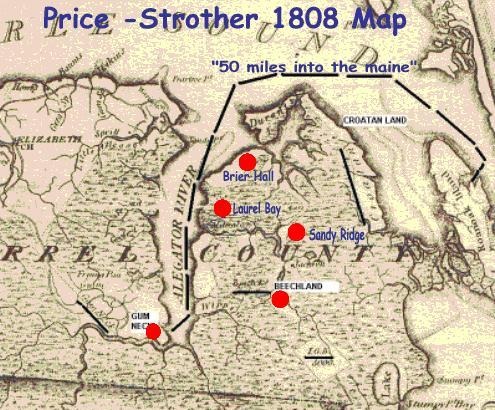
Oral history says that Beechland families all left in the 1840s. Another source says before the Civil War. Mary Wood Long says that the average of all of the various dates she was told in the oral histories she collected is that the plague struck and the remaining families left sometime in the mid-1830s.
When Twiford was young (he was born in 1876, so between 1880 and 1896) and visiting with his father, he tells us that surnames at Beechland were:
The 1850 Tyrrell County census[14] shows is that Manly D. Twiford, the father of Marshall Twiford, is age 6, born 1844[15], living with his parents Wallis Twiford and wife, Nancy, who, if Marshall’s information is correct, would be the Indian woman from Beechland. Wallis, age 49 born in 1801 in NC is listed along with his two 17 year old sons as a laborer and his wife is 39, born 1811 in NC. Their oldest children are twins born in 1833, so their marriage probably occurred in 1832 inTyrrellCounty.
Marriage records do indeed exist for this timeframe and a marriage for Wallis Twiford is not recorded. Searching on Ancestry.com and Rootsweb.com provides (unsubstantiated) information thatNancy’s maiden name was Payne. It provides further information thatNancydied in 1884.
Early Tyrrell and Currituck Records
The earliest available records forTyrrellCountywere actually from when it was a precinct ofAlbemarleCounty. The 1729-1732 Quit Rent rolls exist. Neither Payne, Paine nor Twiford are on these rolls, nor are any of the other surnames mentioned by Twiford or others. Tyrrell was formed in 1729 but it wasn’t until 1739 that the precincts actually became counties.
Miltail district is reported on Genweb to have been in Currituck Precinct/County prior to 1739. At this time Currituck contained the entire area along the seaboard from Albemarle Sound to the PamlicoRiver. The northern portion became part of Tyrrell which is now the part of DareCountyfrom the AlligatorRiverto the Sound. The southern portion of CurrituckCountywas annexed to HydeCountyin 1745.[16]
Checking earlyCurrituckCountyrecords, we find Sanderson there on the 1694-1696 rent rolls, never spelled any other way except Saunderson through the 1735 records which are the last Currituck records available before the Beechland portion of Currituck becomes part of Tyrrell.
On the 1696 -1697 Currituck Tithable list, we find Sandersons, Mr. Courroon, Levi Smith, Samuel Barnes and William Bastett (possibly Barnett, Basnet(t) or Basnight).
On the 1714 Currituck Valuations list, we find the following:
John Neal 150 (value of property in pounds)
George Barnes 10
Richard Smith 50
Levi Smith 50
(Torn)siah White 1 year 18
(Torn)es Carroon Sr 20
(Torn)mes Carroon Jr 6
Samuel Paine 30
Capt. Richard Sanderson 400
John Smith free negro 26
Joseph Sanderson 300
Richard Sanderson Esq 750
Michael Oneal 75
James Brown 75
Jeremiah Smith 2-10-0
Samuel Payne is noted here, but is never listed again. He is designated as having property, so perhapsCurrituckCountydeeds and grants should be searched, or, the surname could be misspelled. Searching the 1715 and 1716 lists, we discover that his last name is then spelled Poyner. In 1716 he is in insolvent and then disappears from the record, although some years later there are other Poyner males.
In 1714/1715 a list of money paid from the treasurer, John Carron, to the names above.
The 1715 Tithable list adds Josiah and Luke White as well as Jeremiah Smith. 1715 levies received lists Sarah Smith, John Oneal and James Mann in addition to earlier names.
The 1717 Currituck Tax Levy list adds David Ambrose.
In 1717 we also find John Penny, which might be Payne misspelled, but if so, it is consistently misspelled for several years. Matthew Migitt is also added this year.
In 1718 we find Webly Payve (sic), 3 tithables and no land.
The 1719 Tithables list adds Thomas Seayers. John Penny is still listed as such, but Webly is now listed as Payne with 3 tithables.
The 1719 list of Levies and Land Taxes shows Weebly Peyve again, with 3 tithes. It also notes that Richard Sanderson has 1000 acres “for Rowneoake”.
The 1720 lands and tithables list shows Wbly Pavey with a negro man at the head of Tulls Creek. James Caron Sr. and Jr. are at Powells Point with Richard Sanderson, James Brown, John Smith and Joseph Sanderson. Luke White and Michael Oneal Sr. are on Currituck Shoar. Michael Oneal Jr. is at Cowinjock. John Penny is at Sand Banks and John Mann is noted as “Quarter: ofRonakIsland”.
In 1721 Webly’s last name is Peavy.
The next records are only a fragment of the 1735 tax list, only those in arrears where we find new names of Margaret Barret, 20 acres, and William (a minor), Peter and James Pyner.
The balance of the Currituck records available are after the 1729/1739 period when the Beechland portion ofDareCountybecomes Tyrrell.
The next available Tyrrell record is the 1747/1748 processioners’ book[17] which also includes some partial tax rolls for this timeframe.
James Sutton is mentioned, his lands not being processioned because the bounds of his land are unknown. This indicates he owns land either by deed or patent and this information could possibly be located.
None of the other Beechland surnames are on this list, indicating that the surnames of men who owned land found in Currituck were not located in the portion of Currituck that became Tyrrell in 1739, and eventually Dare, which includes the Beechland area.
Next is a 1755 tax list. On this list we find John Braveboy, no whites and 5 blacks. Black and white are the only two options. A second household head listed who is not white is a man with only one name, Quomone, and he has one black, no whites. The one black is obviously himself and Quomone looks suspiciously like a native name. Braveboy does as well and is later associated with the Lumbee.[18]
Charles White is present with 3 whites and 2 blacks.
Ann Owens is listed with 1 white (probably not herself, probably a male as only white males were taxed).
The other Beechland names are not listed. This tax list is not restricted to landowners and should reflect all homesteads of free men over the age of 21 or their widows.
In 1779 residents signed a petition to form a new County. Typically petitioners had to be free, white and landowners, although this petition does not state such.
- Martin Dunton is shown. (Dutton?)
- William Sutton is shown.
- Several Sawyers are listed; Dinnis (twice), Ephram, Griffen, Isaac and James.
- Frances Edwards is shown.
- Adam Owens along with Thomas, Zachariah Jr. and Sr. are shown.
- James and William Basnight Jr. are shown, along with William, Joseph and Jacob Basnet, probably a misspelling of Basnight.
The NC 1786 State Census for TyrrellCounty[19] shows two very interesting tidbits. The first district is “Miltail theLake” and it provides us with the following families:
|
Family
|
WM
21 – 60
|
WM < 21
OR > 60
|
ALL WF
|
BM&F
12 – 50
|
BM&F > 50
& < 12
|
| John Carroon |
1 |
5 |
4 |
5 |
8 |
| John Payne[20] |
1 |
5 |
3 |
1 |
0 |
| Joseph Hassell |
1 |
1 |
2 |
0 |
0 |
| Thomas Mann |
1 |
1 |
2 |
1 |
0 |
| John Midgett |
1 |
2 |
1 |
1 |
3 |
| George Poplewell |
1 |
2 |
2 |
0 |
0 |
| Richard Oneal |
1 |
0 |
4 |
0 |
0 |
| Daniel Wrasco[21] |
1 |
2 |
5 |
0 |
0 |
| Stephen Barnett |
1 |
2 |
5 |
0 |
0 |
| Henry Smith[22] |
1 |
1 |
4 |
0 |
0 |
| David Hill |
2 |
3 |
2 |
0 |
0 |
| Zackariah Owen, Senr |
1 |
6 |
3 |
0 |
0 |
| Thomas Owens |
1 |
3 |
5 |
1 |
3 |
| Zackariah Owens, Jun |
1 |
0 |
3 |
0 |
0 |
| Adam Owens |
1 |
4 |
3 |
1 |
1 |
| Isaac Carroon |
1 |
2 |
2 |
3 |
4 |
| William M. Daniel |
1 |
2 |
2 |
0 |
0 |
| HenryHomes |
1 |
2 |
1 |
0 |
0 |
| Henry Fountain |
1 |
1 |
1 |
0 |
0 |
| George Battin |
1 |
1 |
3 |
0 |
0 |
| Dorcas Cook |
0 |
4 |
2 |
0 |
0 |
| Dorothy Barnes |
1 |
0 |
2 |
0 |
0 |
| Zackariah Hunnings |
1 |
4 |
3 |
4 |
5 |
| William Cowell |
1 |
1 |
2 |
3 |
5 |
| William Twyford |
1 |
1 |
4 |
1 |
1 |
| Joseph Browne[23] |
1 |
2 |
5 |
0 |
0 |
| John Tweedy |
2 |
2 |
4 |
0 |
0 |
| Joseph Basnight |
1 |
0 |
5 |
0 |
0 |
| John Smith |
1 |
2 |
3 |
0 |
0 |
| Stephen Hooker |
1 |
3 |
3 |
0 |
0 |
| John Hooker, Junr |
1 |
2 |
2 |
0 |
0 |
| William Basnight |
1 |
5 |
5 |
0 |
0 |
| John Hooker, Senr |
1 |
3 |
2 |
0 |
0 |
| |
34 |
74 |
99 |
21 |
30 |
This district includes several of the names on the list of orally reported “Beechland families”, which are highlighted, plus, interestingly enough, William Twyford, although Marshallreports that his grandfather (Willis born in 1801) was from Kitty Hawk. Apparently some Twiford/Twyford family member was living here was early as 1786. Perhaps the Twiford/Twyford family was originally from Kitty Hawk, but Marshallhad his generations somewhat confused[24].
The above list provides us with a comprehensive listing of Beechland in 1786. Who was native and who was English? Were the “native” families listed by name or were they perhaps included with the “black”, presumably enslaved, population?
The next tidbit is extremely frustrating. Gum Neck, a neighboring area also involved in the history and mystery of this area, located across the Alligator River from Beechland, is shown, with totals, but with no names, as follows[25]:
District: Gum Neck
Page 1 of 1
Census Taker: Col. Benj. Hassell
|
Family
|
WM
21 – 60
|
WM < 21
OR > 60
|
ALL WF
|
BM&F
12 – 50
|
BM&F > 50
& < 12
|
| 59 Households |
79 |
129 |
199 |
25 |
31 |
Note: This 1786 census has a list of the inhabitants in each household but no family names were provided.
However, the fact that these two districts are included shows clearly that the census taker was aware of these areas, both Beechland and Gum Neck, long before the 1830/1840/1850 timeframe and also significantly before 1808 when the surveyors were reported to have entered the mainland of Dare County for the first time.
Checking the Beechland names in the 1786 census, Thomas and William White are both enumerated in the “OldCourtHouseBridgeto Upper end of County” district.
The Basnights; James, Jacob, Joseph and two Williams are on Little Alligator which is located on the northwest end of theAlligatorRivernear the mouth.
The Ambrose families; James Jr. and Sr., Jesse and Shemi (sic) were shown in the district labeled “mark in poplar swamp toScuppernogRiver”.
The 1786 census processioning order is by labeled districts. The order in which those districts are recorded is as follows:
| District |
Enumerator |
Comments |
| Miltail the Lake[26] |
John Hooker |
Includes Beechland |
| Little Alligator |
Col. Hezekiah Spruill |
|
| Greater Alligator |
John Poole |
Names not give, 400 white, 156 black, 556 total |
| Gum Neck |
Col. Benjamin Hassell |
59 households, 407 white, 56 black, 473 total |
| Mark inPoplarSwamptoScuppernogRiver |
Stephen Swain |
|
| OldCourtHouseBridgeto Upper End of County |
Thomas Everitt |
|
We are fortunate that the federal census was only 4 years later.
In the 1790 Tyrrell County census, there are no families that include any individuals enumerated as “other free” within white households. This category means that the individual or family is not white, but is free. This is the category where free negroes would be counted as well as any Indians “not taxed” and not enslaved or anyone of mixed racial heritage.
There are a few Tyrell County 1790 families who are noted as “free colored” and they are:
Page 378 – Column 2 (continued)
Free Colored Persons
|
Head
of
Family
|
Males
16 Years
and Up
|
Males
Under
16 years
|
Females |
Other
Free
Persons
|
Slaves |
| Simpson, Reddin |
1 |
0 |
3 |
0 |
0 |
| Simpson, Jacob |
1 |
1 |
1 |
0 |
0 |
| Hill, Elizabeth |
0 |
1 |
2 |
0 |
0 |
| Williams, Jack |
1 |
0 |
0 |
0 |
0 |
| Foster, William |
1 |
4 |
2 |
0 |
0 |
| Dempsey, John |
1 |
0 |
0 |
0 |
0 |
| Bibbons, Philip |
1 |
0 |
0 |
0 |
0 |
| Jane Vollovay |
0 |
0 |
1 |
0 |
0 |
| Bridgett Bryan |
0 |
0 |
1 |
0 |
0 |
| IsraelPierce |
1 |
2 |
3 |
0 |
0 |
| Thomas Pierce |
1 |
3 |
4 |
0 |
0 |
| Total |
8 |
11* |
17 |
0 |
0 |
(*) – The census total is 10, however the total of the entries is 11.
Free colored persons would have included all “mixed” race people, including mulatto, black, Indian or mixtures between those races or of any of them with white.
Interestingly, of all of the above “free colored” families, in 1800, we can only find Philip Bibbons inWashington County,NC, which was split from Tyrrell in 1799, with no white males. This is not the area that includes Beechland or the Greater Alligator District, although he could have moved between 1790 and 1800. In 1800 in Tyrrell County, no other ‘free colored” families appear with the possible exception of Celia Hill who has some free people of color living with her. We know however that the Bryan/Bryant family was still in the area, because they emerge later in the 1840 census with 3 Bryant males who are free people of color.
Israel Pierce is extremely interesting. He is not found using Ancestry.com’s indexing in any county in 1800 or 1810 (nor are there any other Pierces in Tyrrell County), but in 1820 he is found in Beaufort County with 3 males engaged in agriculture, no whites or slaves, and an entire family of “free colored persons”, 1 male to 14, 1 male to 26, 1 male to 45, 1 male over 45, 2 females to 14, 1 female to 26, 1 female to 45, none over 45.
In 1840Israelis no longer found, and no Pierces inBeaufortCounty, but in Martin, we find in Jameston an Ann Pierce with a white family and 9 houses away, Emmy Pierce who is “free colored”, with one female under 10 and one 10-26.
In 1850 there are both black and white Pierce families listed in Chocowinity, inBeaufort County,NC. The black family is headed by Lucy Ann Pierce, age 30.
Perhaps the most interesting information about the Pierce family[27] comes from the 1916 report of Frank G. Speck published in the American Anthropologist Magazine. Frank had visitedEastern North Carolina in the hopes of finding descendants of local Indian tribes with the hope of “rescuing some facts concerning their early culture and language”. Sadly, he was disappointed, because the few people he found had no direct memory of their Native culture although he felt certain medicinal and cultural aspects of their Native heritage, such as basketmaking, specific types of tea brewing, etc., had been integrated into their daily lives with no knowledge of their origins.
Speck says, “A visit to their old home, however, and persistent inquiry among the settlers of Albemarle and Pamlico sounds, brought to knowledge a few individuals who are descended from Indians who came originally from Pungo River near Mattamuskeet Lake, Hyde county. These are evidently remnants of the Machapunga tribe who have left their name to Pungo River. Those whom I met traced their descent from one Israel Pierce, who was known as a Pungo River Indian. That English Christian names were common among the tribes of this general region as early as 1718, is shown by a list of chief’s names from the Chowan Indians, neighbors of the Machapunga given in the colonial documents.[28] I traced Pierce’s descendants through Mrs. M. H. Pugh, Pierce’s granddaughter, now a very old woman, estimating her age to be about eighty[29] years, who was born and raised in the Pungo River district. Later in her life she moved to Hatteras Island. She has four sons, daughters, and numerous grandchildren. At present the dark-skinned people living on Roanoke, Hatteras, and other neighboring islands of the Pugh, Daniels, and Berry families, largely of negro blood, and some of those named Westcott, of a lighter strain, are of this blood.
In appearance they vary greatly, from individuals with pronounced Indian characteristics, through people with noticeable white or negro features, the latter sort predominating in the younger generations. Not one of these people knew a single word of the Indian language and not one knew of any definite Indian customs or traditions, not even the name of their tribe.”
Tracking the Israel Pierce family from early Tyrell County in 1790 to Beaufort County in 1830 and confirming as best we can that they are of Native heritage, begs the question of whether the rest of the individuals listed on the 1790 census of Tyrrell as “free colored persons” are also Indian, or perhaps admixed.
Perhaps additional work on the Bibbins, Hill, Bryan/t and Pierce families, who seem to have left at least a cursory trail, would be enlightening. The Pierce family was covered recently in the January 2011 issue of the Lost Colony Research Group newsletter.
Reconstructing the 1786 Tyrrell County Missing Gum Neck and Greater Alligator Districts
An attempt was made to reconstruct the 1786 Gum Neck and Greater Alligator districts by using the 1790 census as a basis of comparison using the following steps.
- Matching all 1786/1790 households. We know that if they are listed in 1786 and 1790, they do not live in Gum Neck/Greater Alligator (as the Gum neck 1786 list is missing).
- We are searching for an entire group of people, 59 families (473 people) in 1786, that are “missing” from Gum Neck and about 69 households[30] (556 people) from the Greater Alligator District.
- Men who are obviously young (2 children or less, no white males under 16) should be eliminated from the calculation because they would likely not have established their own household yet in 1786.
Unfortunately, some of the 1790 census districts are in semi-alpha order where letters of the alphabet are generally grouped together, not processioning order which is generally house by house, as follows by page:
| Page Number |
Processioning Order |
| 373 |
Processioning |
| 374 |
Processioning |
| 375 |
Semi-alpha |
| 376 |
Semi-alpha |
| 377 |
Semi-alpha |
| 378 |
Semi-alpha |
| 379 |
Processioning |
| 380 |
Processioning |
The enumerators in 1786 appear to have lived in their district. Therefore, the first clue would be where Col. Benjamin Hassell, the Gum Neck enumerator, is found in 1786 and 1790.
Unfortunately,Col.Benjamin Hassell is found in 1790 on page 376, an alpha page.
Looking for other known surnames and individuals, William Twyford is found located very close to John Hooker, the Miltail enumerator, on page 379 which is in processioning order.
Checking a few specific individuals in 1790 compared to their 1786 district in order to determine who fell into which districts, we find the following:
Little Alligator:
Asa Trueblood – first listing in district – page 374 – processioning order
James Perisho – towards end of district – page 379 – processioning order
Greater Alligator:
John Poole – 380 – processioning order – (enumerator of Greater Alligator in 1786)
Scuppernog:
James Devenport – first on list – 375 – alpha
Shermi Ambrose – last page on list – 375 – alpha
Old Court House Bridge:
4 individuals checked in this district were on pages, 375, 377 and 378, all alpha.
It appears, with the exception of Col. Benjamin Hassell, that the Scuppernog and Court House districts were alpha and the Little Alligator District,MiltailLakeand possibly the Gum Neck and Greater Alligator Districts were in processioning order. Unfortunately, with the Greater Alligator and Gum Neck appearing to be adjacent districts, it is impossible to sort out whom was in Gum Neck versus the Greater Alligator District, but we can indeed determine which households that were not enumerated in 1786.
The following lists were taken from the Tyrrell County Genweb site where the transcribed 1790 census is available. All of the individuals highlighted in yellow, pink or blue are not present on the 1786 census. Of course, there could be many reasons for this. Families do move into the area from elsewhere and from place to place within the county.
For a woman, highlighted in pink, her husband might have died, although there would likely have been a male with the same surname in 1786. When a connection was obvious, I counted it as such.
For males, if they married in 1786, they generally would have not had more than 2 children under the age of 16 by 1790. For families who could have fallen into this category, I have used light blue highlighting instead of yellow. Some of the individuals highlighted in blue may not be young, they might be older, with their family mostly grown and gone. Hints of this might be found by the number of slaves owned. Younger men often couldn’t afford slaves. Any family with 2 males over the age of 16 was colored yellow, not blue, although clearly there could have been an older male living with the family, so this is not absolute.
Yellow indicates the balance of the families who were present in 1790 and absent in 1786 and who had too many children to be considered “possibly young”. Within the group of families highlighted in yellow, we will find the reconstructed Greater Alligator and Gum Neck Districts of 1786, especially where we find groups of people clustered together who are missing from the 1786 census.
The entire grouping of pink, yellow and blue together should represent the entire group of approximately 128 households not enumerated individually in 1786 but counted in 1790. About half would be found in the 2 missing district’s records, the rest being scattered throughout the county. Some families of course would have moved into the area, but others were clearly already there in the Greater Alligator and Gum Neck Districts. There are a total of 207 yellow (absent in 1786, present in 1790, not a young family) and pink families (absent 1786, female head of household 1790). Determining which families comprise the 128 from Gum Neck and the Greater Alligator districts and which fell into other districts is challenging.
Individuals not found in 1790 but who were present in Miltail in 1786 are Henry Smith, one Zachariah Owens (Jr. and Sr. both found in 1786), Isaac Carroon, William M. Daniel, Henry Fountain, Dorcas Cook, Dorothy Barnes, Joseph Browne, and one John Hooker (Jr. and Sr. both found in 1786). Nine of the 33 families present in 1786, or 27%, apparently died or moved away.
Legend
Bolded surnames are those provided by Twiford and others as “Beechland names” and underscoring indicates the individuals on the 1786 “Miltail theLake” district.
Pink indicates female households not present on the 1786 list but present in 1790.
Blue indicates families who may have been too young to have households established in 1786, are missing from the 1786 census, but present in 1790.
Yellow indicates the balance of the families who were absent on the 1786 census and are present in 1790. Unless these families moved into the area in those 4 years, these families should have been found on the 1786 census.
Green indicates a colonist surname.
Grey indicates a surname of interest. In some context, this surname is either proven native or closely associated with the colonist surnames.
Page 373 – Column 1
|
Head
of
Family |
Free
White
Males
16 Years
and Up
|
Free
White
Males
Under
16 years
|
Free
White
Females |
Other
Free
Persons |
Slaves |
| John Clifton |
1 |
4 |
1 |
0 |
0 |
| Jacob Davenport |
1 |
2 |
0 |
0 |
0 |
| James Ambrus |
1 |
2 |
3 |
0 |
0 |
| Robert Clifton |
3 |
1 |
5 |
0 |
0 |
| Benjn. Tarkinton |
1 |
2 |
4 |
0 |
0 |
| Josiah Phelps |
4 |
1 |
3 |
0 |
2 |
| James Phelps |
1 |
1 |
3 |
0 |
0 |
| Rosanna Phelps |
0 |
2 |
3 |
0 |
0 |
| Isaac Barnes |
1 |
0 |
1 |
0 |
0 |
| Reuben Barnes |
1 |
4 |
3 |
0 |
0 |
| Thomas Jethro |
1 |
2 |
2 |
0 |
0 |
| Joseph Tarkinton |
1 |
1 |
3 |
0 |
0 |
| Uphaniah (?)Davis |
2 |
2 |
7 |
0 |
2 |
| Miles Spruil |
1 |
2 |
1 |
0 |
0 |
| Soloman Bateman |
1 |
1 |
4 |
0 |
1 |
| Josiah Phelps |
1 |
1 |
2 |
0 |
2 |
| Thomas Smith |
1 |
2 |
3 |
0 |
0 |
| Joshua Powers |
1 |
1 |
5 |
0 |
0 |
| Anthony Alexander |
1 |
2 |
3 |
0 |
0 |
| John Alexander |
1 |
1 |
2 |
0 |
0 |
| Alexander Oliver |
1 |
2 |
2 |
0 |
0 |
| Joseph Oliver |
1 |
0 |
4 |
0 |
0 |
| Levi Hassell |
1 |
0 |
8 |
0 |
0 |
| Asa Hill |
1 |
2 |
1 |
0 |
0 |
| John Spruil |
1 |
1 |
6 |
0 |
0 |
| Charles Skittlethorpe |
1 |
4 |
3 |
0 |
0 |
| Mecajah Ambrus |
1 |
1 |
1 |
0 |
0 |
| John Farlaw |
2 |
3 |
3 |
0 |
0 |
| Keziah McClary |
0 |
1 |
3 |
0 |
0 |
| Jesse Ambrus |
1 |
1 |
4 |
0 |
0 |
| James Long |
1 |
3 |
1 |
0 |
0 |
| Samuel Caswell |
1 |
2 |
3 |
0 |
0 |
| Andrew Oliver |
1 |
3 |
2 |
0 |
1 |
| Edward Ansley |
1 |
0 |
2 |
0 |
1 |
| Isaac Powers |
1 |
1 |
4 |
0 |
0 |
| Solomon Ansley |
1 |
0 |
3 |
0 |
1 |
| Stephen Bateman |
1 |
3 |
4 |
0 |
0 |
| Joseph Ansley, Junr. |
1 |
0 |
2 |
0 |
0 |
| Henry Hagman |
2 |
0 |
2 |
0 |
0 |
| Thomas Weatherly |
1 |
2 |
1 |
0 |
0 |
| Avery Tillit |
1 |
1 |
2 |
0 |
0 |
| Jonathan White |
2 |
3 |
4 |
0 |
0 |
| Josiah Simmons |
1 |
0 |
2 |
0 |
0 |
| John Simmons |
1 |
2 |
1 |
0 |
0 |
| William Alcock |
1 |
0 |
0 |
0 |
0 |
| Joseph Cahoon |
1 |
0 |
0 |
0 |
0 |
| Benjamin Cahoon |
1 |
0 |
0 |
0 |
0 |
| Total |
54 |
69 |
126 |
0 |
10 |
Page 373 – Column 2
|
Head
of
Family |
Free
White
Males
16 Years
and Up
|
Free
White
Males
Under
16 years
|
Free
White
Females |
Other
Free
Persons |
Slaves |
| Josah Alcock |
3 |
2 |
3 |
0 |
0 |
| Willis Simmons |
1 |
0 |
0 |
0 |
0 |
| Jonathan Sawyer |
1 |
5 |
1 |
0 |
0 |
| Bartlet Sawyer |
1 |
0 |
1 |
0 |
0 |
| Hannah Richason |
0 |
4 |
1 |
0 |
0 |
| Anthony Hutson [31] |
1 |
2 |
2 |
0 |
0 |
| Elijah Hutson |
1 |
3 |
5 |
0 |
0 |
| Willm. Howard, Senr. |
1 |
1 |
1 |
0 |
0 |
| Willm. Howard, Junr. |
1 |
0 |
1 |
0 |
0 |
| William Norris |
1 |
3 |
3 |
0 |
0 |
| Thomas Howard |
1 |
2 |
2 |
0 |
0 |
| John Cahoon |
1 |
3 |
3 |
0 |
0 |
| James Cahoon |
1 |
1 |
5 |
0 |
0 |
| John Smith |
1 |
1 |
3 |
0 |
0 |
| William McGown |
1 |
0 |
1 |
0 |
0 |
| John McGown |
1 |
1 |
3 |
0 |
0 |
| Elizabeth Rowson |
0 |
0 |
2 |
0 |
0 |
| John Liverman, Junr. |
1 |
1 |
3 |
0 |
0 |
| John Mekins |
1 |
0 |
2 |
0 |
0 |
| John Gibson |
1 |
1 |
4 |
0 |
5 |
| Zebedee Smith |
1 |
2 |
1 |
0 |
0 |
| Samuel Gibson |
1 |
0 |
1 |
0 |
0 |
| John Jarman |
1 |
3 |
3 |
0 |
0 |
| Corbin Jones |
1 |
3 |
4 |
0 |
0 |
| Henry Culliper |
1 |
0 |
2 |
0 |
0 |
| James Culliper |
1 |
0 |
3 |
0 |
0 |
| Willm. Liverman |
2 |
2 |
5 |
0 |
15 |
| Thomas Liverman |
1 |
5 |
3 |
0 |
3 |
| John Liverman |
1 |
0 |
4 |
0 |
0 |
| Thomas Hoskins |
2 |
3 |
5 |
0 |
37 |
| Isaac Mekins |
1 |
6 |
4 |
0 |
0 |
| Ezekiel Cahoon |
1 |
3 |
5 |
0 |
0 |
| Soloman Bodwell |
1 |
1 |
1 |
0 |
0 |
| Thos. Francis |
1 |
1 |
2 |
0 |
0 |
| Soloman Hassell |
2 |
1 |
4 |
0 |
0 |
| Soloman Hassell, Junr. |
1 |
0 |
2 |
0 |
0 |
| Joshua Johnston |
1 |
0 |
0 |
0 |
0 |
| Joshua Hassell |
1 |
2 |
2 |
0 |
0 |
John Hassell,
son of Solomon |
1 |
1 |
2 |
0 |
0 |
| Jermimiah Riggins |
0 |
0 |
2 |
0 |
0 |
| John Armstrong |
2 |
2 |
3 |
0 |
0 |
| Edward Phelps |
3 |
2 |
6 |
0 |
0 |
| Benjamin Tarkinton |
1 |
3 |
5 |
0 |
0 |
| Henry Banks |
1 |
0 |
1 |
0 |
0 |
| John Warrington |
1 |
1 |
4 |
0 |
6 |
| Samuel Woodland |
2 |
0 |
2 |
0 |
1 |
| Josiah Powers |
1 |
2 |
3 |
0 |
1 |
| Jacob Davenport |
1 |
1 |
2 |
0 |
0 |
| Isaac Patrick |
1 |
4 |
3 |
0 |
1 |
| John Goddwin |
1 |
3 |
2 |
0 |
0 |
| Jonathan Phelps |
1 |
1 |
2 |
0 |
0 |
| AnneLewark |
1 |
2 |
3 |
0 |
0 |
| Total |
58 |
84 |
137 |
0 |
69 |
End of Page 373
Page 374 – Column 1
|
Head
of
Family |
Free
White
Males
16 Years
and Up
|
Free
White
Males
Under
16 years
|
Free
White
Females |
Other
Free
Persons |
Slaves |
| John Oliver |
1 |
1 |
2 |
0 |
0 |
| Ezekiel Alexander |
1 |
2 |
3 |
0 |
0 |
| Joseph Craddock |
1 |
0 |
1 |
0 |
0 |
| William Hassell |
1 |
3 |
3 |
0 |
0 |
| Ezekiel Goddin |
1 |
1 |
4 |
0 |
0 |
| Zehadee Hassell |
2 |
1 |
2 |
0 |
6 |
| Thomas Hopkins |
1 |
0 |
3 |
0 |
7 |
| Cornelius Morris |
2 |
2 |
3 |
0 |
0 |
| Henry Alexander |
2 |
4 |
2 |
0 |
0 |
| Joseph Alexander |
1 |
0 |
2 |
0 |
1 |
| John Alexander |
1 |
1 |
2 |
0 |
0 |
| John Alexander, Senr. |
2 |
2 |
5 |
0 |
3 |
| John McClease |
1 |
3 |
3 |
0 |
0 |
| Benjamin Meades |
1 |
0 |
2 |
0 |
0 |
| Asa Trueblood |
1 |
1 |
4 |
0 |
0 |
| Hezekiah Davenport |
1 |
0 |
4 |
0 |
0 |
| John Duvol |
1 |
3 |
3 |
0 |
0 |
| Jeremiah Stealman |
1 |
3 |
3 |
0 |
0 |
| William Barnett |
1 |
2 |
3 |
0 |
0 |
| John Caroon |
1 |
5 |
4 |
0 |
12 |
| Joseph Caroon |
1 |
0 |
1 |
0 |
1 |
| John Midgett |
1 |
2 |
3 |
0 |
4 |
| Soloman Mann |
1 |
1 |
3 |
0 |
2 |
| Richard Oneal |
1 |
2 |
3 |
0 |
0 |
| Samuel Brown |
1 |
1 |
1 |
0 |
0 |
| Samuel Mann |
2 |
1 |
4 |
0 |
3 |
| George Popperwill |
1 |
2 |
5 |
0 |
0 |
| Stephen Barnett |
2 |
3 |
7 |
0 |
0 |
| William Coffee [32] |
1 |
3 |
5 |
0 |
0 |
| David Hill |
1 |
1 |
1 |
0 |
0 |
| David Hill, Senr. |
1 |
0 |
1 |
0 |
0 |
| James Williams |
1 |
2 |
2 |
0 |
0 |
| William Psalter |
1 |
0 |
1 |
0 |
1 |
| Daniel Rascow [33] |
2 |
1 |
5 |
0 |
0 |
| John Payne |
2 |
4 |
3 |
0 |
1 |
| Thomas Mann |
2 |
2 |
3 |
0 |
1 |
| Mitchel McGlocklin |
1 |
0 |
1 |
0 |
0 |
| Zilpha Alexander |
1 |
1 |
7 |
0 |
6 |
| Thomas Warrington |
1 |
0 |
2 |
0 |
3 |
| Miles Pierce |
1 |
4 |
3 |
0 |
0 |
| John Davenport |
1 |
2 |
2 |
0 |
0 |
| Seth Phelps |
3 |
2 |
4 |
0 |
5 |
| John Saunders |
1 |
0 |
2 |
0 |
0 |
| John Hassell, Senr |
4 |
1 |
7 |
0 |
15 |
| Joseph Tarkinton |
1 |
2 |
1 |
0 |
2 |
| William Brown |
1 |
2 |
4 |
0 |
0 |
| Sarah Spruil |
1 |
0 |
2 |
0 |
0 |
| Hezekiah Dukes |
1 |
2 |
6 |
0 |
0 |
| John Powers |
1 |
0 |
2 |
0 |
0 |
| Ephraim Powers |
1 |
1 |
2 |
0 |
0 |
| Stephen Hassell |
1 |
2 |
3 |
0 |
0 |
| Total |
65 |
78 |
154 |
0 |
73 |
Page 374 – Column 2
|
Head
of
Family |
Free
White
Males
16 Years
and Up
|
Free
White
Males
Under
16 years
|
Free
White
Females |
Other
Free
Persons |
Slaves |
| Joseph Volloway |
5 |
2 |
5 |
0 |
0 |
| Richard Brinn |
1 |
1 |
6 |
0 |
0 |
| Russell Armstrong |
3 |
4 |
2 |
0 |
4 |
| John Cullifer |
1 |
0 |
2 |
0 |
0 |
| Catharine Cahoon |
0 |
0 |
8 |
0 |
0 |
| John Clayton |
1 |
3 |
4 |
0 |
8 |
| Celia Hill |
0 |
3 |
3 |
0 |
0 |
| Benjamin Baker |
2 |
2 |
4 |
0 |
0 |
| Robert Jones |
1 |
2 |
1 |
0 |
0 |
| Silas Foster |
1 |
0 |
4 |
0 |
0 |
| William Russ |
1 |
1 |
2 |
0 |
0 |
| Josiah Williams |
1 |
4 |
2 |
0 |
0 |
| John Sikes |
1 |
2 |
4 |
0 |
0 |
| AnneSpence |
1 |
2 |
4 |
0 |
0 |
| Robert Spence[34] |
1 |
0 |
3 |
0 |
0 |
| Robert Sawyer |
1 |
2 |
3 |
0 |
0 |
| Isaac Sawyer |
1 |
2 |
2 |
0 |
0 |
| James Sawyer |
1 |
5 |
2 |
0 |
0 |
| Joseph Jannett |
1 |
1 |
1 |
0 |
0 |
| Peter Sawyer |
1 |
4 |
2 |
0 |
0 |
| Jabith Smith |
1 |
1 |
3 |
0 |
0 |
| Joab Sawyer |
1 |
3 |
1 |
0 |
0 |
| Leven Sawyer |
1 |
0 |
2 |
0 |
0 |
| Keziah Sawyer |
0 |
0 |
2 |
0 |
0 |
| Betsy Best |
0 |
2 |
3 |
0 |
0 |
| Elisha Belanger, Senr. |
1 |
1 |
3 |
0 |
0 |
| Elisha Belanger |
1 |
1 |
1 |
0 |
0 |
| Abel Belanger |
1 |
0 |
1 |
0 |
0 |
| Jesse Smith |
1 |
0 |
3 |
0 |
0 |
| John Smith |
1 |
2 |
4 |
0 |
0 |
| Anthony Ward |
1 |
1 |
5 |
0 |
0 |
| Josiah Simmons |
1 |
0 |
0 |
0 |
0 |
| Mary Mc Duvil |
0 |
0 |
1 |
0 |
0 |
| John Liverman, Senr. |
1 |
2 |
5 |
0 |
3 |
| Hezekiah Liverman |
1 |
1 |
5 |
0 |
0 |
| John Liverman |
1 |
0 |
4 |
0 |
0 |
| Rachael Smith |
0 |
2 |
1 |
0 |
0 |
| Dennis Sawyer |
1 |
0 |
1 |
0 |
2 |
| Abram Brown |
1 |
0 |
3 |
0 |
0 |
| Thomas Owens |
1 |
2 |
4 |
0 |
4 |
| Peter Owens |
1 |
0 |
0 |
0 |
0 |
| Joseph Pledger |
1 |
4 |
6 |
0 |
9 |
| Moses Holloway |
2 |
1 |
5 |
0 |
0 |
| Levin Rhoades |
2 |
2 |
3 |
0 |
0 |
| William Hancock |
3 |
1 |
4 |
0 |
0 |
| William Howett |
2 |
3 |
3 |
0 |
9 |
| Joseph Chapman |
1 |
5 |
3 |
0 |
0 |
| John Hopkins |
1 |
2 |
3 |
0 |
0 |
| Major Brickhouse |
3 |
2 |
7 |
0 |
0 |
| Hezekiah Spruill, Esq. |
2 |
0 |
5 |
0 |
12 |
| Asa Parsons |
2 |
1 |
2 |
0 |
0 |
| Elizabeth Hopkins |
0 |
1 |
3 |
0 |
0 |
| Philip Hopkins |
1 |
0 |
0 |
0 |
0 |
| Total |
62 |
80 |
160 |
0 |
51 |
End of Page 374
Page 375 – Column 1
|
Head
of
Family |
Free
White
Males
16 Years
and Up
|
Free
White
Males
Under
16 years
|
Free
White
Females |
Other
Free
Persons |
Slaves |
| Ansley, John |
2 |
2 |
7 |
0 |
7 |
| Ansley, Joseph |
1 |
1 |
2 |
0 |
1 |
| Arnold, Joseph |
3 |
3 |
6 |
0 |
1 |
| Ambrus, Shimee |
1 |
0 |
2 |
0 |
0 |
| Alexander, Joseph Junr. |
2 |
3 |
3 |
0 |
3 |
| Airs, Isaac |
2 |
3 |
5 |
0 |
0 |
| Alexander,Sarah |
0 |
0 |
2 |
0 |
0 |
| Alexander, Joshua |
1 |
1 |
1 |
0 |
0 |
| Alexander, Joseph |
1 |
4 |
3 |
0 |
3 |
| Airs, John |
1 |
0 |
1 |
0 |
0 |
| Armistead, John |
1 |
1 |
2 |
0 |
8 |
| Adams, Isaac |
1 |
2 |
3 |
0 |
2 |
| Adams, Thomas |
1 |
0 |
2 |
0 |
0 |
| Allen, Henry |
1 |
4 |
2 |
0 |
0 |
| Bateman, Jeremiah |
2 |
0 |
2 |
0 |
2 |
| Bateman, Nathan Senr. |
2 |
3 |
5 |
0 |
3 |
| Bateman, John |
1 |
0 |
0 |
0 |
2 |
| Bateman, Levi |
1 |
1 |
1 |
0 |
1 |
| Blount, Steven |
1 |
4 |
1 |
0 |
0 |
| Barnes, John |
1 |
0 |
1 |
0 |
0 |
| Bateman, Godfrey |
1 |
1 |
1 |
0 |
0 |
| Bateman, Stephen |
1 |
2 |
2 |
0 |
0 |
| Blount, Hannah |
1 |
0 |
3 |
0 |
0 |
| Brown, James |
1 |
0 |
1 |
0 |
0 |
| Bateman, Simeon |
1 |
0 |
1 |
0 |
0 |
| Bates, Thomas |
1 |
0 |
0 |
0 |
0 |
| Bobbit, David |
1 |
0 |
0 |
0 |
0 |
| Bateman, Jesse |
1 |
1 |
3 |
0 |
0 |
| Bateman,Bethiah |
1 |
3 |
2 |
0 |
0 |
| Bernbridge,Sarah |
0 |
1 |
2 |
0 |
0 |
| Blount, Jacob |
2 |
0 |
4 |
0 |
3 |
| Blount, Levi |
1 |
1 |
3 |
0 |
23 |
| Bernbridge, Caleb |
3 |
3 |
3 |
0 |
5 |
| Blount, John |
1 |
0 |
1 |
0 |
0 |
| Barns,Anne |
1 |
0 |
1 |
0 |
2 |
| Blount, William |
1 |
4 |
3 |
0 |
22 |
| Blount, Edmound Junr. |
1 |
2 |
3 |
0 |
13 |
| Bateman, Andrew |
1 |
3 |
4 |
0 |
5 |
| Bateman, Jonathan |
3 |
5 |
2 |
0 |
4 |
| Bateman, Isaac |
1 |
3 |
6 |
0 |
1 |
| Bateman, Soloman |
1 |
2 |
2 |
0 |
0 |
| Total |
51 |
63 |
98 |
0 |
111 |
Page 375 – Column 2
|
Head
of
Family |
Free
White
Males
16 Years
and Up
|
Free
White
Males
Under
16 years
|
Free
White
Females |
Other
Free
Persons |
Slaves |
| Blount, Benjamin |
1 |
2 |
3 |
0 |
5 |
| Bozman, John |
1 |
2 |
3 |
0 |
0 |
| Byrd, R. Martin [35] |
1 |
0 |
0 |
0 |
2 |
| Bozman, Levin |
2 |
0 |
1 |
0 |
3 |
| Bozman, Joseph |
1 |
1 |
1 |
0 |
1 |
| Blount, Nathan |
1 |
1 |
2 |
0 |
0 |
| Chesson, Samuel |
1 |
1 |
5 |
0 |
8 |
| Cutter, Ebbin |
1 |
0 |
0 |
0 |
0 |
| Chesson, John |
1 |
0 |
1 |
0 |
1 |
| Chesson, William |
2 |
3 |
2 |
0 |
5 |
| Canady, Richard |
1 |
0 |
0 |
0 |
0 |
| Chesson, Joshua |
1 |
1 |
1 |
0 |
0 |
| Canady, Fredrick |
1 |
0 |
0 |
0 |
0 |
| Canady, John Senr. |
2 |
0 |
3 |
0 |
0 |
| Cullifer, Isaac |
1 |
3 |
5 |
0 |
0 |
| Collins, Caleb |
1 |
2 |
1 |
0 |
0 |
| Court,John |
3 |
3 |
2 |
0 |
0 |
| Clifton, Mary |
0 |
1 |
4 |
0 |
0 |
| Canady, John |
1 |
0 |
0 |
0 |
0 |
| Chesson, Joseph |
2 |
2 |
2 |
0 |
0 |
| Cotrell, Francis |
0 |
1 |
2 |
0 |
3 |
| Camel, John |
1 |
2 |
2 |
0 |
0 |
| Crooke, Clement |
1 |
1 |
5 |
0 |
7 |
| Camel, Rebecca |
0 |
2 |
2 |
0 |
0 |
| Corprew, Joshua |
2 |
3 |
2 |
0 |
5 |
| Corprew, Thomas |
1 |
3 |
2 |
0 |
2 |
| Corprew, Jonathan |
3 |
0 |
2 |
0 |
7 |
| Candy, William |
1 |
3 |
5 |
0 |
0 |
| Blount, Edmund Senr. |
3 |
3 |
5 |
0 |
3 |
| Davenport, Mosses |
1 |
2 |
3 |
0 |
0 |
| Dillon, John |
1 |
3 |
1 |
0 |
0 |
| Davis, Richard |
1 |
1 |
2 |
0 |
4 |
| Davenport, Daniel |
1 |
0 |
3 |
0 |
5 |
| Davenport, Joseph Junr. |
1 |
3 |
2 |
0 |
0 |
| Davonport, Fredrick |
1 |
1 |
2 |
0 |
1 |
| Davenport, John Doctr. |
2 |
2 |
3 |
0 |
0 |
| Davis, John |
1 |
3 |
3 |
0 |
0 |
| Davenport, Ephraim |
1 |
3 |
6 |
0 |
0 |
| Davis, Thomas |
2 |
4 |
2 |
0 |
0 |
| Dunston, Abram |
1 |
0 |
4 |
0 |
0 |
| Davenport, James |
1 |
2 |
1 |
0 |
3 |
| Davenport, David |
1 |
1 |
3 |
0 |
1 |
| Davenport, John |
1 |
2 |
2 |
0 |
0 |
| Dillin, James |
1 |
4 |
4 |
0 |
1 |
| Davenport, Joseph Senr. |
2 |
6 |
2 |
0 |
0 |
| Davenport, Joanne |
0 |
3 |
6 |
0 |
2 |
| Davenport, Issac |
3 |
2 |
4 |
0 |
0 |
| Davison, Robert |
1 |
3 |
4 |
0 |
5 |
| Draper, Richard |
2 |
0 |
1 |
0 |
1 |
| Davis, John Senr. |
2 |
3 |
3 |
0 |
3 |
| Davis, Arther |
1 |
0 |
1 |
0 |
1 |
| Davis, William |
1 |
0 |
0 |
0 |
0 |
| Davis, Matilda |
0 |
1 |
2 |
0 |
0 |
| Total |
66 |
89* |
127 |
0 |
79 |
(*) – The census total is 88, however the total of the entries is 89.
Page 376 – Column 1
|
Head
of
Family |
Free
White
Males
16 Years
and Up
|
Free
White
Males
Under
16 years
|
Free
White
Females |
Other
Free
Persons |
Slaves |
| Airs, David |
2 |
2 |
1 |
0 |
0 |
| Airs, Nathan |
1 |
0 |
1 |
0 |
0 |
| Collins, Ferubah |
2 |
1 |
3 |
0 |
0 |
| Corprew, Ester |
0 |
0 |
5 |
0 |
0 |
| Corprew, John |
1 |
1 |
3 |
0 |
0 |
| Adams, Martha |
0 |
2 |
2 |
0 |
0 |
| Etheridge, Ephraim |
2 |
2 |
6 |
0 |
1 |
| Earl, William |
1 |
0 |
1 |
0 |
10 |
| Everitt, Joseph |
1 |
6 |
5 |
0 |
0 |
| Everitt, Jerisiah |
2 |
3 |
5 |
0 |
2 |
| Ezekiel, Caleb |
1 |
1 |
1 |
0 |
0 |
| Everitt, Thomas |
2 |
2 |
4 |
0 |
5 |
| Everitt, Nathaniel |
1 |
3 |
1 |
0 |
1 |
| Freeman, William |
1 |
2 |
4 |
0 |
0 |
| Freeman, James |
1 |
0 |
2 |
0 |
0 |
| Frasier, Richard |
1 |
0 |
2 |
0 |
2 |
| Ferlaw, William |
1 |
0 |
0 |
0 |
0 |
| Frasier, Jeremiah |
2 |
5 |
8 |
0 |
6 |
| Floyd, Solomon |
1 |
0 |
4 |
0 |
0 |
| Fagan, Thomas |
1 |
0 |
0 |
0 |
0 |
| Fagan, Frederick |
1 |
0 |
0 |
0 |
0 |
| Fagan, Enoch |
1 |
0 |
0 |
0 |
0 |
| Fagan, Shadrack |
1 |
1 |
2 |
0 |
1 |
| Fagan, Richard |
2 |
3 |
5 |
0 |
0 |
| Fagan, William |
1 |
3 |
3 |
0 |
3 |
| Freeman, Thomas |
1 |
0 |
2 |
0 |
1 |
| Goddin, Aaron |
1 |
1 |
1 |
0 |
0 |
| Gilbert, James |
1 |
4 |
4 |
0 |
0 |
| Girkin, Joshua |
1 |
0 |
0 |
0 |
0 |
| Girkin, John |
1 |
0 |
0 |
0 |
0 |
| Girkin,Anne |
0 |
0 |
4 |
0 |
0 |
| Gray, Godfrey |
1 |
3 |
4 |
0 |
0 |
| Gray, Henry |
3 |
0 |
5 |
0 |
0 |
| Gilbert, Nicholas Senr. |
1 |
1 |
2 |
0 |
0 |
| Gilbert, Nicholas Junr. |
1 |
0 |
1 |
0 |
0 |
| George, Isaac |
1 |
0 |
2 |
0 |
1 |
| Griffin, Zilpha |
0 |
2 |
4 |
0 |
0 |
| Gillikin, George Anson |
1 |
1 |
1 |
0 |
1 |
| Garrett, James Junr. |
1 |
1 |
1 |
0 |
0 |
| Garrett, Thomas |
1 |
0 |
1 |
0 |
0 |
| Garrett, Daniel |
1 |
1 |
1 |
0 |
0 |
| Garrett, John Junr. |
1 |
1 |
2 |
0 |
2 |
| Total |
47 |
52 |
103 |
0 |
36 |
Page 376 – Column 2
|
Head
of
Family |
Free
White
Males
16 Years
and Up
|
Free
White
Males
Under
16 years
|
Free
White
Females |
Other
Free
Persons |
Slaves |
| Garrett, Thomas Junr. |
1 |
0 |
3 |
0 |
0 |
| Garrett, John Senr. |
2 |
1 |
3 |
0 |
11 |
| Cunningham, Timothy |
1 |
1 |
1 |
0 |
0 |
| Garrett, Samuel |
1 |
1 |
1 |
0 |
0 |
| Garrett, James Senr. |
2 |
0 |
1 |
0 |
4 |
| Hooker, Nathan |
2 |
1 |
2 |
0 |
9 |
| Hare, James |
1 |
4 |
3 |
0 |
0 |
| Hatfield, Jesse |
3 |
1 |
3 |
0 |
1 |
| Harrisson, John |
1 |
2 |
2 |
0 |
0 |
| Harrisson, Edmund |
3 |
3 |
3 |
0 |
0 |
| Hassell, Benjamin [36] |
2 |
1 |
2 |
0 |
0 |
| Hays, Robert |
1 |
0 |
4 |
0 |
0 |
| Howet, Edmund |
1 |
0 |
0 |
0 |
0 |
| Hassell, Edward Junr. |
1 |
0 |
4 |
0 |
0 |
| Hawkins, Thomas |
2 |
1 |
4 |
0 |
0 |
| Hassell,Anne |
1 |
0 |
4 |
0 |
0 |
| Hassell, Mary |
0 |
0 |
3 |
0 |
0 |
| Harrisson, Joshua |
1 |
3 |
1 |
0 |
0 |
| Hill,Jesse |
1 |
1 |
2 |
0 |
0 |
| Hardison, Benjamin |
2 |
0 |
2 |
0 |
2 |
| Harrisson, William |
2 |
0 |
4 |
0 |
3 |
| Hollis, Armit |
2 |
1 |
4 |
0 |
0 |
| Howard,Sarah |
1 |
1 |
3 |
0 |
1 |
| Harrisson, Benjamin |
1 |
3 |
3 |
0 |
0 |
| Harrisson, Thomas Junr. |
2 |
2 |
3 |
0 |
3 |
| Harrisson, Thomas Senr. |
2 |
2 |
3 |
0 |
6 |
| Hardison, Mary |
1 |
2 |
3 |
0 |
8 |
| Hardison, Jaspher |
1 |
3 |
3 |
0 |
2 |
| Hamilton, James |
1 |
0 |
2 |
0 |
0 |
| Hollis, James |
1 |
2 |
5 |
0 |
0 |
| Harrisson, Frank |
1 |
0 |
3 |
0 |
0 |
| Harrisson, Susannah |
1 |
0 |
1 |
0 |
0 |
| Hoff, Richard |
2 |
1 |
2 |
0 |
3 |
| Jones, John |
1 |
3 |
4 |
0 |
0 |
| Giles, John |
2 |
3 |
2 |
0 |
0 |
| Jones, Joshua |
1 |
0 |
2 |
0 |
0 |
| Jones, James Senr |
1 |
2 |
1 |
0 |
1 |
| Jannett, Abraham |
3 |
1 |
3 |
0 |
2 |
| Jones, Friley |
2 |
2 |
7 |
0 |
11 |
| Jones, Margarett |
0 |
1 |
2 |
0 |
0 |
| Jones, Joseph Junr. |
1 |
0 |
2 |
0 |
0 |
| Jones, Joseph Senr. |
1 |
0 |
1 |
0 |
0 |
| Ivy, George |
1 |
1 |
2 |
0 |
0 |
| Jerard, Henry |
1 |
1 |
1 |
0 |
0 |
| Lasher, John |
2 |
0 |
1 |
0 |
0 |
| Leary, Joshua |
1 |
2 |
2 |
0 |
7 |
| Long, James son of Andrew |
1 |
0 |
0 |
0 |
2 |
| Long, John son of Col. Long |
1 |
1 |
2 |
0 |
11 |
| Long, John Junr. |
1 |
0 |
2 |
0 |
4 |
| Langley, James |
1 |
0 |
1 |
0 |
0 |
| Long, William |
1 |
0 |
1 |
0 |
2 |
| Long, Issac |
2 |
2 |
1 |
0 |
0 |
| Long, James son of Giles |
1 |
0 |
3 |
0 |
6 |
| Long, Rebecca |
4 |
2 |
4 |
0 |
0 |
| Total |
76 |
58 |
131 |
0 |
99 |
End of Page 376
Page 377 – Column 1
|
Head
of
Family |
Free
White
Males
16 Years
and Up
|
Free
White
Males
Under
16 years
|
Free
White
Females |
Other
Free
Persons |
Slaves |
| Leary, John |
1 |
0 |
1 |
0 |
0 |
| Leary, Enoch |
1 |
0 |
1 |
0 |
0 |
| Leary, Cornelius |
2 |
2 |
4 |
0 |
0 |
| Long, James Col. |
2 |
0 |
1 |
0 |
12 |
| Lee, Thomas |
2 |
2 |
1 |
0 |
18 |
| Lewis, Jesse |
2 |
3 |
2 |
0 |
0 |
| Leggett, Daniel |
1 |
1 |
5 |
0 |
0 |
| Leggett, Luke |
1 |
0 |
2 |
0 |
0 |
| Dwight, William |
1 |
1 |
2 |
0 |
0 |
| Jordan, John |
1 |
1 |
4 |
0 |
2 |
| Mariner, John Senr. |
1 |
0 |
0 |
0 |
0 |
| Middleton, Josiah |
1 |
0 |
0 |
0 |
0 |
| Miers, Thomas |
1 |
3 |
3 |
0 |
9 |
| Mariner, John |
1 |
1 |
3 |
0 |
0 |
| Mariner, Peter |
1 |
0 |
1 |
0 |
0 |
| McDewil, Frederick |
1 |
0 |
2 |
0 |
0 |
| Mackey, William |
1 |
2 |
3 |
0 |
15 |
| Mills, Penelopy |
0 |
1 |
2 |
0 |
0 |
| Mariner, Rixoin |
2 |
2 |
4 |
0 |
0 |
| Mashaw, Matthew |
1 |
1 |
3 |
0 |
4 |
| McDonough, Andrew |
1 |
2 |
3 |
0 |
1 |
| Moss, Mary |
0 |
0 |
1 |
0 |
0 |
| Matthews, George |
1 |
0 |
0 |
0 |
0 |
| Norman, Henry |
2 |
1 |
1 |
0 |
8 |
| Newberry, Henry |
1 |
1 |
2 |
0 |
0 |
| Norman, Hezekiah |
1 |
2 |
2 |
0 |
1 |
| Norman, James |
1 |
1 |
4 |
0 |
0 |
| Norman, Simeon |
1 |
1 |
3 |
0 |
0 |
| Norman, Joseph Senr. |
3 |
0 |
2 |
0 |
0 |
| Norman, Joseph Junr. |
1 |
0 |
0 |
0 |
0 |
| Norman, Isaac |
1 |
2 |
2 |
0 |
0 |
| Norman, John Sr. |
1 |
2 |
5 |
0 |
0 |
| Norman, Rachael |
1 |
2 |
3 |
0 |
6 |
| Norman, Thomas |
3 |
0 |
2 |
0 |
2 |
| Neving, John |
1 |
2 |
1 |
0 |
1 |
Dawson, George for
estate of Harrymond |
0 |
0 |
0 |
0 |
15 |
| Overton, Edward |
1 |
0 |
4 |
0 |
0 |
| Oliver, George |
1 |
0 |
0 |
0 |
0 |
| Orsborn, Philip |
1 |
1 |
2 |
0 |
0 |
| Oliver, Edward |
1 |
0 |
0 |
0 |
0 |
| Martin, Charles [37] |
1 |
1 |
2 |
0 |
0 |
| Phelps, John |
1 |
1 |
1 |
0 |
0 |
| Phelps, Joseph |
4 |
1 |
3 |
0 |
0 |
| Phelps, Urijah |
1 |
0 |
0 |
0 |
0 |
| Phelps, Benjamin |
1 |
2 |
1 |
0 |
0 |
| Phelps, John Senr. |
1 |
4 |
3 |
0 |
2 |
| Phelps, Joseph Senr. |
1 |
4 |
2 |
0 |
7 |
| Phelps, James Senr. |
1 |
1 |
4 |
0 |
0 |
| Pratt, Lott |
3 |
1 |
5 |
0 |
0 |
| Phelps, Godfrey |
3 |
2 |
4 |
0 |
0 |
| Phelps, Joseph Junr. |
1 |
0 |
0 |
0 |
0 |
| Phelps, Anna |
2 |
1 |
5 |
0 |
0 |
| Padgett, Jessie |
1 |
0 |
0 |
0 |
0 |
| Total |
68 |
55 |
111 |
0 |
103 |
Page 377 – Column 2
|
Head
of
Family |
Free
White
Males
16 Years
and Up
|
Free
White
Males
Under
16 years
|
Free
White
Females |
Other
Free
Persons |
Slaves |
| Phelps, Zadrock |
1 |
0 |
2 |
0 |
0 |
| Phelps, Joshua |
1 |
3 |
3 |
0 |
0 |
| Phelps, Edward |
1 |
1 |
4 |
0 |
0 |
| Phelps, James Capt. |
2 |
0 |
2 |
0 |
0 |
| Phelps, Asa |
1 |
2 |
1 |
0 |
0 |
| Pettegrew, Charles |
2 |
2 |
1 |
0 |
16 |
| Patrick, Thomas |
1 |
4 |
3 |
0 |
0 |
| Rowe, Levi |
1 |
3 |
3 |
0 |
1 |
| Rankhorn, Joseph |
1 |
1 |
4 |
0 |
0 |
| Russill, Thomas |
1 |
0 |
0 |
0 |
0 |
| Robason, Peter |
1 |
0 |
2 |
0 |
3 |
| Raby, James |
4 |
0 |
4 |
0 |
0 |
| Rogers, Airs |
1 |
1 |
3 |
0 |
0 |
| Rogers, Nathan |
1 |
1 |
2 |
0 |
0 |
| Rogers,Anne |
1 |
0 |
4 |
0 |
0 |
| Patterson, Mary |
0 |
1 |
1 |
0 |
4 |
| Spruil, William |
1 |
3 |
2 |
0 |
0 |
| Spruil, Benjamin |
2 |
1 |
4 |
0 |
20 |
| Stubbs, Thomas Junr. |
2 |
1 |
4 |
0 |
5 |
| Spruil, Samuel Senr. |
3 |
3 |
3 |
0 |
0 |
| Snell, Roger |
2 |
4 |
3 |
0 |
0 |
| Swain, Stephen |
2 |
2 |
2 |
0 |
0 |
| Swain, John |
1 |
3 |
3 |
0 |
1 |
| Swain, Charles |
2 |
1 |
1 |
0 |
3 |
| Swain, Joseph Col. |
2 |
1 |
1 |
0 |
2 |
| Slade, Joshua |
1 |
1 |
2 |
0 |
6 |
| Skinner, Evan |
1 |
2 |
3 |
0 |
2 |
| Swift, Joseph |
1 |
0 |
0 |
0 |
7 |
| Smith, Abram |
1 |
5 |
6 |
0 |
0 |
| Snell, James |
1 |
3 |
3 |
0 |
0 |
| Spruil, Godfrey |
1 |
0 |
1 |
0 |
0 |
| Spruil, Jesse |
1 |
0 |
4 |
0 |
1 |
| Sutton, Lemuel |
1 |
1 |
1 |
0 |
0 |
| Spruil, William |
1 |
1 |
3 |
0 |
0 |
| Spruil, Samuel |
1 |
3 |
3 |
0 |
0 |
| Snell,Sarah |
1 |
2 |
6 |
0 |
0 |
| Swain, Cornelius |
1 |
2 |
3 |
0 |
1 |
| Spruil, Jose |
1 |
3 |
3 |
0 |
0 |
| Spruil, Thos. Hawkins |
1 |
3 |
1 |
0 |
0 |
| Spruil, James |
1 |
2 |
3 |
0 |
0 |
| Spruil, Simeon |
2 |
1 |
4 |
0 |
9 |
| Snell, Abejah |
1 |
0 |
1 |
0 |
0 |
| Snell, Jesse |
1 |
0 |
1 |
0 |
0 |
| Stealy,Elizabeth |
1 |
0 |
2 |
0 |
0 |
| Spruil, William Senr. |
1 |
2 |
5 |
0 |
0 |
| Spruil, Thomas |
2 |
2 |
6 |
0 |
0 |
| Spruil, Joseph |
1 |
0 |
3 |
0 |
0 |
| Spruil, Miles |
1 |
2 |
1 |
0 |
0 |
| Swain, Eleazer |
1 |
3 |
4 |
0 |
2 |
| Stealy, Jeremiah |
1 |
0 |
1 |
0 |
0 |
| Sutton, William |
3 |
0 |
3 |
0 |
0 |
| Stealy, Edmund |
1 |
0 |
0 |
0 |
0 |
| Stealy,Frederick |
1 |
0 |
1 |
0 |
0 |
| Total |
69 |
76 |
136 |
0 |
83 |
End of Page 377
Page 378 – Column 1
|
Head
of
Family |
Free
White
Males
16 Years
and Up
|
Free
White
Males
Under
16 years
|
Free
White
Females |
Other
Free
Persons |
Slaves |
| Smiley, William |
1 |
0 |
2 |
0 |
0 |
| Stubbs, James |
1 |
2 |
3 |
0 |
0 |
| Stubbs, Aaron |
1 |
0 |
1 |
0 |
1 |
| Stubbs, Everard |
1 |
1 |
4 |
0 |
4 |
| Stewart, Thomas |
1 |
0 |
1 |
0 |
4 |
| Stubbs, Samuel |
2 |
1 |
4 |
0 |
0 |
| Stouffer, George |
1 |
1 |
1 |
0 |
0 |
| Stubbs, Levi |
1 |
1 |
3 |
0 |
1 |
| Stubbs, John |
1 |
0 |
2 |
0 |
4 |
| Swinson, John |
1 |
0 |
1 |
0 |
4 |
| Sexton, Dempsey |
1 |
1 |
1 |
0 |
0 |
| Padgett, John |
2 |
1 |
3 |
0 |
0 |
| Peacock, George |
1 |
2 |
4 |
0 |
0 |
| Stubbs, Thomas Senr. |
1 |
0 |
1 |
0 |
4 |
| Stubbs, Mecajah |
1 |
0 |
3 |
0 |
2 |
| Stubbs, Richard |
1 |
2 |
3 |
0 |
4 |
| Stubbs, William |
1 |
0 |
0 |
0 |
1 |
| Snell, John |
1 |
0 |
0 |
0 |
0 |
| Spruil, Josiah |
1 |
2 |
3 |
0 |
0 |
| Spruil, Sammy |
1 |
2 |
4 |
0 |
0 |
| Spruil, Evan |
1 |
3 |
4 |
0 |
0 |
| Smith, Francis |
1 |
4 |
1 |
0 |
0 |
| Spruil, John |
1 |
0 |
0 |
0 |
0 |
| Tarkinton, William |
2 |
2 |
7 |
0 |
4 |
| Tarkinton, Isaac |
3 |
0 |
0 |
0 |
0 |
| Tarkinton, Joseph |
1 |
0 |
2 |
0 |
5 |
| Turner, Arther |
1 |
2 |
4 |
0 |
7 |
| Tetterton, William |
1 |
0 |
2 |
0 |
0 |
| Tarkinton, John |
1 |
1 |
3 |
0 |
10 |
| Tarkinton, Zebulon |
2 |
1 |
7 |
0 |
1 |
| Tod, John |
1 |
2 |
5 |
0 |
0 |
Trotter, Thomas for
the Lake Company |
3 |
0 |
0 |
0 |
113 |
| Thomas,Elizabeth |
0 |
1 |
2 |
0 |
0 |
| Tarkinton, Joseph Junr. |
1 |
0 |
2 |
0 |
1 |
| Tetterton, Ephraim |
1 |
2 |
1 |
0 |
0 |
| Tyrrell, Justice |
1 |
0 |
0 |
0 |
0 |
| Ramsey, William |
1 |
0 |
2 |
0 |
0 |
| Phelps, Cuthbert |
1 |
0 |
2 |
0 |
0 |
| Vandal, Isaac |
1 |
0 |
1 |
0 |
0 |
| Wyatt, Joseph |
3 |
0 |
2 |
0 |
7 |
| Wynne, Jesse |
3 |
0 |
0 |
0 |
1 |
| Wynne, Benjamin |
2 |
2 |
3 |
0 |
0 |
| Wood, James |
4 |
4 |
5 |
0 |
5 |
| Wiley, Stephen |
2 |
1 |
2 |
0 |
0 |
| Walker, John |
1 |
2 |
3 |
0 |
0 |
| Total |
61 |
43 |
104 |
0 |
183 |
Page 378 – Column 2
|
Head
of
Family |
Free
White
Males
16 Years
and Up
|
Free
White
Males
Under
16 years
|
Free
White
Females |
Other
Free
Persons |
Slaves |
| Wiley, Thomas |
1 |
2 |
4 |
0 |
3 |
| Wiley, James |
1 |
1 |
3 |
0 |
0 |
| Wynne, Robert |
1 |
1 |
3 |
0 |
3 |
| Woodland, John |
1 |
0 |
1 |
0 |
0 |
| Wynne, Andrew |
1 |
4 |
2 |
0 |
0 |
| Walker, Thomas |
2 |
1 |
6 |
0 |
13 |
| Webb, Harmon Junr. |
1 |
1 |
1 |
0 |
1 |
| Williams, Thomas |
1 |
3 |
6 |
0 |
0 |
| Walker, Stewart |
1 |
5 |
1 |
0 |
0 |
| Ward, William |
1 |
0 |
0 |
0 |
1 |
| Webb, Harmon Senr. |
2 |
2 |
3 |
0 |
17 |
| Willett, Elizabeth |
0 |
0 |
1 |
0 |
2 |
| Woollard, Joseph |
2 |
1 |
2 |
0 |
0 |
| White, William |
1 |
2 |
2 |
0 |
0 |
| White, Thomas |
1 |
0 |
1 |
0 |
0 |
| Rhoades, Nathan |
1 |
2 |
3 |
0 |
0 |
| Vandyke, Joseph |
1 |
1 |
2 |
0 |
0 |
| Young, Zilpha |
0 |
2 |
6 |
0 |
0 |
| Swain, Joshua |
2 |
2 |
4 |
0 |
0 |
| Walker, Edward |
2 |
2 |
4 |
0 |
1 |
| Simons, Margarett |
0 |
0 |
2 |
0 |
0 |
| Revel, Eliven |
1 |
6 |
2 |
0 |
0 |
| Buncombe, Thomas |
1 |
0 |
0 |
0 |
31 |
| Stubbs, Jesse |
1 |
1 |
3 |
0 |
1 |
| Mackey, Thomas Col. |
1 |
3 |
1 |
0 |
25 |
| John Foster |
1 |
1 |
3 |
0 |
9 |
| David Jones |
1 |
0 |
1 |
0 |
0 |
Hardy Lewis for the
estate of Hardy, Humphrey |
1 |
1 |
4 |
0 |
23 |
| John Gunnin |
1 |
1 |
3 |
0 |
0 |
| Total |
31 |
45 |
74 |
0 |
130 |
Page 378 – Column 2 (continued)
Free Colored Persons
|
Head
of
Family
|
Males
16 Years
and Up
|
Males
Under
16 years
|
Females |
Other
Free
Persons
|
Slaves |
| Simpson, Reddin |
1 |
0 |
3 |
0 |
0 |
| Simpson, Jacob |
1 |
1 |
1 |
0 |
0 |
| Hill, Elizabeth |
0 |
1 |
2 |
0 |
0 |
| Williams, Jack |
1 |
0 |
0 |
0 |
0 |
| Foster, William |
1 |
4 |
2 |
0 |
0 |
| Dempsey, John |
1 |
0 |
0 |
0 |
0 |
| Bibbons, Philip |
1 |
0 |
0 |
0 |
0 |
| Jane Vollovay |
0 |
0 |
1 |
0 |
0 |
| Bridgett Bryan |
0 |
0 |
1 |
0 |
0 |
| IsraelPierce |
1 |
2 |
3 |
0 |
0 |
| Thomas Pierce |
1 |
3 |
4 |
0 |
0 |
| Total |
8 |
11* |
17 |
0 |
0 |
(*) – The census total is 10, however the total of the entries is 11.
End of Page 378
Page 379 – Column 1
|
Head
of
Family |
Free
White
Males
16 Years
and Up
|
Free
White
Males
Under
16 years
|
Free
White
Females |
Other
Free
Persons |
Slaves |
| John Alexander |
1 |
4 |
4 |
0 |
0 |
| Robert McCallister |
1 |
1 |
3 |
0 |
0 |
| Rufus Perisher |
1 |
1 |
5 |
0 |
0 |
| Joseph Crane |
1 |
0 |
3 |
0 |
0 |
| Benjamin Twiddy |
1 |
1 |
2 |
0 |
0 |
| David Twiddy |
1 |
1 |
1 |
0 |
0 |
| Daniel Rowton |
1 |
0 |
1 |
0 |
1 |
| Richd. Rowton |
1 |
1 |
4 |
0 |
0 |
| Jonathan Johnston |
1 |
2 |
3 |
0 |
0 |
| RandalJohnston |
1 |
1 |
2 |
0 |
0 |
| Devotion Perisher |
1 |
1 |
2 |
0 |
0 |
| Edward Rowton |
1 |
0 |
4 |
0 |
1 |
| Jacob Basnett |
1 |
2 |
5 |
0 |
0 |
| Thomas Jackson |
1 |
0 |
2 |
0 |
0 |
| George Owen |
1 |
2 |
1 |
0 |
0 |
| Griffin Sawyer |
1 |
2 |
4 |
0 |
0 |
| Isaac Bray |
1 |
3 |
4 |
0 |
0 |
| AnneHassell |
2 |
0 |
2 |
0 |
5 |
| Paul Thorogood |
1 |
2 |
1 |
0 |
0 |
| Jesse Demeritt |
1 |
2 |
2 |
0 |
0 |
| EzraDavenport |
1 |
1 |
2 |
0 |
0 |
| Benjamin Mann |
1 |
2 |
2 |
0 |
0 |
| John Twiddy [38] |
2 |
0 |
1 |
0 |
0 |
| Devotion Twiddy |
1 |
0 |
2 |
0 |
0 |
| John Brickhouse |
1 |
0 |
2 |
0 |
0 |
| John Alexander |
1 |
2 |
4 |
0 |
1 |
| William Alexander |
1 |
1 |
1 |
0 |
1 |
| Joseph Alexander |
1 |
1 |
4 |
0 |
0 |
| Eleazer Craddock |
1 |
0 |
4 |
0 |
0 |
| Richd. Chapman |
2 |
3 |
2 |
0 |
0 |
| Nathal. Swain |
1 |
3 |
2 |
0 |
1 |
| Jeremy Swain |
1 |
1 |
4 |
0 |
0 |
| Benjn. Alexander |
1 |
4 |
3 |
0 |
3 |
| Willm. Alexander |
1 |
0 |
1 |
0 |
0 |
| William West |
1 |
4 |
7 |
0 |
0 |
| Elisha Vollovay |
1 |
0 |
0 |
0 |
0 |
| James Swain |
1 |
1 |
3 |
0 |
3 |
| Eliakim Swain |
1 |
3 |
2 |
0 |
0 |
| Abram Swain |
1 |
3 |
3 |
0 |
0 |
| Jeremiah Swain |
1 |
6 |
3 |
0 |
0 |
| Ebenezer Swain |
1 |
2 |
2 |
0 |
2 |
| Henry Rhoades |
1 |
1 |
2 |
0 |
0 |
| Andrew Armstrong |
1 |
1 |
2 |
0 |
0 |
| William Horton |
1 |
1 |
0 |
0 |
2 |
| Samuel Powers |
1 |
3 |
3 |
0 |
0 |
| Edward Hassell |
1 |
0 |
2 |
0 |
0 |
| Edward Alexander |
1 |
3 |
3 |
0 |
0 |
| John Patrick |
1 |
3 |
3 |
0 |
0 |
| John Tarkington |
1 |
0 |
4 |
0 |
0 |
| Elisha Davis |
1 |
3 |
1 |
0 |
0 |
| John Alexander |
2 |
0 |
3 |
0 |
0 |
| John Tarkington, Senr. |
1 |
1 |
4 |
0 |
4 |
| Amos Phelps |
2 |
3 |
3 |
0 |
0 |
| Total |
58 |
82 |
139 |
0 |
24 |
Page 379 – Column 2
|
Head
of
Family |
Free
White
Males
16 Years
and Up
|
Free
White
Males
Under
16 years
|
Free
White
Females |
Other
Free
Persons |
Slaves |
| Justice Barnett |
1 |
0 |
1 |
0 |
0 |
| Ezra Cornel |
1 |
0 |
0 |
0 |
0 |
| Joseph Wynne |
1 |
1 |
5 |
0 |
0 |
| Zebulon Hassell |
1 |
2 |
2 |
0 |
1 |
| George Wynne |
1 |
2 |
3 |
0 |
0 |
| Joseph Hassell |
1 |
0 |
0 |
0 |
0 |
| Adkins Massey |
1 |
1 |
1 |
0 |
1 |
| Elisha Simmons |
1 |
2 |
4 |
0 |
0 |
| John Hassell |
1 |
1 |
5 |
0 |
0 |
| Absain Hassell |
1 |
1 |
3 |
0 |
1 |
| Joshua Tarkinton |
2 |
1 |
2 |
0 |
6 |
| Jesse Tarkinton |
1 |
0 |
0 |
0 |
0 |
| James Perisher |
1 |
4 |
2 |
0 |
0 |
| Joshua Alexander |
3 |
0 |
1 |
0 |
3 |
| John Hooker |
1 |
1 |
2 |
0 |
0 |
| George Battin |
1 |
0 |
1 |
0 |
0 |
| William Twiford |
2 |
1 |
6 |
0 |
4 |
| William Cowel |
1 |
1 |
3 |
0 |
10 |
| John Smith |
2 |
0 |
2 |
0 |
0 |
| William Basnett |
2 |
3 |
5 |
0 |
0 |
| Zachariah Owens |
1 |
1 |
3 |
0 |
0 |
| Joseph Basnett [39] |
1 |
1 |
6 |
0 |
0 |
| William Hooker |
1 |
0 |
1 |
0 |
0 |
| Samuel Twiddy |
1 |
0 |
2 |
0 |
0 |
| Nathan Hooker |
1 |
0 |
1 |
0 |
0 |
| Stephen Hooker |
2 |
5 |
3 |
0 |
0 |
| Jacob Edwards |
1 |
2 |
1 |
0 |
0 |
| Isaac Owens |
1 |
0 |
0 |
0 |
0 |
| John Owens |
1 |
0 |
0 |
0 |
0 |
| James Basnett |
3 |
1 |
2 |
0 |
0 |
| Richd. Sawyer |
1 |
2 |
1 |
0 |
0 |
| Levi Crank |
1 |
3 |
3 |
0 |
0 |
| Joshua Johnston |
1 |
0 |
0 |
0 |
0 |
| Isaac Alexander |
1 |
2 |
3 |
0 |
0 |
| Abram Alexander |
1 |
0 |
2 |
0 |
0 |
| Mary Alexander |
0 |
0 |
1 |
0 |
4 |
| Foster Jarvis |
1 |
1 |
2 |
0 |
0 |
| Willis Cooper |
1 |
2 |
2 |
0 |
0 |
| Enoch Ludford |
1 |
1 |
2 |
0 |
2 |
| Jonathan Creed |
1 |
2 |
2 |
0 |
0 |
| Abner Alexander |
1 |
3 |
3 |
0 |
7 |
| John Snell |
5 |
2 |
5 |
0 |
2 |
| John Wynne, Capt. |
2 |
2 |
5 |
0 |
9 |
| Zachariah Hunnings |
3 |
1 |
2 |
0 |
13 |
| Bartlet Jones |
2 |
1 |
4 |
0 |
2 |
| James Cahoon |
1 |
4 |
5 |
0 |
3 |
| Russell Armstrong |
0 |
0 |
0 |
0 |
0 |
| William Neal |
1 |
4 |
5 |
0 |
1 |
| William Kelly |
1 |
0 |
0 |
0 |
0 |
| Nehemiah Spruil |
4 |
1 |
3 |
0 |
11 |
| William Banks |
1 |
1 |
4 |
0 |
0 |
| Henry Holmes[40] |
2 |
2 |
2 |
0 |
3 |
| Total |
71 |
65 |
123 |
0 |
83 |
End of Page 379
Page 380 – Column 1
|
Head
of
Family |
Free
White
Males
16 Years
and Up
|
Free
White
Males
Under
16 years
|
Free
White
Females |
Other
Free
Persons |
Slaves |
| Ebenezer Spruil |
1 |
1 |
5 |
0 |
0 |
| James Phelps |
1 |
2 |
4 |
0 |
0 |
| Enoch Phelps |
1 |
1 |
5 |
0 |
0 |
| Samuel Hopkins |
1 |
2 |
3 |
0 |
1 |
| Joseph Hassell Senr. |
4 |
1 |
2 |
0 |
2 |
| Henry Rhoades |
1 |
0 |
2 |
0 |
0 |
| William McDaniel |
1 |
2 |
3 |
0 |
2 |
| Joseph Goddin |
1 |
0 |
1 |
0 |
0 |
| Isaac Davenport Junr. |
1 |
3 |
7 |
0 |
0 |
| John Pool[41] |
1 |
0 |
3 |
0 |
3 |
| Philip Hunnings |
1 |
0 |
1 |
0 |
5 |
| Nathan Etheridge |
1 |
0 |
0 |
0 |
0 |
| AnneHooker |
0 |
0 |
2 |
0 |
0 |
| Richd. Brin |
1 |
1 |
3 |
0 |
0 |
| Sarah Brown |
1 |
1 |
6 |
0 |
0 |
| Lucretia Owens |
1 |
3 |
2 |
0 |
0 |
| Richd. Howit |
1 |
1 |
4 |
0 |
10 |
| Kimbal Claghorn |
1 |
2 |
2 |
0 |
0 |
| Total |
20 |
20 |
55* |
0 |
23 |
(*) – The census total is 54, however the total of the entries is 55.
End of Page 380
We were looking for a total of about 128 households that would have been clustered together. Obviously, we can’t determine clusters in the semi-alpha districts. We find a total of 207 individuals who are not “possibly young” (blue) who were missing from the 1786 census districts. All of the “free colored” households were missing, so it is possible that “free colored” were not enumerated in 1786 or that they were clustered in one of the missing districts. One obvious cluster begins with the second half of page 373, column 1 and continues for most of page 373, column 2.
The Paine/Payne Family
Let’s reconstruct the Payne family and see if we can find Malochi.
We first find John Payne in 1773 wherein James Conway, taylor, and Ann, his wife, sell 160 acres joining Mashues Creek to John Payne, mariner, of Tyrrell County. On the 1782, 1784 and 1786 tax lists, John Payne is listed with 160 acres.
In 1786, we find John Payne with 1 white male 21-60, 5 white males under 21 or over 60 (presuming here these are children under 21), 4 white females, 5 black males and females 12-50 and 8 over 50 or under 12 (slaves were not considered useful at these ages) for a total of 13 slaves. With 9 children and assuming their births every 2 years and his marriage at age 25, his age would be approximately 43 or older, so John was born in 1743 or earlier. He purchased land at age 30 (or greater) in 1773 and would have already have begun his family by this time, given that his son was of age to witness a deed in 1790 (so born 1769 or before).
If John moved to this area from elsewhere, his wife, with whom he had children before his move would not have been from Beechland. His children however would most likely have married local people. If John had “always lived here” and simply emerged from the swamps and adopted the Payne surname, both he and his wife would have been considered Native. John, a mariner, purchased property, so he did not simply emerge penniless from the swamps.
A second deed record for John is recorded on June 22, 1790, from George Poplewell of Tyrell County when he sells John Payne, also of Tyrrell County, 50 acres on the northeast side of the Great Alligator River joining Philip Hunnings, land that William Twiford formerly possessed. This deed is witnessed by Thomas Payn, Mitchell W. Laughter and William Meekins.
According to the 1786 and 1790 censuses, John Paine had 5 male children. In 1790, 4 were still under 16, but the 5th could be Thomas who signed as a witness. Based on Thomas’s 1792 marriage and the 1800 census where he is living beside John, it’s very likely that Thomas was John Payne’s oldest son.
1790
In 1790 we find John again with 1 male over 16, 4 males under 16, 3 females, no free other and 1 slave. Something has happened to 1 male and 1 female child and most of his slaves. The children may have married or died and he may have sold his slaves, but if he did, how did he get the work done without them that he had accomplished with them? This is too early to be the result of the “plague” that was reported to have occurred between 1830-1845.
1800
In 1800 we find John with no males under 10, 1 between 10 and 15, 3 age 16-25, 1 male over 45, 2 females 16-25, 1 female 26-44 and 2 slaves. His wife has apparently died, but all 3 of his daughters are still with him.
We also find Thomas Payne next door, obviously a son, with one male 16-25 and 2 young daughters, his wife and no slaves. In 1792, Thomas married Ann Carroon (John Carroon was bondsman.)
1810
In 1810 we find 3 Pain men:
John age 45 and up, one male 26-44 and 1 male child under 10, along with a female age 45 and up and one slave. If John was born in 1743, he would be age 57 now and possibly older. In 1812 there is a marriage between a John Pain and Polly Moss (William Owens bondsman). It appears that John may have been remarried prior to 1810, although in 1800 John does have a daughter old enough to be age 45 in 1810, so the one female over age 45 could be his daughter.
Next door we find Thomas age 26-44 (born 1766-1784) with 3 males under 10, 2 females under 10, his wife age 26-44 (born 1766-1784) and no slaves. In 1821 and through 1838 we find 3 orphan’s bonds posted for Ann, orphan of Thomas Paine, so apparently Thomas was dead by 1820[42] (according to the census) and his orphan Ann was not of age until at least 1838, so born about 1817. However, this begs the question of what happened to the 3 males under 10 and the other female under 10. This is too early for the 1830-1845 plague. No bonds were posted for any other children and all of his children would have been entitled to a share of their father’s estate.
In 1827, William Owens, the administrator of the estate of Thomas Payne, petitioned the court and in this petition, he states that Thomas “left as heirs” Fanny Payne, John Payne and Ann Payne, an infant and petitioner for her is her guardian [Thomas M. Midgett].[43]
A few houses away we find Edward with 1 male 26-44 (1766-1784), one male 16-25 (1785-1794) and one female 16-25 (1785-1794) and 3 slaves. In 1809 Edward married Nancy Owens (probably born about 1789). We can’t tell which male is Edward.
1820
In 1820 we find two Pains:
John age 45 and up, with one male age 10-15, a female age 45 and up with a female 16-25. He now has no slaves. John would now be age 67 or older. Indeed, we find John’s estate papers in the NC archives in 1836. At that time, he would have been 73 or older, born before 1763.
Nancy with 3 males under 10, one male 26-44 (1776-1794), 1 female under 10, 1 female 16-25 (1795-1804), one female 45 and older (so born before 1775) and 4 slaves. Nancyis probably the oldest female and a widow, probably of Thomas, although Thomas and his wife had 5 children who would be older than age 10 (age 10-20) in 1820, so the identity of Nancy’s husband remains inconclusive.[44] Thomas’s wife, Ann Carroon, whom he married in 1792 would probably have been born about 1772, fitting the older woman’s age and allowing all of the people living with her to be her children. The 26-44 male and 16-25 female could be a young couple or could both beNancy’s children. Nancy and Ann are also interchangeable names during this historical period, one sufficing as a nickname for the other. Given the ages of these children,Nancy might have married an unknown Payne man about 1810 and been widowed before 1820. IfNancy is the widow of Thomas, she might have been a second wife if Nancy and Ann are not two names for the same individual although a second marriage for Thomas is not recorded. Given that Ann is the only underage orphan (in the 1821 bond), it would appear that the other children either became of age (Fanny and John) or died. The 3 males under 10 in the 1820 census could be the children of the younger couple. The female under 10 could have been Ann, orphan of Thomas, if this if Thomas’s widow. The other children shown with Thomas in 1810 are unaccounted for.
Nancyis too old to be the second wife of Wallis Twiford. Wallis’s wife Nancy was born between 1810-1812 according to four census records, 1850-1880.
1830
In 1830 we find two Paynes:
Edward Payne age 40-50 (so born 1780-1790) with 2 males under 5, 1 male 5-10, 1 male 10-15 and one 15-20. His wife was age 30-40 and he also had one daughter age 5-10 and one 15-20. He also had 3 slaves. If this is the same Edward as we saw in 1810, he was born between 1780-1784. In 1833 an Edward Paine married Esther Basnight. Esther is shown on the 1850 census as born in 1804. There may be a second Edward Payne/Paine, as Nancy Owens Paine is still alive in 1850 as well.
On February 16, 1837, Edward Payne [Jr.] died leaving his wife Esther and 2 young children, unnamed. William Dutton appointed administrator, so he apparently died unexpectedly leaving no will.
In 1845, another Edward Payne died naming Nancy as his widow and Wallis Twiford as his executor.
John Payne age 30-40, wife age 15-20 and one male under 5. He has no slaves. Old John has obviously died. John Pain married Polly Pain (probably a cousin) in 1829. According to estate records, John Pain died on July 7, 1836 and left two underage children, Matthias and Eleanor. He owned 30 acres of land which was to be sold to the highest bidder to pay his debts.
Interestingly enough Edward Payne is 6 houses from Tucksan (?) Twiford who is one house away from Wallis Twiford who is next door to John Payne.
Twiford
Wallis Twiford’s wife wasNancywho was supposed to be a Payne and that she was born in about 1811. The 1830 census shows us that Wallis was age 30-40, his wife was 30-40 (born 1790-1800) and that they had 3 daughters under 10. Looking back at 1820, we find him already married, age 16-26, with 1 female 0-10 and another male 10-15, which might not have been his child, a woman 16-26 (presumably his wife) and a woman age 45 and over. His wife would have been born between 1795 and 1804 and cannot be the Nancy who was born in 1811. What happened to Wallis’s 3 daughters under 10 between the 1830 and 1840 census? This indeed could have been a result of the reported plague, but it seems that there were other, earlier instances of the same type of circumstance. Perhaps the “plague” was on ongoing issue in this area.
In 1840 we fine Wallis with 2 women age 30-40 living 3 houses from Edward Paine. The three daughters under 10 in 1830 are not present. This implies that Wallis lost all of his children and his wife between 1830 and 1840, possibly in the plague, an event of such magnitude that it’s not surprising that his great-grandson carried the oral history and remembered the stories as he was told them vividly.
In 1850, we find Wallis withNancy, age 39, or born 1811. In 1860 we findNancyage 50 or born in 1810. In 1870, a widow, we find her birth as 1815 and her son Manly’s occupation is given as “swamping”. In 1880,Nancy’s birth year is given as 1812, born in NC and both of her parents as well. Many of her neighbors are noted as “working in shingle swamp”.
A ditch today is still evident in the area of Beechland, visible on satellite images, from the Alligator river leading directly into the Beechland area. The image below shows the skiff ditch entrance at the top marked by the upper blue balloon, the beginning of the forested area marked by the center balloon and the site of the riven coffins at the bottom of the image.
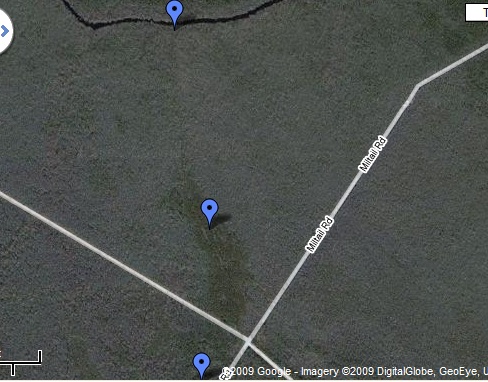
Nancymust have been Wallace (Wallis) Twyford’s (Twiford) second wife. If she was indeed born between 1810 and 1812, and she was a Payne, whose daughter was she?
Again, looking at the records, the only men who had daughters of the correct age would have been Thomas’ widow Nancy shown in 1820 with one female (Ann) under 10, which eliminates this child, unless again Nancy and Ann are two names for the same person. Given that in 1830Nancyis gone and living just a few houses from Wallis Twiford is Edward Payne, and in 1830 Edward Payne has a daughter at home between 15-20, the most logical conclusion is that Nancy Payne is probably the daughter of Edward Payne who was the son of John Paine, especially considering the fact that Wallis Twiford was the executor of the estate of Edward Payne who died in 1845.
Indeed, a Bible record exists, as follows:
“Bible Record of Lemuel and Elizabeth Basnight, Bible printed for the Methodist Episcopal Church, Azor Hayt, Printer, 1827
Received of Michael Payne four dollars and ninety-six cents in full of all account with A. Dough, East Lake, March 24, 1883.
- Edward Payne and Nancy his wife.
- Nancy Payne was born 18 Sept. 1810 lived to be 74 years old[45]
- Edward Payne was born 29 April 1812
- Betsy Payne was born 18 November 1814
- John Payne was born 9 January 1817
- Michael Payne was born 24 October 1819
- Louisa Payne was born 7 December 1821
- Mahaley Payne was born 13 August 1824
- Fredrick Payne was born 22 January 1826
- William Payne was born 22 September 1829
- Betsey Payne was born 28 March 1849
- Micajah Payne was born 20 October 1835
- Holly Payne was born 26 June 1834
- John H. Payne was born 7 May 1836
- Lemuel Basnight was born 3 September 1840 and died 24 September 1904 age 69 years
- Elizabeth Basnight was born 3 September 1840 and died 9 August 1918
This Bible is the property of Mrs. Lora Mae Twiford Basnight, 712 Grady Street, Elizabeth City, NC (no date given).”
Nancy can be concluded to be the daughter of Edward Payne who married Nancy Owens and the granddaughter of John Payne who was born in 1743 or earlier. However, Nancy’s children[46] may not have obtained their Native heritage from the paternal Paine side, but from the maternal Owens, so determining who Nancy Owens’ parents were may be critically important in identifying who, if anyone, was Native in the Payne/Paine family.
Malochi
Now let’s look for Malochi Paine, supposedly the son of Henry Paine (Payne). We find Malochi in the 1850 census. From theTyrrellCountygenweb site, the Paines inTyrrellCountyin 1850 are shown below in the index and extracted records:
| Paine, Beanathy |
04 |
F |
M |
379 |
30 |
| Paine, Elizabeth |
18 |
F |
W |
382 |
36 |
| Paine, Frances |
50 |
F |
W |
380 |
46 |
| Paine, Holloway |
15 |
M |
W |
382 |
38 |
| Paine, J. Esther |
46 |
F |
W |
374 |
27 |
| Paine, John |
12 |
M |
W |
382 |
50 |
| Paine, Malichi |
25 |
M |
W |
382 |
35 |
| Paine, Micajah |
14 |
F |
W |
382 |
37 |
| Paine, Michael |
28 |
M |
W |
382 |
48 |
| Paine, Minerva |
36 |
F |
W |
382 |
49 |
| Paine, Nancy |
56 |
F |
W |
382 |
34 |
| Paine, Sally |
50 |
F |
W |
379 |
77 |
| Paine, Thomas |
11 |
M |
M |
379 |
29 |
| Paine, William W. |
21 |
M |
W |
380 |
47 |
Their family groups are as follows:
Pg 382
| 366 |
366 |
Paine,Nancy |
56 |
F |
W |
|
400 |
NC |
|
| |
|
Paine, Malichi |
25 |
M |
W |
Laborer |
|
NC |
|
| |
|
Paine,Elizabeth |
18 |
F |
W |
|
|
NC |
|
| |
|
Paine, Micajah |
14 |
F |
W |
|
|
NC |
|
| |
|
Paine, Holloway |
15 |
M |
W |
|
|
NC |
|
| 368 |
368 |
Paine, Michael |
28 |
M |
W |
Laborer |
100 |
NC |
|
| |
|
Paine, Minerva |
36 |
F |
W |
|
|
NC |
|
| |
|
Paine, John |
12 |
M |
W |
|
|
NC |
|
| |
|
Owens, Abram |
22 |
M |
W |
Laborer |
|
NC |
|
P 380
| 341 |
341 |
Mann, Mary |
82 |
F |
W |
|
|
NC |
|
| |
|
Paine,Frances |
50 |
F |
W |
|
|
NC |
|
| |
|
Paine, William W. |
21 |
M |
W |
Fisherman |
342 |
NC |
|
P 379
| 326 |
326 |
Midyett, Thomas M. |
67 |
M |
W |
Farmer |
500 |
NC |
|
| |
|
Midyett, Mary |
33 |
F |
W |
|
|
NC |
|
| |
|
Midyett, Nancy |
28 |
F |
W |
|
|
NC |
|
| |
|
Walker, Cary |
24 |
M |
W |
Laborer |
|
NC |
|
| |
|
Tiddy, Basnight |
30 |
M |
W |
Laborer |
|
NC |
|
| |
|
Johnson, Sarah A. |
09 |
F |
W |
|
|
NC |
|
| |
|
Jones, Mary E. |
16 |
F |
W |
|
|
NC |
|
| |
|
Paine, Thomas |
11 |
M |
M |
|
|
NC |
|
| |
|
Paine, Beanathy |
04 |
F |
M |
|
|
NC |
|
P 374
| 253 |
253 |
Smith, Rosa |
60 |
F |
W |
|
|
NC |
|
| |
|
Paine, J. Esther |
46 |
F |
W |
|
|
NC |
|
| |
|
Vanhorn, John L. |
03 |
M |
W |
|
|
NC |
|
| |
|
Vanhorn, William |
01 |
M |
W |
|
|
NC |
|
We do indeed find Malochi with his mother Nancy, who was born in 1795. Nancy’s husband was apparently alive in 1835 when the last child was born, so we would expect to find her with her husband in 1830 and widowed possibly by 1840 and positively by 1850.
There is only one Paine family found in 1840 that fits this description and that is Edward who is also found in 1830. The State Archives in Raleigh hold estate records for Edward Pain Jr. in 1837 and Edward Payne in 1845 and estate administration records exist in Tyrrell County.[47]
The Bible record owned by Lora Mae Twiford Basnight clearly shows that a Mahaley, which could be a transcription error by the individual who transcribed the Bible, was born in the correct birth order, in 1824, to be followed by “Elizabeth (Betsey in the Bible), Micajah and Holloway (Holly in the Bible).
In 1840 we find Edward age 50-60, a son 20-30, one 15-20, one 5-10 and one under 5. His wife was age 40-50 (born 1790-1800) and one daughter was age 5-10. This would roughly fit the family in 1850. Micajah is noted as a female and also as “dumb”[48]. This child could have been disabled. Micajah is typically a male’s name.
Looking a the neighbors of Edward Paine in 1840, we find him next to a James Craine and in 1850, James is 2 houses from Nancy, and one of those houses in-between is Michael Paine, probably her son.
So is Malochi Paine the son of Henry Paine? It appears not, based on both the census and Bible records. The only Henry Pain in NC in 1840 is inBurkeCountywhere there are two and neither had children of the right age to be a candidate to be the father of Malochi. Malochi appears to be the son of Edward Paine and Nancy Owens.
Another item of note in the 1850 census is that two Paine children, Thomas and Beanathy, ages 11 and 4 respectively, are listed as mulatto and they are found living with the white Thomas Midgett family. If they are from the same family, there were likely additional siblings at one time, as there is enough room for 2 or 3 additional children. Beanathy was old enough to have been recorded n the 1840 census. However, the only Paine family in Tyrrell County in 1840 was Edward, whose widow Nancy is accounted for in 1850 and who would have probably been too old in 1840 to have given birth to Beanathy and assuredly would have been too old in 1846 at age 52 to have given birth to Thomas. They may have been illegitimate. If so, they would have taken their mother’s surname, typically, but if this is the case, who was the mother? In 1840, Edwards’s only daughter was between 5 and 10. If the child took the father’s surname, Edward was the only Paine in the county at that time.
The other possibility is that these are remnants of “free colored” who adopted the Paine surname. If they were free colored, they would have been enumerated in the 1840 census, which they were not. If they were enslaved, they would not be enumerated on the 1850 regular census, they would be listed under the owner’s name in the 1850 slave schedule. There is no Payne/Paine slave owner in Tyrrell County in 1850,although there was Robert in 1840 with several slaves. The 1860 census shows neither Beanathy nor Thomas. These children may not have lived to adulthood, but if they did, they could have had death certificates issues. However, none were found.
Samuel Elks in Tyrrell County
A deed was conveyed from Samuel Elks to Isaac Meekins in 1777 for the land known asBuckRidge. McMillan sets forth the theory thatBuckRidgeis Gum Neck, the IndianvillageofTramaskecoockfrom the White-DeBry map of 1590. He modified the White map, as shown below, to illustrate the various locations. It is clear that White or one of men in his party did in fact visit this area or it would not have been labeled with the name of anIndianVillage.
The extracted deed says: March 4, 1777 Tyrrell Co., 100 acres of land known by the name of Buck Ridge from Samuel Elks, planter, for 15 pounds, to Isaac Meekins, the land where Samuel Elks now lives. If this is the same land where Meekins lived in 1786, it fell within the Greater Alligator or Gum Neck districts, but not within the Miltail Lake district.
Where, when and how did Elks obtain that land? Where did Elks go after he conveyed the title?
Checking the early militia lists, tax records, petitions, wills, probate, census, marriage, guardian and bastardry bond, we find no Elks entries at all, so apparently Samuel did not live in TyrrellCountyfor long. Deed records do not reveal how or when Samuel Elks obtained this land.[49]
There are no Elks listed on the 1786 state census, but in 1790 three Elks families are listed, all inPittCounty, Newbern District, as follows:
William Elks, 1 male over 16, 1 under 16, 2 females and 5 slaves. Next to him we find Uriah Elks, 1 male over 16, 2 females, 1 slave. Elsewhere in the same district, Samuel Elks, 2 males over 16, 1 under 16, 2 females no “other free” or slaves.
Pitt was formed in 1760 from Beaufort.
The Elks family is important to the search for the Lost Colony because in 1788 Mary and Elizabeth Elks, “Indians”, on Hatteras Island (previously Currituck, thenHydeCounty, now Dare) sold the land that was the old Indian town to Nathan Midgett. King Elks was referred to there as early as 1756 and in 1759 land was granted to “William Elks and the Hatteras Indians” for the “Indian town”. There is no evidence to connect the William Elks on Hatteras Island with the Samuel Elks family.
The Hatteras Elks family began selling the land in 1770 when William Elks sold 100 acres to Isaac Farrow[50]. In 1771, William sells 50 acres to George Clark[51]. In 1788, Mary and Elizabeth Elks sell 200 acres to Nathan Midgett, including the “old Indian Town”[52].
In another 1802HydeCountydeed, Elizabeth Elks, “Indian”, deed land to Nath. Pinkham for land known as “Indian Lands”. It states…”and Nath Pinkham shall have this land to use occupy and enjoy all the profits of the said lands and timber without any molestation or hindrance of any White person whatsoever…..during his (Pinkham’s) natural life provided my son shall live to the age of twenty one years then and in that case the land shall be at my sons disposal and for his only”. The son’s name is not given here or later when the deed is registered 21 years later in Currituck County. The son apparently died, as it was the heirs of Nathaniel Pinkham who registered the deed.
Who is Nath Pinkham? Nathaniel Pinkham is the son of Nantucket whaler, Zephaniah Pinkham and his paramour, Susanna Hampton, whom he never married because he was already married in Massachusetts to one Mary Coffin. Susanna used the surname Pinkham, gave her sons the surname Pinkham, but in 1795, she married John Lawrence.[53]
Nathaniel Pinkham is listed as living on Nantucket Island until about 1770. Nathaniel Pinkham was employed atShellCastleIslandat the Ocracoke Inlet in the employment as a Ship’s Captain for John Gray Blount in 1796. He is listed on the census report of 1790 the Carteret County District with one male over 16, one under 16 and one female. From his age listings in other census records, Nathaniel Pinkham was born between 1756 and 1765. He lived on Davis Creek in the Straights district.
Nathaniel Pinkham reportedly died the year before the Elizabeth Elks deed was recorded in 1823. The deed, when recorded, has a sworn witness stating that all the parties to the deed had died. However, Nathaniel Pinkham had 7 children listed in 1820 inCarteretCounty, so he assuredly had heirs. It would be extremely interesting to determine what happened to that land, who obtained it, and why. Was the deed finally filed because it was involved in Nathaniel Pinkham’s estate?
Unfortunately, it connecting the dots because of a common surname is an error made by inexperienced researchers.
In an article titled, “Disappearing Indians” by Fred Willard, several erroneous statements are made (including incorrect deed dates and conveyances) and invalid conclusions drawn regarding the Elks family. Willard states that the earliest two Elks found are Richard and John Elks and that Richard Elks was an indentured servant arriving in approximately 1684 along with his wife, Ann, daughter Margrett, and son Richard Jr.[54]
In the book, North Carolina Headrights – A List of Names, 1663-1744 by Caroline B. Whitley, we discover the following three records:
Secretary of State Records, Albemarle Book of Warrants & Surveys 1681-1706 [SS.978.1]
Page 32 Certificate of Rights – Albemarle. Rich. ELKES, 200 acres, for transportation of 4 persons on 29 Mar. 1680. Rich. Elkes & Anne his wife, Rich. his son, and Margret his daughter. Assignment by Ann Stuart to Argell Semmons on 4 Sept. 1694. Warrent given 4 Sept. 1694
Page 41 Warrants for Survey and Returnes – Albemarle ss. Argill Semons, 400 acres, for transportation of 8 persons. 5 Sept. 1694. Rich. ELKES, An ELKES, Rich. ELKS JUNIOR, Margrett ELKS, Lawrence Keeton, Edw. London, John King, Wm. Bread, the last four assigned by Wm. Glover.
Page 75 Patents for Land – Albemarle. Argell Semons, planter, 400 acres in Chowan Precinct for transportation of 1 person for every 50 acres. Jan. 1, 1694. The persons importedd are Richard ELKES, An ELKES, Rich. ELKES JUNIOR, Margeret ELKS, Lawrence Keeton, Edw. London, John King, Wm. Bread
We can see from the above records that indeed, Richard Elks was not an indentured servant. In fact, he was collecting the 50 acres per person that was allotted for all immigrants, for his own passage and that of his wife and children. Had he been indentured, someone else would have been collecting his 200 acres. However, Richard assigns those land rights, as was commonly done at that time, to Argill Semons. Argill Semons obtains some additional land rights as well, from William Glover, and using all 8 individuals’ land rights, he applied for 400 acres of land.
Willard also notes that is of interest that “Richard, in 1694, is listed along with Henry, Ruth, Lavern and Mary Keeton; it is noted that the Keetons are Indians from Massachusetts.” The records above clearly show that there is no connection between the Elks group and the second group that includes only Lawrence Keeton, with no mention of Henry, Ruth, Lavern or Mary. The only reason the second group of individuals, Lawrence Keeton, Edward London, John King and William Bread are listed with the Elks family is because Argell Semons obtains their land rights from William Glover just like he obtained the Elks rights from Richard Elks.
In yet another record, we find confirmation that the Elks family was indeed from England, and not of Indian origin.
In the book Old Albemarle County North Carolina Perquimans Precinct, Births, Marriages, Deaths & Flesh Marks 1659-1820 by Weynette Parks Haun, we find the following:
Original pg. 5 – Richard Elkes the son _ Roger Elkes & Jane his wife of the County of Sollep [possibly Suffolk Co.?] in Ingland & Ann Belliott the Daughter of John Beeliott & Bridgett his wife of North hampton County in Virginia weare Maried by Mr: Wood in Accomock County in Vergenia the 3d: of Aprill 1671
Regardless of the intended location in “Ingland”, the record is clear that they were from England.
Richard Elks’ will exists inRaleighin theNorth Carolinaarchives dated 1696; his plantation on theYeopimRiverin present-day Pasquotank/Perquimens area was left to William Darby. John Elks was married to Mary Stroud of Virginia. Five known children are mentioned in his will dated 1708; John who possibly settled inBertieCounty, Thomas (his will found in Princess Anne County, Virginia), Amanuel, Marmeduke and Ealse. John left his land to all of his sons and a cow to his daughter.
Marmaduke Elks resided on the Perquimans watershed and had a son named Samuel Elks and another son named Jacob. Samuel and Jacob are probably the grandsons of John Elks, based on the fact that Samuel sold land that he inherited from Marmaduke.
From genealogy contributed through the Lost Colony DNA project, we find that Samuel Elks was born approximately 1730 and died between 1810-1820. He sold land in BlackwaterProvincein Princess Anne County, Virginia in 1762, possibly in the present-day Camden, NCarea; land that was inherited from Marmeduke Elks from his father John Elks in his will of 1708. After 1765 there is no more evidence of Samuel in Princess Anne County, Virginia. In TyrrellCountyin 1777, Samuel Elks sells to Isaac Meekins the land known as BuckRidge, possibly in Gum Neck[55]. In 1781, Samuel begins buying land on and around Chicod Creek inPittCounty, along with his brother Jacob. Samuel had four known children: Samuel II (1763), Jacob (approx. 1770), Uriah (1759) and a daughter that married aHudson.
We have clarified a great deal about the Elks family. Samuel Elks was the son of Marmaduke, who was the son of John Elks, who was the son of Richard the immigrant, from England. Richard was not an indentured servant, nor was he connected with a Keaton family of Indians. Nathaniel Pinkham was not the son of Elizabeth Elks, and apparently, the son of Elizabeth Elks died between 1802 and when the deed subsequently was filed in 1823 following Nathaniel Pinkham’s death.
We don’t know how Samuel Elks obtained his land at Buck Ridge, or when, but he is clearly referenced as a planter, not as an Indian, in the same timeframe that William, Mary and Elizabeth Elks were referred to as “Indians” in their Currituck County land transactions. Furthermore, the lack of court, marriage or other Tyrrell County records involving Samuel Elks suggests strongly he spent little, if any, time in the county. He was in Pitt County with the rest of his siblings by 1789.
Historical Evidence
Some of the Beechwood oral history is supported by facts, and other pieces fall in the light of research.
- John Paine was in TyrrellCountyas early as 1786, approximately age 43 or older, but we find no evidence that he is there earlier. If John came from elsewhere, his wife would have not been local and therefore not a Beechland Indian. John is never listed as anything other than “white” and neither are his descendants[56], although they are reported to be “blue-eyed blonde-haired” Indians. If John lived in Beechland all of his life and was simply recorded for the first time in 1786, then he might well have been considered Native, although that seems unlikely given his ownership of 13 slaves in 1790, indicating a fairly wealthy man. DNA from this Paine line indicates a European origin which is what we would expect to find if he were either from elsewhere or one of the Lost Colonists. His children however would have married into the local population, whatever their mixture.
- Marshall Twiford’s information about the various families living in the Milltail and Beechland area is supported by the 1786 state census, the 1790 census as well as later records.
- Marshall Twiford’s grandmother, wife of Wallis (Wallace) Twiford (Twyford) is reported to be Nancy Paine. Both Bible and census records indicate that she is the daughter of Edward Paine and his wife, probably Nancy Owens based on the 1830, 1840 and 1850 census. There may be two Edward Paines. A search for land records and wills might prove enlightening as to how many Edwards existed and the confusing 1830/1840/1850 Nancy/Edward/Esther information. The widow Nancy Paine in 1830 also had a daughter of the right age who may have been Ann, orphan of Thomas, and could have been Wallis’s wife if the names Ann and Nancy were used interchangeably.
- The commentary that these families were unknown to census takers, tax collectors, etc. is refuted by the 1786 and 1790 census where the families listed by Twiford, including the Paine family who was specifically noted as Indian in multiple sources are listed in the 1786 “MiltailLake” district. Gum Neck is also enumerated in 1786, but not detailed.
- While there may have been an epidemic in the 1840 timeframe, there is no evidence of a massive exodus. Comparing children in families in the area (adjacent families from the 1830 census) show about the same death rate between 1820/1830 as compared to 1830/1840. Comparisons of family groupings in the 1830,1840 and 1850 census show that the same families were still living in adjacent areas. The 1850 and later census clearly indicates that people are still “swamping” for a living and several families appear on the 1830, 1840 and 1850 census among the same groups of neighbors. If they moved, it wasn’t far away. There is no evidence of a large number of people leaving the area in a short timeframe. Perhaps the children moved away over time until Beechland proper became deserted. The area may have experienced periodic epidemics given the absence of several groups of children in 1800, 1820, and 1840.
- According to the 1850 census, some residents of this area did own property, so it was not all owned by John Grey Blount and his heirs or Timmergin Sanderlin or his heirs, Thomas and his sister. Timmergin was shown in 1850 as a merchant and owned a significant amount of real estate (valued at $3000 in the census), more than most of his neighbors whose land was typically valued at between $100 and $300. If Trimmergan is a merchant, he is clearly not living alone in a depopulated area.
- There is little direct evidence that the Europeans were living among the Machapungo, although there are some hints. One listing for John Braveboy has been found in 1755 on a tax list, followed in Martin County by a 1790 census listing for John Braveboy and Mother[57] showing one free white female and 7 other free persons (not white), implying that John’s mother was probably considered white. In addition, on the same 1755 document a listing for Quomone (single name) is found. Other than those two 1755 tax list entries and a listing in 1790 for eleven “free colored” families that includes Israel Pierce[58], a man identified as a Pungo River Indian, no other direct evidence of Native people exists.
The 1790 grouping of “free colored”, including the households of Israel and Thomas Pierce, begs the question of whether this is a group of Indian or mixed race Indian households. Most are not found again in 1800 and the one that is found in 1800 has moved toBeaufortCounty. In 1800 there are a few “other free” listed with white heads of household, but no families consist of entirely “other free” with the possible exception of Celia Hill, although there are also whites in residence. 1810 showed no individual “free other” families. Most households that included “free other” also included slaves. Ironically, Isaac Meekins had the most, four, plus one slave. 1820 shows no free colored heads of household nor does 1830. 1840 is slightly different, as there are 5 households headed by free people of color, Samuel Bryant, Thomas Bryant, Micajah Bryan (sic), Abner Hill and Nancy Bowser, inferring that the Bridget Bryan family enumerated with only one female in 1790 may have had sons who remained and either were enumerated as slaves, elsewhere or not at all prior to 1840. Typically people of mixed race are categorized as “free people of color”, regardless of the mixture. Slavery did exist in this area, but most people had few slaves with a couple of exceptions.
Another possibility is that the Machepungo and other Indians were among the “black”, presumably enslaved, population. Aside from the 1790 census, another record that hints at this is the Currituck tax list of 1720 that details the names of (presumed) slaves falling under the heading of the person being taxes (presumable the owner). This list has several entries that say “Indian” instead of “negro” for both men and women. In most instances, they are small groups and with one exception, there is only one Indian in the group. If their movements were restricted by their masters or geographically, their only choices for mates would be from within their own plantation and that would, due to the lack of other available Indians, be either a slave or a family member of the slave owner, an alliance that was typically not encouraged. If this was the case, by 1786, three generations later, the family could indeed have been considered more “black” than Native.
- In 1850, Trimmergin Sanderlin has a Methodist Minister living with him, so there is evidence of religion before the establishment of the later churches. The immediate neighbors are the Owens, Basnights, Sawyers and Edwards, families who did not move away. The men are still listed as boatmen and fishermen.
- Malochi Paine’s father was not Henry, as Henry Paine/Payne never appears in the records and Malochi’s father would be present in at least the 1840 census. His father was most likely Edward Paine, husband of Nancy Owens, based on the most likely candidates for Malochi’s father in 1830 and 1840 andNancy’s proximity to the same neighbors in 1850 and the Bible record where his name is spelled Mahaley, probably as Malachi was pronounced. Land and estate records might positively identify Malochi’s father. His mother was definitelyNancyas Malochi is shown with her in the 1850 census. We have the genealogy and DNA from a descendant of Holloway Paine,Nancy’s son. Holloway’s father is shown as Edward, born about 1790 and his mother as Nancy Owens. The Paine DNA is European, not Native, but if John Paine were a Lost Colonist descendant, this is what we would expect to find. A second gentleman from this line has tested as well, confirming the genetic signature.
- The link claimed by inference between the English Elks family and the Native Elks family is claimed is nefarious and with scrutiny, no evidence of the Samuel Elks family or ancestors being Native exists. Furthermore, there is evidence that the mainland Elks family is not Native and originated in England. Equally convincing evidence exists that there was a Native Elks family living on Hatteras Island, but there is no evidence whatsoever to connect them.
- Some of the colonist surnames do appear at Beechland, Gum Neck and the Alligator River area as indicated in the 1790 census chart used to reconstruct the 1786 Greater Alligator and Gum Neck census districts, but they are not clustered in any one area as one might expect if one specific area was an isolated village hidden from the outside world with many colonists (or descendants) as has been suggested. Furthermore, many of the surnames are very common, such as Smith, Jones, Johnson and Brown. However, a couple of rather remarkable names appear as well. Pierce for example is noted as “free persons of color” in 1790 and Pratt is included which is rather rare. Paine/Payne is probably the most outstanding because of the match with the colonist surname and because of their family history of being “blue-eyed, blonde-haired Indians”, an oral tradition that has been passed through many generations in differing lines.
Oral History Revisited – Accurate or Myth?
Referring back to the four elements of oral history that we had hoped to prove or disprove, how did we do?
1. The oral history of Beechland being the first settlement inDareCounty
This is in fact confirmed by the White-DeBry map that labeled this general area as the Native village, Tramaskecoock. In the same general area was located a picture of a sassafras tree, a valuable commodity inEngland, so this area would indeed have been of interest to the English. Visitations are confirmed by ballast stones found in Miltail Creek. The riven coffins found in an Indian mound indicate early European burials, but how early and of whom is unknown. This area was not as isolated to the Native people as it may have appeared to Europeans, as it was connected through the swamps to the Croatoan area along the seashore across from Roanoke Island and toLakeMattamuskeetto the south. Oral history tells of paths to both locations. We know that Europeans did indeed live in Beechland, as early as 1786 according to the census and in the Gum Neck area earlier according to deeds. What we don’t know is whether European colonization began as a result of the Lost Colony as local oral history states.
2. An oral history of the inhabitants of Beechland being initially the Lost Colonists. Their descendants were considered “blue-eyed blonde-haired” Indians.
“Blue-eyed blonde-haired Indians” were reported in the Paine family as descendants of Henry Paine, an incorrect name. John Paine immigrated from elsewhere, first appearing in his mid-30s or older in 1772 purchasing land. Unless John simply emerged from the swamps at this time, which is unlikely given his large slave holding in 1786, his wife was likely European as well, or at least was not from this area. However, his children married into the local population who may well have included individuals of Native heritage.
John had three known sons. Edward married Nancy Owens in 1809 and their children, Malochi and his sister, carried the oral history of blue-eyed blonde-haired Indians. Thomas married Ann Carroon in 1792 and John married Polly Moss in 1812. These women may indeed have been Indian or had Indian heritage. Their family history needs to be researched. The Owens and Caroon families were in the Beechland area quite early. The Moss family is on the earliest Albemarle and Tyrrell documentation. The history of the three wives families has not been researched.
3. Oral history that the inhabitants of Beechland deserted the area in the 1840s, or between 1830 and 1840 and that by 1850 there was only one familiy remaining, Trimmergin Sanderlin.
Research and comparison of the records from the 1820, 1830 and 1840 census show no evidence of either a massive depopulation or removal. In fact, the death rate of children remains constant throughout this period. The various census records through 1850 show families continuing to live in grouped clusters with the same families and surnames as before, indicating that they did not undertake a massive move. Perhaps the children moved elsewhere effectively depopulating Beechland within a generation following a particularly heinous epidemic. At some point the remoteness would have become problematic and the area would not have been able to support the families of all the offspring.
The oral history states that the “black tongue” plague that devastated the area left no family untouched and was the precipitating factor in the depopulation of Beechland. In 1786 the Miltail theLake Districthad 33 households with an average of 8 people in each home, slaves included. If one person per household died, all households would have suffered, and likely many others would have fallen ill but recovered.
Regardless of how emotionally devastating concurrent deaths in multiple households would have been, removing one eighth of the population would not depopulate the area and one individual per household could have been numerically replaced with the birth of another child within 2 years. While these deaths would surely be considered a tragedy, especially since these families were heavily intermarried, the elimination of one eighth of the population would not be enough to significantly affect the population numbers in the area or to depopulate the neighborhood.
Oral history had indicated that Trimmergin Sanderlin was the last person left in a very isolated Beechland in 1850, but according to the census, he was in fact a merchant, an occupation impossible without customers, indicating that in fact there were families living in Beechland since we know via deed records that he did in fact remain in Beechland, passing his estate to his children after his death.
4. Oral history that the Beechland residents moved away before the census takers, tax collectors or historians knew about them.
The legend of anonymity ascribed to this group of people who were stated to be living among and intermixed with the Machapungo Indians and disappeared before being discovered by the tax collectors and census takers is unfounded.
The names reported as “Indian” and identified as “Beechland families” by Twiford, Long and others are found on early census documents in 1786 and 1790 and some are found on earlier tax lists and petitions.
However, some early marriages appear to be unrecorded raising the possibility that unrecorded marriages reflect marriages between whites and partners of mixed race. North Carolinalaws during this time prohibited marriages between whites and anyone with any nonwhite blood to the 4th generation. It is unclear whether marriages between nonwhite couples would have been recorded. Clearly the marriage between 1830-1832 of Wallis Twiford and Nancy Payne should have been recorded, raising questions of why it and other marriages were not, or if the records have simply been lost.
In essence, it appears that indeed there was an early group of English who lived in the massive swamplands known generally as the impenetrable Dismal Swamp. William Bryd in his Histories of the Dividing Line betwixt Virginia and North Carolina written in 1728 tells of coming across “a Marooner that modestly call’d himself a hermit tho’ he forefeited that name by suffering a wanton female to cohabit with him…subsisting chiefly upon oysters” and later “in the woods we encountered a family of mulattoes who called themselves free….their freedom seemed a little doubtful. It is certain that many slaves shelter themselves in this obscure part of the world nor will any of their righteous neighbours discover them.” Bryd encounters many native families during the surveying of the dividing line and his men enjoy the company of the Native women. He also mentions that the swamps provide shelter and cover for both criminals and debtors and thatNorth Carolina encouraged such to increase their population.
The Beechlanders retained their English surnames and heritage including quaint customs such as the celebration of “Old Christmas”. The residents were not however unknown or anonymous. They apparently did not move away in a mass exodus between 1830 and 1850. The families identified as living in this area were in fact correct and are confirmed by several sources, but the list of families delivered orally was incomplete based on the 1786 tax list identified as “Miltail theLake”.
This area was very inhospitable and the hearty souls who lived there had to be extremely self sufficient. They had a keen sense of community. They lived in kinship groups on small knolls of forested “high ground” spread throughout the swamp. Those knolls supported 33, 49 and 59 homes respectively, based on the 1786 census districts of Miltail, Gum Neck and Greater Alligator. Miltail, which includes Beechland, included 33 households with a total of 258 people both white and enslaved.
Conclusion
We have confirmed the essence of many stories, but have disproven some of the more specific facts. Some cannot be proven or refuted.
Perhaps the legend of “white Indians” was partially a function of the remote and self sufficient lifestyle selected by these settlers who wrestled a living from the swamps, similar to how the Indians originally lived, a lifestyle that would have been considered primitive to outsiders.
One scenario is that early English men intermarried with the Native women.
A second alternative is that the “Indians” at Beechland were part of the slave families and some intermarried with the slaves and others intermarried with the white families in the area. What happened to the Native men, which surnames they adopted and how they selected them has not been answered. Early Currituck county tax lists may provide a glimpse into their world. Several Currituck landowners owned slaves as well. Some slaves were listed as negro, some as mulatto, and others as Indian. Whether Indians were enslaved by being captured and sold or simply intermarried with the slaves, functionally becoming enslaved, we don’t know[59]. Both Indian men and women were listed, presumably as slaves, in the tythe lists about 1720. They may have entered the subculture of slavery and never emerged until generations later when the slaves were emancipated. Some of the “free negroes” and mulattoes may indeed be Indian or Indian admixed families. Early records do exist to confirm that Indians were held as slaves in this area as well as elsewhere inVirginia andNorth Carolina. We know that the English and other Europeans viewed both the Indians and Africans’ as a “lower class”, in the case of Indians as “savages”, and in both cases, nearly subhuman.
DNA testing of the Beechland families found on the 1786 tax list might prove interesting. If either the Lost Colony or later English immigrants were inclined to intermarry with, live among or assimilate with the Native people, the Y-line DNA of their male offspring would be English, regardless of when that admixture occurred. However, the mitochondrial DNA of the maternal lines would still be Native[60]. Finding maternally descended individuals from these early families might well confirm the oral history of Native heritage.[61] Finding the families of the Colonists inEngland and obtaining their DNA profile will allow us to compare the DNA of the Beechland and other families on theEastern Carolina seaboard to see if they are indeed the Lost Colonists of Roanoke.
[1] This was written in 1966. Within memory of men still living would be perhaps 80 years, so perhaps about 1886. This was definitely after 1850 when only one family was supposed to be left at Beechland.
[2] This information is in conflict with the information from Whedbee regarding the cross and INRI inscription.
[3] Known cholera epidemics were reported in 1831-32, Asiatic cholera brought by English immigrants and in 1848-49, another outbreak of cholera. Local outbreaks may not have been reported or recorded. These reported outbreaks were larger in scale. http://en.wikipedia.org/wiki/List_of_epidemics
[4] The only group that we know of that “ran away” fromRoanoke were the Grenville 15 in 1586 who had been attacked by the Indians. One skeleton was found in 1587, and reports that between 2 and 4 were killed have surfaced, but the remaining individuals indeed “ran away” after the Indian attack and were last seen by the Croatoan at Port Fernando, apparently leaving the island. What became of them is unknown. The colonists of 1587 took the time to disassemble their houses and remove them inferring an orderly and planned departure, not a hasty retreat.
[5] Of these surnames, only Dutton, Payne and White are colonist surnames.
[6] Based on the 1786 reconstructed census, presented later in this paper, this number resembles the combined area of the Greater Alligator District and Gum Neck with possibly also Miltail theLake included. In 1786, Miltail had 33 households and 258 people.
[7] Mary Wood Long in her book The Five Lost Colonies of Dare, p 69, states that “within the collection of Blount papers there is no mention of any village within the boundaries known as the Blount Survey other than the sections called Mashoes and Croatan.” She goes on to say that this is the area of Mann’s Harbor and thevillage ofMashoes today. These two areas on the coastline, not the interior. The Blount patent was apparently surveyed in 1796 as John Allen who was sent to survey the boundaries wrote to Blount that he had heard of a great forest of cypress in the wilderness but he himself had not seen it, inferring of course that he had not visited the interior. Blount’s patent was issued inWashington,NC in September of 1796.
[8] Spelling during this timeframe was not standardized and names were common spelled any number of ways. The conjecture that this was an Indian corruption of an English name is one of the ways that speculative information is introduced into family histories as fact. Future generations who repeat this speculation may repeat it as fact, not conjecture.
[9] Various sources indicate that bodies decay relatively rapidly, but that in a non-acidic environment bones can last for 100 years before turning to dust. With the relative wetness of the swamp and the rising and lowering water table, these bodies may have decayed much faster, but given that only ashes were left, in the best circumstances (aside from being buried in a peat bog which mummifies corpses), we can safely say that the burials may have occurred within the past 100 years of when they were excavated, but that assuredly if they occurred prior to the 1850s, they would have been fully deteriorated. I do have to question the “dust” comment, given that they pulled these coffins out of a wet marsh.
[10] Trimagin Sanderlin (listed in the census as Sandlin) was age 69 in 1850. His wife was Rodea age 39. Thomas was age 9. Polly (or Mary, a common nickname) as not listed in 1850. In 1860 Trimagin is listed as age 58, Rhoda is 52 and Thomas is 20. Still no Mary or Polly listed as a child, but in 1850 there is a Mary A. Sandlin, age 35, living with this family. If she is Trimagin’s daughter, it would be from an earlier marriage. In 1850 Trimagin also owns an 11 year old male black slave.
[11] The first Dutton is J.W. Dutton to appear in the 1840 census, so he apparently moved to Beechland between 1830/1840. He lives beside Truxton Twiford, very near the Sanderlin family. If these families had all moved by 1840, they all moved together and resettled as a group and Dutton was among them. However, if this occurred, how did the field at Beechland become known as Duttons Field? It appears that these families were still living as a group in the 1840 census. Dutton is not found in the 1850 census (Ancestry.com indexing and also manually searched 5 pages each direction from Truxton Twiford.) The families of the 1830 and 1840 census are still living as a group in 1850, in the same household order with some new households interspersed.
[12] Long goes on to say that it is known that the families of Sanderlin, Paine, Basnight, Twiford, Dutton and Crain lived at the knoll in the woodland and that later other families such as Sawyer, Pinter, Cahoon and others came to East Lake. Crain first appears in 1786 and resides among this group. However, Carroon/Cahoon is also found there very early, a neighbor of John Paine in 1786. Pinter is not found in the records to 1850, so perhaps this family arrived after that timeframe. So while she has the correct names, the timeframes of when they moved to Beechland orEastLake are disputed by the records.
[14] Ancestry.com,TyrrellCounty 1850 census, page 51, house 389
[15] Manly was reported to have been born after the family moved from Beechland, but the 1830,1840 and 1850 census shows this family with the same group of neighbors, Trimagin Sanderlin, Edward Paine, Amos Owens, John Barnes and others.
[17] Processioning of the entire county was completed every year or two, depending on the local customs. During this event, every landowner’s boundaries were walked with the landowner and witnesses, typically his neighbors, plus at least two processioners who were expected to be disinterested parties, and the boundaries were agreed upon. Disputes were resolved on the spot or within a few days, sometimes with testimony being taken.
[18] Indians during this period were taxed only if they were not living on “Indian lands”, generally a reservation, or had intermarried outside of the Indian community. Unpublished paper of author, “Indians Not Taxed”.
[20] Lost Colonist roster surname.
[22] Lost Colonist roster surname.
[23] Lost Colonist roster surname.
[24] Generational memory as evidenced in other projects is shown to be fairly accurate through two generations (grandparents) but fades and is somewhat distorted increasingly thereafter. Grandparents tend to convey information first hand to grandchildren, but with each passing generation, the details become fuzzy and inaccurate until only the essence of the story is correct, but may not be conveyed connected with the proper generation, individual, timeframe or with correct details.
[26] Per the Tyrrell genweb site, theMiltailLake district was in Currituck before 1739 and inDareCounty after 1870. Early Currituck deed, court and marriage records need to be checked for Beechland surnames to potentially provide information about family interactions and origins.
[28] Speck quotes the North Carolina Colonial Records, vol. IV p 33-35 where Thomas Hoytes, James Bennett, Charles Beasley, Jeremiah Pushing, chief men of the Chowan Indians sold land to the settlers in 1713.
[30] Using Gum Neck as a reference point each household about 8.01 individuals. Dividing the population of Greater Alligator by 8 people gives us the approximate number of households.
[31]Hudson is a family of interest.
[32] Cofer was one of Grenville’s 15.
[33] Spelled Wrasco in 1786
[34] Spencer and Spenser are surnames of interest.
[35] Martyn on colonist roster.
[36] Enumerator in 1786 for the Miltail district.
[37] Martyn on colonist roster.
[39] Basnet is very likely Basnight misspelled. On Hatteras Island, it remains today and is spelled Basnett.
[41] Enumerator of Little Alligator in 1786.
[42] Estate papers for Thomas Paine exist at the NC archives, 1821, C.R.096.508.27
[43] Thank you to Charles Barnes for researching the Tyrrell County court, estate and deed records for the Payne and Elks families.
[44] Given that she has several slaves, as did Thomas, leads me to believe that Thomas was her husband. Furthermore, there are no other evident candidates for her husband. Attempting to cross check the neighbors between the 1810 and 1820 census was unproductive because the 1820 census is recorded alphabetically and by 1830,Nancy is not shown individually. She may have remarried although no marriage is recorded.
[45] Indicating her death in 1884.
[46] Malochi Paine and his sister who were reported to be “blue-eyes and blonde-haired Indians”.
[47] Call numbers C.R.096.508.27 for Edward Jr. in 1837 and C.R.096.508.27 for Edward in 1845. Tyrrell County records extracted by Charles Barnes.
[48] This typically meant “could not speak” but often meant the child was retarded. If so, the census taker may not have been able to easily tell the sex of the child.
[49] Thank you to Charles Barnes and Kay Lynn Sheppard for assistance with lookups for Elks in Tyrrell County.
[50] Currituck Deed book 2 1756-1773 deed 342, page 256 Oct 10 1770, Dec 1771 William Elks of Currituck, Cape Hatteras, to Isaac Farrow of Cape Hatteras, planter, consideration of one ships boat, 100 ac at Joseph Maskue’s corner, sound side, s37e160p, n74e110p, n35w to sound side. Wit Josiah Nicholson, Thomas Miller, signed William x Elks
[51] Currituck Deed book 3 deed [406], p. 340: 25 July 1771, Dec [–], 177[–]; William Elks of Currituck, planter to Gorge Cleark of Currituck, cons. 50 pounds proc., 50A, on Hatarass Banks, beg at a forked live oak stump, “running ye sd: Courses of the patron;” wit: Thomas Oliver, John Scarborough, Thomas Miller, Junr., jurat; signed: William [E] Elks.
[52] Currituck Deed Book 5 (1785-1789), pg. 326, Mary & Elizabeth ELKS of Hatteras Banks in Currituck County sold to Nathan MIDYETT of the same place, 200 acres of land on Hatteras Banks bounded by the old Indian town, the Sound, and the Joseph MASKUS land. This indenture was made March 3, 1788. Wit: Christopher O’Neel, Hezekiah Farrow, Jun. /s/ Mary [x] Elks, Elizabeth [x] Elks.
[55] Based on the fact that there is a location in Gum Neck known asBuckRidge and that the 1786 reconstructed census located Isaac Meekins in either the Greater Alligator or the Gum Neck districts. Of interest, this is the same area noted on the White-DeBry map of 1590 noted as theIndianVillage of Tramaskecoock.
[56] Except possibly for Thomas and Beaunathy in the 1850 census, but we cannot attribute those children to John’s lineage without additional information.
[57] Martin was split from Tyrrell in 1779 indicating that John Braveboy probably lived in the Martin portion of 1755TyrrellCounty.
[58] Timothy Pierce was enumerated in 1786 but he had no slaves and was not enumerated inTyrrellCounty in 1790. Israel Pierce, known as a Pungo River Indian, is discussed by anthropologist Frank Speck in 1916. Israel Pierce is later found inBeaufortCounty.
[59] We do know that Indian enslavement was prevalent in the 1600s and through the Tuscarora war of 1711-1715. Many of the captured Indians were sold, but the males in particular were troublesome and were often sold into theWest Indies instead of within the colonies.
[60] Several participants in the Lost Colony mitochondrial DNA project carry Native mitochondrial DNA, directly descended from their maternal line.
[61] The paternal DNA follows the surname. The father passes his Y chromosome to the son intact, who passes it to his son, on down the line. Today’s descendants should match descendants of a common ancestor hundreds of years ago. Women don’t inherit a Y chromosome, so cannot be tested. Maternal DNA is passed from the mother to all of her children, but only the females pass it on. Children inherit mitochondrial DNA from their mother, who inherits it from her mother, on up the tree. Both Y-line and mitochondrial DNA can be positively identified as being either European, Native American, African or Asian using DNA testing for genealogy. The Lost Colony DNA project is at www.familytreedna.com. Enter “Lost Colony” in the search box.


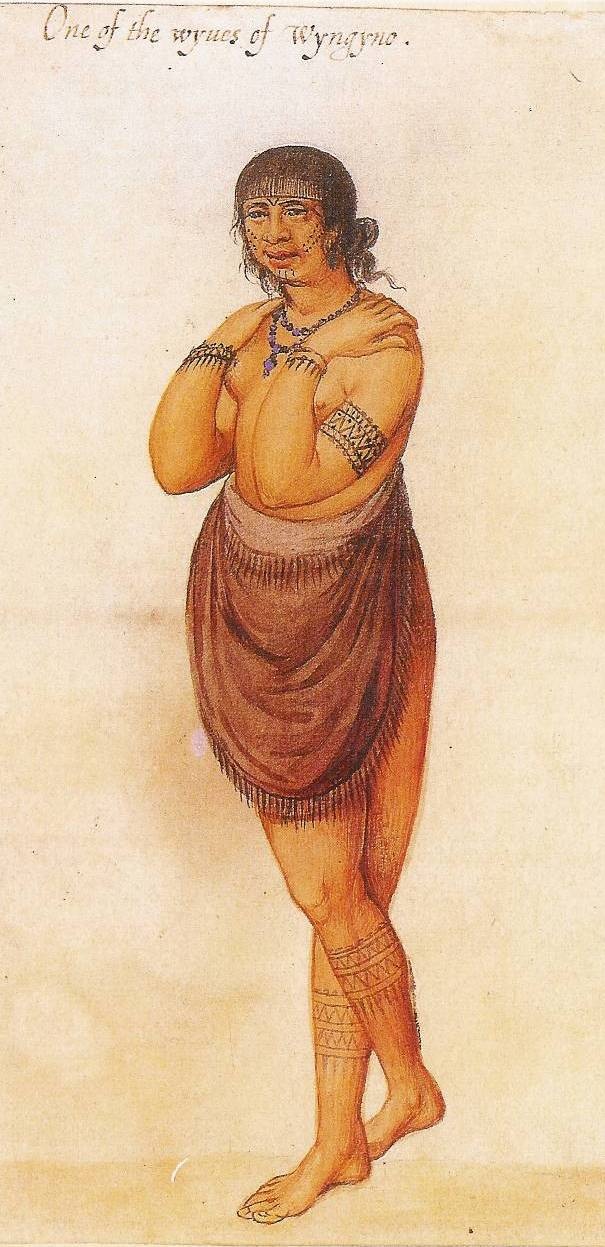
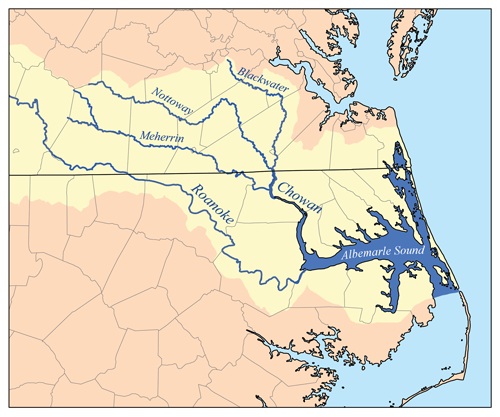
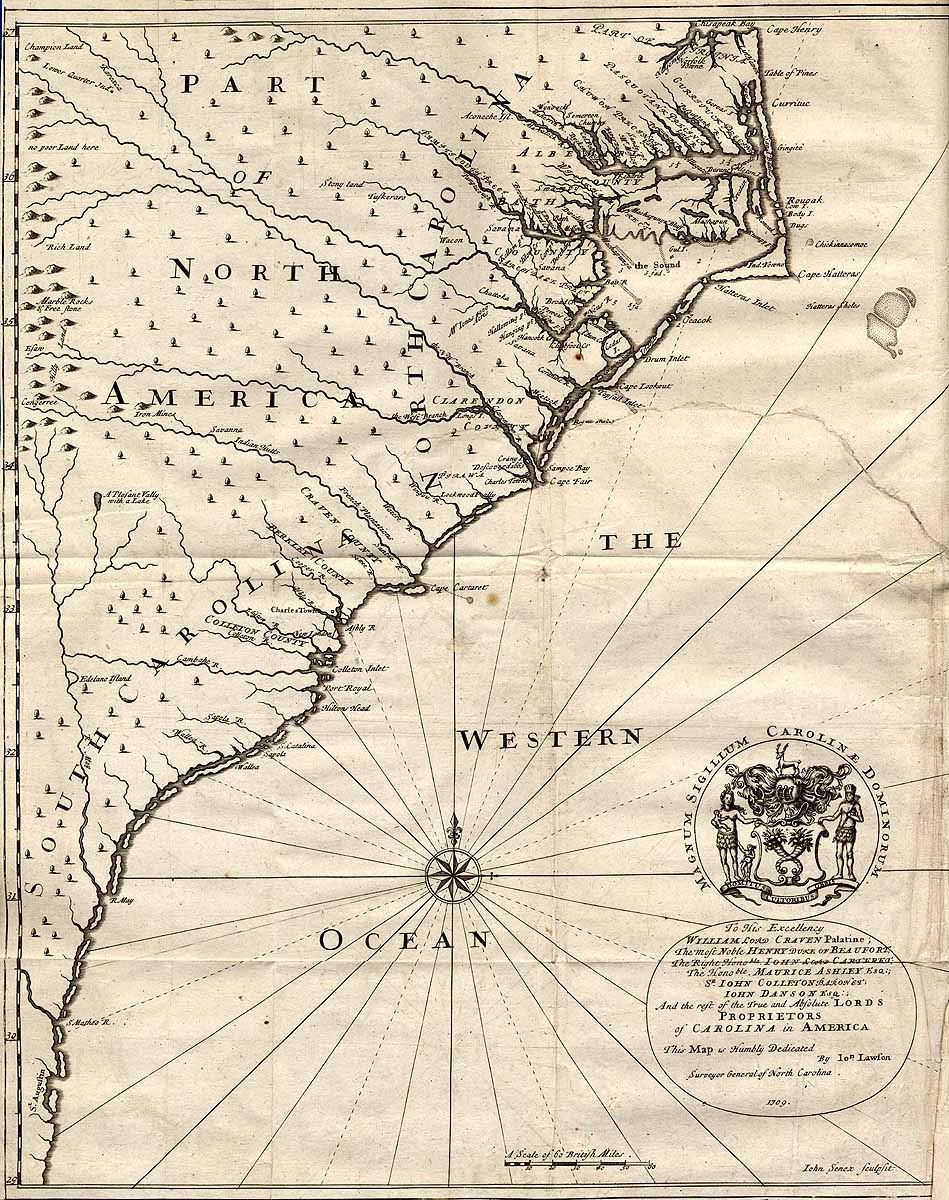




 Native Heritage Project