White Buffalo Calf Born in Goshen, Connecticut

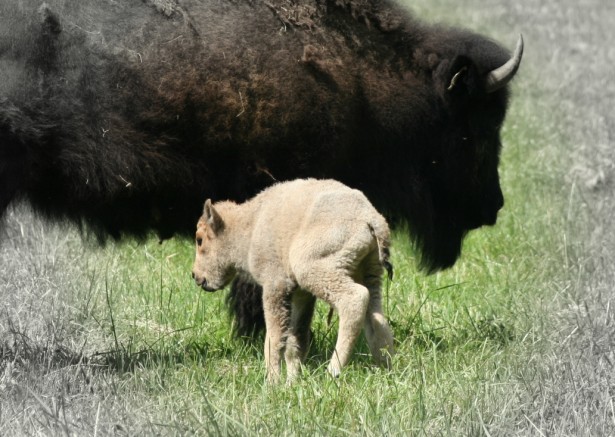
A male white buffalo calf was born in Goshen, Connecticut last month.  Next week, the Lakota elders and about 2000 others will visit the farm to name the white calf in an elaborate ceremony.  You can see a video at this link:

http://news.yahoo.com/video/native-americans-celebrate-rare-white-164514807.html

Here’s another article about the birth of the bison.  He’s already special.  The day after he was born, he escaped into the field of bulls, and lived, unharmed. 

http://indiancountrytodaymedianetwork.com/2012/07/04/lakota-and-others-to-gather-for-white-buffalo-naming-ceremony-121844

You can read about the White Buffalo Calf Prophecy here: 

https://nativeheritageproject.com/2012/05/19/white-buffalo-calf-prophecy/

Here’s some information about a naming ceremony that took place in 2011 in Texas for another white bison calf.

http://keranews.org/post/native-americans-gather-ceremony-naming-white-buffalo-calf

Sadly, that calf was murdered two weeks before his first birthday.  Let’s hope Peter Fay can keep this white buffalo calf safe in Connecticut.

Posted in White Buffalo | Leave a comment

A Report of Research on Lumbee Origins by Robert K. Thomas – Part 3 – Siouian Theory

A continuation of Robert K. Thomas’s Report of Research on Lumbee Origins.  This was transcribed from a photocopy of an original report at the Wilson Library, UNC, Chapel Hill, NC in June of 2012.   Any comments I have will be made at the end of these transcriptions and it will be evident that they are mine.  To see more about Robert K. Thomas, go to:  http://works.bepress.com/robert_thomas/

The third hypothesis of Lumbee origin devised by anthropologists in the 1930s and 40s.  This hypothesis says that the Lumbees are remnants of a great many small Siouan tribes which (p 8 ) once lived in central NC and north central SC.  This is really a logical guess.  It is based on the fact that there were, in fact, in the 1600s, as far as one can reconstruct, primarily Siouan speaking tribes living in the immediate area of Robeson County.  By Siouan speaking, anthropologists simply mean that their language is part of a great language family which has received its scientific name from the Sioux Indians who are a prominent people and language of that language family.  But anthropologists had no direct evidence for this hypothesis.  It is simply a pretty good guess.

Posted in Lumbee, Siouian | 1 Comment

A Report of Research on Lumbee Origins by Robert K. Thomas – Part 2 – Cherokee Theory

A continuation of Robert K. Thomas’s Report of Research on Lumbee Origins.  This was transcribed from a photocopy of an original report at the Wilson Library, UNC, Chapel Hill, NC in June of 2012.   Any comments I have will be made at the end of these transcriptions and it will be evident that they are mine.  To see more about Robert K. Thomas, go to:  http://works.bepress.com/robert_thomas/

The second hypothesis of Lumbee origin was promulgated by a Mr. McLean, a member of a prominent family in Robeson County, an amateur historian and like McMillan, also of Scots background.  He tried to trace origins of the present day Indians of Robeson County to the Cherokee tribe.  His main evidence for this origin was that in the early 1900s many of the Indians of Robeson County, themselves, said they were Cherokees.  However, it is my contention that the Indians of Robeson County had picked up this tribal name in the first half of the 1800s from local whites.  Indians generally learn the name which is applied to them from their neighbors and there is a great deal of evidence to show that at least by Civil War time, whites in Robeson County thought that the Indians of Robeson County, at least the Indian part of their ancestry, stemmed from the Cherokee tribe.  In fact, there is some testimony from the Robeson County attorney in 1875 before a Congressional committee in which he says that the mulattoes as he termed them, in Robeson, were a mixture of Cherokee and Portuguese.

If one looks at Cherokee traditions there is no evidence whatsoever that Cherokees ever got as far east as Robeson County, except perhaps on war parties, and have no tradition of having relatives in Robeson County whatsoever.  In fact, Cherokees are very tied to a mountain environment.  The eastern half of the Cherokee Nation in the Indian territory included, before statehood, part of the Ozark region while the western half was very rich prairie farming and ranching land.  There were few Cherokees in the western half (p 7) of the Cherokee Nation before the Civil War.  After the Civil War none of the traditional Cherokees moved into that area although a few people of mixed background who were very acculturated relocated there and became ranchers.  Cherokees as a whole are very tied to the southern mountains, as an ecological zone.  I cannot imagine  Cherokee migrating to an area like Robeson County.  Such a move would necessitate a tremendous adaptation to a strange and uncongenial ecological zone – the herbs would not be the same; the plant food in the woods wouldn’t be the same; the animals would be different; etc.  Clear creek water, which is very important in the Cherokee religion, is absent in Robeson County.  Cherokees today have no notion of ever having lived east of the Blue Ridge Mountains.  As I say, I think Lumbees picked up a Cherokee designation from whites earlier in the century and McLean simply built on that idea.  Now he does present some evidence, some Lumbee traditions, which would lead one to believe that he may have been speaking of the Cheraw Indians.  In fact, John Swanton who was a famous anthropological expert on southeastern Indians, hypothesized in that 1930s that the Lumbees were descended from the Cheraws and this is how the Lumbees had gotten the notion that they were Cherokees; that is, the two tribal names had become confused.  This is a possibility and later in my paper I will present some evidence which convinces me that the Lumbees are, in part, descended from the Cheraw.  But by and large, I think the Cherokee identification for many Lumbees in McLean’s time simply was taken over earlier from whites.

Posted in Cherokee, Lumbee | 4 Comments

A Report of Research on Lumbee Origins by Robert K. Thomas – Part 1 – Lost Colony Theory

This is the first in an 18 part series.  I have broken the original document into logical sections for publication on the blog.  This document was transcribed from a photocopy of an original report at the Wilson Library, UNC, Chapel Hill, NC in June of 2012.   Any comments I have will be made at the end of these transcriptions and it will be evident that they are mine.  To see more about Robert K. Thomas, go to:  http://works.bepress.com/robert_thomas/

Page 1 – I am sending in this report in lieu of an article for the Smithsonian, primarily because I decided that right now was an inopportune time to publish an article on the origins of the Lumbees, given the limited amount of data that we now have at hand.

I was not able to contact Helen Schierbeck about this decision so I alone am responsible for deciding not to write the article, but instead, to write this report to LRDA.  I understand that in recent months there has been a big furor in Robeson County about Lumbee origins and about the correct tribal designation for the Lumbee people.  I didn’t want to add any more “fuel to the fire” by publishing  premature article which did not have the “iron-clad” evidence needed to make a definitive scientific and historical argument.  At this point, I think we need to do a great deal more research than we have done in order to fill out the picture completely.  One of the things you will see as you read this report is that I have to rely mainly on indirect evidence.  I have an idea that indirect evidence will be most of our evidence, even with more research.  This means that we will have to have mountains of indirect evidence in lieu of direct evidence, bearing on whatever is our final historical hypothesis about Lumbee Origins.

Page 2 – Part I – Previous Hypotheses of Lumbee Origin

In this section I would like to, before I get into the main body of my paper, consider the different hypotheses of Lumbee origin and to evaluate each of them.

A.  The first hypothesis about Lumbee origin was proposed by Hamilton McMillan in the 1880s when he tried to tie the Lumbees into  the famous Lost Colony of Roanoke Island.  As most of you know who read this, Sir Walter Raleigh founded an English colony on Roanoke Island on the coast of what is now North Carolina in the late 1500s.  That colony had disappeared by the time white settlers from Virginia and other explorers began in infiltrate northeastern North Carolina later in the 1600s.

McMillan’s hypothesis is based on several types of evidence.  First, the family names of the Lumbees are basically English names.  This is quite a contrast to the white settlers in Roberson County who have primarily Scots names and are descendants of Scots Highlanders who came to NC from 1730-1760.  Moreover a great number of the Lumbee family names are the same as those of the settlers listed as members of the Lost Colony.  Secondly, McMillan found in talking to older Lumbees that they had a very strong tradition of having formerly lived on the coast of NC and then migrating inland to their present areas in Robeson County.  Thirdly, the Lumbees of the 1800s spoke a very archaeic dialect of English which McMillan ties to the period in which the Lost Colony was founded.  Fourthly, McMillan cites a tradition of local whites that the Lumbeees were already seated in Robeson County when the white settlers entered the area and at the time the Lumbees were living in houses, farming and speaking English.  He tends to (p 3) date this tradition from the 1730s.

Now this is very slim evidence for evidence of a Lost Colony connection.  I think the main piece of evidence which put McMillan onto such a hypothesis was that many of the Lumbee elders told McMillan that their ancestors came from Roanoke in Virginia.  He took this, of course, to mean Roanoke Island off of the coast of northeastern NC.  However, if we simply take the main evidence which he presents – the names, a tradition of living near the coast of NC, the archaeic dialect – then the rural inhabitants of present day Hyde County of the NC coast have an even more valid claim for being descendants of the Lost Colony.  Hyde County NC, in fact, has a higher percentage of names similar to the Lost Colony than do the Lumbees in Robeson County.  They also speak a fairly archaeic dialect of English, particularly the whites who live in isolated rural areas. 

Later, also, McMillan discovered, and he was an honest enough scholar to apprise us of that fact, that the area that the Lumbees means by Roanoke was the areas of the Pamlico Sound which is considerably to the south of Roanoke Island.  More, it is not surprising that the Lumbees would speak an archaeic dialect of English.  Appalachian whites, isolated like the Lumbee until recently, speak an archaeic dialect of English.  Further, it is my experience that when Indians learn English they tend to be more slower to change that English, particularly if they are not involved in a public school system, than do the whites from which they learned their English.  The whites are generally much more “hooked into” the changes in language in the general society than are English-speaking Indians. 

As far as the tradition that the Lumbees were living in the (p 4) 1730s in Robeson County speaking English when the white settlers first came upon the, I have serious doubts that this tradition comes from the 1730s.  McMillan takes the 1730s as a baseline because Fayetteville was being settled at that time.  However, it could have been very much later.  The swamps of Robeson County were not really penetrated by the whites until the 1770s.  I would guess that the tradition probably comes from sometime n the 1770s and is a very local tradition; that is to say, if settlers moved from the area of northern Robeson County south into central Robeson County in the 1770s, they would encounter the Lumbee at that time.  I do not mean to say that I am discounting this tradition, I just think that it is much later in time and much more local than McMillan believed.  In fact, there is a lot of evidence to show that the Lumbees were not in their present location until about 1770 in the particular part of Robeson County in which they now live.

My point is that McMillan simply does not make the case for the Lumbees being descendants of the Lost Colony; a mixture of the Lost Colony settlers with an Indian tribe.  What McMillan, a Scot, was trying to account for was the white blood present among the Lumbees and the startling English names in an area largely peopled by Scots.  McMillan was much less interested in establishing the Indian background of the Robeson County Indians. 

McMillan was an honest scholar and fairly thorough, but he leaps beyond his evidence to a flight of imagination and he was innocent in the extreme.  McMillan would have us believe that a small group of English speaking half-breeds moved from Roanoke Island to the Lumber River in a series of successive steps  in the period  from 1600 to 1700.  Presumably, this small group tarried (p 5) on the Neuse River in this period, the center of the Tuscarora country.  Such a course of action would have been planned suicide.  Further, we must believe that this group escaped the official notice of British and American authorities, explorers and traders for over 200 years.  All of this stretches my credulity beyond its limits.

However, many Lumbee came to accept McMillan’s ideas about their origin largely because it gave them a rather high status origin, I would imagine.  At this point in time, the “lost Colony theory” has almost become a part of the oral history for many modern Lumbee.

The best evidence on the Lost Colony comes from the testimony of Indians given in the 1600s in Virginia.  According to what we can make out, the English settlers on Roanoke Island very soon moved inland to better country; reasonably so, as Roanoke Island is hardly more than a sand dune.  They probably moved into the region of present day Bertie County.  Sometime after the English settlement in Virginia in 1607 they were wiped out by Indians at the instigation of Powhatan, the leader of the Powhatan Confederacy of Algonkian speaking people s in eastern Virginia.  Some few English seem to have survived and it appears they were taken further up on the Roanoke River to about the modern region of Clarksville , VA where the very powerful and influential Occaneechi were living; a tribe very interested in trade.  They few survivors became semislave crafts men for that tribe, but nothing more is beard from them. Presumably the survivors finally died.  As I remember, there were only about 2 or 3 survivors left. 

McMillan did us a great service by recording a great deal of Lumbee tradition, but he certainly did [unreadable sentence at bottom of page] (p 6) descent from the Lost Colony and in fact, the evidence I have just cited leads me to believe that the Lost Colony was massacred, according to testimony of Indians in Virginia.

Posted in Lumbee | Leave a comment

Cree Girl

Sometimes these records give us mixed messages, which may turn out to be valuable hints.

When working with the Carlisle Indian School student records, I found a record for Regina Cree Girl, an Assiniboine from Montana.

This seemed somewhat confusing, so I spent some time researching the Assiniboine.  What I discovered indeed did tie them to the Cree.

A great plains people, the Assiniboine were close allies and trading partners of the Cree, engaging in wars together against the Atsina (Gros Ventre). Together they later fought the Blackfoot. They purchased a great deal of European trade goods from the Hudson’s Bay Company through Cree middlemen.

Given this connection, it’s not surprising to find that these tribes intermarried.  Adoption was common within Native tribes in any number of circumstances.  The question remaining, of course, is whether the designation of Cree Girl was specific to Regina or if is was by this time a “family name” that had originally referred to another individual.

Posted in Assiniboine, Cree | Leave a comment

Dismountsthrice

Some names just fascinate me.  Some are poetical, lyrical in their their beauty.  Others make me wonder as how they were acquired.  Dismountsthrice is one of those.

In the Carlisle Indian School records, I found a record for Edward Dismountsthrice, a Sioux from South Dakota.  Dismountsthrice is not a surname that is common, to put it mildly.  In fact, I figure there is probably one family line in the entire county with this surname.  I set out to see what I could discover about Edward Dismountsthrice or the rest of the family.  I half expected to find nothing, but I was pleasantly surprised.

According to this wonderful site about the Oglala Sioux genealogy, Edward was the son of James Dismountshtrice and Susan, but James’s father is unknown.  Judging from other records, James father’s name was likely in the Native language, not anglicized.  http://freepages.genealogy.rootsweb.ancestry.com/~mikestevens/2010-p/p96.htm#i39369

Another man, simply called Dismountsthrice was also born in 1868, according to this site, which, by the way, is fully sourced. 

It makes me wonder if Dismountsthrice and James Dismountsthrice were brothers.  It would be interesting to see if the two Dismountsthrice lines born in the 1860s were from a common ancestor.  As rare as the name is, one would logically think they would have a common ancestor, but in fact, they may both have adopted this surname for different reasons and their Y chromosomal DNA may not match.

Today the name is often spelled Dismounts Thrice, with two separate words.

Posted in Sioux | 1 Comment

De, Du, Des, Le, La and and sometimes Les

Working with groups of names that span the entire country gives a wonderful general perspective, sort of from the 50,000 foot level, that you just don’t get by working with only one tribe.  Both the WWI draft registrations and the Carlisle Indian School records have provided this type of perspective.  It also helps that I’ve transcribed the Indian school records into a spreadsheet, sorted it by surname and then copy/pasted the names in to the Native Names document.  This allows me to see all of a particular surname across all tribes and groups of similar surnames together.

Something I’ve noticed is that the French influence is far, far greater than I had ever realized.  I’ve been a “student” of Indian history and culture for some 30+ years now, and if this has escaped me, it may well have escaped others as well.

Since the British did win the wars, we speak English in the US.  We tend to think of the US as an English colony – we have English laws and as a country we feel closer historically to England than France.  But the French, especially in the north country, were the first, often by 100 years or so, to visit and establish relationship with Native tribes.  They traversed the St. Lawrence seaway, the Great Lakes and tributaries in birch bark canoes.  The reach of the Hudson Bay company, a fur trading organization, was phenomenal, reaching as far as the Siouian tribes in the Dakotas and Montana.

Often traders lived among the tribes for long periods of time, sometimes permanently.  They left behind their DNA and then eventually, their surnames as well.  The French didn’t stop trading when the British entered the scene.  The French were still quite active along the northern waterways into the 1800s as is evidenced by the Ottawa Half-Breed Census of 1836 and death records later in the 1800s we well. 

This activity level becomes evident in the surnames adopted by the northern tribes’ members.  Many spoke French as their second language, not English.  Surnames that begin with De, Du, Des, Le, La and Les in French are quite evident.  These lists of names are quite lengthy and much higher in proportion to the English names than one would typically find in the general population.  Translate these names and they become much like the English/Native names we find today.  For example Le Roi = the king or simply king.  Of course, Le Roi becomes LeRoi which becomes Leroi which becomes Leroy when it’s anglicized.

One more thing became obvious.  Not all northern Indians stayed in the north.  Members of the DuBray family are typical and are found in Montana and South Dakota as well as in Oklahoma.  If you’re working with an Oklahoma family, and the name looks French, that could well be a hint as to the location of the original genesis of the family. 

Given this finding, I would also suspect that were tribal members (or descendants) to test their DNA, many would discover that their paternal ancestors were European, and indeed French.

Posted in History, Names | 1 Comment

Frank Speck’s Remnants of the Machapunga Indians

Frank Speck, an anthropologist, visited Eastern North Carolina in 1916, hoping to discover some cultural remnant of the Indian tribes that once inhabited the entire coastal area.  He was to be disappointed.  He found no remnants of languages and little in the way of oral history.

He discovered one family with an oral history of Native ancestry, the Israel Pierce and Smith Pugh family, which we researched further in the January 2011 issue in the “Pierce Family of Tyrrell County” and the “Smith Pugh” articles. 

Given his disappointment at the lack of remnant culture, he did share with readers his findings and research, which I am extracting here and adding some commentary of my own.

His records begin with John White’s drawings which provides a few place names and identifies the tribes in this area as Secotan.  These people through their relationship to the Weapemeoc and Pamlico bands, for whom John Lawson left a vocabulary, we know the entire group to be Algonquian or at least Algonquian speakers.  Speck suggests they were the southward drifting bands of the Powhatan of Virginia.

Lawson specifically names and gives locations for the Hatteras of Hatteras Island and the Machapunga who lived nearly Lake Mattamuskeet.  Both of these tribes would fall within the Secotan geography.  Speck says that after the expulsion of the Tuscarora from North Carolina, the final chapter of which occurred in 1805, the eastern coastal tribes fade from history.  He is uncertain whether the remnants of these tribes joined the Tuscarora and Siouian tribes and moved north or whether they scattered and merged with the blacks and whites.

Speck also mentions that the Chowan were neighbors of the Machapunga, and that the Machapunga name is represented by the Pungo River.

While Speck laments that the descendants living in 1916 don’t even know the name of their tribe, don’t speak “one word” of any Indian language, nor had they preserved any of the Native cultural activities, such as basket making, he does state that they have preserved an activity that is historically associated with Native life – fishing.  Lawson reported in 1713 that the Machapunga were “expert watermen”.  We know from the Raleigh expeditions that the Indians made extensive use of fish weirs.  Fishing was the only traditional Native activity that Speck observed that had survived into the 20th century. 

Speck also mentions that basketmaking was the last cultural activity to be lost, other than fishing, and that the baskets had been made with hickory and oak splints in the fashion of the Iroquoian and Algonkian bands of the east. 

While Frank Speck did not find any evidence of hunting and other primarily male cultural activities, perhaps he did not look in the right places.  Today, traditional venison smoking is still taught by the remnants of the Tuscarora near the North Carolina border with South Carolina by descendants who did not move northward, but simply blended in as best they could to survive.

Little is known about the Machapunga tribe.  In 1701 Lawson states that they have one town, Maramuskeet (probably Mattamuskeet) containing 30 fighting men.  Based on other populations, it has been determined that a family ratio of 5 to 1 would adequately represent a total population extrapolated from the number of “fighting men”.  Therefore from Lawson’s informal census, we know that there were about 150 individuals living in their town. 

Perhaps the most interesting thing he told us was a bit more personal.  Lawson divulges that two of the Indian families practice circumcision.  Lawson references it as a Jewish tradition, so even then, it was well known to be Jewish and not a gentile custom.  Lawson says that the balance of the Indians do not practice this custom, nor has he met any other Indians that practice circumcision.  When asked why they do so, they answered him “I will not tell you.”

In another entry, Lawson tells us of an event where the Machapunga visit the Coranine with whom they had long been at war.  Later the Coranine allied with the Machapunga who allied with the Tuscarora.  However, when the Machapunga concluded a peace with the Coranine, they were invited to the Coranine village to celebrate, at which time the Machapunga turned upon the Coranine and slew many of them.  There was no date for this, but it had to be before Lawson’s death during the Tuscarora War in 1711. 

During that war, the “Marmusckits” and the Corree partook in plunder and robbery with part of the Tuscarora Nation.  In 1713 they killed and kidnapped about 20 people on Roanoke Island and Croatan.  Then about 50 Mattamuskeet, Catechnee and Coree warriors attacked the residents on the Alligator River.  The Mattamukeet and their allies would attack and then disappear into the Dismal Swamp and the swamp between the Alligator River and Lake Mattamuskeet.  The English stood no prayer of finding or pursuing the Indians in those swamps so they had to depend on the Tuscarora under King Blount who were friendly towards the English to rout the Mattamuskeet/Machapungo and their allies.  Unable to control or eliminate the swamp inhabiting Indians, finally, in 1715, the “Coree and other enemy Indians” were allowed to settle at Lake Mattamuskeet.  The Tuscarora were sent to join them until they were later awarded their own reservation at Indian Woods in Bertie County. 

By 1731, the “Maremuskeets” were among the tribes that did not number more than 20 families and by 1753 it was reported that the “Mattamuskeets and other Indians on the Islands or ‘Banks’ number some 15 or 20”. 

Speck concludes that the Machapunga and the Mattamuskeet Indians are one and the same.  He also adds that this group, plus the Pamlico, Neuse and Chowan are likely a branch of the Powhatan group.  Their range extended as far south until they bumped up against the Siouian/Iroquoian speaking groups with who they appeared to be initially unfriendly.  Based on this migration and linguistic pattern, Speck feel they were relatively recent intruders into the region and represent the southern-most tentacle of the Algonquian speaking group/migration.  The larger Algonquian group is represented by the Micmac, Ojibwa and Naskapi. 

You can see Frank Speck’s article in full at http://homepages.rootsweb.ancestry.com/~jmack/algonqin/speck.htm

Posted in Machapunga | 5 Comments

Reconstructing the Origin of Native American Populations

A new paper recently released discusses the origins of Native American populations.  Diekenes Anthropology Blog has been a great source for years now, and it looks like he may have obtained an advance copy of the paper.  He does a good job of taking a look at it, so please visit his link at http://dienekes.blogspot.com/2012/07/reconstructing-origin-of-native.html

There has been a lot of discussion over the years about whether the Native people came in one group or in different groups, characterized as waves.  This paper says three groups.  In the past, other researchers have reached other conclusions.

It’s also quiet interesting that it doesn’t seem to be a one way street – that some Native genes are found in the Chukchi people in Russia.  Since we know that the Chukchi people are the closest matches to the Native people in Alaska and western Canada, and we’ve known that for a long time, I wonder how they are measuring the backflow to Russia, and how they know it’s backflow from Native people here.  I think that differentiation would be exceedingly difficult because that is the originating population. 

Academic researchers and papers don’t always agree, but they are all cogs in the  wheel of learning and always interesting.

Posted in Anthropology | 2 Comments

Indian Slaves on the 1720 Currituck County, NC Tax List

Old tax lists are often goldmines – unmined goldmines.  Also, often unpublished.  Fortunately, the Currituck County Genweb hostess has published these lists which have been extracted by volunteers.  Hat tip to Kay Lynn Sheppard for all of her work on the various eastern NC Genweb county sites she hosts, monitors or mothers, whatever the correct word might be.

The 1720 tax list was the most detailed of any in Currituck County.  It has been posted on the Gebweb site as well at http://www.ncgenweb.us/currituck/tax/1720tax.html

In 1720, Richard Sanderson did not have Indian Tom nor the mulattoe boy Jack.  He did have two female slaves, but that’s all in 1720.  However, this tax listing would only encompass his Currituck holdings, not any land or tithes he had in Albemarle County or elsewhere.  He may have owned Indian Tom and Mullattoe Jack at this time, but they were not taxed in Currituck County.

William Williams has an Indian woman, Sue, in 1720 and William Swann had an Indian man, Lewis.  These people were all listed as living at Powell’s Point in Currituck County.

At Cowinjock, which is on the Outer Banks Islands, Fos: (probably Foster) Jarvis owned Davy, an Indian man.

These were the only Indian slaves listed in Currituck County in 1720. 

We know that many other Indians lived there, but were not enslaved.  Those Indians however were not taxed as they did not “own” land in the typical English way.

Often, we find Native American DNA that emerges as a surprise to the participant in African American families.  Indian slavery relegated the slave to the domicile of the other slaves.  African slaves eventually outnumbered Indian slaves, as the Indians dwindled in number from both slavery, disease and dislocation.  Over the generations, the Indian heritage was lost, and only the fact that they were perpetually enslaved remained.

Posted in History, North Carolina | Leave a comment