Treaty with the Cherokee – 1785

Hat tip to Yvonne for this document!

Treaty With The Cherokee, November 28, 1785

The following data is extracted from Indian Treaties, Acts and Agreements.

Articles concluded at Hopewell, on the Keowee, between Benjamin Hawkins, Andrew Pickens, Joseph Martin, and Lachlan M’Intosh, Commissioners Plenipotentiary of the United States of America, of the one Part, and the Head-Men and Warriors of all the Cherokees of the other.

The Commissioners Plenipotentiary of the United States, in Congress assembled, give peace to all the Cherokees, and receive them into the favor and protection of the United States of America, on the following conditions:

Article 1. The Head-Men and Warriors of all the Cherokees shall restore all the prisoners, citizens of the United States, or subjects of their allies, to their entire liberty: They shall also restore all the Negroes, and all other property taken during the late war from the citizens, to such person, and at such time and place, as the Commissioners shall appoint.

Article 2. The Commissioners of the United States in Congress assembled, shall restore all the prisoners taken from the Indians, during the late war, to the Head-Men and Warriors of the Cherokees, as early as is practicable.

Article 3. The said Indians for themselves and their respective tribes and towns do acknowledge all the Cherokees to be under the protection of the United States of America, and of no other sovereign whosoever.

Article 4. The boundary allotted to the Cherokees for their hunting grounds, between the said Indians and the citizens of the United States, within the limits of the United States of America, is, and shall be the following, viz. Beginning at the mouth of Duck River, on the Tennessee; thence running north-east to the ridge dividing the waters running into Cumberland from those running into the Tennessee; thence eastwardly along the said ridge to a north-east line to be run, which shall strike the river Cumberland forty miles above Nashville; thence along the said line to the river; thence up the said river to the ford where the Kentucky road crosses the river; thence to Campbell’s line, near Cumberland gap; thence to the mouth of Claud’s creek on Holstein; thence to the Chimney-top mountain; thence to Camp-creek, near the mouth of Big Limestone, on Nolichuckey; thence a southerly course six miles to a mountain; thence south to the North-Carolina line; thence to the South-Carolina Indian boundary, and along the same south-west over the top of the Oconee mountain till it shall strike Tugaloo River; thence a direct line to the top of the Currohee Mountain; thence to the head of the south fork of Oconee river.

Article 5. If any citizen of the United States, or other person not being an Indian, shall attempt to settle on any of the lands westward or southward of the said boundary which are hereby allotted to the Indians for their hunting grounds, or having already settled and will not remove from the same within six months after the ratification of this treaty, such person shall forfeit the protection of the United States, and the Indians may punish him or not as they please: Provided nevertheless, That this article shall not extend to the people settled between the fork of French Broad and Holstein Rivers, whose particular situation shall be transmitted to the United States in Congress assembled for their decision thereon, which the Indians agree to abide by.

Article 6. If any Indian or Indians, or person residing among them, or who shall take refuge in their nation, shall commit a robbery, or murder, or other capital crime, on any citizen of the United States, or person under their protection, the nation, or the tribe to which such offender or offenders may belong, shall be bound to deliver him or them up to be punished according to the ordinances of the United States; Provided, that the punishment shall not be greater than if the robbery or murder, or other capital crime had been committed by a citizen on a citizen.

Article 7. If any citizen of the United States, or person under their protection, shall commit a robbery or murder, or other capital crime, on any Indian, such offender or offenders shall be punished in the same manner as if the murder or robbery, or other capital crime, had been committed on a citizen of the United States; and the punishment shall be in presence of some of the Cherokees, if any shall attend at the time and place, and that they may have an opportunity so to do, due notice of the time of such intended punishment shall be sent to some one of the tribes.

Article 8. It is understood that the punishment of the innocent under the idea of retaliation, is unjust, and shall not be practiced on either side, except where there is a manifest violation of this treaty; and then it shall be preceded first by a demand of justice, and if refused, then by a declaration of hostilities.

Article 9. For the benefit and comfort of the Indians, and for the prevention of injuries or oppressions on the part of the citizens or Indians, the United States in Congress assembled shall have the sole and exclusive right of regulating the trade with the Indians, and managing all their affairs in such manner as they think proper.

Article 10. Until the pleasure of Congress be known, respecting the ninth article, all traders, citizens of the United States, shall have liberty to go to any of the tribes or towns of the Cherokees to trade with them, and they shall be protected in their persons and property, and kindly treated.

Article 11. The said Indians shall give notice to the citizens of the United States, of any designs which they may know or suspect to be formed in any neighboring tribe, or by any person whosoever, against the peace, trade or interest of the United States.

Article 12. That the Indians may have full confidence in the justice of the United States, respecting their interests, they shall have the right to send a deputy of their choice, whenever they think fit, to Congress.

Article 13. The hatchet shall be forever buried, and the peace given by the United States, and friendship re-established between the said states on the one part, and all the Cherokees on the other, shall be universal; and the contracting parties shall use their utmost endeavors to maintain the peace given as aforesaid, and friendship re-established.

In witness of all and every thing herein determined, between the United States of America and all the Cherokees, we, their underwritten Commissioners, by virtue of our full powers, have signed this definitive treaty, and have caused our seals to be hereunto affixed. Done at Hopewell, on the Keowee, this twenty-eighth of November, in the year of our Lord one thousand seven hundred and eighty-five.
Benjamin Hawkins
And’w Pickens
Jos. Martin
Lach’n McIntosh Koatohee, or Corn Tassel of Toquo, his x mark
Scholauetta, or Hanging Man of Chota, his x mark
Tuskegatahu, or Long Fellow of Chistohoe, his x mark
Ooskwha, or Abraham of Chilkowa, his x mark
Kolakusta, or Prince of Noth, his x mark
Newota, or the Gritzs of Chicamaga, his x mark
Konatota, or the Rising Fawn of Highwassay, his x mark
Tuckasee, or Young Terrapin of Allajoy, his x mark
Toostaka, or the Waker of Oostanawa, his x mark
Untoola, or Gun Rod of Seteco, his x mark
Unsuokanail, Buffalo White Calf New Cussee, his x mark
Kostayeak, or Sharp Fellow Wataga, his x mark
Chonosta, of Cowe, his x mark
Chescoonwho, Bird in Close of Tomotlug, his x mark
Tuckasee, or Terrapin of Hightowa, his x mark
Chesetoa, or the Rabbit of Tlacoa, his x mark
Chesecotetona, or Yellow Bird of the Pine Log, his x mark,
Sketaloska, Second Man of Tillico, his x mark
Chokasatahe, Chickasaw Killer Tasonta, his x mark
Onanoota, of Koosoate, his x mark
Ookoseta, or Sower Mush of Kooloque, his x mark
Umatooetha, the Water Hunter Choikamawga, his x mark
Wyuka, of Lookout Mountain, his x mark
Tulco, or Tom of Chatuga, his x mark
Will, of Akoha, his x mark
Necatee, of Sawta, his x mark
Amokontakona, Kutcloa, his x mark
Kowetatahee, in Frog Town, his x mark
Keukuck, Talcoa, his x mark
Tulatiska, of Chaway, his x mark
Wooaluka, the Waylayer, Chota, his x mark
Tatliusta, or Porpoise of Tilassi, his x mark
John, of Little Tallico, his x mark
Skeleak, his x mark
Akonoluchta, the Cabin, his x mark
Cheanoka, of Kawetakac, his x mark
Yellow Bird, his x mark
Witness:
Wm. Blount
Sam’l Taylor, Major
John Owen
Jess. Walton
Jno. Cowan, Capt. Comm’d’t
Thos. Gregg
W. Hazzard
James Madison
Arthur Cooley
Sworn interpreters

Source: Indian Treaties, Acts and Agreements

Posted in Cherokee | Leave a comment

Facebook Link

We’re on Facebook now at www.facebook.com/NativeHeritageProject.

I’m hopeful that reaching out through Facebook will attract some new people who may have undiscovered information and resources.

Facebook requires 25 “likes” before they will issue a direct link, so thanks to everyone who “liked” these pages.

Posted in Software | Leave a comment

Native Resources Online

Ask and ye shall receive….and I did.  Thanks to Bill and Yvonne, our readers, I have a list of some online resources for you.

You can view on-line or download in pdf format – some quite large, 40MB+ – it’s the “United States Commission to the Five Civilized Tribes”  microfilm records held at the National Archives.   http://archive.org/details/fivecivilizedtribes

The Cherokee Phoenix Newspaper

http://www.wcu.edu/library/DigitalCollections/CherokeePhoenix/index.htm

Family Search books online.  Right click to download.

http://books.familysearch.org/primo_library/libweb/action/search.do?dscnt=0&scp.scps=scope%3A%28DCMS-FHD%29&frbg=&tab=default_tab&dstmp=1353011870414&srt=rank&ct=search&mode=Basic&dum=true&indx=1&vl(1UIStartWith0)=contains&vl(freeText0)=cherokee+indians&fn=search&vid=FHD_PUBLIC

Fold3, with a subscription, has Native records including:

1800-1815 – Records of the Agent of Dept. of War in TN

That should be enough to keep you all busy for a year or so:)

Thanks so much to our subscribers.

Posted in Uncategorized | Leave a comment

Thanksgiving, Spilling the Beans and Reaching Out

Everyone in the US and Canada celebrates the holiday of Thanksgiving, although on different dates.  Traditionally, as all children learn in grade school, in the US this holiday celebrates the Pilgrims being helped by the Indians to survive and a feast they jointly held in Plymouth, Massachusetts in 1621.  There is a lot of debate about that event, whether it happened or not, but I think it’s actually irrelevant.  More important is what Thanksgiving has morphed into, what it is today.

It’s a family day, often more so than Christmas, especially in the northern climates.  In my family, and many others, at Thanksgiving you see more extended family than at Christmas, where Christmas is more immediate family.  In the North, travel has become difficult or iffy at best by the end of December, but the end of November generally is still safe.  Now that I’ve said that of course we’ll have a blizzard.

Thanksgiving is the time when my Aunt Verma inadvertently spilled the beans on the “skeleton in the closet” at the dinner table.  You could have heard a pin drop.  Well, before the gasps.

Thanksgiving is the time to ask about those ancestors or family members, even if you think you know the answer.  Because, you may not.  Often, it’s for lack of asking the question or introducing the subject that you don’t learn those stories.

Probably the number one regret of genealogists is that they never reached out when they could.

Today, reaching out isn’t just across the dinner table or while doing dishes, a favorite time to pick the brains of your relatives, it’s about reaching out using new technology.

If you could make contact with someone who has photos of your great-grandmother, wouldn’t you want to do that?  How about someone who has a copy of the family Bible owned by your Revolutionary War ancestor?  Maybe a tin type and journal of your Civil War ancestor.  Who has those today?  Maybe you don’t even know they exist.

If they aren’t in your family, it will take a new form of reaching out to find them.  I’ve celebrated Thanksgiving this week by reaching out to the younger generation.  I don’t mean to stereotype, but let’s face it, you’ll never meet these people on Rootsweb. Where do you find them?  Facebook, that’s where.  Want to find out what pictures their grandma has in the attic?  Well, you have to make contact with them so they will ask their grandma, or tell their grandma to check out your Facebook page.  And yes, more and more, grandma is using Facebook.

Now stop groaning.  I can hear you from here!  I know, I groaned too.  But I did it anyway.  We need to interest young people.  They can DNA test and someday, maybe one  of them will be who you pass the proverbial family torch to.  If you’re like me, it’s not one of your kids, no matter how badly you want it to be. I think I burned them out in courthouses at the copy machine when they were kids.  My bad.

This is not difficult.  If you are not on Facebook, summon up your courage and go to www.facebook.com and sign up.  If you are already on Facebook, skip down 2 or 3 paragraphs to the section on setting up pages and groups.

If you’re really uncertain, you can google about how to get started using Facebook, but it’s actually really easy and intuitive.  You want to be on Facebook because your kids and grandkids are there and you’re going to lose touch with them and how they communicate if you don’t join.  Just do it.

Once you join, just type names into the top bar to look for your friends and family, where it says “search for people, places and things.”  Then send them a friend request.  You’ll see the “Friend” button, just click on it.  This isn’t difficult, you just need to get used to it.  Here are the results when I searched for Jim.

Once you are a friend, you will see what they put on their timeline and their status posts.  These include photos and such.  I see new photos of my grandkids just about every day.  Your news feed aggregates all of the people and projects that you are following.

Of course, you’ll want to post something, eventually, yourself.  The best way to get a conversation started is to ask questions, just like at Thanksgiving.

On Facebook, you do that by typing something in the field that says “What’s on  your mind?”  Facebook is one big informal conversation.

After you get at least a little comfortable with Facebook and your News Feed, you’ll want to set up either a project group or a page.

Here’s what I did.  And by the way, I am not “comfortable” with Facebook but I just did this anyway.  The only way to get comfortable is to work with the software.

I set up two pages and I’m going to set up project groups.  My new pages are “DNAexplain” and “Native Heritage Project.”  You will have to type those names (minus the quotes) in the search bar at the top of the page at Facebook to find them.  That’s how Facebook works.  Then you click on the image and then click on “like” to connect yourself to them.  So please, do me a favor and “like” both of them.  Facebook requires 25 likes for a new group or page to be recognized as legitimate.

Pages are public.  They are generally for entities, meaning businesses and organizations.  You might want to put a family association there.  ISOGG (International Society of Genetic Genealogists) is there, for example, as is the Lost Colony Research Group.  Everything posted on these pages is available for everyone to see.

Groups can be set up to be entirely public, private or secret, meaning by invitation only.   Facebook has a help page that discusses these differences.  Groups are generally for more personal discussions.  For example, you might choose to form a “by invitation only” intimate family group.  You might choose to set up a Page to advertise your family association and to attract people who are interested in addition to a group for more private discussions.  Remember, the whole point of this exercise it to reach out, so the more public your presence, the better chance you’ll have of attracting interested people.  Be aware however, that these pages are not text searchable and do not have archives like Yahoo Groups or Rootsweb.  But then again, this is for reaching out, not archiving.

To create a page, which is what I recommend for surname projects, scroll all the way down to the bottom of your Facebook page and click where it says, “create a page.”  From there on, Facebook guides you.

To create a group, on the left hand banner, Facebook will show you any groups you are a member of, and at the bottom of the list, it says “create groups.”  Click there and again, Facebook guides you through the rest.

Here is my commitment.  If a Facebook page or group does not exist for each one of my DNA surname or other pet projects, I’ll create one by year end.   Yes, this year, 2012.  There is nothing like the present moment.  I’m reaching out to the next generation.  After all, the old folks are gone now, so I need new information targets:)  Who knows what I’ll find, but if I don’t reach out and try, I’ll find absolutely nothing!  I want more family information to be thankful for by next Thanksgiving!!!  I want to honor those who have gone before by preserving the information about their life.  That is what heritage is.

How about you?  How can you reach out and what do you hope to find?

Posted in DNA, Education | Leave a comment

Indians in Missouri

Missouri at one time hosted several Native tribes, but today, none remain.  The Illini, Missouri, Osage and Quapaw were the primary tribes with the Chickasaw occupying the far southeast corner, the Ioway the northern border and the Otoe the far northwest corner of the state.

This map is from the www.native-labnguages.org site.

All of these tribes were removed to Oklahoma.  A few Missouri Indians were reported to have escaped during the removal. Of course, others may have married into white families earlier and avoided removal in that fashion.

When transcribing records from the WWI draft registration of people who are designated as Native, two things indicate a Native population.

First, if I see repeated occurrences of a particular county that is not a major population center.  For example, St. Louis, MO would never raise my eyebrows since is it a major city and people from many locations would flock there.  However, repeated occurrences of a county with no major city would likely indicate a Native population group living there, whether as a tribe or simply as a group of descendants.

Second, if I see repeated occurrences of specific surnames.  This indicates a family group, especially if they are found in the same county.  In Nebraska, recently, I found both of these conditions, and sure enough, when I checked on Thurston County, where many Native people claimed as home, I discovered that the Winnebago and Omaha tribes both have reservations there.

Neither of these conditions existed in Missouri, but still, they had quite a few people who registered as Native.  If these people were not part of a tribal group, who were they and where did they come from?

Other tribes crossed Missouri on their forced march, known at the Trail of Tears, in the 1830s while being removed to Oklahoma.  In particular, the Cherokee were housed on the east side of the Mississippi during the winter of 1838, many freezing and starving, and crossed into Missouri in the spring of 1839.  Later records show that many fell ill and were left along the way.  Many, but not all, died.  Some of the 1918 draft registrants are likely their descendants.

Not everyone indicated a place of birth, but some did.  The draft forms varied and not every edition of the form asked that question.

However, of the 259 total individuals who registered for the draft in Missouri as native born Indian, a whopping 51.35%, or 133, were Mexican.  This is a surprisingly high number, especially for a state in the geographic center of the US, not near the Mexican border.  These 133 people of Mexican descent either indicated Mexico as their birthplace, listed their race as Mexican/Indian or Latino or had an unquestionably Spanish name.

Of the balance who did state their birth location, the breakdown is as follows:

  • Oklahoma – 17
  • Missouri – 10
  • Kansas – 3
  • New York – 2
  • Manitoba, Canada – 2
  • Mississippi – 1
  • Iowa – 1
  • Wisconsin – 1
  • Minnesota – 1
  • Arkansas – 1
  • Illinois – 1
  • Indiana – 1

So it appears that while the tribes native to Missouri were removed and their lands confiscated in the 1830s, some 80-90 years later, Indians were still present in Missouri, not as an organized tribe, but remnant peoples, half of whom were immigrant Indians from Mexico.

Posted in Chickasaw, Illini, Ioway, Missouria, Osage, Otoe, Quapaw | 2 Comments

Qalipu Mi’kmaq Founding Membership Opportunity Ends Nov. 30th

At the Native American Focus Meeting at the Family Tree DNA Conference, David Pike mentioned an opportunity to apply for membership in the Qalipu Mi’kmaq band.  This is a relatively newly formed band, and the opportunity to become a founding member is fast drawing to a close:  the application deadline is Nov 30th.  Full details of how to apply can be found here:

http://qalipu.ca/membership-programs-and-services/membership/

To summarize:  there is no minimum quantum of native ancestry required to qualify for membership.  Rather, the membership requirements are that you have native ancestry from Newfoundland, that you self-identify as Mi’kmaq, that you maintain ties with a Mi’kmaq community in Newfoundland, and that you maintain Mi’kmaq culture, traditions and/or knowledge in some way.  Of particular interest is that the Application Guidelines state that DNA evidence can be used towards satisfying some of these criteria.

For many people, the major challenge that they face is the requirement to prove that they do indeed descend from a native ancestor.  Useful census records prior to 1921 are essentially non-existent in Newfoundland.  And although the 1921 census did ask if each enumerated person was Micmac, many people who could have said “Yes” did not.

Despite the challenges, it was reported in the media almost two weeks ago that over 60,000 people have now applied for membership in the band.  This already represents well over 10% of the population of Newfoundland and Labrador (although it warrants mention that one does not need to live in Newfoundland to become a Qalipu band member; membership is open to the diaspora, provided that the stated application are met).

The FAQ on the Qalipu website states that after Nov 30th “membership will be determined under the Indian Act rules” so there evidently still will be a mechanism for people to apply and become members afterwards, but how the Indian Act rules will differ from the current rules is not clear.  My expectation is that it will become harder to successfully apply.

Hat tip to Dave for this info!

Posted in Micmac | Leave a comment

Sioux Tribe Raising Funds to Purchase Sacred Land – Deadline Looms

Tribes of the Great Sioux Nation hope to buy nearly 2,000 acres in the Black Hills that they call Pe’ Sla. The property is important to their creation story, and tribal members have long held ceremonies there. When the land was put up for sale, tribal members worried it would be developed because of its proximity to Mount Rushmore.

The 1,942 acres of pristine prairie grass is the only sacred site on private land currently outside Sioux control.

The current owners have accepted the tribes’ bid, for $9 million, to purchase the land if they have the funds by November 30th.  So far they have raised over 7 million.  They need more help and several celebrities have come to their aid.

http://missoulian.com/lifestyles/territory/actor-producer-help-tribes-trying-to-buy-sacred-s-d/article_cc884e18-3017-11e2-87fd-0019bb2963f4.html

You can read more about this project, and donate if you so choose, at this link on the Redbud Sioux Tribe page.  http://protectpesla.org/

This is momentous, not only because of the purchase of the sacred land, but because this cause has served to bring the Sioux people together in a consolidated effort.

Posted in Sioux | 1 Comment

History of the Old Cheraws

The book, “History of the Old Cheraws” by Alexander Gregg (1819-1893) was written and published in 1867.  When I ordered this book, I expected this was about the Cheraws, meaning, the Indians, but for the most part, it wasn’t.

The opening chapters, which are untitled, do reflect some about the early heritage of the area, but nothing like I was hoping.  I extracted, transcribed and in some cases, excerpted the information relevant to the Native inhabitants of that region.

P 1-4 – When first known to the colonists, South Carolina is said to have contained not less than 28 tribes of Indians, with settlements extending from the ocean to the mountains.  Of these tribes but a few names survive to mark the localities they once inhabited, and these with such scattered remains as the waste of time and the leveling work of the white man have spared, are the only memories left to tell of their early occupancy of the soil.  Of the tribes which dwelt upon the Pedee and its tributaries, the Saras or Saraws as they were first called – afterwards Charrows, Charraws and Cheraws – occupied the region still identified by the name: their territory extending thence to the coast, and along the coast from the Cape Fear to the Pedee.  This extensive region has been assigned to the Cheraws by one of the most eminent ethnologists of America, as European, about the year 1600, along the coast of the Atlantic.

If such was the extent of their territory at that early period, it would indicate a population which must have been greatly diminished, when, upon the approach of the Catawbas, a half century later, the supremacy of the Cheraws over the smaller tribes around them, and even over their own distinct nationality, would seem to have been lost or at least acknowledged.  Within these early territorial limits of the Cheraws and along the middle and lower parts of the valley of the river, must be assigned the Pedees; and about the mouth of the river, the Winyaws.  The Kadapaws were found on Lynche’s Creek, after the name of which tribe that stream was called in the Indian tongue.  Of these, the Cheraws – however they may have been diminished in number by disease and war, or perchance by some dismemberment of their nation, and the removal of many, of which no record of tradition remains – continued to be the dominant race on the Pedee; the others having ever been reckoned among the smaller and inferior tribes. Of their origin nothing is known beyond the conjectures of ethnologists.  They have been assigned, but upon what grounds does not appear, to the extensive family of Algonkins.  These occupied that portion of North America on the east extending from 35 degrees to 60 degrees latitude and reaching along the northern line of extension almost to the Pacific on the west.  Beyond this, as the track of aboriginal descent and migration begins to be traced back, even conjecture is lost in a sea of uncertainty.

The tribes on the Pedee continued in their feeble and disconnected state (the Cheraws maintaining the supremacy) until the arrival of the Catawbas from the north, with the history of whom their own was ever after to be inseparably blended.

According to their traditions[1] as it has been handed down to the very recent times, the Catawbas, at a period prior or not long subsequent to the discovery and settlement of North America by the whites, occupied a region far to the northward, from whence, in course of time, they removed to the south.  Being a numerous and warlike race, they vanquished the tribes with whom they came successively in conflict on the way, until they met the Cherokees on the banks of the river, afterwards called by their own name, Catawba.

Here, as the tradition relates, a sanguinary battle ensued between them, which lasted from morning until night, darkness alone serving to put an end to the conflict.  The loss on both sides was heavy, though neither party gained the victory.  They slept on the field of blood among their dead and wounded.  With the approach of morning, propositions of peace were made by the Catawbas and accepted by the Cherokees.  According to the terms of the agreement, the former were to occupy the county east of the river and the latter the territory on the west.  Here they solemnly agree to live together as brothers; and, after burying their dead, and erecting piles of stones as monuments like of their common loss, and of the peace and friendship established between them, returned to their encampments, ever afterwards sacredly observing the terms of the compact.  This tradition of the Catawbas is confirmed throughout by the fuller details which ethnological research has added to their history.  They appear to have been a Canadian tribe and to have left their ancient home about the year 1650, pursued by the Connewangas, a superior and more warlike tribe with whom they had come in conflict.  Forced thus to remove, they turned their faces to the southward and fought their way, when necessary to do so, until they approached the headwaters of the Kentucky River.

Here a separation took place, the larger number becoming absorbed in the great families of the Chickasaws and the Choctaws.

The remainder of the tribe stopped in what was afterwards known as Botetourt County, Virginia, but without making any permanent settlement.

They removed thence in the year 1660, continuing their journey to the south and as Adair, wrote, “settled on the east side of a broad, purling river, that heads in  the great blue ridge of mountains and empties itself into Santee River, in Amelia township, then running eastward of Charlestown, disgorges itself into the Atlantic.”

How the approach of the Catawbas was regarded by the Cheraws and whether any conflict ensued between then, tradition does not inform us.

P 5 – By 1743 the language of the Catawbas is said to have consisted of 20 different dialects of which “Katahba” was the standard and “Cherah” being another. Scarcely anything beyond a bare allusion to them by name is found relating to the tribes on the Pedee in the earliest accounts of the Indians of Carolina.

John Lederer mentioned the “Sara” and “Saras” in 1669 and 1670 where he mentions they are 30 miles west of “Watery” and they had cakes of white salt.

P 8 – The earliest mention in the provincial records of any of the tribes inhabiting the valley of the Pedee is found in the proceedings of the Council or Upper House of Assembly Dec. 15, 1732 where a reference of the murder of a Pedee Indian, Corn-White Johnny, by one Mr., Kemp is mentioned.

The Council then ordered “some of the relation of the deceased”, King Harry, Captain Billy, George and Dancing Johnny to give an account of what they knew.

This record is of interest now as evincing the jealous care exercised by the Provincial Government for the protection of those scattered and defenseless remnants of the Indian tribes whose domain was fast passing away from them, and who continued faithful to the whites to the close of their history.

In 1743, Pedee Indians were reported to be in Charleston and were gifted.  “To the three headmen, each of them a gun and knife, to the others, each of them, a knife.  For the 3 women each of them a looking glass, twenty bullets, half a pound vermillion to be divided among them.  Also on order of Col. Brewton for 10 poiunds of gunpowder for use of said Indians.”

In 1744 it was noted that 7 Catawbas has been barbarously murdered by the Notchee Indians who live among them and confirmed by Mr. Matthew Bird who lives at Goose Creek.  The Catawba were drunk and murdered in their sleep.

P 11 – In 1746, the records reflect that the Governor visited the Congarees and the Catawbas.  The following account was preserved.  “The Governor arrived at the Congarees April 27, 140 miles distance hence, where on the bank of he Santee, the king and a few of the head men met him.  Yenabe Yalangway the King, the old leader, Captain Taylor, Nafkebee and some others awaited on his Excellency. The next day the Governor addressed them.  A place being erected for the Governor to sit under, and the Union Flag hoisted, our men were drawn out in two lines, through which the Indians marched, when they were received with drums beating and colours flying and saluted with some small pieces of cannon: after they had all taken the Governor by the hand and the King with some of his head-men had placed himself near his excellency, a person was sworn truly to interpret all that should pass betwixt the governor and the Indians and then his Excellency addressed them in words, the purport of which was to dissuade them from agreeing to a proposition which had been made to them by some of the other Indian nations to join in a French war against the people of Carolina.  After which presents were distributed consisting chiefly of powder, guns, pistols, paint and c.  That morning the Governor had received an express from Mr. Brown who trades among the Catawbas acquainting him that some of the Pedees and Cheraws, two small tribes who have long been incorporated with the Catawbas intended to leave them, which might prove of dangerous consequence at a time when they were so closely attacked by their enemies, the Northern Indians.

P 12 – The governor ordered the rammers of all the pistols which he had delivered to the Indians to be laid upon the table, desiring that such as were Pedees and Charraws might advance and they, being in a body near him, he spoke to them in these words: “It gives me great concern, my friends, to hear that you entertain the least through of leaving the Catawbas with whom you have been so long and so closely united.  This union makes you strong and enables you to defend yourselves and annoy your enemies; but should you ever separate, you would thereby weaken yourselves and be exposed to every danger.  Consider that if you were single and divided, you may be broke as easily as I break this stick” (at the same time breaking one of the rammers), “but if you continue united together and stand by one another it will be as impossible to hurt or break you as it is impossible for me to break these” (his excellency then taking up a handful of rammers).”

P 13 – In a 1748 record  a negro slave who was “taken up” said that he had been sold to Billy, King of the Pedee Indians, that the Catawba Indians took him from King Billy and carried him to their nation and the when endeavoring to escape from the Catawbas he was lost in the woods.

The Peedees and other smaller tribes who now led a wandering life were in constant danger of being enticed off by the more powerful and hostile nations of Indians to join them in their predatory excursions.  In 1750, the King of the Catawba in a letter to James Glen, the Governor said that “there are a great many Pedee Indians living in the settlements that we want to come and settle amongst us.  We desire for you to send for them and advise them to this and give them this string of wampum in token that we want them to settle here and will always live like brothers with them.  The Northern Indians want them all to settle with us, for as they are now at peace, they may be hunting in the woods or straggling about, killed by some of them, except they join us and make but one nation which will be a great addition of strength to us.”

In 1751, the Governor of New York had written to Governor Glenn of North Carolina asking him to help remove any obstacles to peace.  His letter included the six Nations, the Delawares and the Susquehanna.  He then mentioned all of the different tribes “who may be in friendship with them, particularly those on the Ohio River, being the Cherokees, the Catawbas, the Creeks, called sometimes the Muskogee, the Chickasaws and such part of the Chactaws as are in our interest and all tribes in friendship with these nations that live amongst the settlements such as Charraws, Uchees, Pedees, Notches, Cape Fears or other Indians and I hope that all prisoners on each side will be mutually delivered back.”

In 1755, John Evans made a visit to the Catawbas ordered by the government and his records are preserved.

P 15 – “Met a Catawba man and woman and informed by them that in the summer the Cherrackees and Notchees had killed some Pedees and Waccamaws in the white people’s settlements.”

His further records show that the murder occurred at Goose Creek, 2 women were killed and scalped and 2 boys were taken prisoner as well.  This was reportedly done by a Notchee called the Notchee Doctor.

Evans notes state that Lewis Jones was the chief and another Indian is named Prince who lived at Goose Creek.

P 16 – In 1759, King Johnny is noted as the head of the Charraws who brought the governor the scalp of one of the French Indians taken near Loyal-Henning near Fort Du Quesne with Gen. Forbes.

P 17 – In December 1759, the Gazette reported that “It is pretty certain that the small-pox has lately raged with great violence among the Catawba Indians, and that it has carried off near one half of that Nation, by throwing themselves into the river as soon as they found themselves ill.  This distemper has since appeared among the inhabitants at the Charraws and Waterees, where many families are down, so that unless especial care is taken, it must soon spread through the whole country.  The smallpox went almost through the Province in the year 1738 when it made prodigious havoc.  Ignorant and grossly superstitious, they regarded it as a visible embodiment of the Spirit of Evil, the sentence or wrath from heaven let loose upon them, from which there was no escape. The white families at the “Charraws” and “Waterees” who appear to have suffered severely at this period, where doubtless unprepared for such a visitant and yielded for a time, like their savage neighbors, to the fell destroyer.  At a later period about the time of the Revolution, some of the Catawba warriors having visited Charleston, there contracted the disease again and returning, communicated it to their Nation, which, according to contemporaneous accounts, came well nigh being exterminated.  It was after this that they were advised by their friends to invite the Cheraws to move up and unite with them as one tribe.

P 18 – About the year 1700, the Catawbas numbered about 1500 warriors.  Only half a century later this proud band had dwindled to 400.  Their principal settlement about this latter period was on the Wateree where their country was described as being “an old waste field, 7 miles in extent, with several others of smaller dimensions, which shows that they were formerly a numerous people, to cultivate so much land, with their dull stone axes, before they had an opportunity of trading with the English, or allowed others to incorporate with them.”

In 1787 the Catawba were the only organized tribe under a distinct name of its own in SC. Their town “Catawba” contained then about 450 inhabitants of which not more than 150 were fighting men.

In 1798 they are said to have been in the habit of holding an anniversary meeting of a sadly interesting character intended to commemorate their former greatness by recounting the numbers and deeds of their ancestors, of which tradition had kept them informed.

P 19 – A portion of them had removed at an earlier period to Buncombe County, NC west of the Blue Ridge and thither the miserable remnants with few exceptions followed a few years since.  Reduced in numbers by disease and intermarriage, by the contracted territory to which they had been confined while yet unfitted by the slow process  through which the Indian must always pass, and withal by those habits of idleness and dissipation which the custom of leasing their lands to the whites, and the consequent want of employment had subjected them; drunken and wandering from place to place, their condition became as abject as it had once been elevated among the red men of Carolina.

P 20 – Cheraw means “fire eater” or “fire town” in Cherokee.  The first mention of the Pedee is found I the account of the Eleven Townships, one of which was to be laid out on the river about the year 1731-1732.  But then it was spoken of as having been in familiar use.  It was spelt too as if it had come from 2 capital letters, the initials of a proper name. Nothing is known of the meaning of Cheraw.

P 32 – At the time of the division into counties, 1682, Craven was so sparsely settled as not to be politically considered but 20 years afterwards was described as being pretty well inhabited, the Huguenots having settled on the Santee.

P 36-37 – In the Marion district, with Darlington and Chesterfield above on the west and Marlborough on the east of the Pedee, though more than 70 miles in length and in width from 30-35, there is nothing to indicate that any settlements had been made previous to the year 1730.  In writings 50 years later, the Pedee is not classed in rivers of note.

P 42-43 – From 1696 to 1730 the population gradually increased.  About 1730 a scheme was adopted to promote the settlement of the province which proved successful.  Gov. Johnson was instructed to mark out 11 Townships in square plots on the sides of rivers each consisting of 20,000 acres and to divide the land into shares of 50 acres for each man woman and child that should come to occupy and improve them.  Each township was to form a parish and all had an equal right to the river.  Each settler was to pay 4 shillings a year for every hundred acres of land, excepting the first 10 yeas, during which term they were to be rent free.  The eleven original townships were two on the River Alatamah, two on Savanna, two on Santee, one on Pedee, one on Waccamaw, one on Wateree and one on Black River.  The one in Pedee called Queensborough was marked out in 1731-1732.

P 45 – The inducements to come led to a visit from some of the Welch from Pennsylvania in 1735 for the purpose of exploration and settlement.  Shortly thereafter the migration from Wales to Pennsylvania and from there to the Pedee proceeded.

P 52-53 – In 1736, the large Welsh tract grant was made.  In 1737, they stated that they were concerned that the Indians would molest and disturb them and that Thompson, a trader, holds a great amount of land there and claims it by Indian right.

At this point, the book turns to record the stories of the various Welsh families who settled this region of South Carolina known as the Old Cheraws.

You can download the book for free at this link:  http://archive.org/details/historyofoldcher00gregrich


[1] Given by W. H. Thomas, Esq of Qualla Town, NC who has been intimately connected with them as their head man or chief since their removal to the western part of that state.


Posted in Cape Fear, Catawba, Cheraw, Cherokee, Notchee, Peedee, Uchee | 10 Comments

Chief Silver Tongue – Oscar Norton

One just never knows what’s going to turn up in the WWI draft registrations.  In the Missouri registrations, there was a very confusing entry.  Indexed by Ancestry under the surname of Tongue, a man is listed as Chief Silver Oscar Tongue Norton.  Obviously, I HAD to look at the original, and I found:

So we see that Chief Silver Tongue was in reality Oscar Norton, born in 1880.  In 1918 when he registered, he was living in Kansas City at a hotel and was a singer that obviously went under the stage name of Chief Silver Tongue.  Seems to be a fitting name for him.

You can purchase the postcard shown above from http://www.historyforsale.com/html/prodetails.asp?documentid=156758&start=49&page=153 who also provides the following information:

CHIEF SILVER TONGUE
Color postcard in long head dress, signed on verso.
Photograph signed on verso: “Chief Silver Tongue”. Color, 3½x5½. Captioned in lower margin. Dated (unknown hand): March 30, 1951. It is difficult to separate fact from legend in regard to Chief Silver Tongue, aka Oscar Norton, a fine tenor singer who starred in the Indian Ceremony at the Dells of Wisconsin for many years. Was he of Sioux origins, or, as he told a Florida reporter when he retired to that state, a Houpa Indian from northern California? Did he hold a law degree, as he often told onlookers who treated him condescendingly? He was married to prominent stage actress Corona Riccardo until her death in 1917. This fascinating Native American merits further research.

A papoose carrier attributed to Silver Tongue was sold by an antique dealer.

http://www.maineantiquedigest.com/stories/index.html?id=3059

The auction item is described as follows:

“Native American beaded papoose carrier in blue and red wool, mounted over a buckskin-covered backboard, and trimmed with glass beads, buckskin fringe, and brass bells. Affixed to it was a tag that read, “Flathead Indian Papoose Carrier bought from Chief Silver Tongue (Hoopa), who bought it from Chief Yellow Hair (Flathead). It was used to carry little Chief Silver Tongue.” Apparently as late as the 1950’s there was a Chief Silver Tongue, a.k.a. Oscar Norton, who identified himself as a Sioux or a Hoopa from northern California. The papoose carrier sold well north of the $2500/3500 estimate for $7187.50.”

On March 2 1964, the St. Petersburg Times reported Chief Silver Tongue’s death at age 82.

“Chief Silver Tongue, 82, billed as the World’s Most Famous Indian Tenor died yesterday at his home, 3920 Fifth Avenue, N.

A Hopi (sic) Indian chief from California, he had been a winter resident of St. Petersburg for 33 years.

The chief, Oscar Norton, was born in Blue Lake, California.  For 30 summers he was the featured soloist at Stand Rock Indian Ceremonial in Wisconsin Dells, Wis.

A graduate of Oregon Law School, Chief Silver tongue practiced law in that state a short time before beginning his singing career.  He has given concerns all over the nation, in Canada and at the NY World’s Fair, featuring Indian and religious songs.  Since the fair he had been associated with the Winnebagos Tribe.

Surviving are a wife, Lilia J., a son Thomas O. Norton, Summitt City, CA and a granddaughter Miss Bonnie Norton, St. Petersburg.”

His namesake son who is listed as his contact in his 1918 draft registration must have predeceased him.

He told something more about his life in an interview printed in the Evening Independent, a St. Petersburg, Fl. newspaper on November 21, 1947.  He says that he never used his English name, Oscar Norton except when in school.  His native name, given to him at age 6, was “boy with the ringing voice.”  He was a member of the Houpa tribe’s Thunder clan, and his stage name of “Chief Silver Tongue” reflects his native name.  He grew up on the family dairy farm on the edge of the Houpa Indian reservation in Oregon.  He attended the largest Methodist Church in Portland, Oregon where he began singing.  He said that he attended California grammer and high schools and an Indian trade school in Chemawa, Oregon.  He then attended law school in Oregon and clerked for the S. T. Richardson law firm, but preferred vaudeville and left after a short time for the life of performing.

Checking the 1880 and 1900 census, I don’t find him listed, but if his family did not use English names, he would be impossible to find.  We also don’t know if he was living in California or Oregon.

In any case, Chief Silver Tongue, also known as Oscar Norton, was a colorful person.  I can’t help but wonder if any of his performances were ever recorded.

Posted in Hupa, Winnebago | 6 Comments

Genoa, Nebraska Indian School

While transcribing the Native American draft registrants in Nebraska, I had noticed a few in Nance County.  It’s not the most common county to find Native people.  When I ran across John Red Wolf’s information, the Nance County designation made more sense.

John Red Wolf was born on March 4, 1899 and registered for the draft in Nance Co., Nebraska in 1918, while attending the Genoa Indian School located in Genoa, Nance Co., Nebraska.  His next of kin was listed as Sam Red Wolf in Kyle, SD.  This tells us that John is not likely Native to Nebraska.  His permanent address is also given as Kyle, SD.

This led to me to search for information about the Genoa Indian School, an institution I had never heard of.

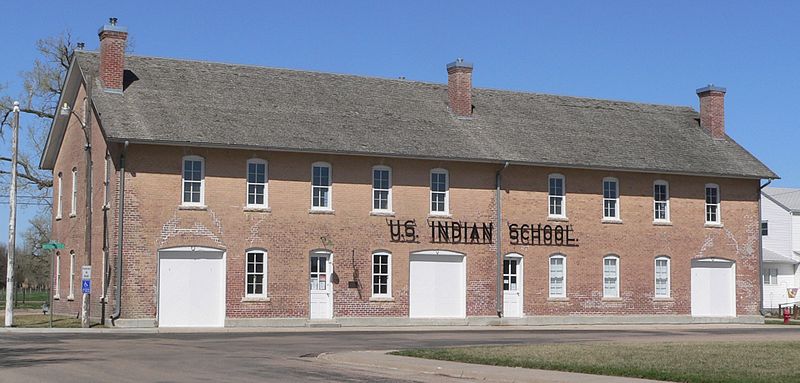
The Indian Industrial School at Genoa, Nebraska was the fourth non-reservation boarding institution established by the Office of Indian Affairs. The facility was completed in 1884 and operated until 1934, a full half of a century. Now restored, it is owned and operated by a foundation as the Genoa U.S. Indian School Museum. The building is listed on the National Register of Historic Places.

This photo is the shop building, now part of the museum.

The facility opened on February 20, 1884, and, like other such schools, its mission was to educate and teach Christianity and European-American culture to Native American children for assimilation. The village of Genoa was selected because the Federal Government already owned the former Pawnee Reservation property there; however, existing buildings at the site were unsuitable and in poor repair.  The Pawnee had been removed to Indian Territory in 1879.

The school expanded, eventually serving Native American children from ten states and over 20 tribes. In time the school grew from the original 74 students to an enrollment of 599. It encompassed more than 30 buildings on 640 acres. The US government closed the school in 1934 during the Great Depression.

Posted in Education, History, Schools | 4 Comments